
The Effective Teaching Profile Making a difference for





- Slides: 11
The Effective Teaching Profile Making a difference for Māori students’ educational achievement Te Kotahitanga
Genesis of the Effective Teaching Profile • During the interviews-as-chat, Māori students told researchers what it would take to engage them in learning. • They talked about the practices of teachers with whom they engaged. They also talked about the practices of teachers with whom they did not engage. • The Effective Teaching Profile came from the experiences of these Māori students and some of their teachers.
The Effective Teaching Profile Effective teachers of Māori students create a culturally appropriate and responsive context for learning in their classroom. In doing so they demonstrate the following: a)they positively reject deficit theorising as a means of explaining Māori students’ educational achievement levels, and b)they know and understand how to bring about change in Māori students’ educational achievement and are professionally committed to doing so in the following observable ways:
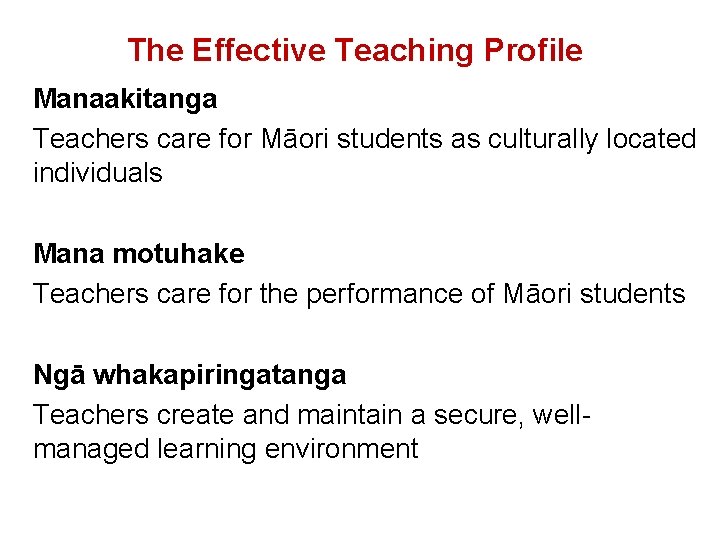
The Effective Teaching Profile Manaakitanga Teachers care for Māori students as culturally located individuals Mana motuhake Teachers care for the performance of Māori students Ngā whakapiringatanga Teachers create and maintain a secure, wellmanaged learning environment
The Effective Teaching Profile Wānanga Teachers engage in effective teaching interactions with Māori students as Māori Ako Teachers use a range of strategies that promote effective teaching and learning interactions and relationships with their Māori students Kotahitanga Teachers promote, monitor and reflect on learning outcomes which, in turn, leads to improvements in educational achievement for Māori students
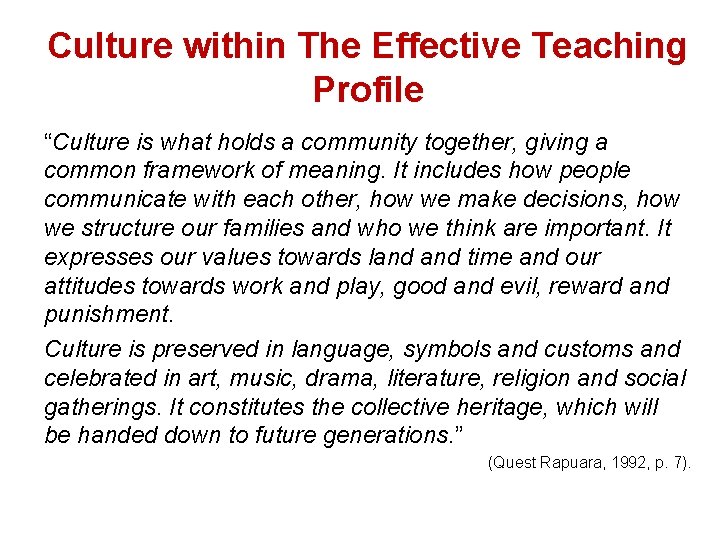
Culture within The Effective Teaching Profile “Culture is what holds a community together, giving a common framework of meaning. It includes how people communicate with each other, how we make decisions, how we structure our families and who we think are important. It expresses our values towards land time and our attitudes towards work and play, good and evil, reward and punishment. Culture is preserved in language, symbols and customs and celebrated in art, music, drama, literature, religion and social gatherings. It constitutes the collective heritage, which will be handed down to future generations. ” (Quest Rapuara, 1992, p. 7).
Culturally Appropriate Effective teachers create culturally appropriate contexts for learning so that Māori students are able to see and/or hear evidence of their own culture, as they define it, within the classroom environment and learning contexts.
Culturally Responsive Effective teachers create contexts for learning that are responsive to the cultural experiences of the learner. That is, Māori students are able to, and encouraged to, bring their own prior experiences and knowledge to their classroom activities in order to make sense of new learning.
THINK, PAIR, SHARE Thinking about the previous two slides, work with a partner to consider and discuss possible examples of both culturally appropriate and culturally responsive contexts for learning within your own curriculum areas?
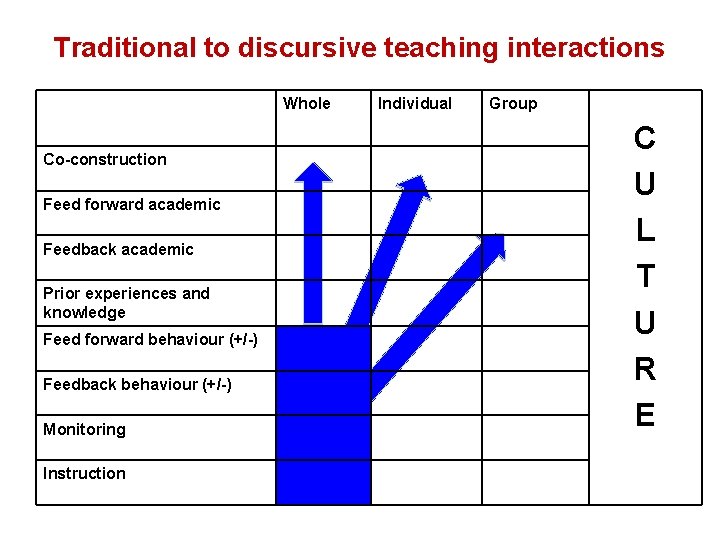
Traditional to discursive teaching interactions Whole Co-construction Feed forward academic Feedback academic Prior experiences and knowledge Feed forward behaviour (+/-) Feedback behaviour (+/-) Monitoring Instruction Individual Group C U L T U R E
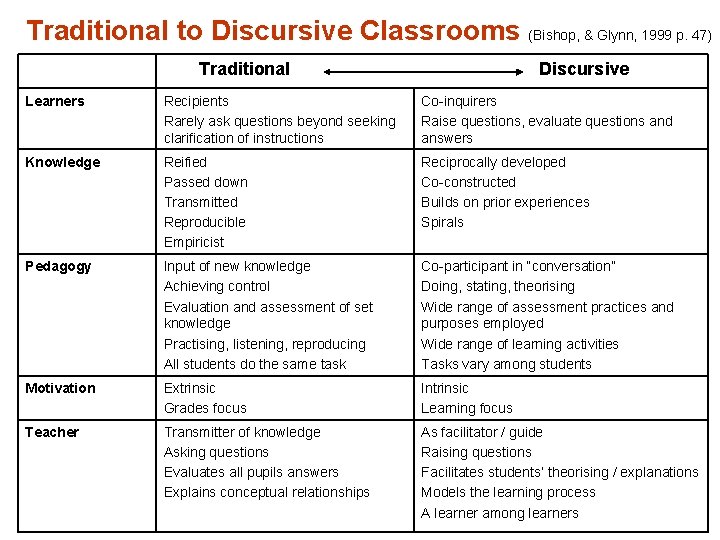
Traditional to Discursive Classrooms (Bishop, & Glynn, 1999 p. 47) Traditional Discursive Learners Recipients Rarely ask questions beyond seeking clarification of instructions Co-inquirers Raise questions, evaluate questions and answers Knowledge Reified Passed down Transmitted Reproducible Empiricist Reciprocally developed Co-constructed Builds on prior experiences Spirals Pedagogy Input of new knowledge Achieving control Evaluation and assessment of set knowledge Practising, listening, reproducing All students do the same task Co-participant in “conversation” Doing, stating, theorising Wide range of assessment practices and purposes employed Wide range of learning activities Tasks vary among students Motivation Extrinsic Grades focus Intrinsic Learning focus Teacher Transmitter of knowledge Asking questions Evaluates all pupils answers Explains conceptual relationships As facilitator / guide Raising questions Facilitates students’ theorising / explanations Models the learning process A learner among learners