
THE EFFECT OF YOUTUBE VIDEO THROUGH STUDENTS SPEAKING

THE EFFECT OF YOUTUBE VIDEO THROUGH STUDENT’S SPEAKING SKILL AT SMKN 5 KOTA TANGERANG x MINI THESIS Novi Aryanti 1688203012 ENGLISH EDUCATION ST UDY PROGRAM FACULT Y O F TEACHERS TRAINING AND EDUCATION UNIVERSITY OF MUHAMMADIYAH T ANGERANG 2020
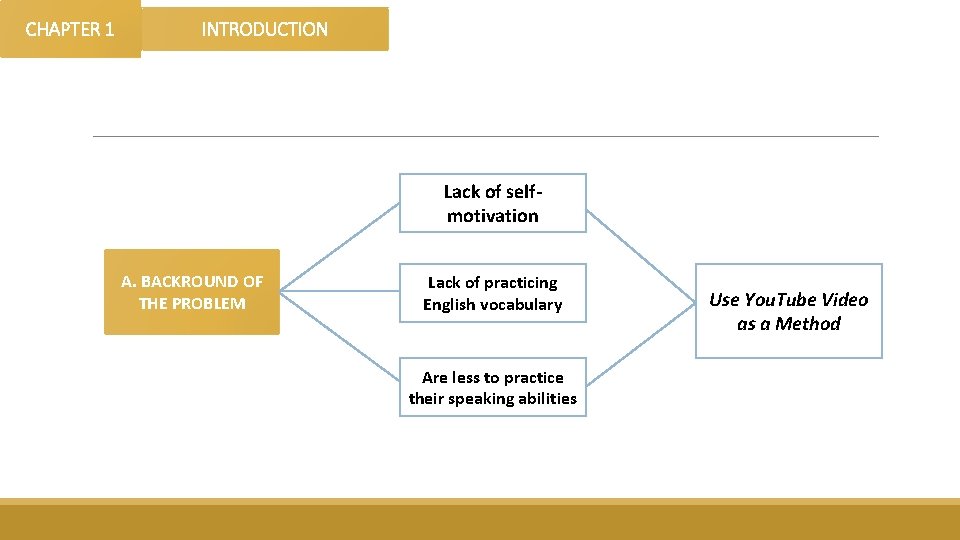
CHAPTER 1 INTRODUCTION Lack of selfmotivation A. BACKROUND OF THE PROBLEM Lack of practicing English vocabulary Are less to practice their speaking abilities Use You. Tube Video as a Method
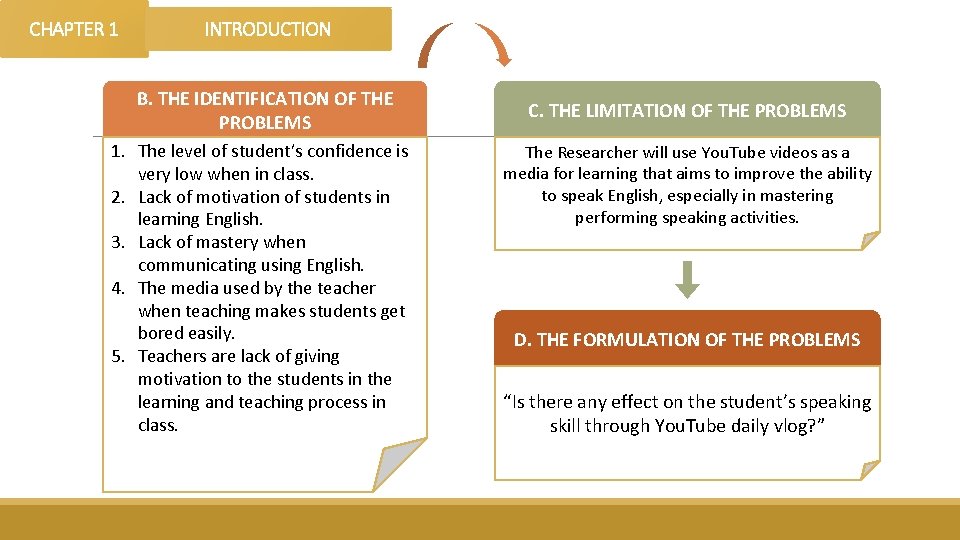
CHAPTER 1 INTRODUCTION B. THE IDENTIFICATION OF THE PROBLEMS 1. The level of student’s confidence is very low when in class. 2. Lack of motivation of students in learning English. 3. Lack of mastery when communicating using English. 4. The media used by the teacher when teaching makes students get bored easily. 5. Teachers are lack of giving motivation to the students in the learning and teaching process in class. C. THE LIMITATION OF THE PROBLEMS The Researcher will use You. Tube videos as a media for learning that aims to improve the ability to speak English, especially in mastering performing speaking activities. D. THE FORMULATION OF THE PROBLEMS “Is there any effect on the student’s speaking skill through You. Tube daily vlog? ”
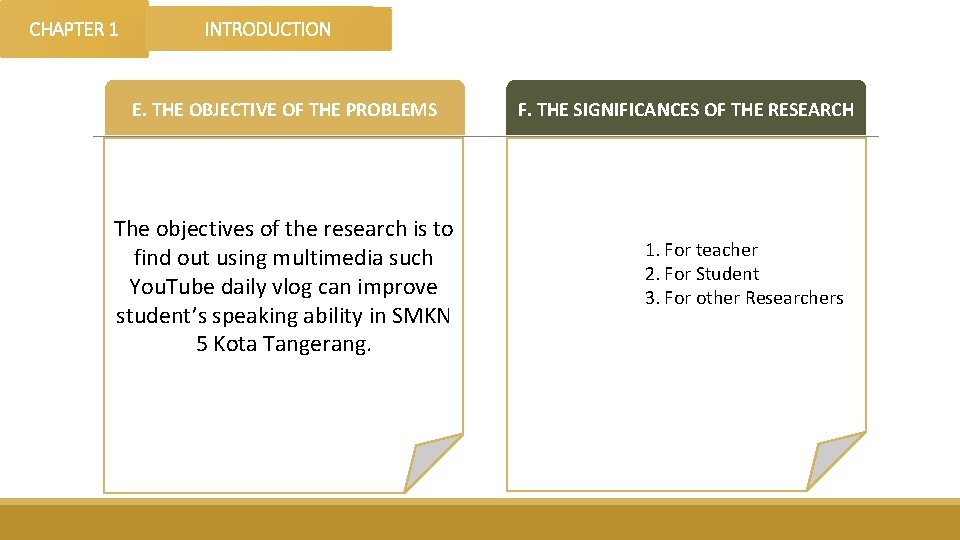
BAB CHAPTER 1 1 PENDAHULUAN INTRODUCTION E. THE OBJECTIVE OF THE PROBLEMS The objectives of the research is to find out using multimedia such You. Tube daily vlog can improve student’s speaking ability in SMKN 5 Kota Tangerang. F. THE SIGNIFICANCES OF THE RESEARCH 1. For teacher 2. For Student 3. For other Researchers
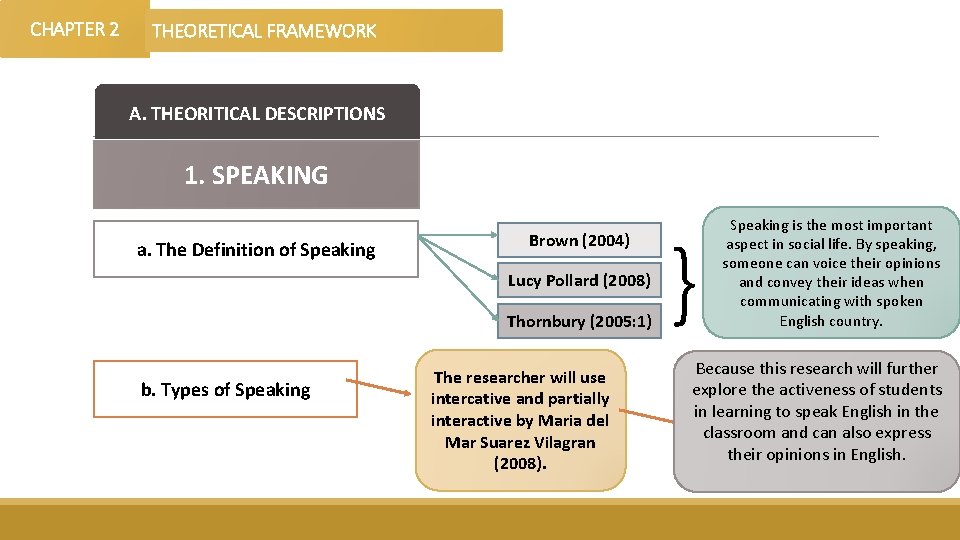
CHAPTER 2 THEORETICAL FRAMEWORK A. THEORITICAL DESCRIPTIONS 1. SPEAKING a. The Definition of Speaking Brown (2004) Lucy Pollard (2008) Thornbury (2005: 1) b. Types of Speaking The researcher will use intercative and partially interactive by Maria del Mar Suarez Vilagran (2008). } Speaking is the most important aspect in social life. By speaking, someone can voice their opinions and convey their ideas when communicating with spoken English country. Because this research will further explore the activeness of students in learning to speak English in the classroom and can also express their opinions in English.
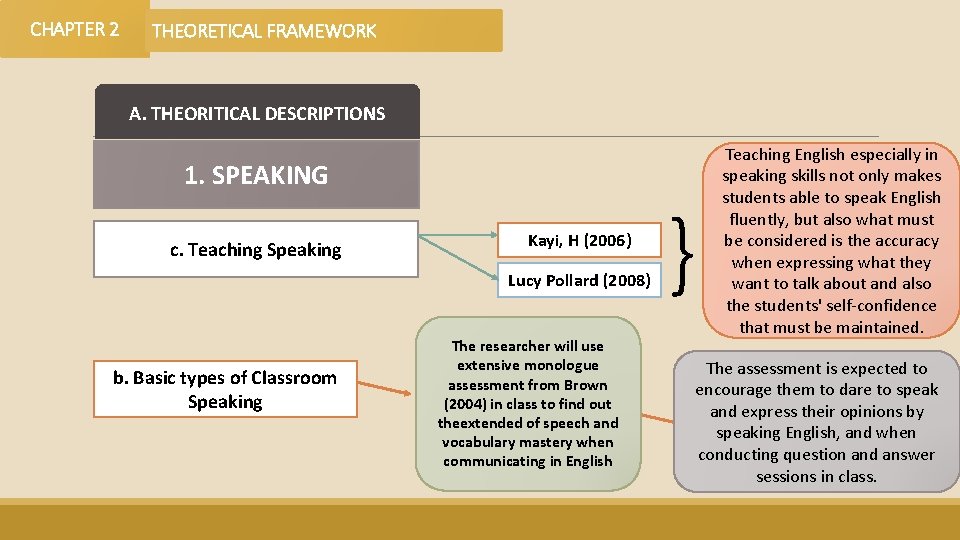
CHAPTER 2 THEORETICAL FRAMEWORK A. THEORITICAL DESCRIPTIONS 1. SPEAKING c. Teaching Speaking Kayi, H (2006) Lucy Pollard (2008) b. Basic types of Classroom Speaking The researcher will use extensive monologue assessment from Brown (2004) in class to find out theextended of speech and vocabulary mastery when communicating in English } Teaching English especially in speaking skills not only makes students able to speak English fluently, but also what must be considered is the accuracy when expressing what they want to talk about and also the students' self-confidence that must be maintained. The assessment is expected to encourage them to dare to speak and express their opinions by speaking English, and when conducting question and answer sessions in class.
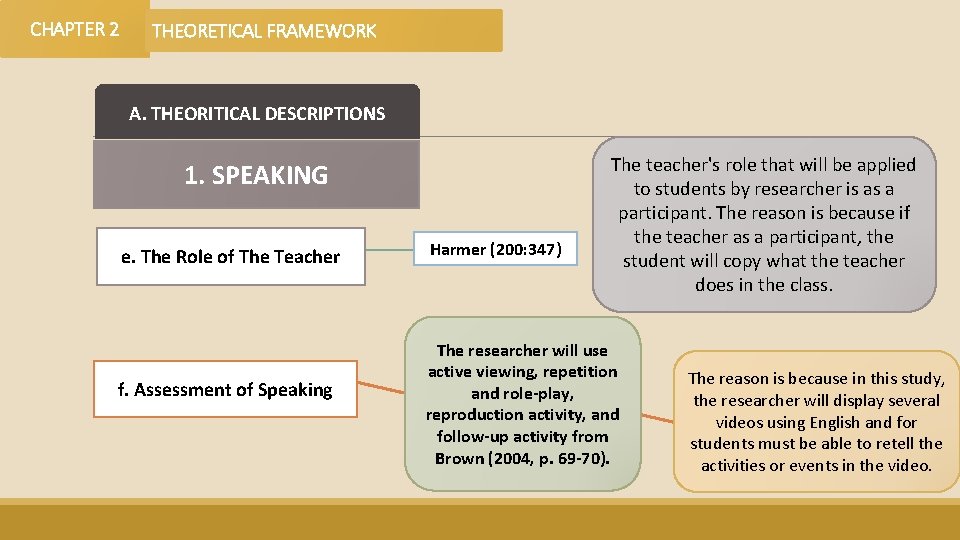
CHAPTER 2 THEORETICAL FRAMEWORK A. THEORITICAL DESCRIPTIONS 1. SPEAKING e. The Role of The Teacher f. Assessment of Speaking Harmer (200: 347) The teacher's role that will be applied to students by researcher is as a participant. The reason is because if the teacher as a participant, the student will copy what the teacher does in the class. } The researcher will use active viewing, repetition and role-play, reproduction activity, and follow-up activity from Brown (2004, p. 69 -70). The reason is because in this study, the researcher will display several videos using English and for students must be able to retell the activities or events in the video.
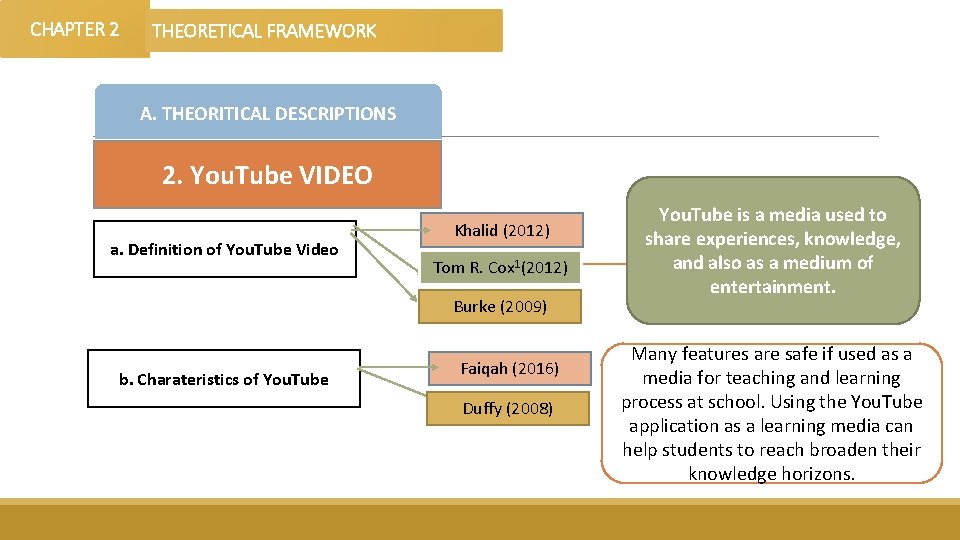
BAB CHAPTER 2 2 THEORETICAL FRAMEWORK A. THEORITICAL DESCRIPTIONS 2. You. Tube VIDEO a. Definition of You. Tube Video Khalid (2012) Tom R. Cox 1(2012) Burke (2009) b. Charateristics of You. Tube Faiqah (2016) Duffy (2008) You. Tube is a media used to share experiences, knowledge, and also as a medium of entertainment. Many features are safe if used as a media for teaching and learning process at school. Using the You. Tube application as a learning media can help students to reach broaden their knowledge horizons.
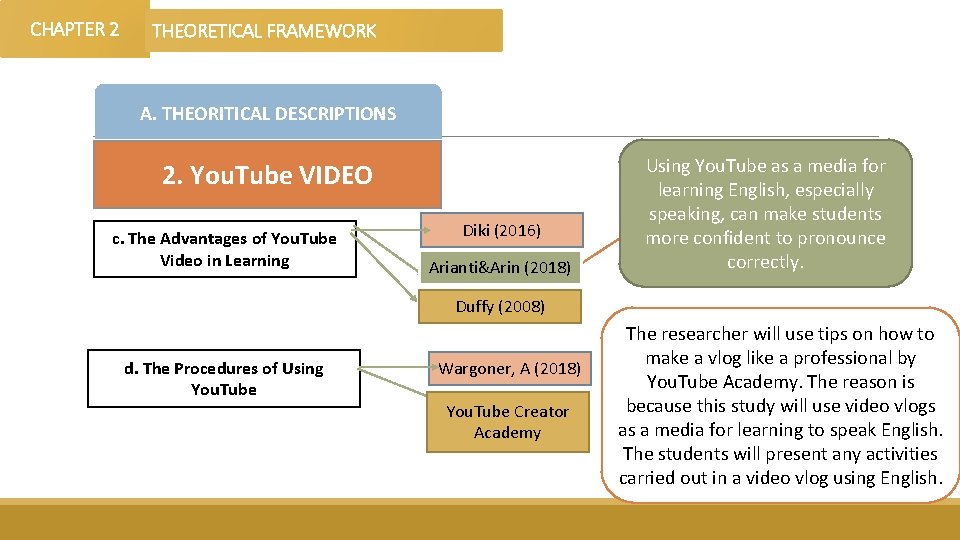
BAB CHAPTER 2 2 THEORETICAL FRAMEWORK A. THEORITICAL DESCRIPTIONS 2. You. Tube VIDEO c. The Advantages of You. Tube Video in Learning Diki (2016) Arianti&Arin (2018) Using You. Tube as a media for learning English, especially speaking, can make students more confident to pronounce correctly. Duffy (2008) d. The Procedures of Using You. Tube Wargoner, A (2018) You. Tube Creator Academy The researcher will use tips on how to make a vlog like a professional by You. Tube Academy. The reason is because this study will use video vlogs as a media for learning to speak English. The students will present any activities carried out in a video vlog using English.
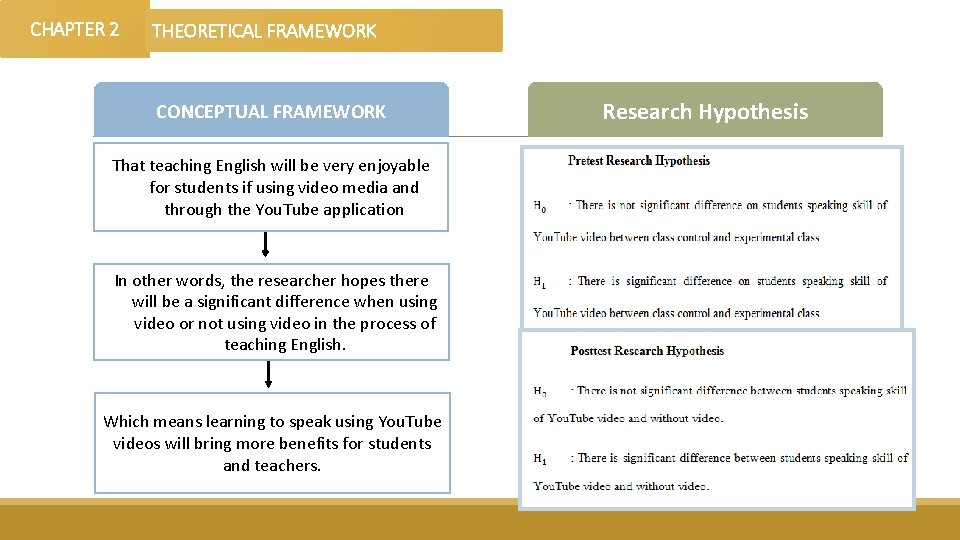
CHAPTER 2 THEORETICAL FRAMEWORK CONCEPTUAL FRAMEWORK That teaching English will be very enjoyable for students if using video media and through the You. Tube application In other words, the researcher hopes there will be a significant difference when using video or not using video in the process of teaching English. Which means learning to speak using You. Tube videos will bring more benefits for students and teachers. Research Hypothesis
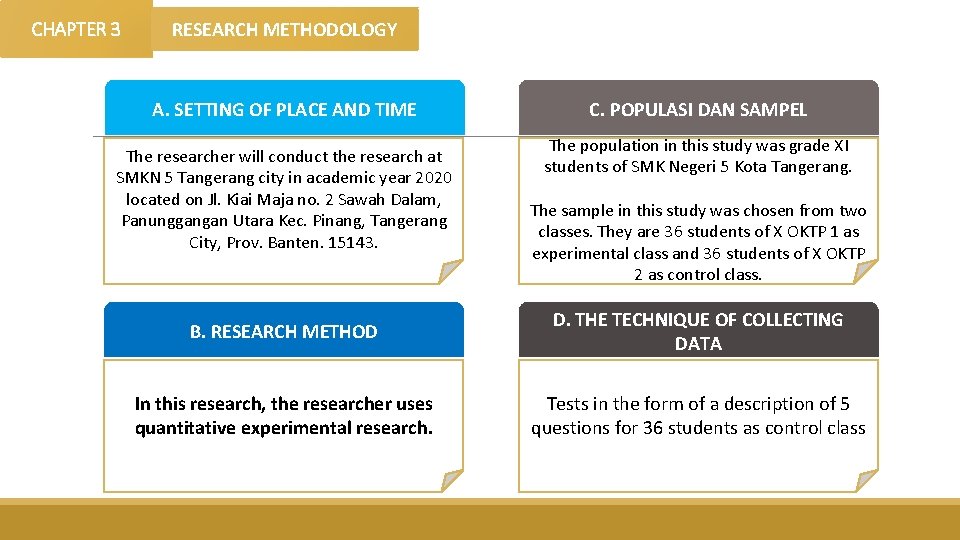
CHAPTER 3 RESEARCH METHODOLOGY A. SETTING OF PLACE AND TIME The researcher will conduct the research at SMKN 5 Tangerang city in academic year 2020 located on Jl. Kiai Maja no. 2 Sawah Dalam, Panunggangan Utara Kec. Pinang, Tangerang City, Prov. Banten. 15143. C. POPULASI DAN SAMPEL The population in this study was grade XI students of SMK Negeri 5 Kota Tangerang. The sample in this study was chosen from two classes. They are 36 students of X OKTP 1 as experimental class and 36 students of X OKTP 2 as control class. B. RESEARCH METHOD D. THE TECHNIQUE OF COLLECTING DATA In this research, the researcher uses quantitative experimental research. Tests in the form of a description of 5 questions for 36 students as control class
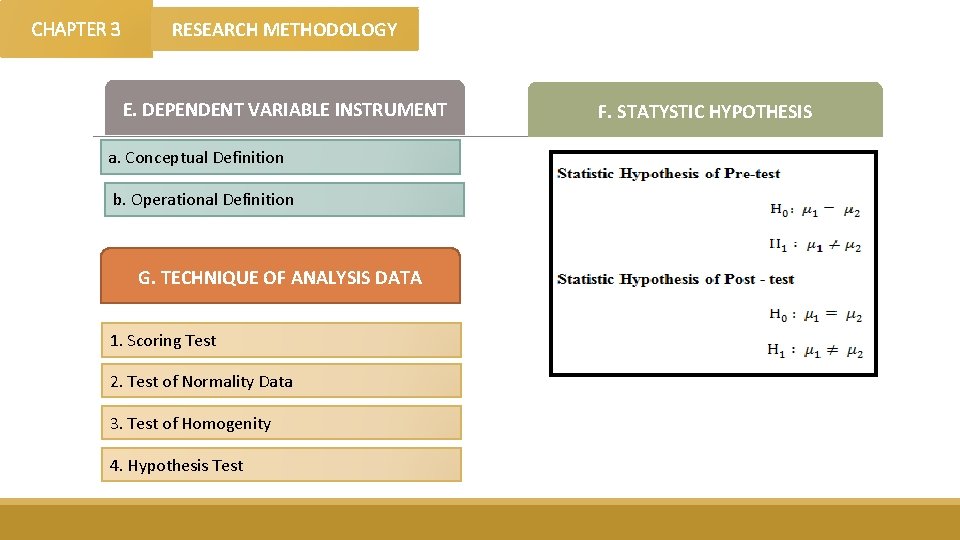
CHAPTER 3 RESEARCH METHODOLOGY E. DEPENDENT VARIABLE INSTRUMENT a. Conceptual Definition b. Operational Definition G. TECHNIQUE OF ANALYSIS DATA 1. Scoring Test 2. Test of Normality Data 3. Test of Homogenity 4. Hypothesis Test F. STATYSTIC HYPOTHESIS

THANKYOU
- Slides: 13