
The Effect of Wafer Shape on Lubrication Regimes
The Effect of Wafer Shape on Lubrication Regimes in Chemical Mechanical Planarization Researcher: Joseph Lu Principal Investigator: Chris Rogers Corporate Sponsors: Cabot Corporation Intel Corporation Freudenberg Nonwovens VEECO Insturments
Outline • Advantages of chemical mechanical planarization • Laboratory scale CMP setup – Slurry film thickness measurement technique – Friction measurement technique • Define wafer shapes • Effects of wafer curvature on slurry film thickness and coefficient of friction • Effects of wafer curvature on fluid pressure distribution • Summary and conclusions
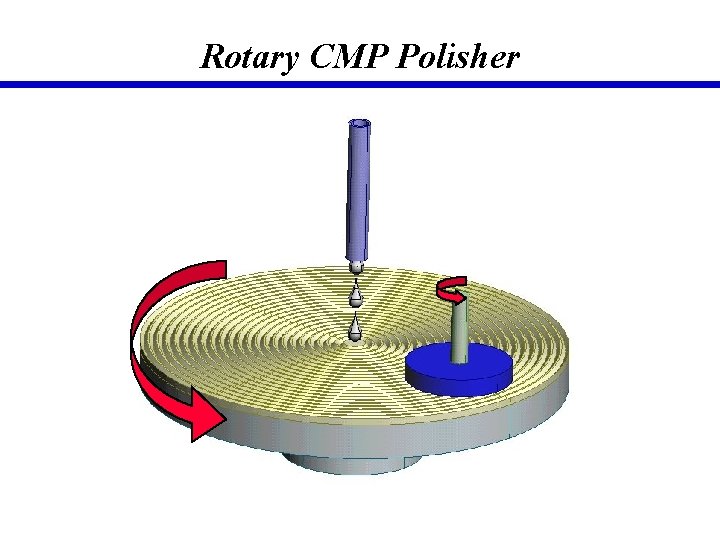
Rotary CMP Polisher
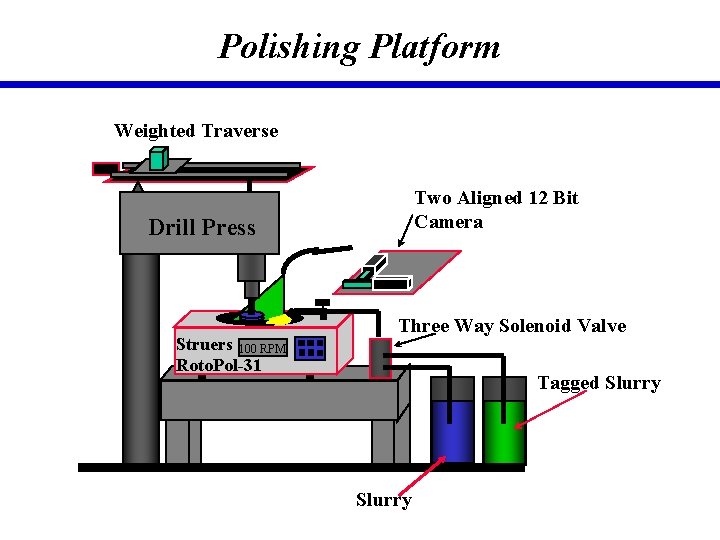
Polishing Platform Weighted Traverse Two Aligned 12 Bit Camera Drill Press Struers 100 RPM Roto. Pol-31 Three Way Solenoid Valve Tagged Slurry
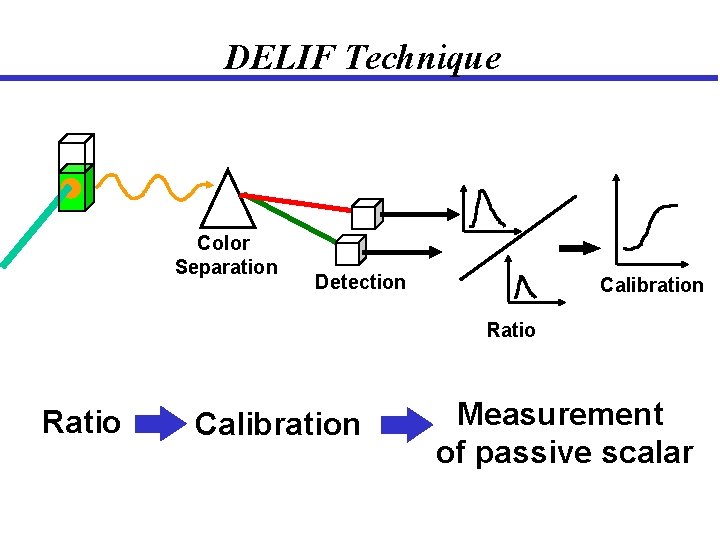
DELIF Technique Color Separation Detection Calibration Ratio Calibration Measurement of passive scalar
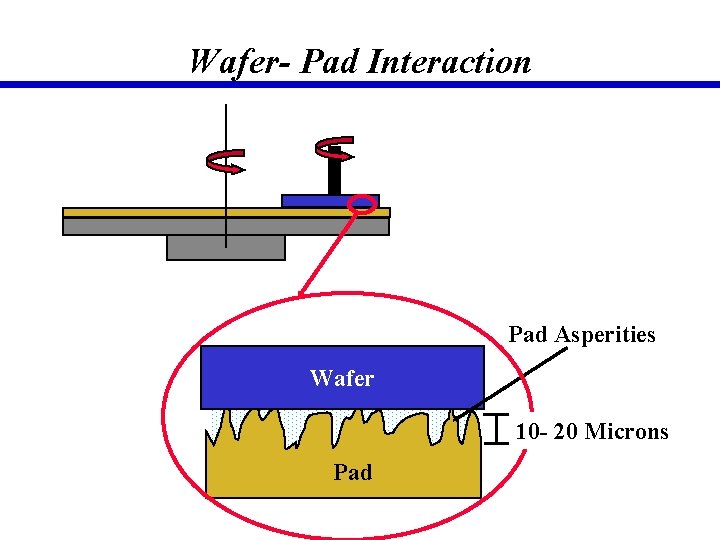
Wafer- Pad Interaction Pad Asperities Wafer 10 - 20 Microns Pad
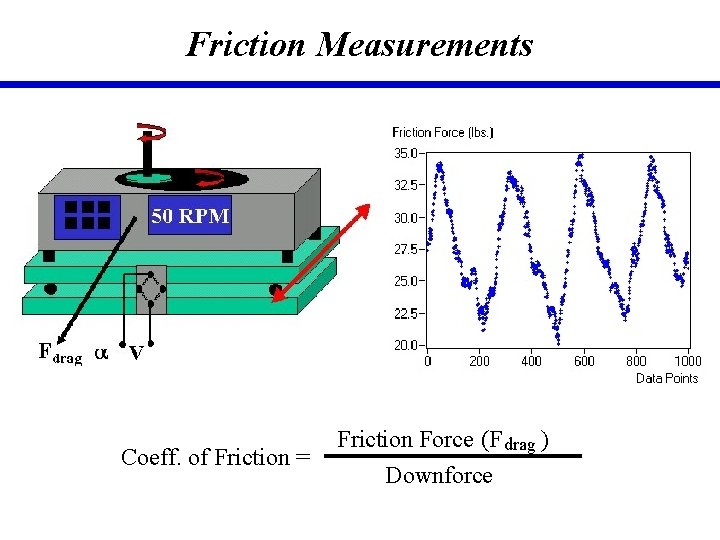
Friction Measurements Coeff. of Friction = Friction Force (F drag ) Downforce
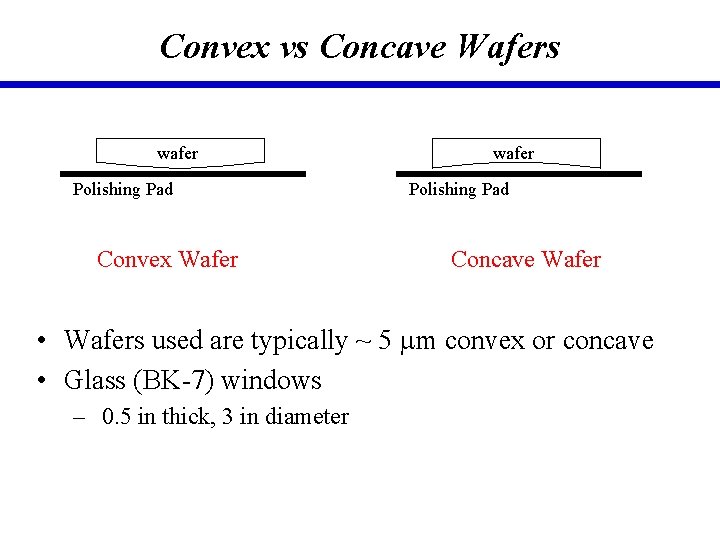
Convex vs Concave Wafers wafer Polishing Pad Convex Wafer wafer Polishing Pad Concave Wafer • Wafers used are typically ~ 5 mm convex or concave • Glass (BK-7) windows – 0. 5 in thick, 3 in diameter
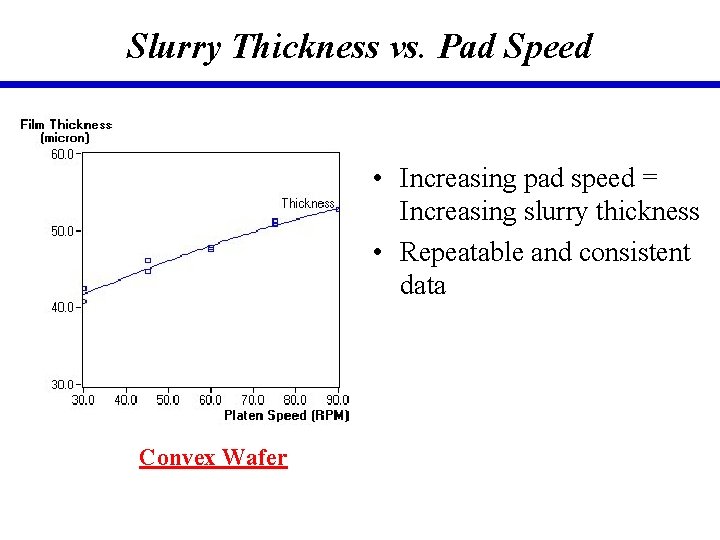
Slurry Thickness vs. Pad Speed • Increasing pad speed = Increasing slurry thickness • Repeatable and consistent data Convex Wafer
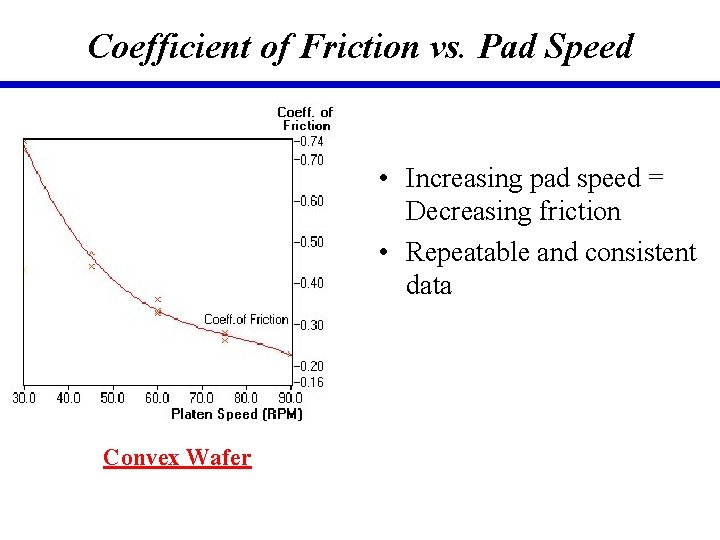
Coefficient of Friction vs. Pad Speed • Increasing pad speed = Decreasing friction • Repeatable and consistent data Convex Wafer
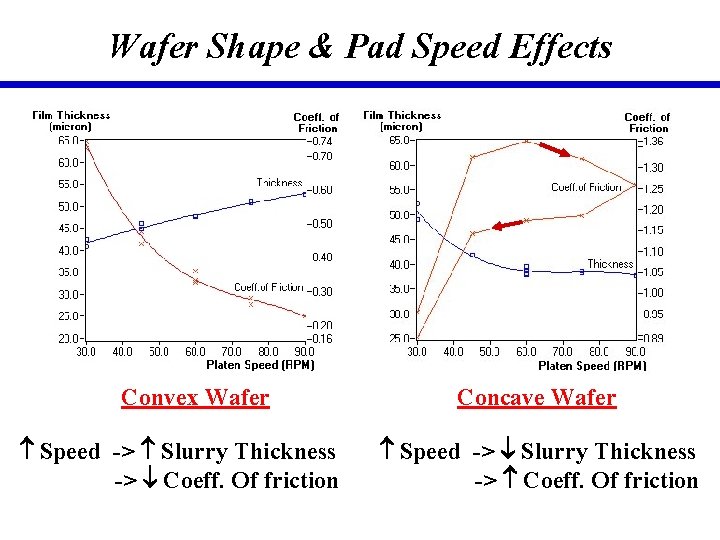
Wafer Shape & Pad Speed Effects Convex Wafer Speed -> Slurry Thickness -> Coeff. Of friction Concave Wafer Speed -> Slurry Thickness -> Coeff. Of friction
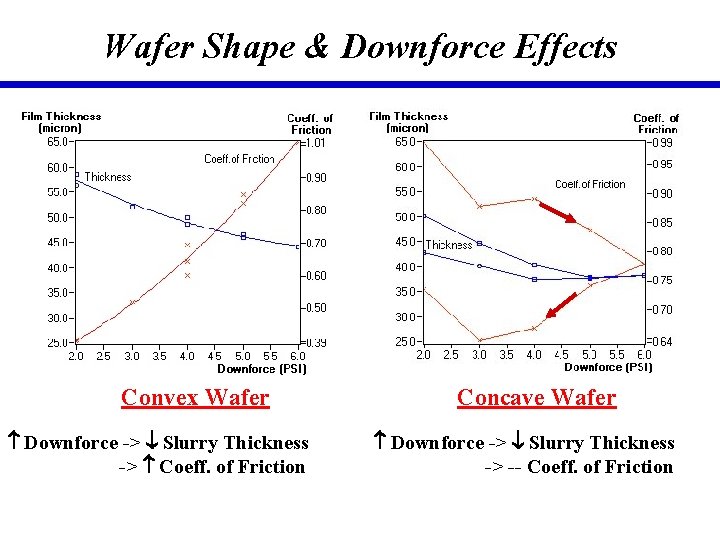
Wafer Shape & Downforce Effects Convex Wafer Downforce -> Slurry Thickness -> Coeff. of Friction Concave Wafer Downforce -> Slurry Thickness -> -- Coeff. of Friction
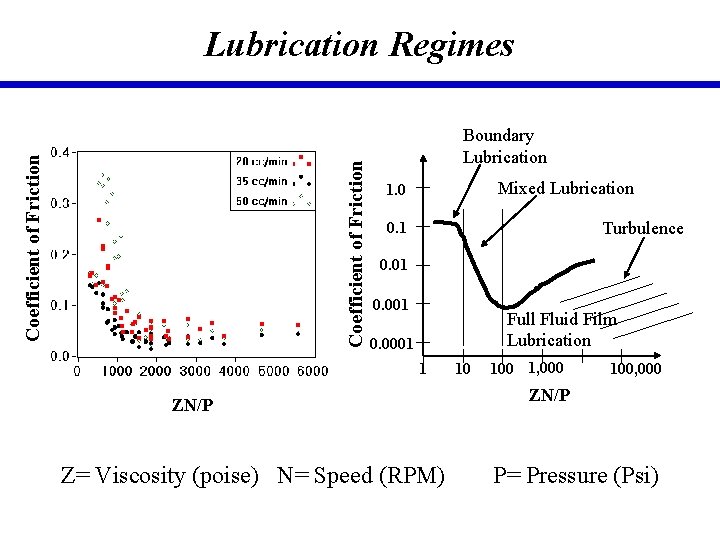
Coefficient of Friction Lubrication Regimes Boundary Lubrication Mixed Lubrication 1. 0 Turbulence 0. 1 0. 001 Full Fluid Film Lubrication 0. 0001 1 ZN/P Z= Viscosity (poise) N= Speed (RPM) 10 100 1, 000 100, 000 ZN/P P= Pressure (Psi)
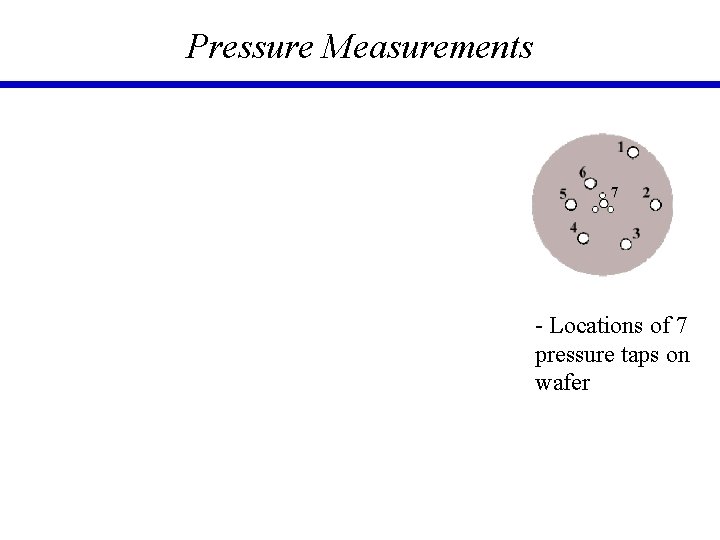
Pressure Measurements - Locations of 7 pressure taps on wafer
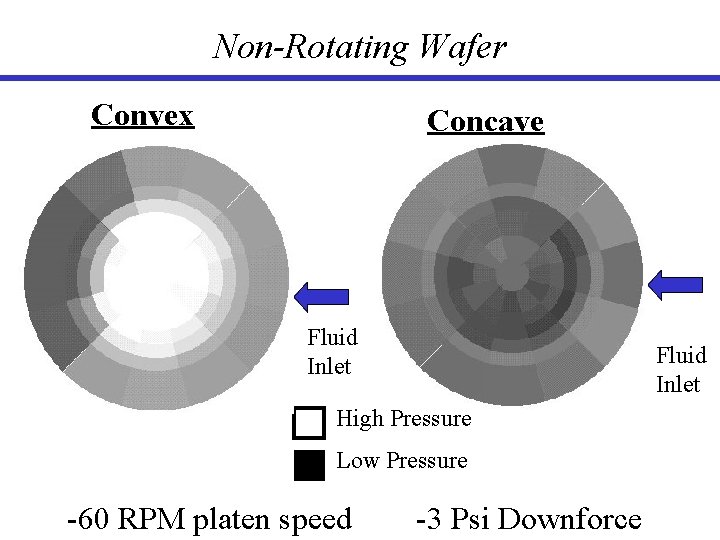
Non-Rotating Wafer Convex Concave Fluid Inlet High Pressure Low Pressure -60 RPM platen speed -3 Psi Downforce
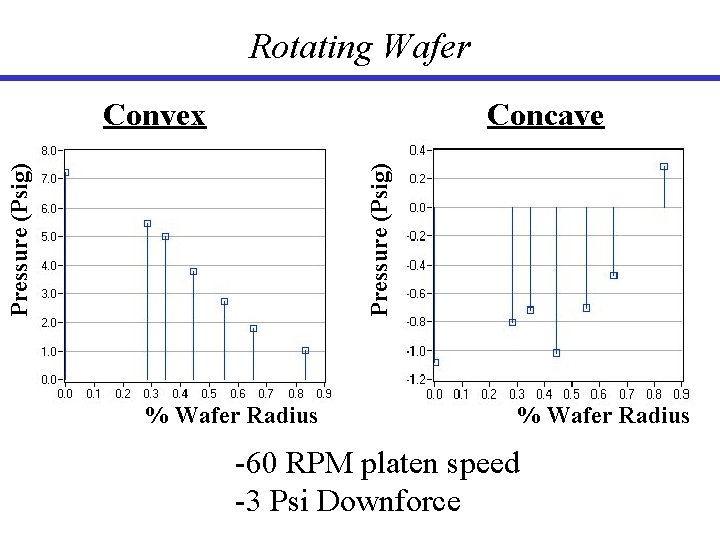
Rotating Wafer Pressure (Psig) Concave Pressure (Psig) Convex % Wafer Radius -60 RPM platen speed -3 Psi Downforce
Summary • Clear difference in slurry film thickness and coeff. of friction trends between convex and concave wafers – Convex wafers seem to be able to support a thicker slurry layer than a concave wafer – Pad - wafer lubrication regime may be characterized by the coeff. of friction and slurry thickness data • Slurry film thickness is not independent of the polishing pad’s response to process parameters • There are significant pressure differences between different wafer shapes
Conclusions & Future Work • Lubrication regime = f (slurry film thickness, friction, fluid pressure) – Convexities = +pressure = hydrodynamic lift – Concavities = suction = asperity contact • Slurry thickness, friction, and fluid pressure are correlated – The understanding of the relationship of these parameters can improve the control of the planarization process • Examine changes in slurry thickness and friction of a polishing wafer as it changes shape • Examine localized feature scale effects - ‘hot spots’
Acknowledgements • Cabot Corporation – Frank Kaufman • Intel Corporation – Mansour Moinpour, Ara Philipossian • Tufts University – Chris Rogers, Vincent Manno, Alicia Scarfo

Visit our web site at http: \www. tuftl. tufts. edu
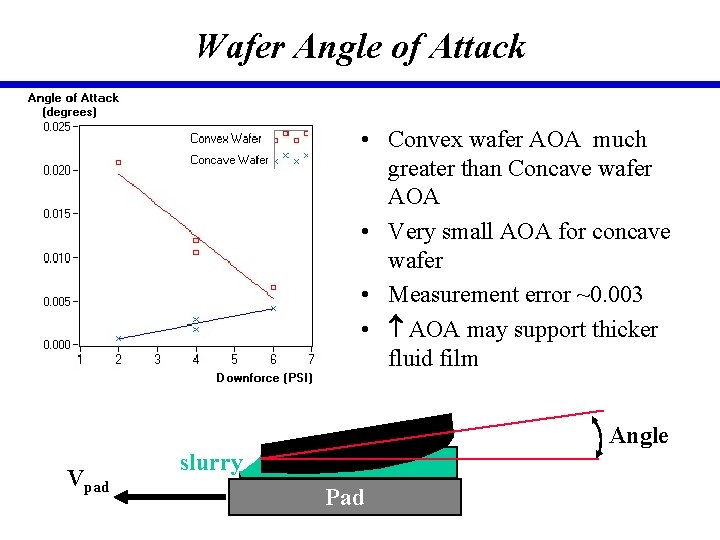
Wafer Angle of Attack • Convex wafer AOA much greater than Concave wafer AOA • Very small AOA for concave wafer • Measurement error ~0. 003 • AOA may support thicker fluid film Angle Vpad slurry Pad
- Slides: 21