
The Effect of the Electronegativity of Terminal Atoms



- Slides: 27
The Effect of the Electronegativity of Terminal Atoms on Bond Angles John Hiscock
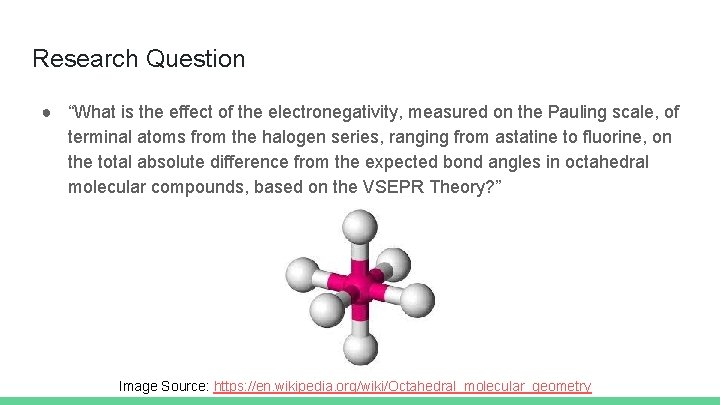
Research Question ● “What is the effect of the electronegativity, measured on the Pauling scale, of terminal atoms from the halogen series, ranging from astatine to fluorine, on the total absolute difference from the expected bond angles in octahedral molecular compounds, based on the VSEPR Theory? ” Image Source: https: //en. wikipedia. org/wiki/Octahedral_molecular_geometry
Background Information ● Electronegativity is defined as “the relative attraction that an atom has for the shared pair of electrons in a covalent bond” (Bylkin et al. , 2014, p. 83). ○ The Pauling scale is based on fluorine being the most electronegative and the remaining elements being assigned an electronegativity value by means of relativity (Salem, 2020). ● The VSEPR Theory is theory that the shape of a molecular compound can be determined based on the idea that the electron pairs on two separate terminal atoms will repel each other as they are both negatively charged (Bylkin et al. , 2014). ○ For the purposes of this investigation, molecular compounds with six terminal atoms, commonly known as octahedral based on the VSEPR Theory, will be studied. ● I hypothesize that as electronegativity increases, the bond angles between one terminal atom, the central atom, and another terminal atom, will increase (Linker, 2020).
Safety, Ethics, and Environmental Issues ● In order to carry out this investigation, Gabedit 2. 4. 8, a computational chemistry modelling software, will be used. ● Considering this, there are no safety, ethical, or environmental issues associated with this procedure.
Independent and Dependent Variables ● The independent variable for this investigation is the range of terminal atoms, with varying electronegativities, which will be attached to a central atom. ○ ○ This will be astatine, iodine, chlorine, bromine, and fluorine, with Pauling electronegativity values of 2. 2, 2. 7, 3. 0, 3. 2, and 4. 0, respectively (International Baccalaureate Organization, 2016, p. 8). When performing an analysis on the data collected, the sum of electronegativities of all terminal atoms in the molecular compound will be compared against the dependent variable. ● The dependent variable for this investigation is the absolute difference from the expected bond angles in VSEPR octahedral molecular compounds, measured in degrees (°). ○ ○ ○ This will be measured by taking the sum of the angles recorded experimentally and subtracting that from the sum of expected angles of octahedral molecular compounds. The expected sum of angles is 15 x 90. 000000°, or 1350. 000000°, as there are 15 90° angles in a VSEPR octahedral compound. In this investigation, the angles will be referred to with the symbol for angle, ∠.
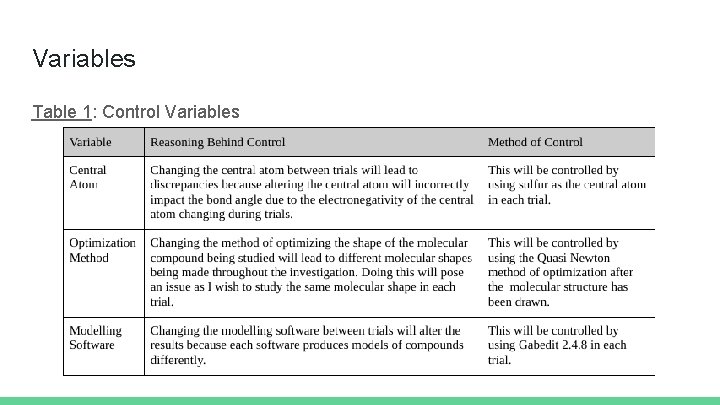
Variables Table 1: Control Variables
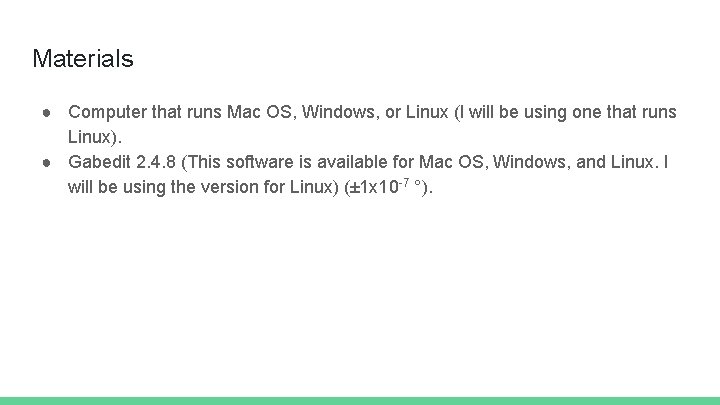
Materials ● Computer that runs Mac OS, Windows, or Linux (I will be using one that runs Linux). ● Gabedit 2. 4. 8 (This software is available for Mac OS, Windows, and Linux. I will be using the version for Linux) (± 1 x 10 -7 °).
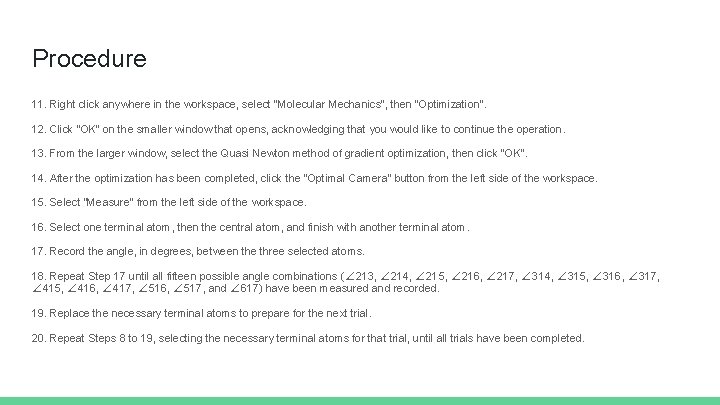
Procedure 1. Install and open Gabedit 2. 4. 8 for Linux (Allouchear, 2014). 2. Click on the “Draw Geometry” button located on the second bar from the top on the home page. This opens a window which will be referred to as the “workspace”. 3. Click on the “Render Ball & Stick” button, located on the left side. 4. Click on the “Insert / Change Atoms or Bond” button, located on the left side. 5. Click on the “Set Atom to Insert” button, located on the left side. 6. Select “S”, representing sulfur, from the periodic table which opens after completing Step 5. 7. Click near the centre of the workspace to place the sulfur atom. 8. Repeat Steps 4 to 6, however this time select At, representing astatine. 9. Click on the sulfur atom in the workspace and drag in any direction to create a molecular bond between sulfur and astatine. 10. Repeat Step 9 until six terminal atoms have been attached.
Procedure 11. Right click anywhere in the workspace, select “Molecular Mechanics”, then “Optimization”. 12. Click “OK” on the smaller window that opens, acknowledging that you would like to continue the operation. 13. From the larger window, select the Quasi Newton method of gradient optimization, then click “OK”. 14. After the optimization has been completed, click the “Optimal Camera” button from the left side of the workspace. 15. Select “Measure” from the left side of the workspace. 16. Select one terminal atom, then the central atom, and finish with another terminal atom. 17. Record the angle, in degrees, between the three selected atoms. 18. Repeat Step 17 until all fifteen possible angle combinations (∠ 213, ∠ 214, ∠ 215, ∠ 216, ∠ 217, ∠ 314, ∠ 315, ∠ 316, ∠ 317, ∠ 415, ∠ 416, ∠ 417, ∠ 516, ∠ 517, and ∠ 617) have been measured and recorded. 19. Replace the necessary terminal atoms to prepare for the next trial. 20. Repeat Steps 8 to 19, selecting the necessary terminal atoms for that trial, until all trials have been completed.
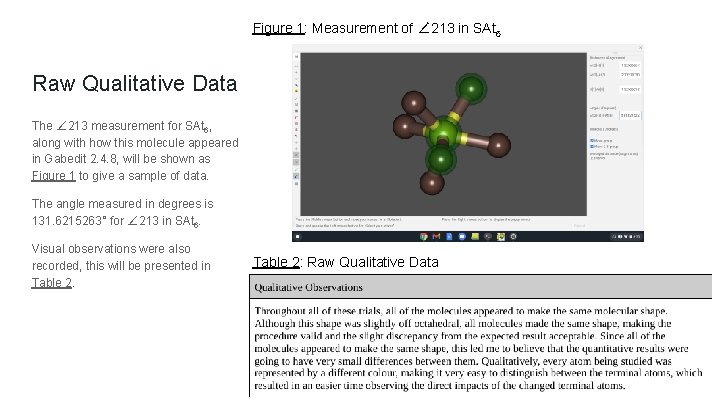
Figure 1: Measurement of ∠ 213 in SAt 6 Raw Qualitative Data The ∠ 213 measurement for SAt 6, along with how this molecule appeared in Gabedit 2. 4. 8, will be shown as Figure 1 to give a sample of data. The angle measured in degrees is 131. 6215263° for ∠ 213 in SAt 6. Visual observations were also recorded, this will be presented in Table 2: Raw Qualitative Data
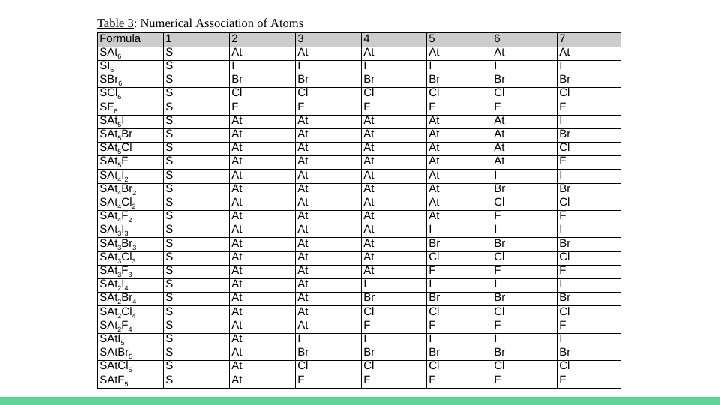
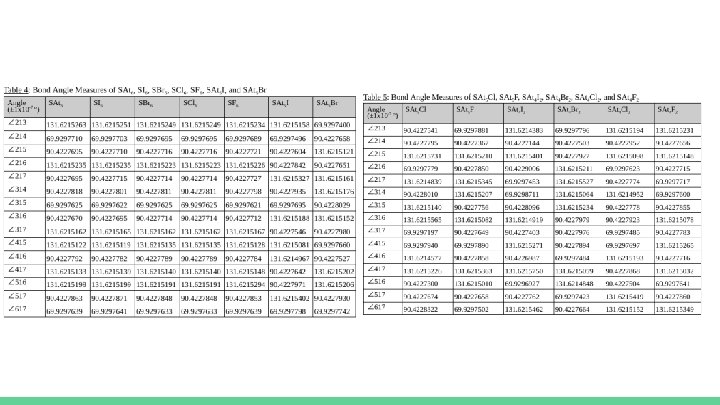
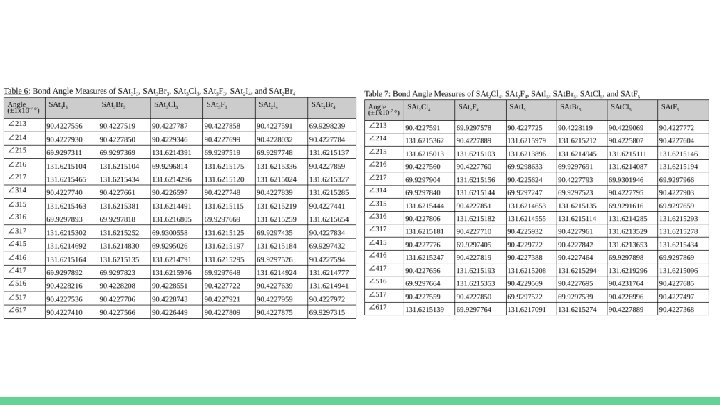
Raw Quantitative Data ● Only one trial was performed for each of these molecules as a result of preliminary trials. ● With the central and terminal atoms of each molecule being clearly identified, as shown in Table 3, the bond angles could be measured in each of the necessary molecules, as previously described. ○ The measured angles with their respective uncertainties will be shown after Table 3 in Table 4, Table 5, Table 6, and Table 7.
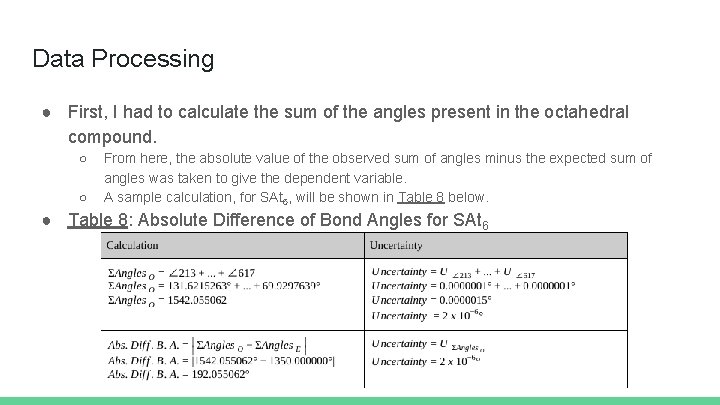
Data Processing ● First, I had to calculate the sum of the angles present in the octahedral compound. ○ ○ From here, the absolute value of the observed sum of angles minus the expected sum of angles was taken to give the dependent variable. A sample calculation, for SAt 6, will be shown in Table 8 below. ● Table 8: Absolute Difference of Bond Angles for SAt 6
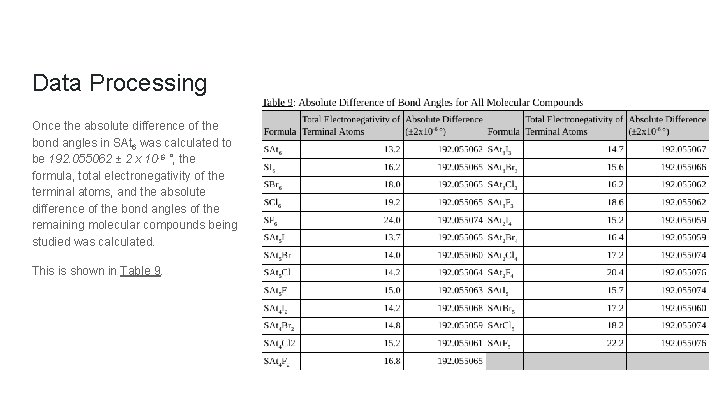
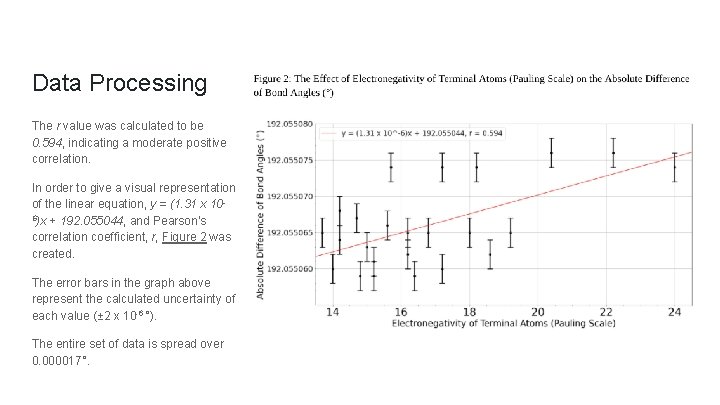
Data Processing Once the absolute difference of the bond angles in SAt 6 was calculated to be 192. 055062 ± 2 x 10 -6 °, the formula, total electronegativity of the terminal atoms, and the absolute difference of the bond angles of the remaining molecular compounds being studied was calculated. This is shown in Table 9.
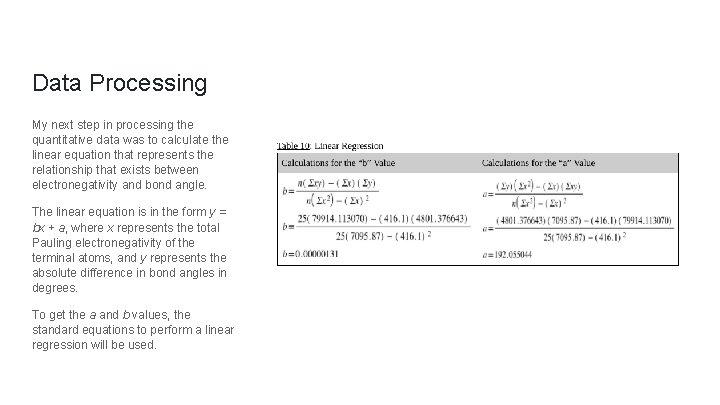
Data Processing My next step in processing the quantitative data was to calculate the linear equation that represents the relationship that exists between electronegativity and bond angle. The linear equation is in the form y = bx + a, where x represents the total Pauling electronegativity of the terminal atoms, and y represents the absolute difference in bond angles in degrees. To get the a and b values, the standard equations to perform a linear regression will be used.
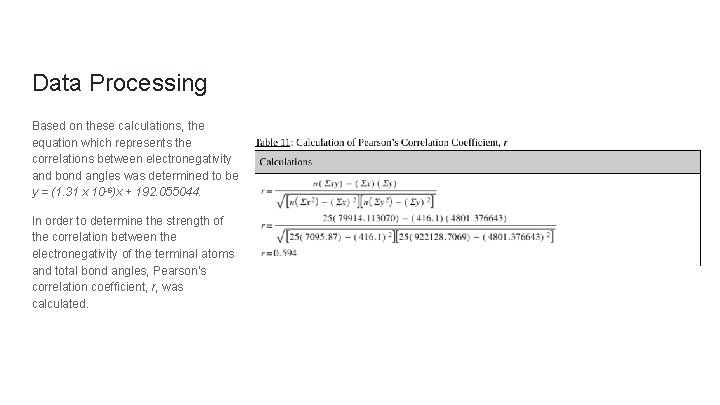
Data Processing Based on these calculations, the equation which represents the correlations between electronegativity and bond angles was determined to be y = (1. 31 x 10 -6)x + 192. 055044. In order to determine the strength of the correlation between the electronegativity of the terminal atoms and total bond angles, Pearson’s correlation coefficient, r, was calculated.
Data Processing The r value was calculated to be 0. 594, indicating a moderate positive correlation. In order to give a visual representation of the linear equation, y = (1. 31 x 106)x + 192. 055044, and Pearson’s correlation coefficient, r, Figure 2 was created. The error bars in the graph above represent the calculated uncertainty of each value (± 2 x 10 -6 °). The entire set of data is spread over 0. 000017°.
Impact of Uncertainty ● The impact of uncertainty is very minimal, because of the measured angles being recorded to seven decimal places, leading to the uncertainty for each measurement taken being ± 1 x 10 -7 °. ● Even with the sum of fifteen angles being calculated, the uncertainty only elevated to ± 2 x 10 -6 °, which is still very small and negligible in most cases, with the exception of this investigation.
Interpretation of Processed Data ● The general pattern, or trend, in the data collected shows that as the total electronegativity of the terminal atoms increases, the bond angles in an octahedral compound begin to differ more from the expected 90°. ● This trend can be modelled by the linear equation, y = (1. 31 x 10 -6)x + 192. 055044, where y equals the total variation of the bond angles from the expected values, and x represents the total electronegativity of the terminal atoms.
Conclusion ● The electronegativity of the terminal atoms appeared to make very little difference, considering that all values recorded ranged from 192. 055059 ± 0. 0000001° to 192. 055076 ± 0. 0000001°. ● This makes the VSEPR Theory for octahedral compounds accurate for electronegativities up until the hundred thousandths place. ● In addition to this, the linear equation which models this relationship is y = (1. 31 x 10 -6)x + 192. 055044, with a Pearson’s correlation coefficient, or r value, of 0. 594, indicating a moderate positive correlation. ● The general trend in data was an increase in bond angle discrepancy from the expected as the sum of electronegativities of the terminal atoms increased.
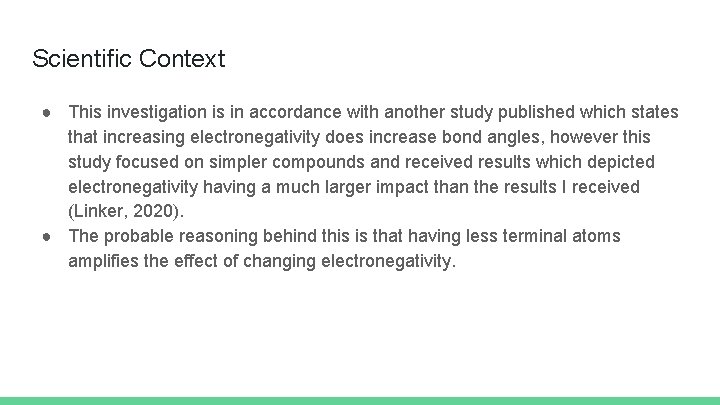
Scientific Context ● This investigation is in accordance with another study published which states that increasing electronegativity does increase bond angles, however this study focused on simpler compounds and received results which depicted electronegativity having a much larger impact than the results I received (Linker, 2020). ● The probable reasoning behind this is that having less terminal atoms amplifies the effect of changing electronegativity.
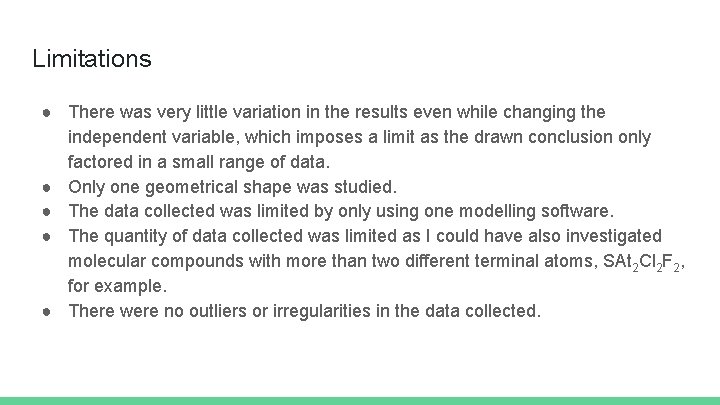
Limitations ● There was very little variation in the results even while changing the independent variable, which imposes a limit as the drawn conclusion only factored in a small range of data. ● Only one geometrical shape was studied. ● The data collected was limited by only using one modelling software. ● The quantity of data collected was limited as I could have also investigated molecular compounds with more than two different terminal atoms, SAt 2 Cl 2 F 2, for example. ● There were no outliers or irregularities in the data collected.
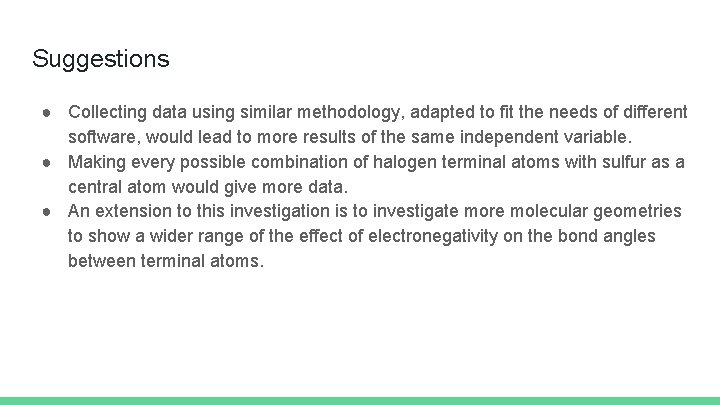
Suggestions ● Collecting data using similar methodology, adapted to fit the needs of different software, would lead to more results of the same independent variable. ● Making every possible combination of halogen terminal atoms with sulfur as a central atom would give more data. ● An extension to this investigation is to investigate more molecular geometries to show a wider range of the effect of electronegativity on the bond angles between terminal atoms.
Acknowledgements ● I would like to thank Ms. Janes, my IB Chemistry teacher, for helping me with this project through the various stages. ● I would also like to thank Husky Energy for hosting this science fair.
References Allouchear. (2014). Gabedit 2. 4. 8. https: //sourceforge. net/projects/gabedit/files/setup. Gabedit 250_linux_64. sh/download Bylkin, S. , Horner, G. , Murphy, B. , & Tarcy, D. (2014). Oxford IB Diploma Programme: Chemistry, 2014 Edition, Course Companion. International Baccalaureate Organization (2016). IB Chemistry Data Booklet. Linker, G. -J. (2020). “Understanding Trends in Molecular Bond Angles”, The Journal of Physical Chemistry A 2020 124(7), pp. 1306 -1311. Accessed November 16, 2020. https: //pubs. acs. org/doi/10. 1021/acs. jpca. 9 b 10248# Salem, M. (2020). “Pauling Electronegativity”. Accessed November 16, 2020. https: //chem. libretexts. org/Bookshelves/Physical_and_Theoretical_Chemistry_Textbook_Maps/Suppleme ntal_Modules_(Physical_and_Theoretical_Chemistry)/Physical_Properties_of_Matter/Atomic_and_Molecu lar_Properties/Electronegativity/Pauling_Electronegativity