
The Effect of Soil Moisture Dynamics on Stream
- Slides: 1
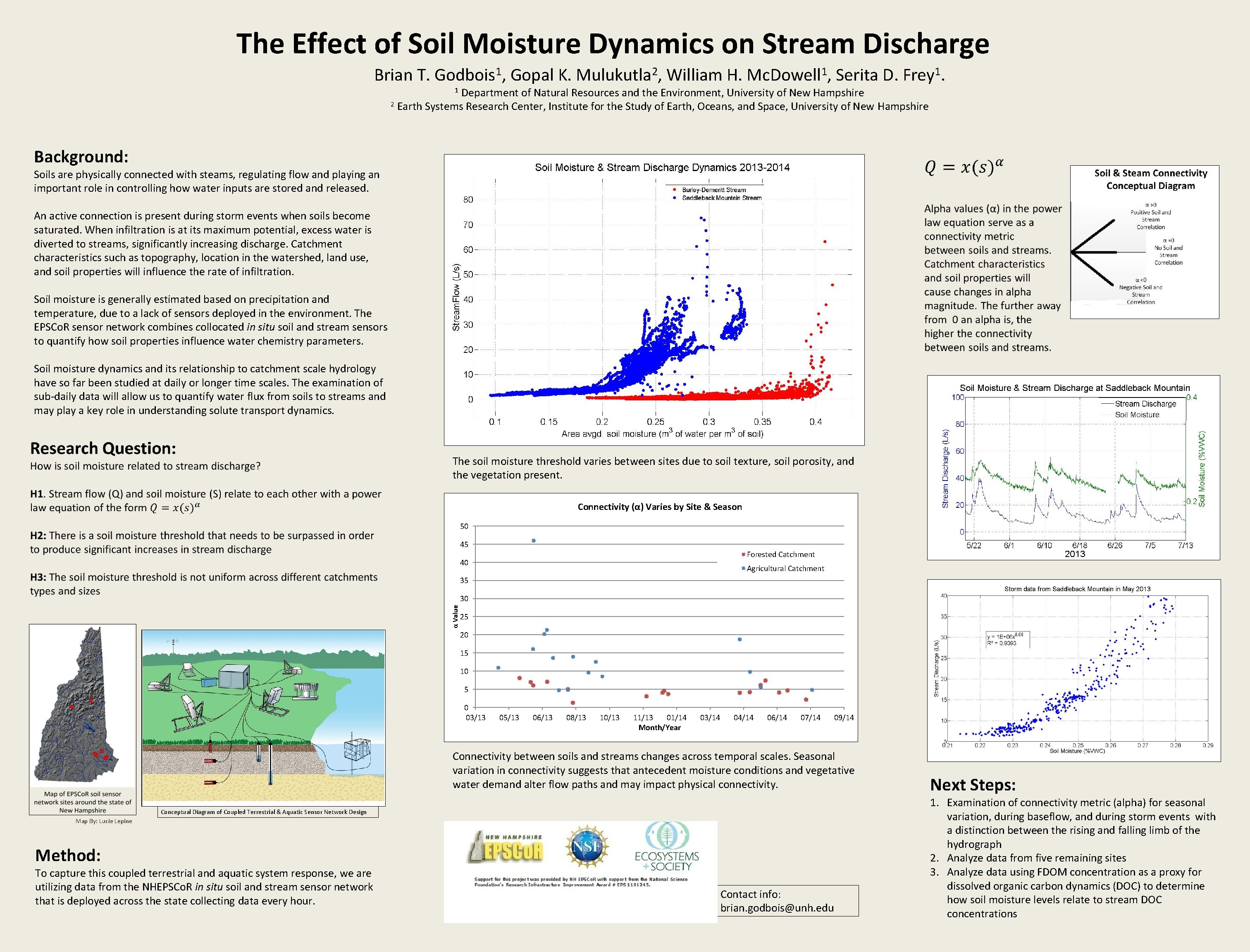
The Effect of Soil Moisture Dynamics on Stream Discharge Brian T. Godbois 1, Gopal K. Mulukutla 2, William H. Mc. Dowell 1, Serita D. Frey 1. Department of Natural Resources and the Environment, University of New Hampshire 2 Earth Systems Research Center, Institute for the Study of Earth, Oceans, and Space, University of New Hampshire 1 Background: Soils are physically connected with steams, regulating flow and playing an important role in controlling how water inputs are stored and released. An active connection is present during storm events when soils become saturated. When infiltration is at its maximum potential, excess water is diverted to streams, significantly increasing discharge. Catchment characteristics such as topography, location in the watershed, land use, and soil properties will influence the rate of infiltration. Soil moisture is generally estimated based on precipitation and temperature, due to a lack of sensors deployed in the environment. The EPSCo. R sensor network combines collocated in situ soil and stream sensors to quantify how soil properties influence water chemistry parameters. Soil moisture dynamics and its relationship to catchment scale hydrology have so far been studied at daily or longer time scales. The examination of sub-daily data will allow us to quantify water flux from soils to streams and may play a key role in understanding solute transport dynamics. The soil moisture threshold varies between sites due to soil texture, soil porosity, and the vegetation present. Connectivity (α) Varies by Site & Season 50 45 Forested Catchment 40 Agricultural Catchment 35 α Value 30 25 20 15 10 5 0 03/13 05/13 06/13 08/13 10/13 11/13 01/14 Month/Year 03/14 04/14 06/14 07/14 09/14 Connectivity between soils and streams changes across temporal scales. Seasonal variation in connectivity suggests that antecedent moisture conditions and vegetative water demand alter flow paths and may impact physical connectivity. Conceptual Diagram of Coupled Terrestrial & Aquatic Sensor Network Design Map By: Lucie Lepine Method: To capture this coupled terrestrial and aquatic system response, we are utilizing data from the NHEPSCo. R in situ soil and stream sensor network that is deployed across the state collecting data every hour. Contact info: brian. godbois@unh. edu Next Steps: 1. Examination of connectivity metric (alpha) for seasonal variation, during baseflow, and during storm events with a distinction between the rising and falling limb of the hydrograph 2. Analyze data from five remaining sites 3. Analyze data using FDOM concentration as a proxy for dissolved organic carbon dynamics (DOC) to determine how soil moisture levels relate to stream DOC concentrations