
The Effect of Nutrients on Leaf Litter Decomposition
- Slides: 1
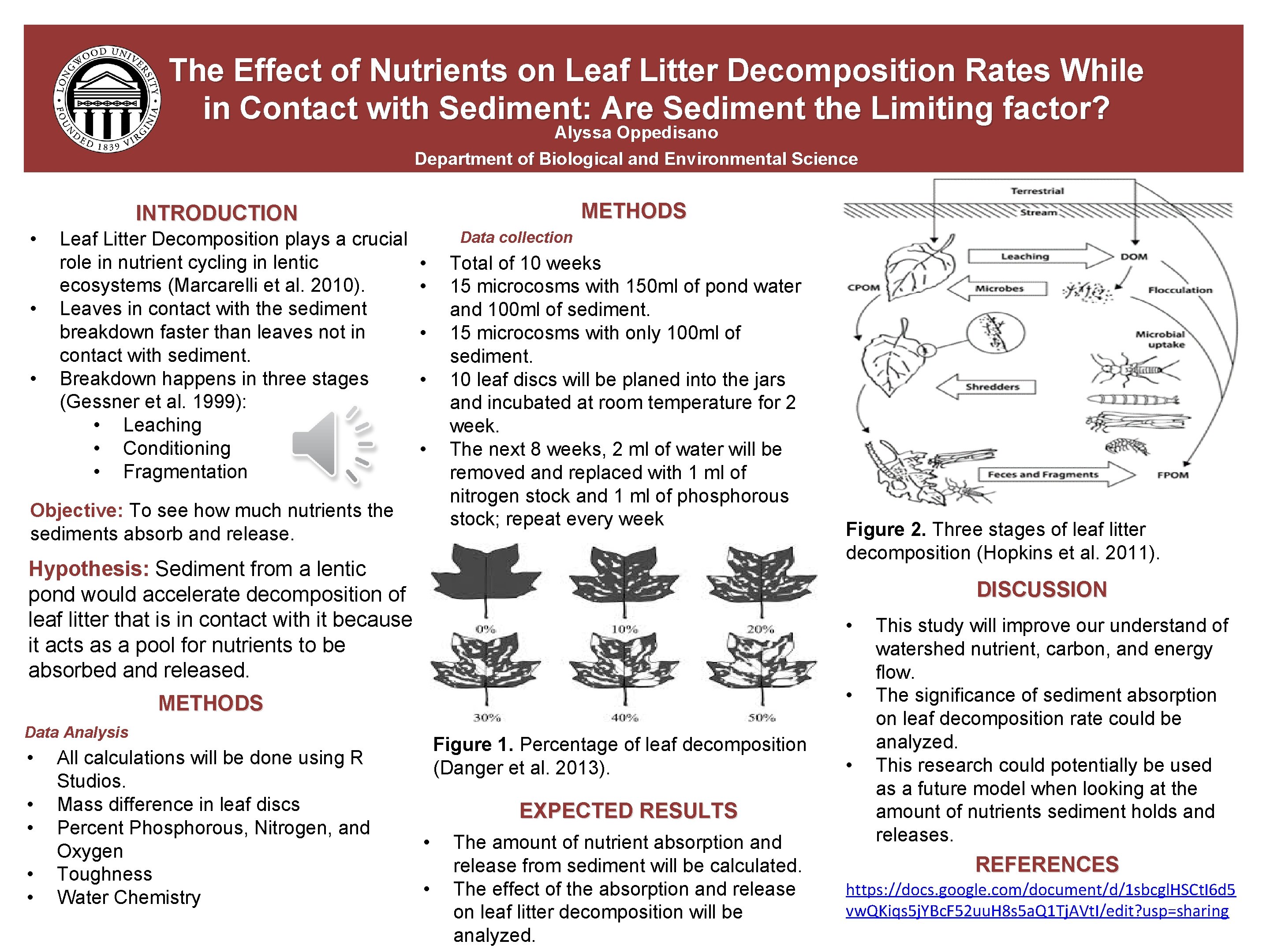
The Effect of Nutrients on Leaf Litter Decomposition Rates While in Contact with Sediment: Are Sediment the Limiting factor? Alyssa Oppedisano Department of Biological and Environmental Science METHODS INTRODUCTION • • • Leaf Litter Decomposition plays a crucial role in nutrient cycling in lentic ecosystems (Marcarelli et al. 2010). Leaves in contact with the sediment breakdown faster than leaves not in contact with sediment. Breakdown happens in three stages (Gessner et al. 1999): • Leaching • Conditioning • Fragmentation Data collection • • • Objective: To see how much nutrients the sediments absorb and release. Hypothesis: Sediment from a lentic pond would accelerate decomposition of leaf litter that is in contact with it because it acts as a pool for nutrients to be absorbed and released. Total of 10 weeks 15 microcosms with 150 ml of pond water and 100 ml of sediment. 15 microcosms with only 100 ml of sediment. 10 leaf discs will be planed into the jars and incubated at room temperature for 2 week. The next 8 weeks, 2 ml of water will be removed and replaced with 1 ml of nitrogen stock and 1 ml of phosphorous stock; repeat every week. • Data Analysis • • All calculations will be done using R Studios. Mass difference in leaf discs Percent Phosphorous, Nitrogen, and Oxygen Toughness Water Chemistry DISCUSSION • METHODS • Figure 2. Three stages of leaf litter decomposition (Hopkins et al. 2011). Figure 1. Percentage of leaf decomposition (Danger et al. 2013). EXPECTED RESULTS • • The amount of nutrient absorption and release from sediment will be calculated. The effect of the absorption and release on leaf litter decomposition will be analyzed. • This study will improve our understand of watershed nutrient, carbon, and energy flow. The significance of sediment absorption on leaf decomposition rate could be analyzed. This research could potentially be used as a future model when looking at the amount of nutrients sediment holds and releases. REFERENCES https: //docs. google. com/document/d/1 sbcgl. HSCt. I 6 d 5 vw. QKiqs 5 j. YBc. F 52 uu. H 8 s 5 a. Q 1 Tj. AVt. I/edit? usp=sharing