
The Effect of Liquidity on Governance Alex Edmans

- Slides: 21
The Effect of Liquidity on Governance Alex Edmans, LBS, Wharton, NBER, CEPR, and ECGI Vivian Fang, University of Minnesota Emanuel Zur, University of Maryland June 19 th, 2013, WFA 1
Background and Research Question v Policy debate: does stock market liquidity improve or weaken corporate governance? v Policies in the 1930 s promoted market liquidity. v Some worries enhanced liquidity hinders governance. 2
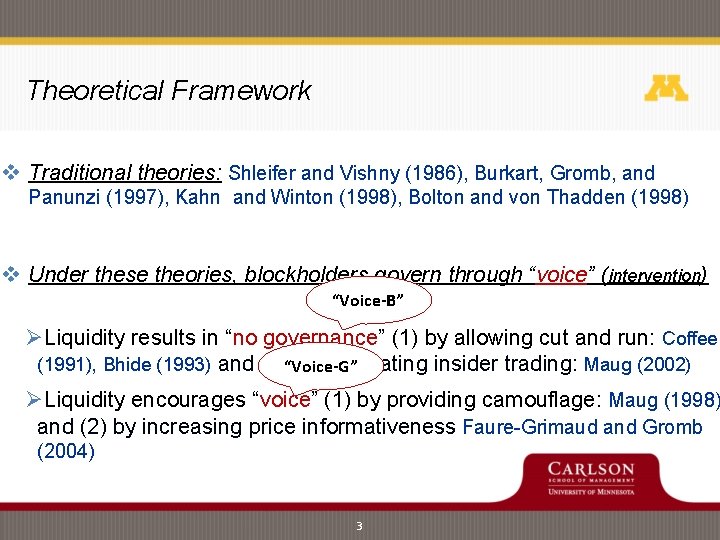
Theoretical Framework v Traditional theories: Shleifer and Vishny (1986), Burkart, Gromb, and Panunzi (1997), Kahn and Winton (1998), Bolton and von Thadden (1998) v Under these theories, blockholders govern through “voice” (intervention) “Voice-B” ØLiquidity results in “no governance” (1) by allowing cut and run: Coffee (1991), Bhide (1993) and (2)“Voice-G” by stimulating insider trading: Maug (2002) ØLiquidity encourages “voice” (1) by providing camouflage: Maug (1998) and (2) by increasing price informativeness Faure-Grimaud and Gromb (2004) 3
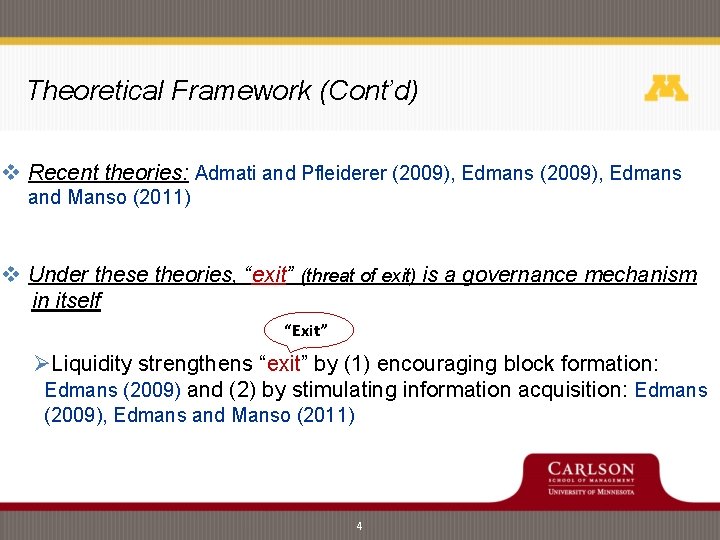
Theoretical Framework (Cont’d) v Recent theories: Admati and Pfleiderer (2009), Edmans and Manso (2011) v Under these theories, “exit” (threat of exit) is a governance mechanism in itself “Exit” ØLiquidity strengthens “exit” by (1) encouraging block formation: Edmans (2009) and (2) by stimulating information acquisition: Edmans (2009), Edmans and Manso (2011) 4
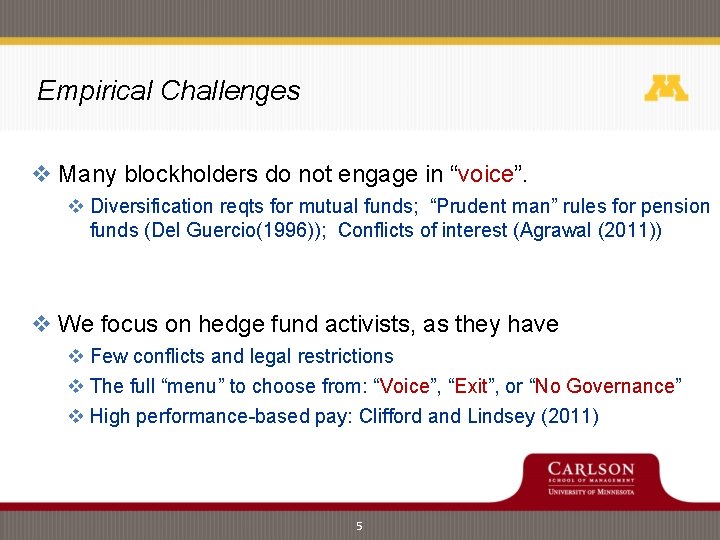
Empirical Challenges v Many blockholders do not engage in “voice”. v Diversification reqts for mutual funds; “Prudent man” rules for pension funds (Del Guercio(1996)); Conflicts of interest (Agrawal (2011)) v We focus on hedge fund activists, as they have v Few conflicts and legal restrictions v The full “menu” to choose from: “Voice”, “Exit”, or “No Governance” v High performance-based pay: Clifford and Lindsey (2011) 5
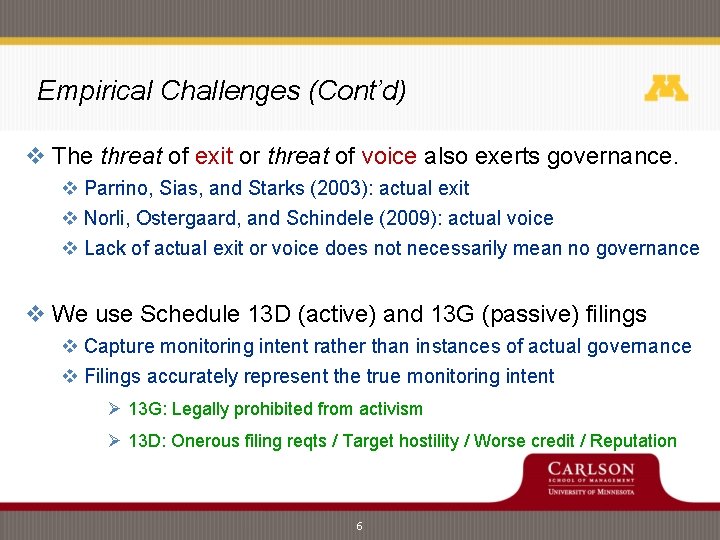
Empirical Challenges (Cont’d) v The threat of exit or threat of voice also exerts governance. v Parrino, Sias, and Starks (2003): actual exit v Norli, Ostergaard, and Schindele (2009): actual voice v Lack of actual exit or voice does not necessarily mean no governance v We use Schedule 13 D (active) and 13 G (passive) filings v Capture monitoring intent rather than instances of actual governance v Filings accurately represent the true monitoring intent Ø 13 G: Legally prohibited from activism Ø 13 D: Onerous filing reqts / Target hostility / Worse credit / Reputation 6
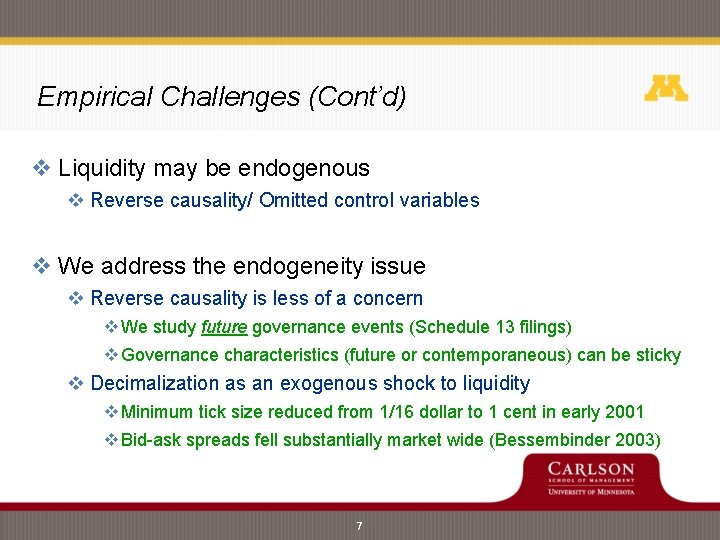
Empirical Challenges (Cont’d) v Liquidity may be endogenous v Reverse causality/ Omitted control variables v We address the endogeneity issue v Reverse causality is less of a concern v We study future governance events (Schedule 13 filings) v Governance characteristics (future or contemporaneous) can be sticky v Decimalization as an exogenous shock to liquidity v Minimum tick size reduced from 1/16 dollar to 1 cent in early 2001 v Bid-ask spreads fell substantially market wide (Bessembinder 2003) 7
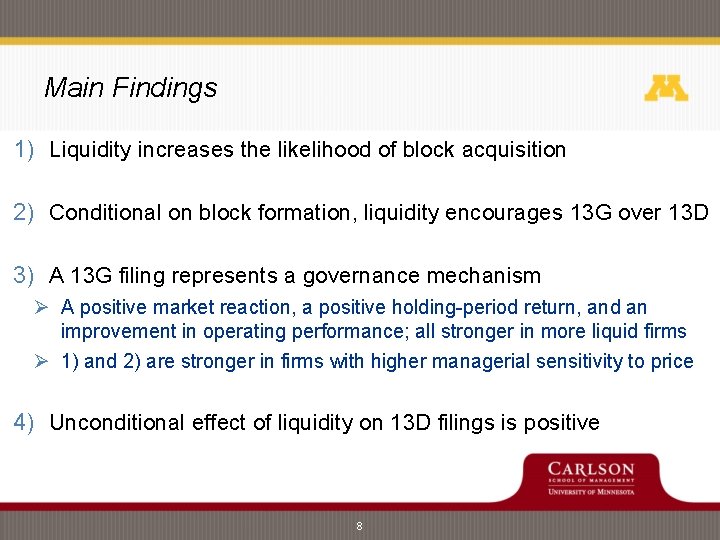
Main Findings 1) Liquidity increases the likelihood of block acquisition 2) Conditional on block formation, liquidity encourages 13 G over 13 D 3) A 13 G filing represents a governance mechanism Ø A positive market reaction, a positive holding-period return, and an improvement in operating performance; all stronger in more liquid firms Ø 1) and 2) are stronger in firms with higher managerial sensitivity to price 4) Unconditional effect of liquidity on 13 D filings is positive 8
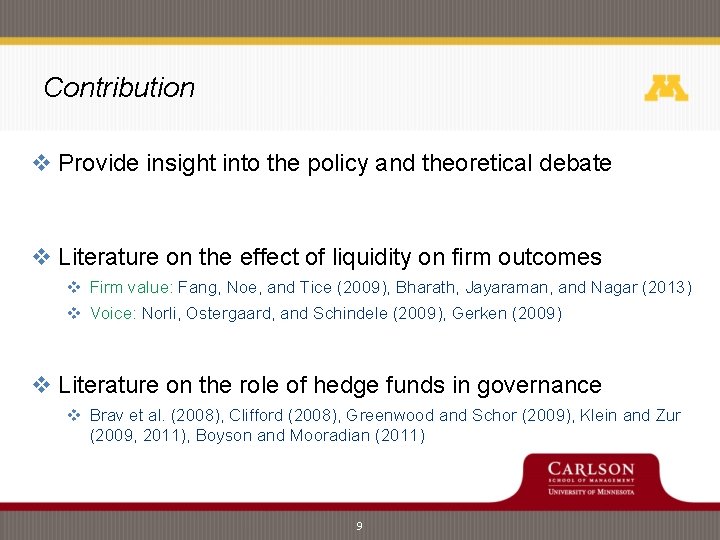
Contribution v Provide insight into the policy and theoretical debate v Literature on the effect of liquidity on firm outcomes v Firm value: Fang, Noe, and Tice (2009), Bharath, Jayaraman, and Nagar (2013) v Voice: Norli, Ostergaard, and Schindele (2009), Gerken (2009) v Literature on the role of hedge funds in governance v Brav et al. (2008), Clifford (2008), Greenwood and Schor (2009), Klein and Zur (2009, 2011), Boyson and Mooradian (2011) 9
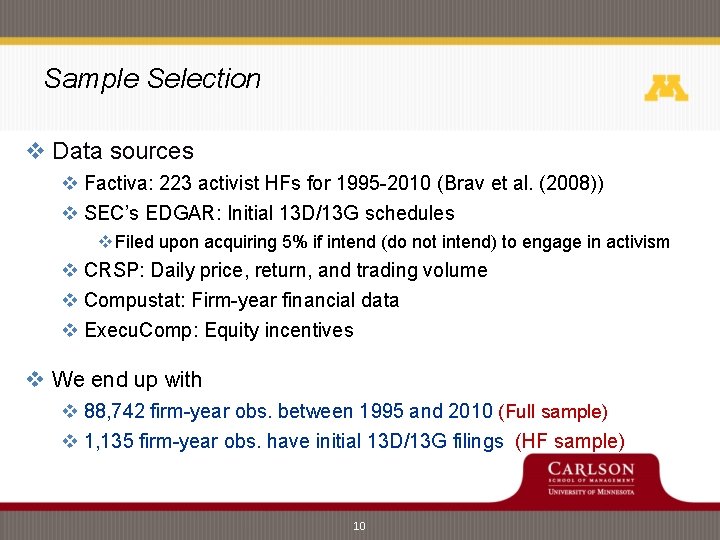
Sample Selection v Data sources v Factiva: 223 activist HFs for 1995 -2010 (Brav et al. (2008)) v SEC’s EDGAR: Initial 13 D/13 G schedules v Filed upon acquiring 5% if intend (do not intend) to engage in activism v CRSP: Daily price, return, and trading volume v Compustat: Firm-year financial data v Execu. Comp: Equity incentives v We end up with v 88, 742 firm-year obs. between 1995 and 2010 (Full sample) v 1, 135 firm-year obs. have initial 13 D/13 G filings (HF sample) 10
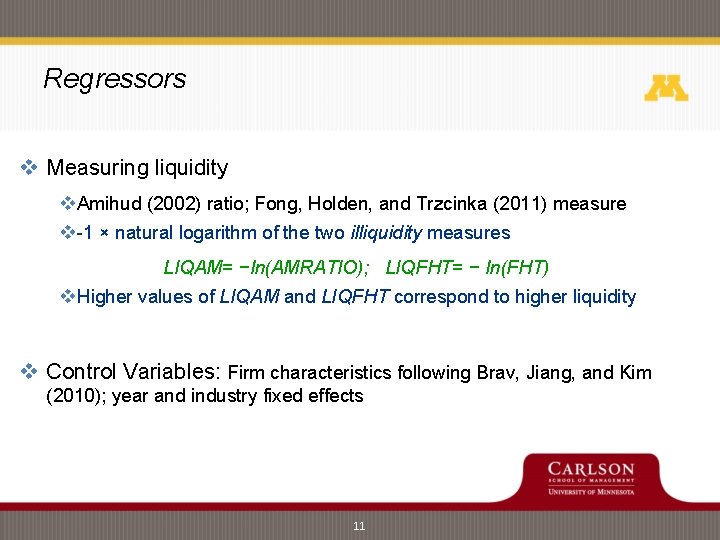
Regressors v Measuring liquidity v Amihud (2002) ratio; Fong, Holden, and Trzcinka (2011) measure v -1 × natural logarithm of the two illiquidity measures LIQAM= −ln(AMRATIO); LIQFHT= − ln(FHT) v Higher values of LIQAM and LIQFHT correspond to higher liquidity v Control Variables: Firm characteristics following Brav, Jiang, and Kim (2010); year and industry fixed effects 11
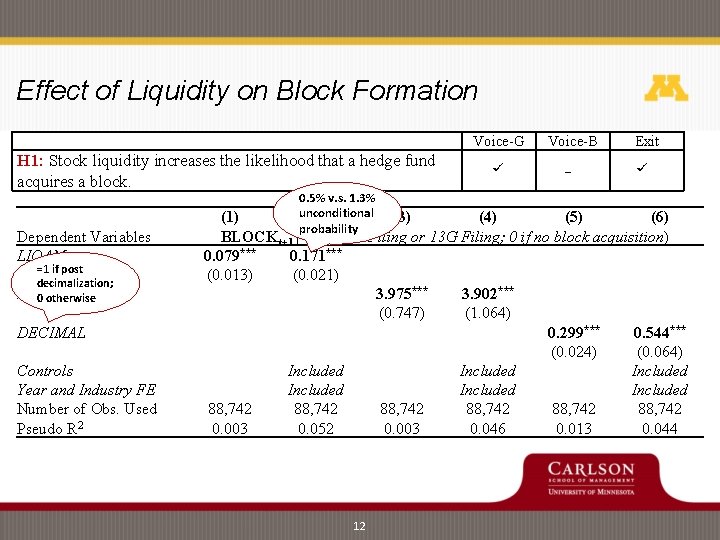
Effect of Liquidity on Block Formation Voice-G H 1: Stock liquidity increases the likelihood that a hedge fund acquires a block. Dependent Variables LIQAMt if post =1 decimalization; LIQFHT 0 otherwise t DECIMAL Controls Year and Industry FE Number of Obs. Used Pseudo R 2 0. 5% v. s. 1. 3% unconditional (2) probability Voice-B Exit – (1) (3) (4) (5) (6) BLOCKt+1 (=1 if 13 D Filing or 13 G Filing; 0 if no block acquisition) 0. 079*** 0. 171*** (0. 013) (0. 021) 3. 975*** 3. 902*** (0. 747) (1. 064) 0. 299*** 0. 544*** (0. 024) (0. 064) Included Included 88, 742 88, 742 0. 003 0. 052 0. 003 0. 046 0. 013 0. 044 12
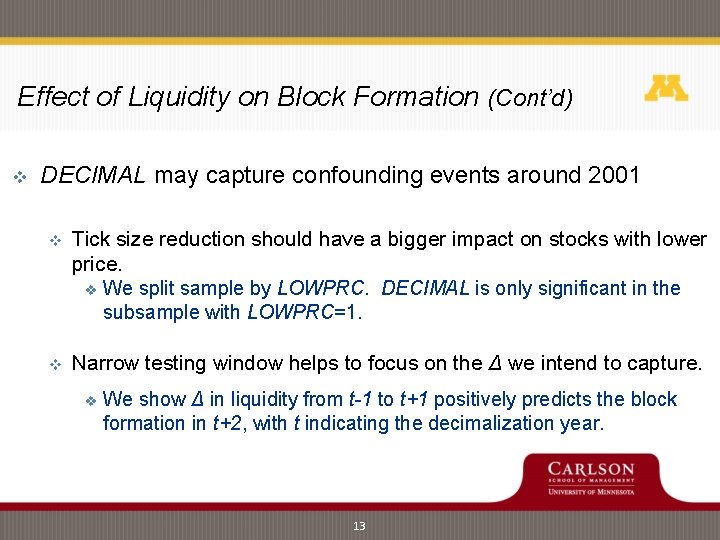
Effect of Liquidity on Block Formation (Cont’d) v DECIMAL may capture confounding events around 2001 v Tick size reduction should have a bigger impact on stocks with lower price. v We split sample by LOWPRC. DECIMAL is only significant in the subsample with LOWPRC=1. v Narrow testing window helps to focus on the Δ we intend to capture. v We show Δ in liquidity from t-1 to t+1 positively predicts the block formation in t+2, with t indicating the decimalization year. 13
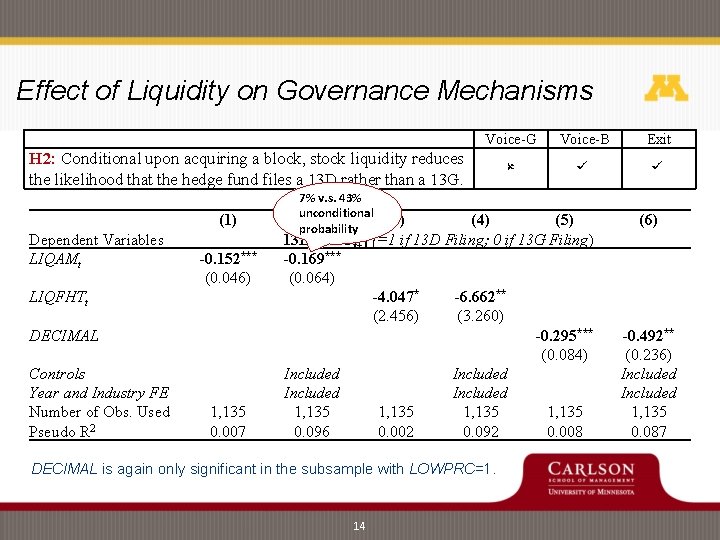
Effect of Liquidity on Governance Mechanisms Voice-G H 2: Conditional upon acquiring a block, stock liquidity reduces the likelihood that the hedge fund files a 13 D rather than a 13 G. Dependent Variables LIQAMt LIQFHTt DECIMAL Controls Year and Industry FE Number of Obs. Used Pseudo R 2 (1) -0. 152*** (0. 046) 1, 135 0. 007 7% v. s. 43% unconditional (2) probability Voice-B (3) (4) (5) 13 Dvs 13 Gt+1 (=1 if 13 D Filing; 0 if 13 G Filing) -0. 169*** (0. 064) -4. 047* -6. 662** (2. 456) (3. 260) -0. 295*** (0. 084) Included 1, 135 0. 096 0. 002 0. 092 0. 008 DECIMAL is again only significant in the subsample with LOWPRC=1. 14 Exit (6) -0. 492** (0. 236) Included 1, 135 0. 087
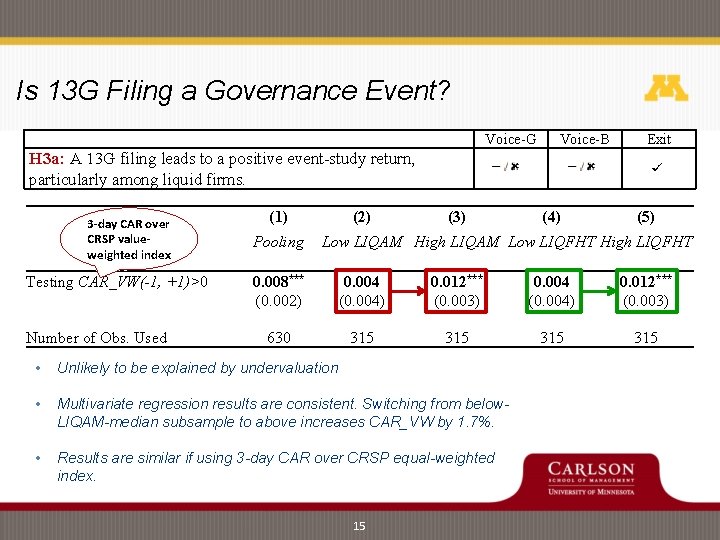
Is 13 G Filing a Governance Event? Voice-G Voice-B Exit H 3 a: A 13 G filing leads to a positive event-study return, particularly among liquid firms. 3 -day CAR over CRSP valueweighted index Testing CAR_VW(-1, +1)>0 Number of Obs. Used (1) Pooling (2) (3) (4) (5) Low LIQAM High LIQAM Low LIQFHT High LIQFHT 0. 008*** (0. 002) 0. 004 (0. 004) 0. 012*** (0. 003) 630 315 315 • Unlikely to be explained by undervaluation • Multivariate regression results are consistent. Switching from below. LIQAM-median subsample to above increases CAR_VW by 1. 7%. • Results are similar if using 3 -day CAR over CRSP equal-weighted index. 15
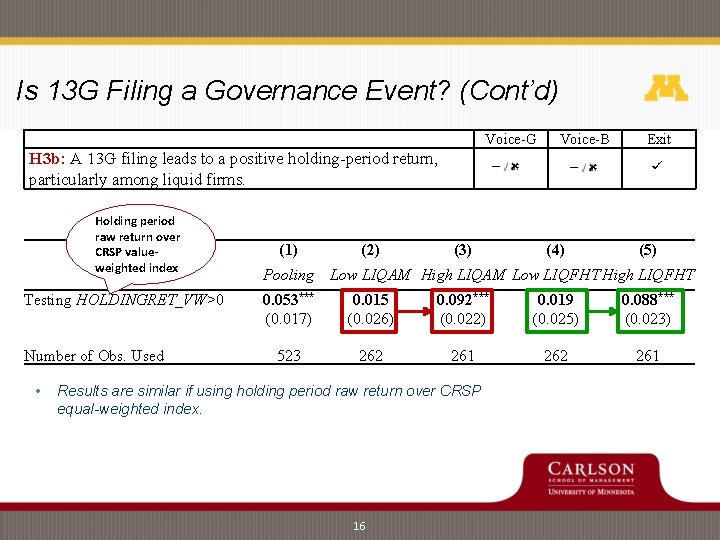
Is 13 G Filing a Governance Event? (Cont’d) Voice-G Voice-B Exit H 3 b: A 13 G filing leads to a positive holding-period return, particularly among liquid firms. Holding period raw return over CRSP valueweighted index Testing HOLDINGRET_VW>0 Number of Obs. Used • (1) Pooling (2) (3) (4) (5) Low LIQAM High LIQAM Low LIQFHT High LIQFHT 0. 053*** (0. 017) 0. 015 (0. 026) 0. 092*** (0. 022) 0. 019 (0. 025) 0. 088*** (0. 023) 523 262 261 Results are similar if using holding period raw return over CRSP equal-weighted index. 16
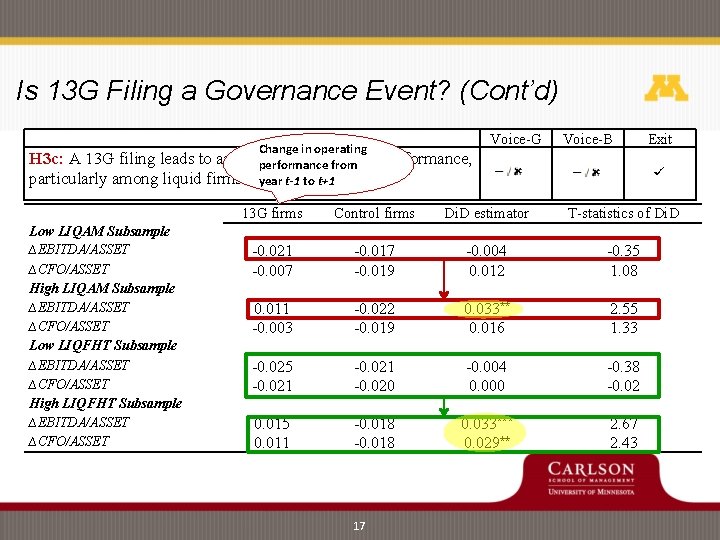
Is 13 G Filing a Governance Event? (Cont’d) Change in operating H 3 c: A 13 G filing leads to an increase in operating performance, performance from particularly among liquid firms. year t-1 to t+1 Low LIQAM Subsample ∆EBITDA/ASSET ∆CFO/ASSET High LIQAM Subsample ∆EBITDA/ASSET ∆CFO/ASSET Low LIQFHT Subsample ∆EBITDA/ASSET ∆CFO/ASSET High LIQFHT Subsample ∆EBITDA/ASSET ∆CFO/ASSET 13 G firms Control firms -0. 021 -0. 007 0. 011 -0. 003 -0. 025 -0. 021 0. 015 0. 011 Voice-G Di. D estimator -0. 017 -0. 019 -0. 022 -0. 019 -0. 021 -0. 020 -0. 018 17 Voice-B T-statistics of Di. D -0. 004 0. 012 0. 033** 0. 016 -0. 004 0. 000 0. 033*** 0. 029** Exit -0. 35 1. 08 2. 55 1. 33 -0. 38 -0. 02 2. 67 2. 43
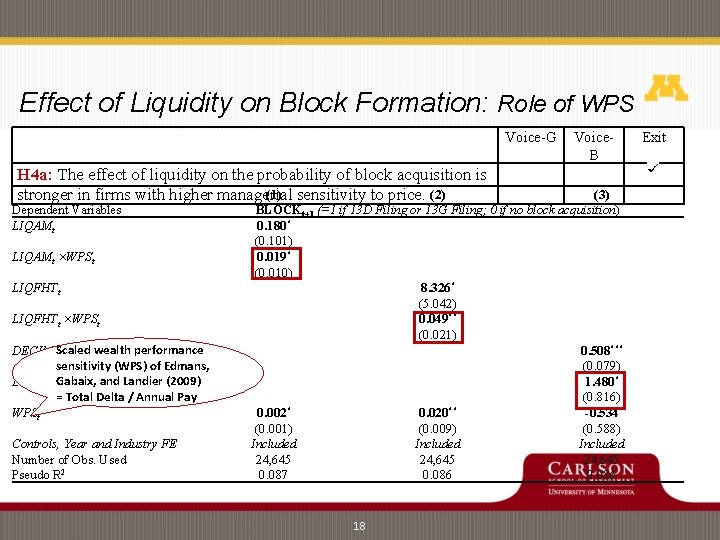
Effect of Liquidity on Block Formation: Role of WPS Voice-G H 4 a: The effect of liquidity on the probability of block acquisition is stronger in firms with higher managerial sensitivity to price. (1) (2) Dependent Variables LIQAMt ×WPSt LIQFHTt ×WPSt Scaled wealth performance DECIMAL sensitivity (WPS) of Edmans, Gabaix, and Landier (2009) DECIMAL×WPS t = Total Delta / Annual Pay WPSt Controls, Year and Industry FE Number of Obs. Used Pseudo R 2 – Voice. B – (3) BLOCKt+1 (=1 if 13 D Filing or 13 G Filing; 0 if no block acquisition) 0. 180* (0. 101) * 0. 019 (0. 010) * 8. 326 (5. 042) ** 0. 049 (0. 021) 0. 508*** (0. 079) 1. 480* (0. 816) * ** 0. 002 0. 020 -0. 534 (0. 001) (0. 009) (0. 588) Included 24, 645 0. 087 0. 086 18 Exit
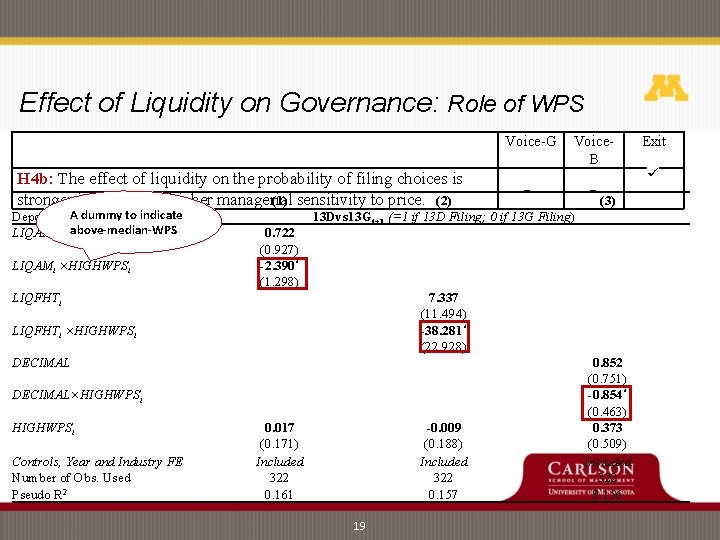
Effect of Liquidity on Governance: Role of WPS Voice-G H 4 b: The effect of liquidity on the probability of filing choices is stronger in firms with higher managerial sensitivity to price. (1) (2) A dummy to indicate Dependent Variables LIQAMt above-median-WPS LIQAMt ×HIGHWPSt LIQFHTt ×HIGHWPSt DECIMAL×HIGHWPSt Controls, Year and Industry FE Number of Obs. Used Pseudo R 2 0. 722 (0. 927) -2. 390* (1. 298) 0. 017 (0. 171) Included 322 0. 161 – Voice. B – 13 Dvs 13 Gt+1 (=1 if 13 D Filing; 0 if 13 G Filing) 7. 337 (11. 494) -38. 281* (22. 928) -0. 009 (0. 188) Included 322 0. 157 19 (3) 0. 852 (0. 751) -0. 854* (0. 463) 0. 373 (0. 509) Included 322 0. 156 Exit
Effect of Liquidity on HF Activism Liquidity increases the likelihood that a HF acquires a block (H 1); Conditional on BA, liquidity increases the likelihood of 13 G over 13 D (H 2). Which effect dominates? Voice-G H 5: Stock liquidity increases the unconditional likelihood that a 0. 14% v. s. 0. 6% hedge fund files Schedule 13 D. Dependent Variables LIQAMt LIQFHTt DECIMAL Controls Year and Industry FE Number of Obs. Used Pseudo R 2 Voice-B Exit – unconditional (1) (2) (3) probability 13 DFILINGt+1 (=1 if 13 D Filing; 0 if 13 G Filing or no block acquisition) 0. 103*** (0. 026) *** 3. 851 (1. 435) 0. 309*** (0. 088) Included Included 88, 742 0. 040 0. 038 0. 036 20
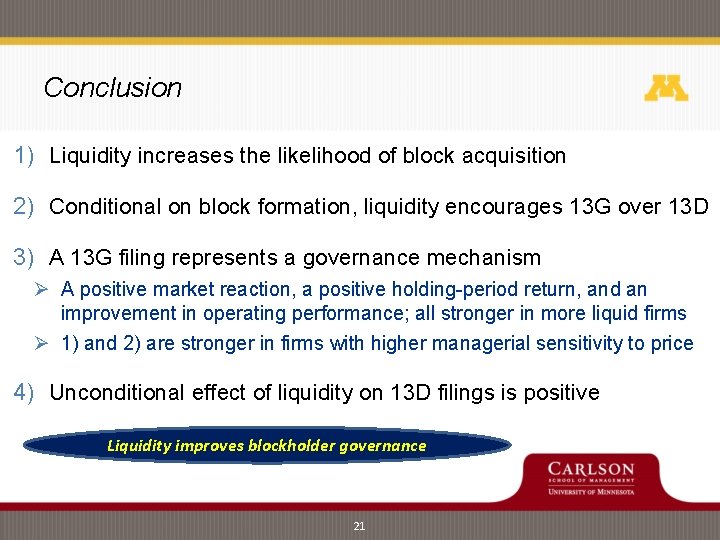
Conclusion 1) Liquidity increases the likelihood of block acquisition 2) Conditional on block formation, liquidity encourages 13 G over 13 D 3) A 13 G filing represents a governance mechanism Ø A positive market reaction, a positive holding-period return, and an improvement in operating performance; all stronger in more liquid firms Ø 1) and 2) are stronger in firms with higher managerial sensitivity to price 4) Unconditional effect of liquidity on 13 D filings is positive Liquidity improves blockholder governance 21