
The Effect of Leaflet Closing Angle on the
- Slides: 1
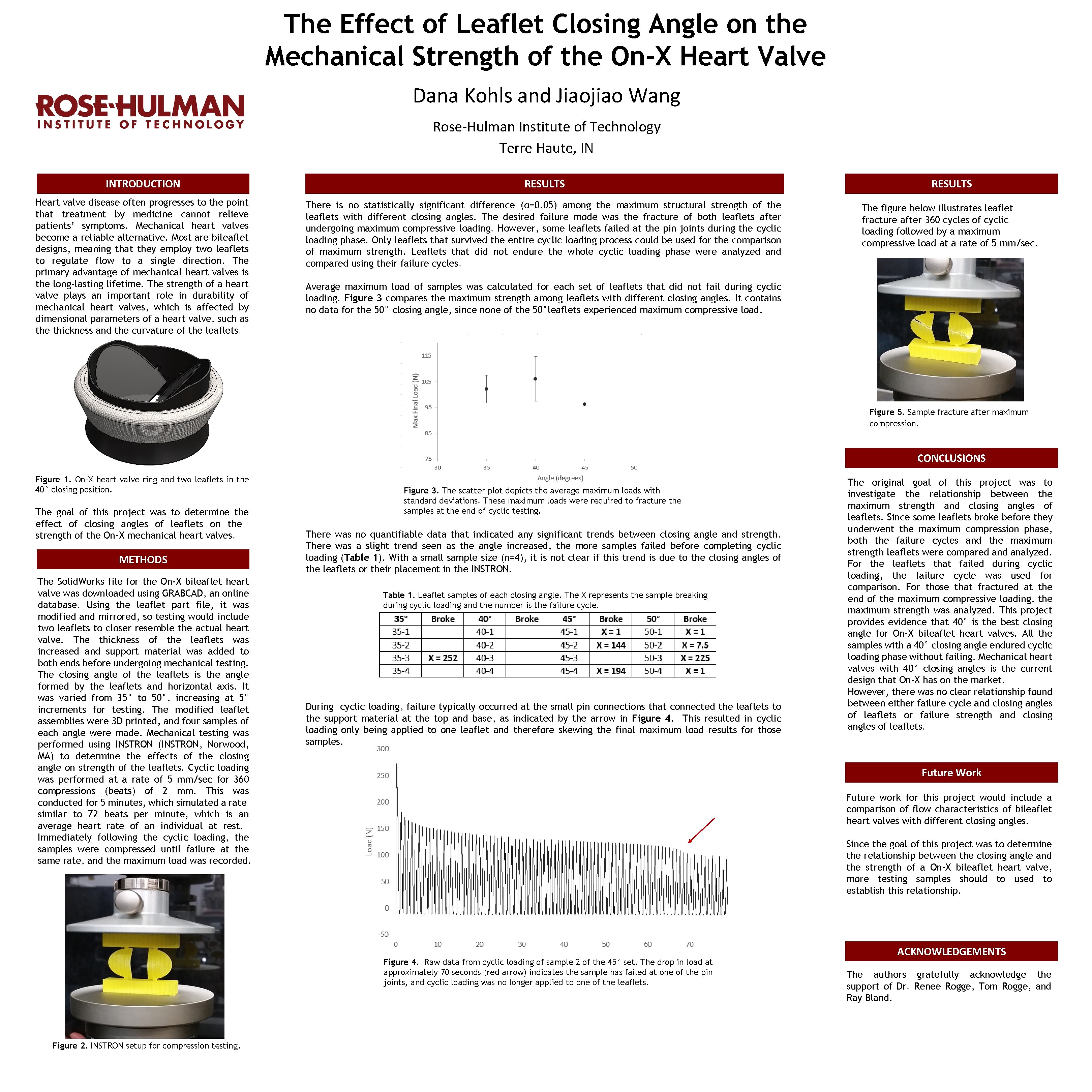
The Effect of Leaflet Closing Angle on the Mechanical Strength of the On-X Heart Valve Dana Kohls and Jiaojiao Wang Rose-Hulman Institute of Technology Terre Haute, IN INTRODUCTION RESULTS Heart valve disease often progresses to the point that treatment by medicine cannot relieve patients’ symptoms. Mechanical heart valves become a reliable alternative. Most are bileaflet designs, meaning that they employ two leaflets to regulate flow to a single direction. The primary advantage of mechanical heart valves is the long-lasting lifetime. The strength of a heart valve plays an important role in durability of mechanical heart valves, which is affected by dimensional parameters of a heart valve, such as the thickness and the curvature of the leaflets. There is no statistically significant difference (α=0. 05) among the maximum structural strength of the leaflets with different closing angles. The desired failure mode was the fracture of both leaflets after undergoing maximum compressive loading. However, some leaflets failed at the pin joints during the cyclic loading phase. Only leaflets that survived the entire cyclic loading process could be used for the comparison of maximum strength. Leaflets that did not endure the whole cyclic loading phase were analyzed and compared using their failure cycles. The figure below illustrates leaflet fracture after 360 cycles of cyclic loading followed by a maximum compressive load at a rate of 5 mm/sec. Average maximum load of samples was calculated for each set of leaflets that did not fail during cyclic loading. Figure 3 compares the maximum strength among leaflets with different closing angles. It contains no data for the 50° closing angle, since none of the 50°leaflets experienced maximum compressive load. Figure 5. Sample fracture after maximum compression. CONCLUSIONS Figure 1. On-X heart valve ring and two leaflets in the 40° closing position. The goal of this project was to determine the effect of closing angles of leaflets on the strength of the On-X mechanical heart valves. METHODS The Solid. Works file for the On-X bileaflet heart valve was downloaded using GRABCAD, an online database. Using the leaflet part file, it was modified and mirrored, so testing would include two leaflets to closer resemble the actual heart valve. The thickness of the leaflets was increased and support material was added to both ends before undergoing mechanical testing. The closing angle of the leaflets is the angle formed by the leaflets and horizontal axis. It was varied from 35° to 50°, increasing at 5° increments for testing. The modified leaflet assemblies were 3 D printed, and four samples of each angle were made. Mechanical testing was performed using INSTRON (INSTRON, Norwood, MA) to determine the effects of the closing angle on strength of the leaflets. Cyclic loading was performed at a rate of 5 mm/sec for 360 compressions (beats) of 2 mm. This was conducted for 5 minutes, which simulated a rate similar to 72 beats per minute, which is an average heart rate of an individual at rest. Immediately following the cyclic loading, the samples were compressed until failure at the same rate, and the maximum load was recorded. Figure 3. The scatter plot depicts the average maximum loads with standard deviations. These maximum loads were required to fracture the samples at the end of cyclic testing. There was no quantifiable data that indicated any significant trends between closing angle and strength. There was a slight trend seen as the angle increased, the more samples failed before completing cyclic loading (Table 1). With a small sample size (n=4), it is not clear if this trend is due to the closing angles of the leaflets or their placement in the INSTRON. Table 1. Leaflet samples of each closing angle. The X represents the sample breaking during cyclic loading and the number is the failure cycle. During cyclic loading, failure typically occurred at the small pin connections that connected the leaflets to the support material at the top and base, as indicated by the arrow in Figure 4. This resulted in cyclic loading only being applied to one leaflet and therefore skewing the final maximum load results for those samples. Future Work Future work for this project would include a comparison of flow characteristics of bileaflet heart valves with different closing angles. Since the goal of this project was to determine the relationship between the closing angle and the strength of a On-X bileaflet heart valve, more testing samples should to used to establish this relationship. Figure 4. Raw data from cyclic loading of sample 2 of the 45° set. The drop in load at approximately 70 seconds (red arrow) indicates the sample has failed at one of the pin joints, and cyclic loading was no longer applied to one of the leaflets. Figure 2. INSTRON setup for compression testing. The original goal of this project was to investigate the relationship between the maximum strength and closing angles of leaflets. Since some leaflets broke before they underwent the maximum compression phase, both the failure cycles and the maximum strength leaflets were compared analyzed. For the leaflets that failed during cyclic loading, the failure cycle was used for comparison. For those that fractured at the end of the maximum compressive loading, the maximum strength was analyzed. This project provides evidence that 40° is the best closing angle for On-X bileaflet heart valves. All the samples with a 40° closing angle endured cyclic loading phase without failing. Mechanical heart valves with 40° closing angles is the current design that On-X has on the market. However, there was no clear relationship found between either failure cycle and closing angles of leaflets or failure strength and closing angles of leaflets. ACKNOWLEDGEMENTS The authors gratefully acknowledge the support of Dr. Renee Rogge, Tom Rogge, and Ray Bland.