
The effect of future ambient air pollution on
The effect of future ambient air pollution on global premature mortality and the impact of climate change to 2100 Raquel A. Silva, J. Jason West, Jean-François Lamarque, Drew T. Shindell, and the ACCMIP modelers 14 th Annual CMAS Conference 10/07/15
Motivation Since the industrial revolution, anthropogenic ambient air pollution has increased significantly. Exposure to ozone and PM 2. 5 has been associated with cardiopulmonary morbidity (e. g. asthma exacerbation) and mortality (e. g. death from cardiovascular and respiratory diseases as well as lung cancer). Changes in ambient concentrations have been mainly driven by changes in emissions, but they are also affected by climate change. Introduction Methods Results Conclusions Q&A 2
Air quality and climate change Changes in: - Photochemical reaction rates - Biogenic emissions - Deposition -Jacob Atmospheric and Winnercirculation 2009; Air Quality Weaver et al 2009; Fiore et al 2012 Ozone: � Likely increase in polluted regions during the warm season, particularly in urban areas and during pollution episodes � Likely decrease in remote regions (background ozone) PM 2. 5: � Effects are uncertain and vary regionally (different changes in precipitation, wildfires and biogenic emissions, different PM 2. 5 composition, etc. ) Introduction Methods Results Conclusions Q&A 3
Objective Use modeled ozone and PM 2. 5 concentrations from the ACCMIP ensemble to quantify the global ozone- and PM 2. 5 -related mortality impacts of: � Future concentrations considering the effects of both emissions and climate change - four RCP scenarios; � Future climate change by using pairs of simulations – one simulation ensemble with present emissions and climate and one with present emissions but future climate (RCP 8. 5 climate). Introduction Methods Results Conclusions Q&A 4
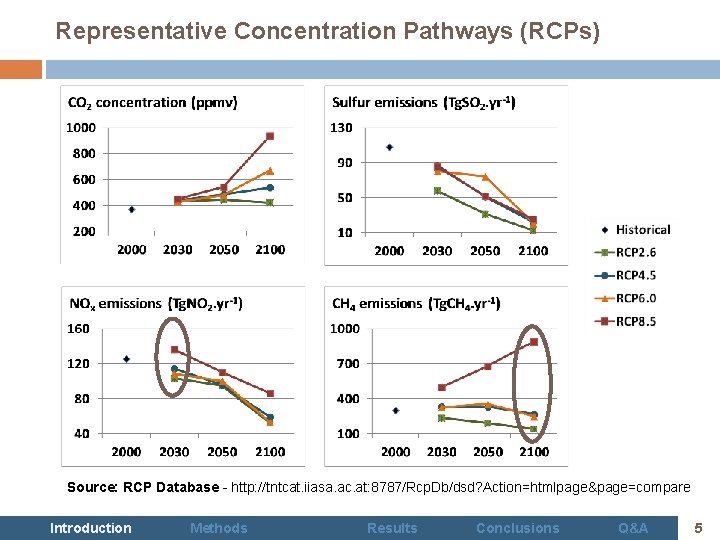
Representative Concentration Pathways (RCPs) Source: RCP Database - http: //tntcat. iiasa. ac. at: 8787/Rcp. Db/dsd? Action=htmlpage&page=compare Introduction Methods Results Conclusions Q&A 5
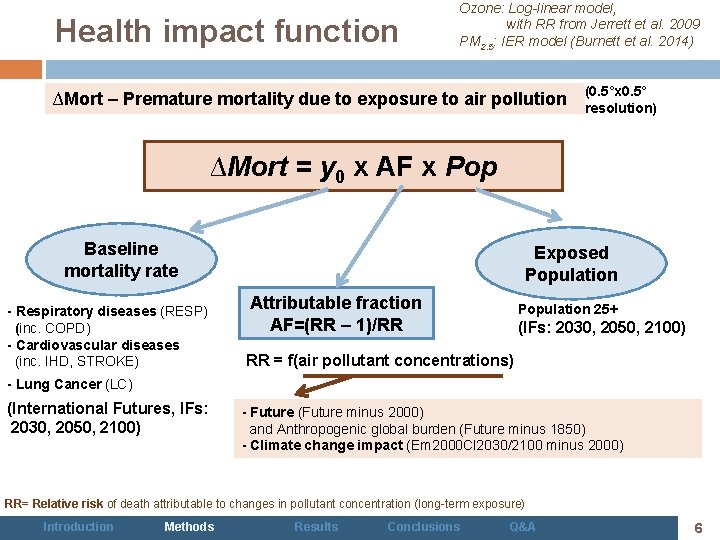
Health impact function Ozone: Log-linear model, with RR from Jerrett et al. 2009 PM 2. 5: IER model (Burnett et al. 2014) ∆Mort – Premature mortality due to exposure to air pollution (0. 5°x 0. 5° resolution) ∆Mort = y 0 x AF x Pop Baseline mortality rate - Respiratory diseases (RESP) (inc. COPD) - Cardiovascular diseases (inc. IHD, STROKE) Exposed Population Attributable fraction AF=(RR – 1)/RR Population 25+ (IFs: 2030, 2050, 2100) RR = f(air pollutant concentrations) - Lung Cancer (LC) (International Futures, IFs: 2030, 2050, 2100) - Future (Future minus 2000) and Anthropogenic global burden (Future minus 1850) - Climate change impact (Em 2000 Cl 2030/2100 minus 2000) RR= Relative risk of death attributable to changes in pollutant concentration (long-term exposure) Introduction Methods Results Conclusions Q&A 6
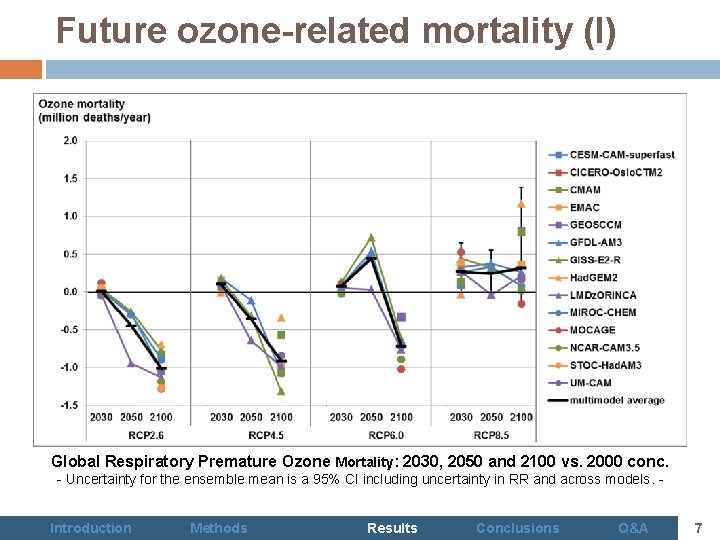
Future ozone-related mortality (I) Global Respiratory Premature Ozone Mortality: 2030, 2050 and 2100 vs. 2000 conc. - Uncertainty for the ensemble mean is a 95% CI including uncertainty in RR and across models. Introduction Methods Results Conclusions Q&A 7
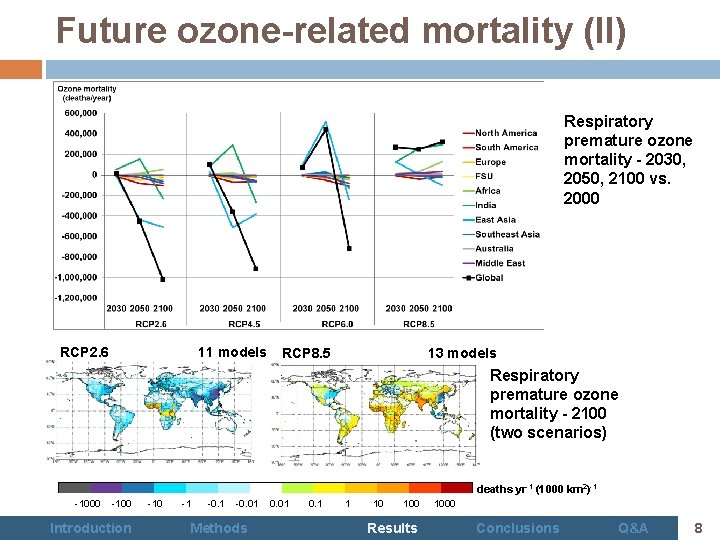
Future ozone-related mortality (II) Respiratory premature ozone mortality - 2030, 2050, 2100 vs. 2000 RCP 2. 6 11 models RCP 8. 5 13 models Respiratory premature ozone mortality - 2100 (two scenarios) deaths yr-1 (1000 km 2)-1 -1000 -100 Introduction -10 -1 -0. 01 Methods 0. 01 0. 1 1 10 100 Results 1000 Conclusions Q&A 8
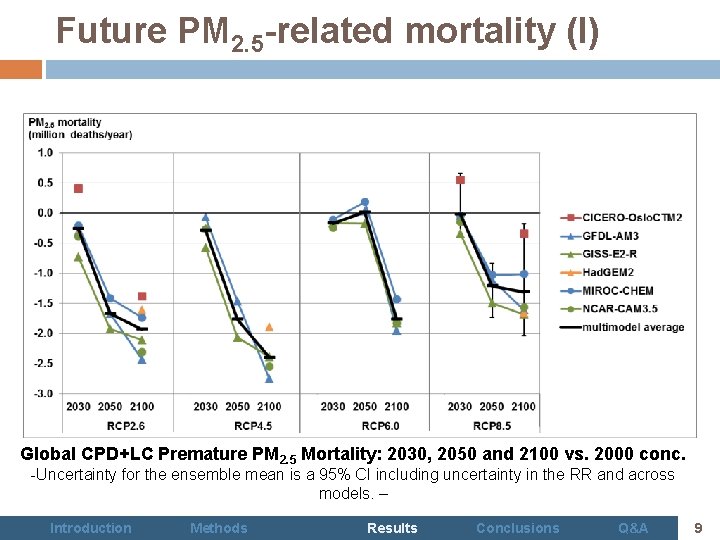
Future PM 2. 5 -related mortality (I) Global CPD+LC Premature PM 2. 5 Mortality: 2030, 2050 and 2100 vs. 2000 conc. -Uncertainty for the ensemble mean is a 95% CI including uncertainty in the RR and across models. – Introduction Methods Results Conclusions Q&A 9
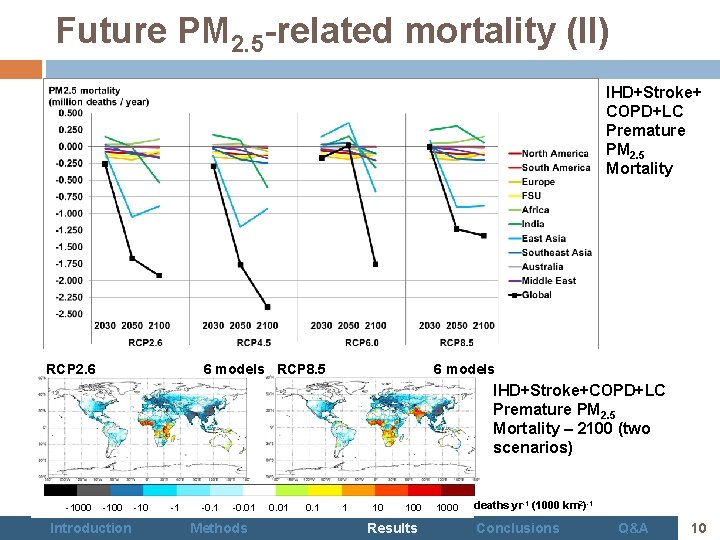
Future PM 2. 5 -related mortality (II) IHD+Stroke+ COPD+LC Premature PM 2. 5 Mortality RCP 2. 6 6 models RCP 8. 5 6 models IHD+Stroke+COPD+LC Premature PM 2. 5 Mortality – 2100 (two scenarios) -1000 -100 Introduction -10 -1 -0. 01 Methods 0. 01 0. 1 1 10 100 Results 1000 deaths yr-1 (1000 km 2)-1 Conclusions Q&A 10
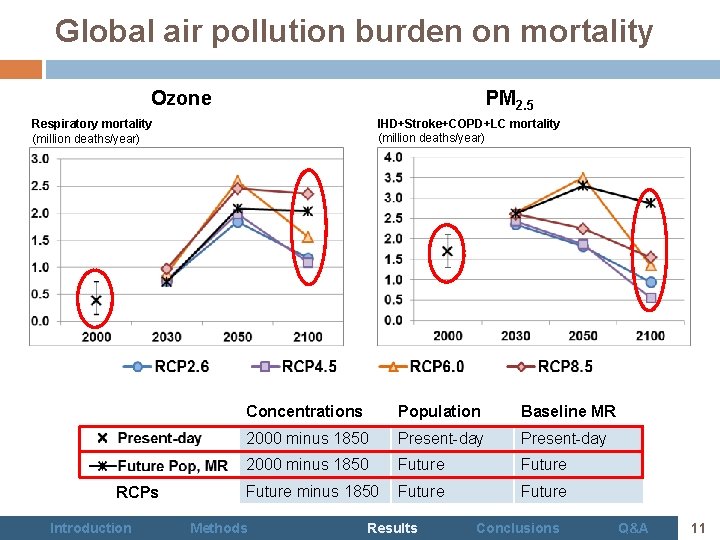
Global air pollution burden on mortality Ozone PM 2. 5 IHD+Stroke+COPD+LC mortality (million deaths/year) Respiratory mortality (million deaths/year) RCPs Introduction Concentrations Population Baseline MR 2000 minus 1850 Present-day 2000 minus 1850 Future minus 1850 Future Methods Results Conclusions Q&A 11
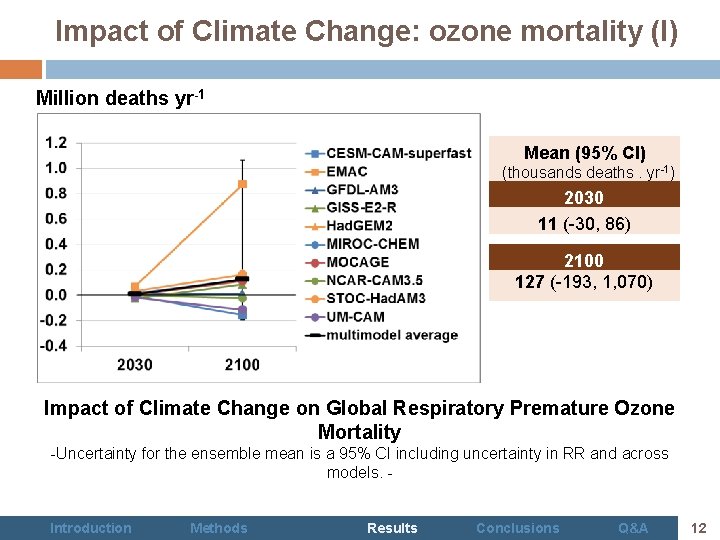
Impact of Climate Change: ozone mortality (I) Million deaths yr-1 Mean (95% CI) (thousands deaths. yr-1) 2030 11 (-30, 86) 2100 127 (-193, 1, 070) Impact of Climate Change on Global Respiratory Premature Ozone Mortality -Uncertainty for the ensemble mean is a 95% CI including uncertainty in RR and across models. Introduction Methods Results Conclusions Q&A 12
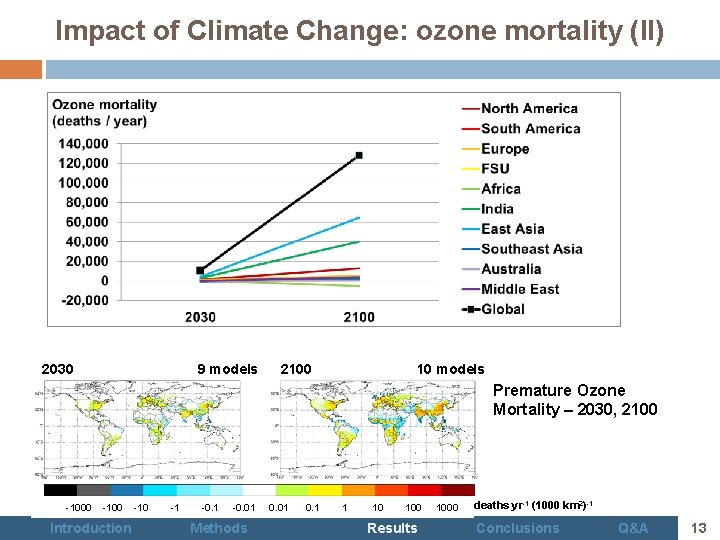
Impact of Climate Change: ozone mortality (II) 2030 9 models 2100 10 models Premature Ozone Mortality – 2030, 2100 -100 Introduction -10 -1 -0. 01 Methods 0. 01 0. 1 1 10 100 Results 1000 deaths yr-1 (1000 km 2)-1 Conclusions Q&A 13
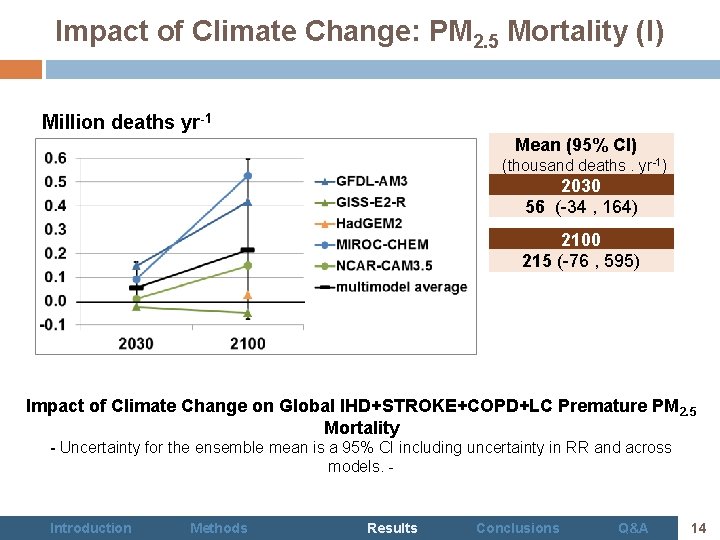
Impact of Climate Change: PM 2. 5 Mortality (I) Million deaths yr-1 Mean (95% CI) (thousand deaths. yr-1) 2030 56 (-34 , 164) 2100 215 (-76 , 595) Impact of Climate Change on Global IHD+STROKE+COPD+LC Premature PM 2. 5 Mortality - Uncertainty for the ensemble mean is a 95% CI including uncertainty in RR and across models. - Introduction Methods Results Conclusions Q&A 14
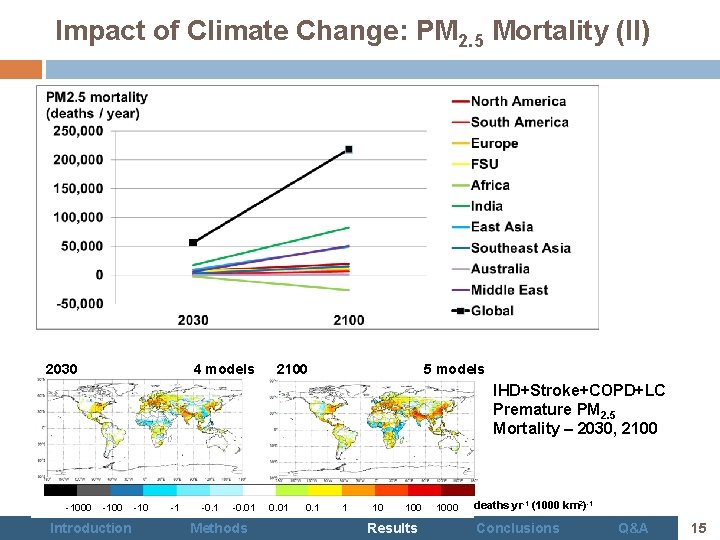
Impact of Climate Change: PM 2. 5 Mortality (II) 2030 4 models 2100 5 models IHD+Stroke+COPD+LC Premature PM 2. 5 Mortality – 2030, 2100 -100 Introduction -10 -1 -0. 01 Methods 0. 01 0. 1 1 10 100 Results 1000 deaths yr-1 (1000 km 2)-1 Conclusions Q&A 15
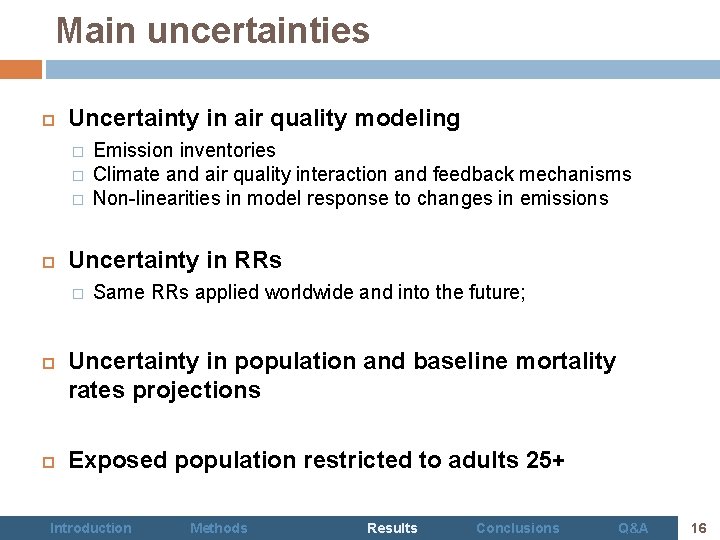
Main uncertainties Uncertainty in air quality modeling � � � Uncertainty in RRs � Emission inventories Climate and air quality interaction and feedback mechanisms Non-linearities in model response to changes in emissions Same RRs applied worldwide and into the future; Uncertainty in population and baseline mortality rates projections Exposed population restricted to adults 25+ Introduction Methods Results Conclusions Q&A 16
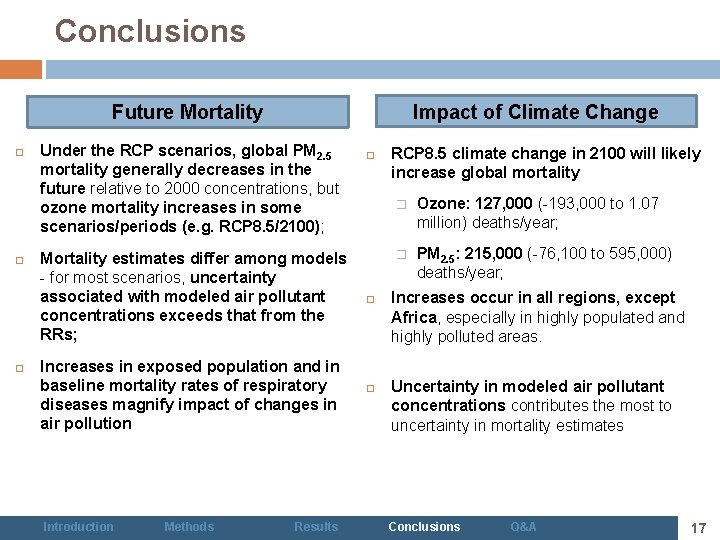
Conclusions Impact of Climate Change Future Mortality Under the RCP scenarios, global PM 2. 5 mortality generally decreases in the future relative to 2000 concentrations, but ozone mortality increases in some scenarios/periods (e. g. RCP 8. 5/2100); Mortality estimates differ among models - for most scenarios, uncertainty associated with modeled air pollutant concentrations exceeds that from the RRs; Increases in exposed population and in baseline mortality rates of respiratory diseases magnify impact of changes in air pollution Introduction Methods Results RCP 8. 5 climate change in 2100 will likely increase global mortality � Ozone: 127, 000 (-193, 000 to 1. 07 million) deaths/year; � PM 2. 5: 215, 000 (-76, 100 to 595, 000) deaths/year; Increases occur in all regions, except Africa, especially in highly populated and highly polluted areas. Uncertainty in modeled air pollutant concentrations contributes the most to uncertainty in mortality estimates Conclusions Q&A 17
The effect of future ambient air pollution on global premature mortality and the impact of climate change to 2100 The research described in this presentation has been funded by a fellowship from the Portuguese Foundation for Science and Technology, a Dissertation Completion Fellowship from The Graduate School (UNC – Chapel Hill), and NIEHS grant #1 R 21 ES 022600 -01. THANK YOU Raquel A. Silva rasilva@live. unc. edu CMAS Conference 10/07/2015
Supplemental Material
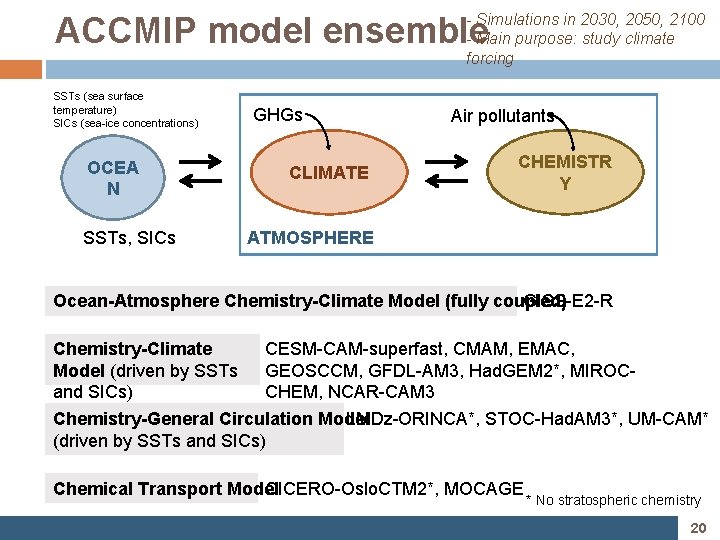
- Simulations in 2030, 2050, 2100 - Main purpose: study climate forcing ACCMIP model ensemble SSTs (sea surface temperature) SICs (sea-ice concentrations) OCEA N SSTs, SICs GHGs CLIMATE Air pollutants CHEMISTR Y ATMOSPHERE Ocean-Atmosphere Chemistry-Climate Model (fully coupled) GISS-E 2 -R Chemistry-Climate CESM-CAM-superfast, CMAM, EMAC, Model (driven by SSTs GEOSCCM, GFDL-AM 3, Had. GEM 2*, MIROCand SICs) CHEM, NCAR-CAM 3 Chemistry-General Circulation Model LMDz-ORINCA*, STOC-Had. AM 3*, UM-CAM* (driven by SSTs and SICs) Chemical Transport Model CICERO-Oslo. CTM 2*, MOCAGE * No stratospheric chemistry 20
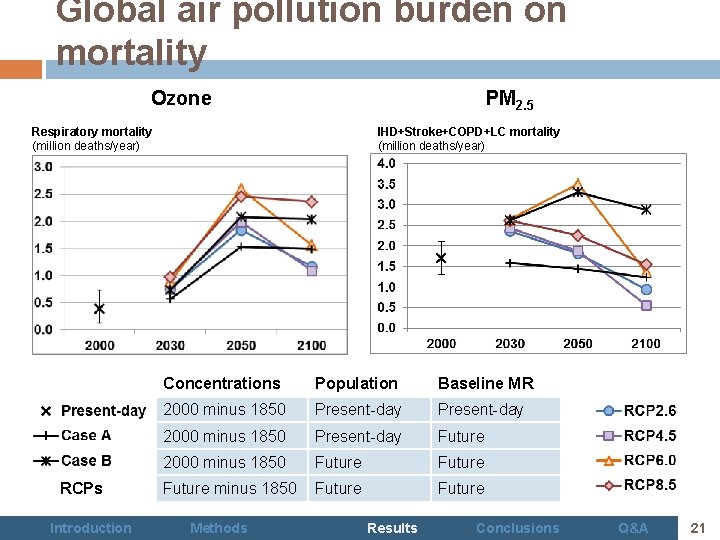
Global air pollution burden on mortality Ozone PM 2. 5 IHD+Stroke+COPD+LC mortality (million deaths/year) Respiratory mortality (million deaths/year) RCPs Introduction Concentrations Population Baseline MR 2000 minus 1850 Present-day Future 2000 minus 1850 Future minus 1850 Future Methods Results Conclusions Q&A 21
Uncertainty in air quality modeling � Emission inventories � Climate and air quality interaction and feedback mechanisms Climate sensitivity to biogenic emissions (e. g. isoprene, soil NOx and methane) Stratosphere-troposphere interactions (e. g. stratospheric influx of ozone) Aerosol-cloud interactions Impact of climate change on wildfires, etc. � Non-linearities in model response to changes in emissions Introduction Methods Results Conclusions Q&A 22
- Slides: 22