
The Effect of DNA Percentage on the Frequency
- Slides: 1
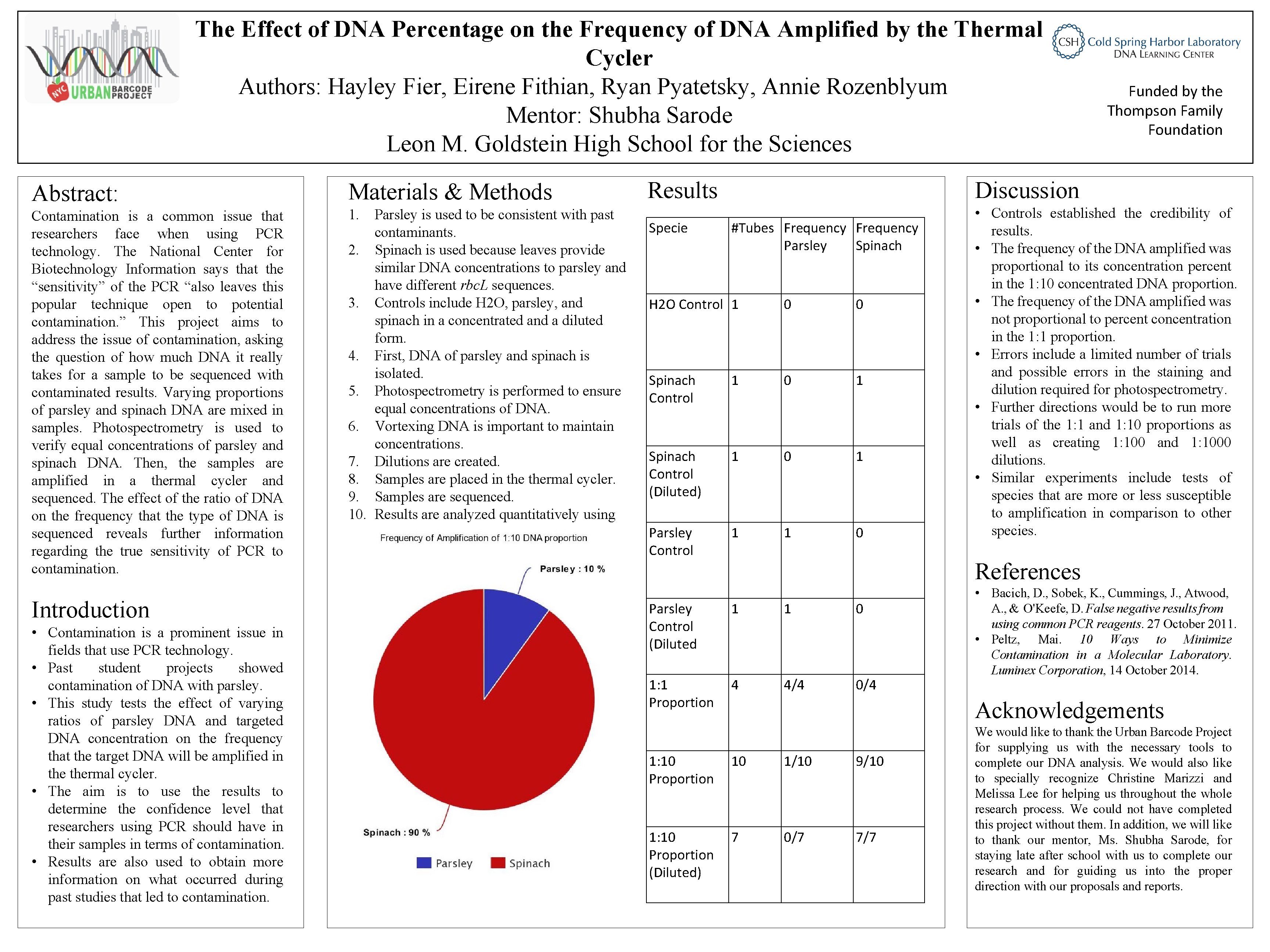
The Effect of DNA Percentage on the Frequency of DNA Amplified by the Thermal Cycler Authors: Hayley Fier, Eirene Fithian, Ryan Pyatetsky, Annie Rozenblyum Mentor: Shubha Sarode Leon M. Goldstein High School for the Sciences Abstract: Contamination is a common issue that researchers face when using PCR technology. The National Center for Biotechnology Information says that the “sensitivity” of the PCR “also leaves this popular technique open to potential contamination. ” This project aims to address the issue of contamination, asking the question of how much DNA it really takes for a sample to be sequenced with contaminated results. Varying proportions of parsley and spinach DNA are mixed in samples. Photospectrometry is used to verify equal concentrations of parsley and spinach DNA. Then, the samples are amplified in a thermal cycler and sequenced. The effect of the ratio of DNA on the frequency that the type of DNA is sequenced reveals further information regarding the true sensitivity of PCR to contamination. Introduction • Contamination is a prominent issue in fields that use PCR technology. • Past student projects showed contamination of DNA with parsley. • This study tests the effect of varying ratios of parsley DNA and targeted DNA concentration on the frequency that the target DNA will be amplified in thermal cycler. • The aim is to use the results to determine the confidence level that researchers using PCR should have in their samples in terms of contamination. • Results are also used to obtain more information on what occurred during past studies that led to contamination. Materials & Methods 1. Parsley is used to be consistent with past contaminants. 2. Spinach is used because leaves provide similar DNA concentrations to parsley and have different rbc. L sequences. 3. Controls include H 2 O, parsley, and spinach in a concentrated and a diluted form. 4. First, DNA of parsley and spinach is isolated. 5. Photospectrometry is performed to ensure equal concentrations of DNA. 6. Vortexing DNA is important to maintain concentrations. 7. Dilutions are created. 8. Samples are placed in thermal cycler. 9. Samples are sequenced. 10. Results are analyzed quantitatively using BLAST. Discussion Results Specie Funded by the Thompson Family Foundation #Tubes Frequency Parsley Spinach H 2 O Control 1 0 0 Spinach Control 1 0 1 Spinach Control (Diluted) 1 0 1 Parsley Control 1 1 0 • Controls established the credibility of results. • The frequency of the DNA amplified was proportional to its concentration percent in the 1: 10 concentrated DNA proportion. • The frequency of the DNA amplified was not proportional to percent concentration in the 1: 1 proportion. • Errors include a limited number of trials and possible errors in the staining and dilution required for photospectrometry. • Further directions would be to run more trials of the 1: 1 and 1: 10 proportions as well as creating 1: 100 and 1: 1000 dilutions. • Similar experiments include tests of species that are more or less susceptible to amplification in comparison to other species. References Parsley Control (Diluted 1 1 0 1: 1 Proportion 4 4/4 0/4 • Bacich, D. , Sobek, K. , Cummings, J. , Atwood, A. , & O'Keefe, D. False negative results from using common PCR reagents. 27 October 2011. • Peltz, Mai. 10 Ways to Minimize Contamination in a Molecular Laboratory. Luminex Corporation, 14 October 2014. Acknowledgements 1: 10 Proportion 10 1/10 9/10 1: 10 Proportion (Diluted) 7 0/7 7/7 We would like to thank the Urban Barcode Project for supplying us with the necessary tools to complete our DNA analysis. We would also like to specially recognize Christine Marizzi and Melissa Lee for helping us throughout the whole research process. We could not have completed this project without them. In addition, we will like to thank our mentor, Ms. Shubha Sarode, for staying late after school with us to complete our research and for guiding us into the proper direction with our proposals and reports.