
The effect of different materials on the propagation
- Slides: 29
The effect of different materials on the propagation of guided waves in multi-wire cables R. Mijarez 1 1 Gerencia de Control e Instrumentación, Instituto de Investigaciones Eléctricas, CP 62490 Cuernavaca, Morelos, México. G. Trane 1 , A. Baltazar 2 2 Centro de Investigación y Estudios Avanzados del IPN, Unidad, Saltillo, Coahuila, Mexico 1 SIX SIGMA
Outline §Introduction §Objective §Work in progress §Conclusions 2 SIX SIGMA
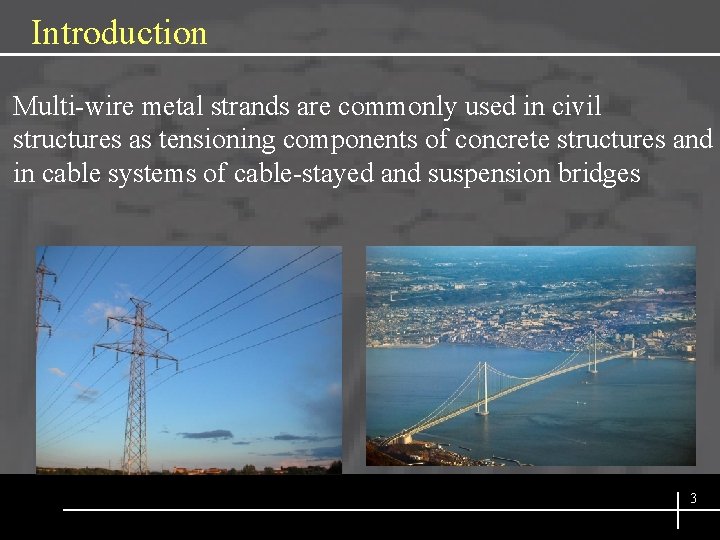
Introduction Multi-wire metal strands are commonly used in civil structures as tensioning components of concrete structures and in cable systems of cable-stayed and suspension bridges 3 SIX SIGMA
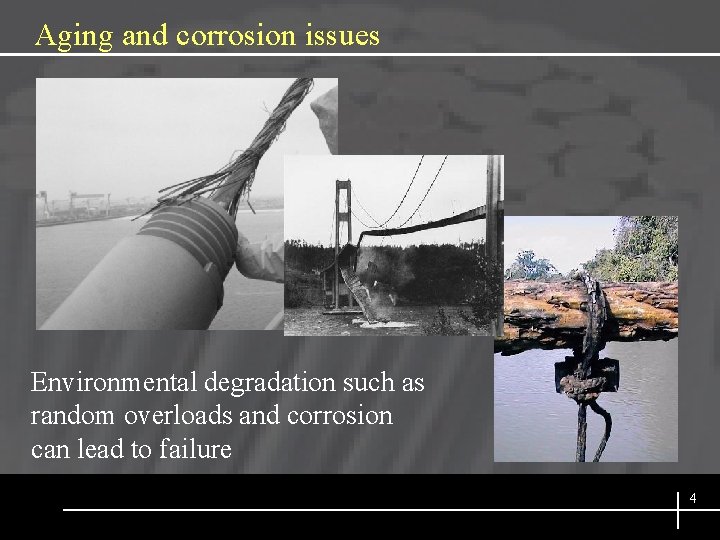
Aging and corrosion issues Environmental degradation such as random overloads and corrosion can lead to failure 4 SIX SIGMA
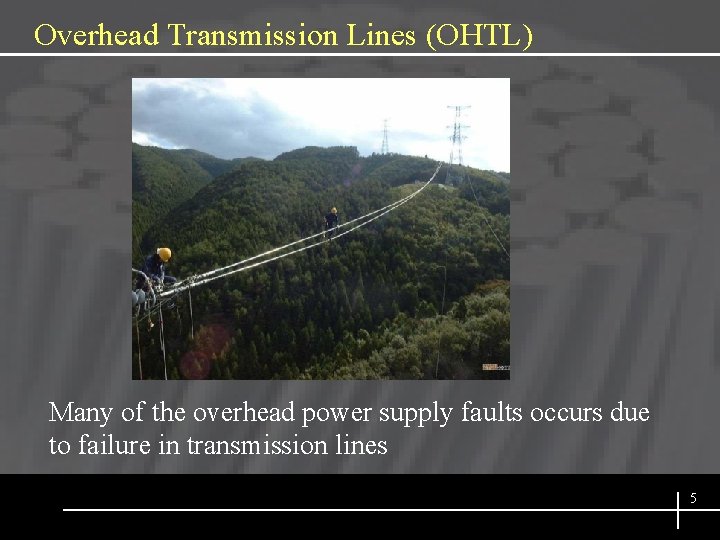
Overhead Transmission Lines (OHTL) Many of the overhead power supply faults occurs due to failure in transmission lines 5 SIX SIGMA
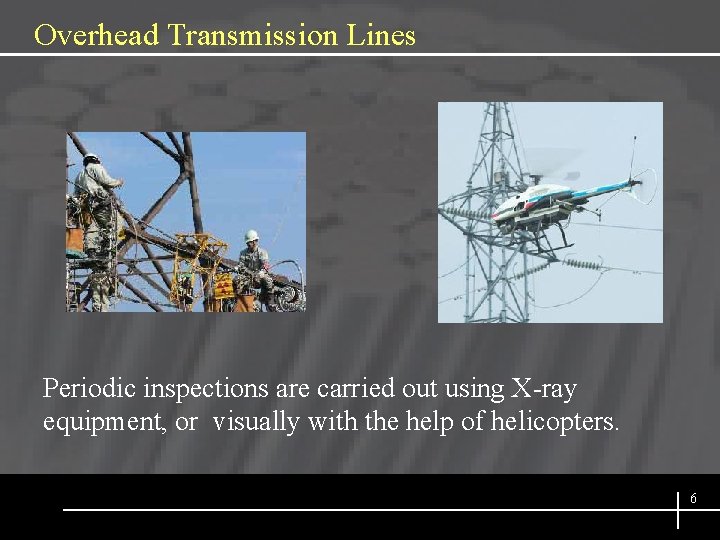
Overhead Transmission Lines Periodic inspections are carried out using X-ray equipment, or visually with the help of helicopters. 6 SIX SIGMA
Overhead Transmission Lines X-ray inspections has exhibited good results; however, they require the deployment of personnel or a robot to operate the system. Airborne inspections are specially a dangerous task due to sun glare, cloud cover, close proximity to power lines and the rapidly changing visual circumstances. 7 SIX SIGMA
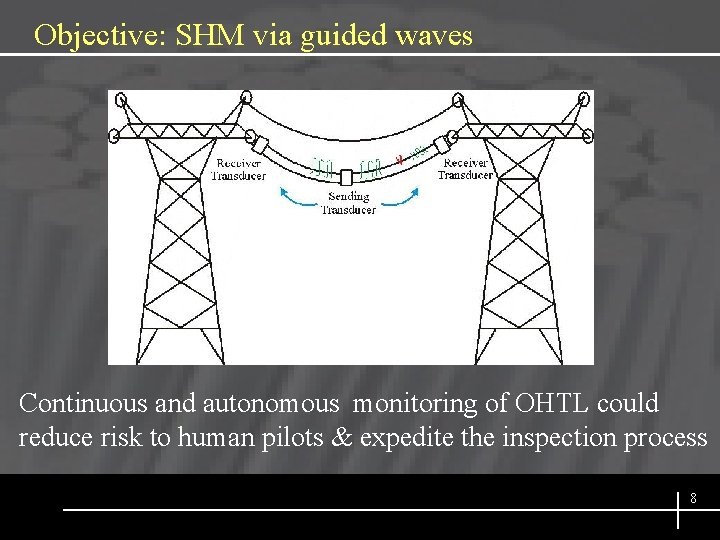
Objective: SHM via guided waves Continuous and autonomous monitoring of OHTL could reduce risk to human pilots & expedite the inspection process 8 SIX SIGMA
Work in progress ØGuided wave propagation in rods ØSignal processing (wavelet transform) ØExperiment setup at 500 k. Hz using an ACSR cable ØModes identification & Signal processing ØEnergy-transference analysis Ø 3 -D FEM analysis 9 SIX SIGMA
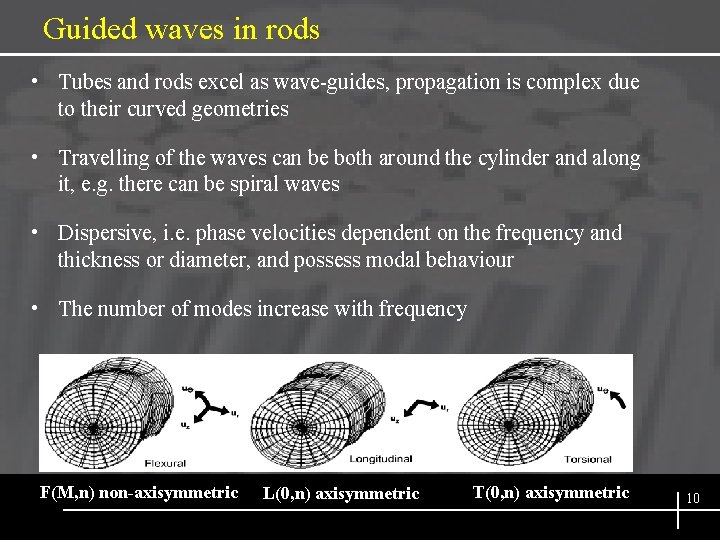
Guided waves in rods • Tubes and rods excel as wave-guides, propagation is complex due to their curved geometries • Travelling of the waves can be both around the cylinder and along it, e. g. there can be spiral waves • Dispersive, i. e. phase velocities dependent on the frequency and thickness or diameter, and possess modal behaviour • The number of modes increase with frequency F(M, n) non-axisymmetric SIX SIGMA L(0, n) axisymmetric T(0, n) axisymmetric 10
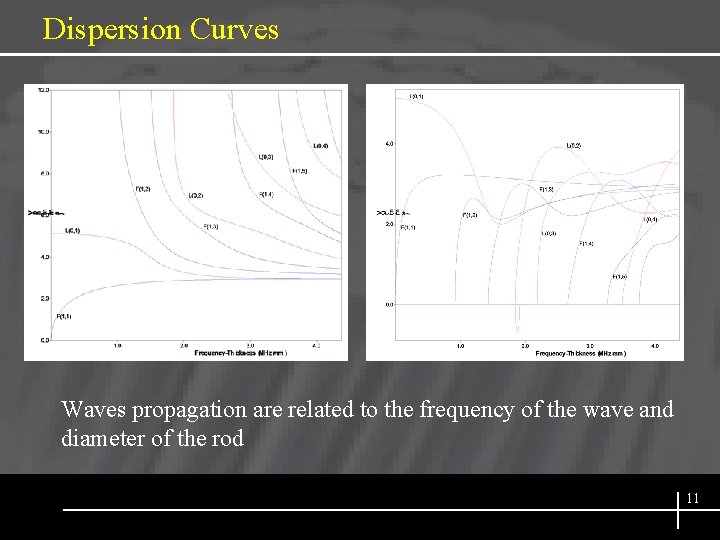
Dispersion Curves Waves propagation are related to the frequency of the wave and diameter of the rod 11 SIX SIGMA
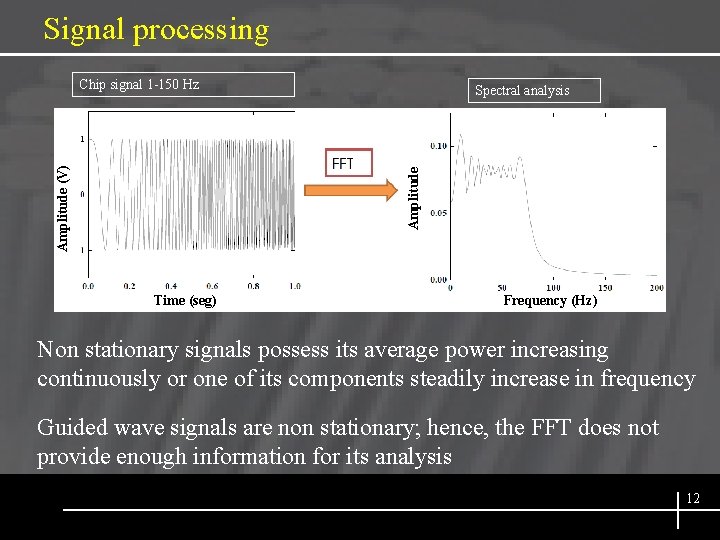
Signal processing Spectral analysis Amplitude (V) Chip signal 1 -150 Hz Time (seg) Frequency (Hz) Non stationary signals possess its average power increasing continuously or one of its components steadily increase in frequency Guided wave signals are non stationary; hence, the FFT does not provide enough information for its analysis 12 SIX SIGMA
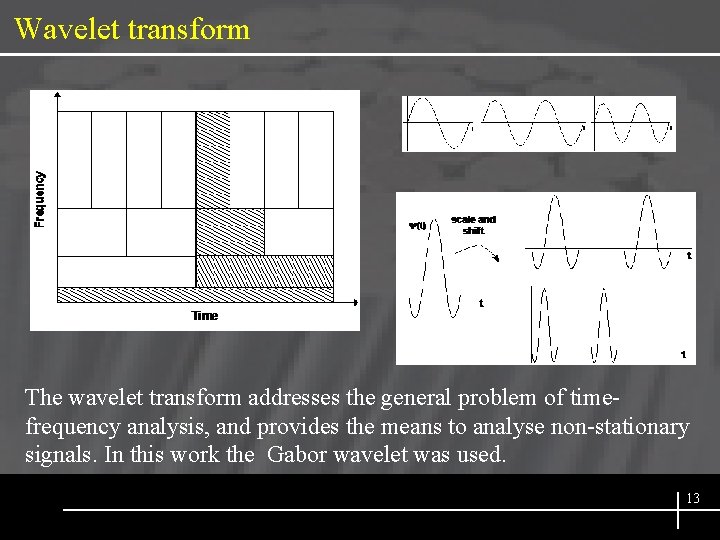
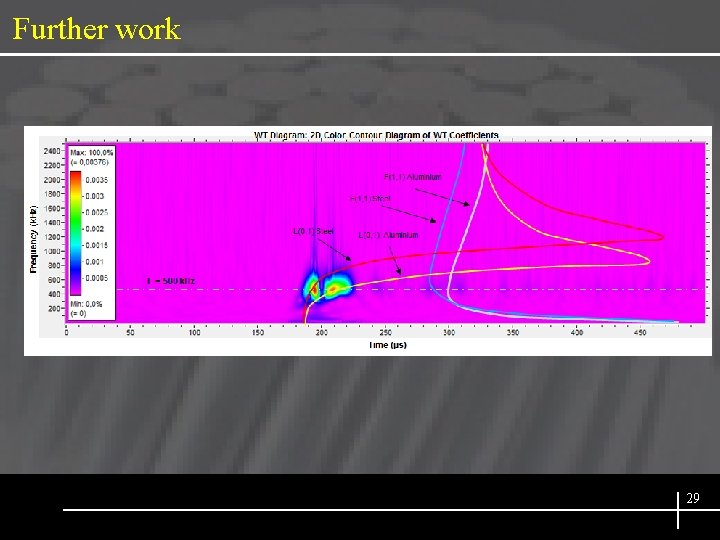
Wavelet transform The wavelet transform addresses the general problem of timefrequency analysis, and provides the means to analyse non-stationary signals. In this work the Gabor wavelet was used. 13 SIX SIGMA
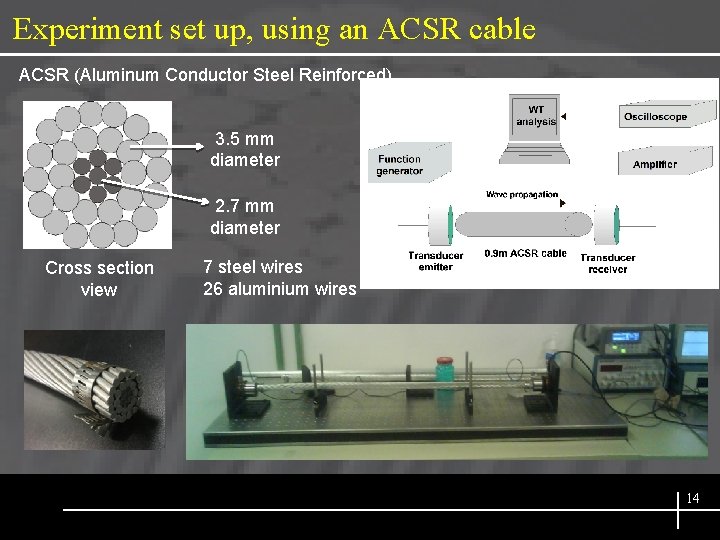
Experiment set up, using an ACSR cable ACSR (Aluminum Conductor Steel Reinforced) 3. 5 mm diameter 2. 7 mm diameter Cross section view 7 steel wires 26 aluminium wires 14 SIX SIGMA
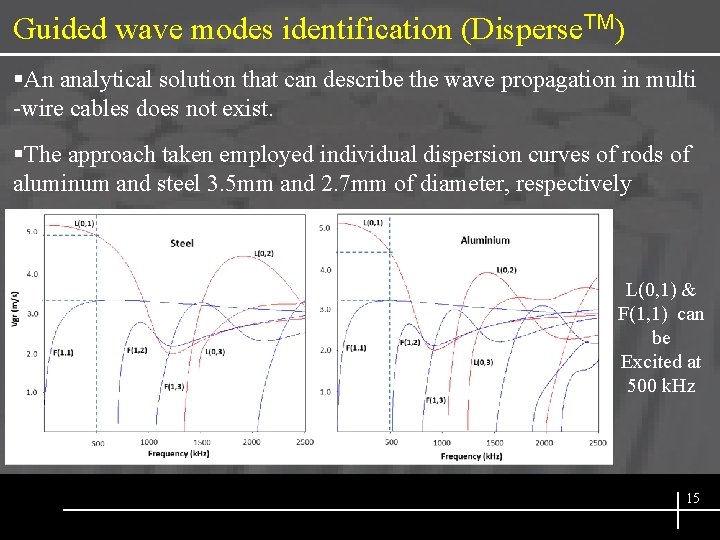
Guided wave modes identification (Disperse. TM) §An analytical solution that can describe the wave propagation in multi -wire cables does not exist. §The approach taken employed individual dispersion curves of rods of aluminum and steel 3. 5 mm and 2. 7 mm of diameter, respectively L(0, 1) & F(1, 1) can be Excited at 500 k. Hz 15 SIX SIGMA
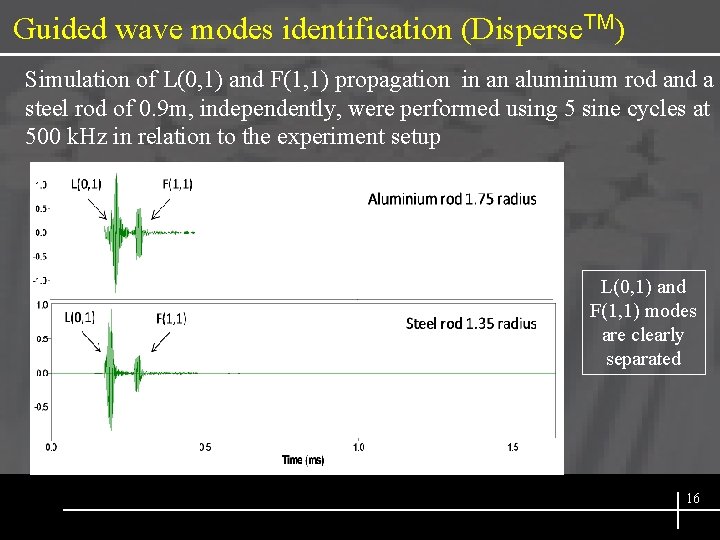
Guided wave modes identification (Disperse. TM) Simulation of L(0, 1) and F(1, 1) propagation in an aluminium rod and a steel rod of 0. 9 m, independently, were performed using 5 sine cycles at 500 k. Hz in relation to the experiment setup L(0, 1) and F(1, 1) modes are clearly separated 16 SIX SIGMA
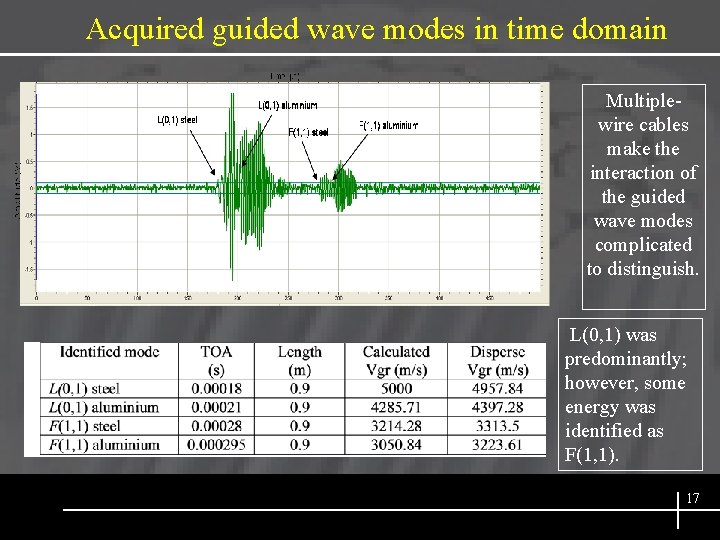
Acquired guided wave modes in time domain Multiplewire cables make the interaction of the guided wave modes complicated to distinguish. L(0, 1) was predominantly; however, some energy was identified as F(1, 1). 17 SIX SIGMA
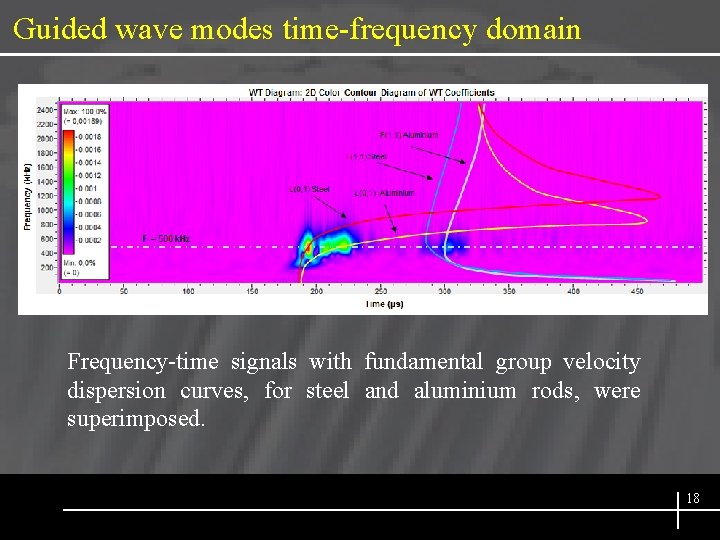
Guided wave modes time-frequency domain Frequency-time signals with fundamental group velocity dispersion curves, for steel and aluminium rods, were superimposed. 18 SIX SIGMA
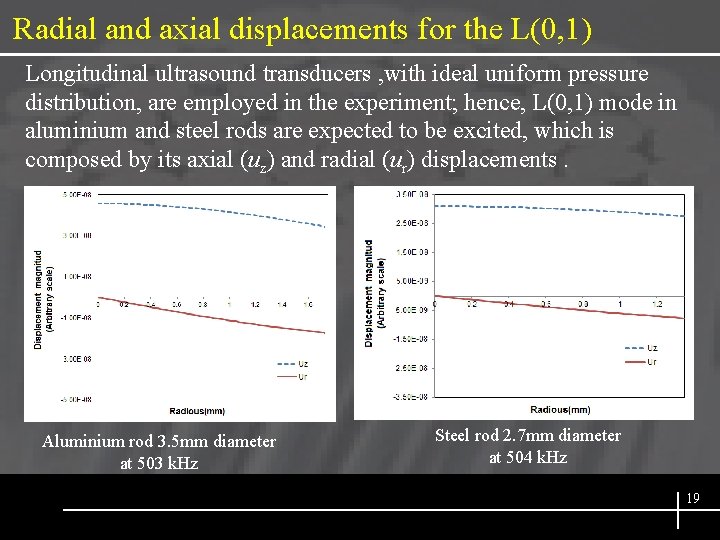
Radial and axial displacements for the L(0, 1) Longitudinal ultrasound transducers , with ideal uniform pressure distribution, are employed in the experiment; hence, L(0, 1) mode in aluminium and steel rods are expected to be excited, which is composed by its axial (uz) and radial (ur) displacements. Aluminium rod 3. 5 mm diameter at 503 k. Hz Steel rod 2. 7 mm diameter at 504 k. Hz 19 SIX SIGMA
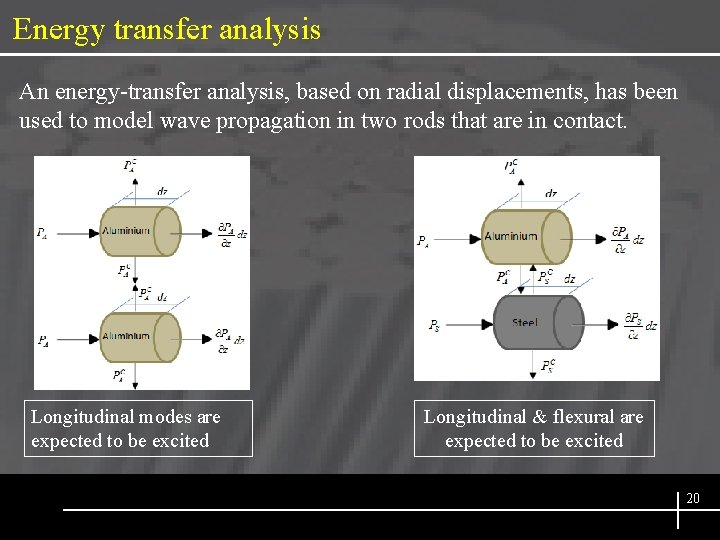
Energy transfer analysis An energy-transfer analysis, based on radial displacements, has been used to model wave propagation in two rods that are in contact. Longitudinal modes are expected to be excited Longitudinal & flexural are expected to be excited 20 SIX SIGMA
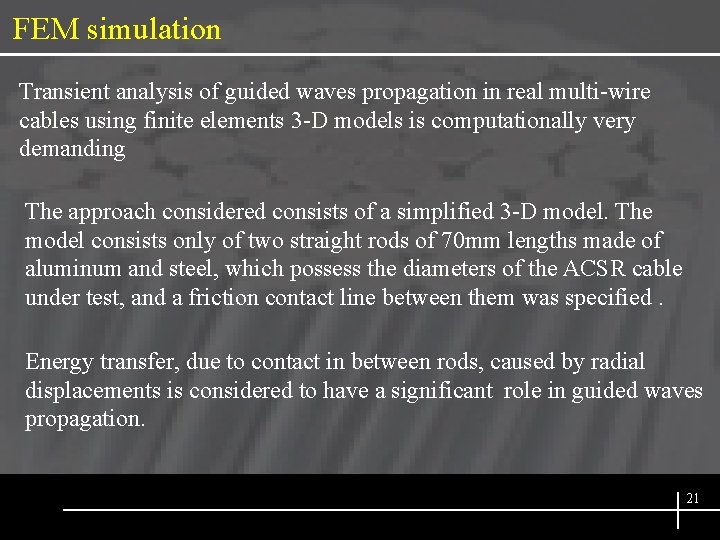
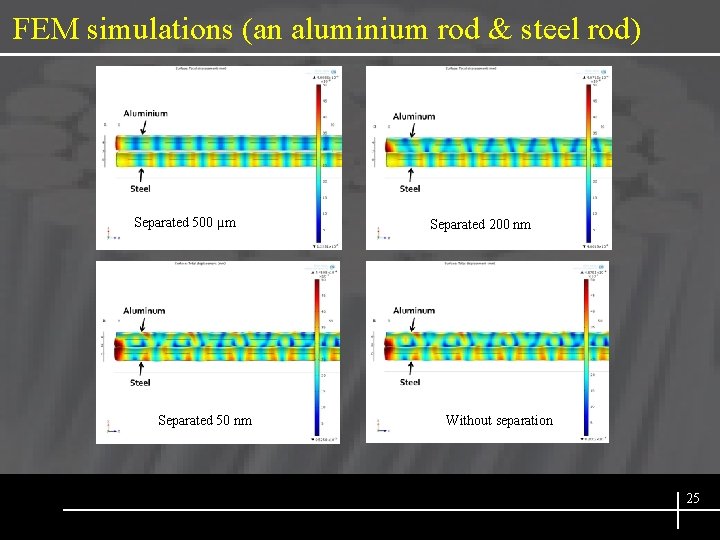
FEM simulation Transient analysis of guided waves propagation in real multi-wire cables using finite elements 3 -D models is computationally very demanding The approach considered consists of a simplified 3 -D model. The model consists only of two straight rods of 70 mm lengths made of aluminum and steel, which possess the diameters of the ACSR cable under test, and a friction contact line between them was specified. Energy transfer, due to contact in between rods, caused by radial displacements is considered to have a significant role in guided waves propagation. 21 SIX SIGMA
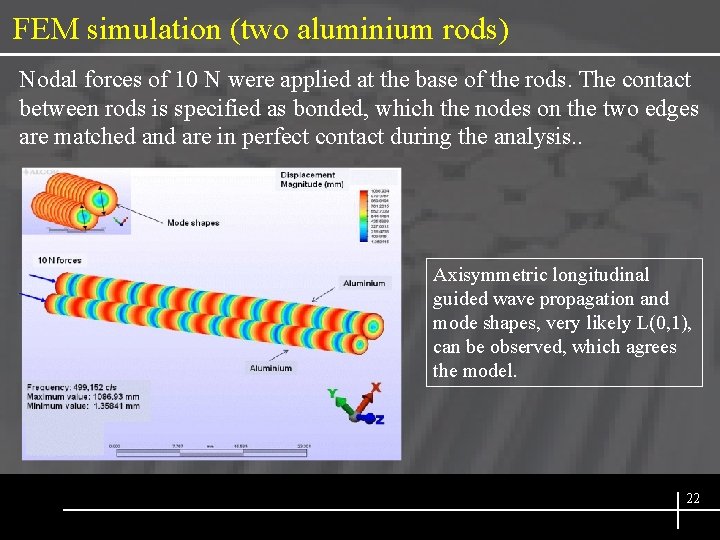
FEM simulation (two aluminium rods) Nodal forces of 10 N were applied at the base of the rods. The contact between rods is specified as bonded, which the nodes on the two edges are matched and are in perfect contact during the analysis. . Axisymmetric longitudinal guided wave propagation and mode shapes, very likely L(0, 1), can be observed, which agrees the model. 22 SIX SIGMA
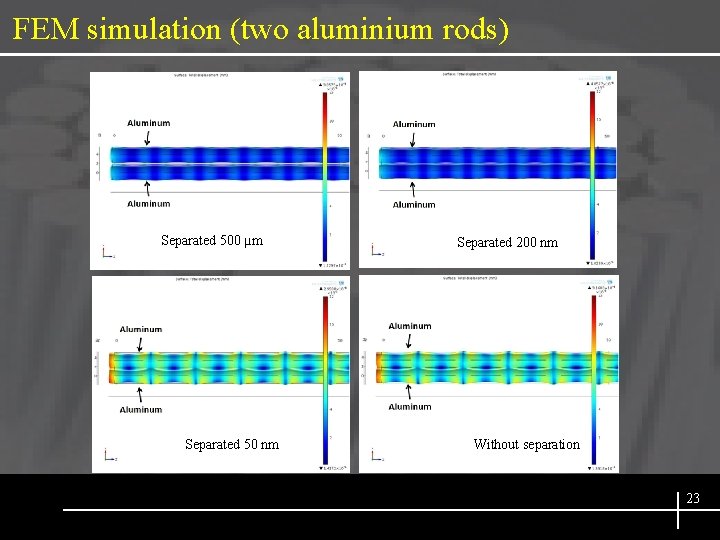
FEM simulation (two aluminium rods) Separated 500 µm Separated 50 nm Separated 200 nm Without separation 23 SIX SIGMA
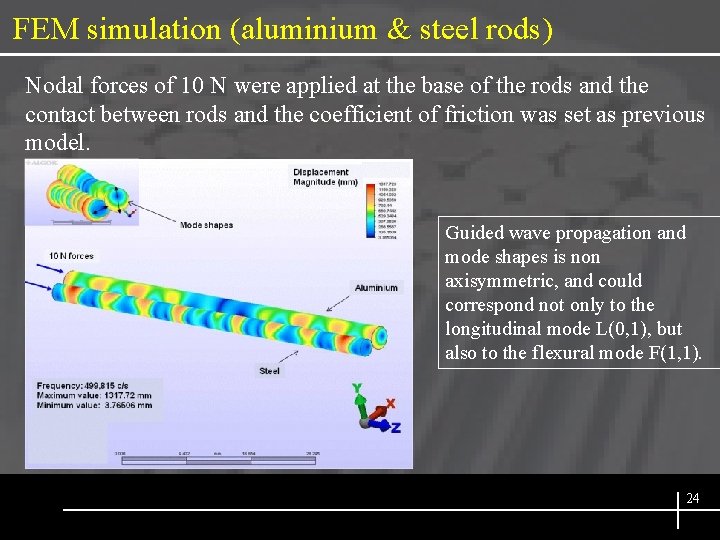
FEM simulation (aluminium & steel rods) Nodal forces of 10 N were applied at the base of the rods and the contact between rods and the coefficient of friction was set as previous model. Guided wave propagation and mode shapes is non axisymmetric, and could correspond not only to the longitudinal mode L(0, 1), but also to the flexural mode F(1, 1). 24 SIX SIGMA
FEM simulations (an aluminium rod & steel rod) Separated 500 µm Separated 50 nm Separated 200 nm Without separation 25 SIX SIGMA
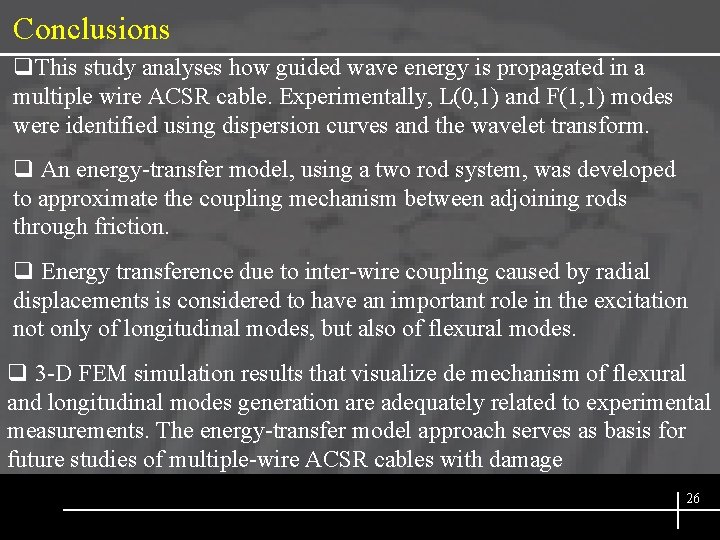
Conclusions q. This study analyses how guided wave energy is propagated in a multiple wire ACSR cable. Experimentally, L(0, 1) and F(1, 1) modes were identified using dispersion curves and the wavelet transform. q An energy-transfer model, using a two rod system, was developed to approximate the coupling mechanism between adjoining rods through friction. q Energy transference due to inter-wire coupling caused by radial displacements is considered to have an important role in the excitation not only of longitudinal modes, but also of flexural modes. q 3 -D FEM simulation results that visualize de mechanism of flexural and longitudinal modes generation are adequately related to experimental measurements. The energy-transfer model approach serves as basis for future studies of multiple-wire ACSR cables with damage 26 SIX SIGMA
Conclusions Thanks ? 27 SIX SIGMA
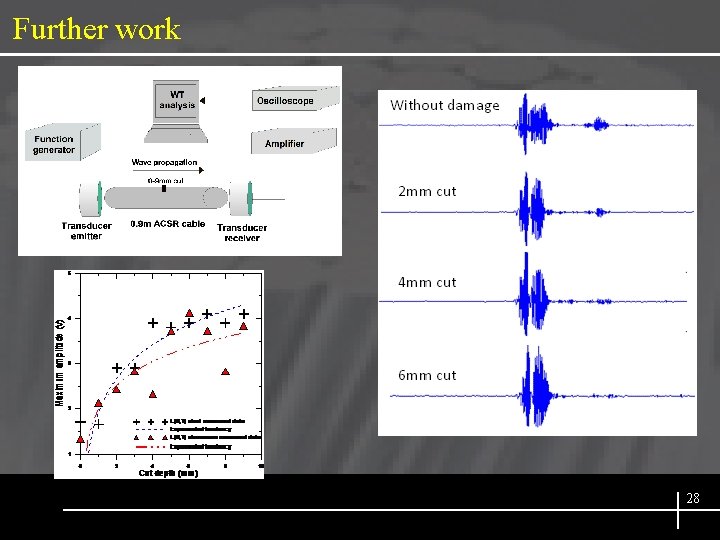
Further work 28 SIX SIGMA
Further work 29 SIX SIGMA