
The Effect of Class Time on Grades of
- Slides: 1
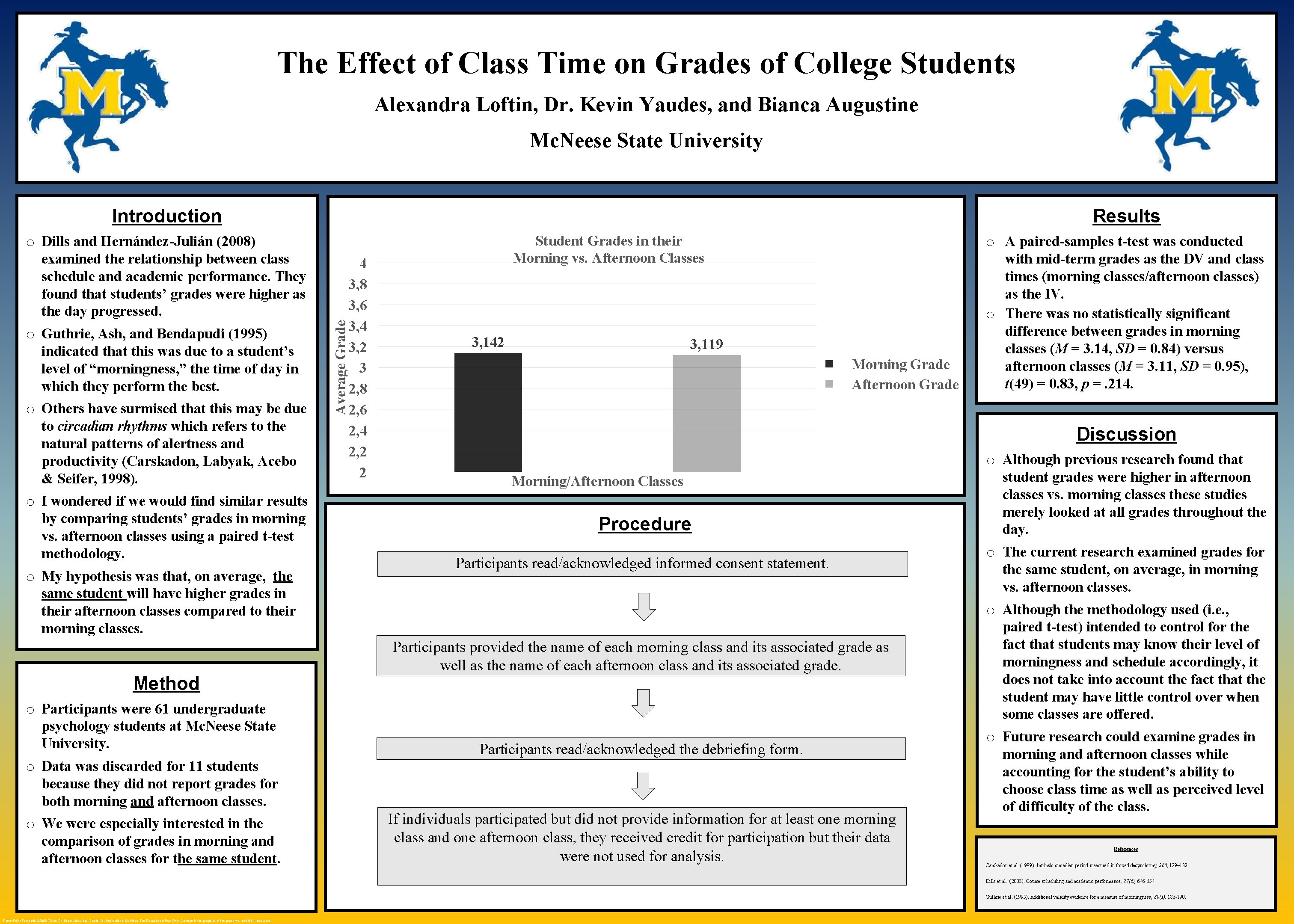
The Effect of Class Time on Grades of College Students Alexandra Loftin, Dr. Kevin Yaudes, and Bianca Augustine Mc. Neese State University Results Introduction o Guthrie, Ash, and Bendapudi (1995) indicated that this was due to a student’s level of “morningness, ” the time of day in which they perform the best. o Others have surmised that this may be due to circadian rhythms which refers to the natural patterns of alertness and productivity (Carskadon, Labyak, Acebo & Seifer, 1998). o I wondered if we would find similar results by comparing students’ grades in morning vs. afternoon classes using a paired t-test methodology. o My hypothesis was that, on average, the same student will have higher grades in their afternoon classes compared to their morning classes. Method o Participants were 61 undergraduate psychology students at Mc. Neese State University. Average Grade o Dills and Hernández-Julián (2008) examined the relationship between class schedule and academic performance. They found that students’ grades were higher as the day progressed. 4 3, 8 3, 6 3, 4 3, 2 3 2, 8 2, 6 2, 4 2, 2 2 Student Grades in their Morning vs. Afternoon Classes 3, 142 3, 119 Morning Grade Afternoon Grade Discussion Morning/Afternoon Classes Procedure o Although previous research found that student grades were higher in afternoon classes vs. morning classes these studies merely looked at all grades throughout the day. Participants read/acknowledged informed consent statement. o The current research examined grades for the same student, on average, in morning vs. afternoon classes. Participants provided the name of each morning class and its associated grade as well as the name of each afternoon class and its associated grade. o Although the methodology used (i. e. , paired t-test) intended to control for the fact that students may know their level of morningness and schedule accordingly, it does not take into account the fact that the student may have little control over when some classes are offered. Participants read/acknowledged the debriefing form. o Data was discarded for 11 students because they did not report grades for both morning and afternoon classes. o We were especially interested in the comparison of grades in morning and afternoon classes for the same student. o A paired-samples t-test was conducted with mid-term grades as the DV and class times (morning classes/afternoon classes) as the IV. o There was no statistically significant difference between grades in morning classes (M = 3. 14, SD = 0. 84) versus afternoon classes (M = 3. 11, SD = 0. 95), t(49) = 0. 83, p =. 214. If individuals participated but did not provide information for at least one morning class and one afternoon class, they received credit for participation but their data were not used for analysis. o Future research could examine grades in morning and afternoon classes while accounting for the student’s ability to choose class time as well as perceived level of difficulty of the class. References Carskadon et al. (1999). Intrinsic circadian period measured in forced desynchrony, 260, 129– 132. Dills et al. (2008). Course scheduling and academic performance, 27(6), 646 -654. Guthrie et al. (1995). Additional validity evidence for a measure of morningness , 80(1), 186 -190. Power. Point Template © 2009 Texas Christian University, Center for Instructional Services. For Educational Use Only. Content is the property of the presenter and their resources.