
The Effect of Balloon Type on Helium Diffusion
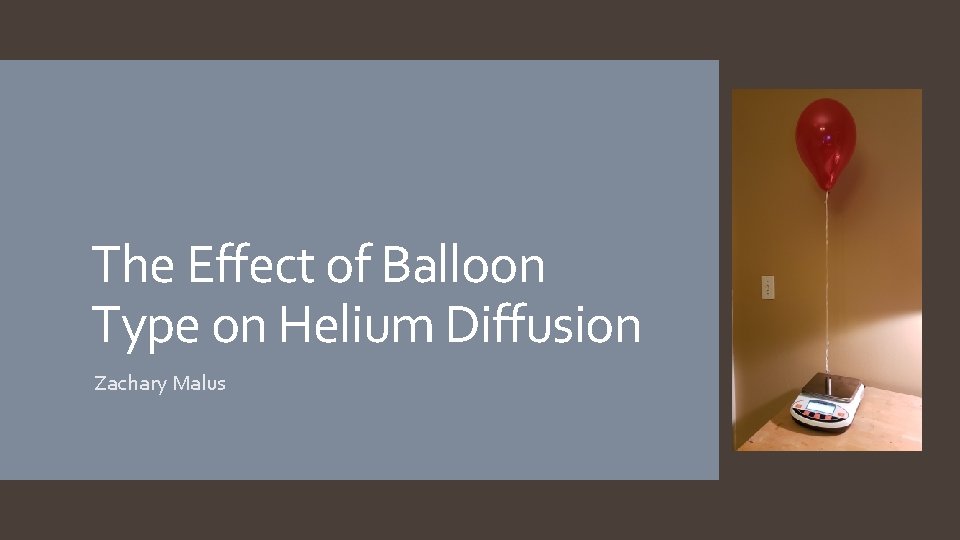
The Effect of Balloon Type on Helium Diffusion Zachary Malus
The Main Question: How does helium diffusion differ when using various types of balloons and with the application of hair spray to the surface of a balloon?
Research There are several concepts that needed to be researched in order to interpret the results of the experiment. These topics are discussed in the proceeding slides.
Law of Buoyancy – Why Helium Balloons Float For a balloon to travel upwards, it must have more force pushing up on it than down. The opposite is true for a balloon to travel downwards (Helium). The reason a helium balloon floats is because the pressure of the air above it is less than the pressure of the air below it. This difference in pressure results in a net upwards force on the balloon, which causes the balloon to float, as helium is light enough so that the upwards/buoyancy force is greater than the gravitational pull downward (Helium).
Exponential Decay/Growth Exponential decay/growth is when a number decreases/increases by a set percent over constant intervals. An example of exponential decay would be atmospheric pressure, which decreases at around 12% for every 1000 meters. An example of exponential growth would be a population which grows at a rate of 50% every year.
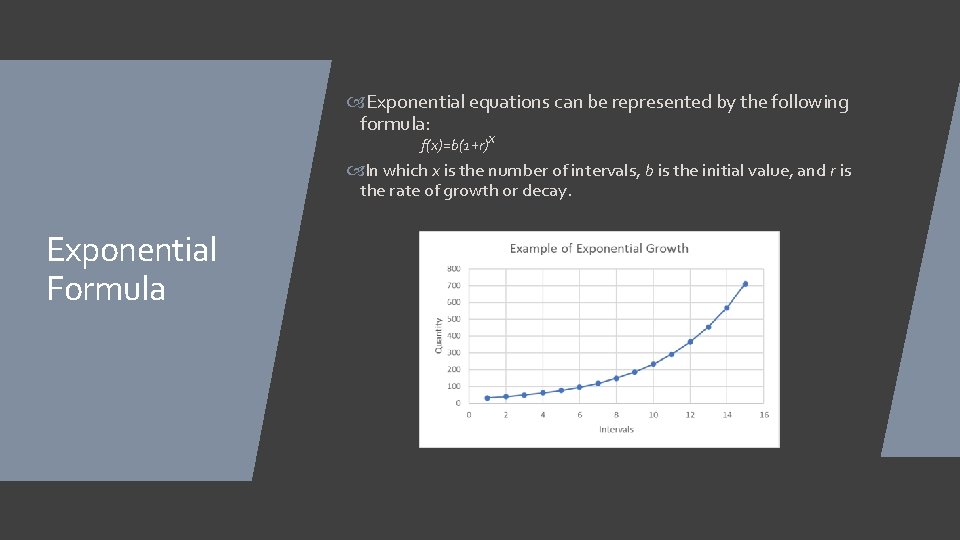
Exponential equations can be represented by the following formula: f(x)=b(1+r)x In which x is the number of intervals, b is the initial value, and r is the rate of growth or decay. Exponential Formula
Linear Decrease/Increase Linear decrease/increase is when a number decreases/increases by a set amount over constant intervals. An example of linear increase would be the distance traveled in a car moving at a constant speed measured every 10 minutes. An example of linear decrease would be the distance to the destination of the car mentioned previously.
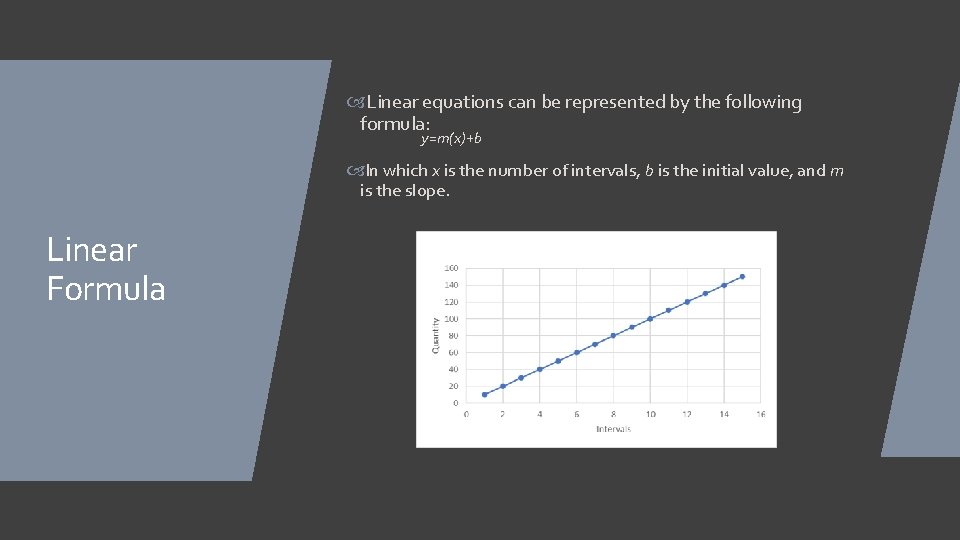
Linear equations can be represented by the following formula: y=m(x)+b In which x is the number of intervals, b is the initial value, and m is the slope. Linear Formula
Gas Diffusion Gas diffusion is defined as the passage of gas through a barrier (Gaseous). In this experiment, we are measuring the rate of helium gas diffusion through various materials.
Risk Analysis Helium must be used in a well-ventilated location and should be supervised by an adult. Latex can cause allergic reactions.
Independent Variable: - Balloon type (including the addition or absence of hairspray) Dependent Variable: - Upwards force excreted on the balloon by helium over time Constants: -Scale - Altitude of the balloon Variables
Hypothesis If different types of balloons are used, and/or if hair spray is applied to the surface of the balloons, then the rate of helium diffusion will differ.
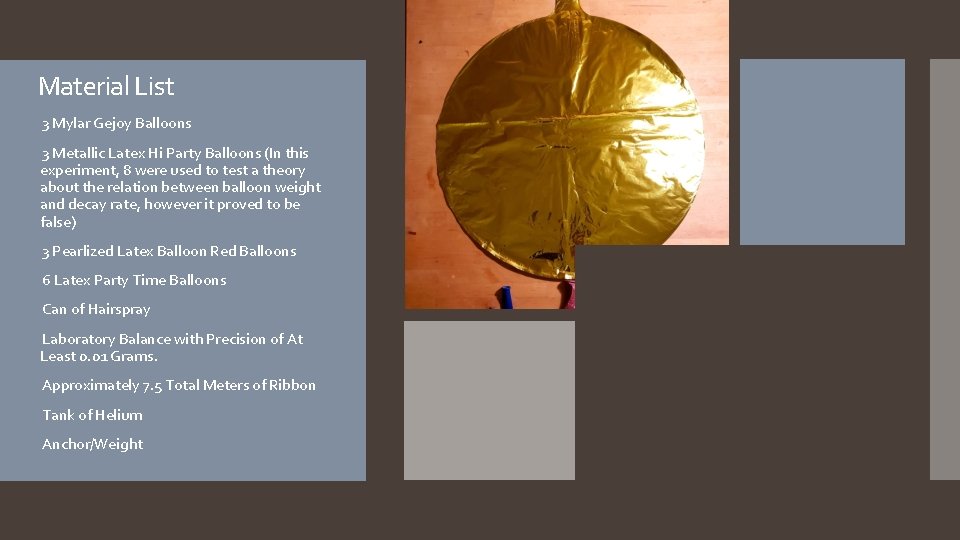
Material List 3 Mylar Gejoy Balloons 3 Metallic Latex Hi Party Balloons (In this experiment, 8 were used to test a theory about the relation between balloon weight and decay rate, however it proved to be false) 3 Pearlized Latex Balloon Red Balloons 6 Latex Party Time Balloons Can of Hairspray Laboratory Balance with Precision of At Least 0. 01 Grams. Approximately 7. 5 Total Meters of Ribbon Tank of Helium Anchor/Weight
Procedure: Cut a ribbon so that it is approximately 0. 5 meters long. Mass the ribbon and an individual balloon, as well as an anchor/weight to be used. Fill the balloon with helium (make sure not to overfill). Tie one end of the ribbon to the balloon and the other to the anchor/weight. Place the anchor/weight on the scale and record the mass; this will be hour zero. Record the mass of the balloon, ribbon and anchor/weight on set intervals. Repeat step 6 until the balloon is no longer afloat. Repeat steps 1 -7 for each balloon. Repeat steps 1 -8 for a total of three times for each balloon type. With the three remaining latex balloons, spray each with hairspray and repeat steps 1 -8, treating the hairsprayed latex balloons as their own type.

Data and Observations The data captured during the experiment

Key Terms: Sample of Individual Run (1/20)

Key Terms Summary Table
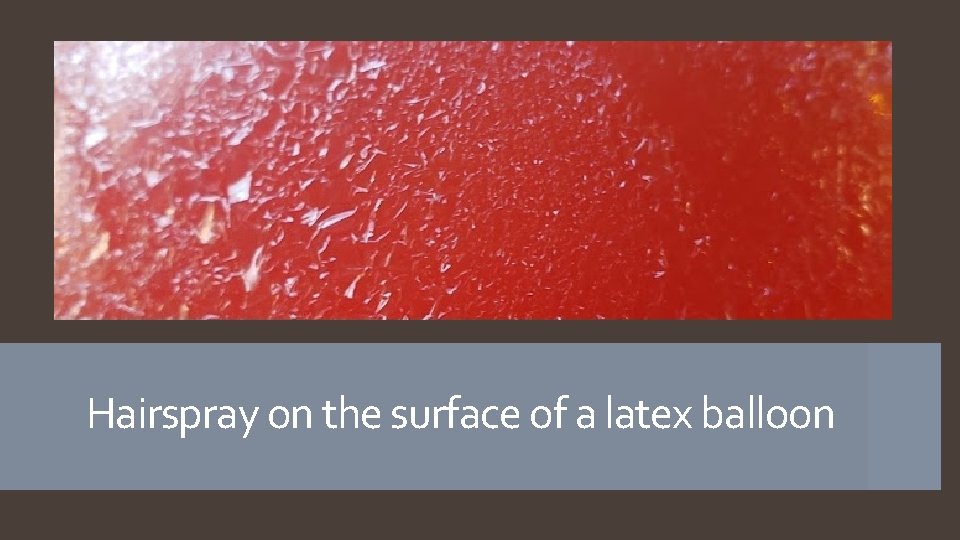
Hairspray on the surface of a latex balloon
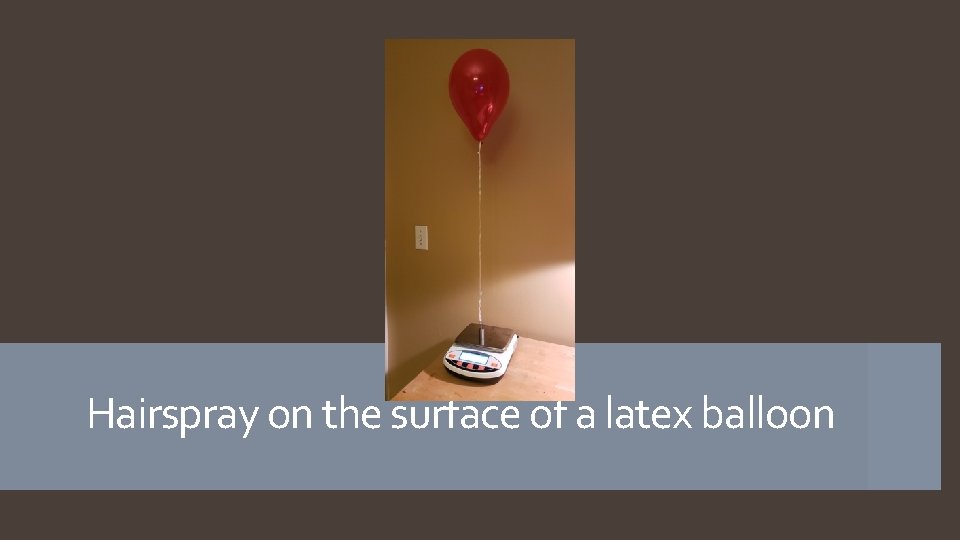
Hairspray on the surface of a latex balloon
Graphs Data from the experiment put into a visual representation
Example Latex Run 1/3
Example Latex + Hairspray Run 1/3 y = -0. 216 x + 4. 41
Example Metallic Run 6/8
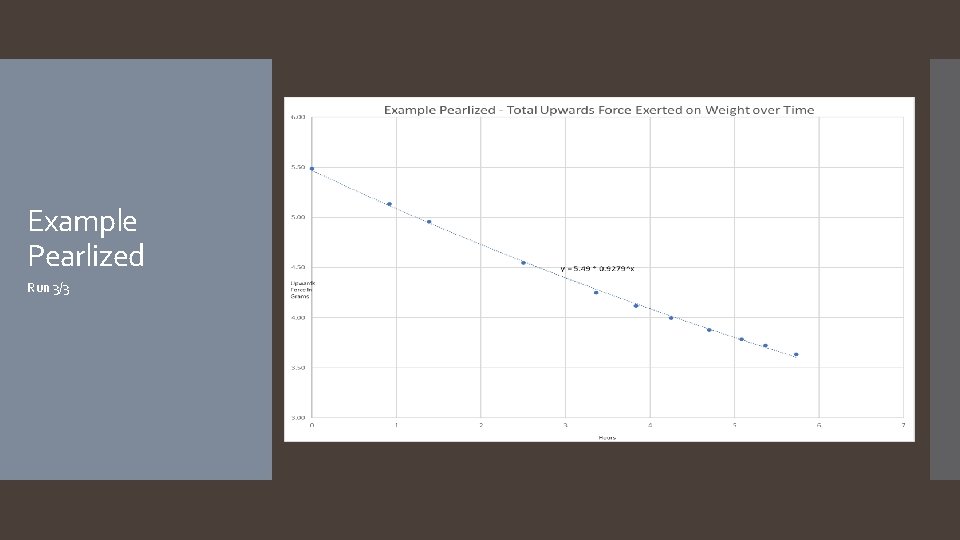
Example Pearlized Run 3/3
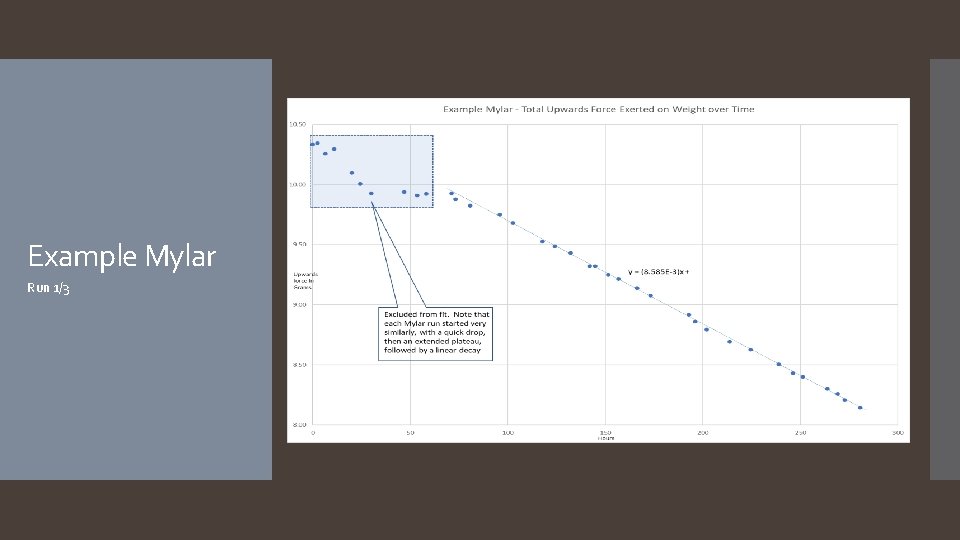
Example Mylar Run 1/3
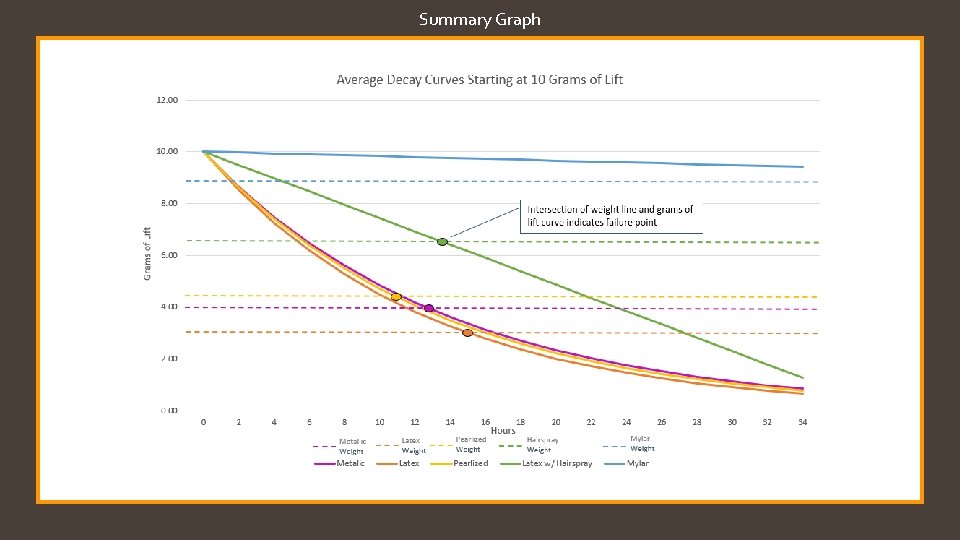
Summary Graph
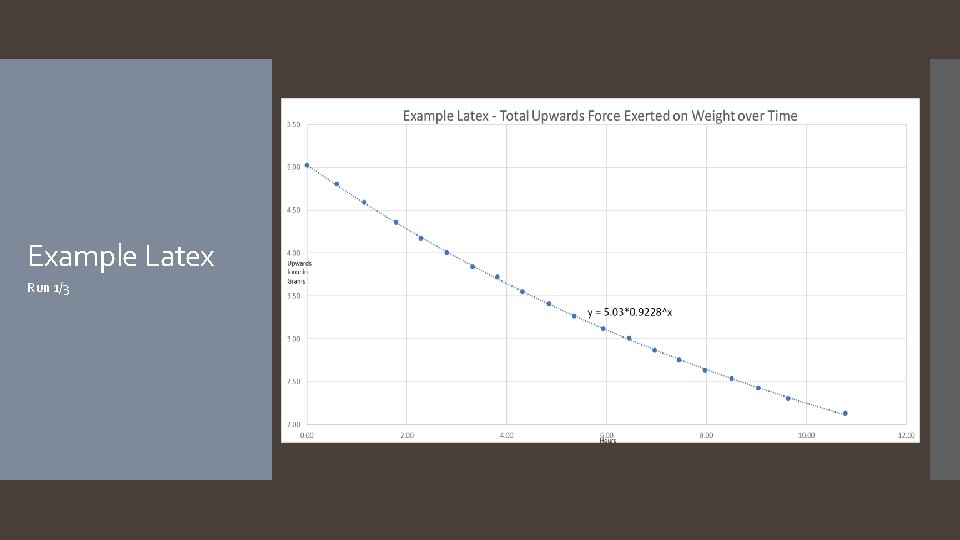
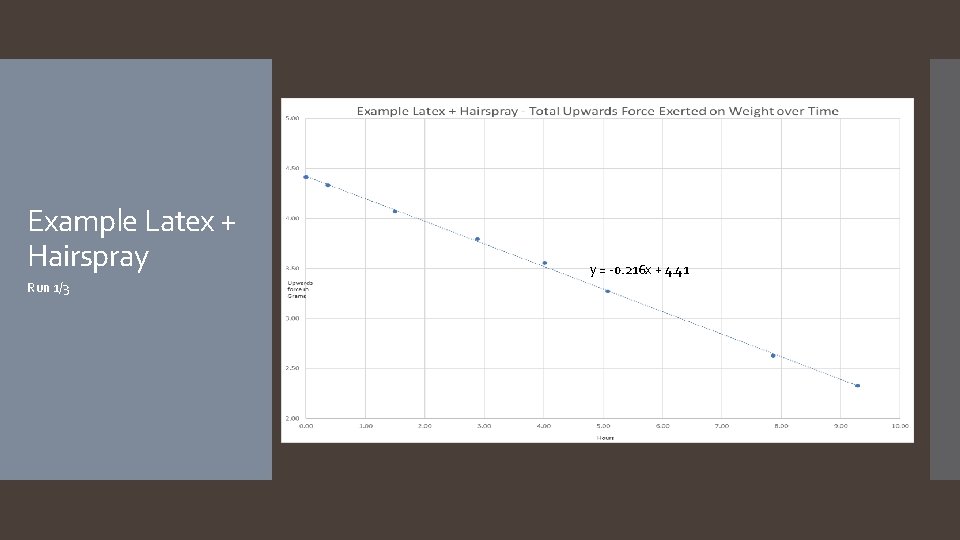
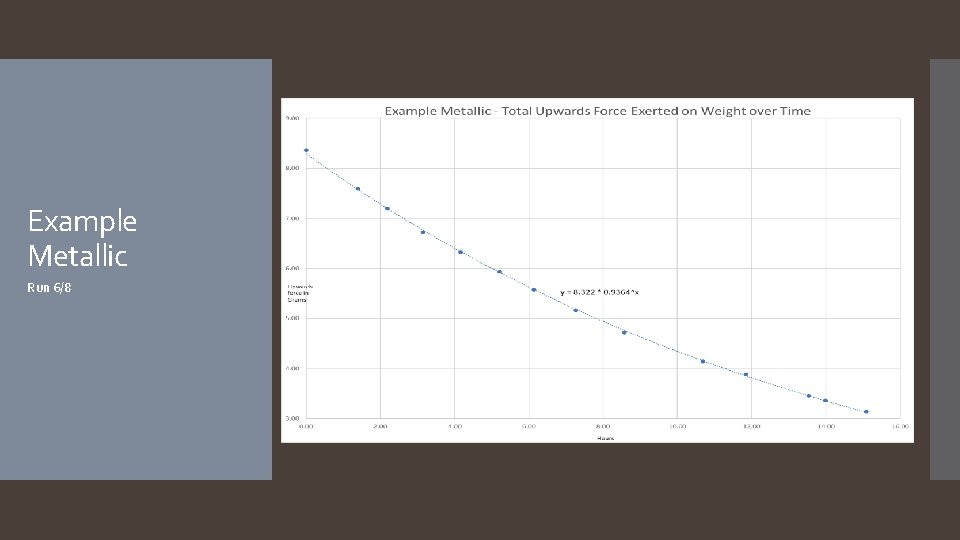
The hypothesis that if different types of balloons are used, and/or hair spray is applied to the surface of the balloons, then the rate of helium diffusion will differ was accepted. The rate of helium diffusion for metallic, latex, and pearlized balloons was found to follow an exponential decay pattern, with average decay rates of 7. 0%/hour, 7. 7%/hour, and 7. 3%/hour respectively. Rates for mylar and hairsprayed latex followed a linear decay pattern, with average decay rates of -0. 02 grams of lift/hour and -0. 27 grams of lift/hour. It is worth noting that the application of hairspray to the latex balloon changed the decay pattern from exponential to linear. A reasonable explanation as to why the different types of balloons have different decay patterns (exponential versus linear) is that the diffusion rate depends on the thickness of the barrier, which for latex balloons starts off thin and becomes thicker as the balloon deflates, continuously changing the diffusion rate, resulting in an exponential curve. In the case of mylar balloons and the hairspray coating around the latex balloons, however, the material is incapable of stretching and thus the thickness of the balloon’s barrier does not change throughout the duration of the experiment, resulting in a constant diffusion rate and a linear slope. Another thing to note about the mylar balloons is some interesting behavior that was observed for the first few days of each mylar run: the first day of readings showed an inconsistent decline, after which the readings would plateau for roughly another day, before continuing in a much more predictable linear decay (see the Example Mylar graph on slide 23). Future experimentation with mylar balloons under different conditions focusing on the first few days could help explain this behavior. As far as the hairsprayed latex balloons go, it was found that while the application of the hairspray decreased the decay rate, its significant increase to the weight of the balloon more than offset the decay rate, resulting in a balloon that failed faster. It is possible that there is an ideal amount of hairspray that can be applied which would result in a better performing latex balloon, however more experiments would need to be done to investigate. Conclusion
Error Analysis It was discovered during one of the early unused runs that the scale’s zero-point would become offset after leaving the scale on for extended periods of time. The original method of leaving the weight on the scale and taking readings had to be modified to accommodate for this error. The scale manufacturer was contacted, and at their advice, the process was changed to taking readings by removing the weight from the scale and powering it down between measurements, which ended up working, verified by weighing a known 50 -gram weight. One other potential error was possible temperature fluctuations, which could affect the diffusion rate of helium inside the balloons. The temperature was measured during a run to see if it influenced the measurements, but there were no detectable patterns.
Gaseous Diffusion. www. dictionary. com/browse/gaseous-diffusion. Work Cited “Helium Balloon – Balloon Physics. ” You. Tube, uploaded by Lab. Rat Scientific, 1 Mar. 2018, https: //www. youtube. com/watch? v=oa. Wj. C_VDlq. Q. Photo of
- Slides: 29