
The effect of a collision warning system on
![Procedure Goal References Method Results & Discussion [ Step 1 ] Subjects were asked](https://slidetodoc.com/presentation_image_h2/561dbbf9e0837358f67923c1709cd963/image-9.jpg "Procedure Goal References Method Results & Discussion [ Step 1 ] Subjects were asked")
- Slides: 21
The effect of a collision warning system on the driving performance of young drivers at intersections Shun-Hui Chang , Chih-Yung Lin , Chun-Chia Hsu , Chin-Ping Fung , Jiun-Ren Hwang 報告者:楊子群
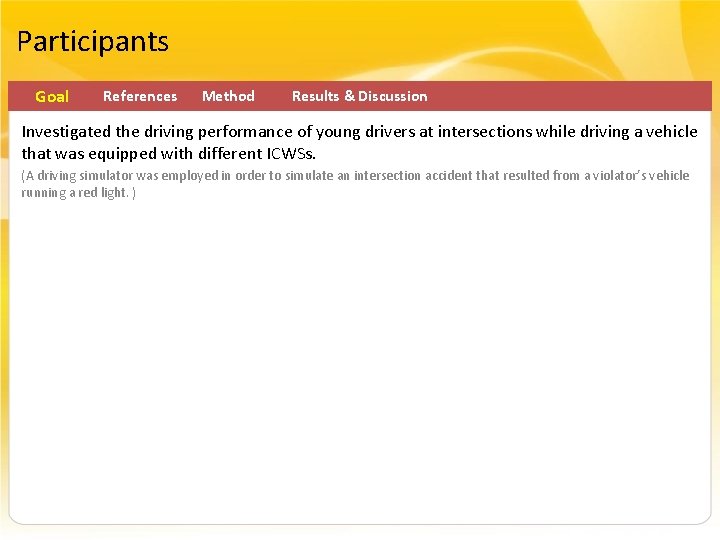
Participants Goal References Method Results & Discussion Investigated the driving performance of young drivers at intersections while driving a vehicle that was equipped with different ICWSs. (A driving simulator was employed in order to simulate an intersection accident that resulted from a violator’s vehicle running a red light. )
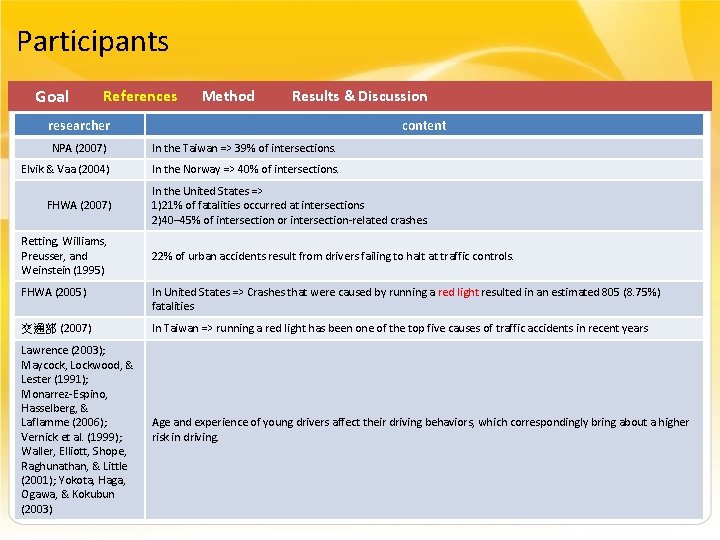
Participants Goal References Method Results & Discussion researcher content NPA (2007) In the Taiwan => 39% of intersections. Elvik & Vaa (2004) In the Norway => 40% of intersections. FHWA (2007) Retting, Williams, Preusser, and Weinstein (1995) In the United States => 1)21% of fatalities occurred at intersections 2)40– 45% of intersection or intersection-related crashes. 22% of urban accidents result from drivers failing to halt at traffic controls. FHWA (2005) In United States => Crashes that were caused by running a red light resulted in an estimated 805 (8. 75%) fatalities 交通部 (2007) In Taiwan => running a red light has been one of the top five causes of traffic accidents in recent years Lawrence (2003); Maycock, Lockwood, & Lester (1991); Monarrez-Espino, Hasselberg, & Laflamme (2006); Vernick et al. (1999); Waller, Elliott, Shope, Raghunathan, & Little (2001); Yokota, Haga, Ogawa, & Kokubun (2003) Age and experience of young drivers affect their driving behaviors, which correspondingly bring about a higher risk in driving.
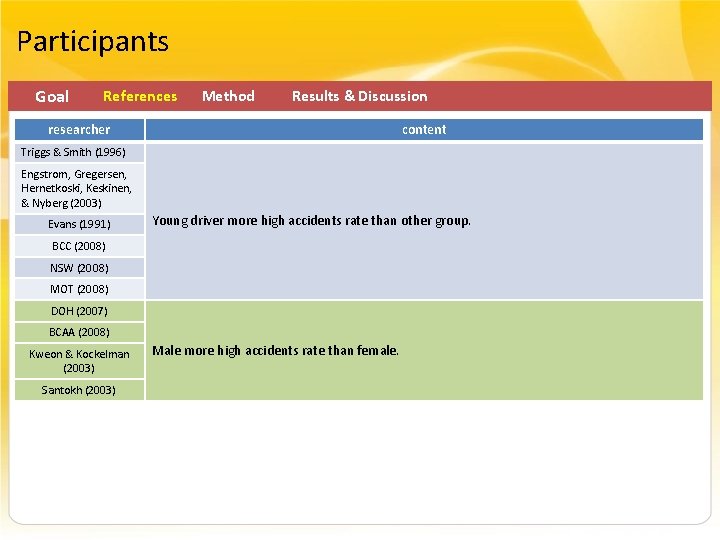
Participants Goal References Method Results & Discussion researcher content Triggs & Smith (1996) Engstrom, Gregersen, Hernetkoski, Keskinen, & Nyberg (2003) Evans (1991) Young driver more high accidents rate than other group. BCC (2008) NSW (2008) MOT (2008) DOH (2007) BCAA (2008) Kweon & Kockelman (2003) Santokh (2003) Male more high accidents rate than female.
Participants Goal References Method Results & Discussion Ø 30 male subjects. Ø Age : 20~25 years. (Average : 23. 1 years) Ø Driver’s license at least 2 years. Ø Average number of driving days per week was around two.
Apparatus Goal References Method Results & Discussion Ø Driving simulator : Six-degree-of-freedom Stewart motion platform. Virtual-reality-based visual and audio system. ØVehicle motion simulation software. ØComputer ØScene is updated at rates between 25 and 35 Hz.
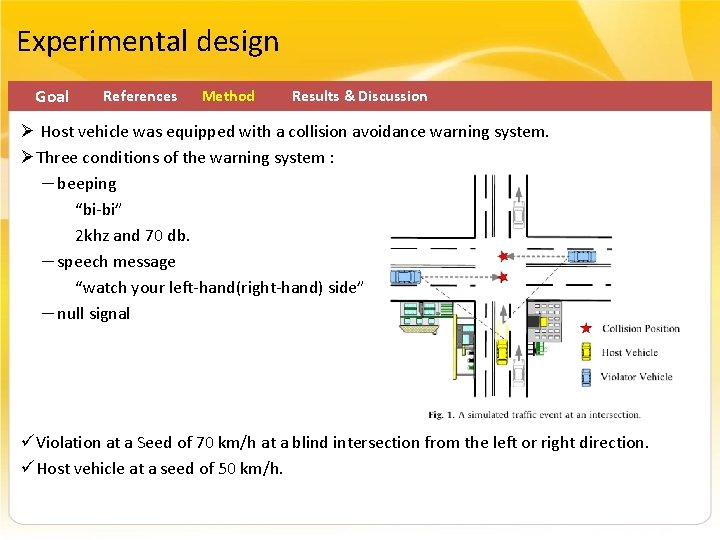
Experimental design Goal References Method Results & Discussion Ø Host vehicle was equipped with a collision avoidance warning system. ØThree conditions of the warning system : -beeping “bi-bi” 2 khz and 70 db. -speech message “watch your left-hand(right-hand) side” -null signal üViolation at a Seed of 70 km/h at a blind intersection from the left or right direction. üHost vehicle at a seed of 50 km/h.
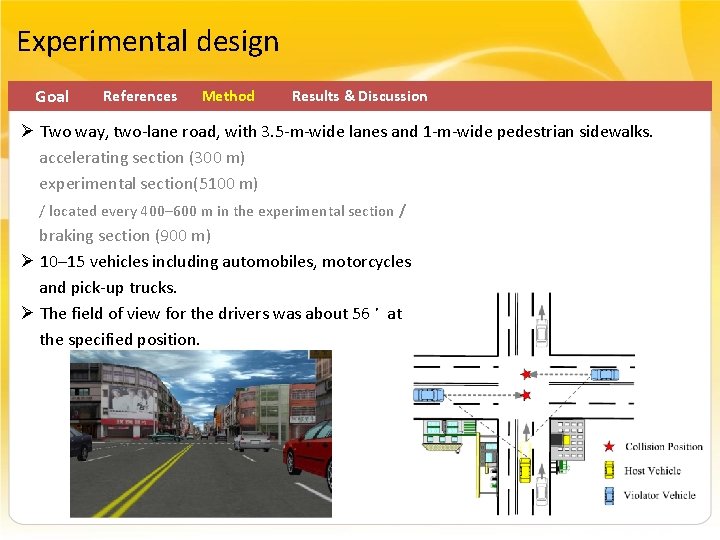
Experimental design Goal References Method Results & Discussion Ø Two way, two-lane road, with 3. 5 -m-wide lanes and 1 -m-wide pedestrian sidewalks. accelerating section (300 m) experimental section(5100 m) / located every 400– 600 m in the experimental section / braking section (900 m) Ø 10– 15 vehicles including automobiles, motorcycles and pick-up trucks. Ø The field of view for the drivers was about 56。 at the specified position.
Procedure Goal References Method Results & Discussion [ Step 1 ] Subjects were asked to provide personal information. (gender, age and driving experience) [ Step 2 ] Experimental instructions. [ Step 3 ] Experimental practice. (20 -25 min) [ Step 4 ] Formal experiment. (7 -10 min)
Data collection and statistical analysis Goal References Method Results & Discussion Øreaction time ØSpeed Ølateral position deviation Øaccident rates All data were collected at 30 Hz. ü driving performance => Multivariate analysis of variance (MANOVA) different ICWS content. direction of the violator’s vehicle. location of intersection accident. number of driving days per week. ü post-hoc testing => Tukey’s honesty significant difference (HSD). üAccident rate=>chi-square test and path analysis.
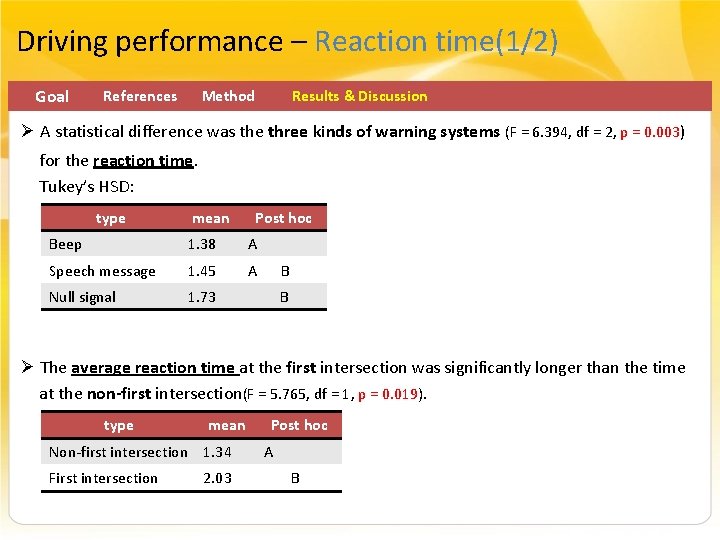
Driving performance – Reaction time(1/2) Goal References Method Results & Discussion Ø A statistical difference was the three kinds of warning systems (F = 6. 394, df = 2, p = 0. 003) for the reaction time. Tukey’s HSD: type mean Post hoc Beep 1. 38 A Speech message 1. 45 A Null signal 1. 73 B B Ø The average reaction time at the first intersection was significantly longer than the time at the non-first intersection(F = 5. 765, df = 1, p = 0. 019). type mean Non-first intersection 1. 34 First intersection 2. 03 Post hoc A B
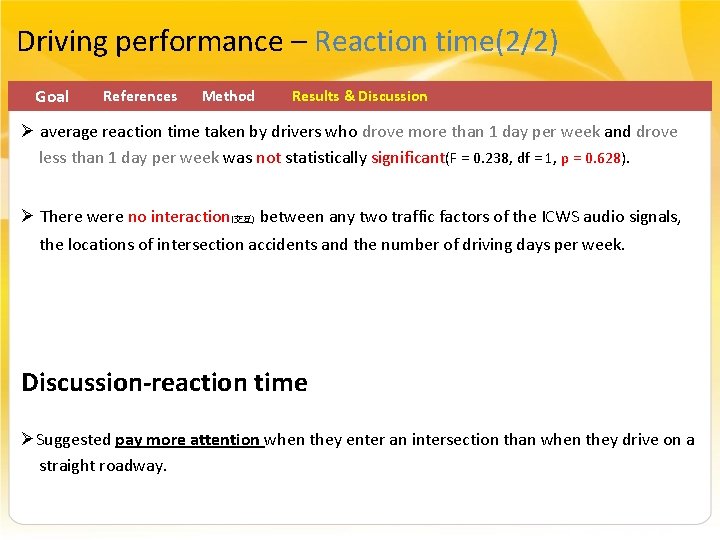
Driving performance – Reaction time(2/2) Goal References Method Results & Discussion Ø average reaction time taken by drivers who drove more than 1 day per week and drove less than 1 day per week was not statistically significant(F = 0. 238, df = 1, p = 0. 628). Ø There were no interaction(交互) between any two traffic factors of the ICWS audio signals, the locations of intersection accidents and the number of driving days per week. Discussion-reaction time ØSuggested pay more attention when they enter an intersection than when they drive on a straight roadway.
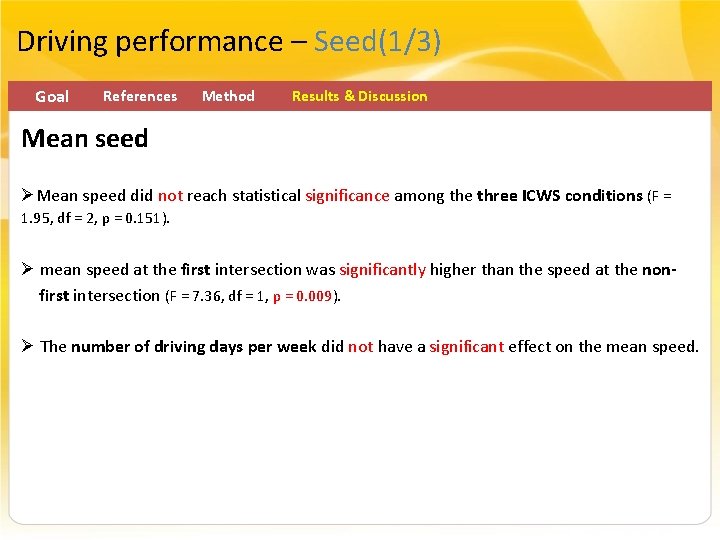
Driving performance – Seed(1/3) Goal References Method Results & Discussion Mean seed ØMean speed did not reach statistical significance among the three ICWS conditions (F = 1. 95, df = 2, p = 0. 151). Ø mean speed at the first intersection was significantly higher than the speed at the nonfirst intersection (F = 7. 36, df = 1, p = 0. 009). Ø The number of driving days per week did not have a significant effect on the mean speed.
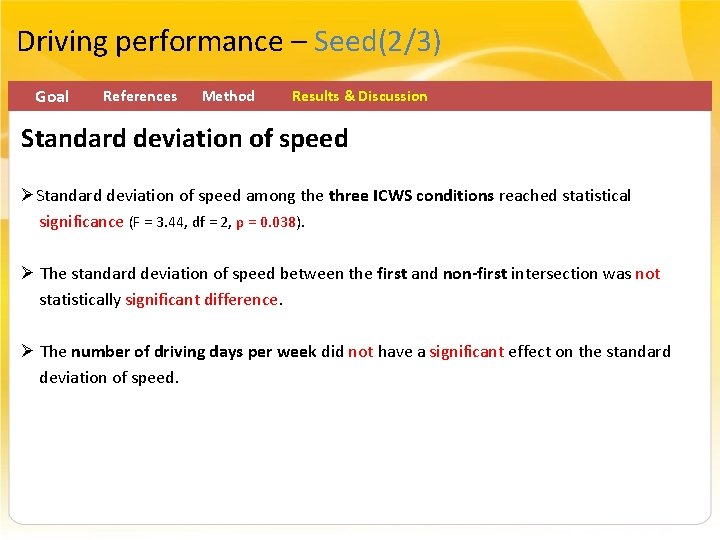
Driving performance – Seed(2/3) Goal References Method Results & Discussion Standard deviation of speed ØStandard deviation of speed among the three ICWS conditions reached statistical significance (F = 3. 44, df = 2, p = 0. 038). Ø The standard deviation of speed between the first and non-first intersection was not statistically significant difference. Ø The number of driving days per week did not have a significant effect on the standard deviation of speed.
Driving performance – Seed(3/3) Goal References Method Results & Discussion-seed 1) A high driving speed may require a longer brake time in order to avoid an accident. 2) When drivers were not aware of any violator vehicles at an intersection and maintained a high driving speed, their reaction time was long.
Driving performance – Lateral position deviation Goal References Method Results & Discussion There were no significant differences in the lateral control over the host vehicle among the three ICWS conditions.
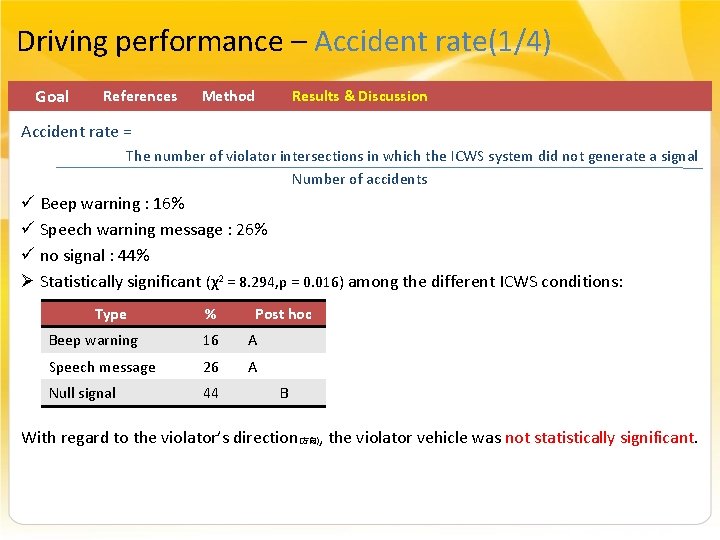
Driving performance – Accident rate(1/4) Goal References Method Results & Discussion Accident rate = The number of violator intersections in which the ICWS system did not generate a signal Number of accidents ü Beep warning : 16% ü Speech warning message : 26% ü no signal : 44% Ø Statistically significant (χ2 = 8. 294, p = 0. 016) among the different ICWS conditions: Type % Post hoc Beep warning 16 A Speech message 26 A Null signal 44 B With regard to the violator’s direction(方向), the violator vehicle was not statistically significant.
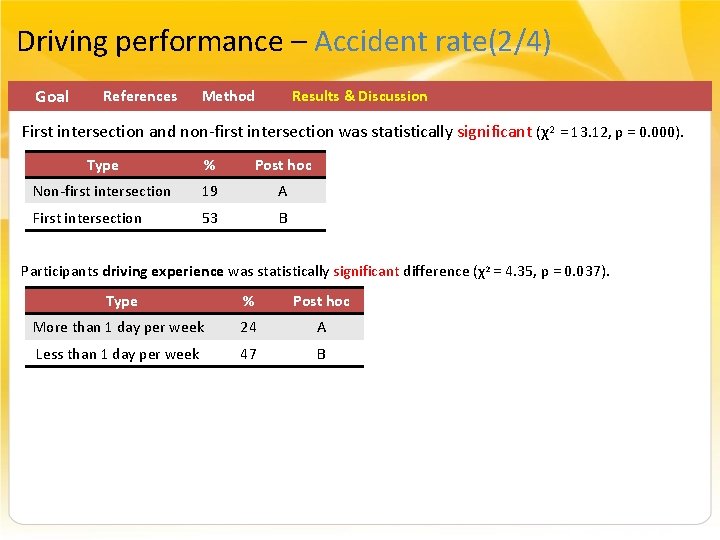
Driving performance – Accident rate(2/4) Goal References Method Results & Discussion First intersection and non-first intersection was statistically significant (χ2 = 13. 12, p = 0. 000). Type % Post hoc Non-first intersection 19 A First intersection 53 B Participants driving experience was statistically significant difference (χ2 = 4. 35, p = 0. 037). Type % Post hoc More than 1 day per week 24 A Less than 1 day per week 47 B
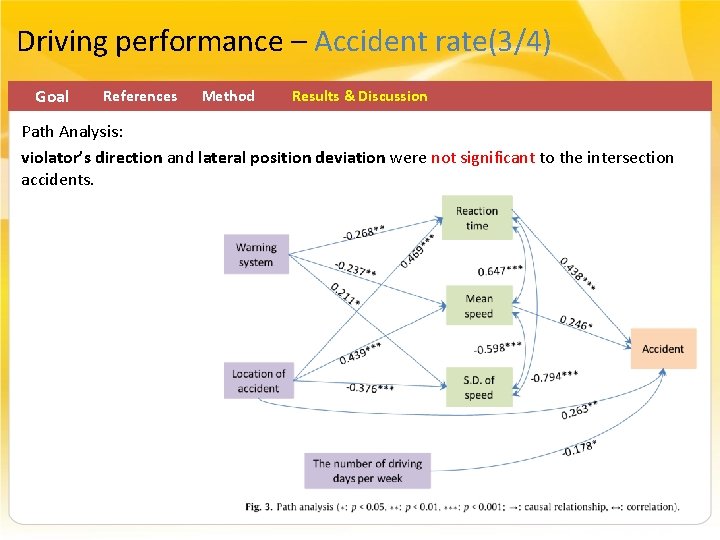
Driving performance – Accident rate(3/4) Goal References Method Results & Discussion Path Analysis: violator’s direction and lateral position deviation were not significant to the intersection accidents.
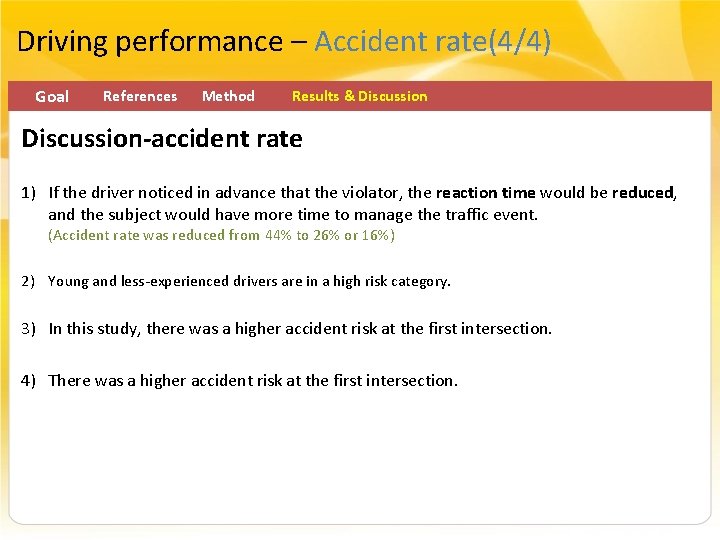
Driving performance – Accident rate(4/4) Goal References Method Results & Discussion-accident rate 1) If the driver noticed in advance that the violator, the reaction time would be reduced, and the subject would have more time to manage the traffic event. (Accident rate was reduced from 44% to 26% or 16%) 2) Young and less-experienced drivers are in a high risk category. 3) In this study, there was a higher accident risk at the first intersection. 4) There was a higher accident risk at the first intersection.