
The education system in Poland Structure of the
- Slides: 14
The education system in Poland
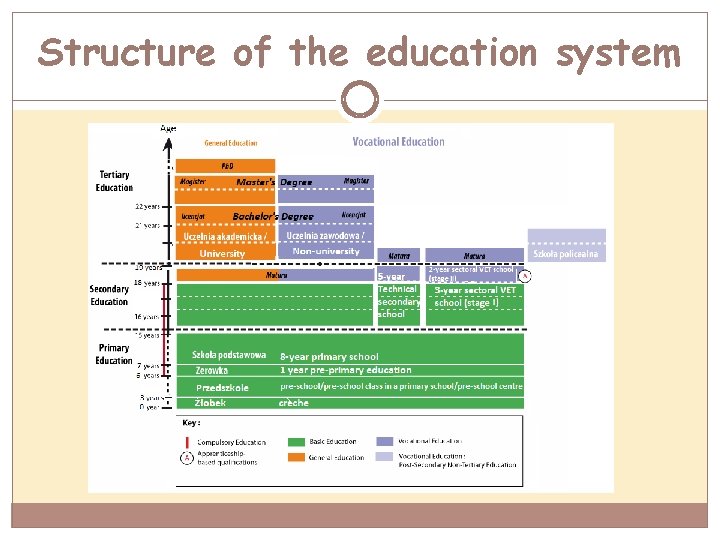
Structure of the education system
Legal basis for the school education The main legal basis for the school education and higher education systems is provided by the Constitution of the Republic of Poland. Every person has the right to education. Education is compulsory until the age of 18. Education in public schools is free of charge. Parents are free to choose schools other than public for their children.
Compulsory education is divided into: one-year pre-school preparation; full-time education in school settings that lasts until the completion of primary education (typically 15 years of age); part-time education until the age of 18 in school or nonschool settings.
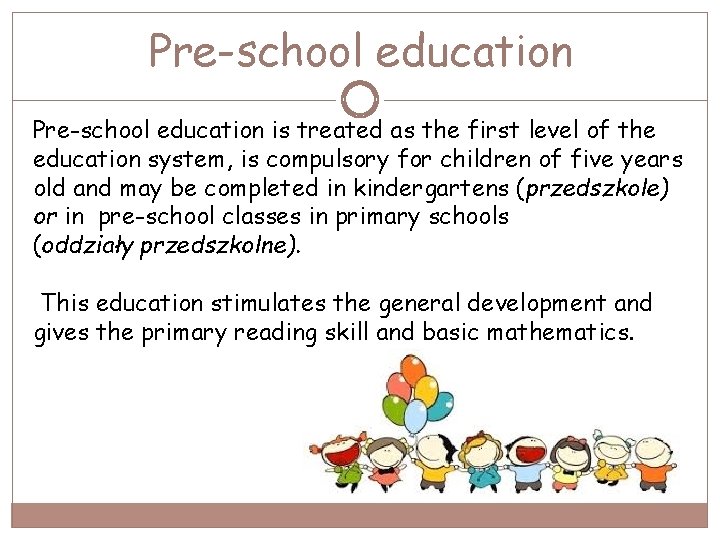
Pre-school education is treated as the first level of the education system, is compulsory for children of five years old and may be completed in kindergartens (przedszkole) or in pre-school classes in primary schools (oddziały przedszkolne). This education stimulates the general development and gives the primary reading skill and basic mathematics.
Primary school Pupils of 6 -15 attend primary school, which is compulsory. Primary education is divided into two cycles: the first cycle (grades 1 -3) at which beginning learning is offered, the second cycle (grades 4 -8) at which systematic learning is provided.
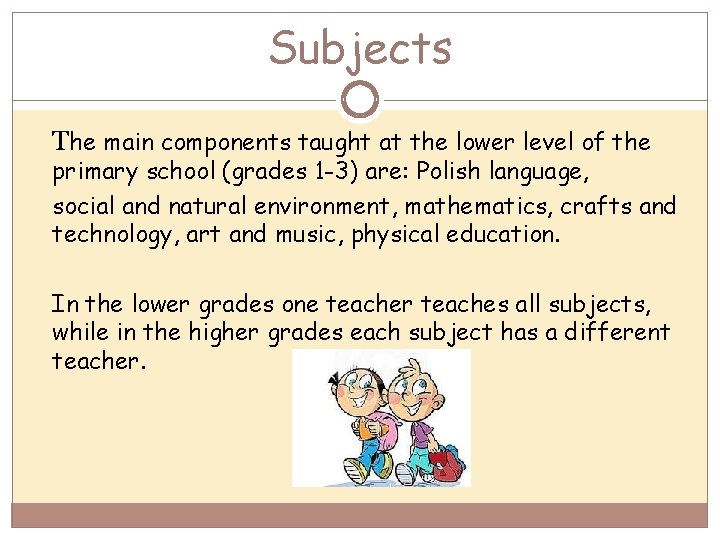
Subjects The main components taught at the lower level of the primary school (grades 1 -3) are: Polish language, social and natural environment, mathematics, crafts and technology, art and music, physical education. In the lower grades one teacher teaches all subjects, while in the higher grades each subject has a different teacher.
At the end of the 8 -year primary school, pupils take an external compulsory test (set by the Regional Examination Boards and assessed by examiners selected by these boards). This test is designed to provide information and is not an examination.
Secondary education Primary school graduates can continue their education in the following types of schools: 4 -year general secondary school (liceum ogólnokształcące) leading to the receipt of the matriculation certificate (świadectwo maturalne) upon passing of the external matriculation exam (Matura);
- 5 -year technical secondary school (technikum) leading to the receipt of a diploma confirming vocational qualifications upon passing of an examination, - 3 -year sectoral vocational school stage I (branżowa szkoła I stopnia) that leads to the receipt of a diploma confirming vocational qualifications upon passing of an exam, - 2 -year sectoral vocational school stage II (branżowa szkoła II stopnia) leading to the receipt of a diploma confirming higher vocational qualifications and the matriculation certificate (świadectwo maturalne) upon passing of the external matriculation exam (Matura);
The grading system is as follows: 1 2 3 4 5 6 (niedostateczna, insufficient) (dopuszczajaca, passing) (dostateczna, sufficient) (dobra, good) (bardzo dobra, very good) (celujaca, excellent) 1 is the failing grade, 2 to 5 are normal passing grades and 6 means that the student has exceeded expectations.
Higher education Graduates of secondary schools in Poland who hold the matriculation certificate have a wide variety of educational possibilities. Those who have passed the final examination called „matura" may apply to universities. Those who do not want to study at university and those who have not taken the „matura" examination may continue their education in post - secondary vocational schools.
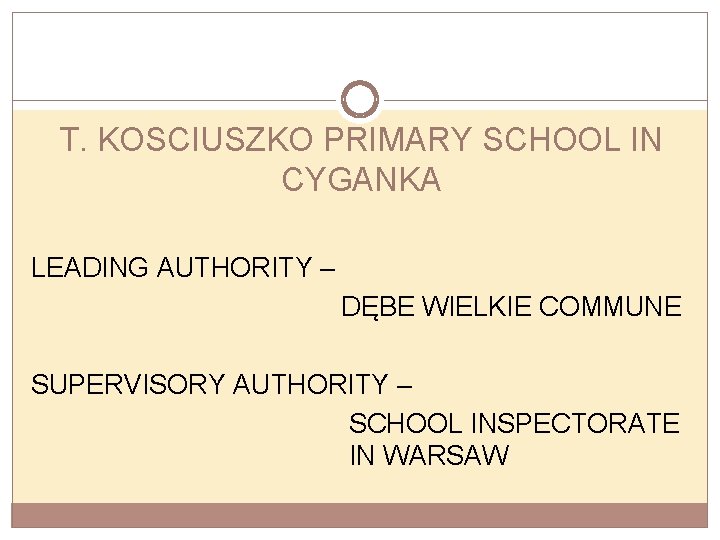
T. KOSCIUSZKO PRIMARY SCHOOL IN CYGANKA LEADING AUTHORITY – DĘBE WIELKIE COMMUNE SUPERVISORY AUTHORITY – SCHOOL INSPECTORATE IN WARSAW