
The Education Class Total Hip Replacement Welcome Use

- Slides: 81
The Education Class Total Hip Replacement
Welcome! • Use the information in this Power. Point presentation to guide you through your joint replacement journey • Please also watch the Hip Replacement Journey Videos. These mini video clips can be viewed at the relevant stages of your journey. You will find them on the SWATT webpage. • Ensure you have read and watched all this information prior to your surgery
Hip Replacement Surgery • Joint replacement is elective surgery; this means it is your choice • The aims of hip replacement surgery are to: – relieve your hip pain – correct any deformity – restore your function – improve your quality of life
Length of Stay • Some patients will go home the day of their surgery • Most patients will stay overnight • Rehab at home with SWATT – South – Warwickshire – Accelerated – Transfer – Team
Benefits of Short Hospital Stay There are many benefits of a short hospital stay: ü Lower risk of infection ü Reduced risk of blood clots ü Faster recovery ü Improved comfort
Content This presentation will cover the main stages of your hip replacement journey: • • Pre-Operation Post-Operation Discharge
Pre-Operation
Mini Health Screen On the day you were listed for surgery, you would have attended Pre-Op Assessment Clinic for a mini health screen. This would have included: • your blood pressure, weight and height measurements • an assessment for sleep apnoea • a finger prick test to assess iron levels • an MRSA swab from your nose and groin Due to measures in place during the COVID pandemic this may not have occurred and would have formed part of your full pre-operative assessment
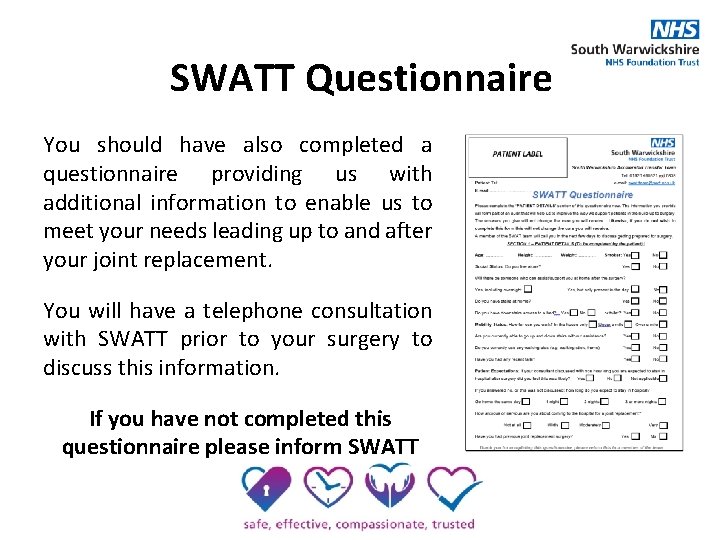
SWATT Questionnaire You should have also completed a questionnaire providing us with additional information to enable us to meet your needs leading up to and after your joint replacement. You will have a telephone consultation with SWATT prior to your surgery to discuss this information. If you have not completed this questionnaire please inform SWATT
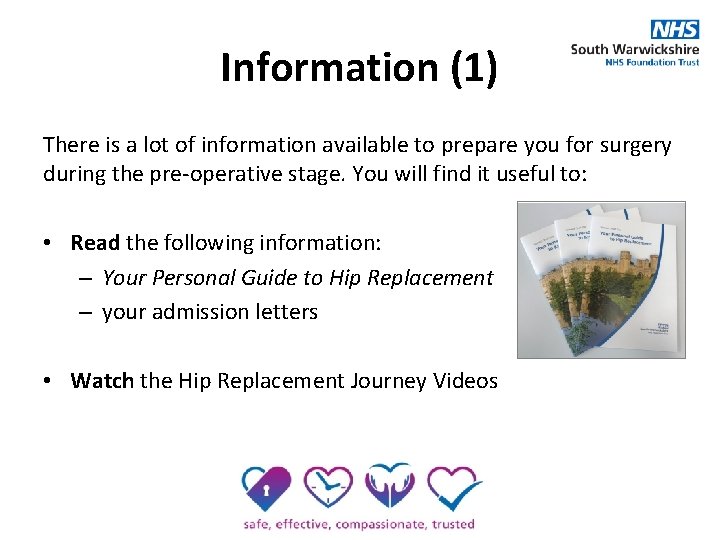
Information (1) There is a lot of information available to prepare you for surgery during the pre-operative stage. You will find it useful to: • Read the following information: – Your Personal Guide to Hip Replacement – your admission letters • Watch the Hip Replacement Journey Videos
Information (2) • Listen to advice given to prepare and plan for your surgery and recovery • Ask questions during your telephone consultation with SWATT • Involve your supporter Be positive!
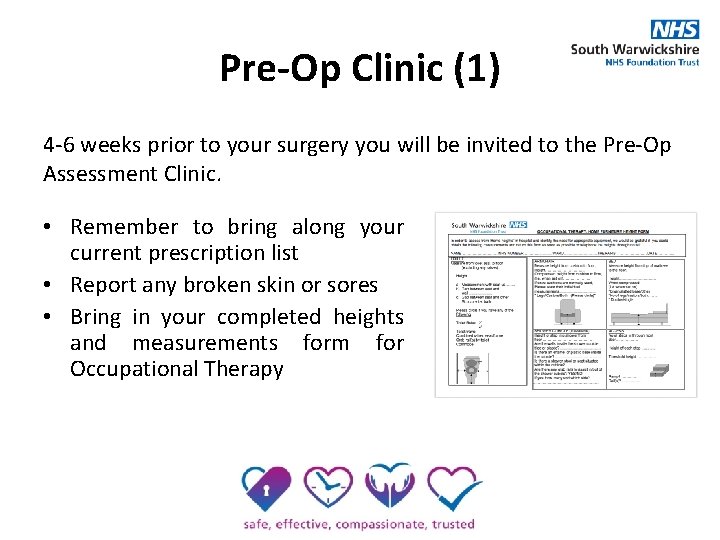
Pre-Op Clinic (1) 4 -6 weeks prior to your surgery you will be invited to the Pre-Op Assessment Clinic. • Remember to bring along your current prescription list • Report any broken skin or sores • Bring in your completed heights and measurements form for Occupational Therapy
Pre-Op Clinic (2) Your assessment will include: • A discussion of your medical history • Medication advice • Repeat MRSA swabs • A blood test It may also include: • An ECG • An X-Ray of your hip
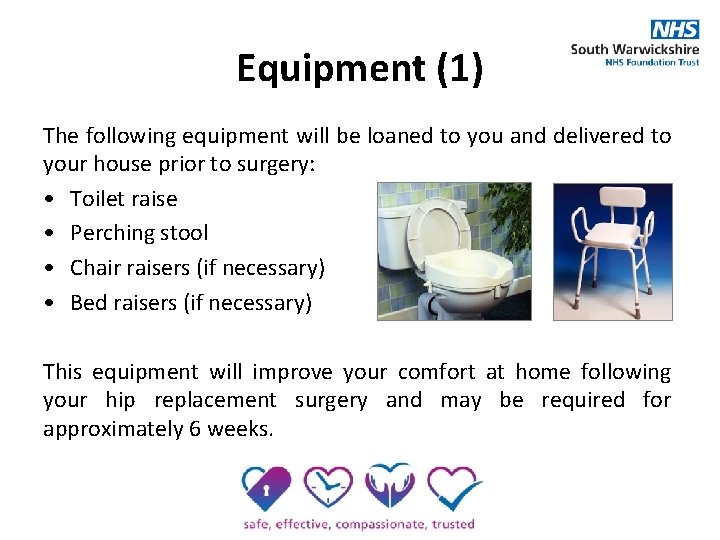
Equipment (1) The following equipment will be loaned to you and delivered to your house prior to surgery: • Toilet raise • Perching stool • Chair raisers (if necessary) • Bed raisers (if necessary) This equipment will improve your comfort at home following your hip replacement surgery and may be required for approximately 6 weeks.
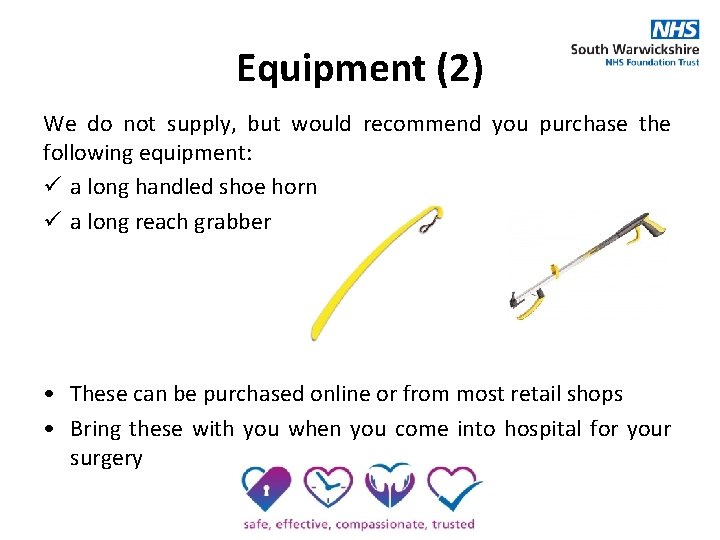
Equipment (2) We do not supply, but would recommend you purchase the following equipment: ü a long handled shoe horn ü a long reach grabber • These can be purchased online or from most retail shops • Bring these with you when you come into hospital for your surgery
Handy Hints • In your kitchen and bathroom move frequently used items to waist height to save you stretching or bending unnecessarily • Arrange your furniture to give you clear pathways around your home and remove trip hazards • Stock your freezer with frozen foods or easy to prepare meals • Arrange help with shopping and housework • Consider care for pets for at least 2 weeks post-surgery It is not a discharge requirement to have someone with you at home, but if you are able to have someone initially this will help
Exercises • The following exercises are really important • These are the same exercises that you will do after your surgery • Practising them now will help strengthen your muscles, improve your flexibility and make it easier for you after your surgery Please watch the video: Getting Fit for Surgery
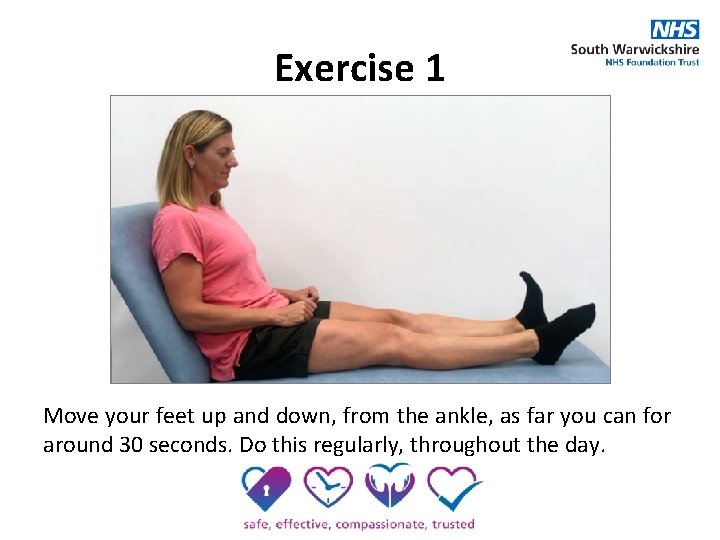
Exercise 1 Move your feet up and down, from the ankle, as far you can for around 30 seconds. Do this regularly, throughout the day.
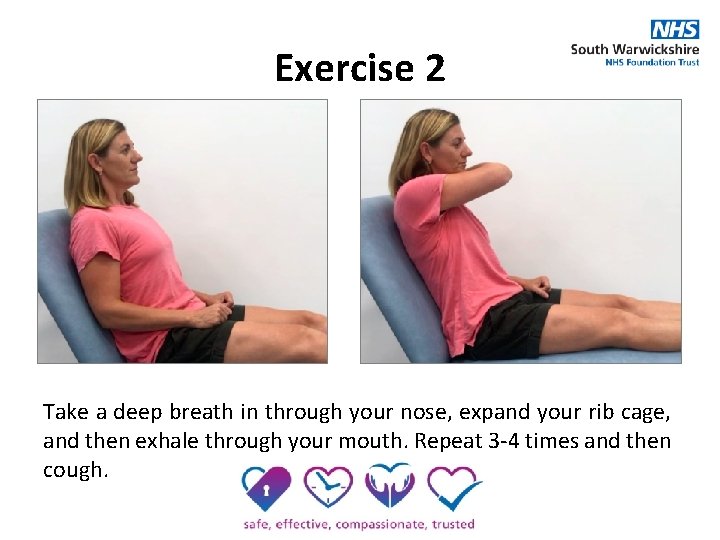
Exercise 2 Take a deep breath in through your nose, expand your rib cage, and then exhale through your mouth. Repeat 3 -4 times and then cough.
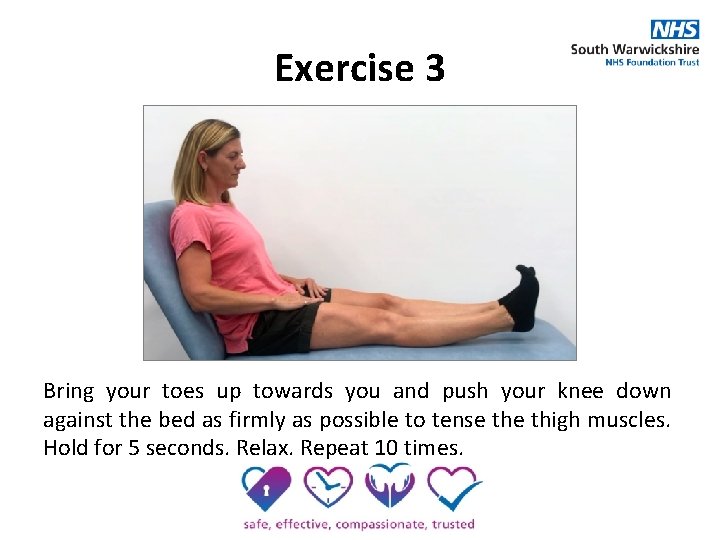
Exercise 3 Bring your toes up towards you and push your knee down against the bed as firmly as possible to tense thigh muscles. Hold for 5 seconds. Relax. Repeat 10 times.
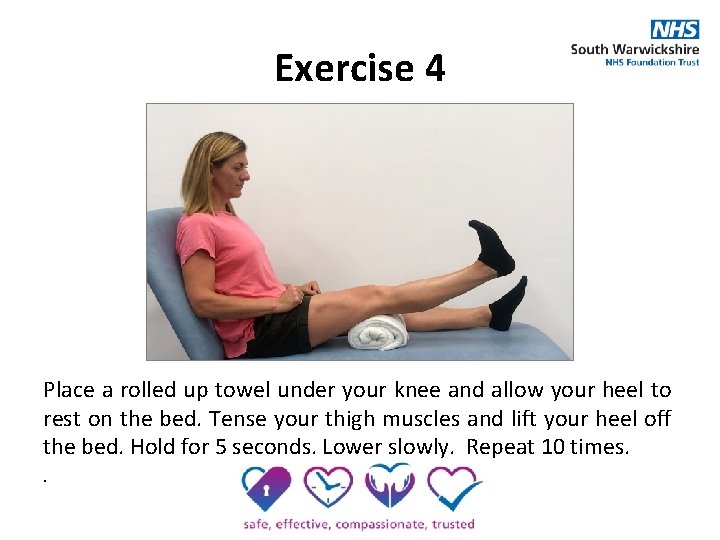
Exercise 4 Place a rolled up towel under your knee and allow your heel to rest on the bed. Tense your thigh muscles and lift your heel off the bed. Hold for 5 seconds. Lower slowly. Repeat 10 times. .
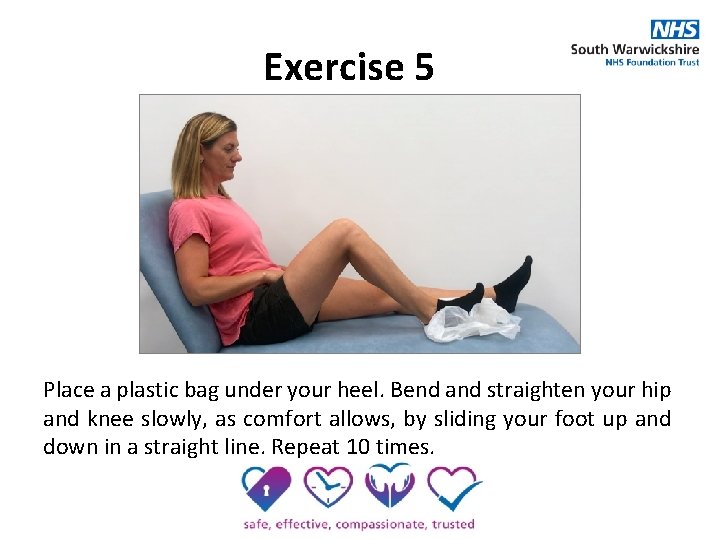
Exercise 5 Place a plastic bag under your heel. Bend and straighten your hip and knee slowly, as comfort allows, by sliding your foot up and down in a straight line. Repeat 10 times.
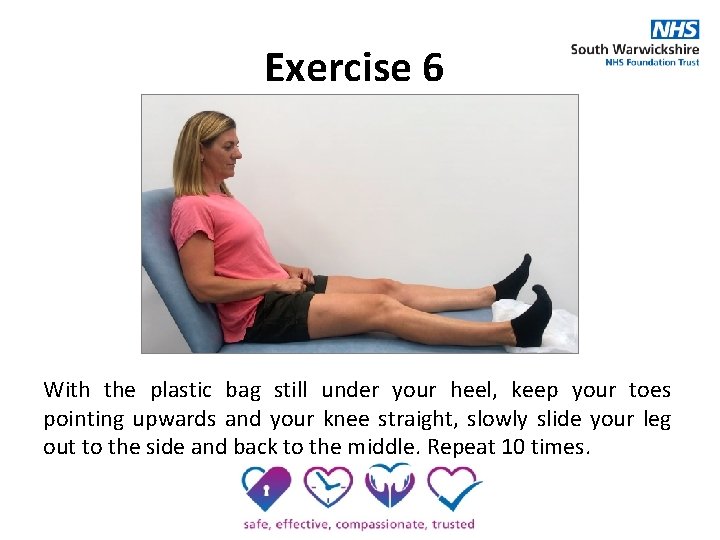
Exercise 6 With the plastic bag still under your heel, keep your toes pointing upwards and your knee straight, slowly slide your leg out to the side and back to the middle. Repeat 10 times.
Exercises • It is normal to expect some pain and tightness as you do these exercises • Try to do these exercises 2 or 3 times a day • Aim to do 10 repetitions of each exercise Start today!
Getting Fit • Eat a well-balanced diet • Ensure adequate fluid intake (6 -8 glasses of water a day) • Remain active with gentle exercise, e. g. walking and swimming • Keep alcohol within NHS guidelines (no more than 14 units a week, on a regular basis) • Smoking increases risk of infection and slows down healing so if you are a smoker, use this time leading up to surgery to cut down. If you need further help or advice, please see your GP or Practice Nurse.
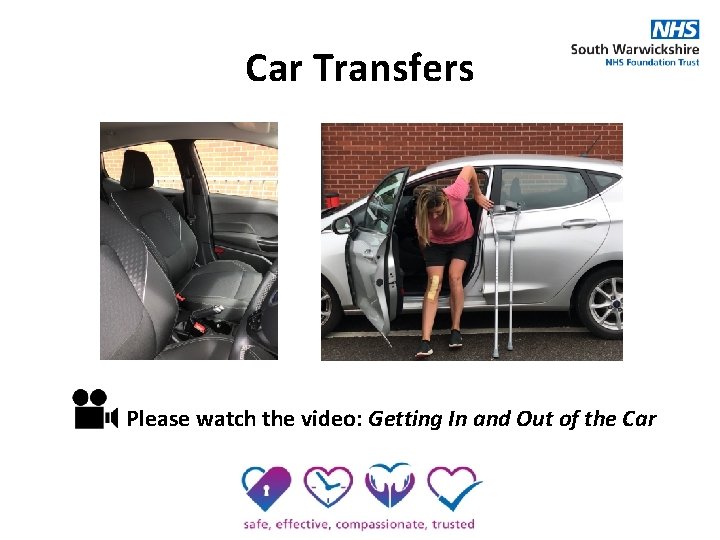
Car Transfers Please watch the video: Getting In and Out of the Car
Packing Your Bag • Please refer to Your Personal Guide to Hip Replacement Surgery which contains a checklist of everything you will need to bring into hospital • Time can pass slowly on the ward so bring something to occupy yourself • You might also want to bring in a small amount of money. Please bring your own padlock for your locker • Please remember to bring in a 14 day supply of your current medication, in their original packets
Night Before Surgery • The evening before surgery, have a good carbohydrate-loaded meal, according to your dietary needs • Ensure you have a good bowel movement to reduce the risk of post-operative constipation and drink plenty of fluids • Have a bath or shower, the night before or the morning of your surgery with unscented products and remove all nail varnish or gels • Please read your admission letter carefully for advice on: • Admission time • Fasting time
If you feel unwell before your surgery please phone: Greville Ward ext. 6067/6068 as soon as possible
Operation
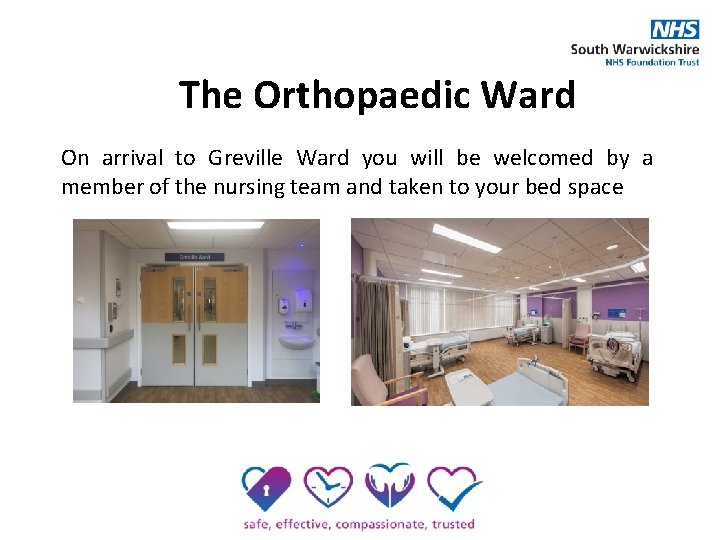
The Orthopaedic Ward On arrival to Greville Ward you will be welcomed by a member of the nursing team and taken to your bed space
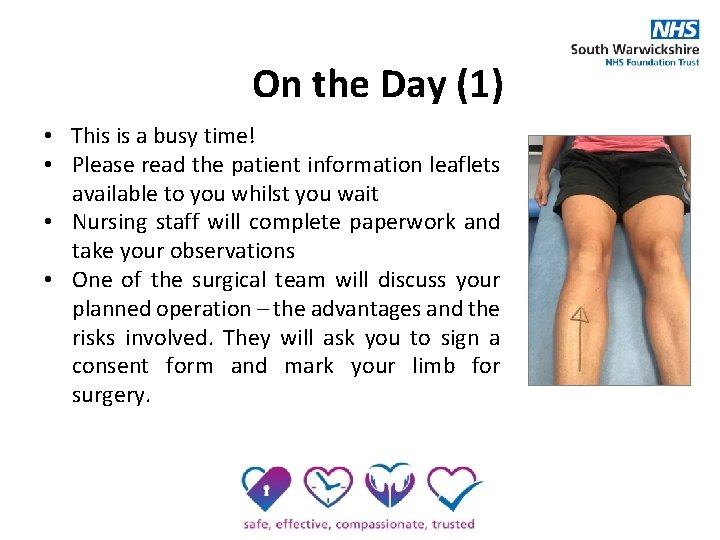
On the Day (1) • This is a busy time! • Please read the patient information leaflets available to you whilst you wait • Nursing staff will complete paperwork and take your observations • One of the surgical team will discuss your planned operation – the advantages and the risks involved. They will ask you to sign a consent form and mark your limb for surgery.
On the Day (2) • You will also be reviewed by your Anaesthetist who will discuss your anaesthetic options with you and decide which option will be best for you • Nursing staff will inform you when to change into your theatre gown, dressing gown and slippers • A member of the team will walk with you down to theatre and will stay with you until you go into the anaesthetic room
Anaesthetic Options There are 2 anaesthetic options for joint replacement surgery: Spinal Anaesthetic General Anaesthetic There is a link below this presentation to a leaflet called Anaesthetic Choices for Hip and Knee Replacement. This provides further information regarding both techniques. You will also receive a copy in the post. Both techniques are safe in their own merits
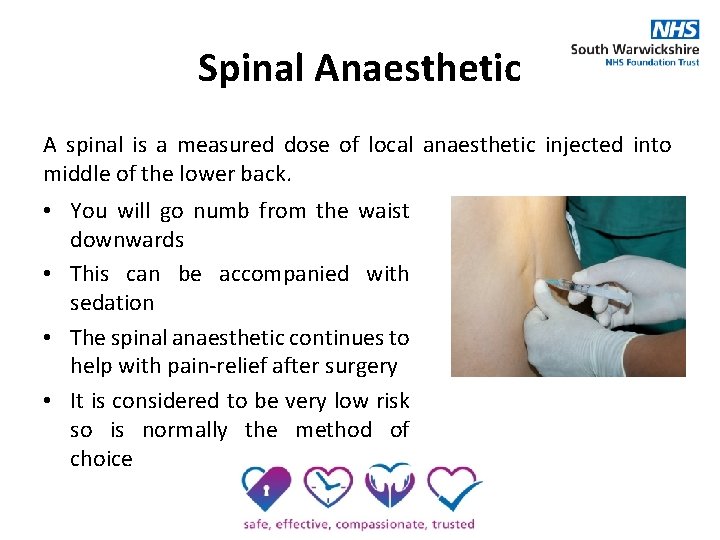
Spinal Anaesthetic A spinal is a measured dose of local anaesthetic injected into middle of the lower back. • You will go numb from the waist downwards • This can be accompanied with sedation • The spinal anaesthetic continues to help with pain-relief after surgery • It is considered to be very low risk so is normally the method of choice
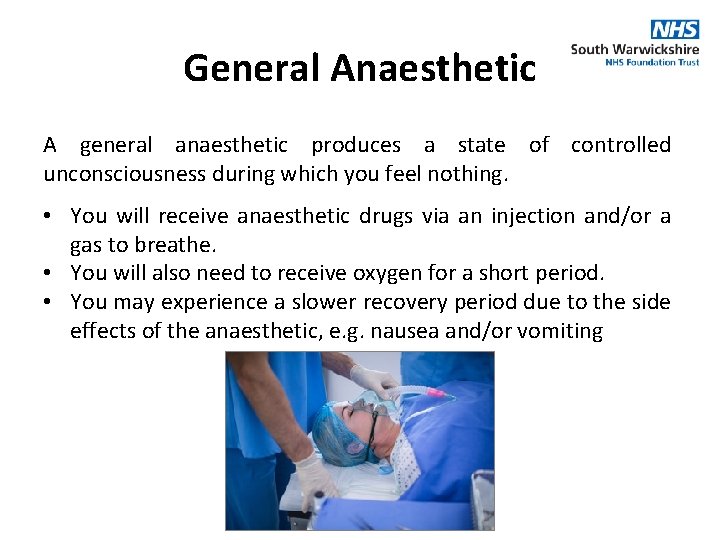
General Anaesthetic A general anaesthetic produces a state of controlled unconsciousness during which you feel nothing. • You will receive anaesthetic drugs via an injection and/or a gas to breathe. • You will also need to receive oxygen for a short period. • You may experience a slower recovery period due to the side effects of the anaesthetic, e. g. nausea and/or vomiting
Anaesthetic Choice • Please read the anaesthetic information provided • Your Anaesthetist will come and see you on the day of your surgery • The decision regarding which anaesthetic choice will be best for you will be made between you and your Anaesthetist
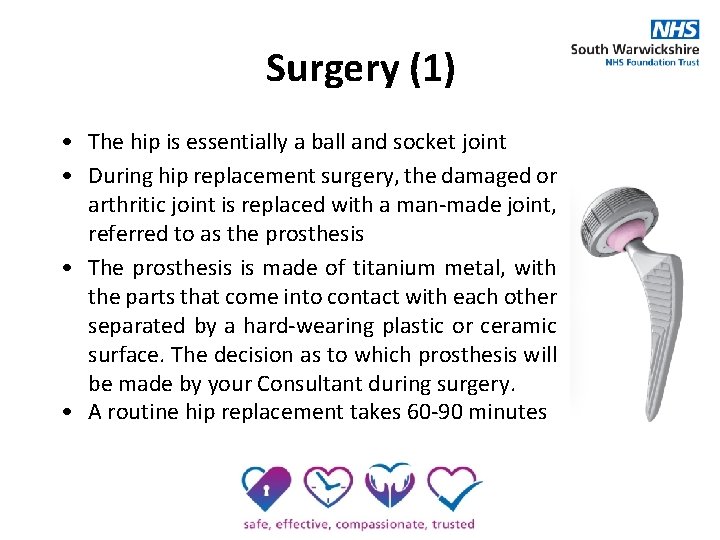
Surgery (1) • The hip is essentially a ball and socket joint • During hip replacement surgery, the damaged or arthritic joint is replaced with a man-made joint, referred to as the prosthesis • The prosthesis is made of titanium metal, with the parts that come into contact with each other separated by a hard-wearing plastic or ceramic surface. The decision as to which prosthesis will be made by your Consultant during surgery. • A routine hip replacement takes 60 -90 minutes
Surgery (2) • Your scar will be around the outside of your hip and will be closed with dissolvable stitches • After your surgery is complete, you will be taken to the recovery area • You will be connected to various pieces of equipment which will help the nurses monitor your blood pressure and other observations as well as giving you fluids, pain medication and oxygen • Once the Anaesthetist is happy that you are medically stable, you will be transferred back to Greville Ward
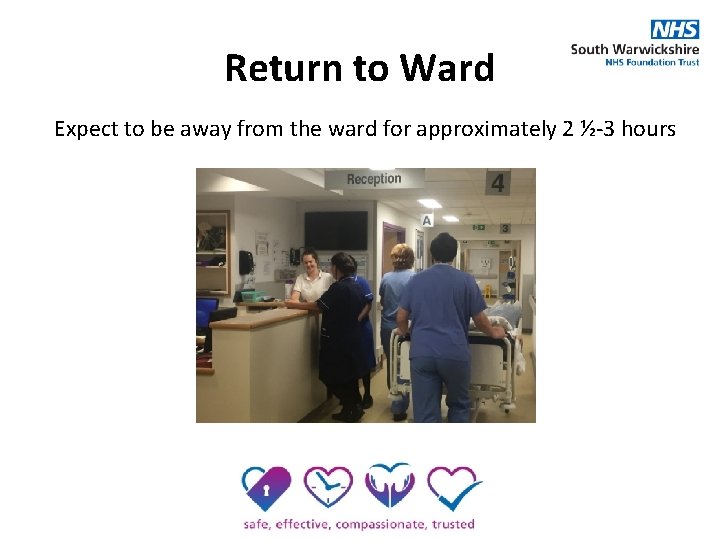
Return to Ward Expect to be away from the ward for approximately 2 ½-3 hours
Post-Operation
Recovery After Surgery (1) • A handover of your care and treatment in theatre will be given to ward staff, who will continue to take your observations regularly • You can call a member of the nursing team at any time • If you have had a spinal anaesthetic, your leg may feel numb for a few hours after your surgery but start taking regular pain relief before the numbness wears off • Some of the painkillers may cause nausea, so let a member of the nursing team know if you feel sick as you can be given anti -sickness medication
Recovery After Surgery (2) • You will be encouraged to eat and drink normally • Please accept gentle laxatives as fasting, anaesthetic and medications will constipate you • Catheters are not routine but if you need one it will be removed as soon as possible and any fluid drips will be removed once you are drinking well • Your bloods and an X-Ray of your new joint will be taken and checked either on the day of your surgery, or the following day.
Recovery After Surgery (3) • You can restart your exercises as soon as you have regained sensation in your legs. You will be seen by a physiotherapist to review your exercises. • It may be possible for you to mobilise from 2 hours after returning to the ward. This may be with a physiotherapist or another healthcare professional. • It is normal for you to mobilise before you have had a check XRay as your new joint is assessed at the end of surgery.
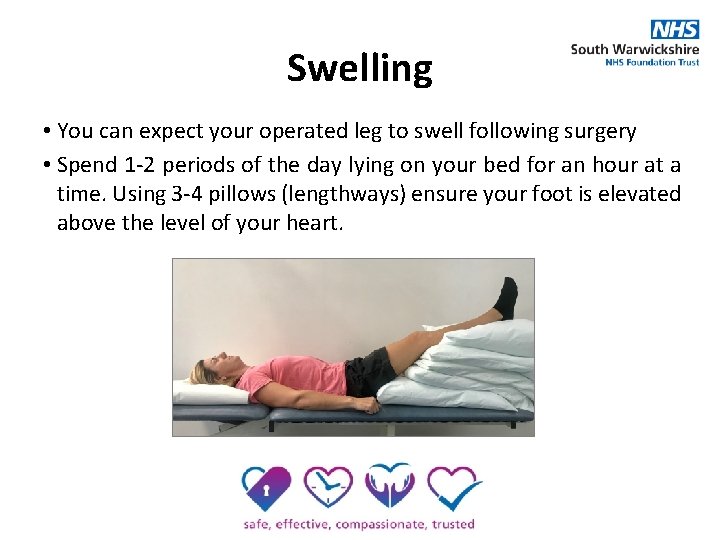
Recovery After Surgery (4) • You will normally mobilise with a walking frame initially and then be progressed to elbow crutches as soon as able Please watch the videos: Walking with a Frame Walking with Crutches • To help relieve expected swelling we recommend you spend 1 -2 periods of the day lying on your bed with your leg elevated for an hour at a time
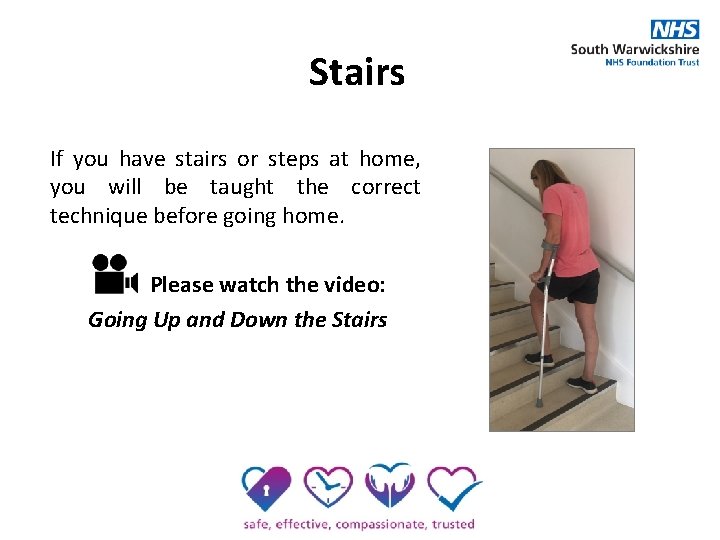
Stairs If you have stairs or steps at home, you will be taught the correct technique before going home. Please watch the video: Going Up and Down the Stairs
Swelling • You can expect your operated leg to swell following surgery • Spend 1 -2 periods of the day lying on your bed for an hour at a time. Using 3 -4 pillows (lengthways) ensure your foot is elevated above the level of your heart.
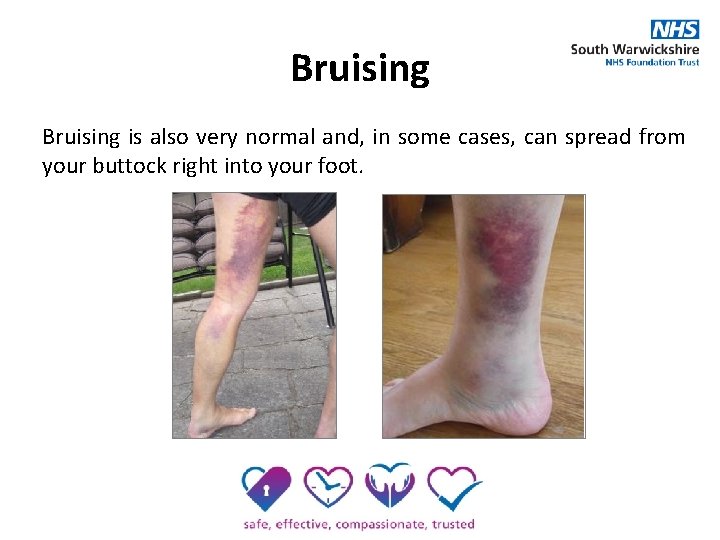
Bruising is also very normal and, in some cases, can spread from your buttock right into your foot.
Risks and Complications As with all surgery, there are risks involved. One of your Surgical Team will discuss these with you on the day of your surgery. Risks and complications include: • Wound infection • Chest infection • Blood clots • Dislocation
Wound Infections Despite measures to reduce the risk of infection there is still a very small chance of developing a wound infection. These are the signs and symptoms of a wound infection: • If the surrounding skin becomes hot and red and is spreading outwards • You notice an unusual odour • Increased pain • You feel unwell; feverish, shivery or achy • Or if your healed scar begins to leak fluid
Avoiding Infections The following precautions should be taken by the Orthopaedic Team: • Hand washing/gel • MRSA screening • Antibiotics during surgery The following precautions should be taken by you: • Shower before surgery • Eat and drink well • Reduce smoking • Aim for discharge home as soon as able
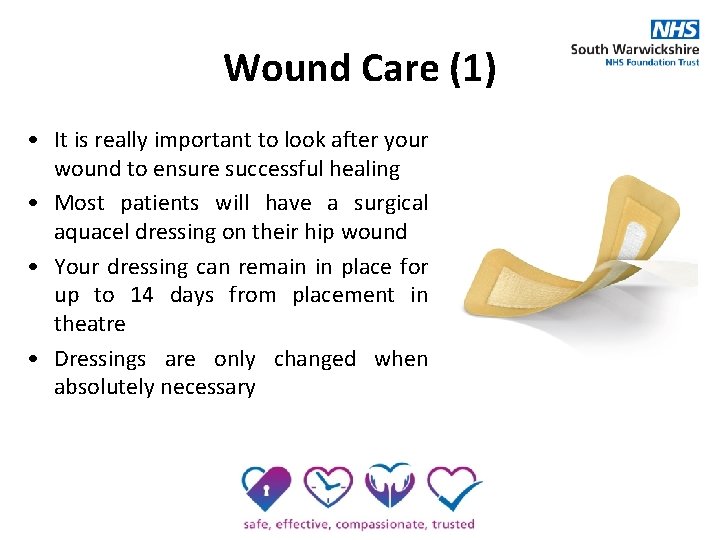
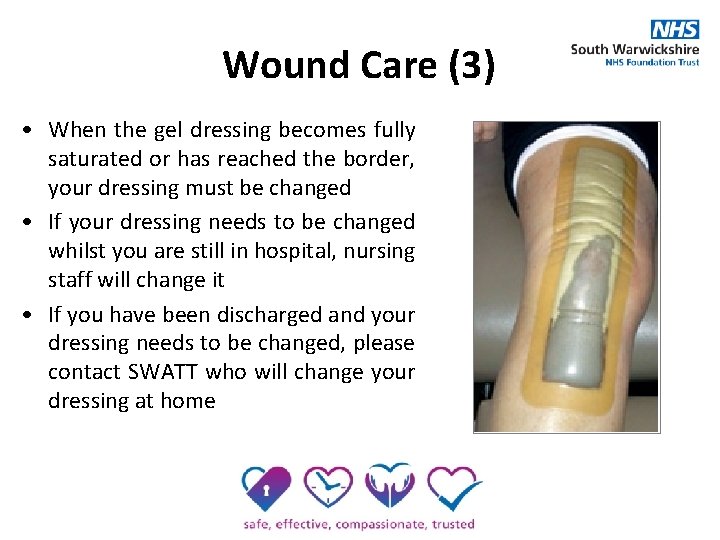
Wound Care (1) • It is really important to look after your wound to ensure successful healing • Most patients will have a surgical aquacel dressing on their hip wound • Your dressing can remain in place for up to 14 days from placement in theatre • Dressings are only changed when absolutely necessary
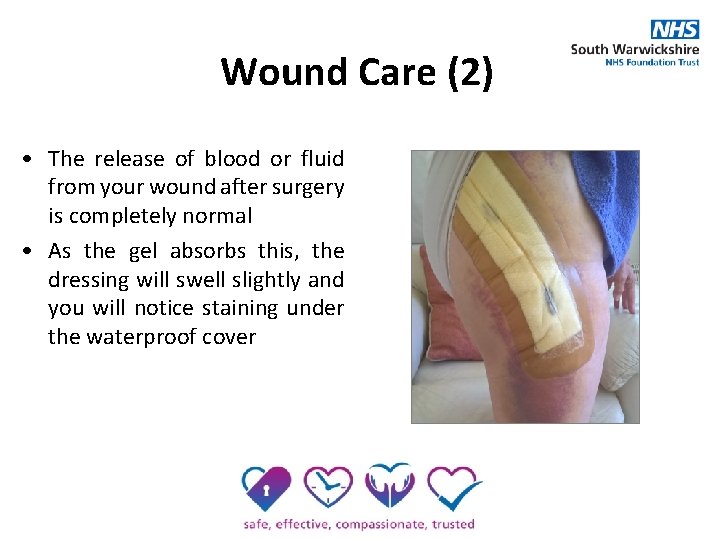
Wound Care (2) • The release of blood or fluid from your wound after surgery is completely normal • As the gel absorbs this, the dressing will swell slightly and you will notice staining under the waterproof cover
Wound Care (3) • When the gel dressing becomes fully saturated or has reached the border, your dressing must be changed • If your dressing needs to be changed whilst you are still in hospital, nursing staff will change it • If you have been discharged and your dressing needs to be changed, please contact SWATT who will change your dressing at home
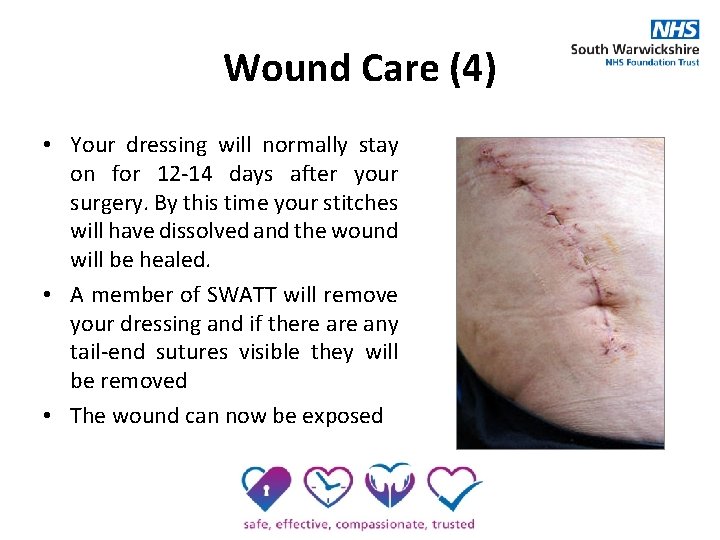
Wound Care (4) • Your dressing will normally stay on for 12 -14 days after your surgery. By this time your stitches will have dissolved and the wound will be healed. • A member of SWATT will remove your dressing and if there any tail-end sutures visible they will be removed • The wound can now be exposed
Avoiding Chest Infections The following activities will help you reduce your risk of developing a chest infection post-op: • Deep breathing exercises (Exercise 2) every hour • Sit up or out of bed • Get mobile as soon as you are able after surgery
Avoiding Blood Clots (1) • Surgery on the lower limb carries a risk of blood clots forming in the deep veins of the leg and occasionally in the lungs • A deep vein thrombosis (DVT) occurs when slow blood flow in veins of the leg causes it to clot. This causes progressive painful, red, hot, swelling of the leg (usually the calf). • A pulmonary embolism (PE) happens when a blood vessel in your lungs becomes blocked. Most of the time, this blockage is caused by a blood clot and happens suddenly. • Blood clots occur in less than 1% of joint replacement patients
Avoiding Blood Clots (2) We take precautions during and after surgery to minimise the risk of blood clots developing: • Flowtron pumps are wrapped around your calves to mechanically pump blood away from your lower legs until you are mobile • Perform circulatory exercises (Exercise 1) as soon as you are able, ideally every hour • You will also be started on blood-thinning medication: – Tinzaparin injections for 10 days – Dispersible aspirin for 28 days
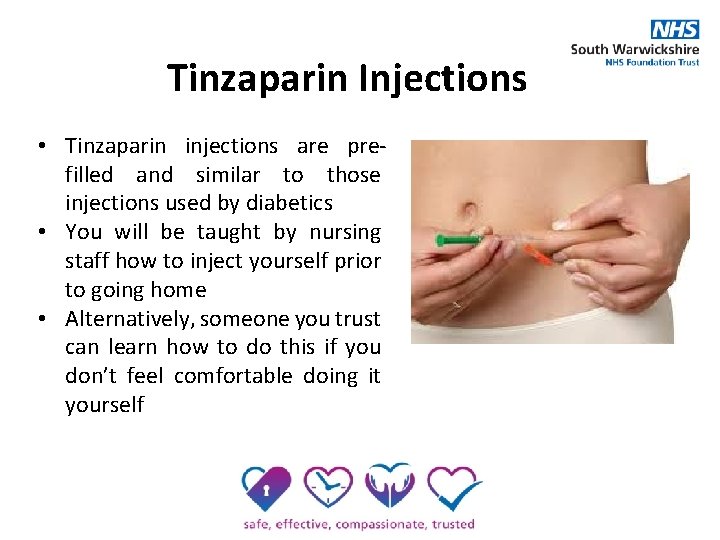
Tinzaparin Injections • Tinzaparin injections are prefilled and similar to those injections used by diabetics • You will be taught by nursing staff how to inject yourself prior to going home • Alternatively, someone you trust can learn how to do this if you don’t feel comfortable doing it yourself
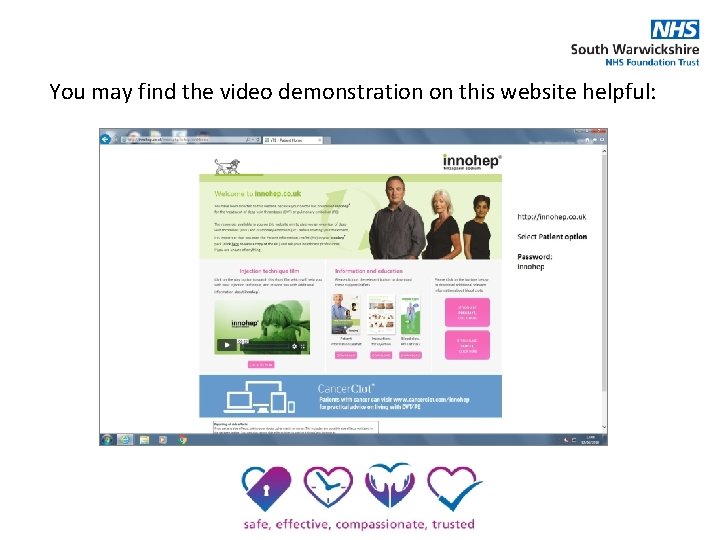
You may find the video demonstration on this website helpful:
Avoiding Dislocation • After surgery, the muscles supporting your new hip joint will be weak • Therefore, in the first 6 weeks, you may move as comfort allows, but avoid extreme movements whilst you strengthen the muscles surrounding your hip • Try and sleep on your back if you can • If a dislocation occurs, the joint can be put back into place. However, if the hip keeps dislocating, revision surgery may be needed. • Dislocations are a rare occurrence (only 1 -2% patients)
Discharge
Going Home This decision will be made by the Orthopaedic Team. You must satisfy the following criteria: ü You must be medically fit ü Your pain should be well controlled ü You should be mobilising and able to do the stairs safely ü You tablets must be ready to take home Some patients will go home the same day as their surgery (this will have been agreed prior to your admission). However, most patients will stay overnight.
Useful Contacts SWATT: Greville Ward: NHS 111: Emergency: 8 am - 4 pm - 8 am 24 hrs ext. 6838 ext. 6067/6068 111 999/112
Getting Better at Home Once at home you need to continue to: • Eat and drink well • Take medication as advised • Mobilise hourly • Complete your exercises at least 3 times a day • Rest on the bed for a 1 -hour period during the day with your leg elevated above your heart • Apply ice for 20 minutes after exercises and regularly through the day
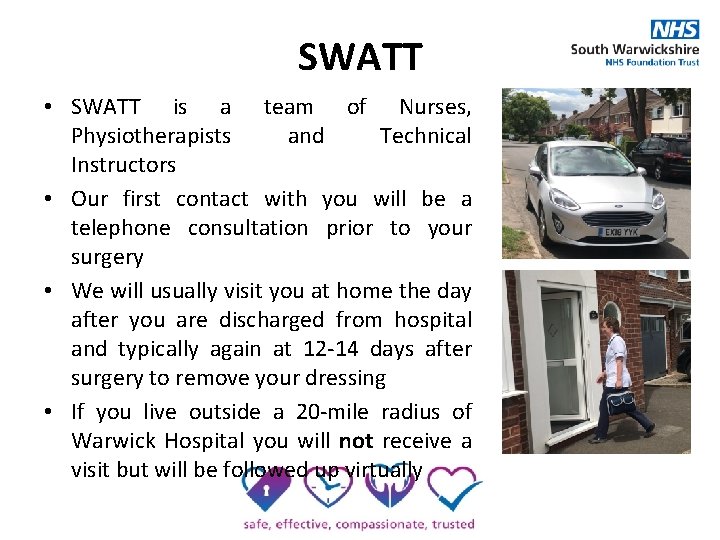
SWATT • SWATT is a team of Nurses, Physiotherapists and Technical Instructors • Our first contact with you will be a telephone consultation prior to your surgery • We will usually visit you at home the day after you are discharged from hospital and typically again at 12 -14 days after surgery to remove your dressing • If you live outside a 20 -mile radius of Warwick Hospital you will not receive a visit but will be followed up virtually
SWATT Visit A typical SWATT visit may include the following: • Observations e. g. blood pressure • Wound review and dressing change (if indicated) • Exercise review • Mobility progression • Transfer practice, e. g. bed or stairs • Bowel care advice and/or treatment • Take-home medications review • Advice about weaning off medication appropriately
Lifetime Guarantee Even after you have been discharged from SWATT, you must contact us if you have any concerns about your wound or scar - even if this is weeks, months or years after surgery… …you have a ‘lifetime guarantee’
Getting Back to Normal • At first, you may find the day-to-day routine rather awkward and tiring, although it will get easier as the weeks go by • Make sure that you eat a healthy, balanced diet and try to continue to drink 6 -8 glasses of water a day • If you have lost weight, try to keep it off; it will reduce pressure on your new joint and help you to undertake your exercises more easily • Please try not compare yourselves to others Everyone is unique and recovers at different rates
Showering • The dressing on your hip is waterproof so you can shower when you can get in and out of the shower easily • Although the dressing is shower proof, it is recommended to keep it as dry as possible as the dressing will only stick to dry skin • When showering, place your back to the shower to avoid the shower directly going onto your dressing
Driving • Driving is usually possible after 6 weeks when your joint is feeling comfortable and you are not requiring strong painkillers that might impair your judgement • Make sure that you can perform an emergency stop safely • You have a legal obligation to inform your car insurance company that you have had joint replacement surgery
Travel • You are at an increased risk of developing a blood clot if you take a prolonged journey after your joint replacement • You are therefore advised against flying short-haul (less than 4 hours) for 6 weeks and long-haul (more than 4 hours) for 12 weeks. • If you take a prolonged car journey you must stop for regular breaks • The metal in your new joint may activate metal detectors and security devices; it may be a good idea to carry a copy of your discharge paperwork
Sex • • You may resume sexual activities as soon as you feel ready Let your partner take an active role You may find that certain positions are more comfortable. Just remember to avoid extremes of movement
Try not to compare yourselves to others; you are all unique and will therefore recover at a different rate
Expected Progression Weeks 1 -3: • Continue exercises • Walk short distances, mostly around your home • Use crutches for at least the first 3 weeks • Pain in your back and even your non-operated hip is common and will settle with time
Expected Progression Weeks 3 -6: • Your pain should now be improving • You may sleep in any position, including on either side if your scar feels comfortable • Continue exercises, including the advanced exercises in standing • Progress to one crutch (on your non-operated side) • Return your crutches to the Physiotherapy Departments at Warwick, Stratford or Leamington Hospitals
Expected Progression Weeks 6 -12: • Start to return to your normal daily activities • Gradually increase walking distance without crutches, indoors and outdoors • Start going up and down stairs normally • Put on your own socks and shoes • Overdoing it can cause soreness and swelling that may last a few days • You may return to a desk-based job from 6 -8 weeks • You may not return to a manual job until closer to 12 weeks post-surgery
Physical Exercise Returning to physical exercise may be an important goal for you. We are keen for you to do this too and to get the most out of your new hip. • The NHS recommends 150 minutes moderate exercise per week • Walking is the best exercise for you in the first few months • Avoid demanding physical activities, e. g. tennis, hiking and dancing for at least 3 months post-surgery • As with all physical activities, you should build up the duration and intensity slowly
6 -Week Follow-Up • You will receive a letter inviting you to a follow-up appointment (usually around 6 -weeks following your surgery) to ensure that you are coping with your new hip • This may be in the format of a group setting • Bring along any questions you have • Many patients recover quickly without the need for any additional therapy but if you feel you are not achieving your goals please discuss this with us so we can arrange further support
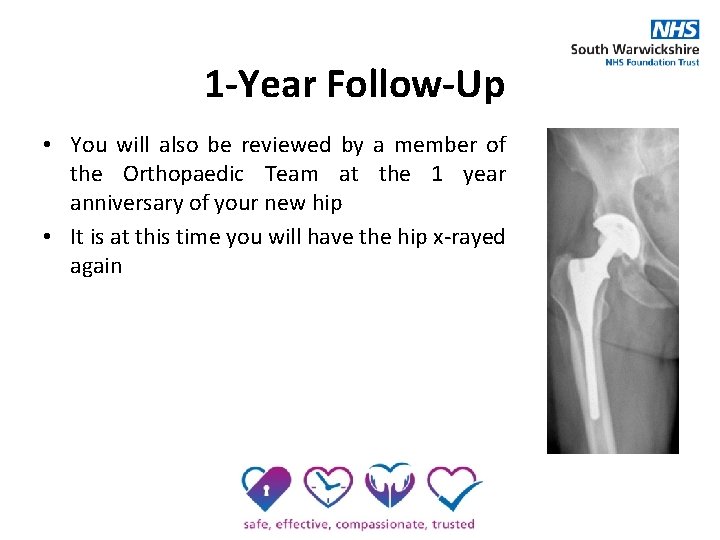
1 -Year Follow-Up • You will also be reviewed by a member of the Orthopaedic Team at the 1 year anniversary of your new hip • It is at this time you will have the hip x-rayed again
What’s Next? • Please watch the Hip Replacement Journey Videos • You will receive a telephone consultation from SWATT prior to your surgery • You will receive a letter inviting you to attend an appointment at Pre-Op Assessment Clinic • You will then receive a letter giving you a date for your surgery If you have been listed for surgery and no longer wish to proceed, or have serious doubts, please call the Bookings Office: 01926 600036 Thank you for taking the time to watch this presentation. We look forward to meeting you soon!