
The Edmonton Narrative Norms Instrument ENNI Update Phyllis
- Slides: 67
The Edmonton Narrative Norms Instrument (ENNI) -- Update Phyllis Schneider Rita Dubé Denyse Hayward The ENNI is available on-line at: http: //www. rehabmed. ualberta. ca/spa/enni
Overview of the ENNI • The ENNI was designed as a measure of storytelling abilities with ‘local’ norms • Story stimuli: pictures drawn to story scripts by a professional cartoonist • Normative sample: 377 children aged 4 -9 • 50 children with typical development per age group • 10 -17 children with specific language impairments per age group
Choice of task • In previous research, we found that children have more difficulty telling a good story from pictures when they did not hear the story first • Telling stories from pictures seems to tap the child’s storytelling abilities • Retelling stories seems to tap auditory memory more than storytelling ability
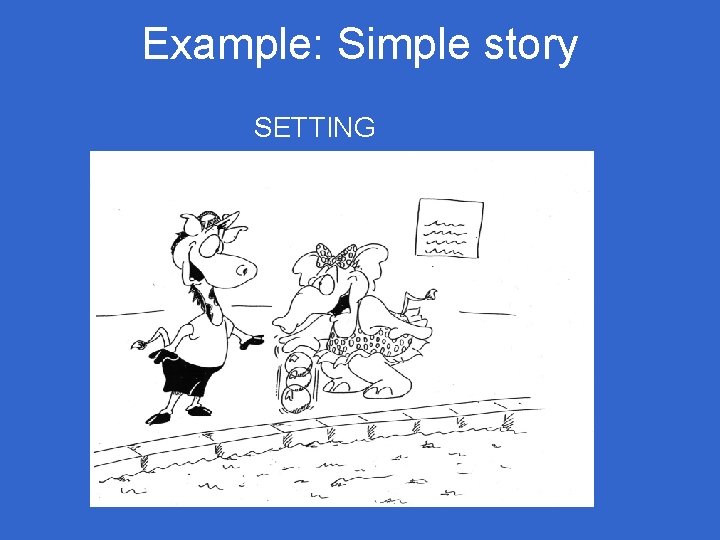
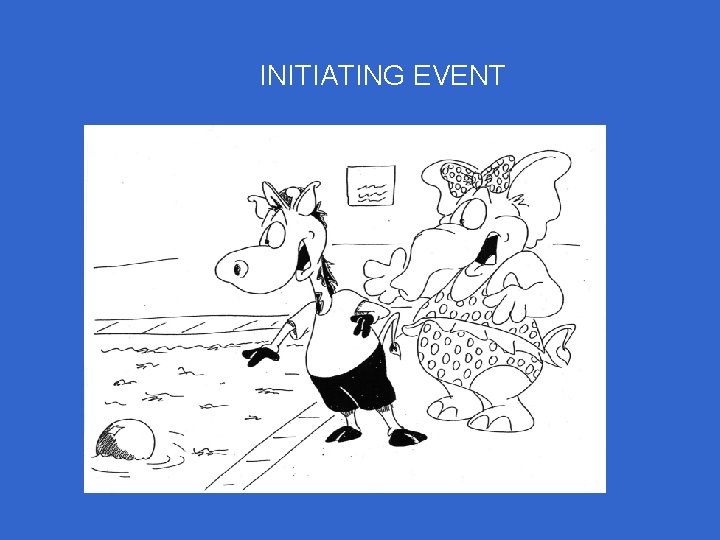
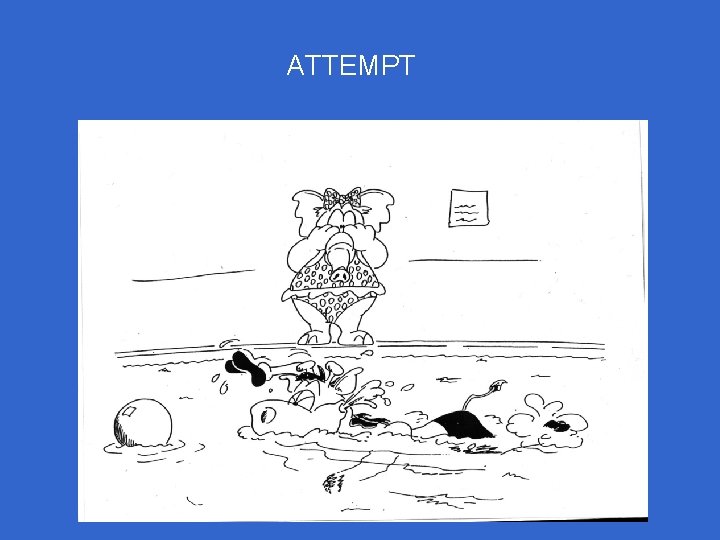
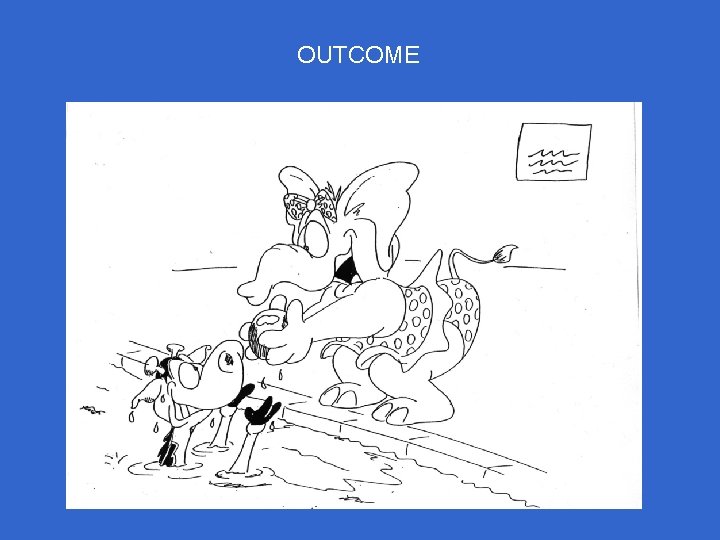
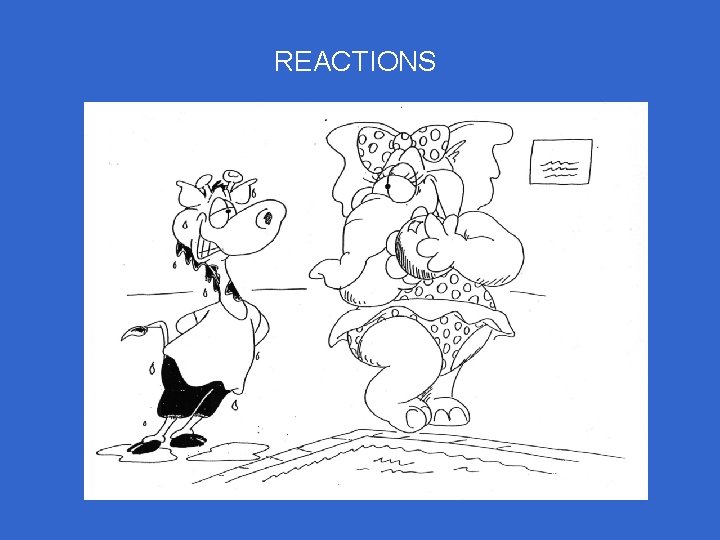
Example: Simple story SETTING
INITIATING EVENT
ATTEMPT
OUTCOME
REACTIONS
The ENNI can be used to assess… • Edmonton children suspected of having language impairments without cognitive delay between the ages of 4 -9 • They are represented in the normative sample • Other children suspected of having language impairment • But with caution; they are not represented in the norms
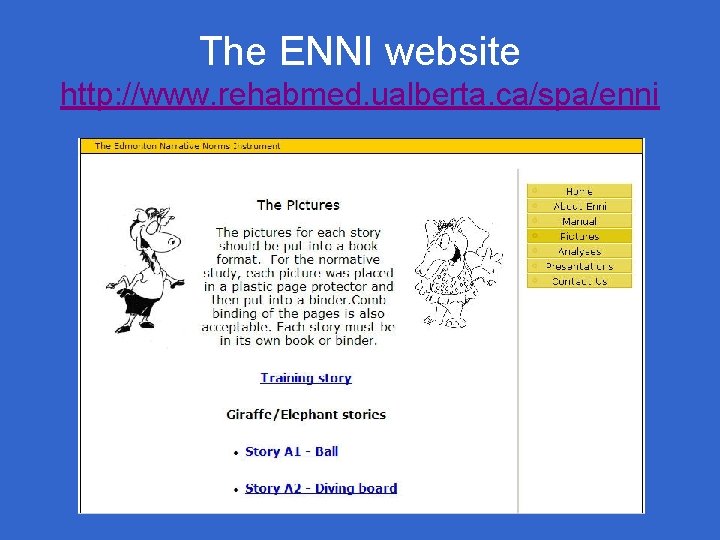
The ENNI website http: //www. rehabmed. ualberta. ca/spa/enni
Psychometric update
Interscorer Reliability • Naomi Beswick: study of interscorer reliability for the story grammar measure • Asked 4 community SLPs to score SG • Calculated intraclass correlations • Results: • A 1: 92% (range: 83%-97%) • A 3: 96% (92%-98%) • Thus: reliability is excellent
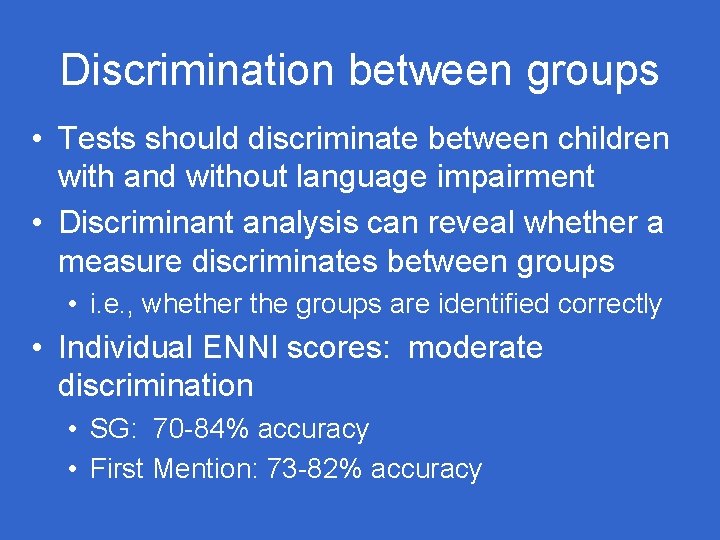
Discrimination between groups • Tests should discriminate between children with and without language impairment • Discriminant analysis can reveal whether a measure discriminates between groups • i. e. , whether the groups are identified correctly • Individual ENNI scores: moderate discrimination • SG: 70 -84% accuracy • First Mention: 73 -82% accuracy
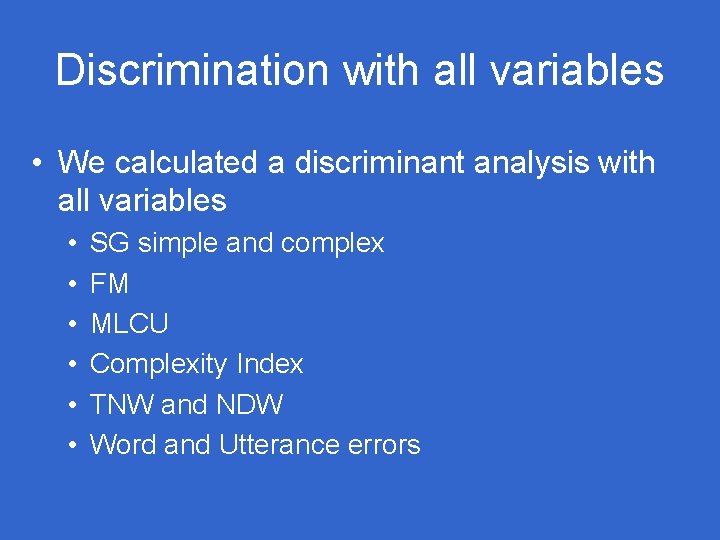
Discrimination with all variables • We calculated a discriminant analysis with all variables • • • SG simple and complex FM MLCU Complexity Index TNW and NDW Word and Utterance errors
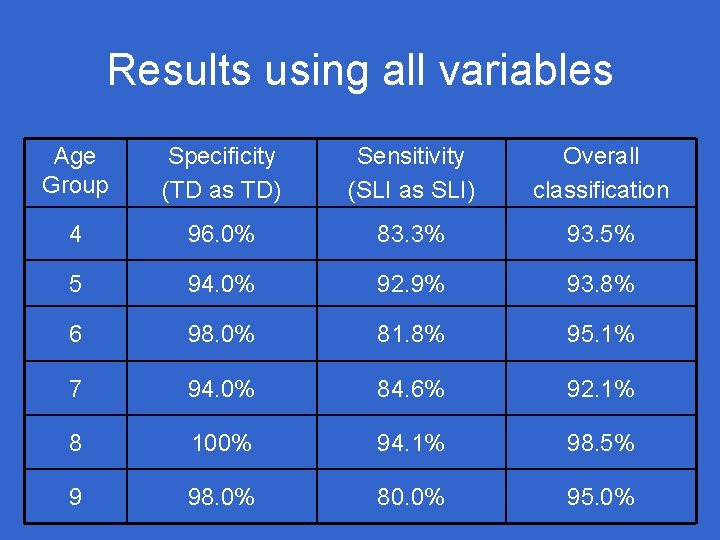
Results using all variables Age Group Specificity (TD as TD) Sensitivity (SLI as SLI) Overall classification 4 96. 0% 83. 3% 93. 5% 5 94. 0% 92. 9% 93. 8% 6 98. 0% 81. 8% 95. 1% 7 94. 0% 84. 6% 92. 1% 8 100% 94. 1% 98. 5% 9 98. 0% 80. 0% 95. 0%
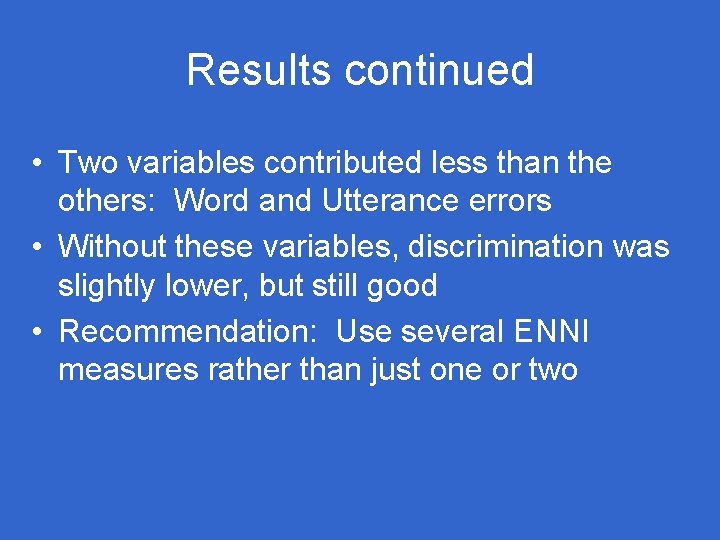
Results continued • Two variables contributed less than the others: Word and Utterance errors • Without these variables, discrimination was slightly lower, but still good • Recommendation: Use several ENNI measures rather than just one or two
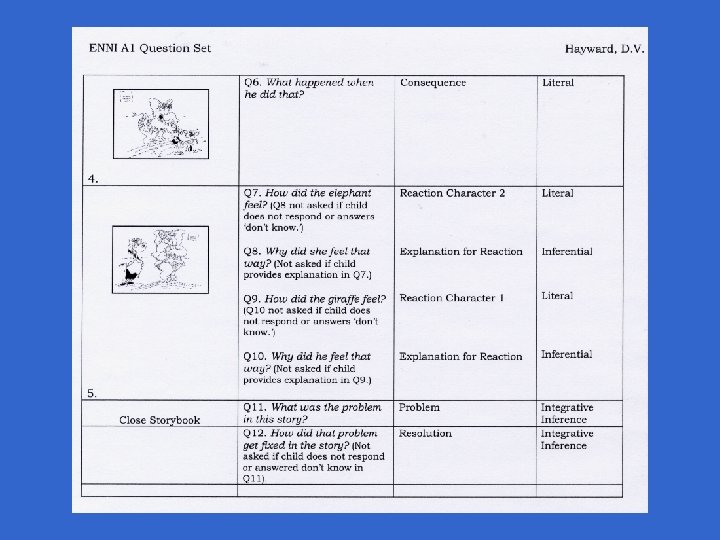
ENNI questions
Questions Graesser (1985), Goldman (1985), Trabasso et al. (1988) • Production and questioning tasks place different demands on child • Questioning tasks • reduce processing demands • child doesn’t have to generate own strategy • reduces information needed to be held in working memory • Questions are especially likely to help when child has not made inferences spontaneously
Theoretical models • We used the Story Grammar model to create a set of questions • The questions focused on SG units • We also used Causal Network model • Focus on causal relations that link SG categories to produce a causal network representation
previous research on SG questions with children Goldman (1985, 1986) - Children 5 & 10 • Children understood more (i. e. , answered more questions correctly) than indicated in recall task • 10 year olds included more ‘understood’ information in retell than 5 yr olds
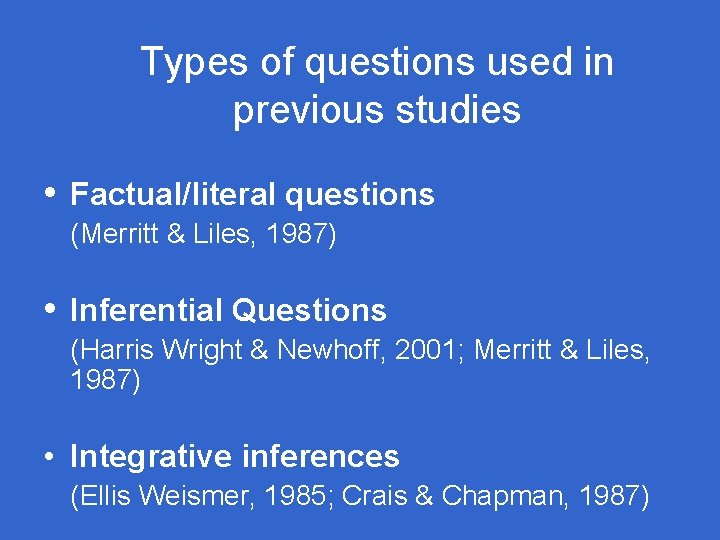
Types of questions used in previous studies • Factual/literal questions (Merritt & Liles, 1987) • Inferential Questions (Harris Wright & Newhoff, 2001; Merritt & Liles, 1987) • Integrative inferences (Ellis Weismer, 1985; Crais & Chapman, 1987)
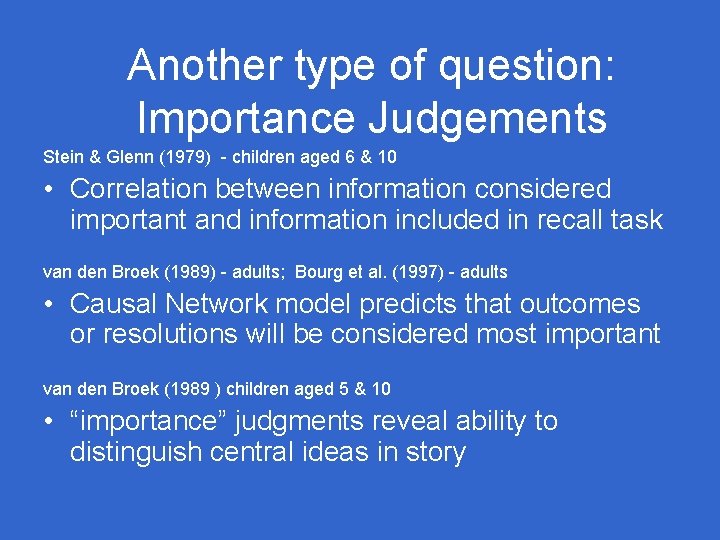
Another type of question: Importance Judgements Stein & Glenn (1979) - children aged 6 & 10 • Correlation between information considered important and information included in recall task van den Broek (1989) - adults; Bourg et al. (1997) - adults • Causal Network model predicts that outcomes or resolutions will be considered most important van den Broek (1989 ) children aged 5 & 10 • “importance” judgments reveal ability to distinguish central ideas in story
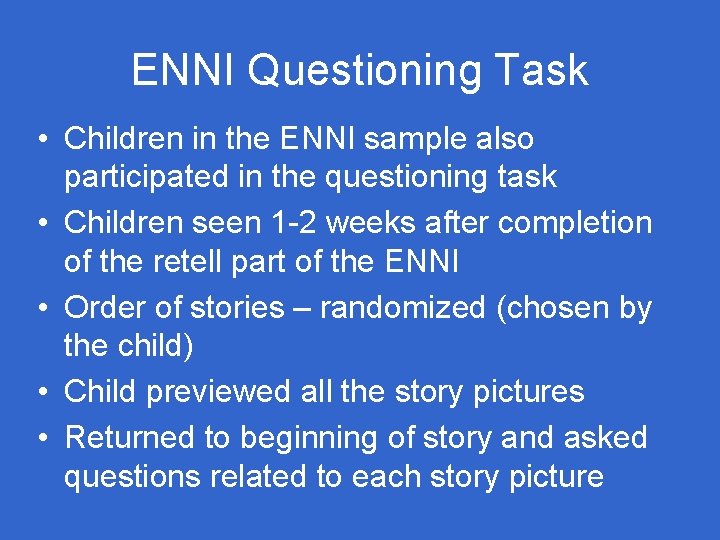
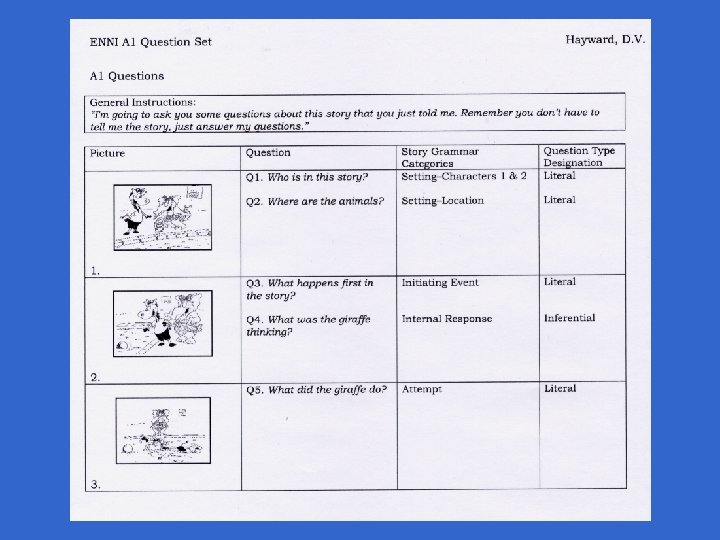
ENNI Questioning Task • Children in the ENNI sample also participated in the questioning task • Children seen 1 -2 weeks after completion of the retell part of the ENNI • Order of stories – randomized (chosen by the child) • Child previewed all the story pictures • Returned to beginning of story and asked questions related to each story picture
Results Simple and Complex Story • Literal / Inferential Questions • Importance Questions • Story Questions / Story Production • Data are presented for 4 -8 year olds
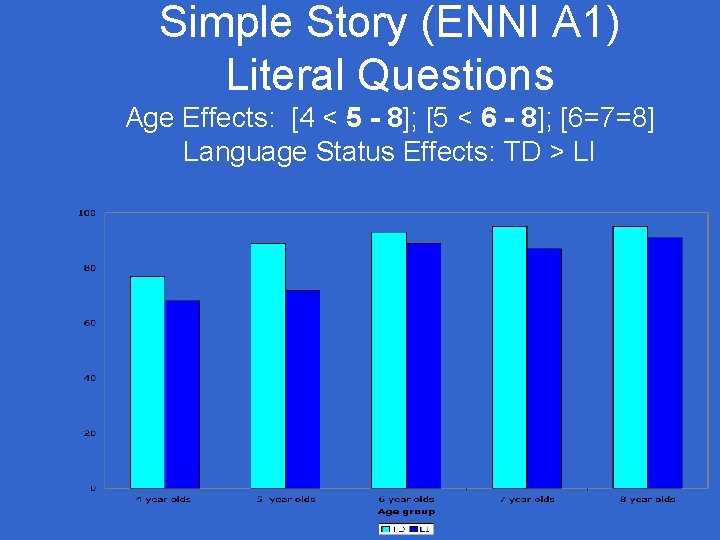
Simple Story (ENNI A 1) Literal Questions Age Effects: [4 < 5 - 8]; [5 < 6 - 8]; [6=7=8] Language Status Effects: TD > LI
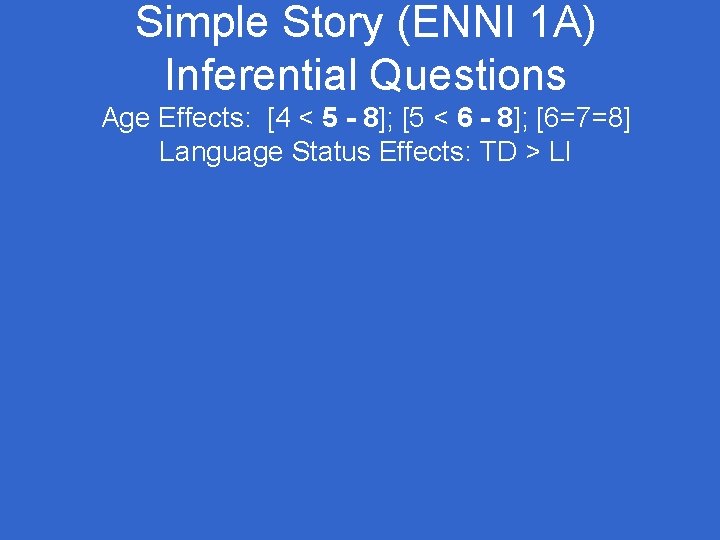
Simple Story (ENNI 1 A) Inferential Questions Age Effects: [4 < 5 - 8]; [5 < 6 - 8]; [6=7=8] Language Status Effects: TD > LI
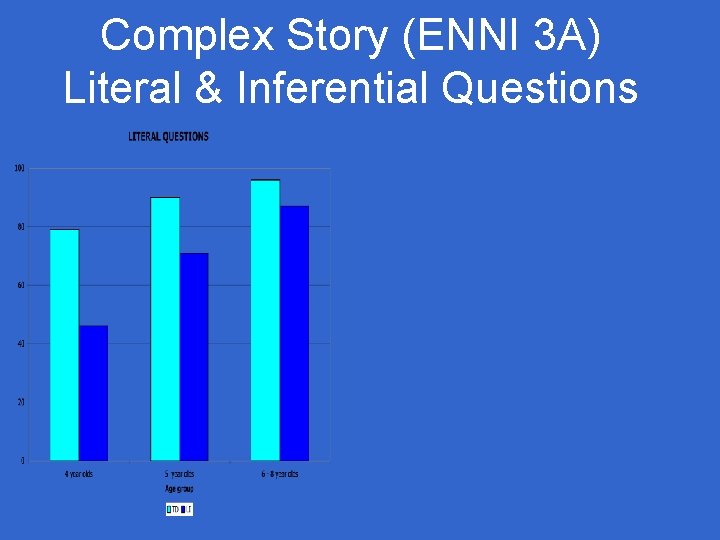
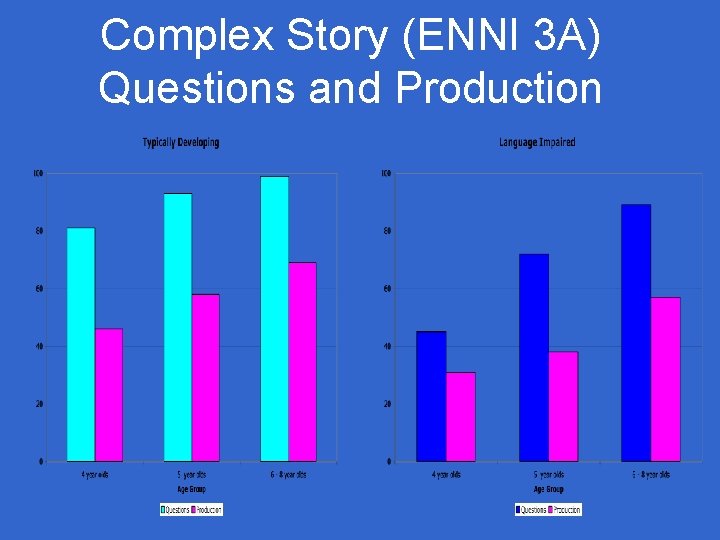
Complex Story (ENNI 3 A) Literal & Inferential Questions
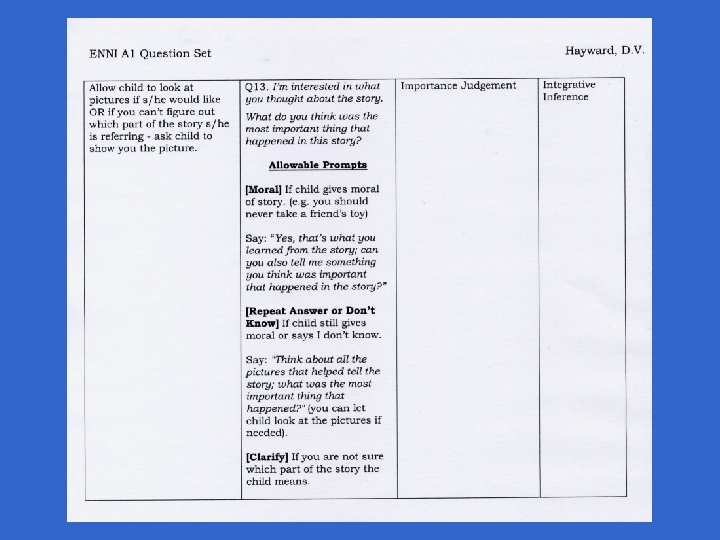
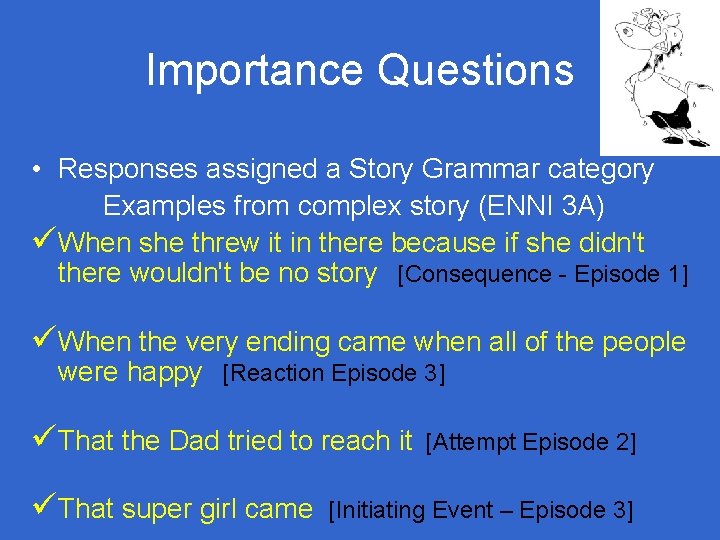
Importance Questions • Responses assigned a Story Grammar category Examples from complex story (ENNI 3 A) üWhen she threw it in there because if she didn't there wouldn't be no story [Consequence - Episode 1] üWhen the very ending came when all of the people were happy [Reaction Episode 3] üThat the Dad tried to reach it üThat super girl came [Attempt Episode 2] [Initiating Event – Episode 3]
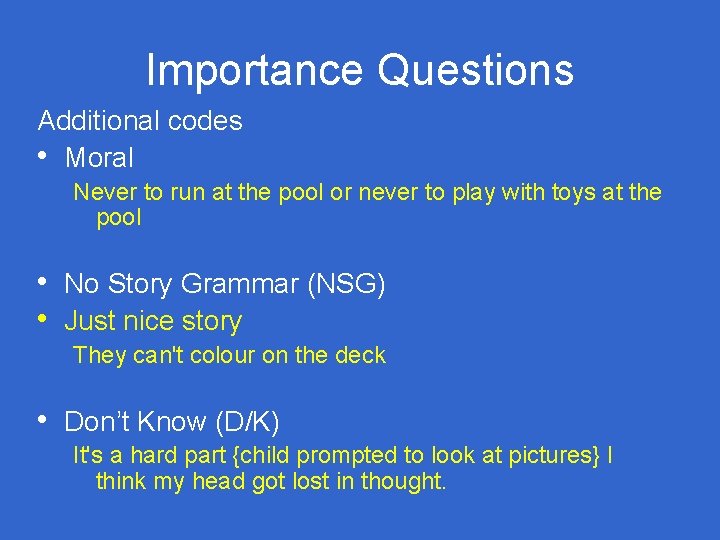
Importance Questions Additional codes • Moral Never to run at the pool or never to play with toys at the pool • No Story Grammar (NSG) • Just nice story They can't colour on the deck • Don’t Know (D/K) It's a hard part {child prompted to look at pictures} I think my head got lost in thought.
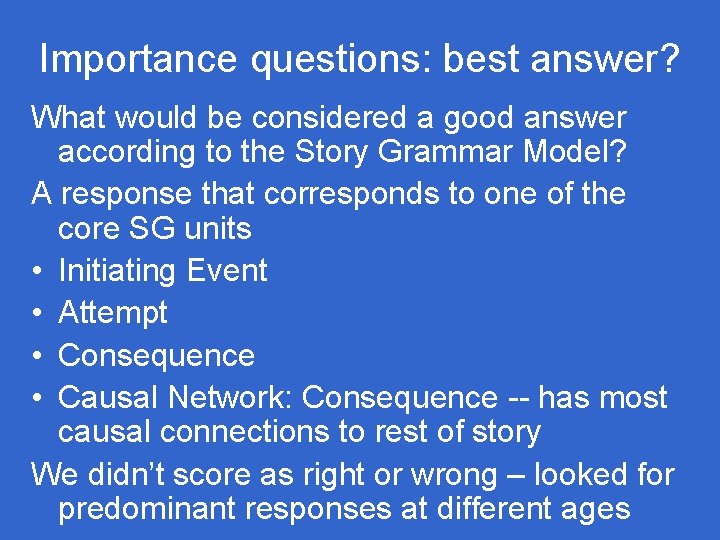
Importance questions: best answer? What would be considered a good answer according to the Story Grammar Model? A response that corresponds to one of the core SG units • Initiating Event • Attempt • Consequence • Causal Network: Consequence -- has most causal connections to rest of story We didn’t score as right or wrong – looked for predominant responses at different ages
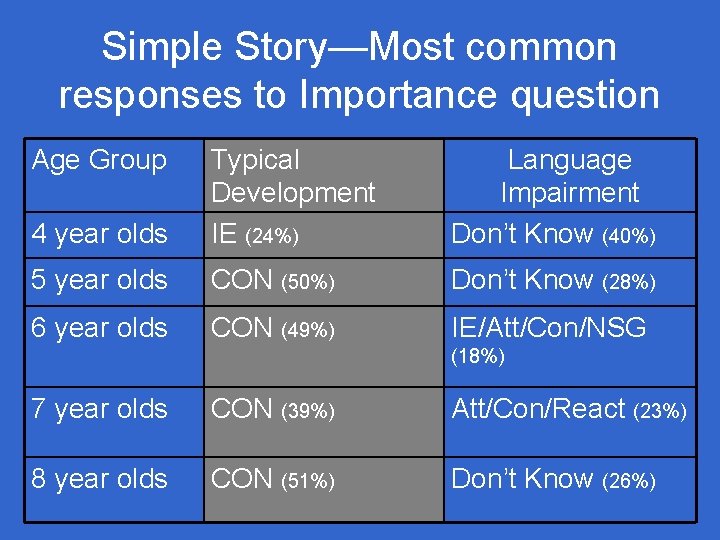
Simple Story—Most common responses to Importance question Age Group 4 year olds Typical Development IE (24%) Language Impairment Don’t Know (40%) 5 year olds CON (50%) Don’t Know (28%) 6 year olds CON (49%) IE/Att/Con/NSG (18%) 7 year olds CON (39%) Att/Con/React (23%) 8 year olds CON (51%) Don’t Know (26%)
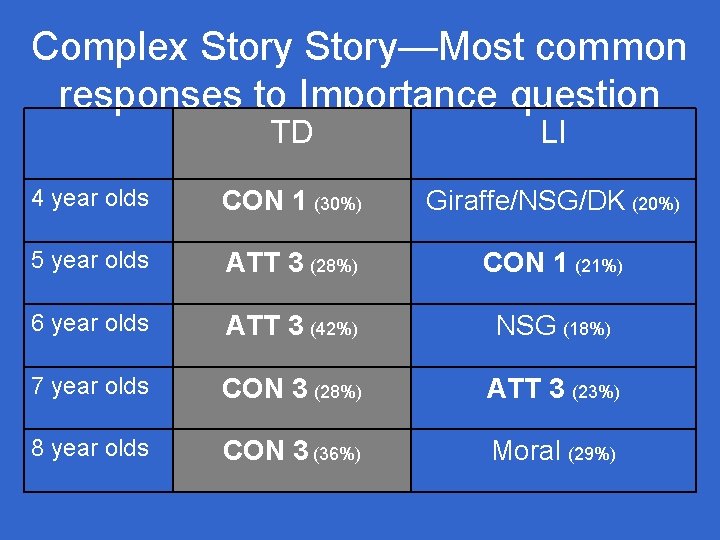
Complex Story—Most common responses to Importance question TD LI 4 year olds CON 1 (30%) Giraffe/NSG/DK (20%) 5 year olds ATT 3 (28%) CON 1 (21%) 6 year olds ATT 3 (42%) NSG (18%) 7 year olds CON 3 (28%) ATT 3 (23%) 8 year olds CON 3 (36%) Moral (29%)
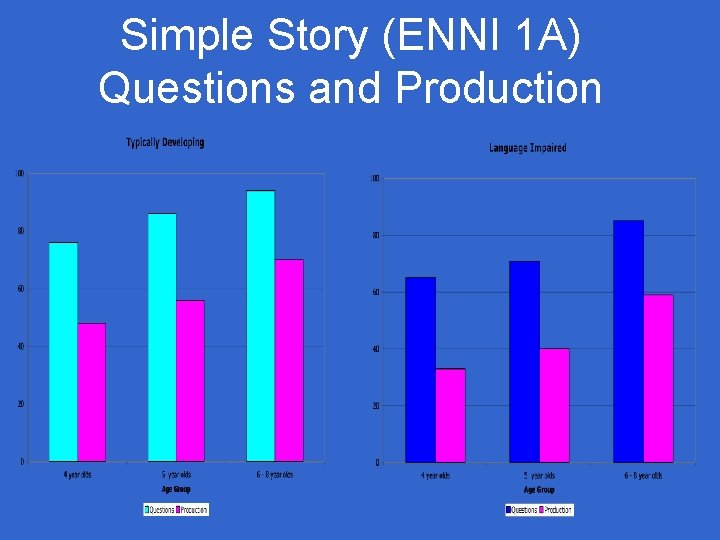
Simple Story (ENNI 1 A) Questions and Production
Complex Story (ENNI 3 A) Questions and Production
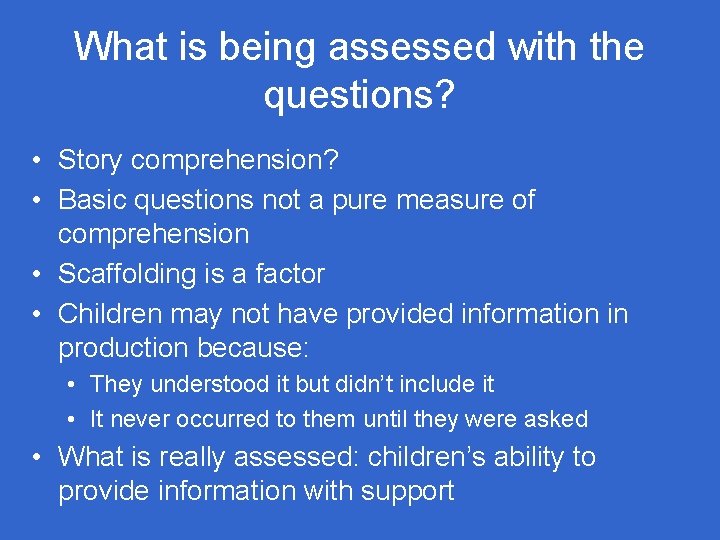
What is being assessed with the questions? • Story comprehension? • Basic questions not a pure measure of comprehension • Scaffolding is a factor • Children may not have provided information in production because: • They understood it but didn’t include it • It never occurred to them until they were asked • What is really assessed: children’s ability to provide information with support
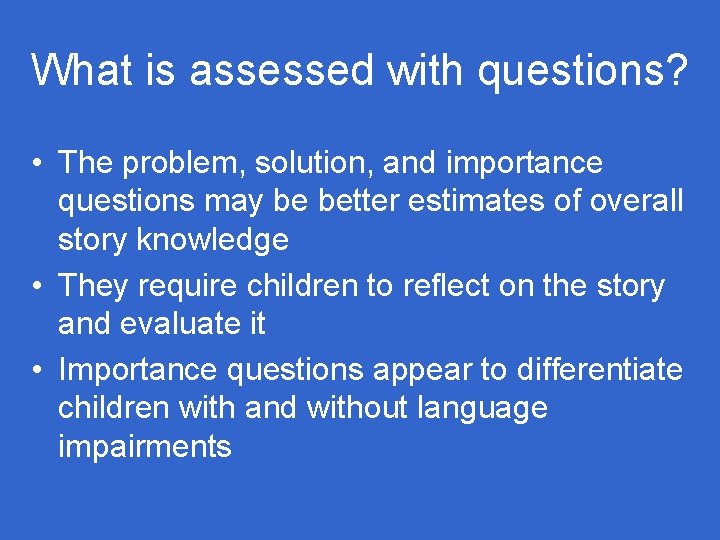
What is assessed with questions? • The problem, solution, and importance questions may be better estimates of overall story knowledge • They require children to reflect on the story and evaluate it • Importance questions appear to differentiate children with and without language impairments
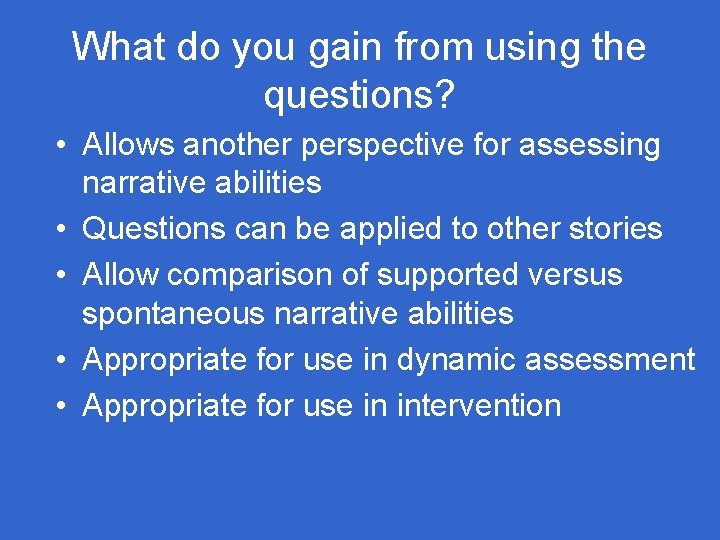
What do you gain from using the questions? • Allows another perspective for assessing narrative abilities • Questions can be applied to other stories • Allow comparison of supported versus spontaneous narrative abilities • Appropriate for use in dynamic assessment • Appropriate for use in intervention
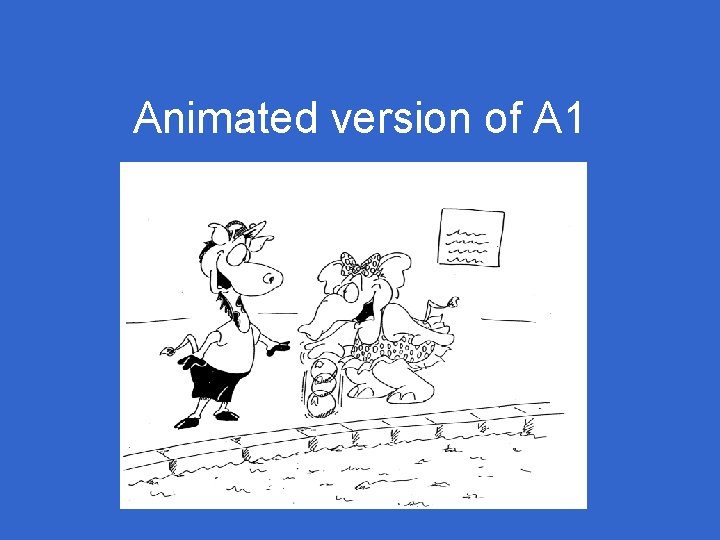
Animated version of A 1
Effects of story stimuli • Previous work: the way stories are presented to children affects the way they (re)tell the story • E. g. : Telling the story for retell versus asking child to tell the story from pictures • We wondered: does the static nature of pictures affect younger children’s storytelling in the ENNI?
Possible effects • Typically developing 4 -year-old children’s stories were sometimes very different from older children’s • They do not always seem to ‘get’ some aspects of the story • For example, in the simple story: • Ball going in the water • Goal-related reason for Giraffe swimming • Who gave ball to whom
Example 1: ENNI A 1 a elephant and a cow. (that) that guy fell in the mud. and this girl picked him up # elephant. and he was very mad at her. • C did not mention the ball at all • Did not understand emotions • Got points only for characters
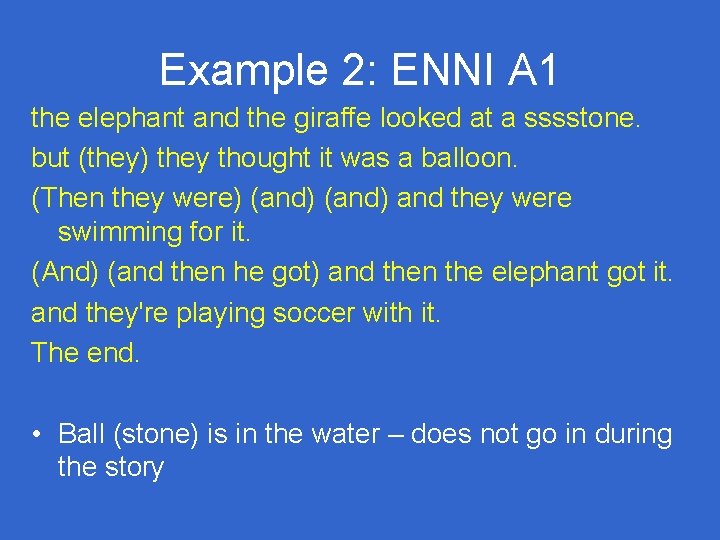
Example 2: ENNI A 1 the elephant and the giraffe looked at a sssstone. but (they) they thought it was a balloon. (Then they were) (and) and they were swimming for it. (And) (and then he got) and then the elephant got it. and they're playing soccer with it. The end. • Ball (stone) is in the water – does not go in during the story
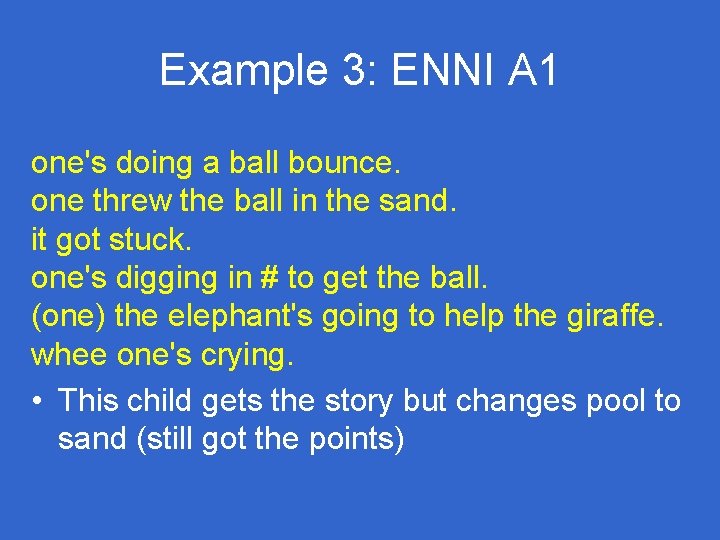
Example 3: ENNI A 1 one's doing a ball bounce. one threw the ball in the sand. it got stuck. one's digging in # to get the ball. (one) the elephant's going to help the giraffe. whee one's crying. • This child gets the story but changes pool to sand (still got the points)
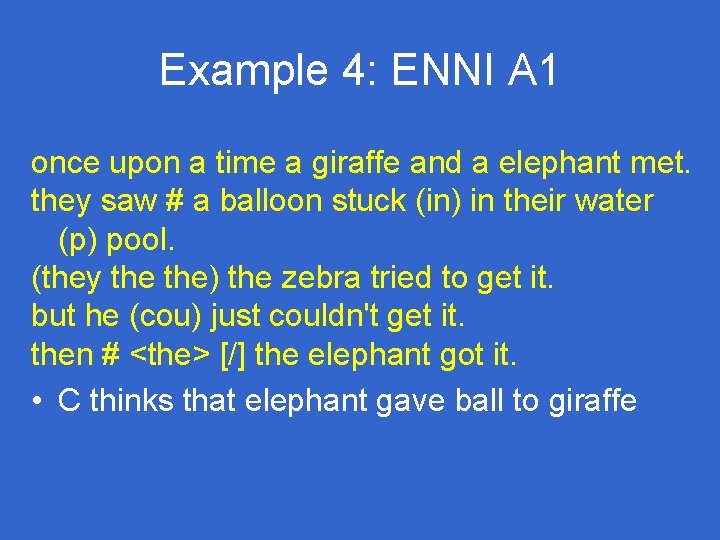
Example 4: ENNI A 1 once upon a time a giraffe and a elephant met. they saw # a balloon stuck (in) in their water (p) pool. (they the) the zebra tried to get it. but he (cou) just couldn't get it. then # <the> [/] the elephant got it. • C thinks that elephant gave ball to giraffe
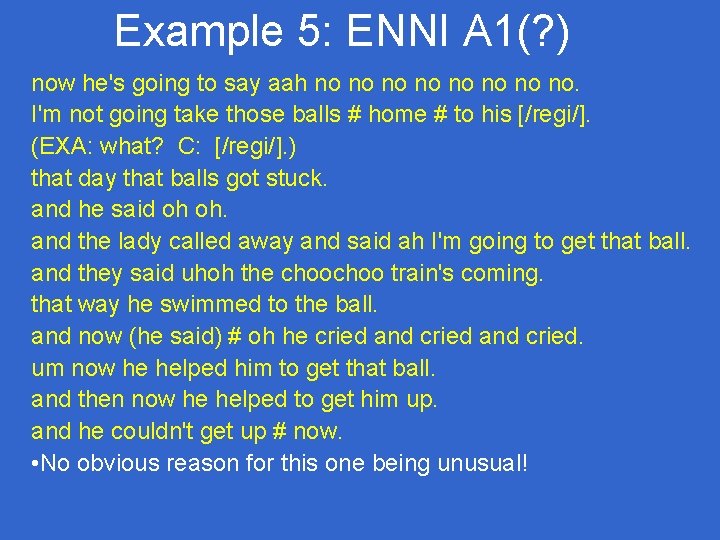
Example 5: ENNI A 1(? ) now he's going to say aah no no. I'm not going take those balls # home # to his [/regi/]. (EXA: what? C: [/regi/]. ) that day that balls got stuck. and he said oh oh. and the lady called away and said ah I'm going to get that ball. and they said uhoh the choo train's coming. that way he swimmed to the ball. and now (he said) # oh he cried and cried. um now he helped him to get that ball. and then now he helped to get him up. and he couldn't get up # now. • No obvious reason for this one being unusual!
Animated version of A 1 • Students from New Media program at the University of Alberta needed a project • They animated the simple story from Set A of the ENNI • They animated those units that are often misunderstood and/or omitted by young children
What was highlighted • Ball going into water • Internal response (facial expression) of elephant • Giraffe swimming towards ball • Ball going from giraffe to elephant Let’s view the animation
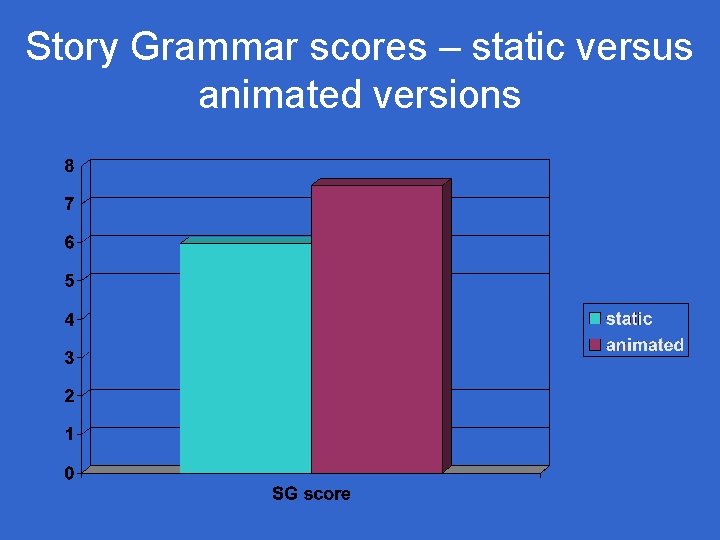
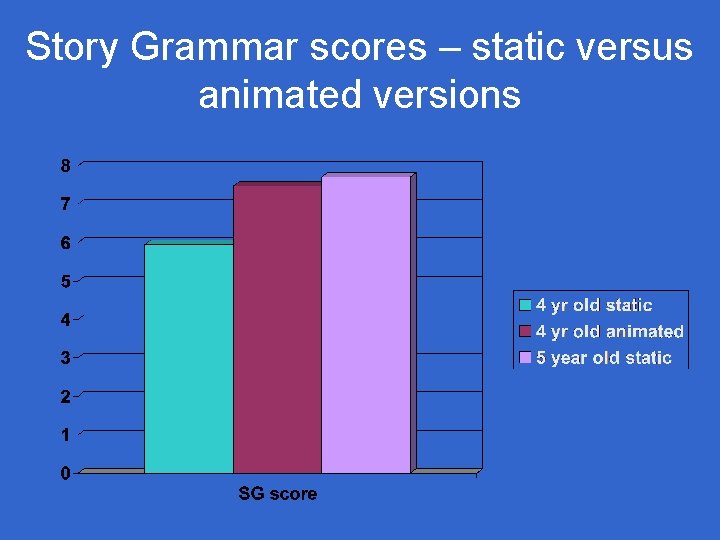
Trying out the animated version • Nikki Dooley, Kara Kvile, Kelly Millar and Carla Monteleone conducted a study • We gave the animation to 25 typically developing 4 -year-old children • We compared their stories to 25 4 year olds from the ENNI normative sample • Results: children provided slightly but significantly more information with the animated version
Story Grammar scores – static versus animated versions
Story Grammar scores – static versus animated versions
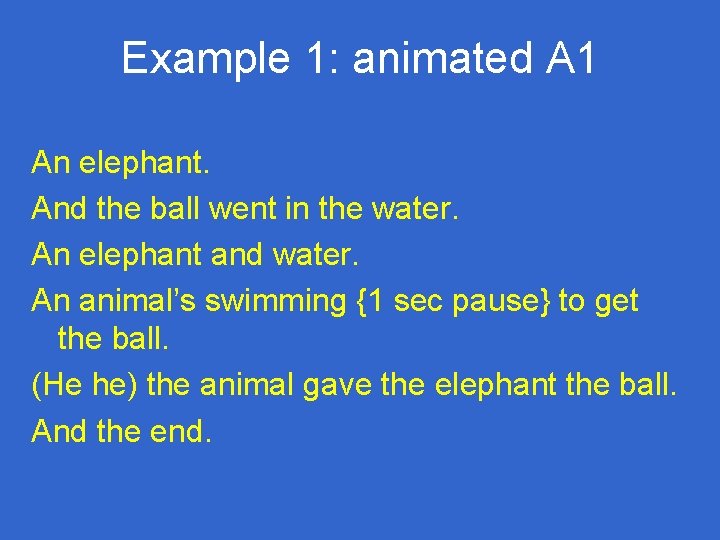
Example 1: animated A 1 An elephant. And the ball went in the water. An elephant and water. An animal’s swimming {1 sec pause} to get the ball. (He he) the animal gave the elephant the ball. And the end.
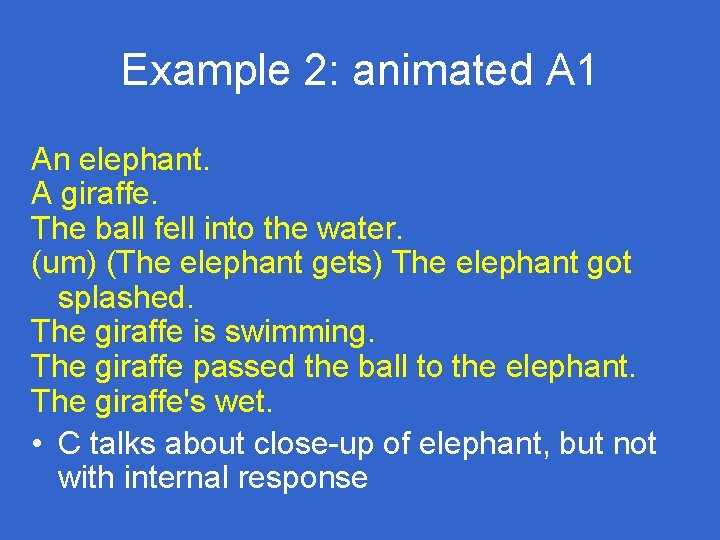
Example 2: animated A 1 An elephant. A giraffe. The ball fell into the water. (um) (The elephant gets) The elephant got splashed. The giraffe is swimming. The giraffe passed the ball to the elephant. The giraffe's wet. • C talks about close-up of elephant, but not with internal response
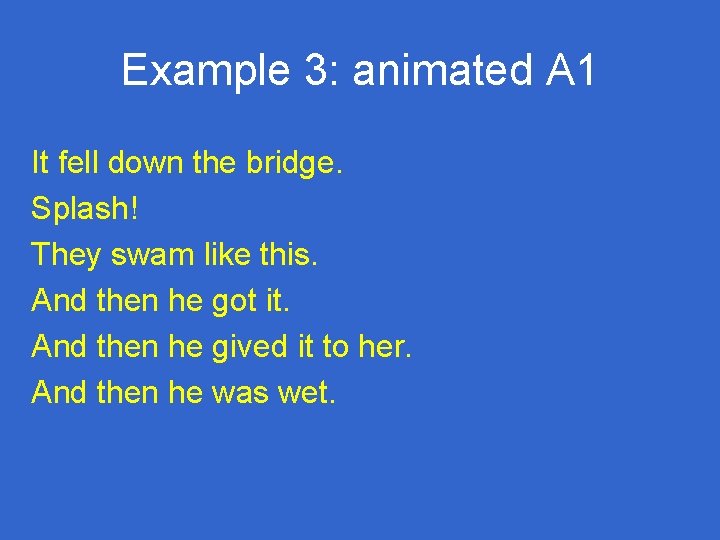
Example 3: animated A 1 It fell down the bridge. Splash! They swam like this. And then he got it. And then he gived it to her. And then he was wet.
Example 4: animated A 1 First they are bouncing the ball. And then it flies into the pool. That) The longest one goes to get it. And then what? And then he gives it to (th) the girl. Then she likes that.
Example 4: animated A 1 (some are still strange!) what is the ball doing? (E: can you tell us what’s happening? ) it’s drowning # down {laughs}. water splashing up in her mouth and face. oh bubbles # bubbles. bounce. the elephant’s can squirt water. he’s drowning # the giraffe. he giraffed. he giraffes.
Animated versus static: what we learned • Most 4 -year-olds will get some SG units in their stories told from static pictures • Children who view animated pictures tend to get 1 -2 more SG units • Animation may make the story easier to understand • However, other factors are also involved in 4 -year-olds’ lower story performance
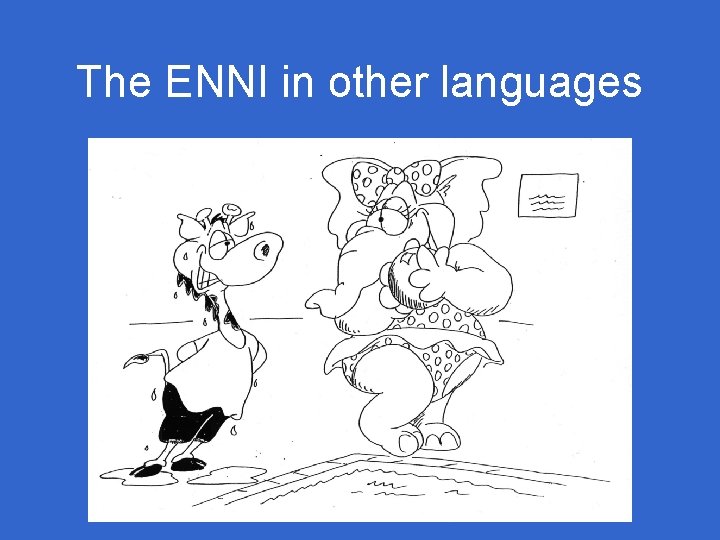
The ENNI in other languages
ENNI studies in other languages • The ENNI was designed to be useful for collecting narrative data in any language • Previous research: with a given stimuli, people from other cultures and languages will tell similar stories • The ENNI has been used in several other languages for various purposes
French studies using the ENNI Pilot study (A. Chambers and J. Mallette) • Small sample of children aged 5 and 9 • Pictures were altered to change English words to French • SG and First Mention scoring were adapted Elin Thordardottir’s studies • Currently using ENNI in prevalence study in Quebec with preschool aged children
French studies continued Andréanne Gagné & Martha Crago, U de Montréal • Used the ENNI to compare Francophone children’s storytelling to adults versus infants • Found typically developing children and children with SLI both adjust their MLT-units for infants • SLI children use more SG units with infants than with adults; TD children used same • Seemed to be a trade-off between content and syntax
French studies continued French as Second Language learners (L. Baker, C. Traverse, K. Pollock, P. Schneider) • 10 children aged 6 -8 enrolled in French immersion programs were tested in English and French • PPVT and EVIP (French version of PPVT) • ENNI in French and English • Scores were lower on EVIP than PPVT • Scores not different for A 1, lower in French for A 3
Other languages • Icelandic (Elin Thordardottir) – as a second language compared to native language (including Lithuanian, Russian, Polish, Tagalog) • Cantonese (M. Y. Wong) – typically developing children and children with language impairment
• Finnish– one study with children with autism (P. Pelttari), one with typically developing children (H. M. Vakkuri) • Kannada speakers, Mysore, India (Padakannaya, Rao, Hayward, Schneider)– typical readers and children with reading disabilities
Future research • Story Grammar scoring and norms for story B 3 • Norms for sets A and B separately • First Mentions • Syntax measures • Word counts • Narrative intervention study: will the ENNI reveal changes due to intervention?