
The EDIPO Accident The coil assembly of the
The EDIPO Accident The coil assembly of the EDIPO test facility was destroyed upon an unprotected quench on May 31 st 2016. Pierluigi Bruzzone February 14 th 2017
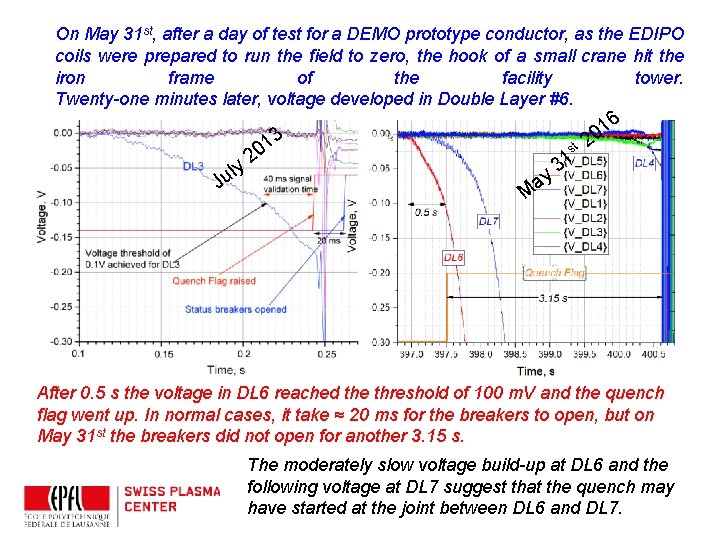
On May 31 st, after a day of test for a DEMO prototype conductor, as the EDIPO coils were prepared to run the field to zero, the hook of a small crane hit the iron frame of the facility tower. Twenty-one minutes later, voltage developed in Double Layer #6. ly u J 3 1 20 st a M 1 3 y 6 1 0 2 After 0. 5 s the voltage in DL 6 reached the threshold of 100 m. V and the quench flag went up. In normal cases, it take ≈ 20 ms for the breakers to open, but on May 31 st the breakers did not open for another 3. 15 s. The moderately slow voltage build-up at DL 6 and the following voltage at DL 7 suggest that the quench may have started at the joint between DL 6 and DL 7.
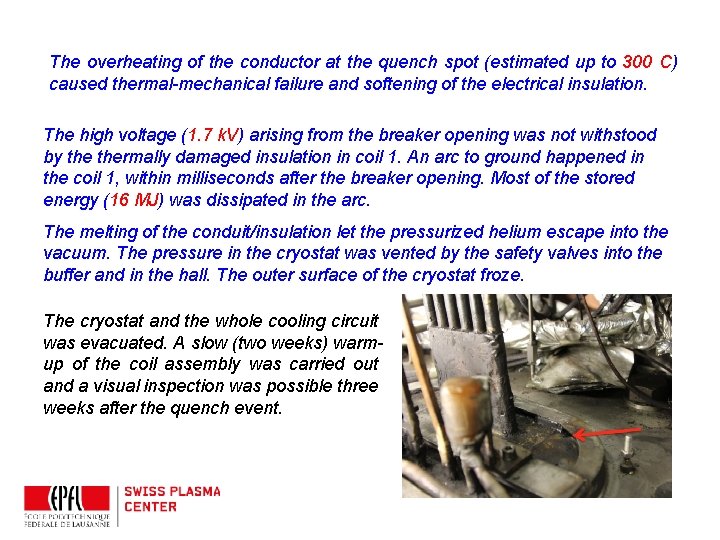
The overheating of the conductor at the quench spot (estimated up to 300 C) caused thermal-mechanical failure and softening of the electrical insulation. The high voltage (1. 7 k. V) arising from the breaker opening was not withstood by thermally damaged insulation in coil 1. An arc to ground happened in the coil 1, within milliseconds after the breaker opening. Most of the stored energy (16 MJ) was dissipated in the arc. The melting of the conduit/insulation let the pressurized helium escape into the vacuum. The pressure in the cryostat was vented by the safety valves into the buffer and in the hall. The outer surface of the cryostat froze. The cryostat and the whole cooling circuit was evacuated. A slow (two weeks) warmup of the coil assembly was carried out and a visual inspection was possible three weeks after the quench event.

After the coil terminals are disconnected from the leads, the cooling pipes are used to assess the short to ground. One pipe is fully floating. The coil assembly is fully impregnated and is not designed to be disassembled. The upper flange of the coil assembly could be “lifted”, but to access the winding a major machining of the outer cylinder would be necessary.
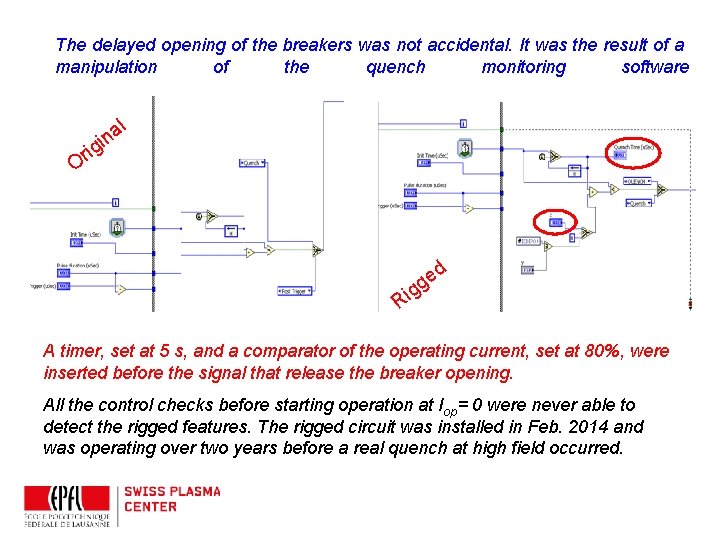
The delayed opening of the breakers was not accidental. It was the result of a manipulation of the quench monitoring software ig r O l a in d e g ig R A timer, set at 5 s, and a comparator of the operating current, set at 80%, were inserted before the signal that release the breaker opening. All the control checks before starting operation at Iop= 0 were never able to detect the rigged features. The rigged circuit was installed in Feb. 2014 and was operating over two years before a real quench at high field occurred.
The coil assembly of EDIPO is lost. No repair action is possible. The other components of the test facility are intact: • The vacuum vessel, thermal shield and gravity support • The cryo-lines, valves box, vacuum pumps and refrigerator • The power supplies for DC (18 k. A), bus bars and HTS current leads • The sample environment (transformer, sample holder, cranes) • The transmitters, sensors, data acquisition, control system The capital investment value of the coil assembly is ≈ 50% of the total value The procurement of the coil assembly, 2005 – 2011, was done under industrial contracts placed by EFDA (no longer existing) and transferred to EPFL. The procurement of the other components and the installation/commissioning was done by CRPP (now SPC) under contract of Association EURATOM. The former constellation of funding agencies does not exist anymore. The criminal act is prosecuted by law, but there is no way to recover the value of the damage.
Top technical boundary conditions for a new coil assembly: -Outer diameter of the assembly ≤ 1450 mm - Free bore 150 mm x 100 mm (for a vacuum test well of 144 mm x 94 mm) - Maximum operating current/voltage ≤ 18 k. A /10 V - Maximum weight of the assembly 20 t (crane lifting limit) - Target DC field in the well 13 -15 T - Target homogenous field length 1 m - Cooling by helium (either supercritical flow or bath 4. 2 K) The replacement of the coil assembly is not a long term objective. The needs that drive the reconstruction are urgent. In the past six months, two technical “mature” options have been sketched…
- Slides: 7