
The Economy of Care An Economic Approach for
- Slides: 29
The Economy of Care An Economic Approach for a Sustainable Future Thera van Osch (Foundation for the Economy of Care)
Conference Counting on Women Gender – Care and Economics 1. 2. 3. 4. 5. 6. 7. Work-definition Economy of Care: Paradigm shift Basic model: Economy of Care vs Neo-liberal Macro-economic policy based on Economy of Care Gender effects of multiple crisis Why neo-liberal economic model cannot solve the multiple crisis Transition towards a human sustainable future
1. Work-definition: Economy of Care The science of human behaviour focused on maintaining, continuation, and restauration of the planet to improve quality of life for all in a sustainable way.
2. Economy of Care: Paradigm shift Humans Production Consumption Labour Distribution (example: Care-labour and income)
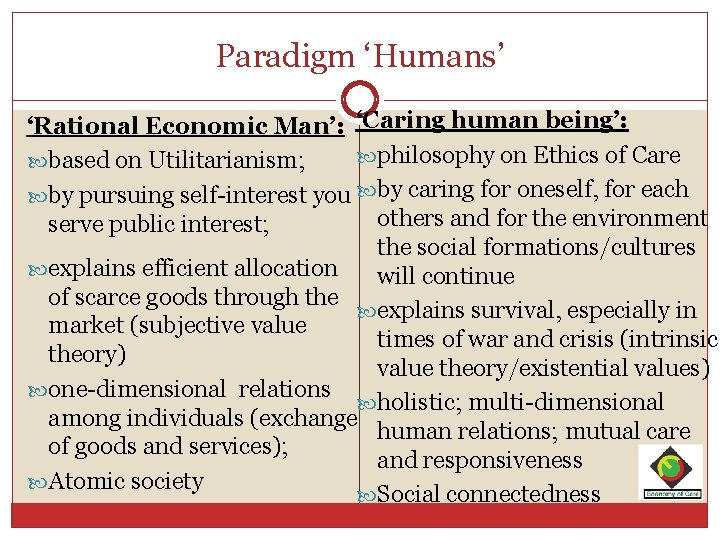
Paradigm ‘Humans’ ‘Rational Economic Man’: ‘Caring human being’: philosophy on Ethics of Care based on Utilitarianism; by pursuing self-interest you by caring for oneself, for each others and for the environment serve public interest; the social formations/cultures explains efficient allocation will continue of scarce goods through the explains survival, especially in market (subjective value times of war and crisis (intrinsic theory) value theory/existential values) one-dimensional relations holistic; multi-dimensional among individuals (exchange human relations; mutual care of goods and services); and responsiveness Atomic society Social connectedness
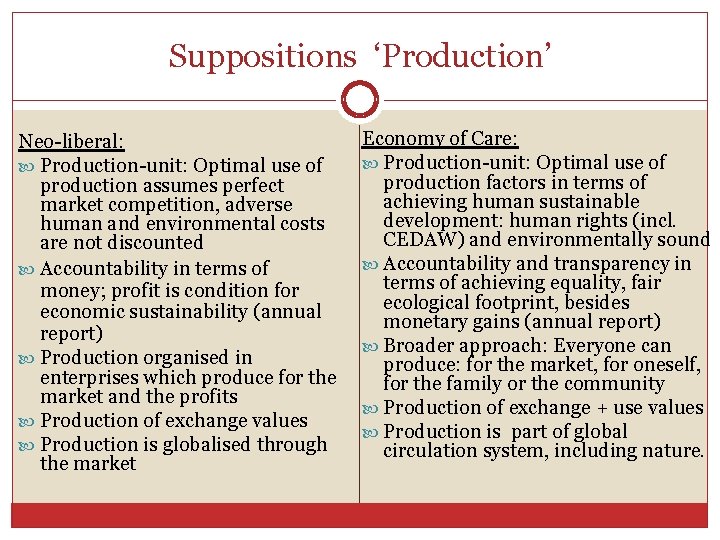
Suppositions ‘Production’ Neo-liberal: Production-unit: Optimal use of production assumes perfect market competition, adverse human and environmental costs are not discounted Accountability in terms of money; profit is condition for economic sustainability (annual report) Production organised in enterprises which produce for the market and the profits Production of exchange values Production is globalised through the market Economy of Care: Production-unit: Optimal use of production factors in terms of achieving human sustainable development: human rights (incl. CEDAW) and environmentally sound Accountability and transparency in terms of achieving equality, fair ecological footprint, besides monetary gains (annual report) Broader approach: Everyone can produce: for the market, for oneself, for the family or the community Production of exchange + use values Production is part of global circulation system, including nature.
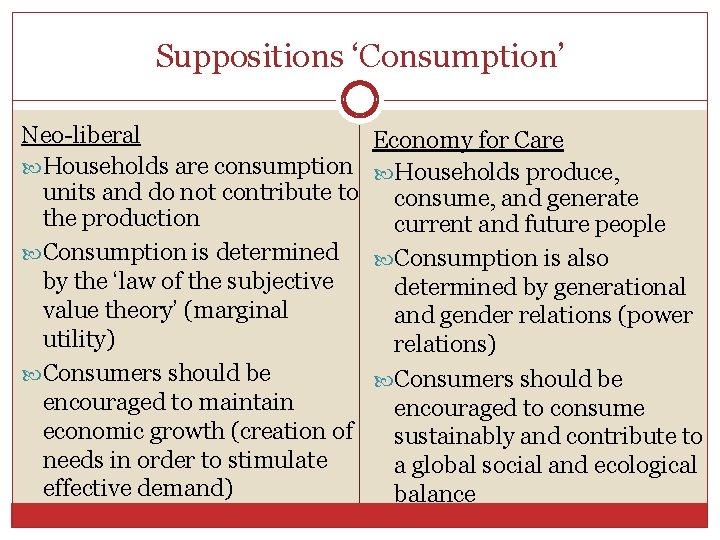
Suppositions ‘Consumption’ Neo-liberal Households are consumption units and do not contribute to the production Consumption is determined by the ‘law of the subjective value theory’ (marginal utility) Consumers should be encouraged to maintain economic growth (creation of needs in order to stimulate effective demand) Economy for Care Households produce, consume, and generate current and future people Consumption is also determined by generational and gender relations (power relations) Consumers should be encouraged to consume sustainably and contribute to a global social and ecological balance
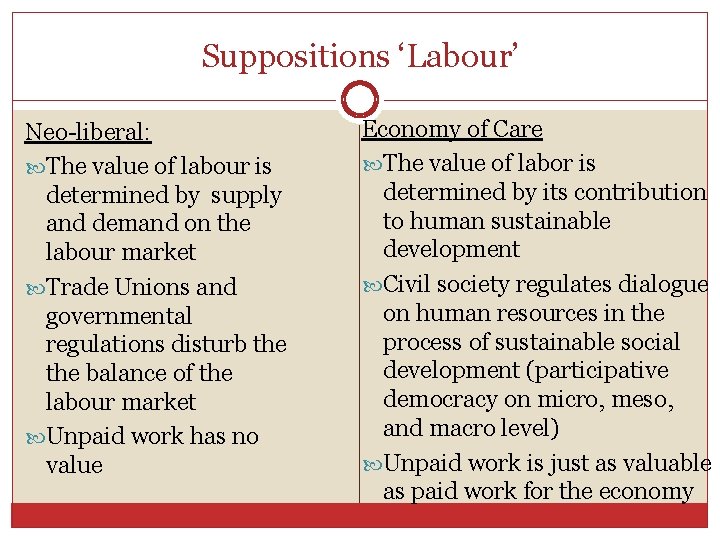
Suppositions ‘Labour’ Neo-liberal: The value of labour is determined by supply and demand on the labour market Trade Unions and governmental regulations disturb the balance of the labour market Unpaid work has no value Economy of Care The value of labor is determined by its contribution to human sustainable development Civil society regulates dialogue on human resources in the process of sustainable social development (participative democracy on micro, meso, and macro level) Unpaid work is just as valuable as paid work for the economy
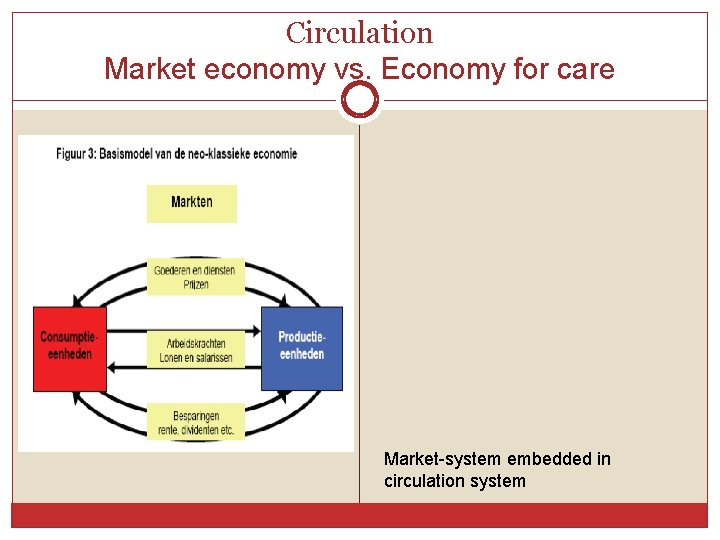
Circulation Market economy vs. Economy for care Market-system embedded in circulation system
Circulation/distribution Neo-liberal economy Distribution: market and Economy of Care Distribution: market, government, reciprocity, solidarity, mutual support, gifts, recycling, LETS Regulation also through local Regulation through monetary exchange systems, gender + system, banksystem and generational relations (e. g. family, government friendship), virtual global exchange systems , participative (gender) budgeting Value linked to ecological footprint Value expressed in prices (money and PUW quote units) Scarcity is a relative concept: The Scarcity: What has no price on perspective of human sustainable the market, has no value and is development (contributing to quality abundant and free for anyone of life for present and future generations) defines what is (such as air, trees, unpaid labour). scarce/abundant government
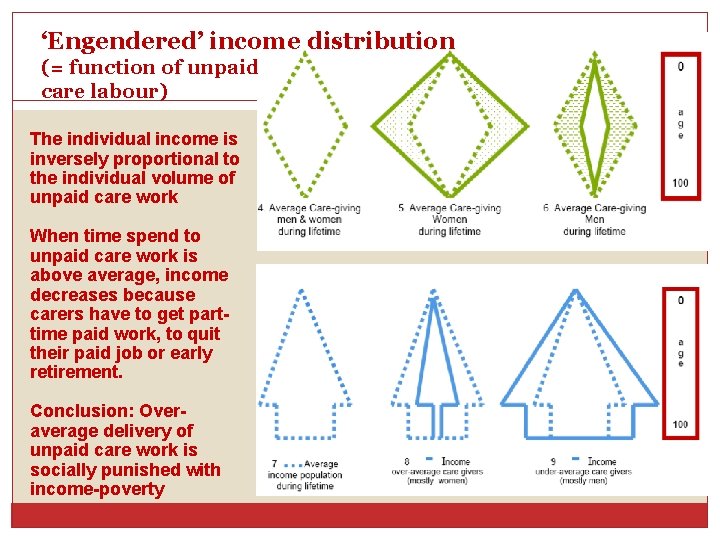
Example: Distribution of care labour based on gender and generational relations There is a gender-based relationship between care-receiving and care-giving During their lifecycle, women give more care than they receive, whereas men receive more care than they give The asymmetrical relations differ between the several age cohorts Distribution of care labour is inversily related to distribution of income. (Source: Dauvellier, M. , 2008: Equalising Care)
For example: Distribution of Care Labour CARE RECEIVING & CARE GIVING
‘Engendered’ income distribution (= function of unpaid care labour) The individual income is inversely proportional to the individual volume of unpaid care work When time spend to unpaid care work is above average, income decreases because carers have to get parttime paid work, to quit their paid job or early retirement. Conclusion: Overage delivery of unpaid care work is socially punished with income-poverty
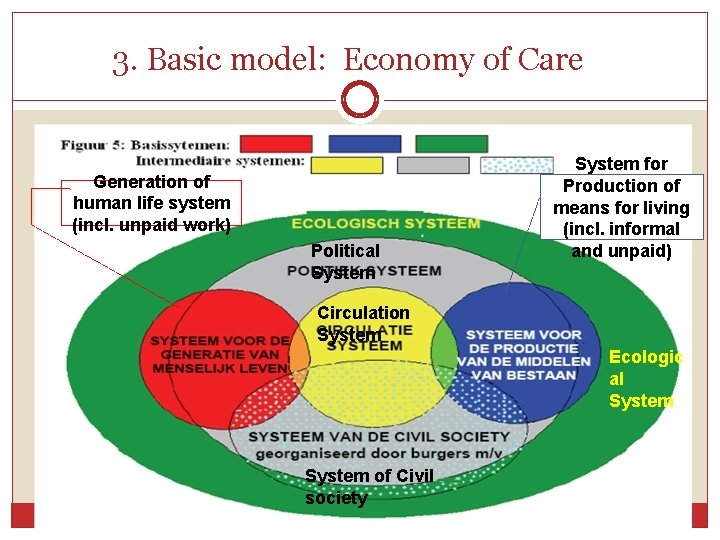
3. Basic model: Economy of Care Generation of human life system (incl. unpaid work) Political System for Production of means for living (incl. informal and unpaid) Circulation System Ecologic al System of Civil society
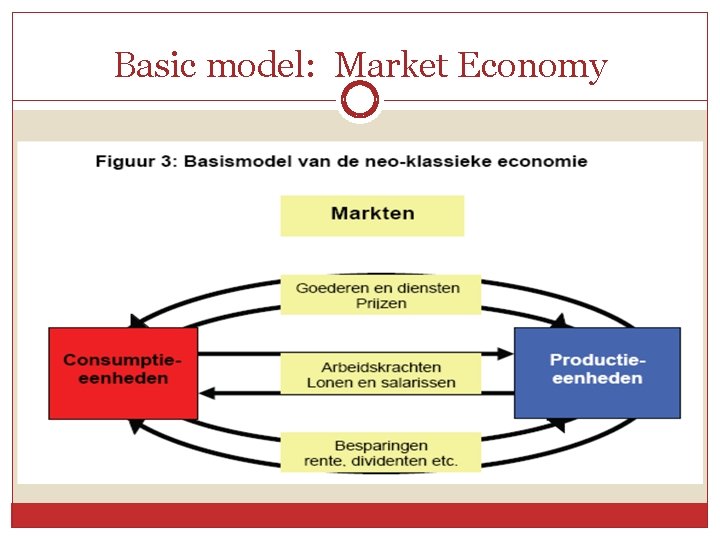
Basic model: Market Economy
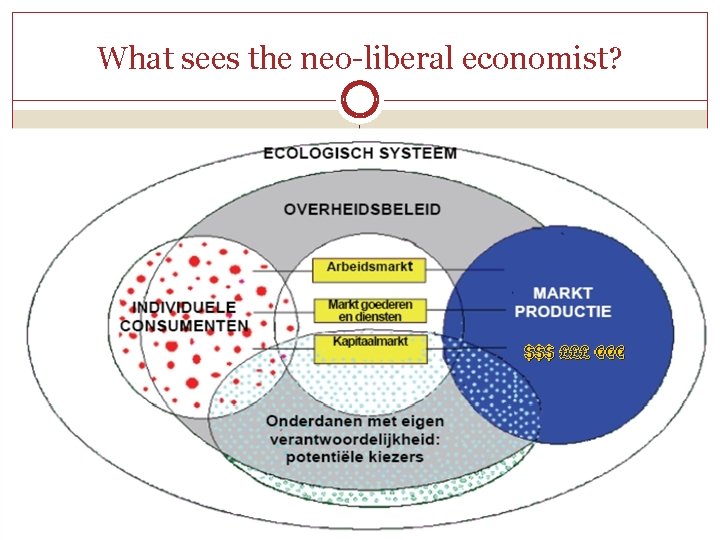
What sees the neo-liberal economist? De Zorgeconomie? $$$ £££ €€€
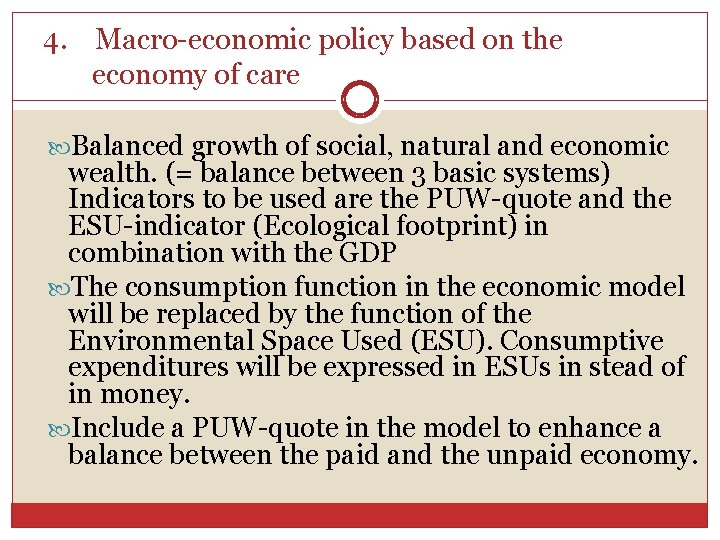
4. Macro-economic policy based on the economy of care Balanced growth of social, natural and economic wealth. (= balance between 3 basic systems) Indicators to be used are the PUW-quote and the ESU-indicator (Ecological footprint) in combination with the GDP The consumption function in the economic model will be replaced by the function of the Environmental Space Used (ESU). Consumptive expenditures will be expressed in ESUs in stead of in money. Include a PUW-quote in the model to enhance a balance between the paid and the unpaid economy.
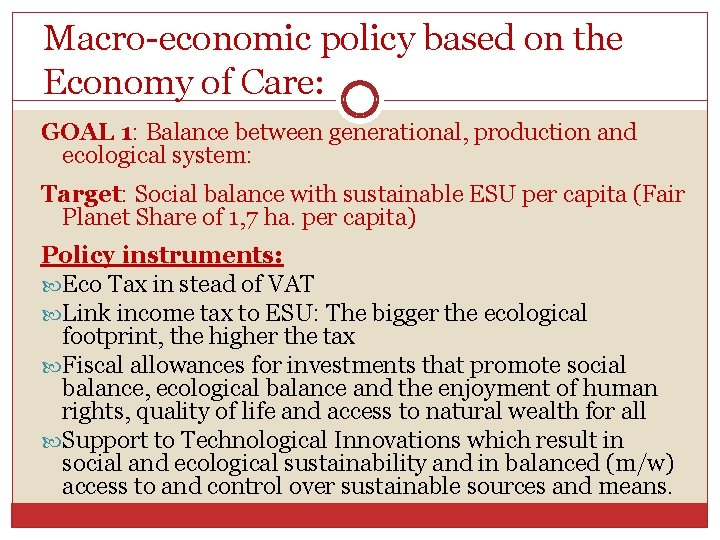
Macro-economic policy based on the Economy of Care: GOAL 1: Balance between generational, production and ecological system: Target: Social balance with sustainable ESU per capita (Fair Planet Share of 1, 7 ha. per capita) Policy instruments: Eco Tax in stead of VAT Link income tax to ESU: The bigger the ecological footprint, the higher the tax Fiscal allowances for investments that promote social balance, ecological balance and the enjoyment of human rights, quality of life and access to natural wealth for all Support to Technological Innovations which result in social and ecological sustainability and in balanced (m/w) access to and control over sustainable sources and means.
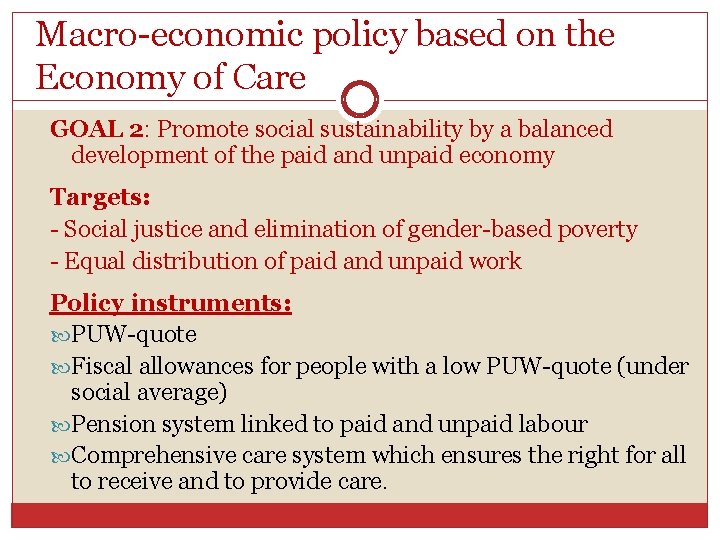
Macro-economic policy based on the Economy of Care GOAL 2: Promote social sustainability by a balanced development of the paid and unpaid economy Targets: - Social justice and elimination of gender-based poverty - Equal distribution of paid and unpaid work Policy instruments: PUW-quote Fiscal allowances for people with a low PUW-quote (under social average) Pension system linked to paid and unpaid labour Comprehensive care system which ensures the right for all to receive and to provide care.
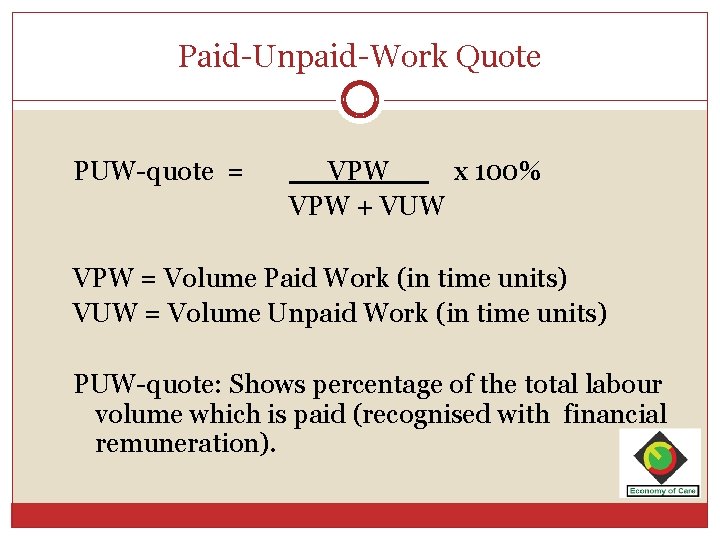
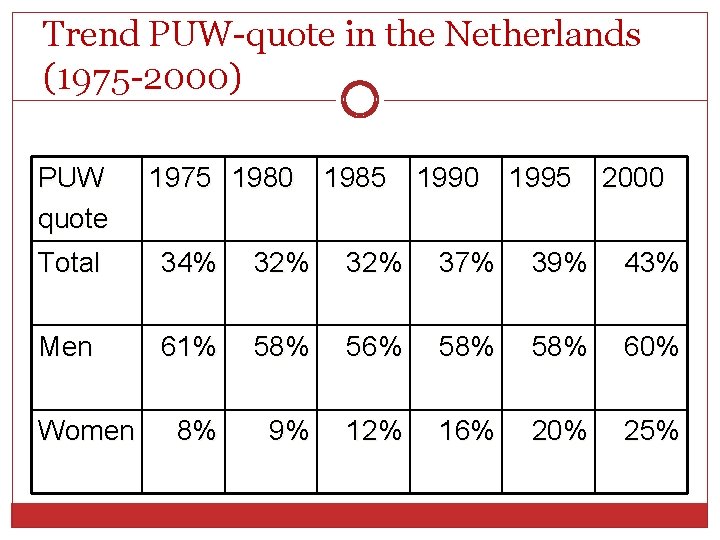
Paid-Unpaid-Work Quote PUW-quote = VPW x 100% VPW + VUW VPW = Volume Paid Work (in time units) VUW = Volume Unpaid Work (in time units) PUW-quote: Shows percentage of the total labour volume which is paid (recognised with financial remuneration).
Trend PUW-quote in the Netherlands (1975 -2000) PUW quote 1975 1980 1985 1990 1995 2000 Total 34% 32% 37% 39% 43% Men 61% 58% 56% 58% 60% 8% 9% 12% 16% 20% 25% Women
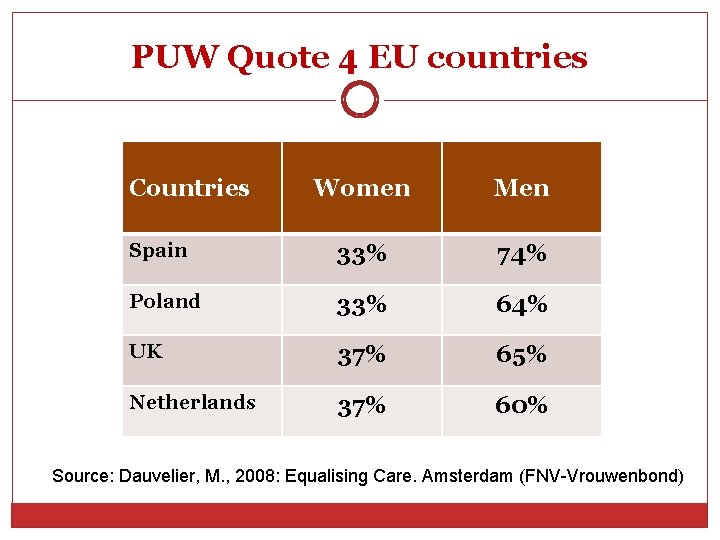
PUW Quote 4 EU countries Countries Women Men Spain 33% 74% Poland 33% 64% UK 37% 65% Netherlands 37% 60% Source: Dauvelier, M. , 2008: Equalising Care. Amsterdam (FNV-Vrouwenbond)
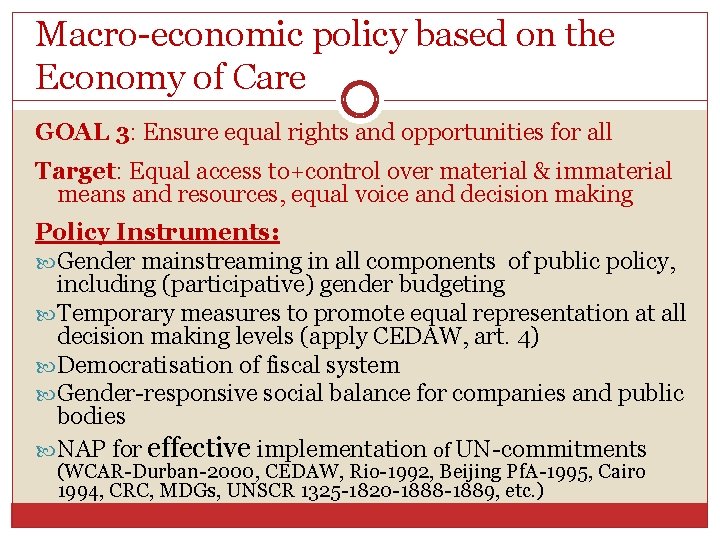
Macro-economic policy based on the Economy of Care GOAL 3: Ensure equal rights and opportunities for all Target: Equal access to+control over material & immaterial means and resources, equal voice and decision making Policy Instruments: Gender mainstreaming in all components of public policy, including (participative) gender budgeting Temporary measures to promote equal representation at all decision making levels (apply CEDAW, art. 4) Democratisation of fiscal system Gender-responsive social balance for companies and public bodies NAP for effective implementation of UN-commitments (WCAR-Durban-2000, CEDAW, Rio-1992, Beijing Pf. A-1995, Cairo 1994, CRC, MDGs, UNSCR 1325 -1820 -1888 -1889, etc. )
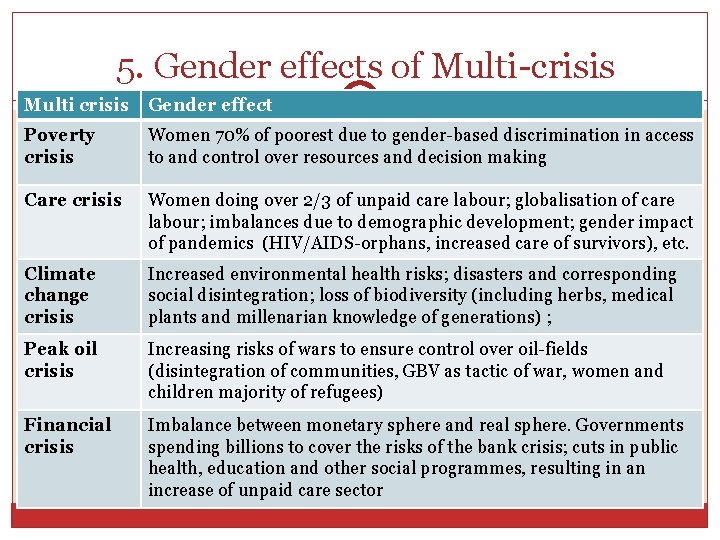
5. Gender effects of Multi-crisis Multi crisis Gender effect Poverty crisis Women 70% of poorest due to risks gender-based discrimination in access to and control over resources and decision making Care crisis Women doing over 2/3 of unpaid care labour; globalisation of care labour; imbalances due to demographic development; gender impact of pandemics (HIV/AIDS-orphans, increased care of survivors), etc. Climate change crisis Increased environmental health risks; disasters and corresponding social disintegration; loss of biodiversity (including herbs, medical plants and millenarian knowledge of generations) ; Peak oil crisis Increasing risks of wars to ensure control over oil-fields (disintegration of communities, GBV as tactic of war, women and children majority of refugees) Financial crisis Imbalance between monetary sphere and real sphere. Governments spending billions to cover the risks of the bank crisis; cuts in public health, education and other social programmes, resulting in an increase of unpaid care sector
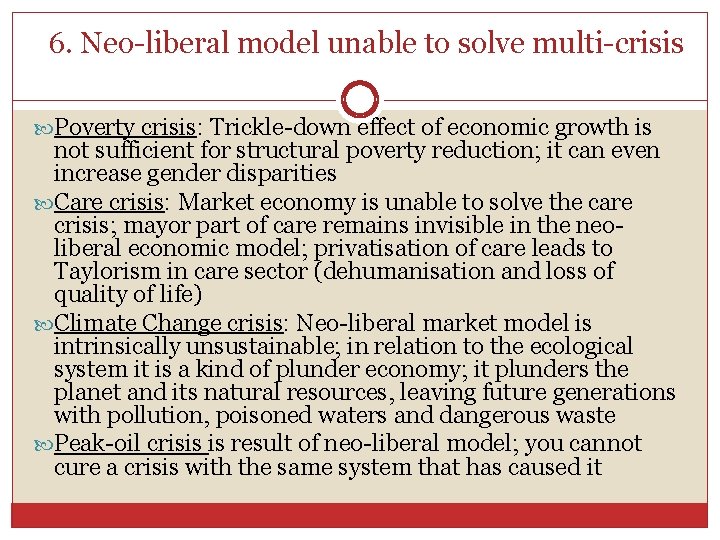
6. Neo-liberal model unable to solve multi-crisis Poverty crisis: Trickle-down effect of economic growth is not sufficient for structural poverty reduction; it can even increase gender disparities Care crisis: Market economy is unable to solve the care crisis; mayor part of care remains invisible in the neoliberal economic model; privatisation of care leads to Taylorism in care sector (dehumanisation and loss of quality of life) Climate Change crisis: Neo-liberal market model is intrinsically unsustainable; in relation to the ecological system it is a kind of plunder economy; it plunders the planet and its natural resources, leaving future generations with pollution, poisoned waters and dangerous waste Peak-oil crisis is result of neo-liberal model; you cannot cure a crisis with the same system that has caused it
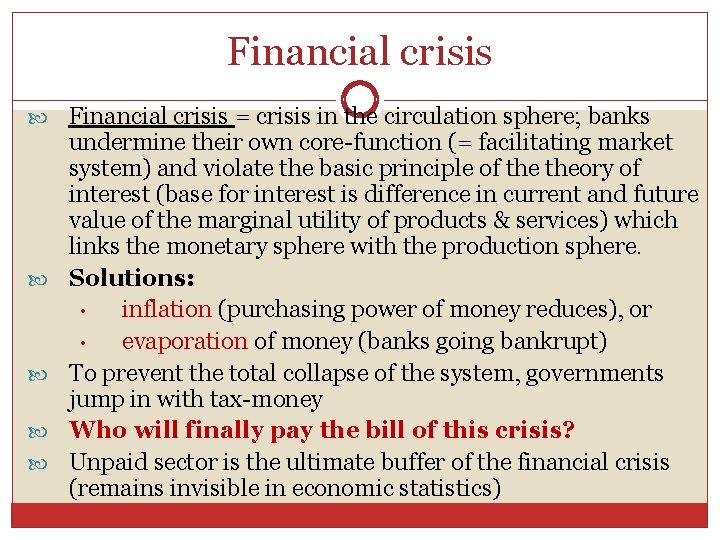
Financial crisis Financial crisis = crisis in the circulation sphere; banks undermine their own core-function (= facilitating market system) and violate the basic principle of theory of interest (base for interest is difference in current and future value of the marginal utility of products & services) which links the monetary sphere with the production sphere. Solutions: • inflation (purchasing power of money reduces), or • evaporation of money (banks going bankrupt) To prevent the total collapse of the system, governments jump in with tax-money Who will finally pay the bill of this crisis? Unpaid sector is the ultimate buffer of the financial crisis (remains invisible in economic statistics)
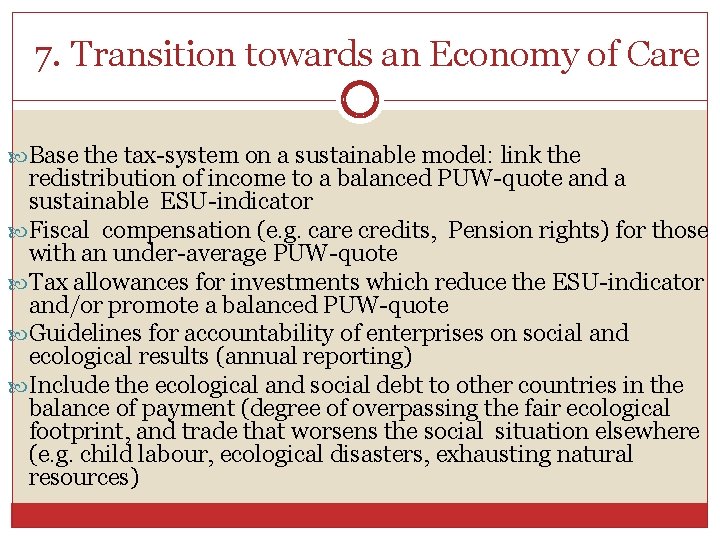
7. Transition towards an Economy of Care Base the tax-system on a sustainable model: link the redistribution of income to a balanced PUW-quote and a sustainable ESU-indicator Fiscal compensation (e. g. care credits, Pension rights) for those with an under-average PUW-quote Tax allowances for investments which reduce the ESU-indicator and/or promote a balanced PUW-quote Guidelines for accountability of enterprises on social and ecological results (annual reporting) Include the ecological and social debt to other countries in the balance of payment (degree of overpassing the fair ecological footprint, and trade that worsens the social situation elsewhere (e. g. child labour, ecological disasters, exhausting natural resources)
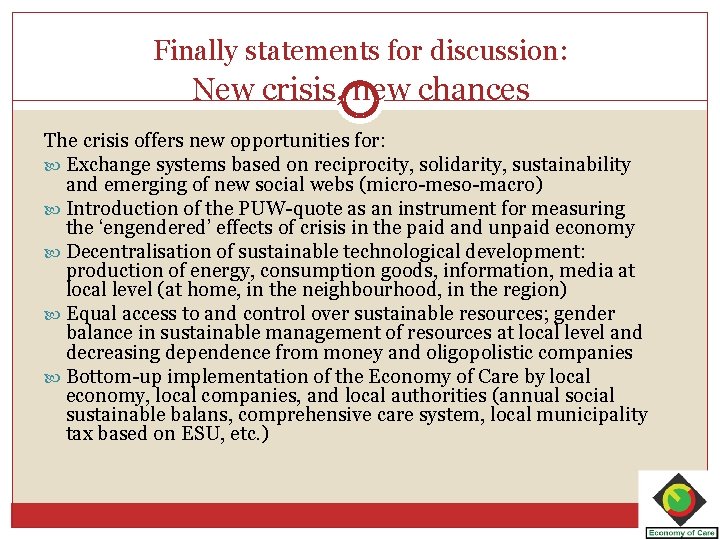
Finally statements for discussion: New crisis, new chances The crisis offers new opportunities for: Exchange systems based on reciprocity, solidarity, sustainability and emerging of new social webs (micro-meso-macro) Introduction of the PUW-quote as an instrument for measuring the ‘engendered’ effects of crisis in the paid and unpaid economy Decentralisation of sustainable technological development: production of energy, consumption goods, information, media at local level (at home, in the neighbourhood, in the region) Equal access to and control over sustainable resources; gender balance in sustainable management of resources at local level and decreasing dependence from money and oligopolistic companies Bottom-up implementation of the Economy of Care by local economy, local companies, and local authorities (annual social sustainable balans, comprehensive care system, local municipality tax based on ESU, etc. )
THANKS FOR YOUR ATTENTION QUESTIONS AND ANSWERS?