
The Economy 1964 79 BRITAIN IN DECLINE A
The Economy 1964 -79 BRITAIN IN DECLINE?
A Mixed Economy A mix of public ownership and private enterprise and mixed in the sense that there was state intervention in areas where the free market supposedly operated Stop-Go When domestic consumption and prices rose too quickly the government increased taxes and raised interest rates. When production and exports declined, the government cut taxes and lowered interest
Stagflation Stagnation + Inflation Industry declined but inflation persisted. The result was that the economy received the worst of both worlds!
� Why was Britain’s growth rate in this period slower than that of its main industrial competitors? � Were the trade unions a barrier to economic growth?
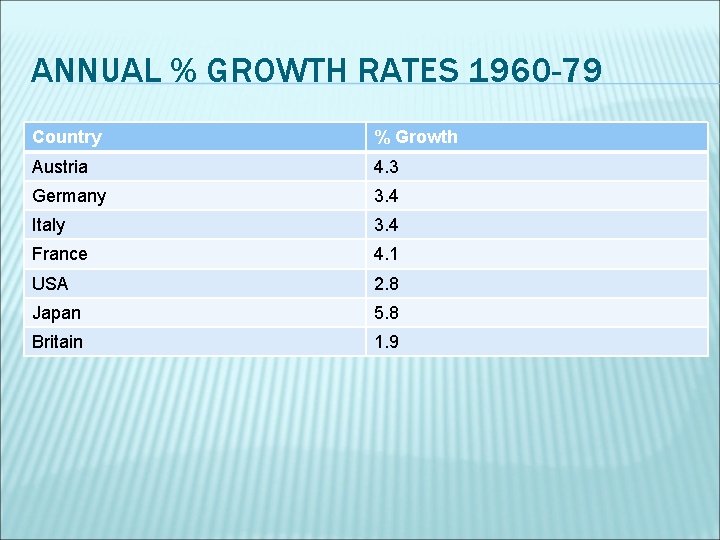
ANNUAL % GROWTH RATES 1960 -79 Country % Growth Austria 4. 3 Germany 3. 4 Italy 3. 4 France 4. 1 USA 2. 8 Japan 5. 8 Britain 1. 9

• • • Britain, at this time, was changing from an industrial to a post-industrial economy Manufacturing industries were shrinking Service and finance industries were expanding • • • This change often led to social disruption Central and local government played only a small role in this change They responded to changes, but did not direct them
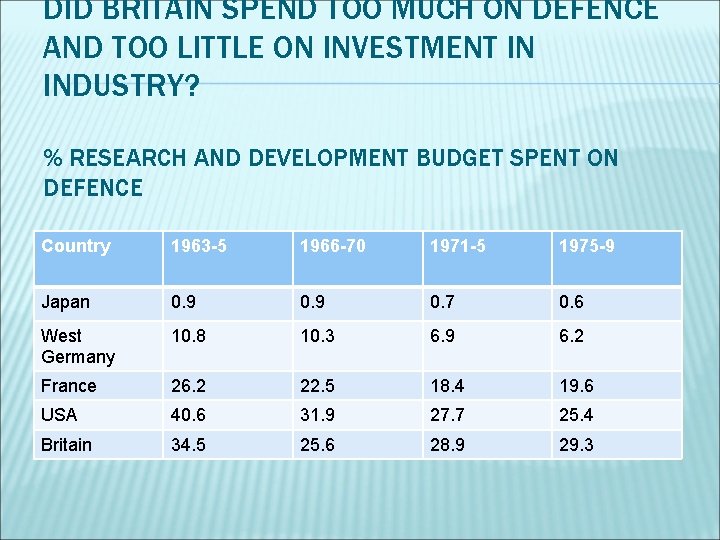
DID BRITAIN SPEND TOO MUCH ON DEFENCE AND TOO LITTLE ON INVESTMENT IN INDUSTRY? % RESEARCH AND DEVELOPMENT BUDGET SPENT ON DEFENCE Country 1963 -5 1966 -70 1971 -5 1975 -9 Japan 0. 9 0. 7 0. 6 West Germany 10. 8 10. 3 6. 9 6. 2 France 26. 2 22. 5 18. 4 19. 6 USA 40. 6 31. 9 27. 7 25. 4 Britain 34. 5 25. 6 28. 9 29. 3
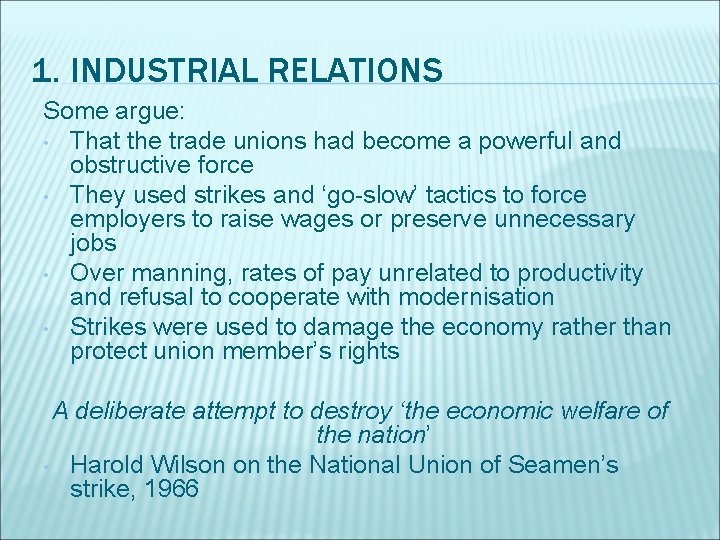
1. INDUSTRIAL RELATIONS Some argue: • That the trade unions had become a powerful and obstructive force • They used strikes and ‘go-slow’ tactics to force employers to raise wages or preserve unnecessary jobs • Over manning, rates of pay unrelated to productivity and refusal to cooperate with modernisation • Strikes were used to damage the economy rather than protect union member’s rights A deliberate attempt to destroy ‘the economic welfare of the nation’ • Harold Wilson on the National Union of Seamen’s strike, 1966
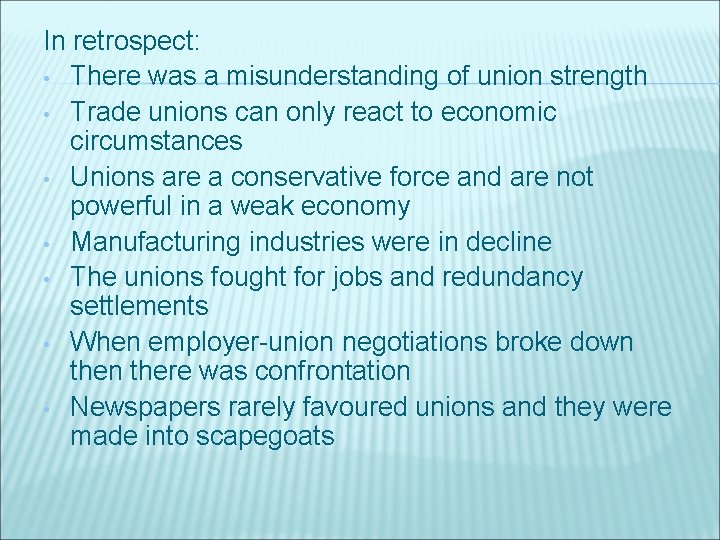
In retrospect: • There was a misunderstanding of union strength • Trade unions can only react to economic circumstances • Unions are a conservative force and are not powerful in a weak economy • Manufacturing industries were in decline • The unions fought for jobs and redundancy settlements • When employer-union negotiations broke down there was confrontation • Newspapers rarely favoured unions and they were made into scapegoats
• • Both parties tried to improve the situation but were unprepared to push too hard For the Labour Party, the unions were their chief supporters and financial backers This accounts for the failure of ‘In place of strife’, 1969 The Conservatives could not easily reconcile thought of impositions on employers and workers with their belief in a free market Heath’s attempts led to battles with the unions In 1972, strikes meant that 23 million working days were lost In 1974 there was an industrial crisis and a 3 day week
2. CONSUMERISM • • • Living standards rose and therefore a rise in purchasing power ‘You’ve never had it so good’ However, wages and purchases were increasing as the economy was going into decline Britain was paying itself wages and salaries that it was not really earning! People were buying imported products so consumerism was not helping British manufacturing industries = Inflation + Balance of Payments Crisis
3. THE INTERNATIONAL OIL PRICE RISE, 1973 • • • Until the early 1970 s, large multi-national companies controlled the production and distribution of oil The West was supplied with relatively cheap fuel From the early 1960 s OPEC members established greater control over their own oil industries OPEC (The Organisation of Petroleum Exporting Countries) represented all major oil-producing nations including Bahrain, Iraq, Kuwait, Libya and Saudi Arabia. OPEC had the strength to resist western domination
• • Oil supplies to the West were reduced by Arab members following western support of Israel in the Arab-Israeli War OPEC also raised the price of oil exports Oil increased from $2 a barrel in 1972 to $35 a barrel in 1980 The USA was the main target but other countries were effected Plastics and other oil-based products became more expensive There was rapid and severe inflation throughout the industrial world In the decade after 1973 Britain suffered a severe recession
THE IMMEDIATE EFFECTS IN BRITAIN � The balance of payments deficit rose to £ 1 billion � The annual inflation rate rose to 16% � The value of the £ dropped to $1. 57 � The interest rate was raised to 15% � A record budget deficit � Between 1974 and 1976 the unemployment figures doubled to 1. 44 million
OIL. . . • • • Caused inflation and economic difficulties of the 1970 s BUT Then offered economic salvation North sea oil was discovered in 1974 By 1980 Britain was exporting more oil than was being imported There was a possibility that Britain could improve its balance of trade
BRITAIN’S ECONOMIC DIFFICULTIES 1. 2. 3. 4. 5. 6. 7. Costly military and defence commitments The legacy of two world wars The cost of running a welfare state Troubled industrial relations The problems of changing from an industrialbased economy to a service-based one The heavy costs incurred by joining the EEC in 1973 The oil price rise from 1973 onwards

� Was Britain ‘the sick man of Europe’?
- Slides: 17