
THE ECONOMICS OF WASTE Accounting for environmental externalities
- Slides: 33
THE ECONOMICS OF WASTE: Accounting for environmental externalities at various stages in the life cycle Kenneth G. Ruffing, Ph. D. Deputy Director for Environment, OECD Integrated Waste Management & Life Cycle Assessment Conference 13 April 2004, Prague 1
What is the OECD? l l Organisation for Economic Co-operation and Development A forum to compare experience, discuss common problems and develop policy responses, and hold governments accountable to implement them through the peer review processes. 30 member countries with a shared commitment: market economy, democratic principles and respect for human rights. A Secretariat which provides policy analysis and advice. 2
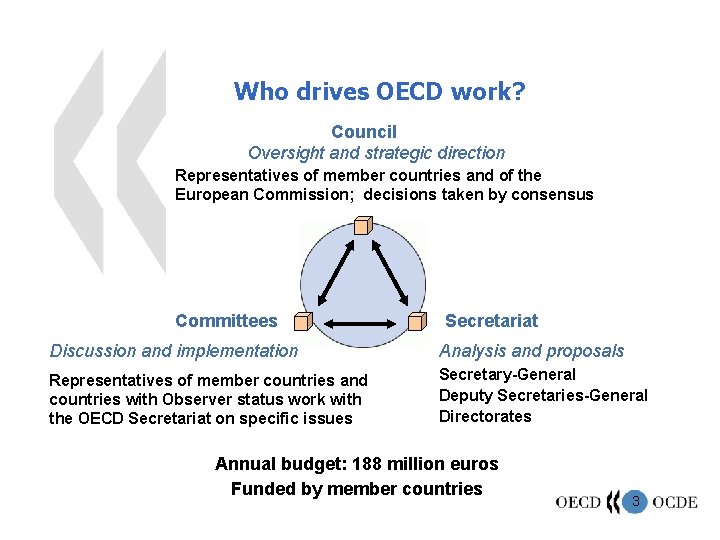
Who drives OECD work? Council Oversight and strategic direction Representatives of member countries and of the European Commission; decisions taken by consensus Committees Secretariat Discussion and implementation Analysis and proposals Representatives of member countries and countries with Observer status work with the OECD Secretariat on specific issues Secretary-General Deputy Secretaries-General Directorates Annual budget: 188 million euros Funded by member countries 3
OECD policy framework for Sustainable Development n Wider use of markets n Stronger policy coherence n Harness science and technology n Manage links to the global economy 4
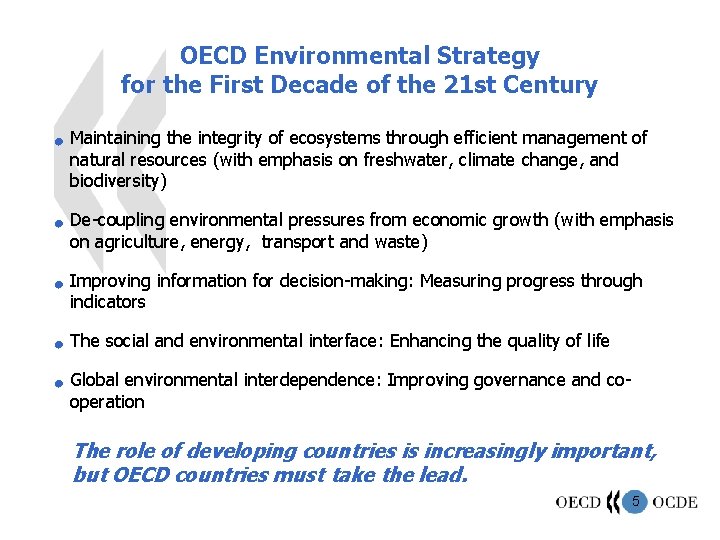
OECD Environmental Strategy for the First Decade of the 21 st Century n n n Maintaining the integrity of ecosystems through efficient management of natural resources (with emphasis on freshwater, climate change, and biodiversity) De-coupling environmental pressures from economic growth (with emphasis on agriculture, energy, transport and waste) Improving information for decision-making: Measuring progress through indicators The social and environmental interface: Enhancing the quality of life Global environmental interdependence: Improving governance and cooperation The role of developing countries is increasingly important, but OECD countries must take the lead. 5
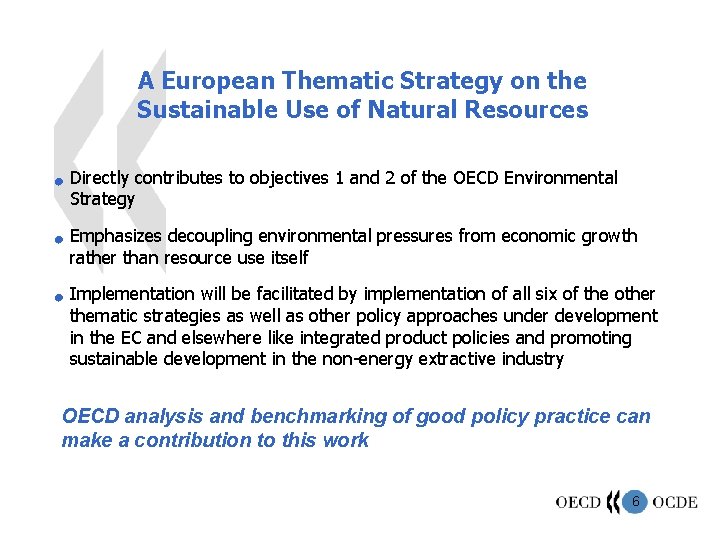
A European Thematic Strategy on the Sustainable Use of Natural Resources n n n Directly contributes to objectives 1 and 2 of the OECD Environmental Strategy Emphasizes decoupling environmental pressures from economic growth rather than resource use itself Implementation will be facilitated by implementation of all six of the other thematic strategies as well as other policy approaches under development in the EC and elsewhere like integrated product policies and promoting sustainable development in the non-energy extractive industry OECD analysis and benchmarking of good policy practice can make a contribution to this work 6
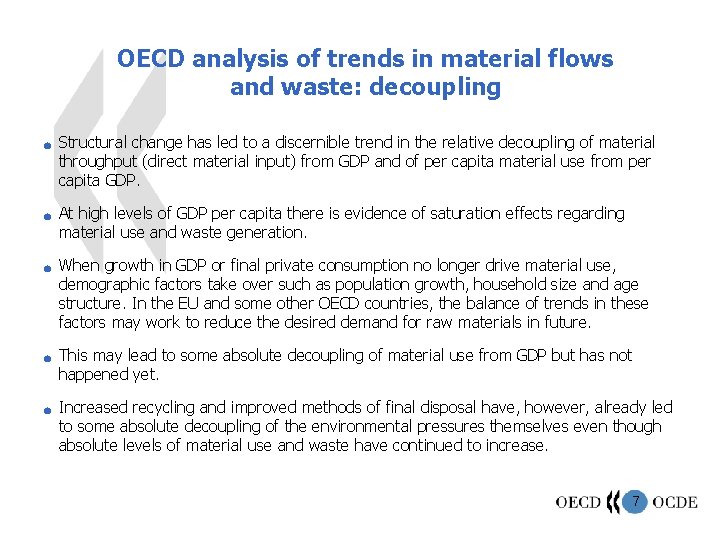
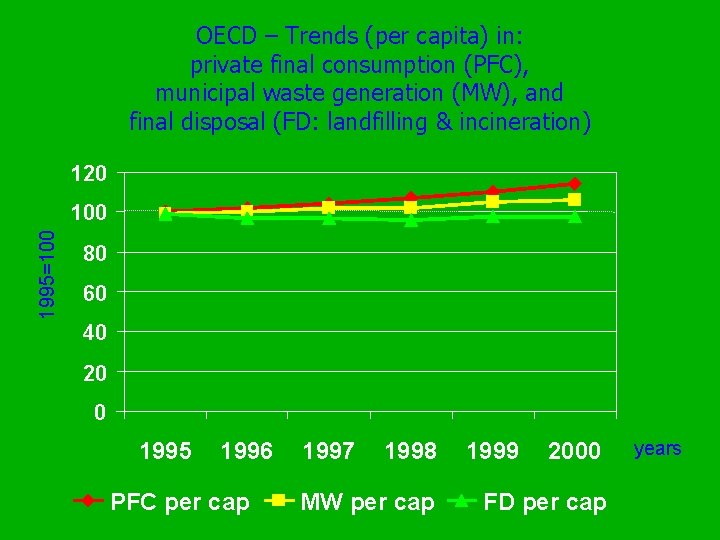
OECD analysis of trends in material flows and waste: decoupling n n n Structural change has led to a discernible trend in the relative decoupling of material throughput (direct material input) from GDP and of per capita material use from per capita GDP. At high levels of GDP per capita there is evidence of saturation effects regarding material use and waste generation. When growth in GDP or final private consumption no longer drive material use, demographic factors take over such as population growth, household size and age structure. In the EU and some other OECD countries, the balance of trends in these factors may work to reduce the desired demand for raw materials in future. This may lead to some absolute decoupling of material use from GDP but has not happened yet. Increased recycling and improved methods of final disposal have, however, already led to some absolute decoupling of the environmental pressures themselves even though absolute levels of material use and waste have continued to increase. 7
OECD – Trends (per capita) in: private final consumption (PFC), municipal waste generation (MW), and final disposal (FD: landfilling & incineration) 120 1995=100 80 60 40 20 0 1995 1996 PFC per cap 1997 1998 MW per cap 1999 2000 FD per cap years
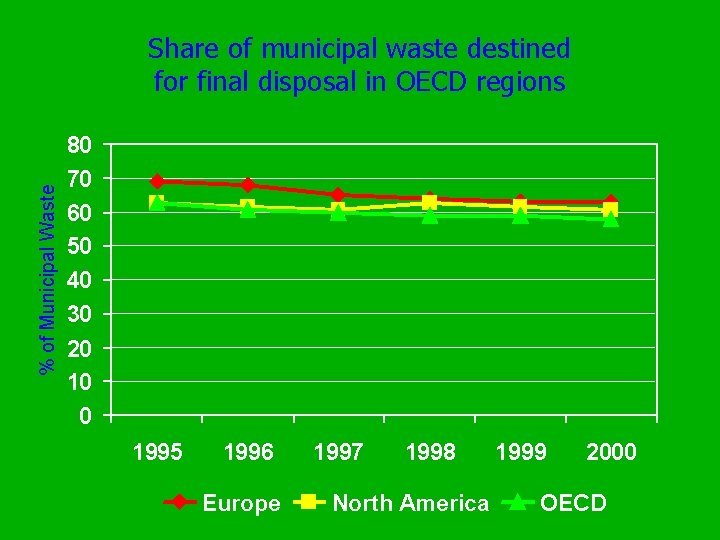
% of Municipal Waste Share of municipal waste destined for final disposal in OECD regions 80 70 60 50 40 30 20 10 0 1995 1996 Europe 1997 1998 North America 1999 2000 OECD
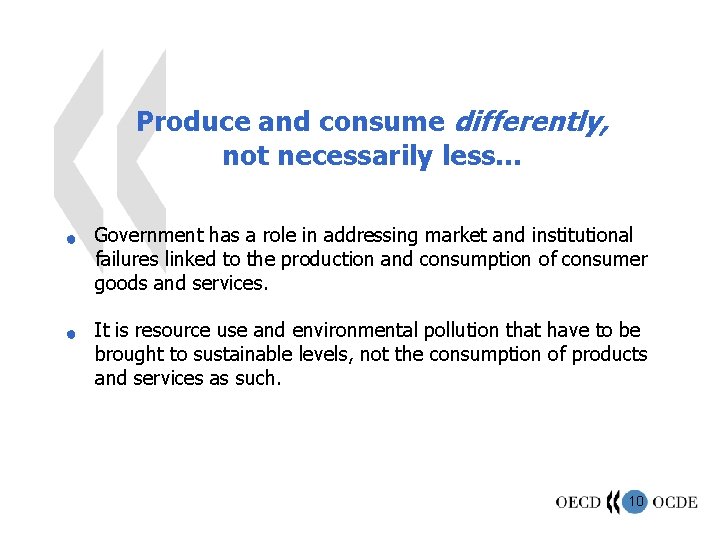
Produce and consume differently, not necessarily less. . . n n Government has a role in addressing market and institutional failures linked to the production and consumption of consumer goods and services. It is resource use and environmental pollution that have to be brought to sustainable levels, not the consumption of products and services as such. 10
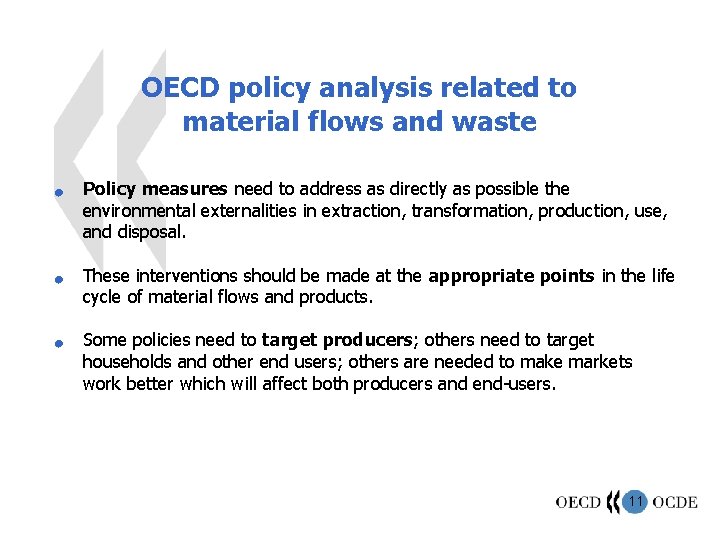
OECD policy analysis related to material flows and waste n n n Policy measures need to address as directly as possible the environmental externalities in extraction, transformation, production, use, and disposal. These interventions should be made at the appropriate points in the life cycle of material flows and products. Some policies need to target producers; others need to target households and other end users; others are needed to make markets work better which will affect both producers and end-users. 11
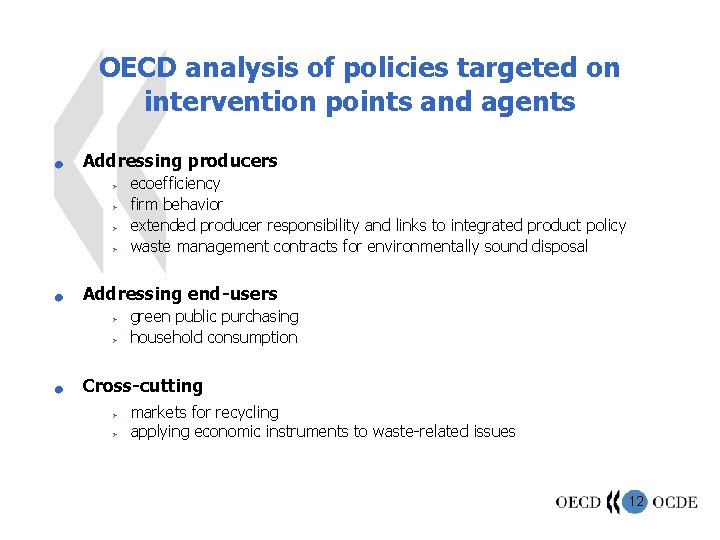
OECD analysis of policies targeted on intervention points and agents n Addressing producers Ø Ø n Addressing end-users Ø Ø n ecoefficiency firm behavior extended producer responsibility and links to integrated product policy waste management contracts for environmentally sound disposal green public purchasing household consumption Cross-cutting Ø Ø markets for recycling applying economic instruments to waste-related issues 12
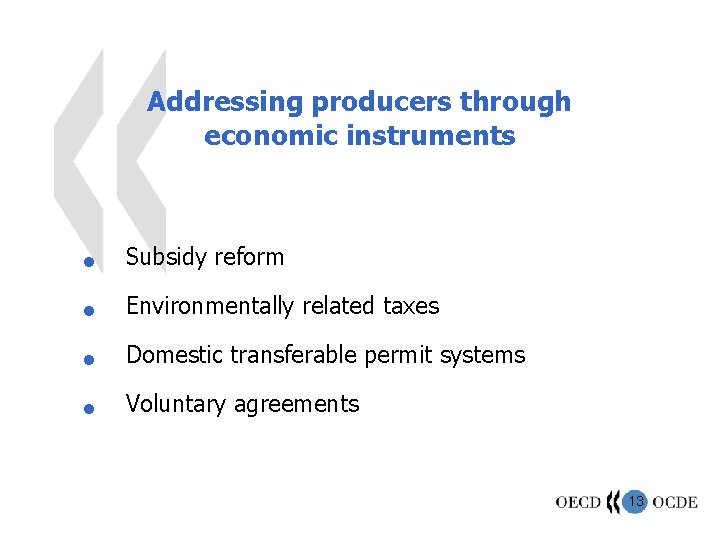
Addressing producers through economic instruments n Subsidy reform n Environmentally related taxes n Domestic transferable permit systems n Voluntary agreements 13
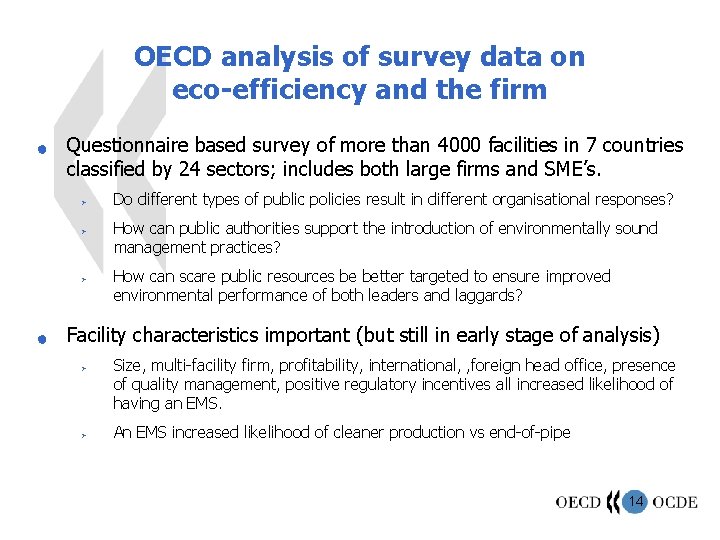
OECD analysis of survey data on eco-efficiency and the firm n Questionnaire based survey of more than 4000 facilities in 7 countries classified by 24 sectors; includes both large firms and SME’s. Ø Ø Ø n Do different types of public policies result in different organisational responses? How can public authorities support the introduction of environmentally sound management practices? How can scare public resources be better targeted to ensure improved environmental performance of both leaders and laggards? Facility characteristics important (but still in early stage of analysis) Ø Ø Size, multi-facility firm, profitability, international, , foreign head office, presence of quality management, positive regulatory incentives all increased likelihood of having an EMS. An EMS increased likelihood of cleaner production vs end-of-pipe 14
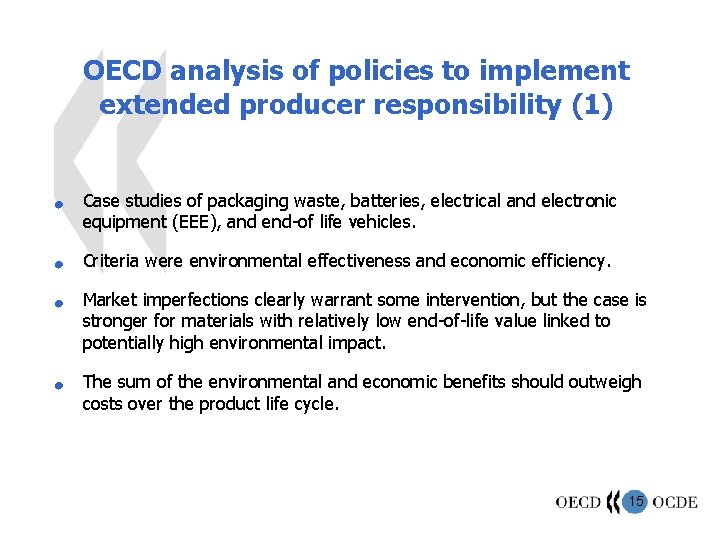
OECD analysis of policies to implement extended producer responsibility (1) n n Case studies of packaging waste, batteries, electrical and electronic equipment (EEE), and end-of life vehicles. Criteria were environmental effectiveness and economic efficiency. Market imperfections clearly warrant some intervention, but the case is stronger for materials with relatively low end-of-life value linked to potentially high environmental impact. The sum of the environmental and economic benefits should outweigh costs over the product life cycle. 15
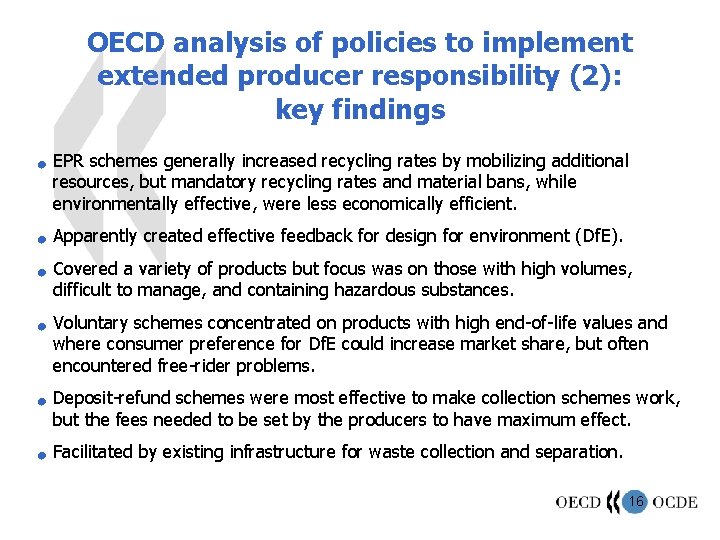
OECD analysis of policies to implement extended producer responsibility (2): key findings n n n EPR schemes generally increased recycling rates by mobilizing additional resources, but mandatory recycling rates and material bans, while environmentally effective, were less economically efficient. Apparently created effective feedback for design for environment (Df. E). Covered a variety of products but focus was on those with high volumes, difficult to manage, and containing hazardous substances. Voluntary schemes concentrated on products with high end-of-life values and where consumer preference for Df. E could increase market share, but often encountered free-rider problems. Deposit-refund schemes were most effective to make collection schemes work, but the fees needed to be set by the producers to have maximum effect. Facilitated by existing infrastructure for waste collection and separation. 16
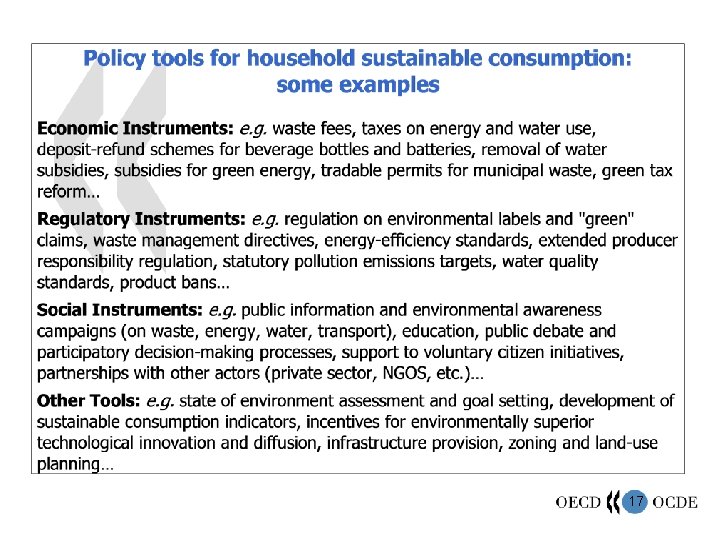
17
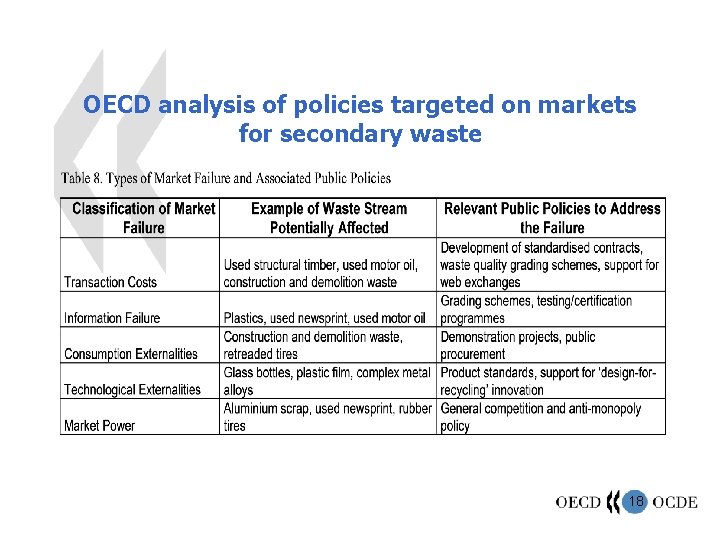
OECD analysis of policies targeted on markets for secondary waste 18
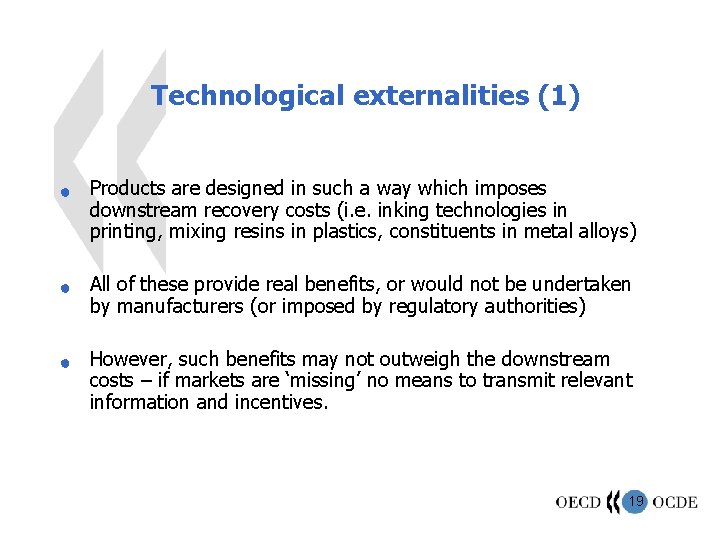
Technological externalities (1) n n n Products are designed in such a way which imposes downstream recovery costs (i. e. inking technologies in printing, mixing resins in plastics, constituents in metal alloys) All of these provide real benefits, or would not be undertaken by manufacturers (or imposed by regulatory authorities) However, such benefits may not outweigh the downstream costs – if markets are ‘missing’ no means to transmit relevant information and incentives. 19
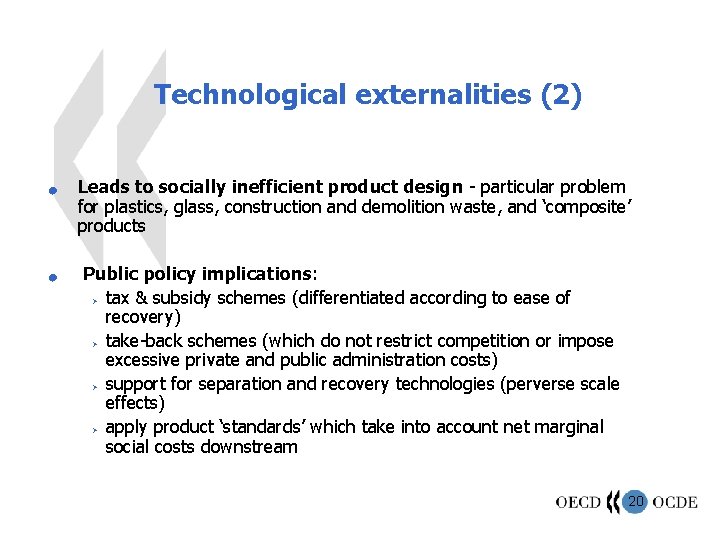
Technological externalities (2) n n Leads to socially inefficient product design - particular problem for plastics, glass, construction and demolition waste, and ‘composite’ products Public policy implications: Ø tax & subsidy schemes (differentiated according to ease of recovery) Ø take-back schemes (which do not restrict competition or impose excessive private and public administration costs) Ø support for separation and recovery technologies (perverse scale effects) Ø apply product ‘standards’ which take into account net marginal social costs downstream 20
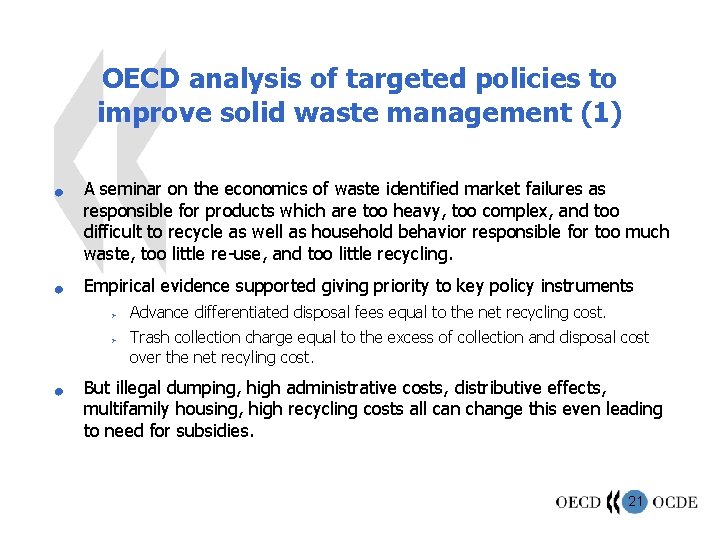
OECD analysis of targeted policies to improve solid waste management (1) n n A seminar on the economics of waste identified market failures as responsible for products which are too heavy, too complex, and too difficult to recycle as well as household behavior responsible for too much waste, too little re-use, and too little recycling. Empirical evidence supported giving priority to key policy instruments Ø Ø n Advance differentiated disposal fees equal to the net recycling cost. Trash collection charge equal to the excess of collection and disposal cost over the net recyling cost. But illegal dumping, high administrative costs, distributive effects, multifamily housing, high recycling costs all can change this even leading to need for subsidies. 21
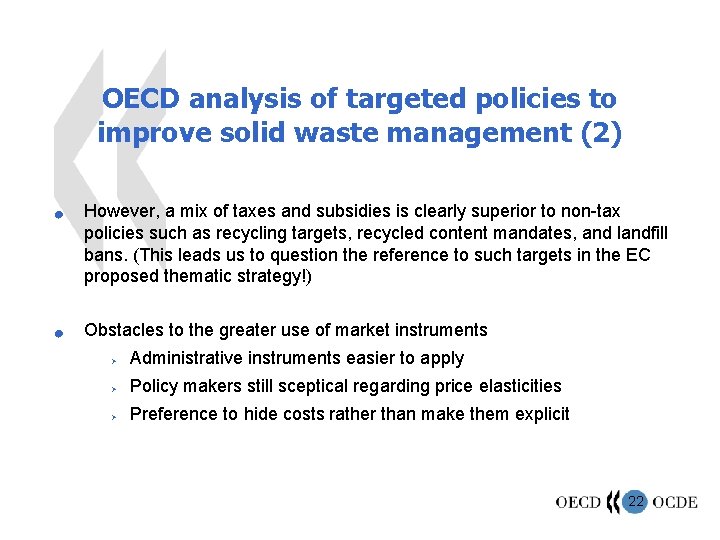
OECD analysis of targeted policies to improve solid waste management (2) n n However, a mix of taxes and subsidies is clearly superior to non-tax policies such as recycling targets, recycled content mandates, and landfill bans. (This leads us to question the reference to such targets in the EC proposed thematic strategy!) Obstacles to the greater use of market instruments Ø Administrative instruments easier to apply Ø Policy makers still sceptical regarding price elasticities Ø Preference to hide costs rather than make them explicit 22
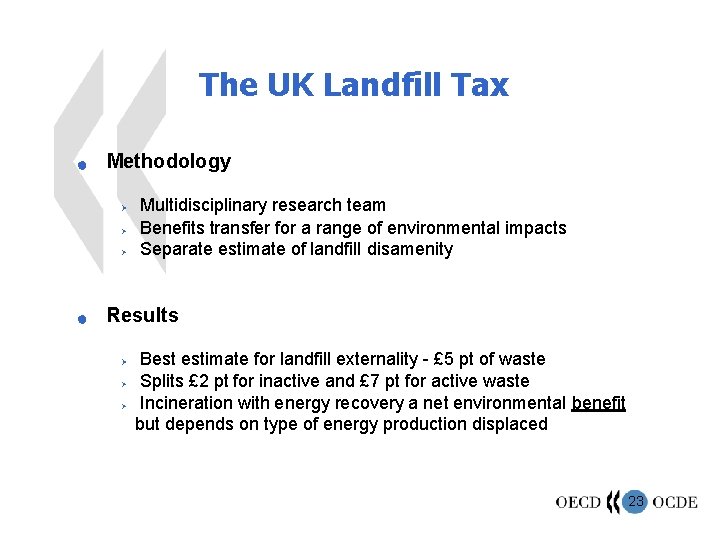
The UK Landfill Tax n Methodology Ø Ø Ø n Multidisciplinary research team Benefits transfer for a range of environmental impacts Separate estimate of landfill disamenity Results Ø Ø Ø Best estimate for landfill externality - £ 5 pt of waste Splits £ 2 pt for inactive and £ 7 pt for active waste Incineration with energy recovery a net environmental benefit but depends on type of energy production displaced 23
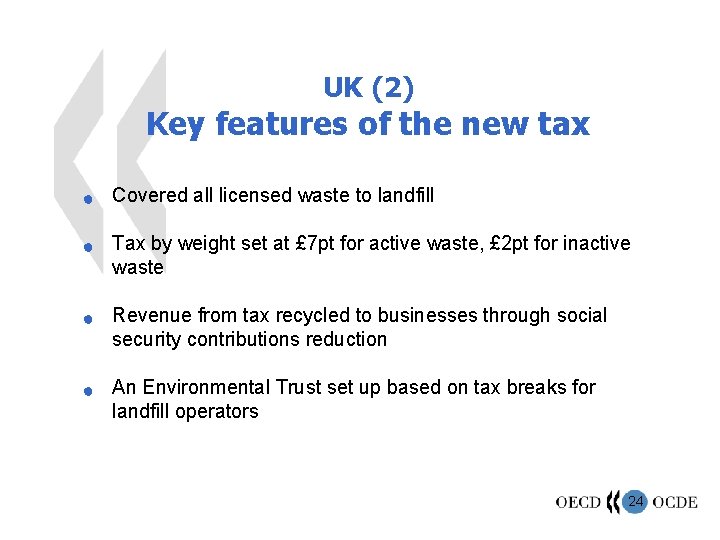
UK (2) Key features of the new tax n n Covered all licensed waste to landfill Tax by weight set at £ 7 pt for active waste, £ 2 pt for inactive waste Revenue from tax recycled to businesses through social security contributions reduction An Environmental Trust set up based on tax breaks for landfill operators 24
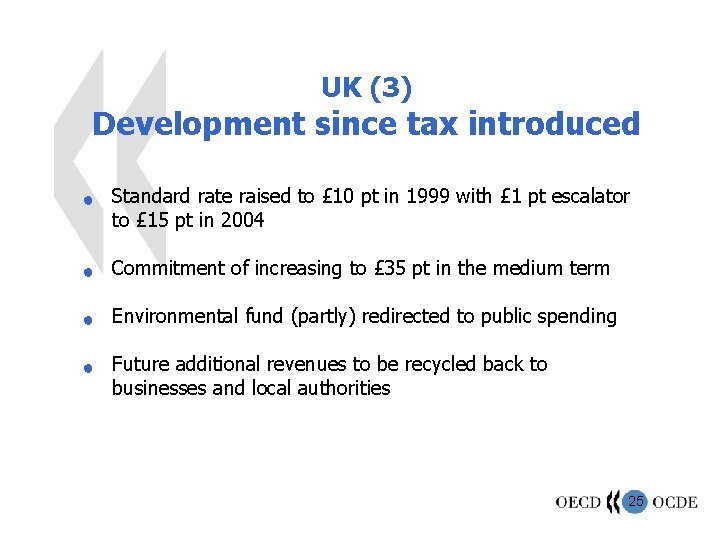
UK (3) Development since tax introduced n Standard rate raised to £ 10 pt in 1999 with £ 1 pt escalator to £ 15 pt in 2004 n Commitment of increasing to £ 35 pt in the medium term n Environmental fund (partly) redirected to public spending n Future additional revenues to be recycled back to businesses and local authorities 25
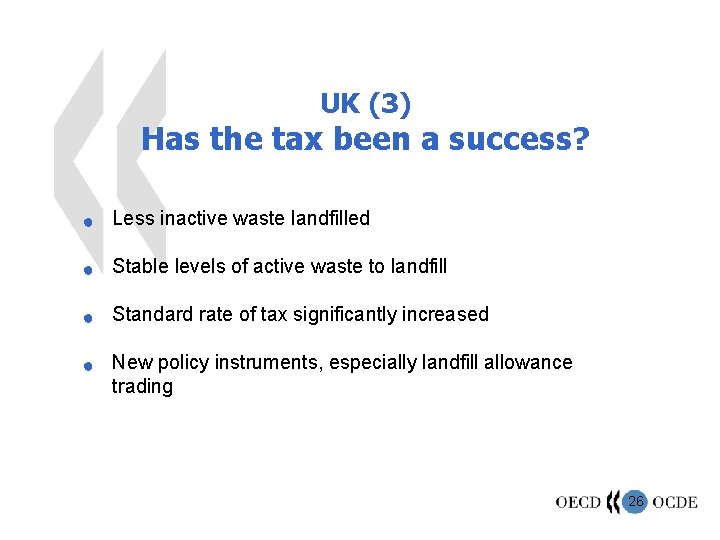
UK (3) Has the tax been a success? n Less inactive waste landfilled n Stable levels of active waste to landfill n Standard rate of tax significantly increased n New policy instruments, especially landfill allowance trading 26
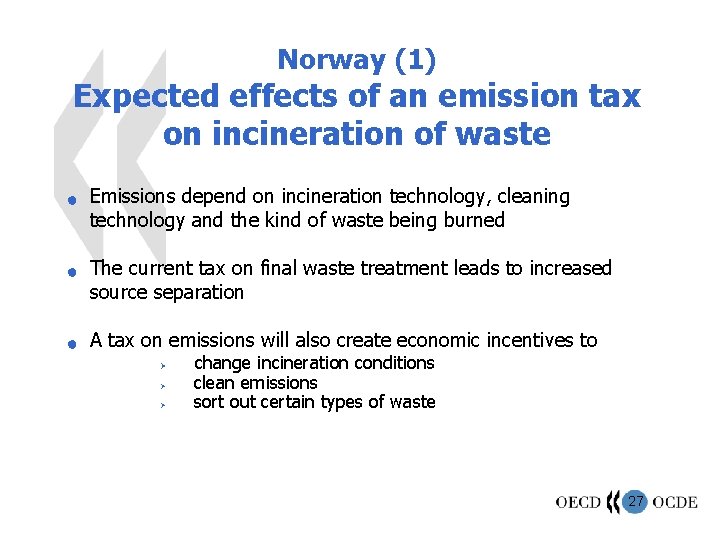
Norway (1) Expected effects of an emission tax on incineration of waste n n n Emissions depend on incineration technology, cleaning technology and the kind of waste being burned The current tax on final waste treatment leads to increased source separation A tax on emissions will also create economic incentives to Ø Ø Ø change incineration conditions clean emissions sort out certain types of waste 27
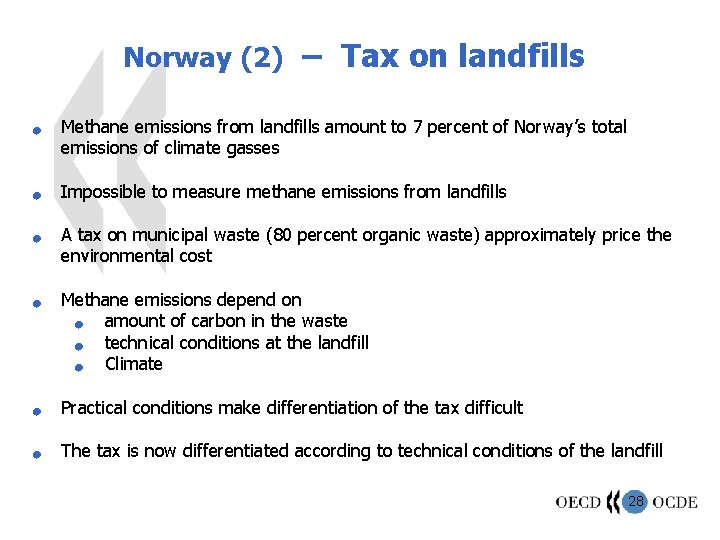
Norway (2) – Tax on landfills n n Methane emissions from landfills amount to 7 percent of Norway’s total emissions of climate gasses Impossible to measure methane emissions from landfills A tax on municipal waste (80 percent organic waste) approximately price the environmental cost Methane emissions depend on n amount of carbon in the waste n technical conditions at the landfill n Climate n Practical conditions make differentiation of the tax difficult n The tax is now differentiated according to technical conditions of the landfill 28
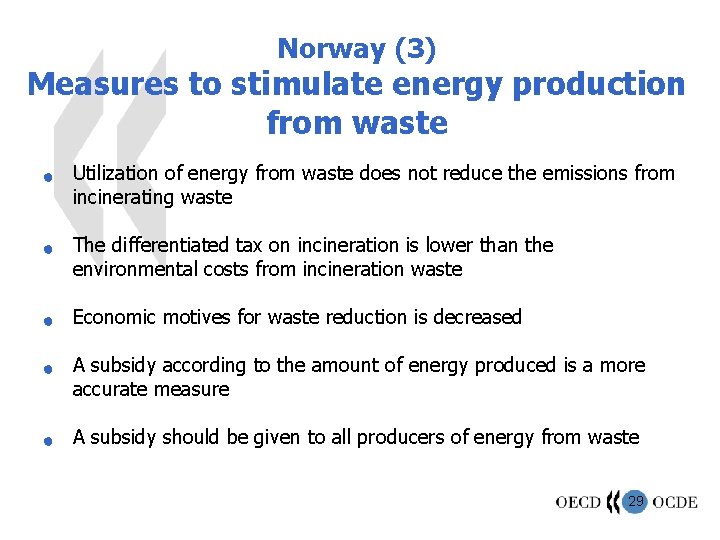
Norway (3) Measures to stimulate energy production from waste n n n Utilization of energy from waste does not reduce the emissions from incinerating waste The differentiated tax on incineration is lower than the environmental costs from incineration waste Economic motives for waste reduction is decreased A subsidy according to the amount of energy produced is a more accurate measure A subsidy should be given to all producers of energy from waste 29
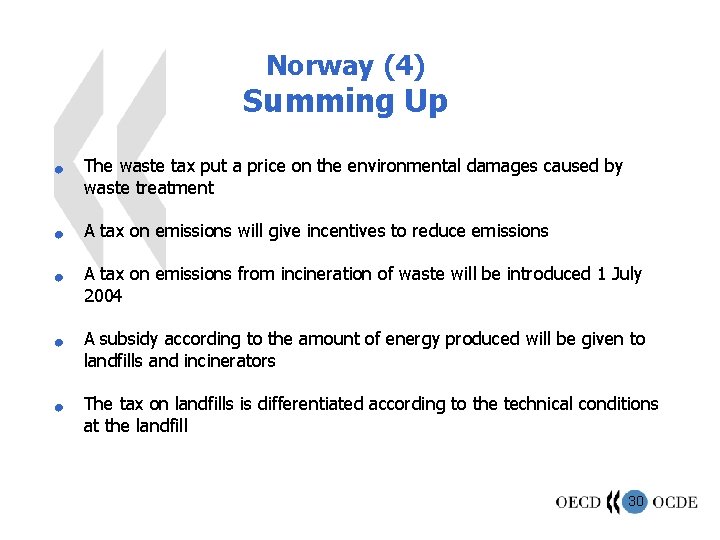
Norway (4) Summing Up n n n The waste tax put a price on the environmental damages caused by waste treatment A tax on emissions will give incentives to reduce emissions A tax on emissions from incineration of waste will be introduced 1 July 2004 A subsidy according to the amount of energy produced will be given to landfills and incinerators The tax on landfills is differentiated according to the technical conditions at the landfill 30
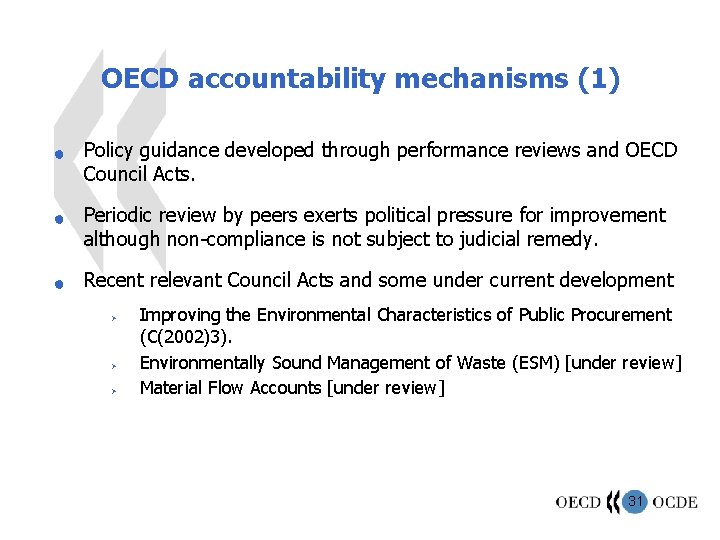
OECD accountability mechanisms (1) n n n Policy guidance developed through performance reviews and OECD Council Acts. Periodic review by peers exerts political pressure for improvement although non-compliance is not subject to judicial remedy. Recent relevant Council Acts and some under current development Ø Ø Ø Improving the Environmental Characteristics of Public Procurement (C(2002)3). Environmentally Sound Management of Waste (ESM) [under review] Material Flow Accounts [under review] 31
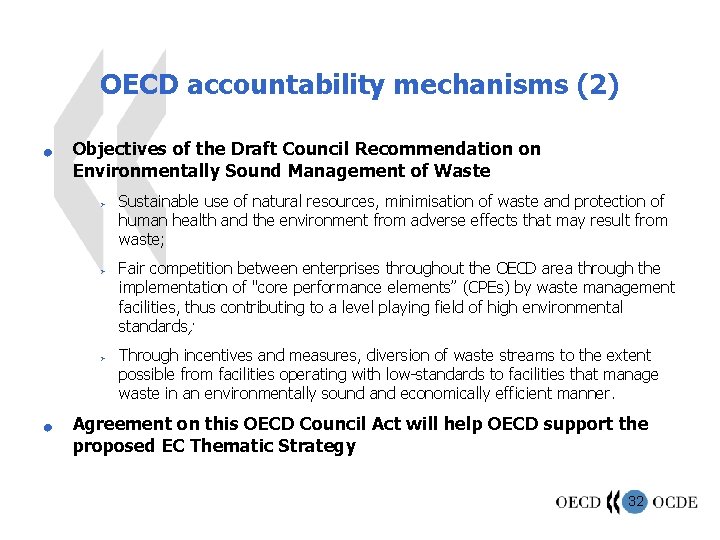
OECD accountability mechanisms (2) n Objectives of the Draft Council Recommendation on Environmentally Sound Management of Waste Ø Ø Ø n Sustainable use of natural resources, minimisation of waste and protection of human health and the environment from adverse effects that may result from waste; Fair competition between enterprises throughout the OECD area through the implementation of "core performance elements” (CPEs) by waste management facilities, thus contributing to a level playing field of high environmental standards; Through incentives and measures, diversion of waste streams to the extent possible from facilities operating with low-standards to facilities that manage waste in an environmentally sound and economically efficient manner. Agreement on this OECD Council Act will help OECD support the proposed EC Thematic Strategy 32
For Further Information on OECD Work http: //www. oecd. org/env 33