
The Economics of Urban Growth Dr Adnan A
The Economics of Urban Growth Dr. Adnan A. Alshiha
Determinants of the Growth process • The distribution of resources. • Relative mode of production. • Level of demand. • The efficiency of price system.
The Principles of Location Analysis • People want to locate where they can maximize their satisfaction. • Producers desire to locate where their profit are expected to be maximize. • Producers motives are more important than worker motives. Why? Because: ü Businessman has more to lose. ü More change in the pattern that determine firm preferences than the pattern that determine consumers preferences.
The Principles of Location Analysis • We begin with producers decision. • Production process is consist of three stages: Ø Procurement. Ø Processing. Ø Distribution. • Procurement and Distribution have a common determinant: transportation cost
Transfer Cost and Firm Location • The reduction of transfer costs is a strong incentive to concentrate three stages of production at a single point in space. • Transfer cost must be consider in relation to distance. • For given modes of transportation, transfer cost per unit of product increase with distance. • But at longer distance , the increase begin to tail off. • In other word, as distance increases , the marginal cost of shipping a good anther
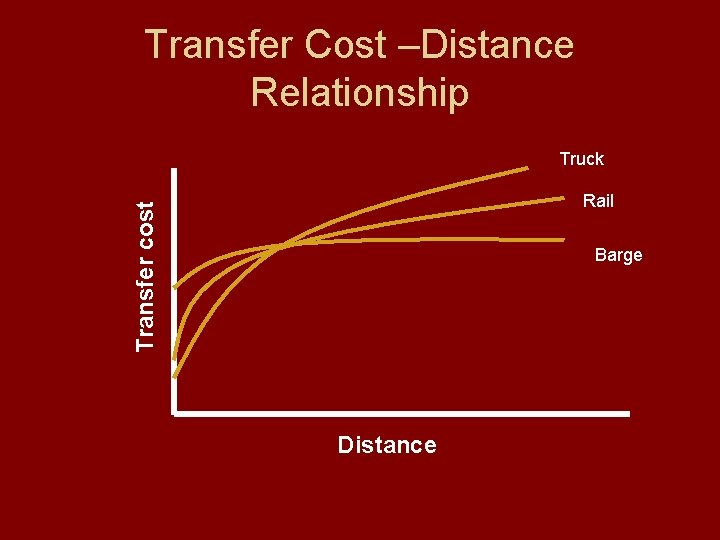
Transfer Cost –Distance Relationship Truck Transfer cost Rail Barge Distance
How Do Transfer Cost Affect Individual Producer? • Consider a producer (bakery) in single linear market, where neither the volume of business nor his processing cost varies with his location. • The bakery hires a boy for deliveries and the boy can carry only one customer’s order at a time. • Where the firm locate to minimize the boy trips? • The mean or Average distance? • The mode?
Single Materials and Market site Location Problem • If the marginal procurement cost exceeds the marginal distribution costs, it will pay to locate at the material site. • When firm’s market are cities and the marginal procurement cost relatively low, we would expect firms to locate in cities
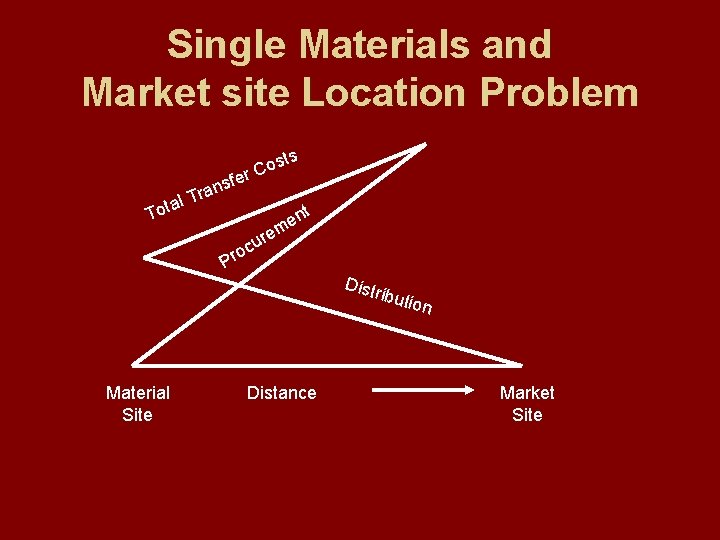
Single Materials and Market site Location Problem an l Tr ts s o r. C sfe a Tot nt e m re u roc P Dist ribut Material Site Distance ion Market Site
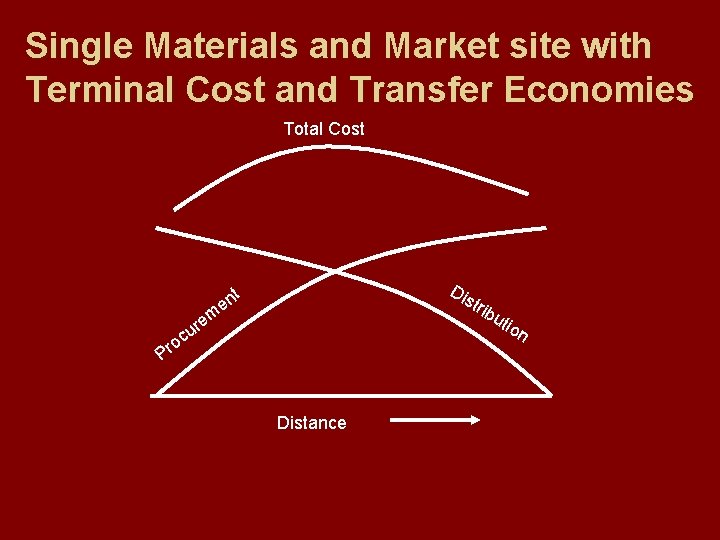
Single Materials and Market site with Terminal Cost and Transfer Economies Total Cost Di t en str m re u c ro ibu tio n P Distance
Single Materials and Market site with Terminal Cost and Transfer Economies • It will pay producer to locate at the material site or the market site. For at these points the firm could save terminal cost on materials or the final product. • In general , producers will be oriented toward markets when the product: • 1 - is weight – gaining manufacturing, as beer. • 2 - has higher transfer costs on distribution , than on procurement • 3 - is perishable, as are ice , baked goods, and fresh agricultural product.
The Location Decision of Persons • Firms motives are more important in determining the location of economic activities than person’s motive. • It follows, that people will tend to be “pulled” to the center or areas of rising economic activity. • People will be “pushed” away from areas having low levels of income per capita or wage rate and high unemployment level. • “pull” and “push” factors diminish as distance between the two cities increases (people have lee information). • These ideas can be expressed in simple gravity model.
Models of Urban Growth • A short – Run Determination. Model • Urban Economic Base Models. • Central – Place Models. • Input-Output Models. Income
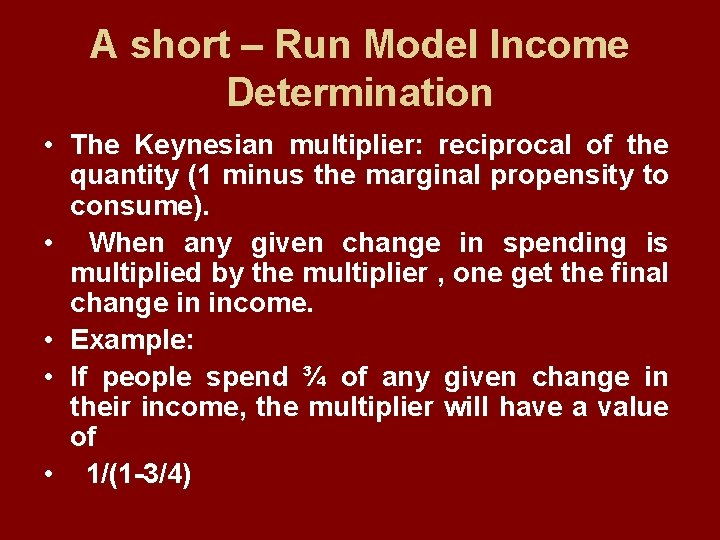
A short – Run Model Income Determination • The Keynesian multiplier: reciprocal of the quantity (1 minus the marginal propensity to consume). • When any given change in spending is multiplied by the multiplier , one get the final change in income. • Example: • If people spend ¾ of any given change in their income, the multiplier will have a value of • 1/(1 -3/4)

A short – Run Model Income Determination • Aggregate income or production (Y) =the sum of consumption (C), Investment (I), Government expenditure (G), and net export (X).
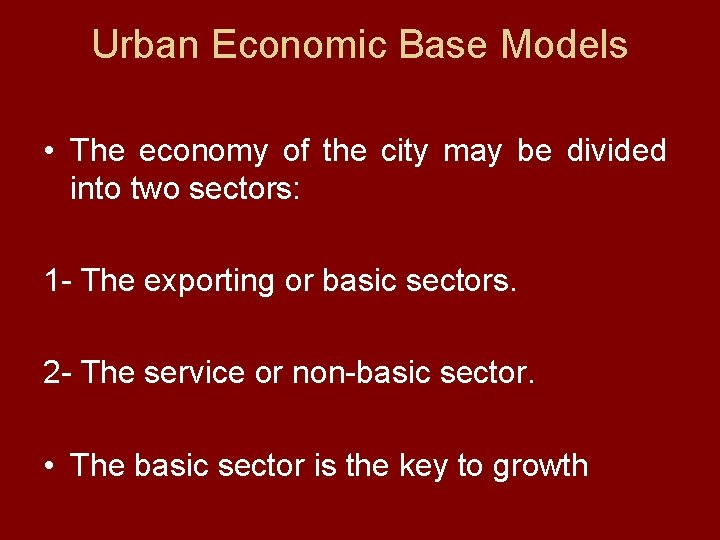
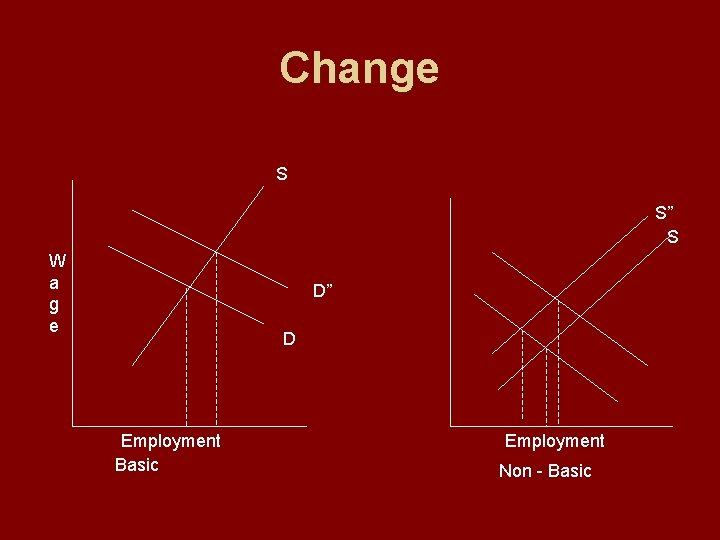
Urban Economic Base Models • The economy of the city may be divided into two sectors: 1 - The exporting or basic sectors. 2 - The service or non-basic sector. • The basic sector is the key to growth
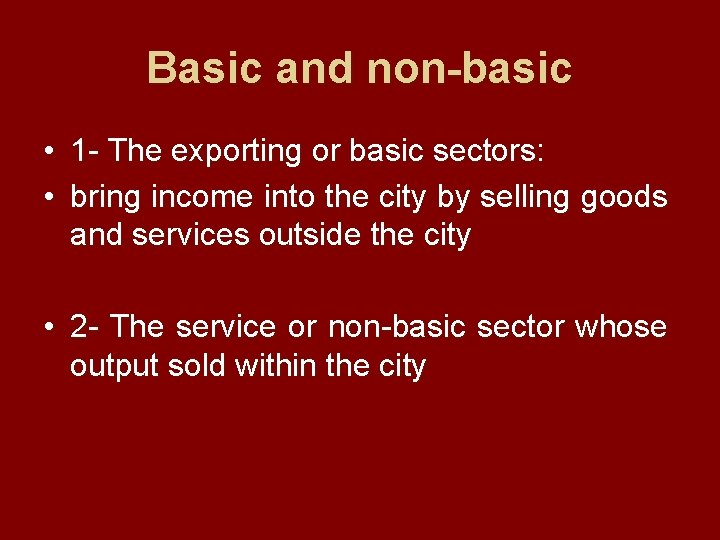
Basic and non-basic • 1 - The exporting or basic sectors: • bring income into the city by selling goods and services outside the city • 2 - The service or non-basic sector whose output sold within the city
Economic-Base Studies • Base studies were done by estimating the amount of employment that was used to produce goods and services sold outside the city.
Methods of estimating “export employment” • The location quotient • The minimum-requirement
The location quotient • For any sector is found by comparing that sector’s share of the total employment in the city with the share of employment for that sector in benchmark area. • Example: • If the chemical sector in a given city has 20% of the city’s total employment • While chemical share of total employment in Saudi Arabia is only 10% • This method allocate ½ of the chemicals employment in the city to export.
The minimum-requirement • Involve arraying the Percentage of total employment of industry for number of cities. • Cities are grouped according to population size class • The percentages are arrayed from smallest to largest. • The lowest percentage is considered that share of employment rquired to service local needs. • The remaining employment is said to be basic.
Change S S” S W a g e D” D Employment Basic Employment Non - Basic
Central – Place Models • Explain the size , number, and distribution of towns across space. • The word central comes from the relatively efficient location of the city with respect to its hinterland.
Degree of Centrality • Is measured by its order. • High-order cities offer high-order goods, have many establishment , large population, and a vast hinterland. • High-order good: are shopping goods the consumer would travel a sizable distance to purchase (mink coats, diamond, professional sport).
• Lower-order places: provide lowerorder good to small surrounding areas. • Lower-order goods are primary necessities, such as groceries and gasoline, which require frequent purchase with minimal travel
Origin and Size of Central Places • Are explained by two concepts: • Threshold: is the minimum level of demand required to support the production of good by (at least) a single establishment. • Once production is originated for any good , how far does the market extend? This is determined by the range. • The range: delineates the zone around any central place from which a person travel to obtain the good. • Since the price of any good rises with distance the range is limited by the relevant transportation cost. • Technically, the boundary of the range is that point in space where a person is indifferent in choosing between two central places that offer the same good.
Input-Output Models • Describe the interrelationships among industries and final users of products for any economy. • Industries are defined on product basis, each industry produce a single homogeneous product. • Final users (final demand): consumer, government, investors and export. • The model shows how the output of each industry is distributed to all of its users. • The model also show the purchases of inputs from all other industries or sectors.
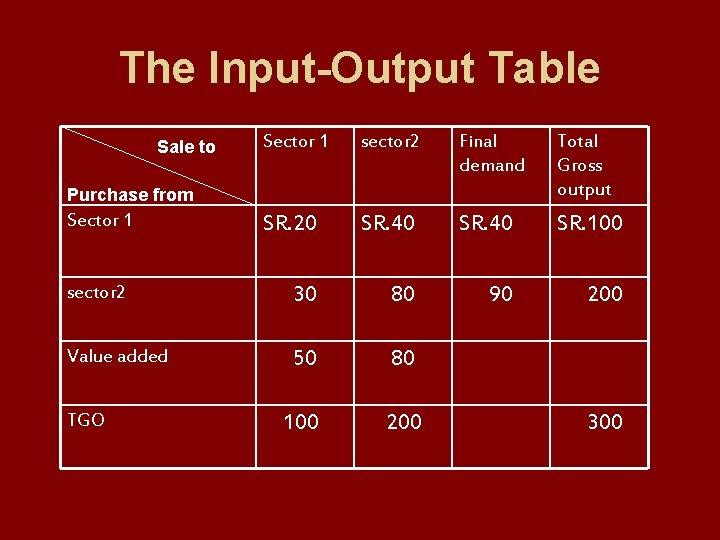
The Input-Output Table Sector 1 sector 2 Final demand Total Gross output SR. 20 SR. 40 SR. 100 sector 2 30 80 90 200 Value added 50 80 100 200 Sale to Purchase from Sector 1 TGO 300
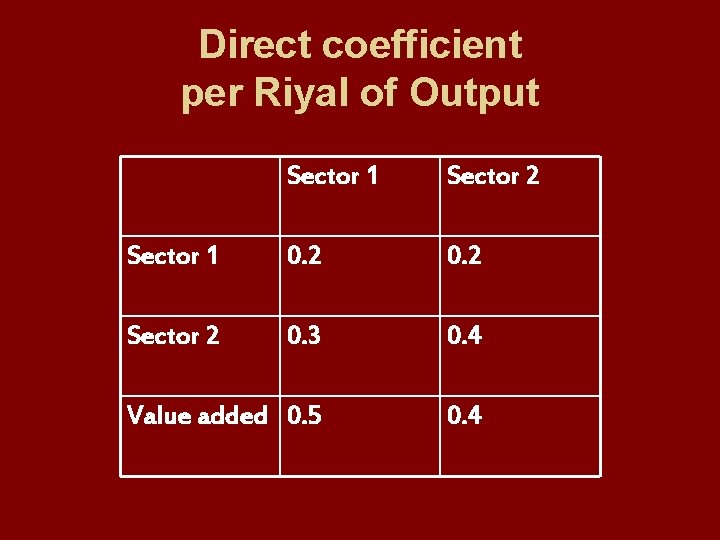
Direct coefficient per Riyal of Output Sector 1 Sector 2 Sector 1 0. 2 Sector 2 0. 3 0. 4 Value added 0. 5 0. 4
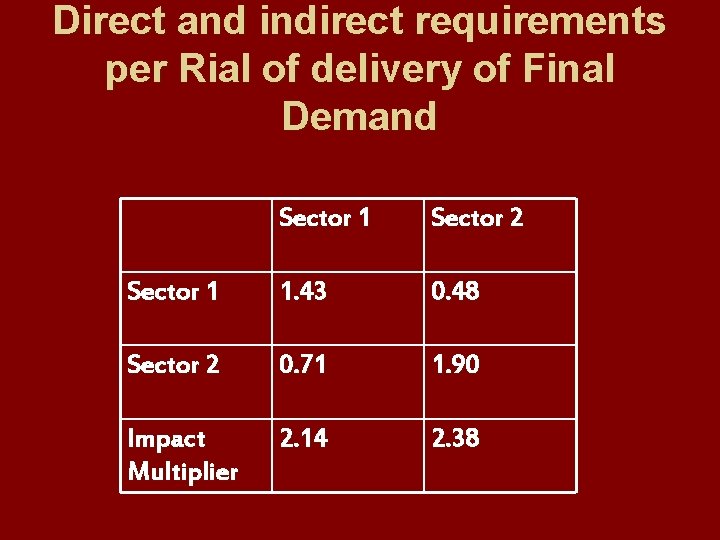
Direct and indirect requirements per Rial of delivery of Final Demand Sector 1 Sector 2 Sector 1 1. 43 0. 48 Sector 2 0. 71 1. 90 Impact Multiplier 2. 14 2. 38
Distributional Impact of Urban Growth • How income is distributed? • The importance of This issue to contemporary urban poverty and other problem is self-evidence • In general, the distribution of income is determined by how things are produced and the taste of consumers.
Is urban Growth Immutable? • The urban size ratchet: the rate growth never fall bellow zero. • This is a reasonable explanation why big cities continue to grow
Is There an Optimum Sized City? • Demand comparative advantage act as limits on the size of cities. • The problems of pollution, congestion, and interjurisdictional spillover could be classified as possible symptoms of excessive urban size. • Optimal city size is reached when the additional social benefits of adding anther person to the city are exactly equal to the additional social cost. • That is , when the marginal social utility of adding anther person is zero
- Slides: 33