
The Economics of the Industrial Revolution SWBAT identify
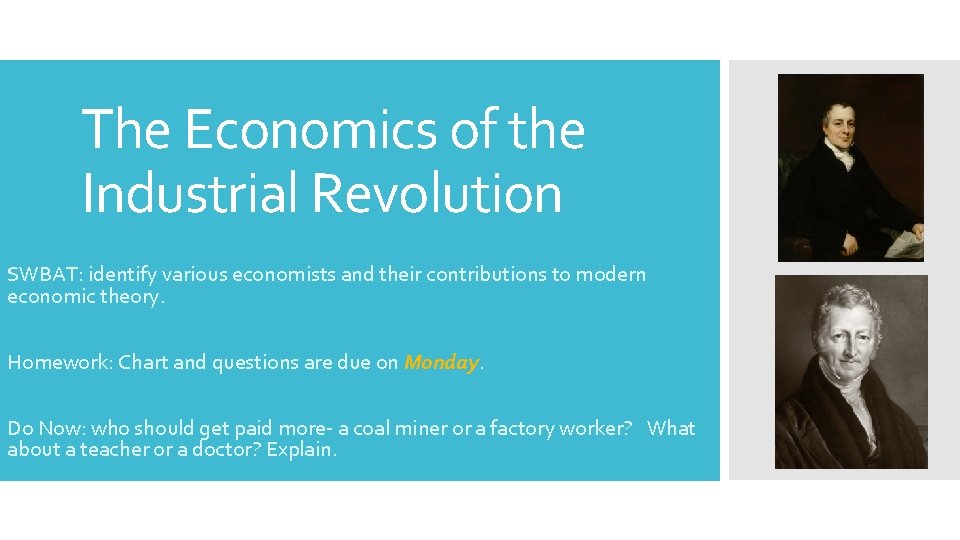
The Economics of the Industrial Revolution SWBAT: identify various economists and their contributions to modern economic theory. Homework: Chart and questions are due on Monday. Do Now: who should get paid more- a coal miner or a factory worker? What about a teacher or a doctor? Explain.
Prior to the Industrial Rev. , people saw national wealth in terms of a country’s stock of gold and silver. Importing goods from abroad was seen as damaging because it meant that this wealth must be given up to pay for them; The Old View of Econ Exporting goods was seen as good because these precious metals came back. Aka maintaining a favorable balance of trade in a mercantilist system. So countries maintained a vast network of controls to prevent this metal wealth draining out – taxes on imports, subsidies to exporters, and protection for domestic industries.
The Industrial Revolution and Econ The Industrial Revolution provided the world with some of the leading thinkers in modern economics. Important figures include: Adam Smith Karl Marx/Friedrich Engels Thomas Malthus David Ricardo
Adam Smith, the father of modern economics, showed that this ‘mercantilist’ idea was wrong. He argued that in a free exchange, both sides became better off. Welcome to Adam Smith 101 Became known as free enterprise. Quite simply, nobody would trade if they expected to lose from it. The buyer profits, just as the seller does. A nation’s wealth is not the quantity of gold and silver in its vaults, but the total of its production and commerce – what today we would call gross national product.
Welcome to Adam Smith 102 Adam Smith argued this and other important econ. theories in Inquiry into the Nature and Causes of the Wealth of Nations. Argued that two natural laws governed all business and economic activity: 1. Law of supply and demand. 2. Law of competition.
In a nutshell, prices and profits depend on both the amt. of available goods and the demand for those goods. Example 1: Law of Supply and Demand You own a cupcake shop. At the end of the day, you are always sold out, and still customers keep coming in to buy cupcakes. What can you do to your prices? Example 2: You own the same cupcake shop in example 1, but this time, you have 5 dozen cupcakes left at the end of the day. What should you do to your prices now?
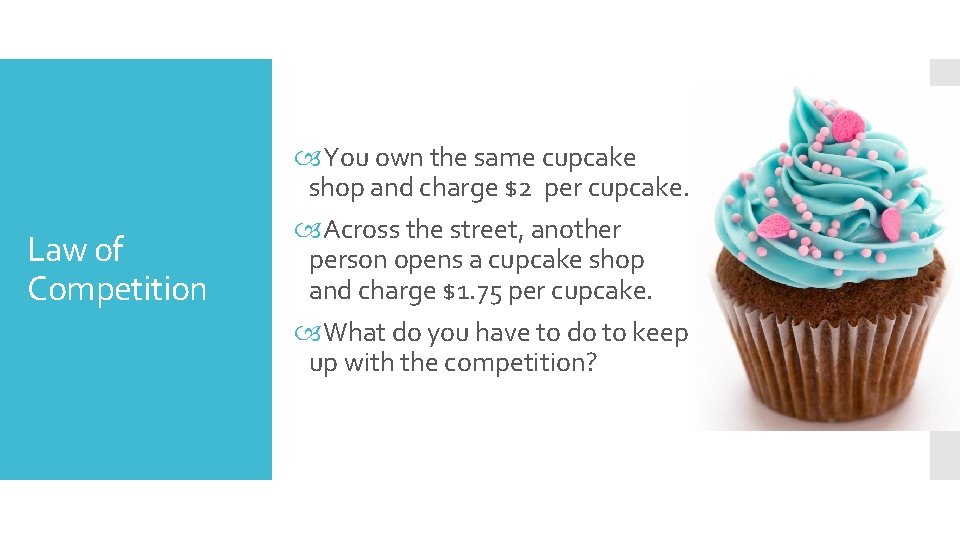
Law of Competition You own the same cupcake shop and charge $2 per cupcake. Across the street, another person opens a cupcake shop and charge $1. 75 per cupcake. What do you have to do to keep up with the competition?
Competition in the market is theoretically beneficial to consumers. Competition’s Benefits Keeps costs down. Forces production of higher quality goods. Demands good customer service It prevents businesses from taking advantage of consumers.
While seemingly commonsense, Smith also explained why wage rates differed. Wage rates would be higher for trades that were more difficult to learn Wages Why? Because people would not be willing to learn them if they were not compensated by a higher wage. Similarly, wage rates would also be higher for those who engaged in dirty or unsafe occupations. i. e. coal mining and butchering In short, differences in work were compensated by differences in pay.
More Economists, more Theories Use your textbook p. 560 -562 to complete the chart and answer the questions that follow. For online textbook users: Unit 6 Ch. 22 Sec. 4 If you don’t finish, it is due on Monday.
- Slides: 10