
The Economic Problem Lower 6 th Micro Nature
The Economic Problem Lower 6 th Micro Nature of Economics Mr O’Grady
The Basic Economic Problem The Economic Problem Mr O’Grady

The Economic Problem Human Needs: the minimum that is necessary for human survival. FINITE Human Wants: desires for non-essential consumption. INFINITE Problem: Resources are scarce (Finite). However, since human wants are unlimited choices must be made as scarce resources have to be allocated between competing uses. The Basic Economic Problem: SCARCITY (there aren’t enough resources to meet everyone’s wants) Three fundamental choices that must be answered to solve the Economic problem: WHAT is to be produced? HOW is production to be organised? FOR WHOM is production to take place? Examples: Consumers Firms Government
Opportunity Cost The Economic Problem Mr O’Grady
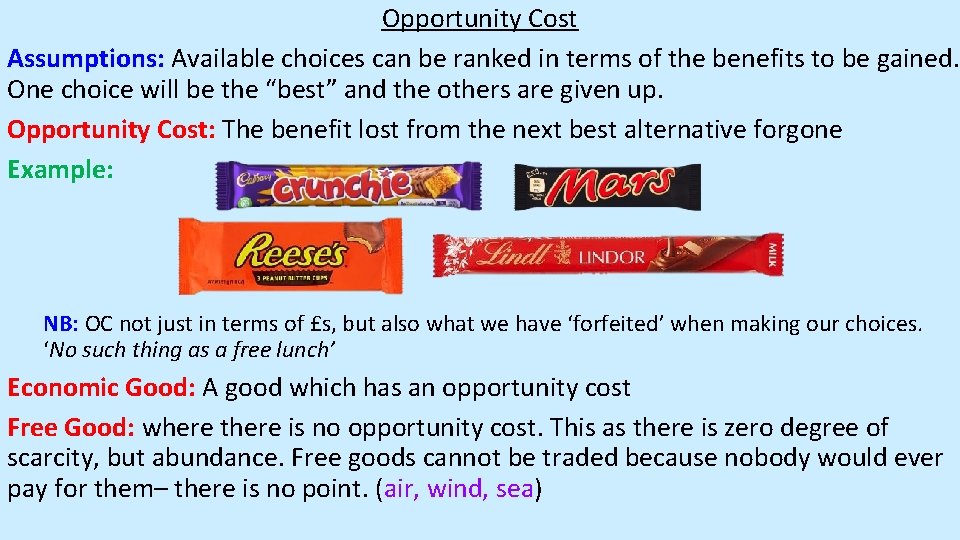
Opportunity Cost Assumptions: Available choices can be ranked in terms of the benefits to be gained. One choice will be the “best” and the others are given up. Opportunity Cost: The benefit lost from the next best alternative forgone Example: NB: OC not just in terms of £s, but also what we have ‘forfeited’ when making our choices. ‘No such thing as a free lunch’ Economic Good: A good which has an opportunity cost Free Good: where there is no opportunity cost. This as there is zero degree of scarcity, but abundance. Free goods cannot be traded because nobody would ever pay for them– there is no point. (air, wind, sea)
Factors of Production The Economic Problem Mr O’Grady
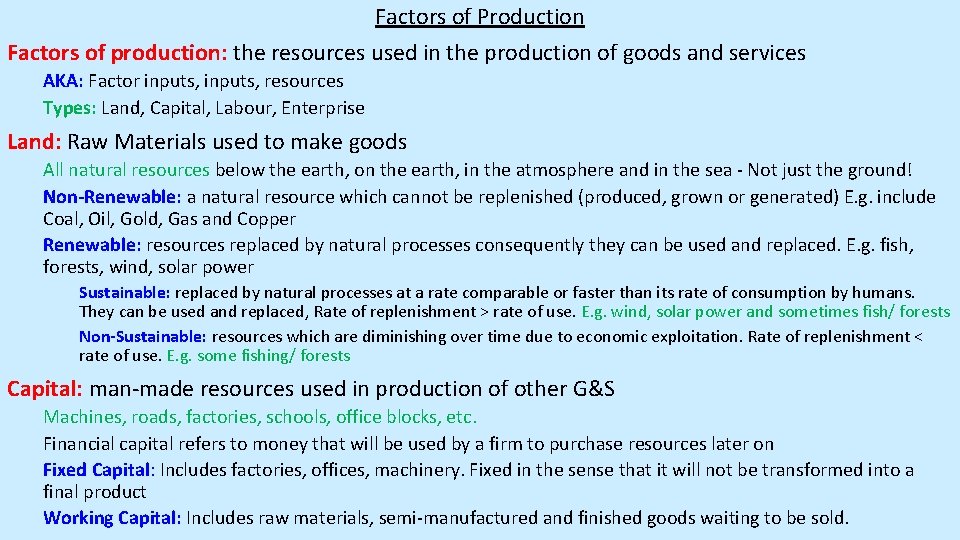
Factors of Production Factors of production: the resources used in the production of goods and services AKA: Factor inputs, resources Types: Land, Capital, Labour, Enterprise Land: Raw Materials used to make goods All natural resources below the earth, on the earth, in the atmosphere and in the sea - Not just the ground! Non-Renewable: a natural resource which cannot be replenished (produced, grown or generated) E. g. include Coal, Oil, Gold, Gas and Copper Renewable: resources replaced by natural processes consequently they can be used and replaced. E. g. fish, forests, wind, solar power Sustainable: replaced by natural processes at a rate comparable or faster than its rate of consumption by humans. They can be used and replaced, Rate of replenishment > rate of use. E. g. wind, solar power and sometimes fish/ forests Non-Sustainable: resources which are diminishing over time due to economic exploitation. Rate of replenishment < rate of use. E. g. some fishing/ forests Capital: man-made resources used in production of other G&S Machines, roads, factories, schools, office blocks, etc. Financial capital refers to money that will be used by a firm to purchase resources later on Fixed Capital: Includes factories, offices, machinery. Fixed in the sense that it will not be transformed into a final product Working Capital: Includes raw materials, semi-manufactured and finished goods waiting to be sold.
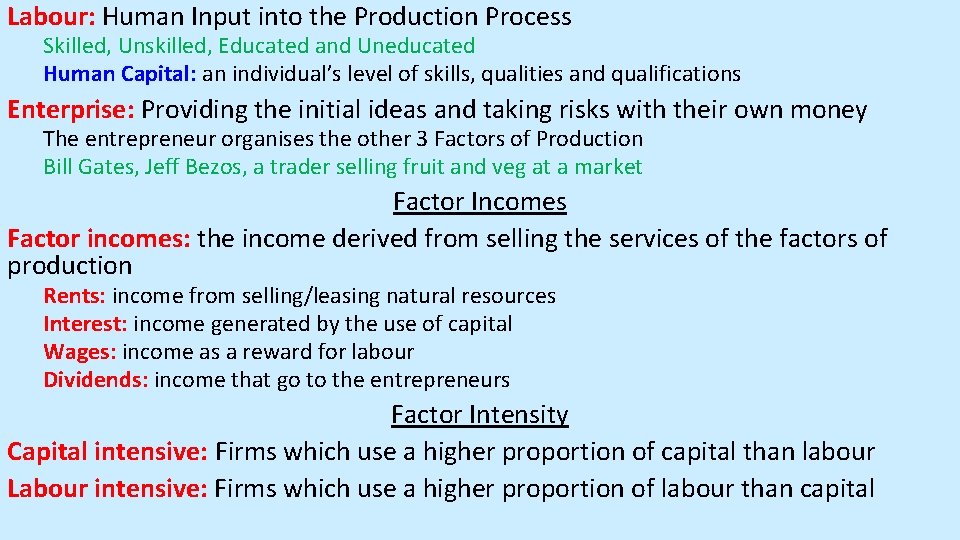
Labour: Human Input into the Production Process Skilled, Unskilled, Educated and Uneducated Human Capital: an individual’s level of skills, qualities and qualifications Enterprise: Providing the initial ideas and taking risks with their own money The entrepreneur organises the other 3 Factors of Production Bill Gates, Jeff Bezos, a trader selling fruit and veg at a market Factor Incomes Factor incomes: the income derived from selling the services of the factors of production Rents: income from selling/leasing natural resources Interest: income generated by the use of capital Wages: income as a reward for labour Dividends: income that go to the entrepreneurs Factor Intensity Capital intensive: Firms which use a higher proportion of capital than labour Labour intensive: Firms which use a higher proportion of labour than capital
Where next? Visit our website: www. smootheconomics. co. uk Find more resources, enrichment materials, details of courses, competitions, and more! Find Our socials: You. Tube: Smooth Economics Instagram: @smootheconomics Twitter: @Smooth. Economics Facebook: @Smooth. Economics
- Slides: 9