
The economic importance of volunteering and local authority

- Slides: 22
The economic importance of volunteering and local authority contribution to sport and the potential for local economic growth. Dr Themis Kokolakakis, Sport Industry Research Centre, Sheffield Hallam University (United Kingdom)
Introduction • Local Authorities sport spending mainly on facilities parks and community sport • Home events • No element of funding for elite sport • Elite sport is financed through UK Sport • Sport through Local Authorities involves: Grassroots sport, home events (of small scale- not mega events), volunteering, mass sport participation, sport clubs and facilities. • LAs own playing fields. At a time when pressures to develop land are high, playing fields are inevitably vulnerable.
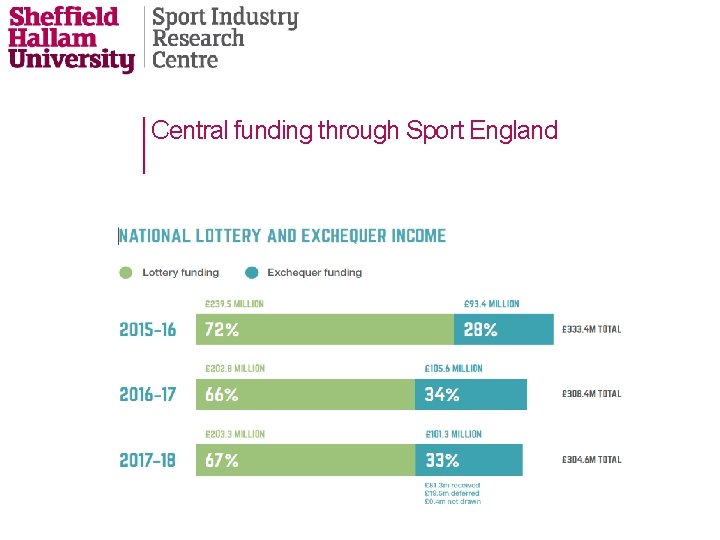
Central funding through Sport England
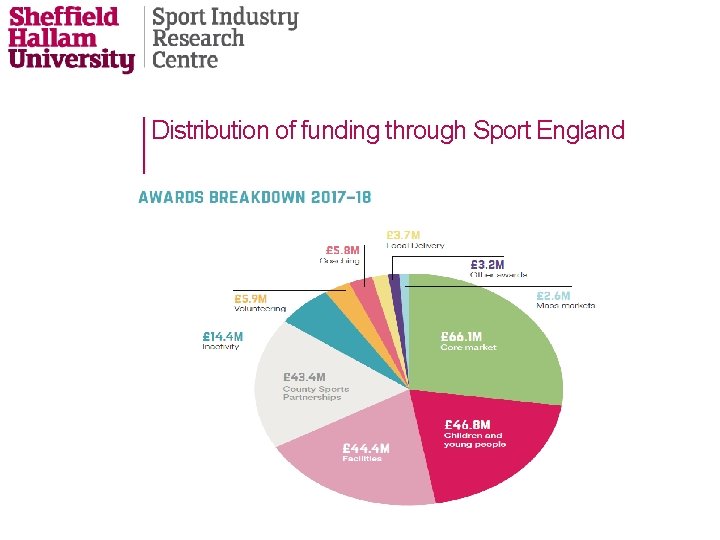
Distribution of funding through Sport England
Economic development-Multiplier effects • Local areas are very affected by local investment in sport and the multiplier effects: • Indirect GVA multipliers in Scotland for example can be as high as 1. 4 for sport services and 1. 6 for sport related construction. • This means that if sport GVA increases by £ 1 m then overall GVA in the economy would increase by £ 1. 4 -£ 1. 6 m.
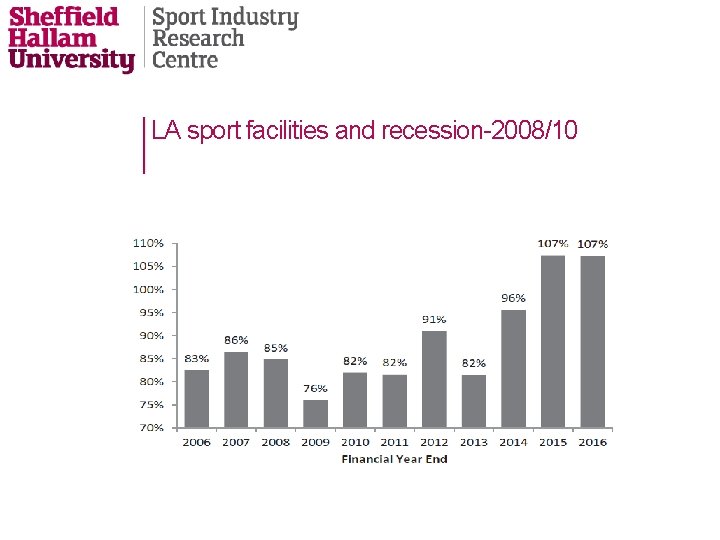
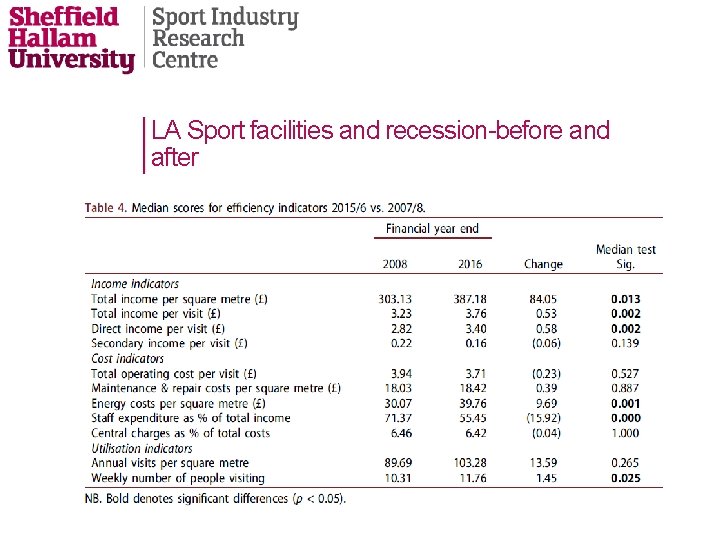
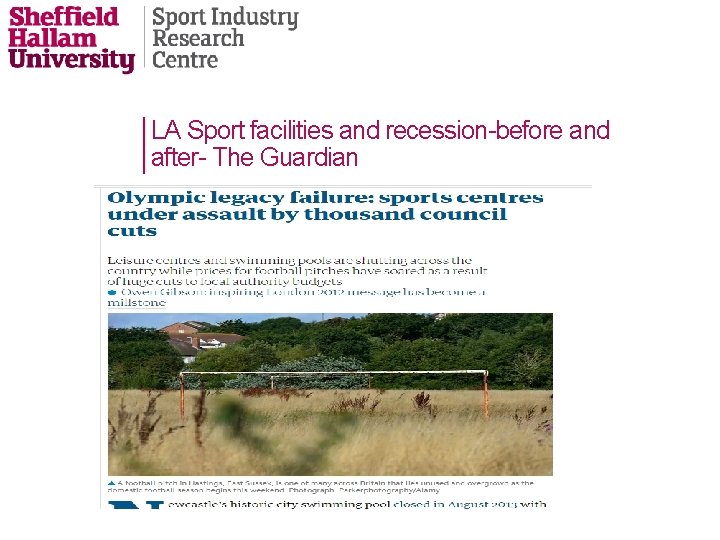
LA sport facilities and recession • Using Sport England’s National Benchmarking Service, we track the changes in a series of key operational performance measures (Ramchandani et al 2018, International Journal of Sport Policy and Politics) • Access, Finance, Utilisation, and Customer satisfaction. • 1116 sports centres • The financial efficiency of English public sport facilities has improved significantly in the face of a reduction in local authority expenditure on sport and leisure services. • Business model: outsourcing management and raising activity charges • Disadvantage: diminished focus on social inclusion objectives
LA sport facilities and recession-2008/10
LA Sport facilities and recession-before and after
LA Sport facilities and recession-before and after- The Guardian
Physical activity empowers social change • Case study: Active Burngreave community initiative, which aims to encourage more people from Sheffield’s most culturally diverse district – one of the most deprived wards in the UK – to take part in weekly physical activities. • Key Target: empower local people to create social change and have a positive impact on social issues. • Target Outcomes: • Reducing isolation • Increasing understanding of the importance of physical activity • Creating opportunities for training or education • Increasing aspirations of young people.
Affecting sport participation- inequalities • More than a quarter of England’s population is inactive, meaning they do less than 30 minutes’ physical activity in a week. Some groups, including those in lower-paid jobs, women and disabled people are disproportionally affected. • Targeting of the most inactive people. • Sport participation is now stable, but in the past it increased through a vast programme of LA sport facilities. • LAs can influence sport participation through local facilities (supply) and home events (demand)
LAs and Parks Heritage Lottery Fund’s (2016) State of the UK public parks 2016 report found that: 57% of the UK population visit their local parks at least once a month or more often 90% of families with children under 5 visit their local park at least once a month 70% of people aged 25 -34 use their local park
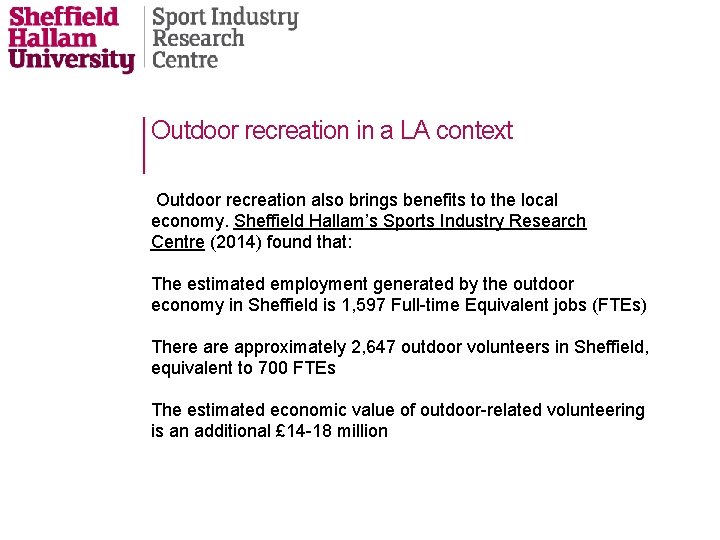
Outdoor recreation in a LA context Outdoor recreation also brings benefits to the local economy. Sheffield Hallam’s Sports Industry Research Centre (2014) found that: The estimated employment generated by the outdoor economy in Sheffield is 1, 597 Full-time Equivalent jobs (FTEs) There approximately 2, 647 outdoor volunteers in Sheffield, equivalent to 700 FTEs The estimated economic value of outdoor-related volunteering is an additional £ 14 -18 million
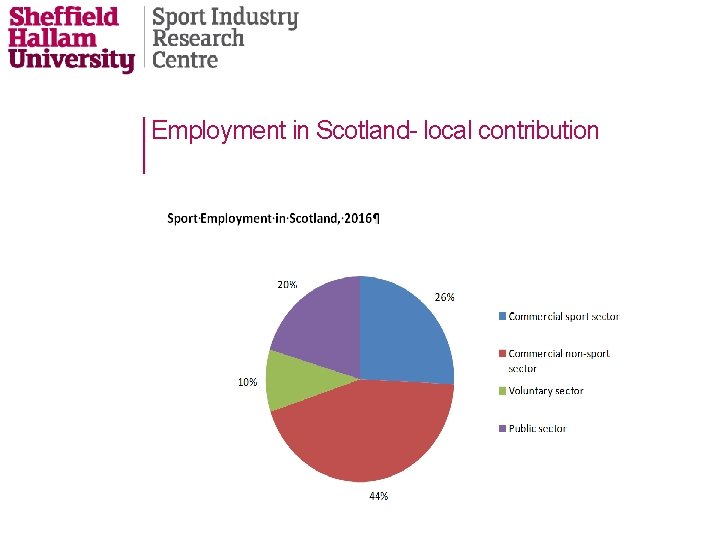
Employment in Scotland- local contribution
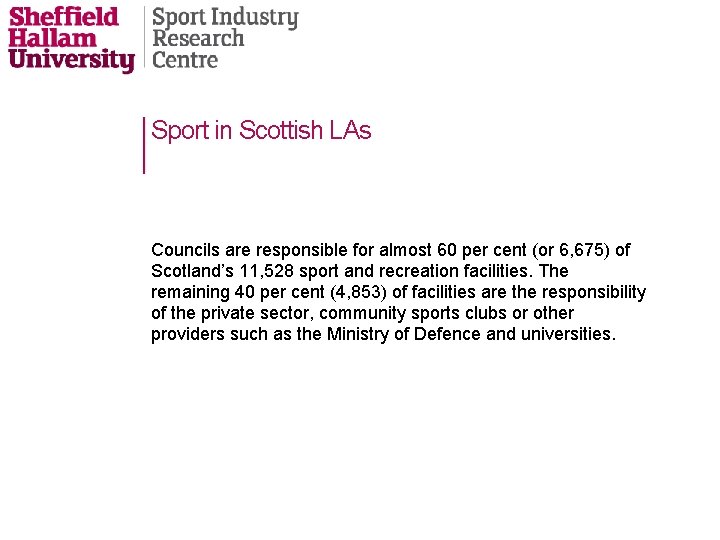
Sport in Scottish LAs Councils are responsible for almost 60 per cent (or 6, 675) of Scotland’s 11, 528 sport and recreation facilities. The remaining 40 per cent (4, 853) of facilities are the responsibility of the private sector, community sports clubs or other providers such as the Ministry of Defence and universities.
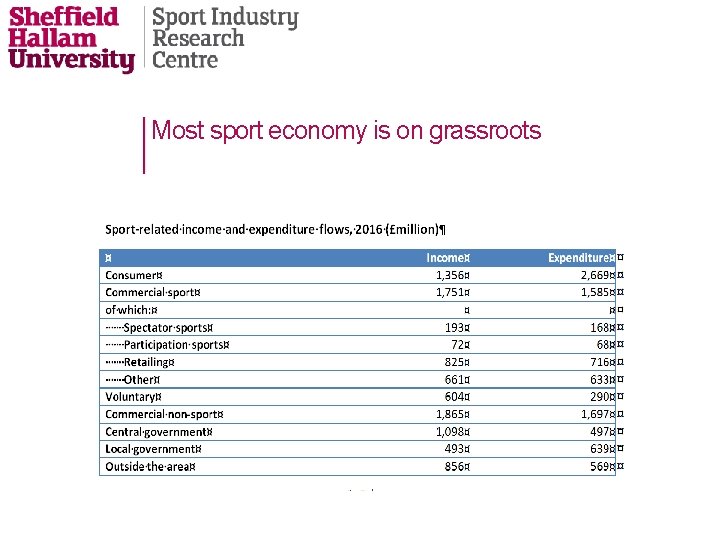
Most sport economy is on grassroots
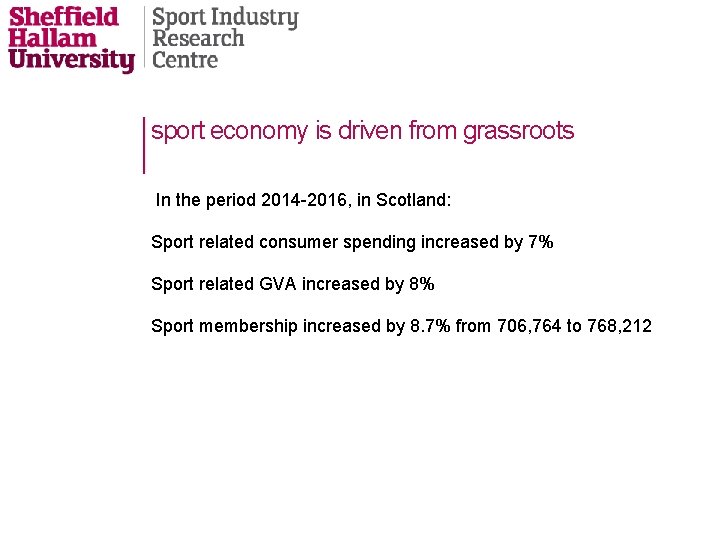
sport economy is driven from grassroots In the period 2014 -2016, in Scotland: Sport related consumer spending increased by 7% Sport related GVA increased by 8% Sport membership increased by 8. 7% from 706, 764 to 768, 212
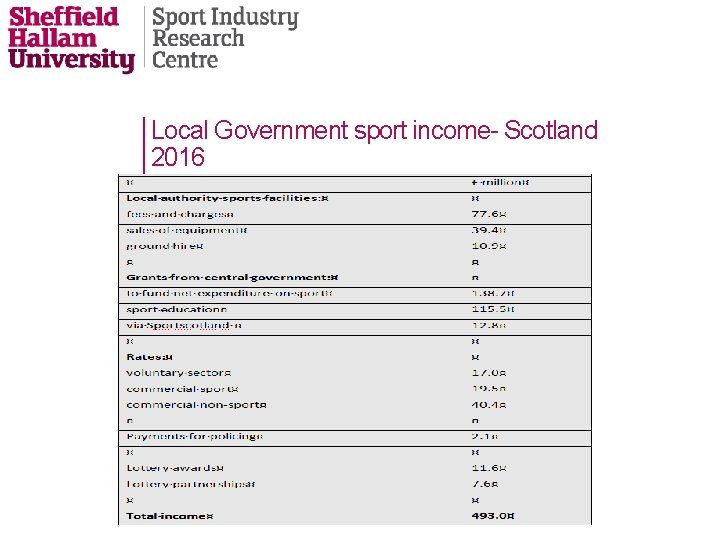
Local Government sport income- Scotland 2016
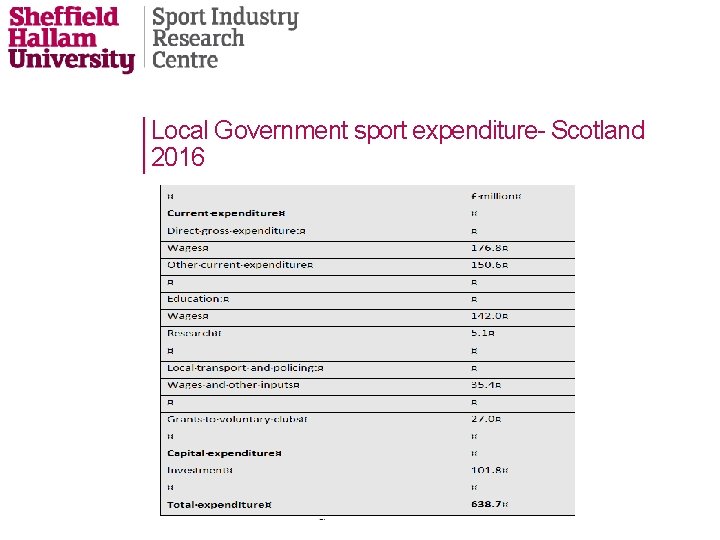
Local Government sport expenditure- Scotland 2016
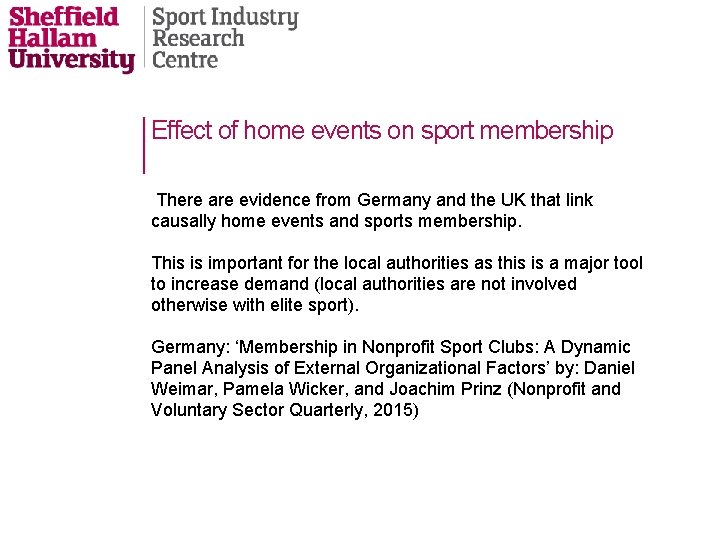
Effect of home events on sport membership There are evidence from Germany and the UK that link causally home events and sports membership. This is important for the local authorities as this is a major tool to increase demand (local authorities are not involved otherwise with elite sport). Germany: ‘Membership in Nonprofit Sport Clubs: A Dynamic Panel Analysis of External Organizational Factors’ by: Daniel Weimar, Pamela Wicker, and Joachim Prinz (Nonprofit and Voluntary Sector Quarterly, 2015)
Effect of home events on sport membership-2 Results: Home events increase sport membership in the current year of the event. This is mostly in the sport under consideration and is mostly true within the local population. Case study Scottish gymnastics. In the UK this effect is even stronger, with home events affecting sport membership even two years after the event. This creates a lot of possibilities for affecting participation and the sport economy through LA policy.
Thank you for listening Themis Kokolakakis Sport Industry Research Centre Sheffield Hallam University Collegiate Hall Collegiate Campus Sheffield S 10 2 BP t. kokolakakis@shu. ac. uk