
The Economic Impact of Migration Productivity Analysis for
![Percentage of migrants in total employment. Spain & UK [3]](https://slidetodoc.com/presentation_image_h2/db5c05ddcaff03a57435342d857a7c73/image-3.jpg "Percentage of migrants in total employment. Spain & UK [3]")
![Difference between actual and virtual [6]](https://slidetodoc.com/presentation_image_h2/db5c05ddcaff03a57435342d857a7c73/image-6.jpg "Difference between actual and virtual [6]")
![Growth accounting, migrant contributions 1996 -2005 [9]](https://slidetodoc.com/presentation_image_h2/db5c05ddcaff03a57435342d857a7c73/image-9.jpg "Growth accounting, migrant contributions 1996 -2005 [9]")
![Labour productivity, migrant contributions 1996 -2005 [ 10 ]](https://slidetodoc.com/presentation_image_h2/db5c05ddcaff03a57435342d857a7c73/image-10.jpg "Labour productivity, migrant contributions 1996 -2005 [ 10 ]")
![Estimation results [ 13 ]](https://slidetodoc.com/presentation_image_h2/db5c05ddcaff03a57435342d857a7c73/image-13.jpg "Estimation results [ 13 ]")
![Distributions ofelasticities of substitution (fixed effects) [ 14 ]](https://slidetodoc.com/presentation_image_h2/db5c05ddcaff03a57435342d857a7c73/image-14.jpg "Distributions ofelasticities of substitution (fixed effects) [ 14 ]")
- Slides: 15
The Economic Impact of Migration – Productivity Analysis for Spain and the UK M. KANGASNIEMI (NIESR); M. MAS (IVIE & U. VALENCIA); C. ROBINSON (NIESR) L. SERRANO (IVIE & U. VALENCIA) Washington DC, May 14 th 2008 This project is funded by the European Commission, Research Directorate General as part of the 6 th Framework Programme, Priority 8, “Policy Support and Anticipating Scientific and Technological Needs” [1]
Objectives • To analyze the impact of migration on productivity growth • And compare two different experiences: • Spain: with a very recent presence of migrants • UK: traditional recipient of immigration flows • We take three perspectives: • Impact on GDP through demography • Analysis through growth accounting • Analysis via econometric estimates • Data • EUKLEMS data – augmented with • UK Labour Force Survey (ONS) data provided by the UK Data Archive • Encuesta de Poblacion Activa (INE) [2]
Percentage of migrants in total employment. Spain & UK [3]
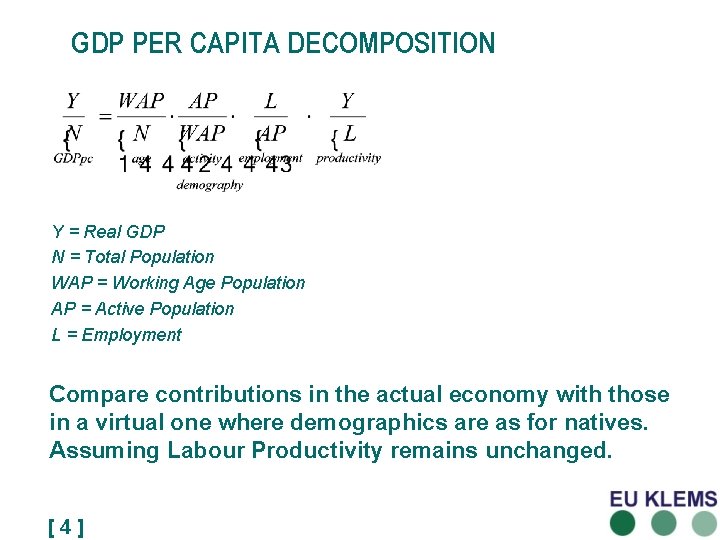
GDP PER CAPITA DECOMPOSITION Y = Real GDP N = Total Population WAP = Working Age Population AP = Active Population L = Employment Compare contributions in the actual economy with those in a virtual one where demographics are as for natives. Assuming Labour Productivity remains unchanged. [4]
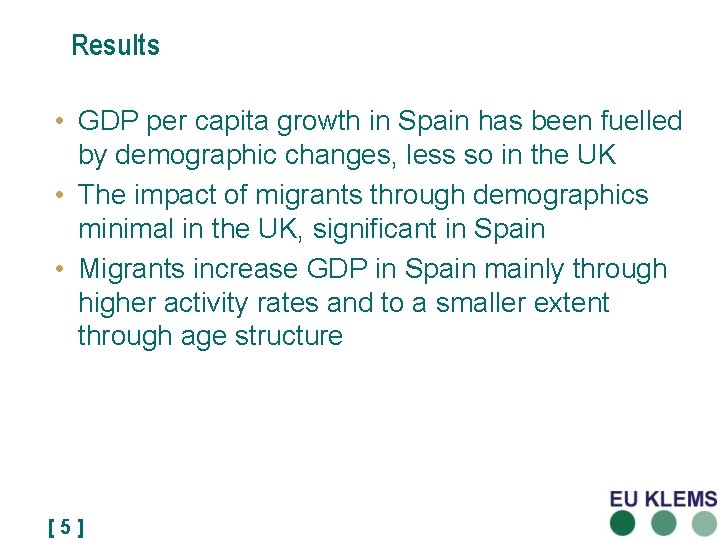
Results • GDP per capita growth in Spain has been fuelled by demographic changes, less so in the UK • The impact of migrants through demographics minimal in the UK, significant in Spain • Migrants increase GDP in Spain mainly through higher activity rates and to a smaller extent through age structure [5]
Difference between actual and virtual [6]
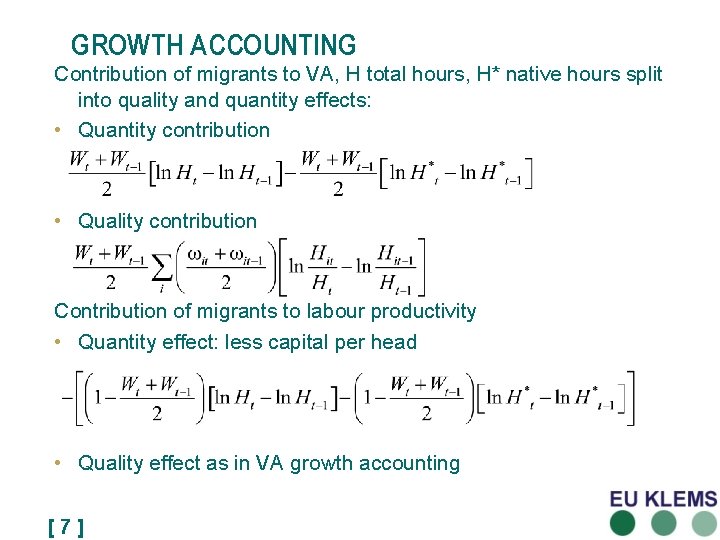
GROWTH ACCOUNTING Contribution of migrants to VA, H total hours, H* native hours split into quality and quantity effects: • Quantity contribution • Quality contribution Contribution of migrants to labour productivity • Quantity effect: less capital per head • Quality effect as in VA growth accounting [7]
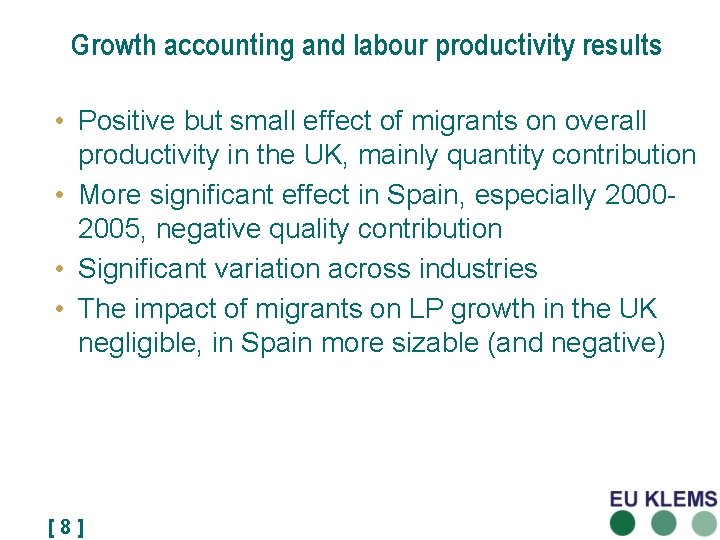
Growth accounting and labour productivity results • Positive but small effect of migrants on overall productivity in the UK, mainly quantity contribution • More significant effect in Spain, especially 20002005, negative quality contribution • Significant variation across industries • The impact of migrants on LP growth in the UK negligible, in Spain more sizable (and negative) [8]
Growth accounting, migrant contributions 1996 -2005 [9]
Labour productivity, migrant contributions 1996 -2005 [ 10 ]
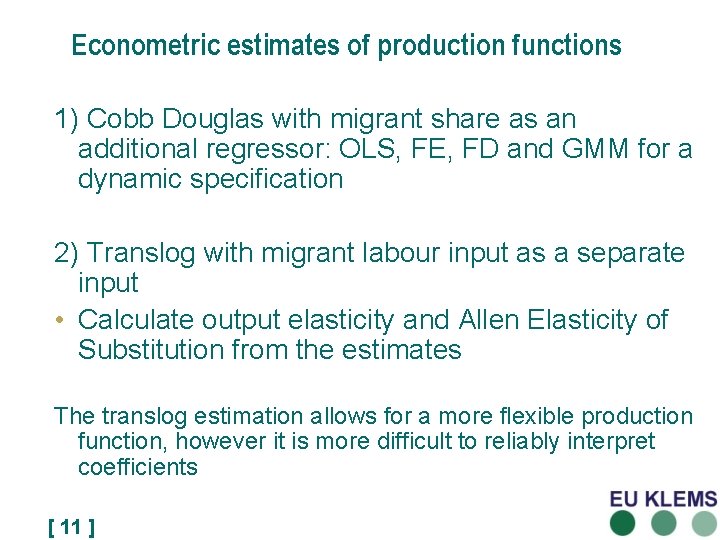
Econometric estimates of production functions 1) Cobb Douglas with migrant share as an additional regressor: OLS, FE, FD and GMM for a dynamic specification 2) Translog with migrant labour input as a separate input • Calculate output elasticity and Allen Elasticity of Substitution from the estimates The translog estimation allows for a more flexible production function, however it is more difficult to reliably interpret coefficients [ 11 ]
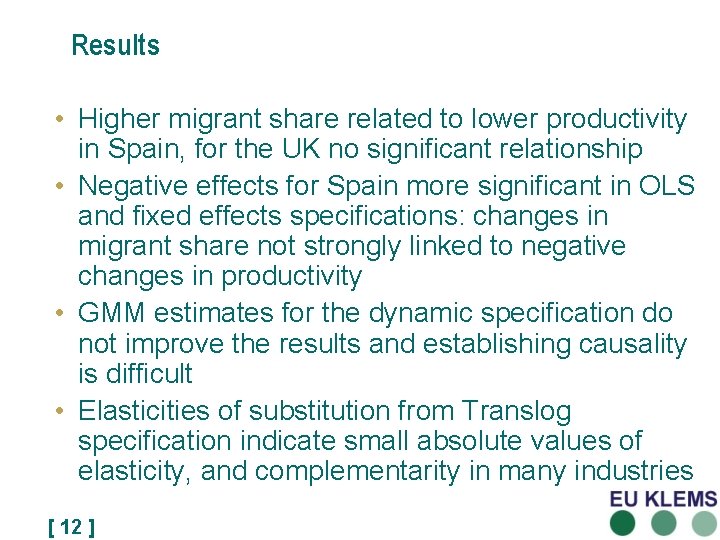
Results • Higher migrant share related to lower productivity in Spain, for the UK no significant relationship • Negative effects for Spain more significant in OLS and fixed effects specifications: changes in migrant share not strongly linked to negative changes in productivity • GMM estimates for the dynamic specification do not improve the results and establishing causality is difficult • Elasticities of substitution from Translog specification indicate small absolute values of elasticity, and complementarity in many industries [ 12 ]
Estimation results [ 13 ]
Distributions ofelasticities of substitution (fixed effects) [ 14 ]
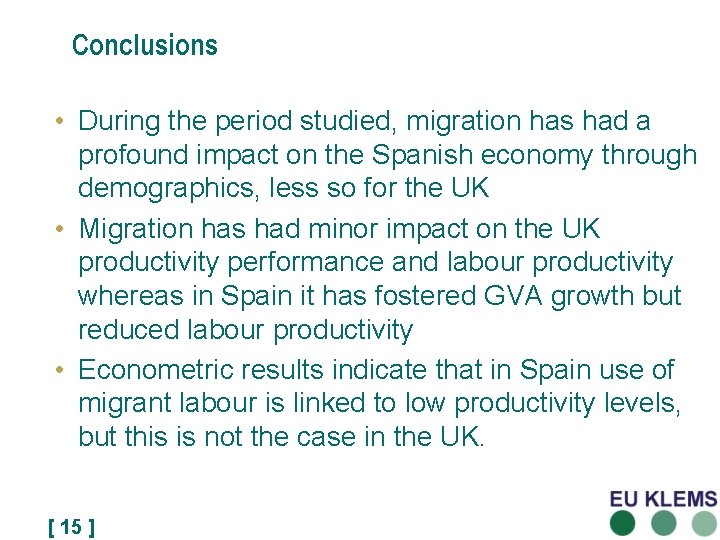
Conclusions • During the period studied, migration has had a profound impact on the Spanish economy through demographics, less so for the UK • Migration has had minor impact on the UK productivity performance and labour productivity whereas in Spain it has fostered GVA growth but reduced labour productivity • Econometric results indicate that in Spain use of migrant labour is linked to low productivity levels, but this is not the case in the UK. [ 15 ]