
The Economic Impact of Creative Industries in the
- Slides: 27
The Economic Impact of Creative Industries in the Americas Adrian Cooper, CEO, Oxford Economics
Overview l Overview of Oxford Economics research project l Defining the Creative Industries l An overview of data availability in the Americas l Accurate measurement of the creative industries l Outputs of the study l Next steps 2
Overview of Oxford Economics research project - The Economic Impact of Creative Industries in the Americas
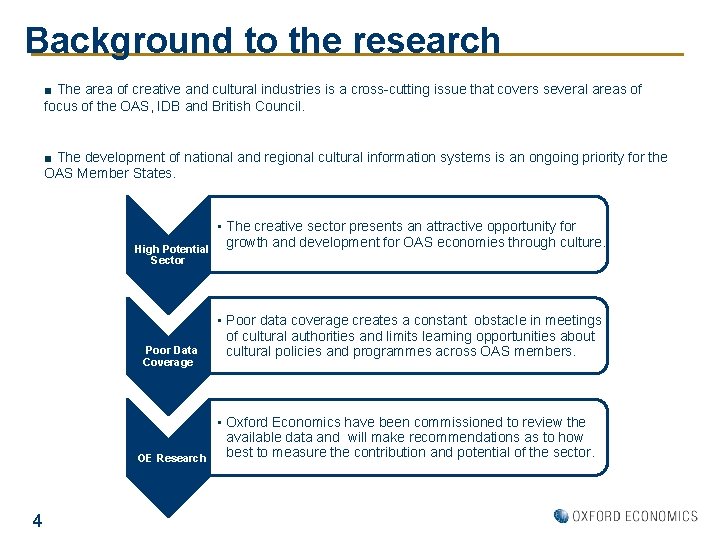
Background to the research ■ The area of creative and cultural industries is a cross-cutting issue that covers several areas of focus of the OAS, IDB and British Council. ■ The development of national and regional cultural information systems is an ongoing priority for the OAS Member States. ■High Potential Sector ■Poor Data Coverage ■OE Research 4 • The creative sector presents an attractive opportunity for growth and development for OAS economies through culture. • Poor data coverage creates a constant obstacle in meetings of cultural authorities and limits learning opportunities about cultural policies and programmes across OAS members. • Oxford Economics have been commissioned to review the available data and will make recommendations as to how best to measure the contribution and potential of the sector.
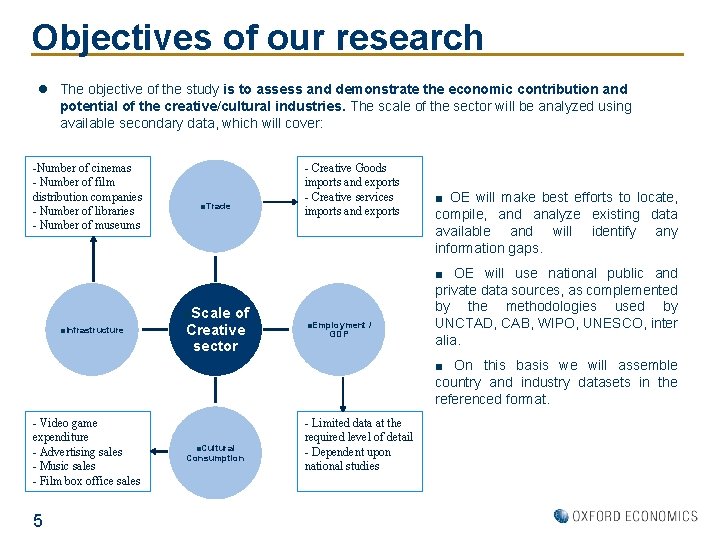
Objectives of our research l The objective of the study is to assess and demonstrate the economic contribution and potential of the creative/cultural industries. The scale of the sector will be analyzed using available secondary data, which will cover: -Number of cinemas - Number of film distribution companies - Number of libraries - Number of museums ■Infrastructure ■Trade ■Scale of Creative sector - Creative Goods imports and exports - Creative services imports and exports ■Employment / GDP ■ OE will make best efforts to locate, compile, and analyze existing data available and will identify any information gaps. ■ OE will use national public and private data sources, as complemented by the methodologies used by UNCTAD, CAB, WIPO, UNESCO, inter alia. ■ On this basis we will assemble country and industry datasets in the referenced format. - Video game expenditure - Advertising sales - Music sales - Film box office sales 5 ■Cultural Consumption - Limited data at the required level of detail - Dependent upon national studies
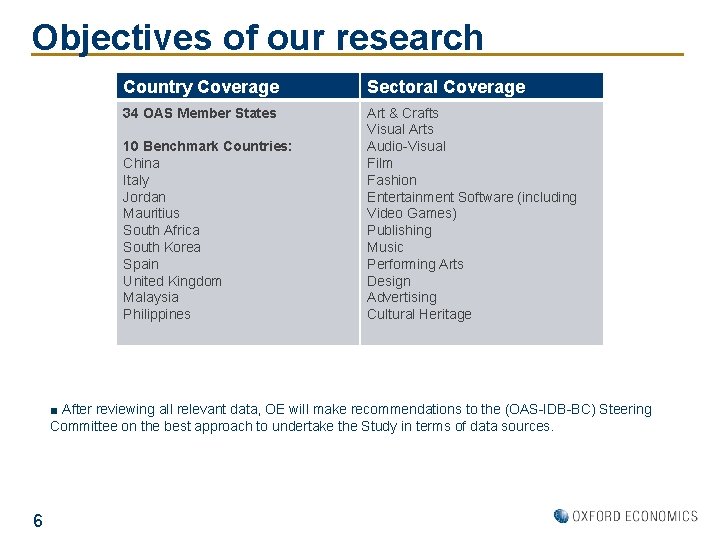
Objectives of our research Country Coverage Sectoral Coverage 34 OAS Member States Art & Crafts Visual Arts Audio-Visual Film Fashion Entertainment Software (including Video Games) Publishing Music Performing Arts Design Advertising Cultural Heritage 10 Benchmark Countries: China Italy Jordan Mauritius South Africa South Korea Spain United Kingdom Malaysia Philippines ■ After reviewing all relevant data, OE will make recommendations to the (OAS-IDB-BC) Steering Committee on the best approach to undertake the Study in terms of data sources. 6
Defining the Creative industries
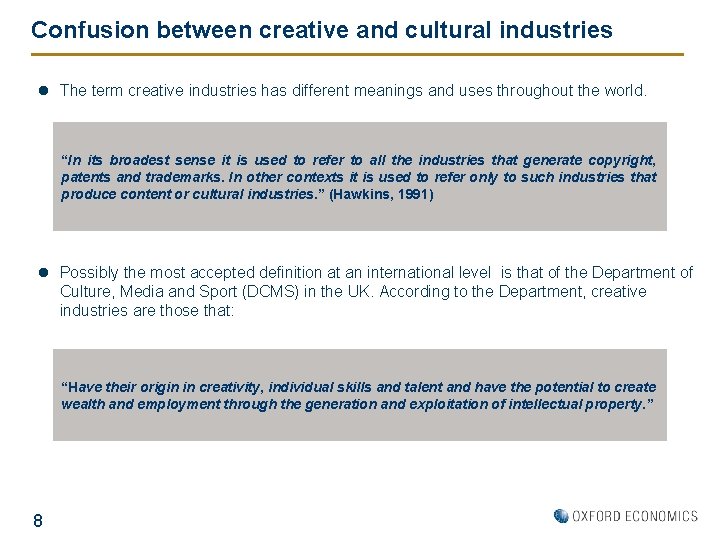
Confusion between creative and cultural industries l The term creative industries has different meanings and uses throughout the world. “In its broadest sense it is used to refer to all the industries that generate copyright, patents and trademarks. In other contexts it is used to refer only to such industries that produce content or cultural industries. ” (Hawkins, 1991) l Possibly the most accepted definition at an international level is that of the Department of Culture, Media and Sport (DCMS) in the UK. According to the Department, creative industries are those that: “Have their origin in creativity, individual skills and talent and have the potential to create wealth and employment through the generation and exploitation of intellectual property. ” 8
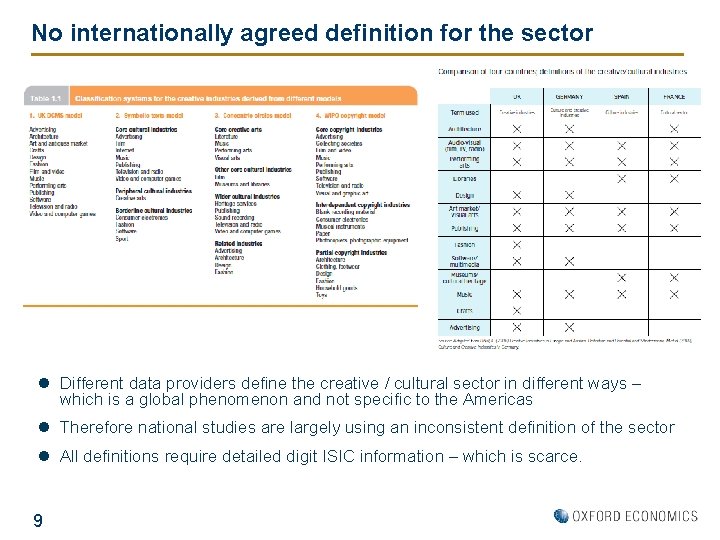
No internationally agreed definition for the sector l Different data providers define the creative / cultural sector in different ways – which is a global phenomenon and not specific to the Americas l Therefore national studies are largely using an inconsistent definition of the sector l All definitions require detailed digit ISIC information – which is scarce. 9
Overview of data availability in the Americas
Availability of Employment by Industry Data on national statistics websites ■ Difficult to get granular employment information from national statistics websites ■ Dependent upon placing statistical requests with National statistics authorities 11
Numerous national studies produced ■ Data available from ad hoc national studies and statistical authorities on creative / cultural activity 12
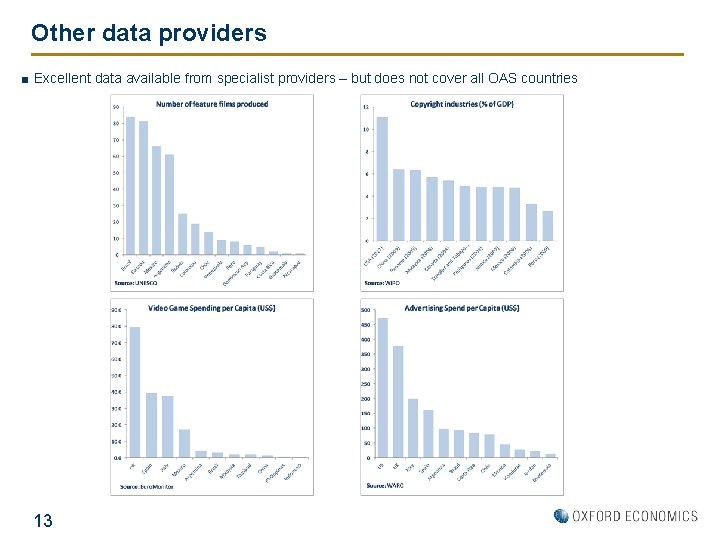
Other data providers ■ Excellent data available from specialist providers – but does not cover all OAS countries 13
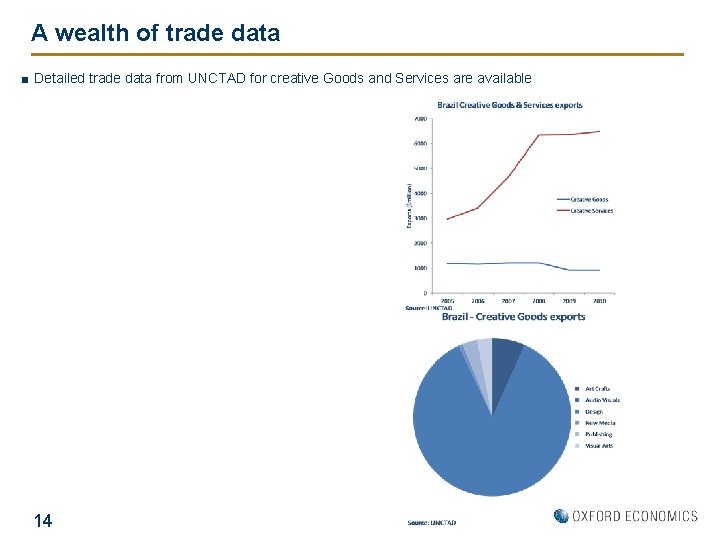
A wealth of trade data ■ Detailed trade data from UNCTAD for creative Goods and Services are available 14
Accurate measurement of the creative industries
Importance of measuring the sector l The creative economy has become a topical issue of the international economic and development agenda l UNCTAD statistics highlight it accounts for a significant and growing slice of the world’s economy, with the creative sector accounting for: ■ $592 billion of exports (in 2008), growing at an average annual rate of 14 per cent between 2002 and 2008. ■ 2. 73% of world export of Goods (in 2008) ■ 4. 8% of world export of services (in 2008) l As the sector grows it is important to continue to improve measurement and data coverage to ■ Identify niche growth markets ■ To track the evolution of the sector ■ To enable policy officials to create a trading environment to enable the creative sector to continue to grow 16
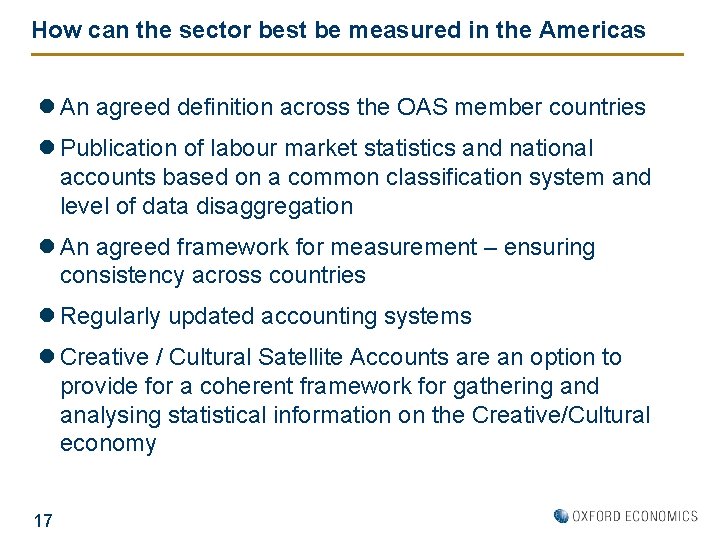
How can the sector best be measured in the Americas l An agreed definition across the OAS member countries l Publication of labour market statistics and national accounts based on a common classification system and level of data disaggregation l An agreed framework for measurement – ensuring consistency across countries l Regularly updated accounting systems l Creative / Cultural Satellite Accounts are an option to provide for a coherent framework for gathering and analysing statistical information on the Creative/Cultural economy 17
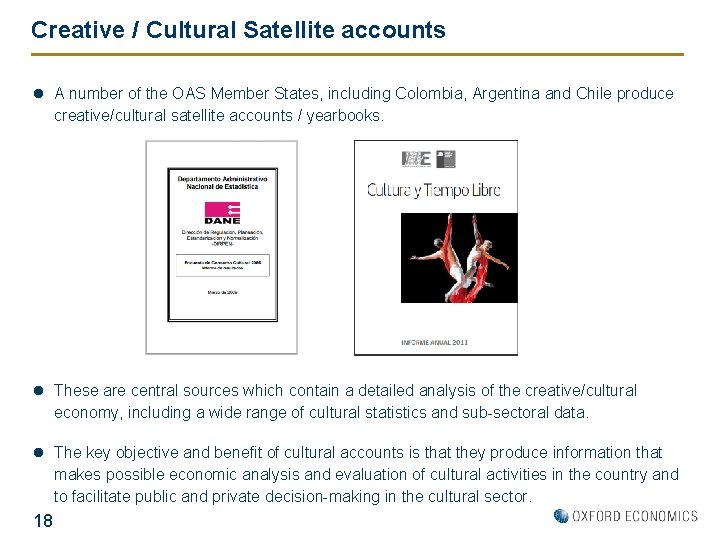
Creative / Cultural Satellite accounts l A number of the OAS Member States, including Colombia, Argentina and Chile produce creative/cultural satellite accounts / yearbooks. l These are central sources which contain a detailed analysis of the creative/cultural economy, including a wide range of cultural statistics and sub-sectoral data. l The key objective and benefit of cultural accounts is that they produce information that makes possible economic analysis and evaluation of cultural activities in the country and to facilitate public and private decision-making in the cultural sector. 18
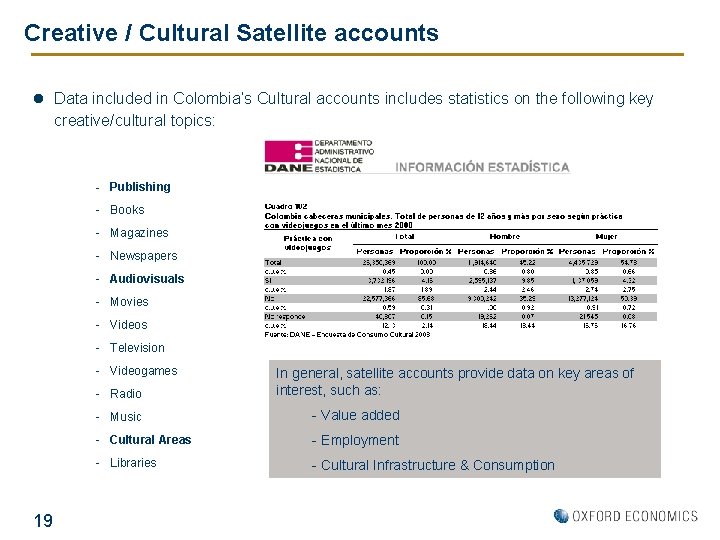
Creative / Cultural Satellite accounts l Data included in Colombia’s Cultural accounts includes statistics on the following key creative/cultural topics: - Publishing - Books - Magazines - Newspapers - Audiovisuals - Movies - Videos - Television - Videogames - Radio 19 In general, satellite accounts provide data on key areas of interest, such as: - Music - Value added - Cultural Areas - Employment - Libraries - Cultural Infrastructure & Consumption
Outputs of the study
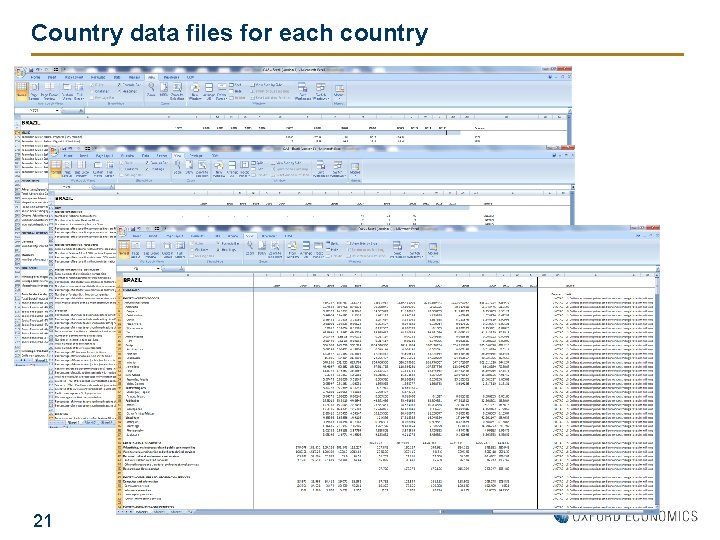
Country data files for each country 21
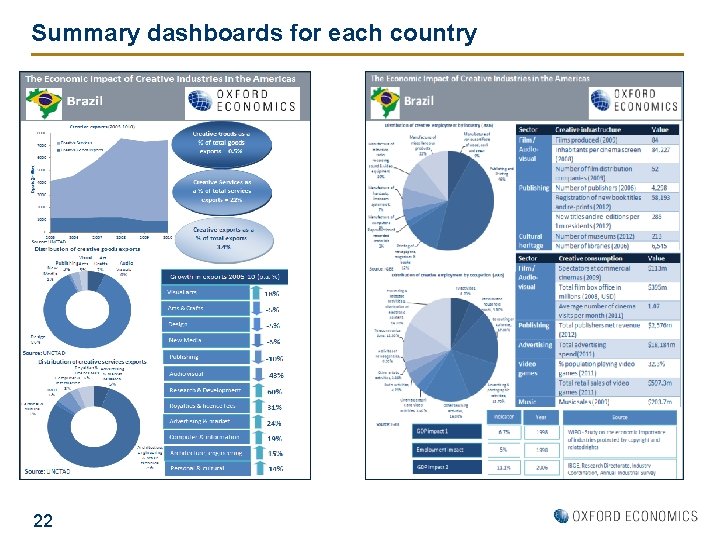
Summary dashboards for each country 22
Next steps
Next Steps l The format for the final report will include: ■Excel spreadsheets for all OAS and benchmark countries ■Economic dashboards to summarise key information and trends ■Narrative highlighting key findings, main trends, and information gaps and recommendation. l The final report is to be submitted by May 1 st. 24
APPENDIX 1: Review of International Labor Force Surveys
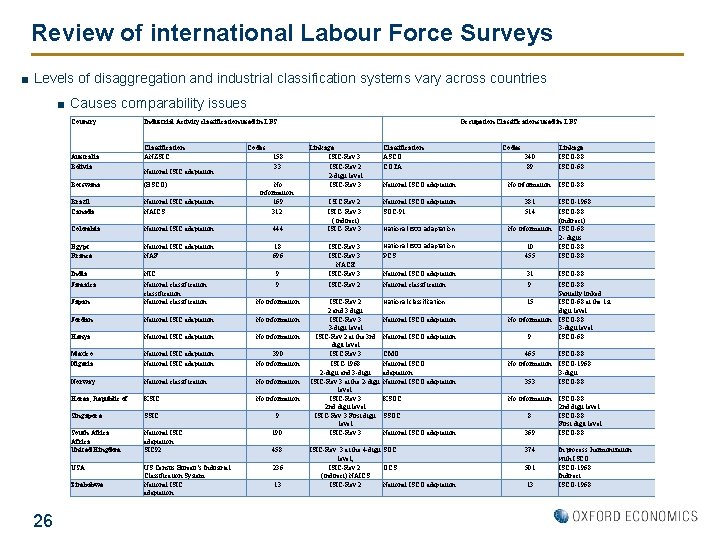
Review of international Labour Force Surveys ■ Levels of disaggregation and industrial classification systems vary across countries ■ Causes comparability issues Country Australia Bolivia Classification ANZSIC National ISIC adaptation Codes 158 33 Botswana (BSCO). Brazil Canada National ISIC adaptation NAICS No information. 169 312. Colombia National ISIC adaptation 444 Egypt France National ISIC adaptation NAF 18 696 India NIC Jamaica Japan National classification Jordan National ISIC adaptation No information Kenya National ISIC adaptation No information Mexico Nigeria National ISIC adaptation 390 No information Norway National classification No information Korea, Republic of KSIC No information Singapore SSIC 9 South Africa United Kingdom National ISIC adaptation SIC 92. 190. USA US Census Bureau’s Industrial Classification System. National ISIC adaptation 236 Zimbabwe 26 Industrial Activity classification used in LFS Occupation Classifications used in LFS Linkage ISIC-Rev. 3. ISIC-Rev. 2 2 -digit level ISIC-Rev. 3 Classification ASCO COTA National ISCO adaptation Codes 340 89 Linkage ISCO-88 ISCO-68 No information. ISCO-88. ISIC Rev. 2. ISIC- Rev. 3. ( indirect) ISIC- Rev. 3. National ISCO adaptation SOC-91 381 514 National ISCO adaptation No information National ISCO adaptation PCS 10 455 9 ISIC-Rev. 3. NACE ISIC-Rev. 3. ISCO-1968 ISCO-88. (indirect) ISCO-68 2 - digits ISCO-88. National ISCO adaptation 31 ISCO-88. 9 ISIC-Rev. 2. National classification 9 No information ISIC-Rev. 2 2 and 3 digit ISIC-Rev. 3 3 -digit level ISIC-Rev. 2 at the 3 rd digit level ISIC Rev. 3 ISIC-1968 2 -digit and 3 -digit ISIC-Rev. 3 at the 2 -digit level. ISIC-Rev. 3 2 nd digit level ISIC-Rev. 3 First digit level ISIC-Rev. 3 National classification 15 ISCO-88 Partially linked ISCO-68 at the 1 st digit level ISCO-88. 3 -digit level. ISCO-68 458. 13 National ISCO adaptation No information National ISCO adaptation 9 CMO National ISCO adaptation 465 No information KSOC No information SSOC 8. 353 National ISCO adaptation 369 ISIC-Rev. 3 at the 4 -digit SOC level; ISIC-Rev. 2. OCS (indirect) NAICS ISIC-Rev. 2 National ISCO adaptation 374 501 13 ISCO-88 ISCO-1968 3 -digit ISCO-88 2 nd digit level ISCO-88. First digit level ISCO-88. In process: harmonization with ISCO-1968 Indirect ISCO-1968
Contact Details: Oxford Economics USA 5 Hanover Square 19 th Floor New York NY 10004 USA Tel: 00 1 646 503 3050 27