
The economic costs of violence against women Presentation
- Slides: 28
The economic costs of violence against women Presentation for the Expert Group Meeting: Step by Step towards Costing Violence against Women in the Arab Region. 20 – 21 September 2018, United Nations House, Beirut. Dr Philippa Olive Senior Research Fellow, Child and Family Health and Wellbeing / Health Services Research, University of Central Lancashire, UK
Estimating the Cost of Gender-based Violence in the European Union • This presentation is drawn from research undertaken by Professor Sylvia Walby and Dr Philippa Olive for the European Institute for Gender Equality (EIGE). • The full report is available here:
Introduction • Importance of economic conditions and violence against women • Purpose of measuring the cost • Measuring the costs of violence against women involves translating the impacts of violence against women into economic terms • What types of costs should be measured? • Contested principles • How are the costs measured? • Data challenges • Example from the UK and EU
Economic conditions and VAW (Walby et al 2015) • There are bi-directional causal pathways between gendered economic inequalities and violence against women • Gendered economic inequalities contribute to higher rates of violence against women. • Impact of violence against women on economic needs of women and the social and economic well-being of women.
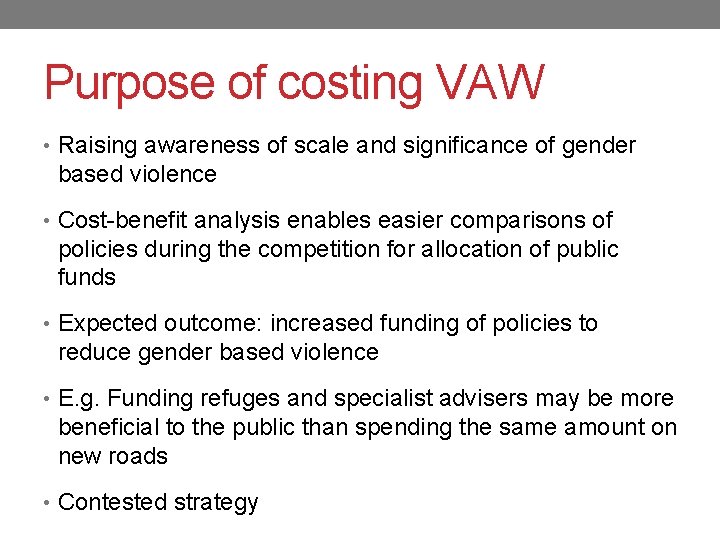
Purpose of costing VAW • Raising awareness of scale and significance of gender based violence • Cost-benefit analysis enables easier comparisons of policies during the competition for allocation of public funds • Expected outcome: increased funding of policies to reduce gender based violence • E. g. Funding refuges and specialist advisers may be more beneficial to the public than spending the same amount on new roads • Contested strategy
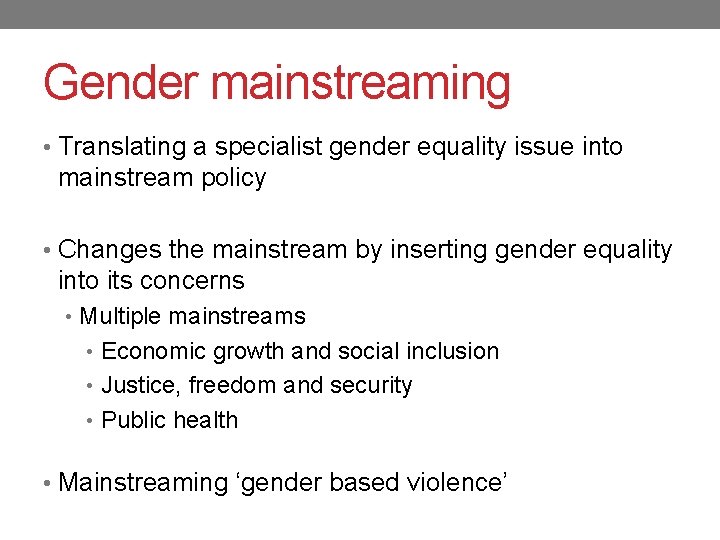
Gender mainstreaming • Translating a specialist gender equality issue into mainstream policy • Changes the mainstream by inserting gender equality into its concerns • Multiple mainstreams • Economic growth and social inclusion • Justice, freedom and security • Public health • Mainstreaming ‘gender based violence’
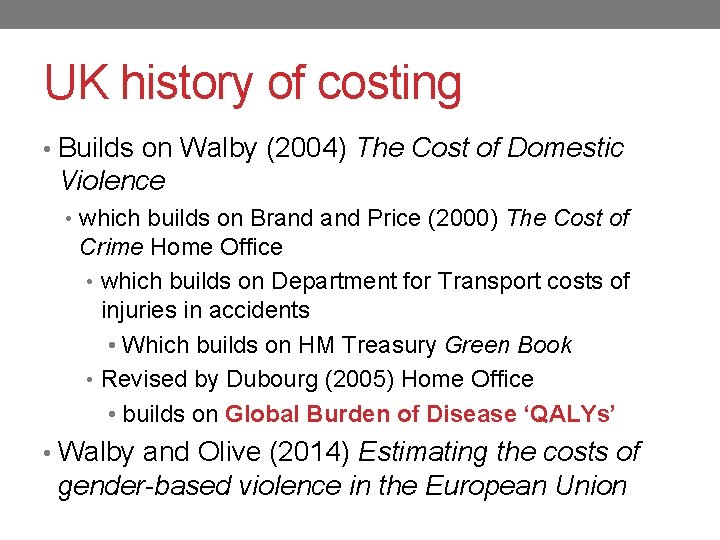
UK history of costing • Builds on Walby (2004) The Cost of Domestic Violence • which builds on Brand Price (2000) The Cost of Crime Home Office • which builds on Department for Transport costs of injuries in accidents • Which builds on HM Treasury Green Book • Revised by Dubourg (2005) Home Office • builds on Global Burden of Disease ‘QALYs’ • Walby and Olive (2014) Estimating the costs of gender-based violence in the European Union
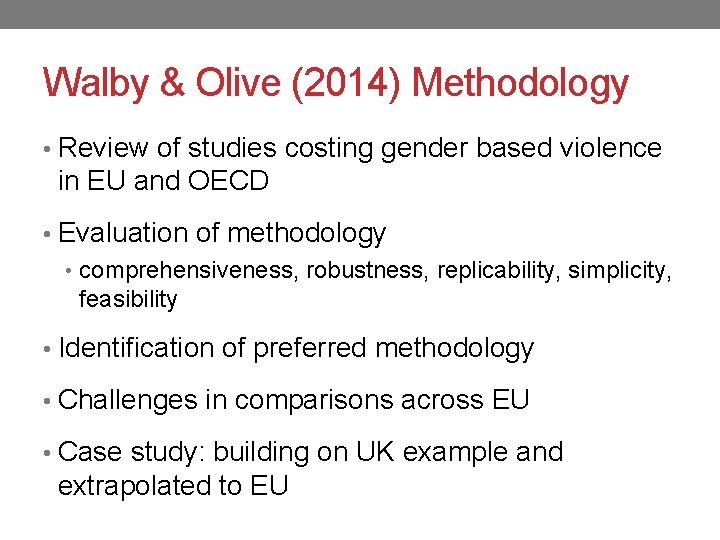
Walby & Olive (2014) Methodology • Review of studies costing gender based violence in EU and OECD • Evaluation of methodology • comprehensiveness, robustness, replicability, simplicity, feasibility • Identification of preferred methodology • Challenges in comparisons across EU • Case study: building on UK example and extrapolated to EU
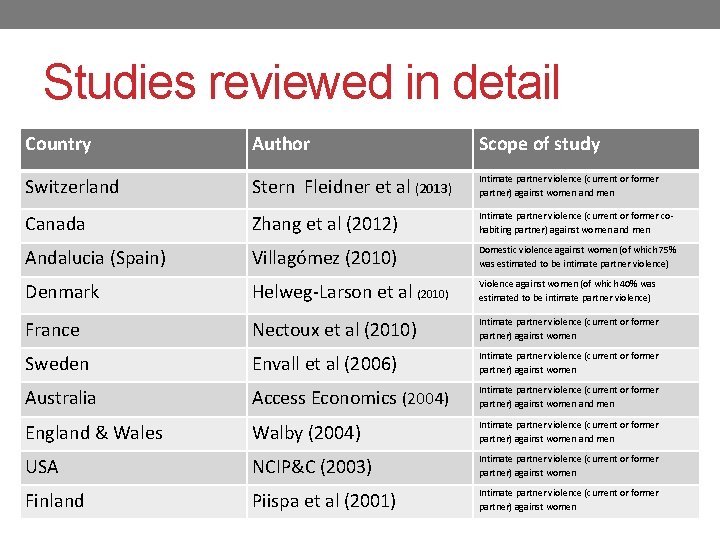
Studies reviewed in detail Country Author Scope of study Switzerland Stern Fleidner et al (2013) Intimate partner violence (current or former partner) against women and men Canada Zhang et al (2012) Intimate partner violence (current or former cohabiting partner) against women and men Andalucia (Spain) Villagómez (2010) Domestic violence against women (of which 75% was estimated to be intimate partner violence) Denmark Helweg-Larson et al (2010) Violence against women (of which 40% was estimated to be intimate partner violence) France Nectoux et al (2010) Intimate partner violence (current or former partner) against women Sweden Envall et al (2006) Intimate partner violence (current or former partner) against women Australia Access Economics (2004) Intimate partner violence (current or former partner) against women and men England & Wales Walby (2004) Intimate partner violence (current or former partner) against women and men USA NCIP&C (2003) Intimate partner violence (current or former partner) against women Finland Piispa et al (2001) Intimate partner violence (current or former partner) against women
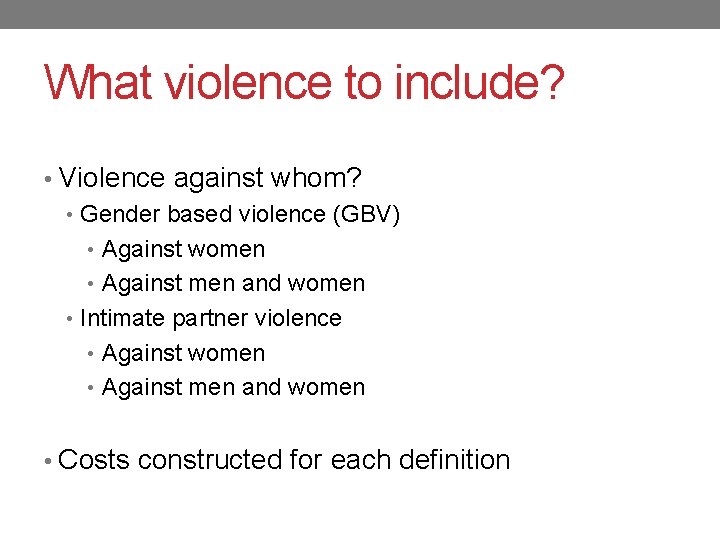
What violence to include? • Violence against whom? • Gender based violence (GBV) • Against women • Against men and women • Intimate partner violence • Against women • Against men and women • Costs constructed for each definition
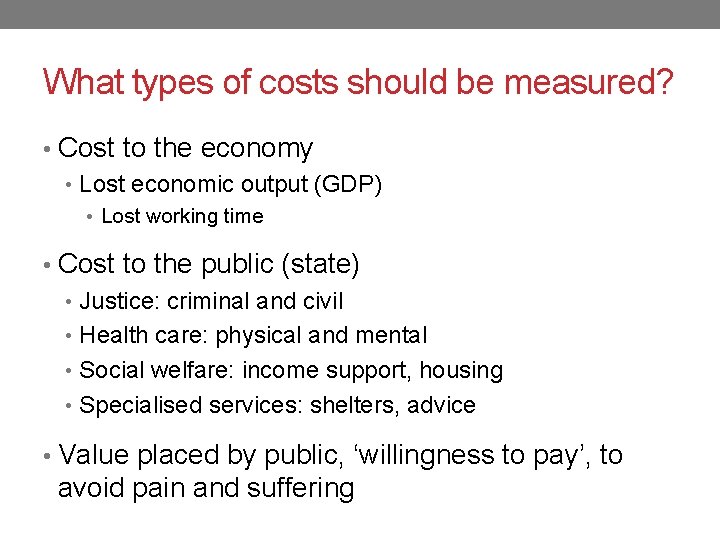
What types of costs should be measured? • Cost to the economy • Lost economic output (GDP) • Lost working time • Cost to the public (state) • Justice: criminal and civil • Health care: physical and mental • Social welfare: income support, housing • Specialised services: shelters, advice • Value placed by public, ‘willingness to pay’, to avoid pain and suffering
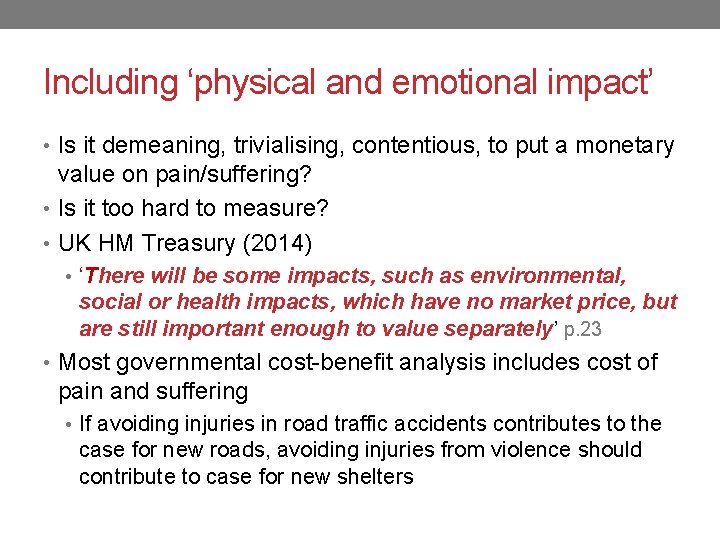
Including ‘physical and emotional impact’ • Is it demeaning, trivialising, contentious, to put a monetary value on pain/suffering? • Is it too hard to measure? • UK HM Treasury (2014) • ‘There will be some impacts, such as environmental, social or health impacts, which have no market price, but are still important enough to value separately’ p. 23 • Most governmental cost-benefit analysis includes cost of pain and suffering • If avoiding injuries in road traffic accidents contributes to the case for new roads, avoiding injuries from violence should contribute to case for new shelters
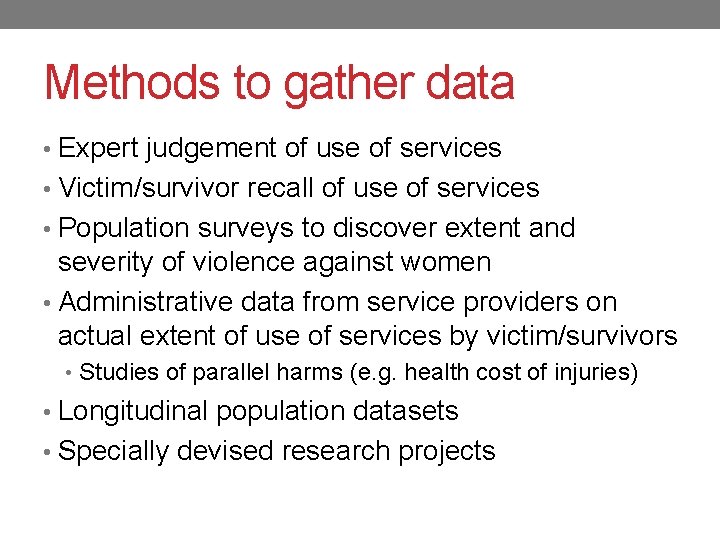
Methods to gather data • Expert judgement of use of services • Victim/survivor recall of use of services • Population surveys to discover extent and severity of violence against women • Administrative data from service providers on actual extent of use of services by victim/survivors • Studies of parallel harms (e. g. health cost of injuries) • Longitudinal population datasets • Specially devised research projects
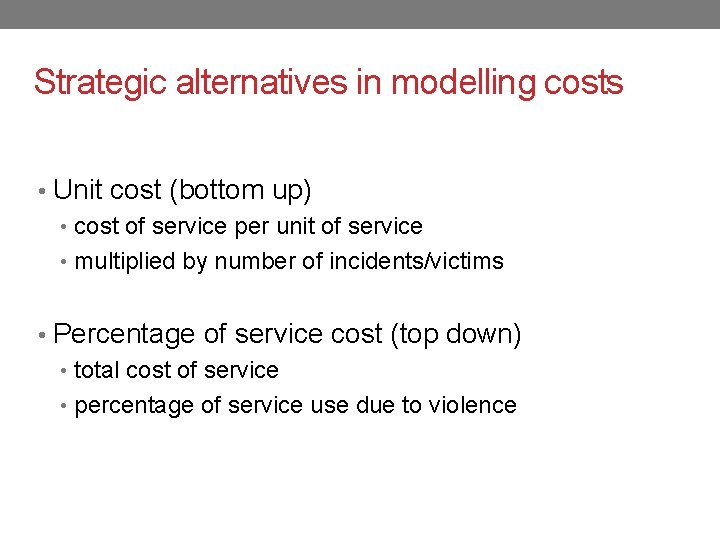
Strategic alternatives in modelling costs • Unit cost (bottom up) • cost of service per unit of service • multiplied by number of incidents/victims • Percentage of service cost (top down) • total cost of service • percentage of service use due to violence
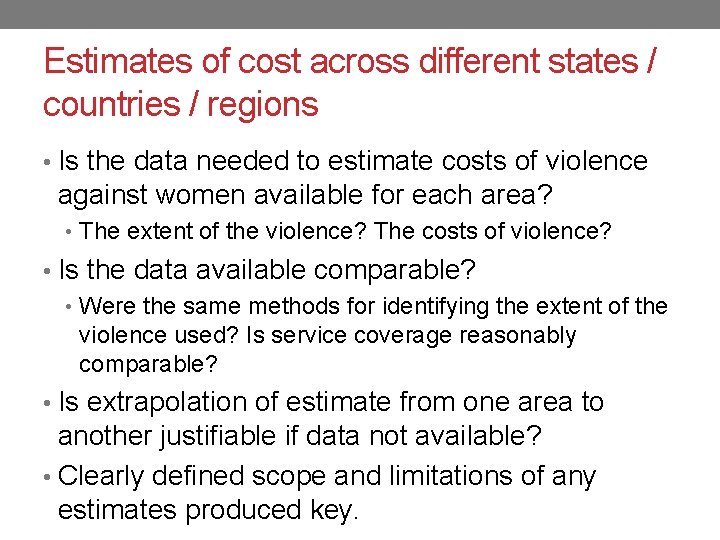
Estimates of cost across different states / countries / regions • Is the data needed to estimate costs of violence against women available for each area? • The extent of the violence? The costs of violence? • Is the data available comparable? • Were the same methods for identifying the extent of the violence used? Is service coverage reasonably comparable? • Is extrapolation of estimate from one area to another justifiable if data not available? • Clearly defined scope and limitations of any estimates produced key.
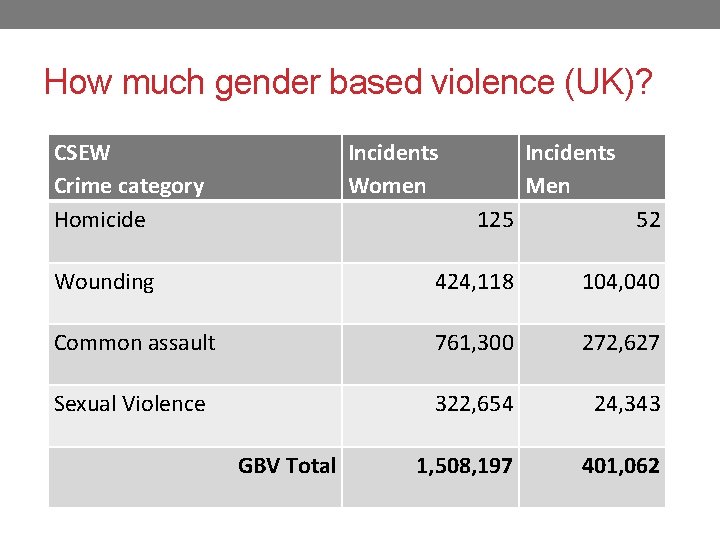
How much gender based violence (UK)? CSEW Crime category Homicide Incidents Women Incidents Men 125 52 Wounding 424, 118 104, 040 Common assault 761, 300 272, 627 Sexual Violence 322, 654 24, 343 1, 508, 197 401, 062 GBV Total
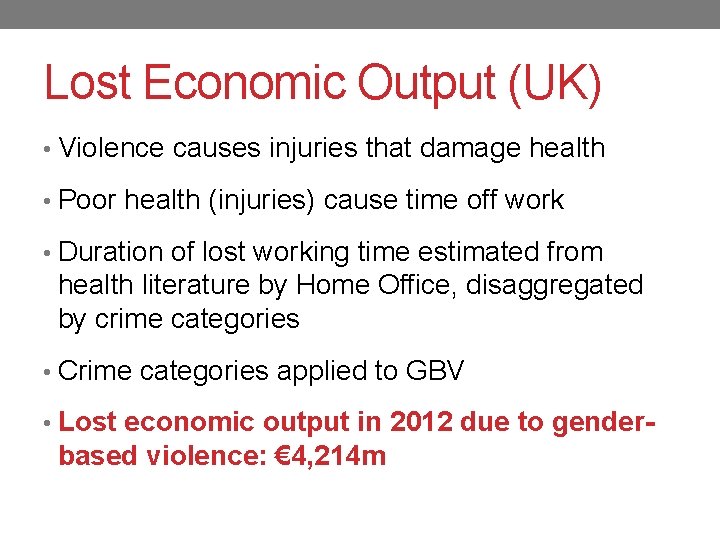
Lost Economic Output (UK) • Violence causes injuries that damage health • Poor health (injuries) cause time off work • Duration of lost working time estimated from health literature by Home Office, disaggregated by crime categories • Crime categories applied to GBV • Lost economic output in 2012 due to gender- based violence: € 4, 214 m
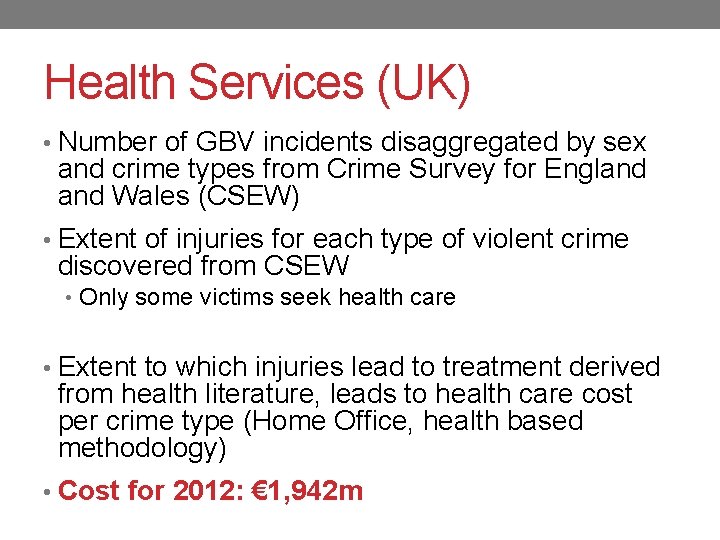
Health Services (UK) • Number of GBV incidents disaggregated by sex and crime types from Crime Survey for England Wales (CSEW) • Extent of injuries for each type of violent crime discovered from CSEW • Only some victims seek health care • Extent to which injuries lead to treatment derived from health literature, leads to health care cost per crime type (Home Office, health based methodology) • Cost for 2012: € 1, 942 m
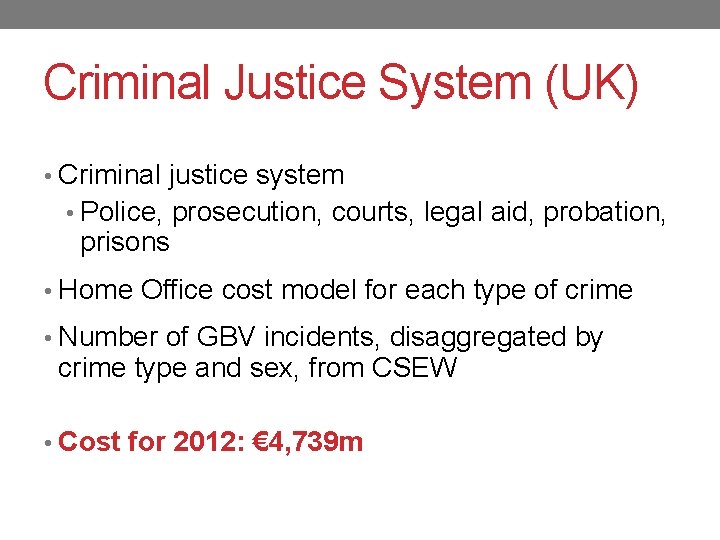
Criminal Justice System (UK) • Criminal justice system • Police, prosecution, courts, legal aid, probation, prisons • Home Office cost model for each type of crime • Number of GBV incidents, disaggregated by crime type and sex, from CSEW • Cost for 2012: € 4, 739 m
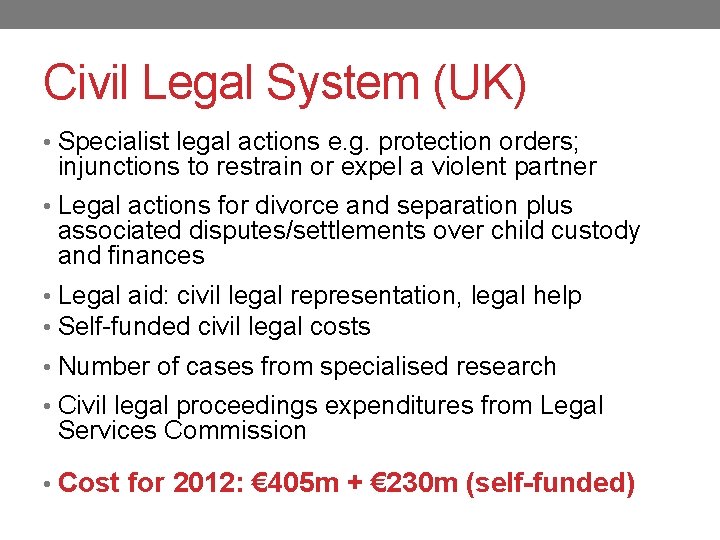
Civil Legal System (UK) • Specialist legal actions e. g. protection orders; injunctions to restrain or expel a violent partner • Legal actions for divorce and separation plus associated disputes/settlements over child custody and finances • Legal aid: civil legal representation, legal help • Self-funded civil legal costs • Number of cases from specialised research • Civil legal proceedings expenditures from Legal Services Commission • Cost for 2012: € 405 m + € 230 m (self-funded)
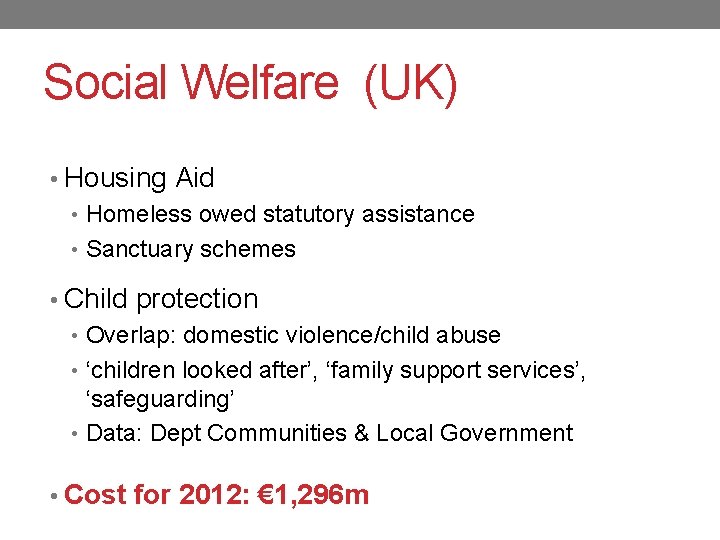
Social Welfare (UK) • Housing Aid • Homeless owed statutory assistance • Sanctuary schemes • Child protection • Overlap: domestic violence/child abuse • ‘children looked after’, ‘family support services’, ‘safeguarding’ • Data: Dept Communities & Local Government • Cost for 2012: € 1, 296 m
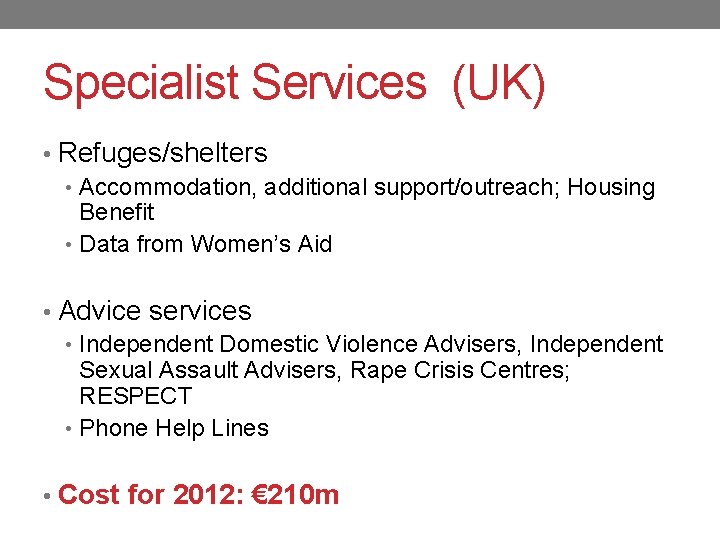
Specialist Services (UK) • Refuges/shelters • Accommodation, additional support/outreach; Housing Benefit • Data from Women’s Aid • Advice services • Independent Domestic Violence Advisers, Independent Sexual Assault Advisers, Rape Crisis Centres; RESPECT • Phone Help Lines • Cost for 2012: € 210 m
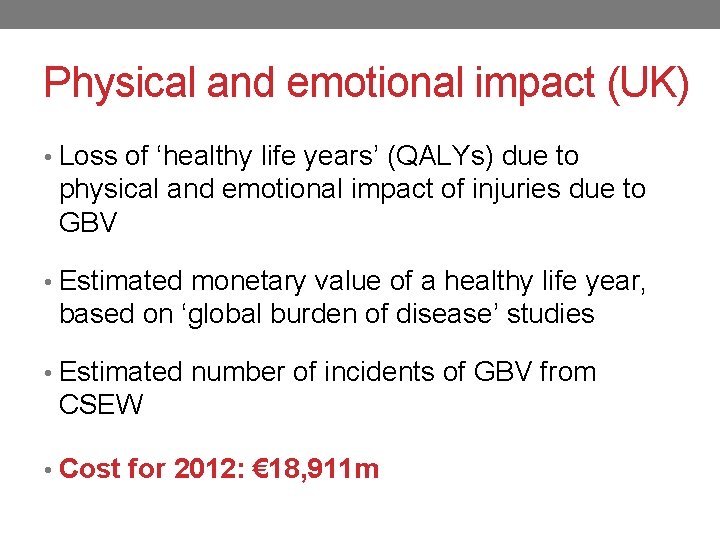
Physical and emotional impact (UK) • Loss of ‘healthy life years’ (QALYs) due to physical and emotional impact of injuries due to GBV • Estimated monetary value of a healthy life year, based on ‘global burden of disease’ studies • Estimated number of incidents of GBV from CSEW • Cost for 2012: € 18, 911 m
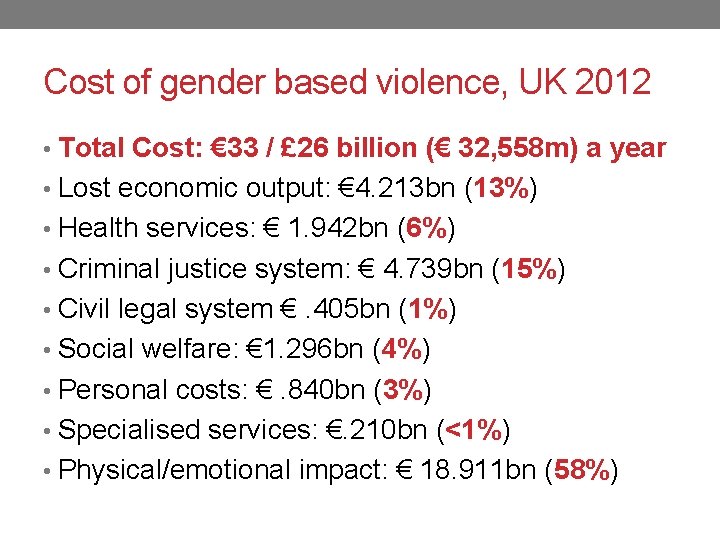
Cost of gender based violence, UK 2012 • Total Cost: € 33 / £ 26 billion (€ 32, 558 m) a year • Lost economic output: € 4. 213 bn (13%) • Health services: € 1. 942 bn (6%) • Criminal justice system: € 4. 739 bn (15%) • Civil legal system €. 405 bn (1%) • Social welfare: € 1. 296 bn (4%) • Personal costs: €. 840 bn (3%) • Specialised services: €. 210 bn (<1%) • Physical/emotional impact: € 18. 911 bn (58%)
Extrapolation from UK to EU • If the UK were typical in the extent of violence, the use of services, the loss of employment, and value of physical and emotional impact, then cost to EU can be estimated as a multiple of UK • Should this proportion be linked to population size or GDP? • OECD recommends that when estimating the statistical value of a human life in a group of countries that the same value should be used in each of the countries. • Therefore we extrapolated based on population size. • Gender-based violence costs the EU € 258 bn each year
Conclusions • Gender based violence costs the EU an estimated € 258 billion each year • Less than 1% of the cost of gender based violence is spent on specialised services to combat this violence • The statistical systems to identify the extent and impact of gender based violence in Member States of the EU, and indeed most countries, need substantial improvement
Impact from costings study • Cost estimate was used in a randomised control trial to determine cost effectiveness of a domestic violence intervention: • Barbosa et al (2018) ‘Cost-effectiveness of a domestic violence and abuse training and support programme in primary care in the real world: Updated modelling based on an MRC phase IV observational pragmatic implementation study’ http: //dx. doi. org/10. 1136/bmjopen-2017 -021256 • This study has been cited in thirteen academic papers and numerous costing studies and has been read more than 100 times on Research. Gate. • Earlier estimates of Cost of Domestic Violence (UK) have been utilised by: • Government Institutions (e. g. National Institute for Health. Care Excellence; NHS London) • Local Government (e. g. Safer Portsmouth Partnerships; Devon County Council) • Non-Government Organisations (e. g. Women’s Aid; Refuge: Living Without Abuse)
References • HM Treasury (2014), The Green Book: Appraisal and Evaluation in • Central Government. HMSO, London. • Walby, S. (2004) The Cost of Domestic Violence. London: Department of • • Trade and Industry. Walby, S. and Olive, P. (2013) Economic aspects of the added value of measures to combat violence against women. European Parliament Value Added Unit. Walby, S. and Olive, P. (2014) Estimating the Costs of Gender-Based Violence in the European Union. Vilnius: European Institute for Gender Equality. Available at: https: //eige. europa. eu/node/393 Walby, S. , Francis, B. , Towers, J. (2014), A critical appreciation of the FRA Survey: Does the FRA Survey provide statically reliable data on the differences between intimate partner violence against women in EU‑ 28 Member States? , Unpublished Working Paper. Walby, S. , Towers, J. , & Francis, B. (2016). Is violence increasing or decreasing? a new methodology to measure repeat attacks making visible the significance of gender and domestic relations. British Journal of Criminology, 56(6), 1203 -1234. DOI: 10. 1093/bjc/azv 131 • Contact: POlive 1@uclan. ac. uk s. walby@lancaster. ac. uk