
The Ecological Economics of Biodiversity Biodiversity ecosystem services
The Ecological Economics of Biodiversity: Biodiversity, ecosystem services and human wellbeing
Outline of Lecture • From empty world to full world • Biodiversity, ecosystem goods and ecosystem services • Biodiversity, markets and the nature of resources • Economics as if biodiversity and ecosystems mattered • Biodiversity and payments for ecosystem services • Ethics and the new biodiversity economy
From Empty World to Full World
From empty world to full world • Economic production requires raw materials, energy from nature • Opportunity cost of economic growth = loss of ecosystem goods and services • Population and consumption have soared • Relative scarcity of human made and natural capital has shifted
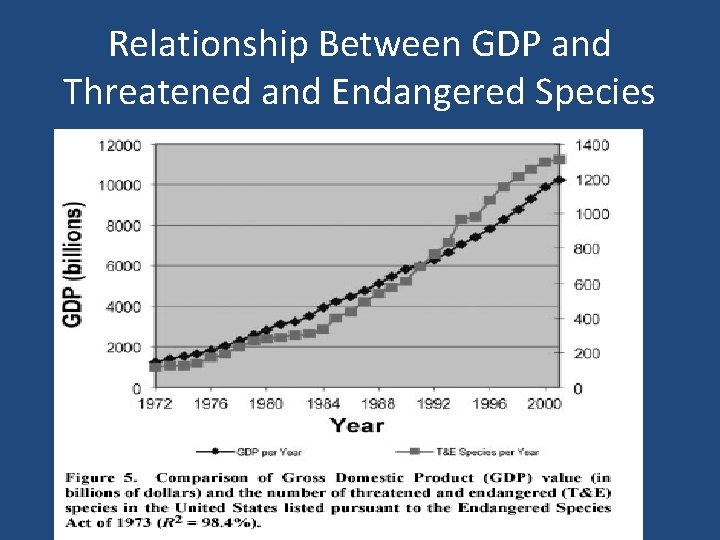
Relationship Between GDP and Threatened and Endangered Species
What is economics? • The allocation of scarce resources among alternative desirable ends • Sequence of questions: – What are the desirable ends? – What are the scarce resources, and what are their physical and institutional characteristics relevant to allocation? – What allocation mechanisms are most effective?
Ecological economics • Pre-analytic vision – Economy is part, ecosystem whole: endless growth impossible – Highly complex system, transdisciplinary approach required • Requirements for human well-being – Sustainable and desirable scale • Continuous economic growth undesirable • Biodiversity is essential – Just distribution – Efficient allocation
Environmental economics • Pre-analytic vision – economic system is whole, ecosystem is part – Unlimited economic growth is possible – Complicated system. Disciplinary approach suitable • Requirements for human well-being – Maximize total monetary value of market and non-market goods and services.
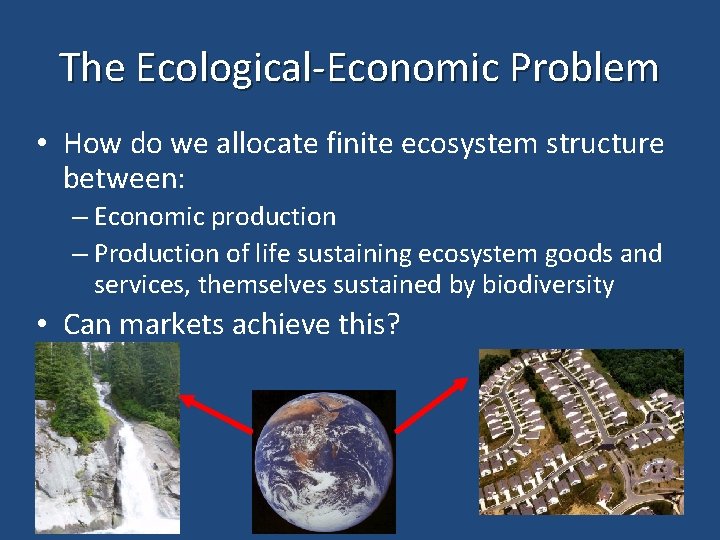
The Ecological-Economic Problem • How do we allocate finite ecosystem structure between: – Economic production – Production of life sustaining ecosystem goods and services, themselves sustained by biodiversity • Can markets achieve this?
Biodiversity, Ecosystem Goods and Ecosystem Services
Ecosystem goods Raw materials Structural building blocks of ecosystems Low entropy matter-energy Stock-flow resources Materially transformed into something else Used up, not worn out: use = depletion Units independent of time—we can clear cut a forest today, or harvest slowly over time Can be stockpiled Mostly market goods
Ecosystem services Structure generates function ecosystem services Fund-service resources Fund not materially transformed when generating services Units time dependent: production per year Cannot be stockpile—not using water regulation this year will not leave us more for next year Spontaneously restored by solar energy Mostly non-market, non-priced
So What? Economic production depletes ecosystem structure, and generates waste Depletion of ecosystem structure and waste emissions both deplete ecosystem services Both ecosystem goods and services are essential Economic growth has an enormous opportunity cost, measured in the depletion of ecosystem services
Biodiversity, the nature of resources, and economic institutions

Excludability Excludable resource regime One person or group can prevent others from using the resource Necessary for markets to exist Non-excludable No enforceable property rights Can’t charge for use Some resources non-excludable by nature. None are inherently excludable. Excludability function of institutions. Policy variable

Rivalry Rival resources My use leaves less for you to use Non-rival My use does not leave less for you to use Rationing through prices reduces benefits without reducing costs: INEFFICIENT Innate characteristic of the resource, not a result of institutions
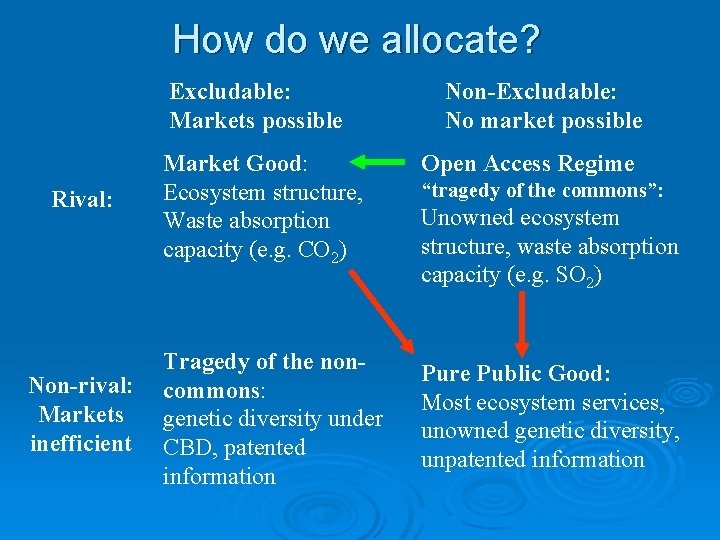
How do we allocate? Excludable: Markets possible Rival: Non-rival: Markets inefficient Non-Excludable: No market possible Market Good: Ecosystem structure, Waste absorption capacity (e. g. CO 2) Open Access Regime Tragedy of the noncommons: genetic diversity under CBD, patented information Pure Public Good: Most ecosystem services, unowned genetic diversity, unpatented information “tragedy of the commons”: Unowned ecosystem structure, waste absorption capacity (e. g. SO 2)
The Value of Biodiversity and Ecosystem Services
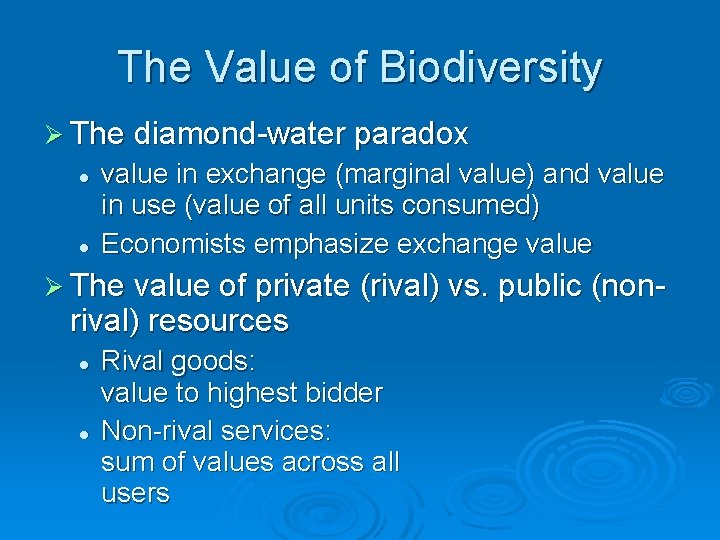
The Value of Biodiversity The diamond-water paradox value in exchange (marginal value) and value in use (value of all units consumed) Economists emphasize exchange value The value of private (rival) vs. public (non- rival) resources Rival goods: value to highest bidder Non-rival services: sum of values across all users
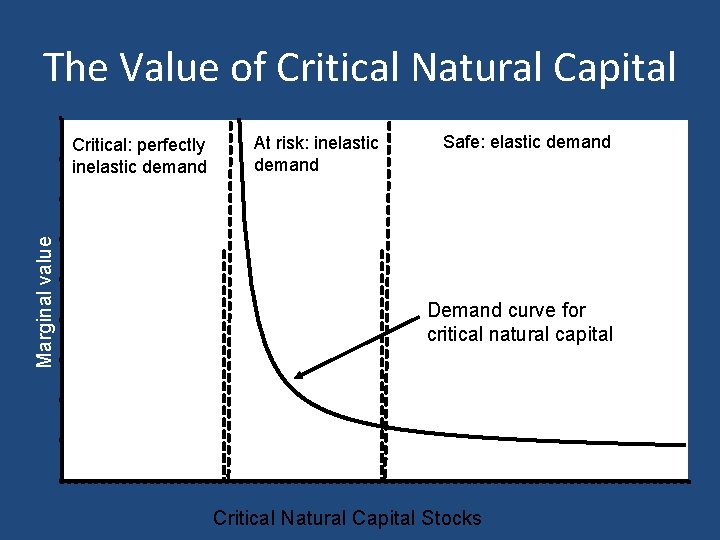
The Value of Critical Natural Capital Marginal value Critical: perfectly inelastic demand At risk: inelastic demand Safe: elastic demand Demand curve for critical natural capital Critical Natural Capital Stocks
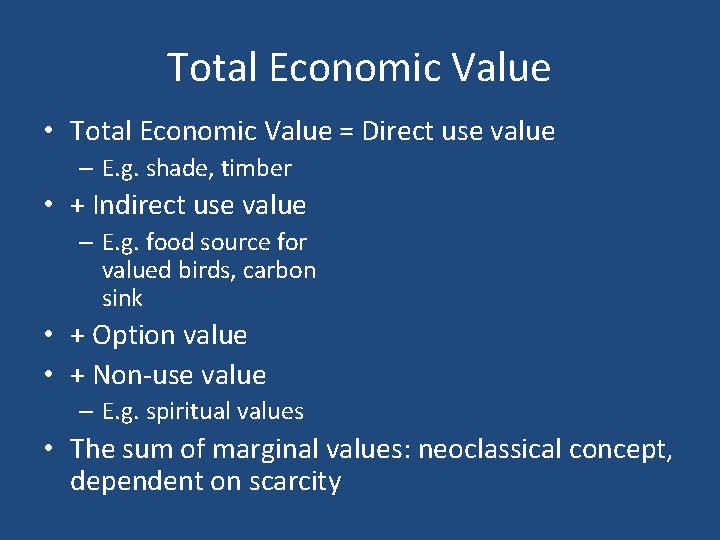
Total Economic Value • Total Economic Value = Direct use value – E. g. shade, timber • + Indirect use value – E. g. food source for valued birds, carbon sink • + Option value • + Non-use value – E. g. spiritual values • The sum of marginal values: neoclassical concept, dependent on scarcity
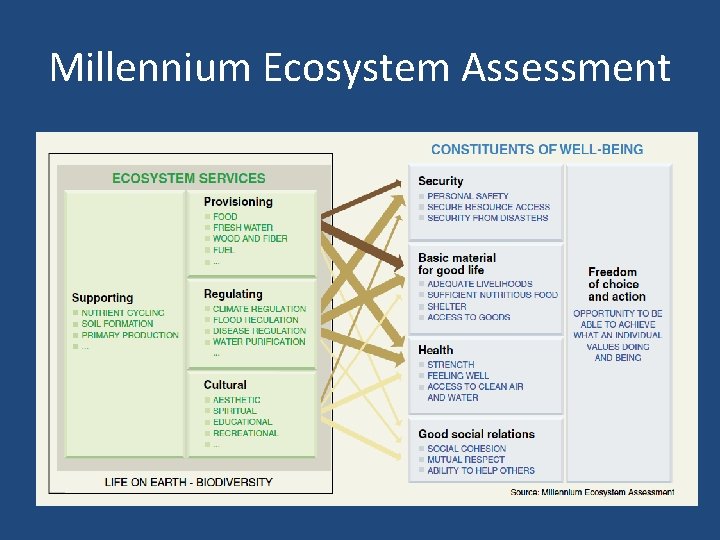
Millennium Ecosystem Assessment
Estimating Demand Curves: Willingness to Pay • Typical approach to estimating monetary values. – Revealed by market purchases for market resources, typically determined by contingent valuation surveys for non-market resources. • Preferences weighted by purchasing power: one dollar, one vote • Fails to account for values to future generations • Is monetary valuation appropriate?
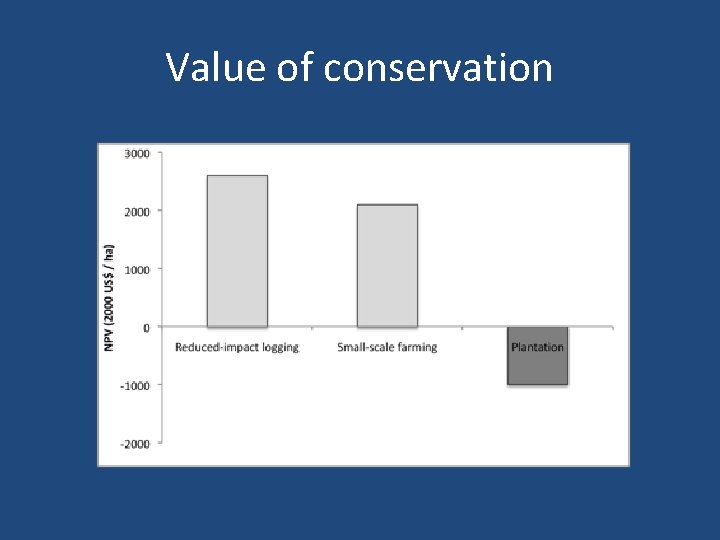
Value of conservation
Biodiversity and Payments for Ecosystem Services
Payments for Biodiversity and Ecosystem Services
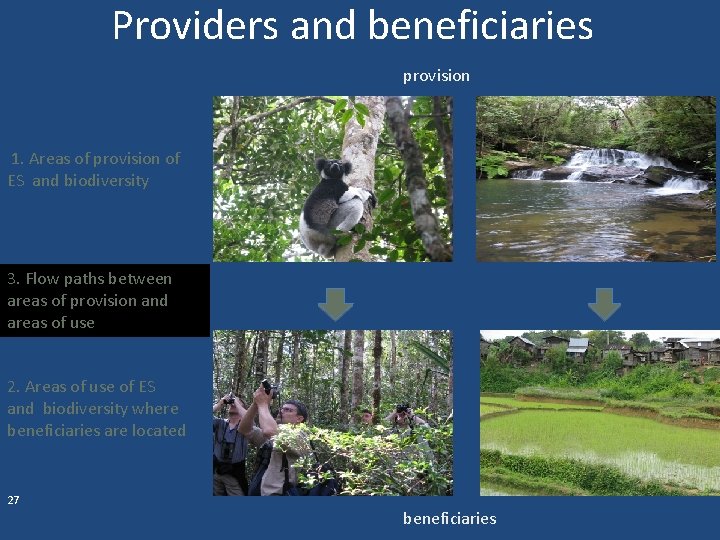
Providers and beneficiaries provision 1. Areas of provision of ES and biodiversity 3. Flow paths between areas of provision and areas of use 2. Areas of use of ES and biodiversity where beneficiaries are located 27 beneficiaries
Payment for Ecosystem Services • There are real costs to conservation, and someone must pay them – Opportunity costs of conservation: The income gained from conversion (e. g. timber) or from use of the converted ecosystem (e. g. agricultural land) • PES is based on the beneficiary pays principle – “a transfer of resources between social actors, which aims to create incentives to align individual and/or collective land use decisions with the social interest in the management of natural resources” (Muradian et al. 2010 p. 1205), • Generally instigated by beneficiaries
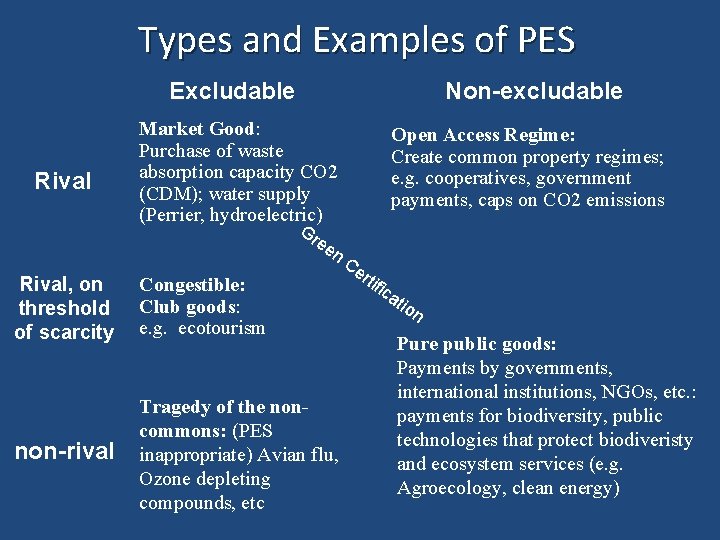
Types and Examples of PES Excludable Rival Non-excludable Market Good: Purchase of waste absorption capacity CO 2 (CDM); water supply (Perrier, hydroelectric) Gr ee n Rival, on threshold of scarcity Congestible: Club goods: e. g. ecotourism non-rival Tragedy of the noncommons: (PES inappropriate) Avian flu, Ozone depleting compounds, etc Open Access Regime: Create common property regimes; e. g. cooperatives, government payments, caps on CO 2 emissions Ce rtif ica tio n Pure public goods: Payments by governments, international institutions, NGOs, etc. : payments for biodiversity, public technologies that protect biodiveristy and ecosystem services (e. g. Agroecology, clean energy)
Ethics and the new biodiversity economy • Deciding on the desirable ends is inherently normative • Ethical behavior stresses the group over the individual, unethical behavior the individual over the group. • Conserving biodiversity requires cooperative, collective economic institutions, not competitive markets
- Slides: 30