
The EASIIUIS recommendations for standardization of ANA tests


- Slides: 15
The EASI-IUIS recommendations for standardization of ANA tests Nancy Agmon-Levin The Zabludowicz center for Autoimmune diseases, Sheba, Israel
Our Aim To create a set of recommendations for standardized determination of “ANA” and related antibodies, that will enable the creation of a local algorithm according to the local needs and regulations.
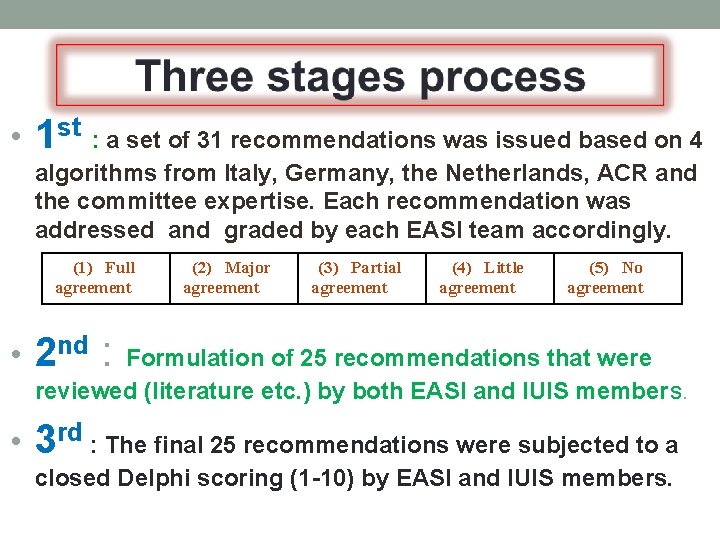
• 1 st : a set of 31 recommendations was issued based on 4 algorithms from Italy, Germany, the Netherlands, ACR and the committee expertise. Each recommendation was addressed and graded by each EASI team accordingly. (1) Full agreement • 2 nd (2) Major agreement (3) Partial agreement (4) Little agreement (5) No agreement : Formulation of 25 recommendations that were reviewed (literature etc. ) by both EASI and IUIS members. • 3 rd : The final 25 recommendations were subjected to a closed Delphi scoring (1 -10) by EASI and IUIS members.
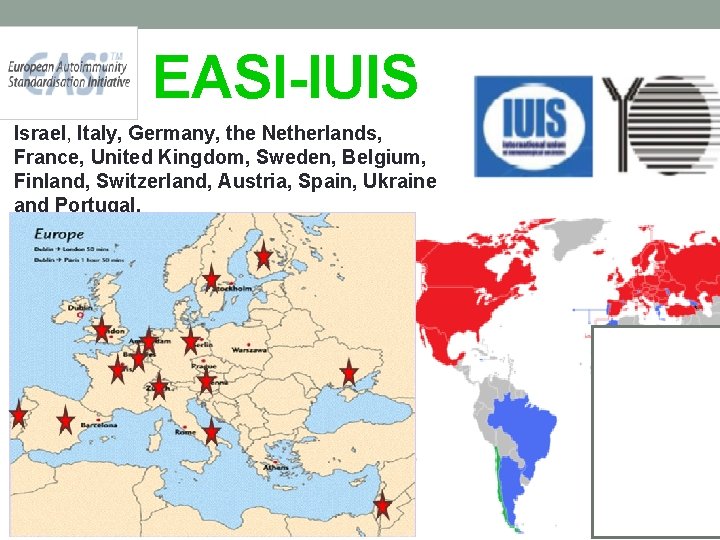
EASI-IUIS Israel, Italy, Germany, the Netherlands, France, United Kingdom, Sweden, Belgium, Finland, Switzerland, Austria, Spain, Ukraine and Portugal.
The recommendation 23/25 recommendations are dedicated to determination and interpretation of: ANA, anti-ds. DNA, Specific autoantibodies (“ENA”) and address both clinical and laboratory aspects Table 1 (mean±S. D. ) Most received very high Delphi scores No differences were observed between groups (EASI vs. IUIS)
Key points • Incompatibilities • (methods/clinical assessment) • Communication • Validation of kits • Terminology * • Training (Table 3) *
Incompatibilities • If discrepancy between methods is observed, especially in the setting of high clinical suspicion, another platform should be utilized. • ……choosing another platform or deciding which method is preferred may require a collaborative assessment of clinicians and laboratory specialist. • In cases of high clinical suspicion a physician request for determination of specific antibodies should be granted, irrespective of the result of previous tests (i. e. ANA-screen).
Communication • An all embracing issue (R - 7, 11, 12, 13, 14, 16, 19, 20, and 21). • The autoimmune laboratory should specify methods used…. . IIFA titers and patterns. • If multiple methods are being used either for ANA, anti- ds. DNA or anti-ENA antibodies, the results obtained by each method should be reported separately. • If further testing is advised added laboratory comment is recommended (R. 14 and 19)
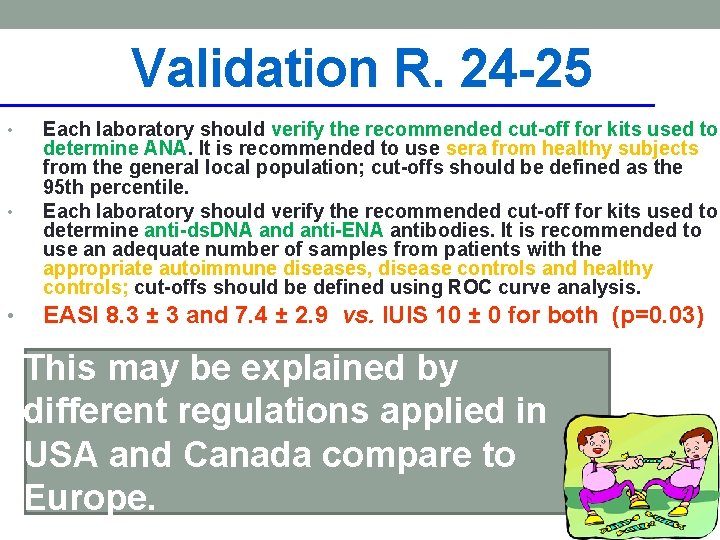
Validation R. 24 -25 • Each laboratory should verify the recommended cut-off for kits used to determine ANA. It is recommended to use sera from healthy subjects from the general local population; cut-offs should be defined as the 95 th percentile. Each laboratory should verify the recommended cut-off for kits used to determine anti-ds. DNA and anti-ENA antibodies. It is recommended to use an adequate number of samples from patients with the appropriate autoimmune diseases, disease controls and healthy controls; cut-offs should be defined using ROC curve analysis. • EASI 8. 3 ± 3 and 7. 4 ± 2. 9 vs. IUIS 10 ± 0 for both (p=0. 03) • This may be explained by different regulations applied in USA and Canada compare to Europe.
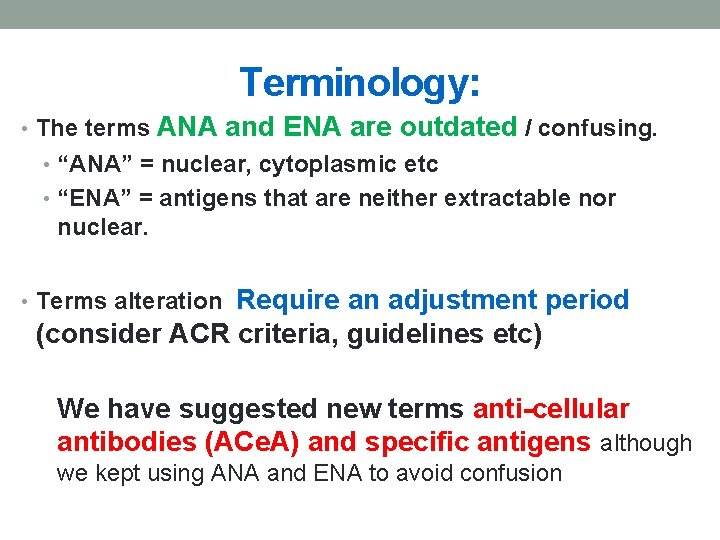
Terminology: • The terms ANA and ENA are outdated / confusing. • “ANA” = nuclear, cytoplasmic etc • “ENA” = antigens that are neither extractable nor nuclear. • Terms alteration Require an adjustment period (consider ACR criteria, guidelines etc) We have suggested new terms anti-cellular antibodies (ACe. A) and specific antigens although we kept using ANA and ENA to avoid confusion
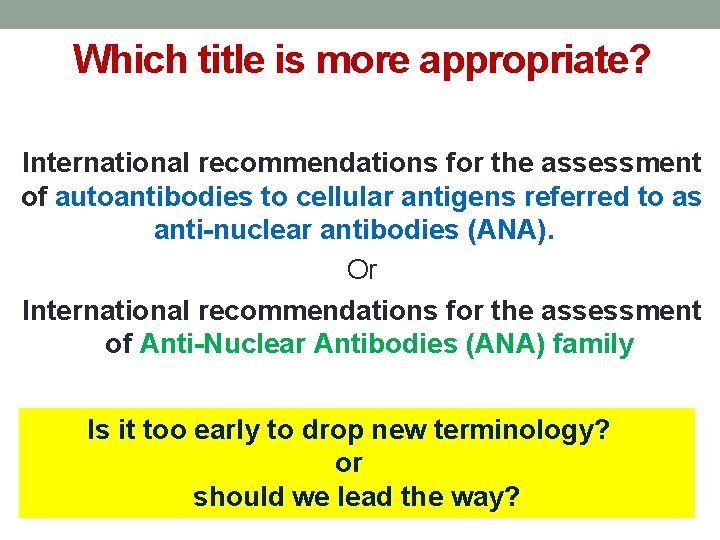
Which title is more appropriate? International recommendations for the assessment of autoantibodies to cellular antigens referred to as anti-nuclear antibodies (ANA). Or International recommendations for the assessment of Anti-Nuclear Antibodies (ANA) family Is it too early to drop new terminology? or should we lead the way?
Training : • The urgent need for training programs (lab technicians and physicians) has been highlighted in abstract, text and conclusions. Should we elaborate on such a program in the current manuscript?
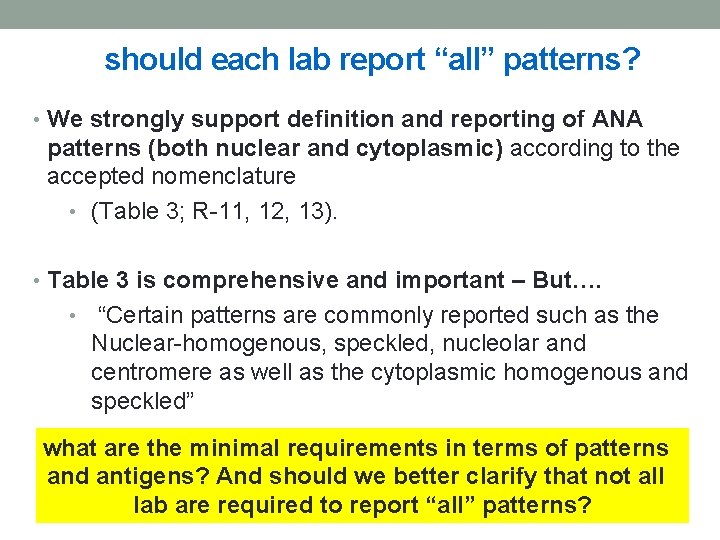
should each lab report “all” patterns? • We strongly support definition and reporting of ANA patterns (both nuclear and cytoplasmic) according to the accepted nomenclature • (Table 3; R-11, 12, 13). • Table 3 is comprehensive and important – But…. • “Certain patterns are commonly reported such as the Nuclear-homogenous, speckled, nucleolar and centromere as well as the cytoplasmic homogenous and speckled” what are the minimal requirements in terms of patterns and antigens? And should we better clarify that not all lab are required to report “all” patterns?
Last but not least: The first part of our project is almost completed However Local algorithms should be formulated and validated (a new project for each EASI team ? ) The number of methods for detecting anti-cellular antibodies is bound to increase (i. e. automated IIFA), hence updating of current recommendations is already pending….