
The Earth Geology Geologic Time Scale Relative time
- Slides: 48
The Earth Geology
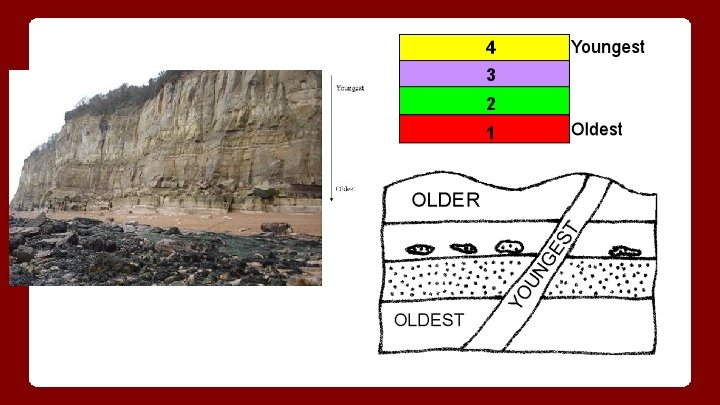
Geologic Time Scale: Relative time scale 1. Rock layers (strata) are laid down in succession with each strata representing a “slice” of time 2. The principle of superposition: any given stratum is probably older than those above it and younger than those below it
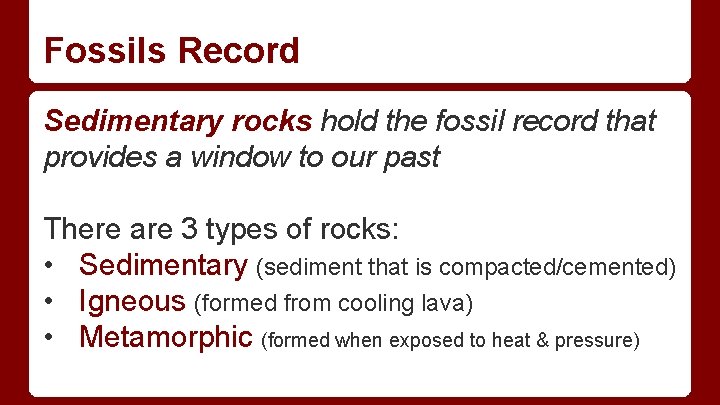
Fossils Record Sedimentary rocks hold the fossil record that provides a window to our past There are 3 types of rocks: • Sedimentary (sediment that is compacted/cemented) • Igneous (formed from cooling lava) • Metamorphic (formed when exposed to heat & pressure)
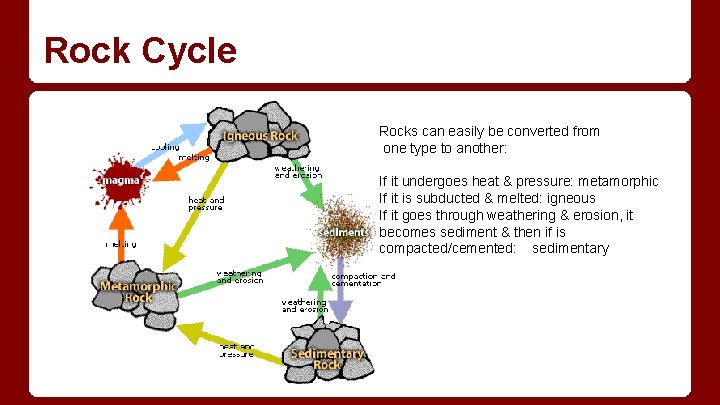
Rock Cycle Rocks can easily be converted from one type to another: If it undergoes heat & pressure: metamorphic If it is subducted & melted: igneous If it goes through weathering & erosion, it becomes sediment & then if is compacted/cemented: sedimentary
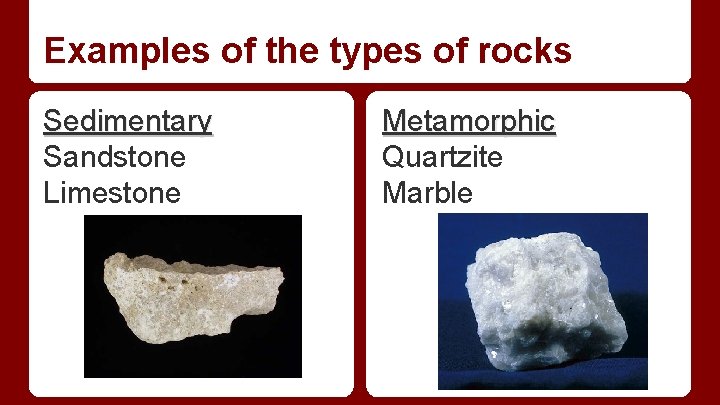
Examples of the types of rocks Sedimentary Sandstone Limestone Metamorphic Quartzite Marble
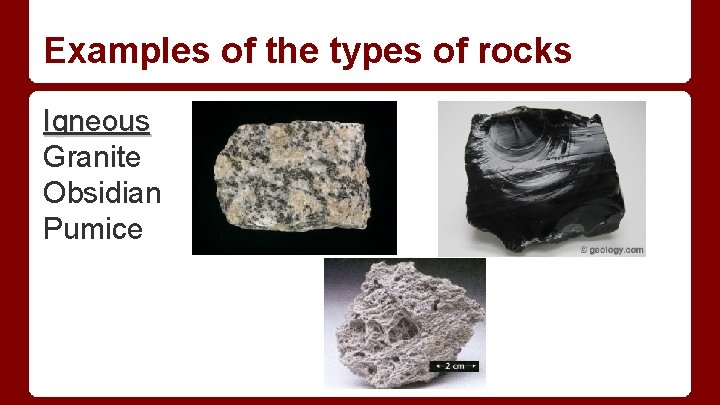
Examples of the types of rocks Igneous Granite Obsidian Pumice
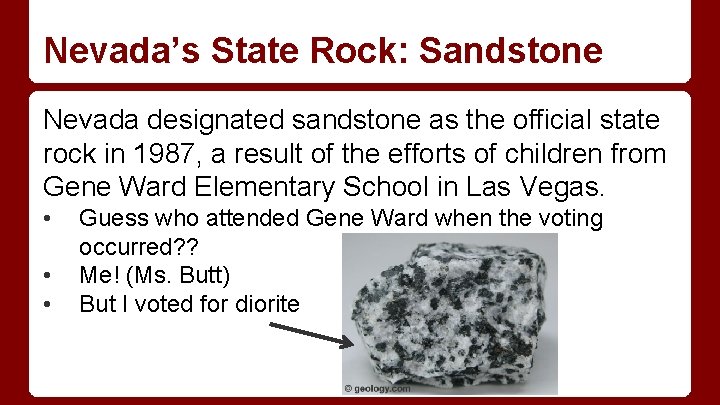
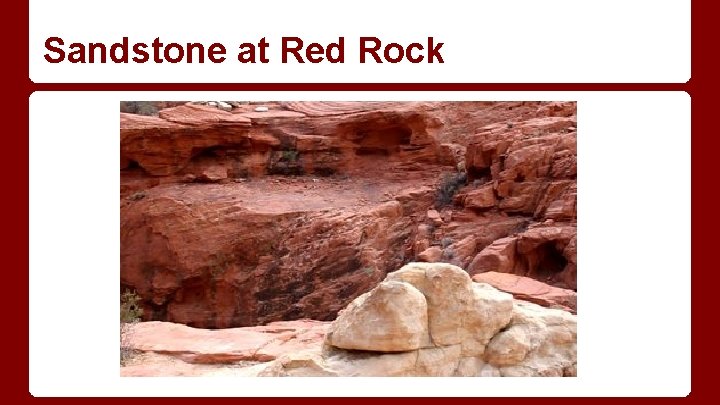
Nevada’s State Rock: Sandstone Nevada designated sandstone as the official state rock in 1987, a result of the efforts of children from Gene Ward Elementary School in Las Vegas. • • • Guess who attended Gene Ward when the voting occurred? ? Me! (Ms. Butt) But I voted for diorite
Sandstone at Red Rock
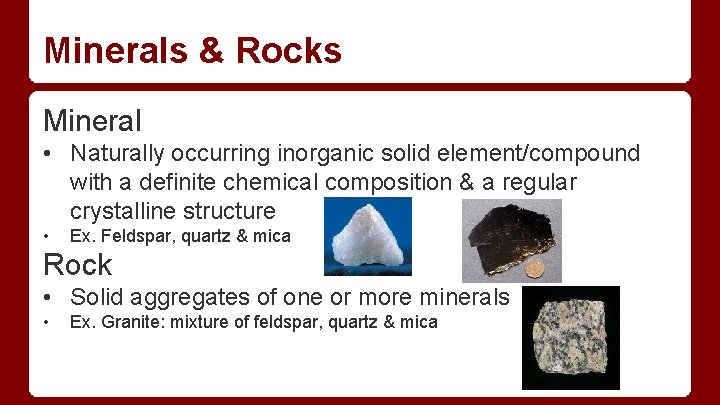
Minerals & Rocks Mineral • Naturally occurring inorganic solid element/compound with a definite chemical composition & a regular crystalline structure • Ex. Feldspar, quartz & mica Rock • Solid aggregates of one or more minerals • Ex. Granite: mixture of feldspar, quartz & mica
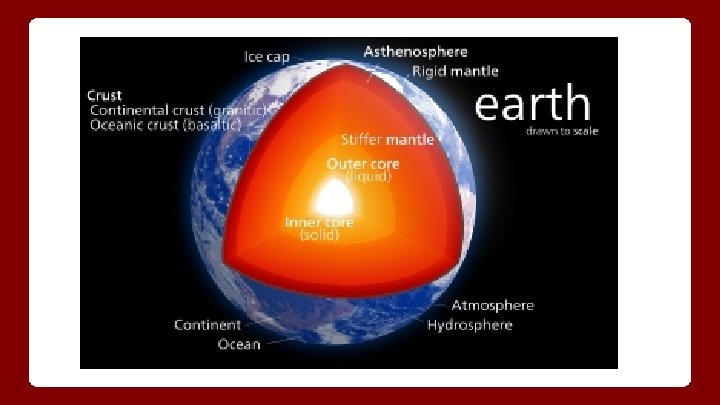
Internal structure of Earth Crust: brittle & rocky, so it can fracture in earthquakes 1. Continental Crust: basalt-rich, thick but less dense than oceanic-crust 2. Oceanic Crust: granite-rich, covers about ⅔ of earth’s surface, thin and more dense than continental crust
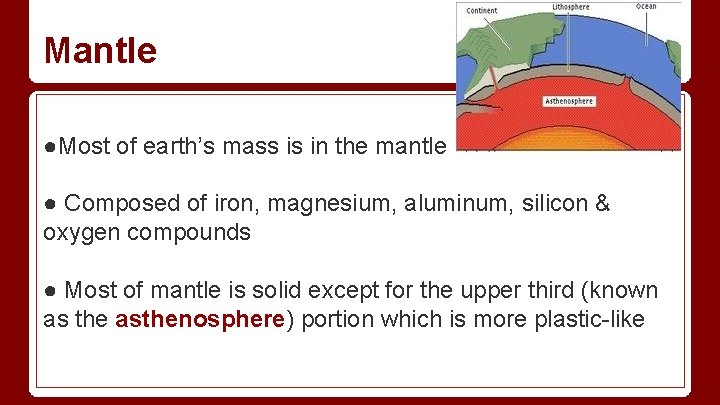
Mantle ●Most of earth’s mass is in the mantle ● Composed of iron, magnesium, aluminum, silicon & oxygen compounds ● Most of mantle is solid except for the upper third (known as the asthenosphere) portion which is more plastic-like
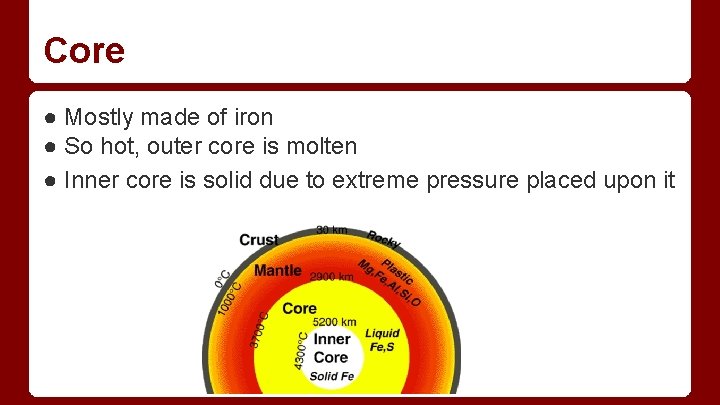
Core ● Mostly made of iron ● So hot, outer core is molten ● Inner core is solid due to extreme pressure placed upon it
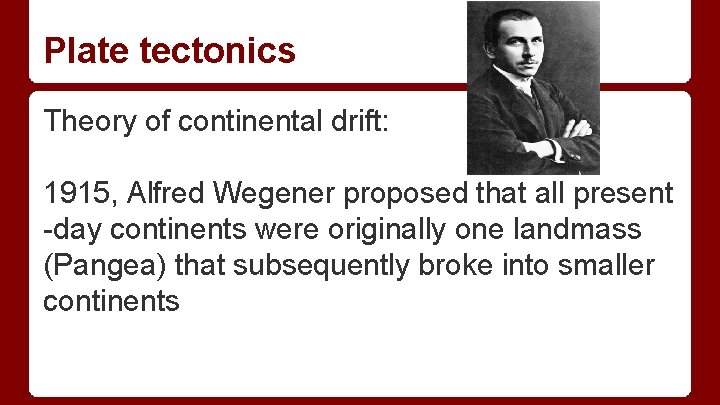
Plate tectonics Theory of continental drift: 1915, Alfred Wegener proposed that all present -day continents were originally one landmass (Pangea) that subsequently broke into smaller continents
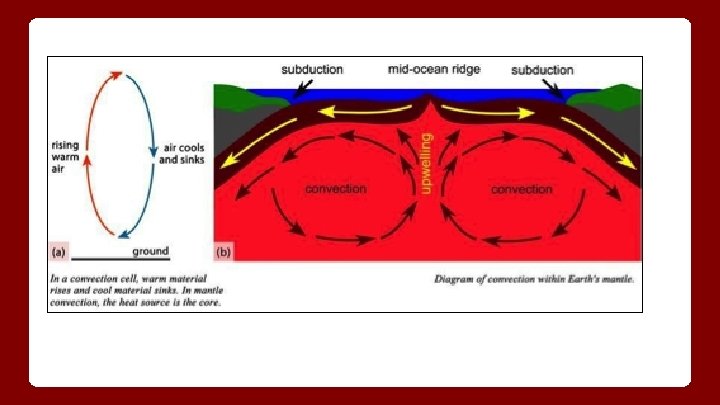
Theory of plate tectonics ● The crust is divided into 10 major plates & many minor plates that move across earth’s surface relative to one another. ● The movement is caused by convection currents located in the asthenosphere Convection cell= hot material rise, then sinks as it cools
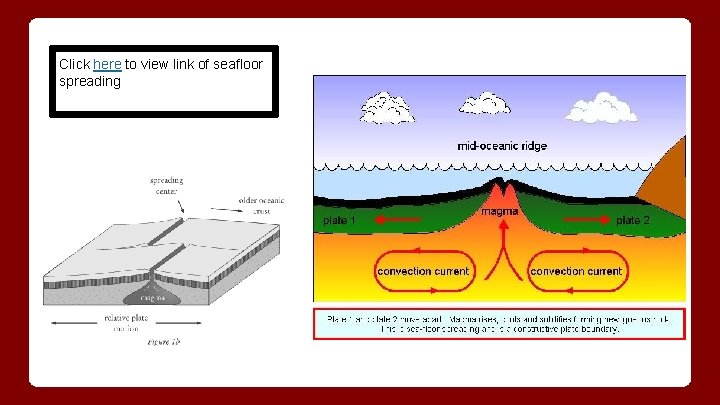
Theory of Seafloor Spreading ● During the 1960 s it was discovered near the mid-ocean ridge dating of rocks indicated that as one moved away from the ridge, the rocks became older. ● This suggested that new crust was being created at volcanic rift zones
Click here to view link of seafloor spreading
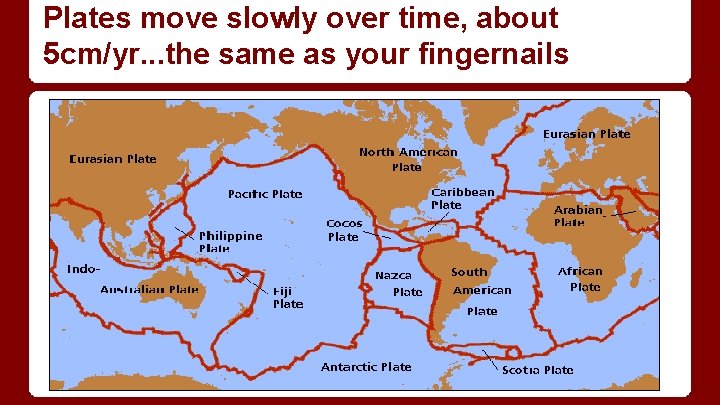
Plates move slowly over time, about 5 cm/yr. . . the same as your fingernails
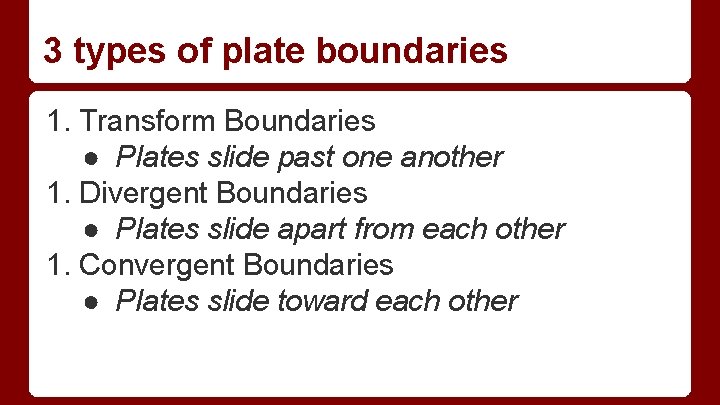
3 types of plate boundaries 1. Transform Boundaries ● Plates slide past one another 1. Divergent Boundaries ● Plates slide apart from each other 1. Convergent Boundaries ● Plates slide toward each other
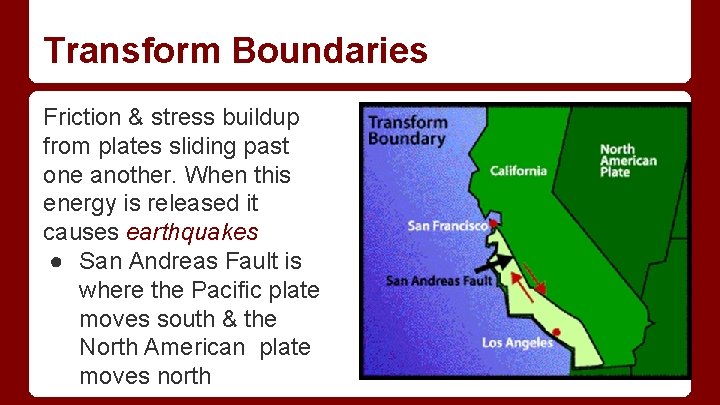
Transform Boundaries Friction & stress buildup from plates sliding past one another. When this energy is released it causes earthquakes ● San Andreas Fault is where the Pacific plate moves south & the North American plate moves north
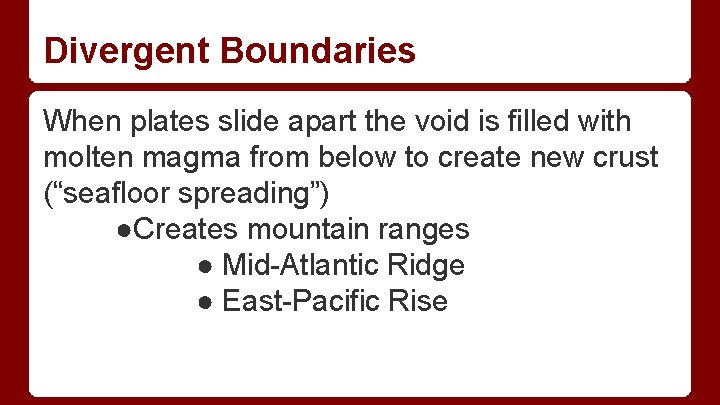
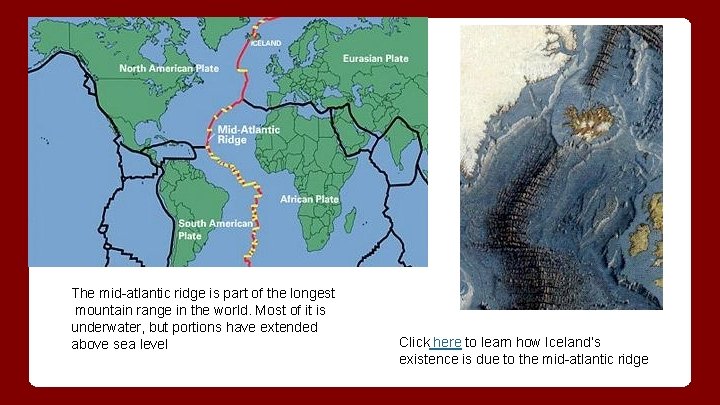
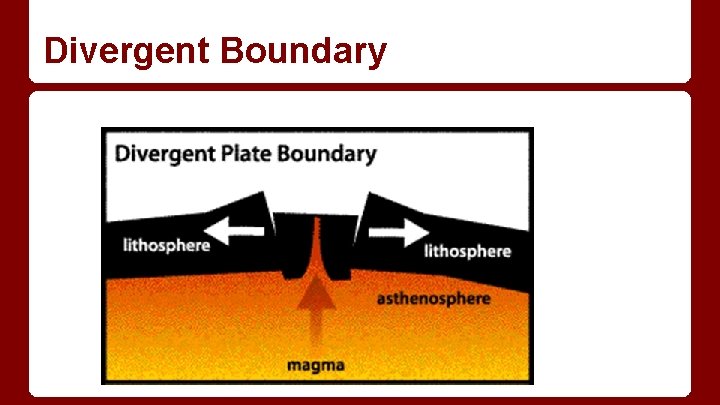
Divergent Boundaries When plates slide apart the void is filled with molten magma from below to create new crust (“seafloor spreading”) ●Creates mountain ranges ● Mid-Atlantic Ridge ● East-Pacific Rise
The mid-atlantic ridge is part of the longest mountain range in the world. Most of it is underwater, but portions have extended above sea level Click here to learn how Iceland’s existence is due to the mid-atlantic ridge
Divergent Boundary
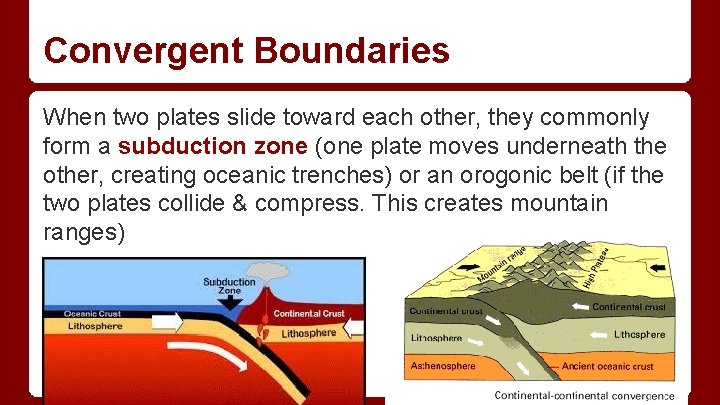
Convergent Boundaries When two plates slide toward each other, they commonly form a subduction zone (one plate moves underneath the other, creating oceanic trenches) or an orogonic belt (if the two plates collide & compress. This creates mountain ranges)
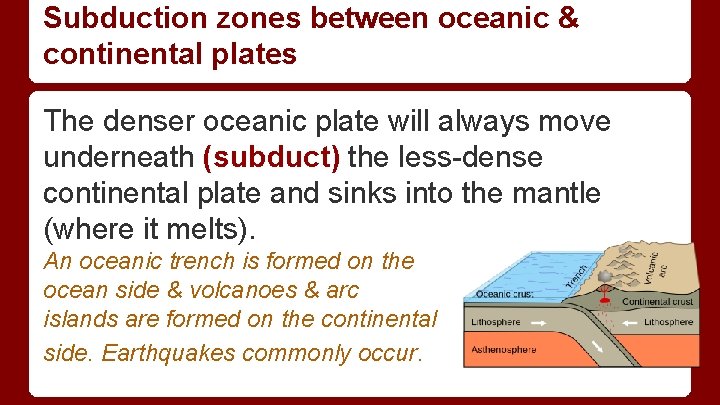
Subduction zones between oceanic & continental plates The denser oceanic plate will always move underneath (subduct) the less-dense continental plate and sinks into the mantle (where it melts). An oceanic trench is formed on the ocean side & volcanoes & arc islands are formed on the continental side. Earthquakes commonly occur.
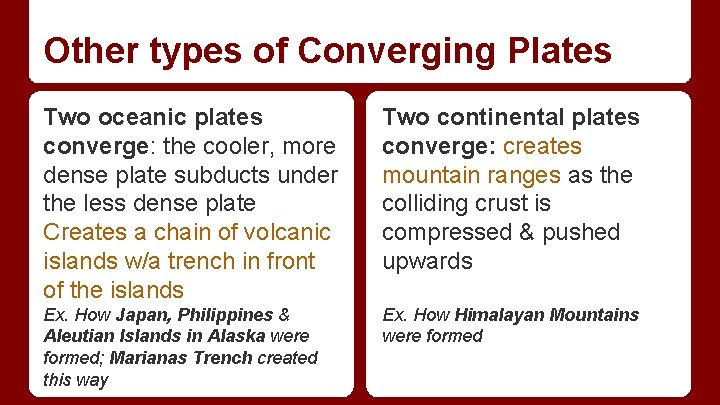
Other types of Converging Plates Two oceanic plates converge: the cooler, more dense plate subducts under the less dense plate Creates a chain of volcanic islands w/a trench in front of the islands Two continental plates converge: creates mountain ranges as the colliding crust is compressed & pushed upwards Ex. How Japan, Philippines & Aleutian Islands in Alaska were formed; Marianas Trench created this way Ex. How Himalayan Mountains were formed
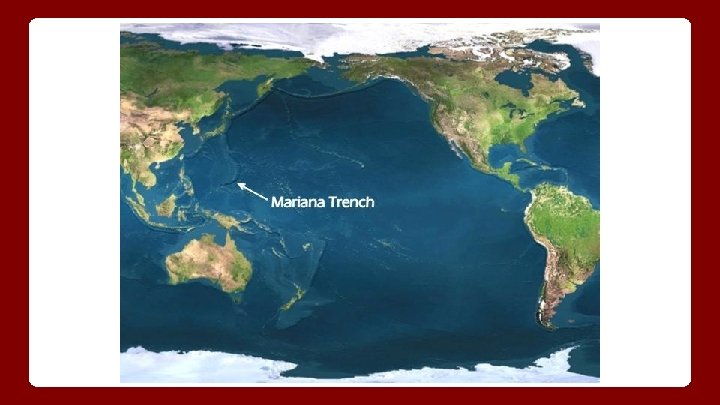
Trenches The Marianas Trench, where the enormous Pacific Plate is descending under the leading edge of the Eurasian Plate, is the deepest sea floor in the world. It curves northward from near the island of Guam and its bottom lies close to 36, 000 feet below the surface of the Pacific Ocean.
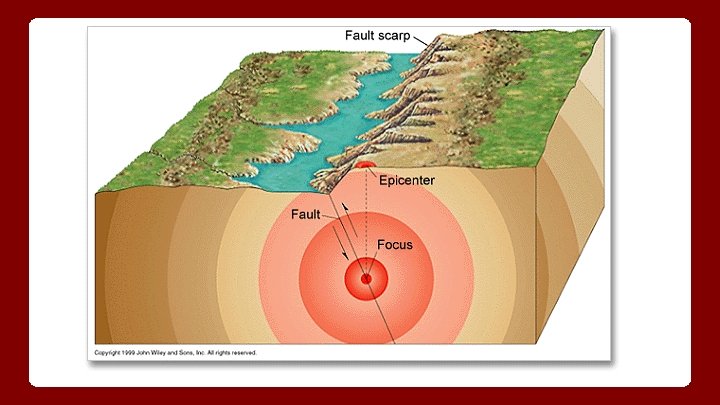
Earthquakes Occur during abrupt movements on existing faults, along tectonic plate boundary zones or along mid-ocean ridges. ● A massive amount of stored energy, held in place by friction, is released in a very short period of time ● The area where the energy is released is called the focus ● From the focus, seismic waves travel outward in all directions. ● Directly above the focus, on Earth’s surface, is the epicenter
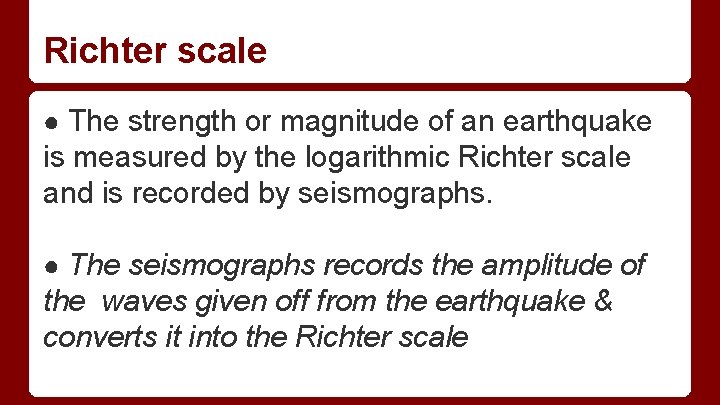
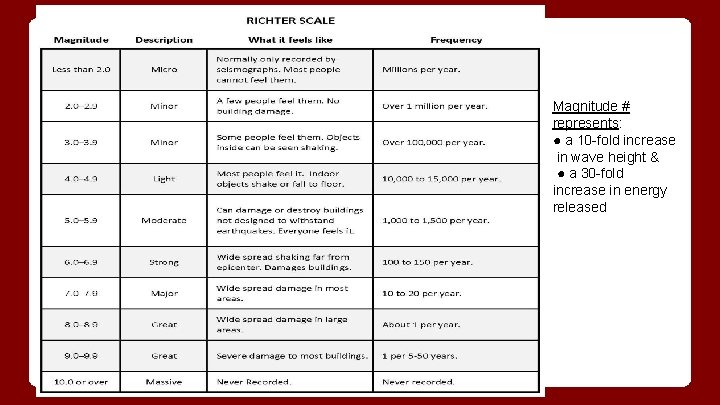
Richter scale ● The strength or magnitude of an earthquake is measured by the logarithmic Richter scale and is recorded by seismographs. ● The seismographs records the amplitude of the waves given off from the earthquake & converts it into the Richter scale
Magnitude # represents: ● a 10 -fold increase in wave height & ● a 30 -fold increase in energy released
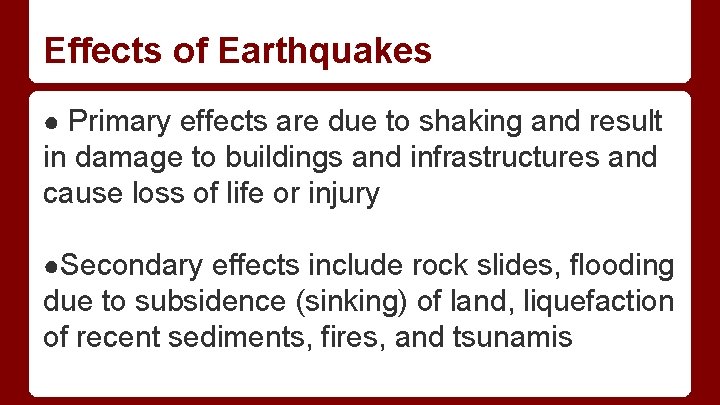
Effects of Earthquakes ● Primary effects are due to shaking and result in damage to buildings and infrastructures and cause loss of life or injury ●Secondary effects include rock slides, flooding due to subsidence (sinking) of land, liquefaction of recent sediments, fires, and tsunamis
How to reduce damage done by earthquakes: ● Mapping of faults ● Strengthening building codes ● Preparing emergency teams with adequate training ● Upgrading communication technology & availability ● Storing emergency supplies ● Educating the public
Did you know? ● The #1 state for earthquakes is Alaska, followed by California and Hawaii ● The earthquake that caused the most deaths occurred in China in 1556 ● In the US the earthquake that caused the most deaths occurred in Alaska in 1964
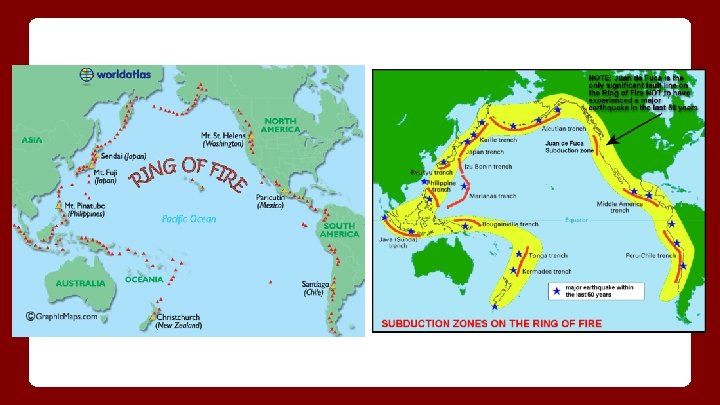
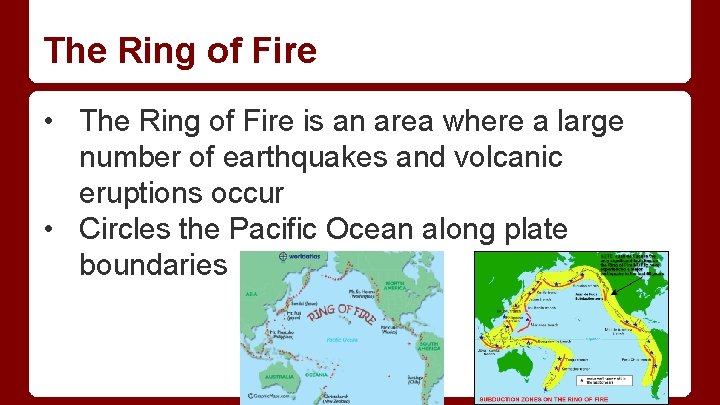
The Ring of Fire • The Ring of Fire is an area where a large number of earthquakes and volcanic eruptions occur • Circles the Pacific Ocean along plate boundaries
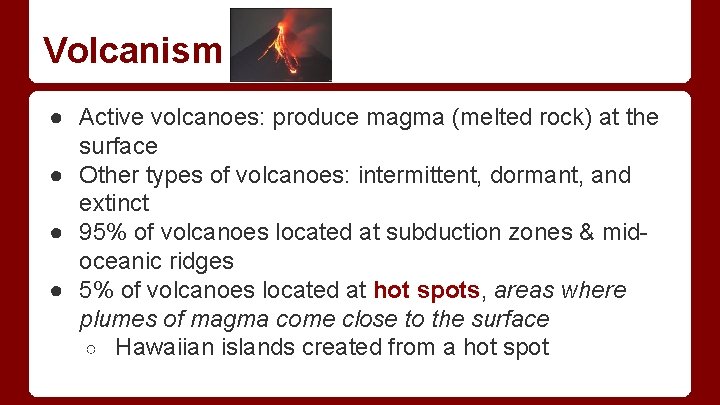
Volcanism ● Active volcanoes: produce magma (melted rock) at the surface ● Other types of volcanoes: intermittent, dormant, and extinct ● 95% of volcanoes located at subduction zones & midoceanic ridges ● 5% of volcanoes located at hot spots, areas where plumes of magma come close to the surface ○ Hawaiian islands created from a hot spot
What comes out of a Volcano ● Ejecta (lava rock and/or ash= particulate matter) ● Molten lava ● Toxic gases ○ ○ steam carbon dioxide sulfur dioxide hydrogen chloride
Volcanoes can affect global temperature ● Volcanoes affect the climate by introducing large quantities of sulfur dioxide (SO 2) into the atmosphere ● The sulfur dioxide reacts with water & oxygen, then condenses into fine droplets called aerosols, which reflect sunlight back into space & thereby cool the atmosphere & surface ● In 1992, a year after Mt. Pinatubo (Philippines) erupted the average global temperature went down by as much as one degree fahrenheit, due to sulfate particles ● The particles eventually will settle out of the atmosphere within two years and contribute to acid deposition.
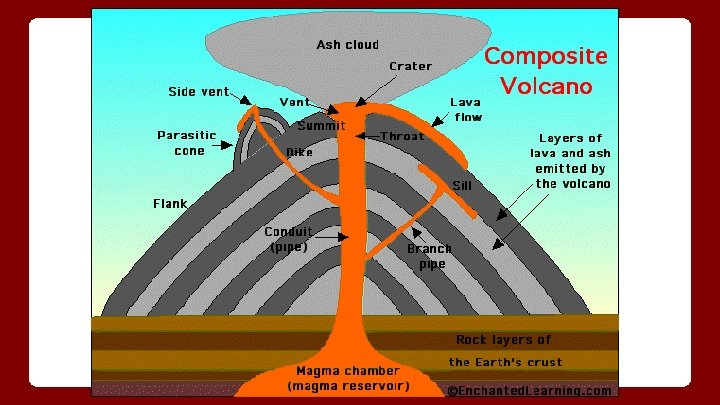
Eruption: pressure within a magma chamber forces molten magma up through a conduit (pipe) and out a vent at the top of the volcano The type of eruption depends on: ● the gases ● the amount of silica in the magma ○ This determines how viscos it is ● how free the conduit is (whether the volcano flows or explodes)
Benefits of volcanic eruptions ● Creates new landforms ○ Hawaiian Islands ● Increases soil nutrient levels produced from erosion of lava rock
Negatives of volcanic eruptions Air pollution • • • Acid precipitation (sulfur) Global climate change (aerosols) Particulate matter may blow into the stratosphere, where it can circle the globe & remain aloft for months or years Lava- Destruction of habitat/Displacement of people • Example of primary succession Health issues • • Respiratory issues- especially those with asthma Burns eyes & throat Current Volcanic Eruptions: 2014 - Iceland 2015 - Chile
Article on Iceland’s volcanos Click on the following link to read an article on Iceland’s current volcanic activity. After you read the article, watch the Volcanoes 101 video. 1. Write a 3 sentence summary of the article. 2. Write down 3 facts from the video. 3. You will turn these into me next class