
The Early Writing Tools Robyn and Rachelle Timeline
The Early Writing Tools Robyn and Rachelle
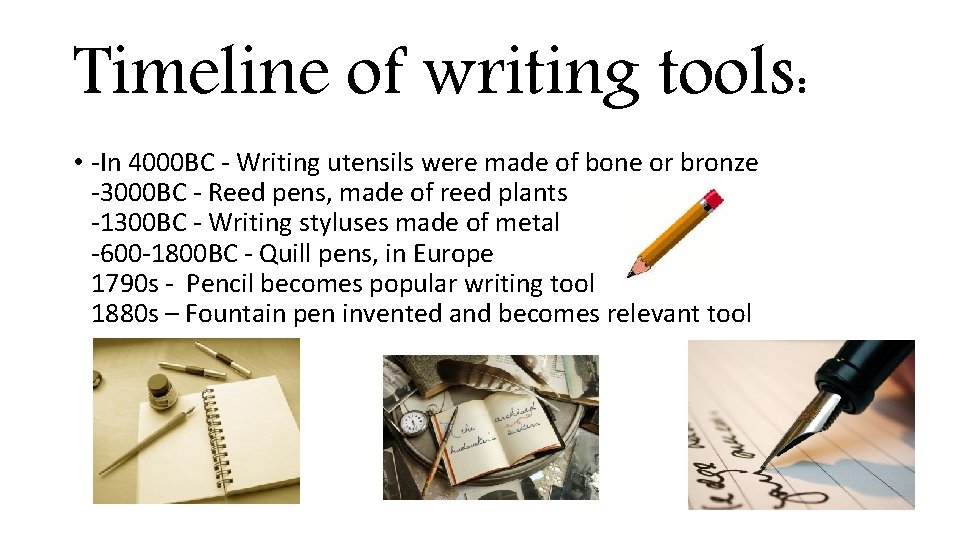
Timeline of writing tools: • -In 4000 BC - Writing utensils were made of bone or bronze -3000 BC - Reed pens, made of reed plants -1300 BC - Writing styluses made of metal -600 -1800 BC - Quill pens, in Europe 1790 s - Pencil becomes popular writing tool 1880 s – Fountain pen invented and becomes relevant tool
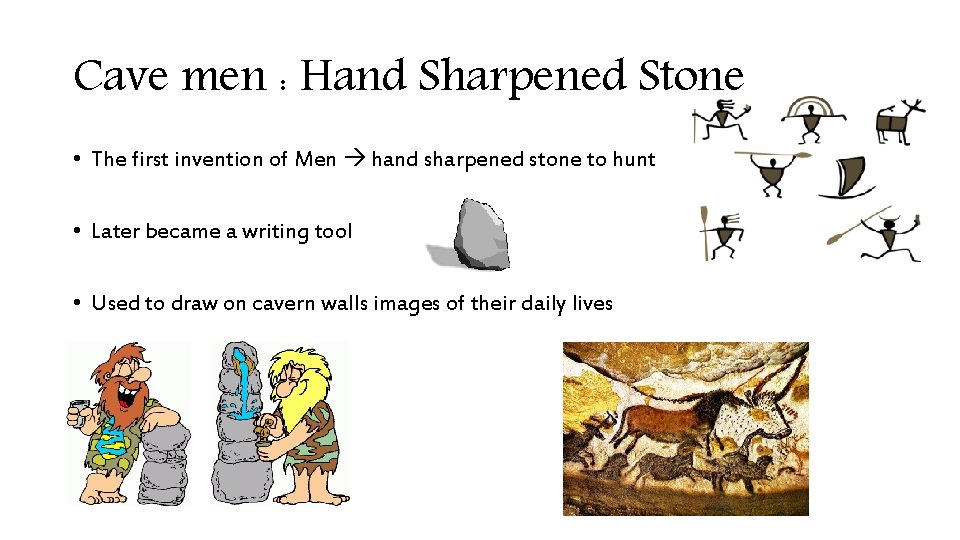
Cave men : Hand Sharpened Stone • The first invention of Men hand sharpened stone to hunt • Later became a writing tool • Used to draw on cavern walls images of their daily lives
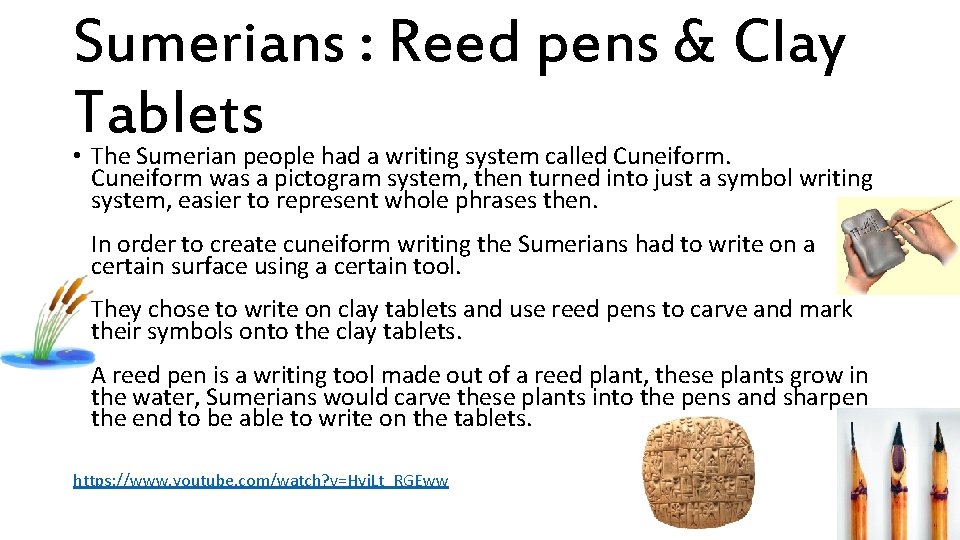
Sumerians : Reed pens & Clay Tablets • The Sumerian people had a writing system called Cuneiform was a pictogram system, then turned into just a symbol writing system, easier to represent whole phrases then. In order to create cuneiform writing the Sumerians had to write on a certain surface using a certain tool. They chose to write on clay tablets and use reed pens to carve and mark their symbols onto the clay tablets. A reed pen is a writing tool made out of a reed plant, these plants grow in the water, Sumerians would carve these plants into the pens and sharpen the end to be able to write on the tablets. https: //www. youtube. com/watch? v=Hyj. Lt_RGEww
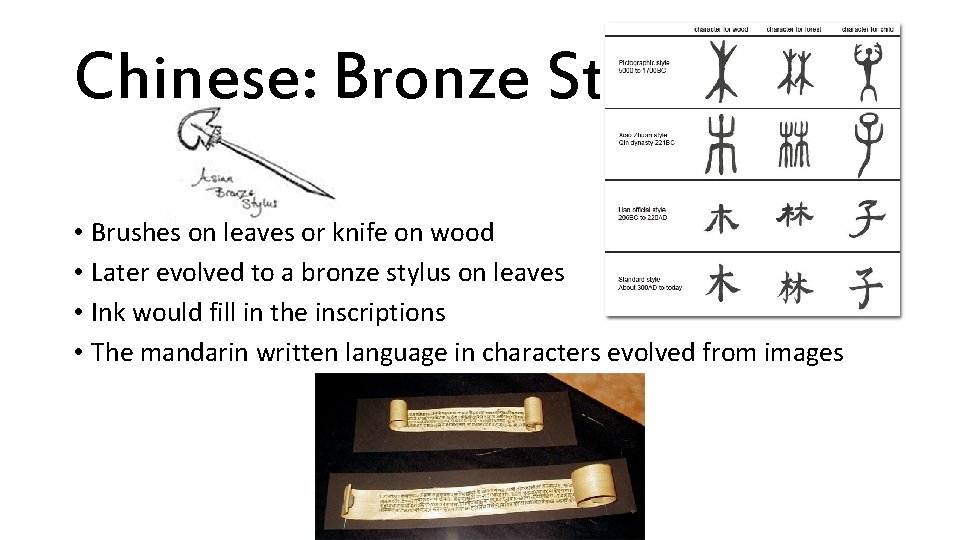
Chinese: Bronze Stylus • Brushes on leaves or knife on wood • Later evolved to a bronze stylus on leaves • Ink would fill in the inscriptions • The mandarin written language in characters evolved from images
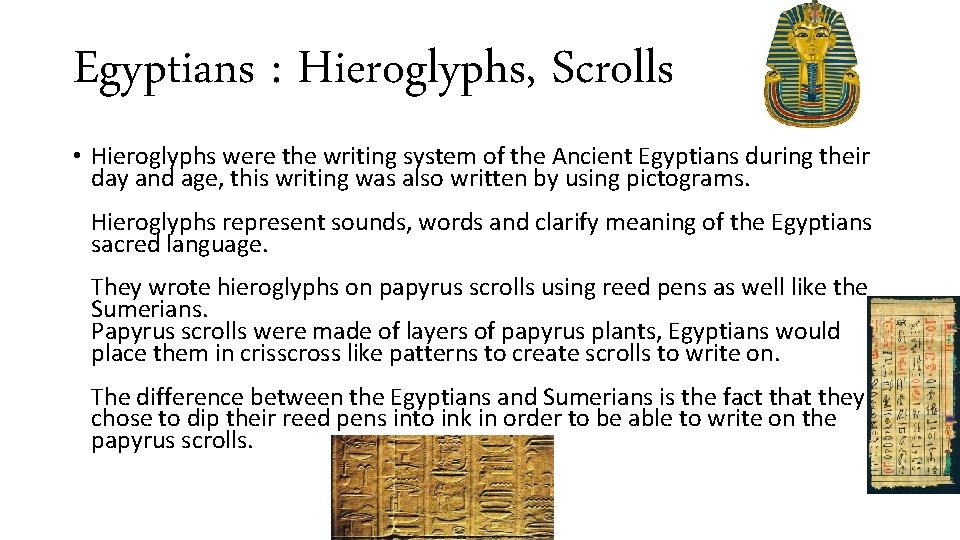
Egyptians : Hieroglyphs, Scrolls • Hieroglyphs were the writing system of the Ancient Egyptians during their day and age, this writing was also written by using pictograms. Hieroglyphs represent sounds, words and clarify meaning of the Egyptians sacred language. They wrote hieroglyphs on papyrus scrolls using reed pens as well like the Sumerians. Papyrus scrolls were made of layers of papyrus plants, Egyptians would place them in crisscross like patterns to create scrolls to write on. The difference between the Egyptians and Sumerians is the fact that they chose to dip their reed pens into ink in order to be able to write on the papyrus scrolls.
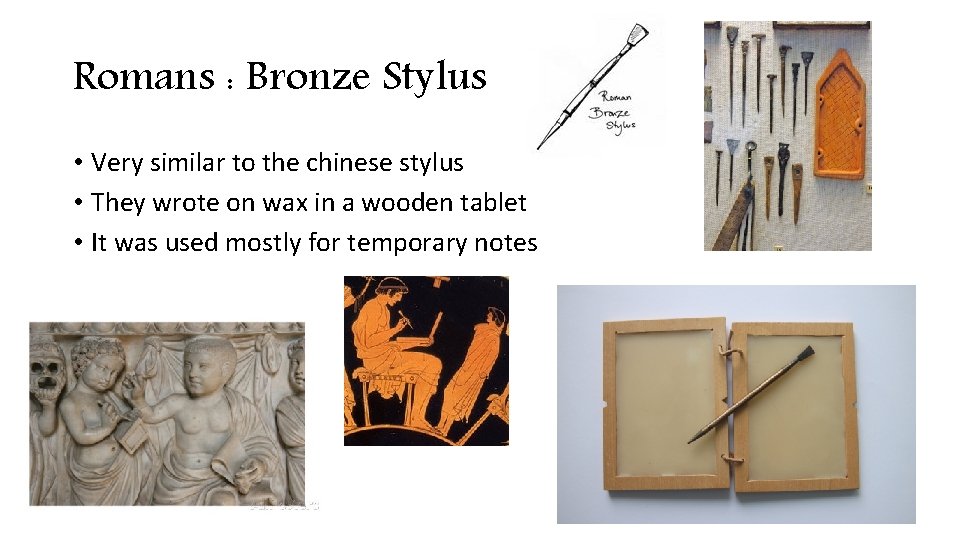
Romans : Bronze Stylus • Very similar to the chinese stylus • They wrote on wax in a wooden tablet • It was used mostly for temporary notes
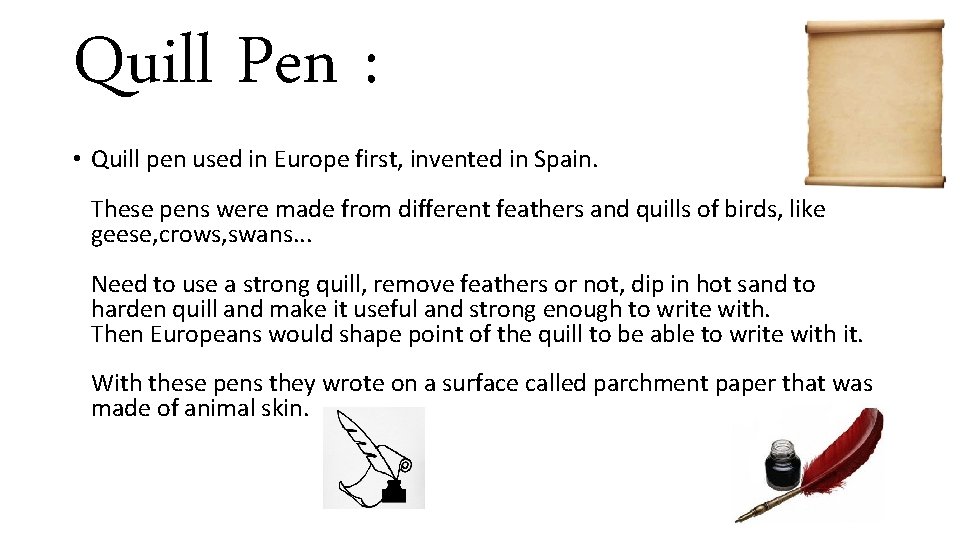
Quill Pen : • Quill pen used in Europe first, invented in Spain. These pens were made from different feathers and quills of birds, like geese, crows, swans. . . Need to use a strong quill, remove feathers or not, dip in hot sand to harden quill and make it useful and strong enough to write with. Then Europeans would shape point of the quill to be able to write with it. With these pens they wrote on a surface called parchment paper that was made of animal skin.
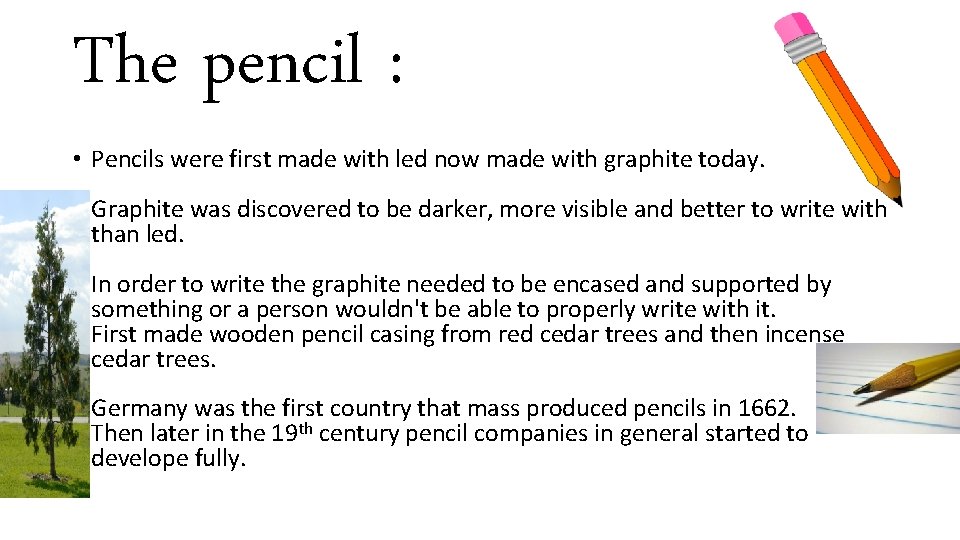
The pencil : • Pencils were first made with led now made with graphite today. Graphite was discovered to be darker, more visible and better to write with than led. In order to write the graphite needed to be encased and supported by something or a person wouldn't be able to properly write with it. First made wooden pencil casing from red cedar trees and then incense cedar trees. Germany was the first country that mass produced pencils in 1662. Then later in the 19 th century pencil companies in general started to develope fully.
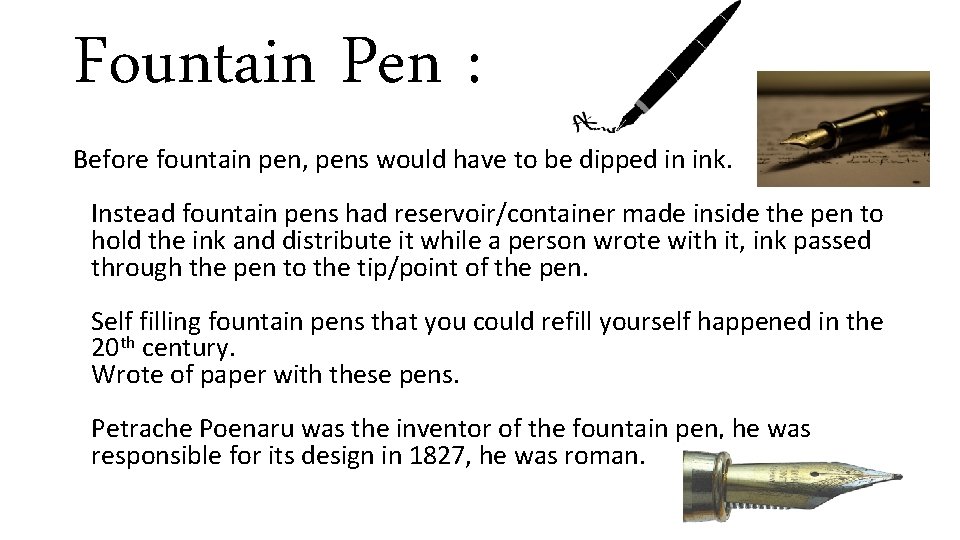
Fountain Pen : Before fountain pen, pens would have to be dipped in ink. Instead fountain pens had reservoir/container made inside the pen to hold the ink and distribute it while a person wrote with it, ink passed through the pen to the tip/point of the pen. Self filling fountain pens that you could refill yourself happened in the 20 th century. Wrote of paper with these pens. Petrache Poenaru was the inventor of the fountain pen, he was responsible for its design in 1827, he was roman.
Bibliography http : //www. brighthubeducation. com/history-homework-help/123138 -stylus-quill-and-pen-short-history-on-writing-instruments/ http: //www. ringpen. com/history. html http: //inventors. about. com/od/timelines/fl/A-Brief-History-of-Writing. htm Images; https: //s 3. amazonaws. com/engrade-myfiles/4029704110428364/wh 06 as_c 03000010 a_mask. jpg http: //www. omniglot. com/images/langsamples/smp_sumerian. jpg https: //pittkyle 123. files. wordpress. com/2011/03/egytptian-hieroglyphics-on-papyrus. jpg https: //www. aai. uni-hamburg. de/en/forschung/ngmcp/history/scenes. html http: //www. randyasplund. com/pages/article/waxedtabletstylus. html https: //en. wikipedia. org/wiki/Wax_tablet http: //www. allposters. com/-sp/Roman-Art-Relief-of-Sarcophagus-Child-and-Tutor-Writing-on-Wax-Tablet-with-a-Styli-Vatican-Posters_i 10116561_. htm -Most images from clip art. https: //pencils. com/pencil-history/ http: //medievalwriting. 50 megs. com/tools/quill. htm http: //www. brighthubeducation. com/history-homework-help/123138 -stylus-quill-and-pen-short-history-on-writing-instruments/#imgn_5 http: //www. history. org/foundation/journal/winter 07/lettersside. cfm? show. Site=mobile http: //www. ringpen. com/history. html http: //www. hrc. utexas. edu/educator/modules/gutenberg/books/early/ http: //www. mesopotamia. co. uk/writing/story/sto_set. html http: //www. ancient. eu/cuneiform/ http: //www. ancient. eu/Egyptian_Hieroglyphs/ http: //www. omniglot. com/writing/sumerian. htm http: //www. wonderful-romania. com/index. php/component/k 2/item/45 -petrache-poenaru-the-romanian-outlaw-who-invented-the-first-modern-fountain-pen
- Slides: 11