
The Early Start Denver Model intervention implemented in




- Slides: 36
The Early Start Denver Model intervention implemented in the Public Health System: an Italian experience Dr. Raffaella Devescovi Division of Child Neurology and Psychiatry Institute for Maternal and Child Health I. R. C. C. S. Burlo Garofolo Trieste
The Early Start Denver Model (ESDM): An Intensive, Comprehensive, Early Intervention for Toddlers and Preschoolers with Autism Spectrum Disorders (ASD)
Ø ESDM is an extension of the first Denver model, developed as a group model in the 1980 s in Denver by Prof. Sally Rogers and colleagues, aimed at children between 24 and 60 months of age with autism in preschool. Ø ESDM was developed at the UC Davis M. I. N. D. Institute for children with autism starting from 12 months up to 48 -60 months. Ø ESDM derives from research on learning processes in young children and on the effects that autism has on early development. Ø The goal of ESDM is to decrease the severity of autism symptoms and accelerate development in all domains (especially cognitive, socio-emotional and linguistic area).
Basic Elements of the Intervention Model l Comprehensive developmental curriculum l In a relationship-based approach l With strong positive affective frame l l Emphasis on social development: communication and language, imitation and play Naturalistic teaching is preferred; increased structure as per needed
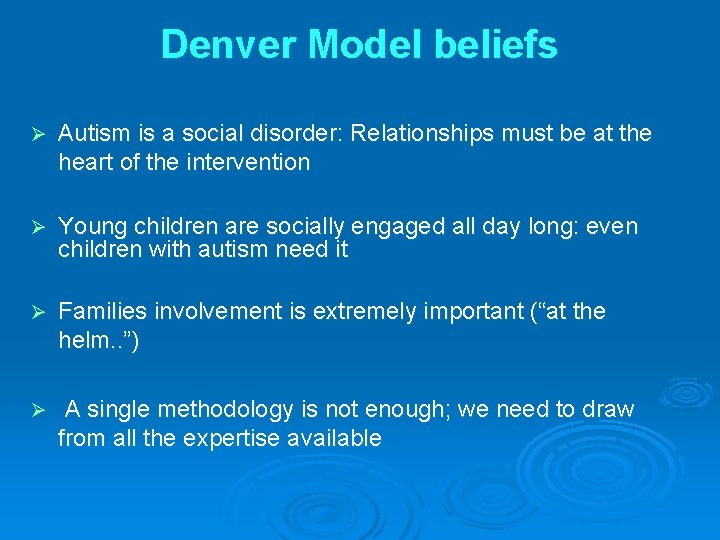
Denver Model beliefs Ø Autism is a social disorder: Relationships must be at the heart of the intervention Ø Young children are socially engaged all day long: even children with autism need it Ø Families involvement is extremely important (“at the helm. . ”) Ø A single methodology is not enough; we need to draw from all the expertise available
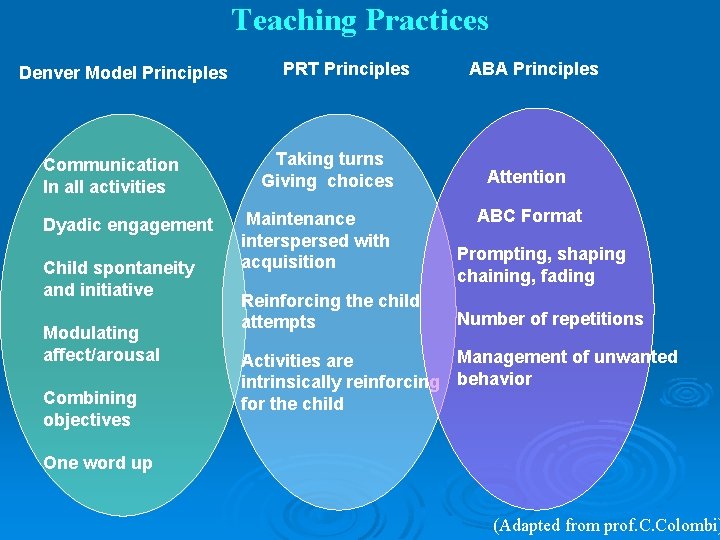
Teaching Practices Denver Model Principles Communication In all activities Dyadic engagement Child spontaneity and initiative Modulating affect/arousal Combining objectives PRT Principles Taking turns Giving choices Maintenance interspersed with acquisition Reinforcing the child attempts ABA Principles Attention ABC Format Prompting, shaping chaining, fading Number of repetitions Management of unwanted Activities are intrinsically reinforcing behavior for the child One word up (Adapted from prof. C. Colombi)
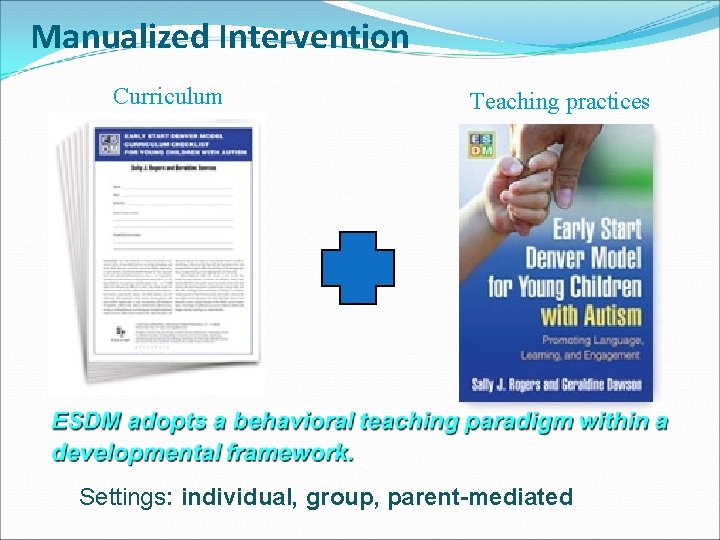
Manualized Intervention Curriculum Teaching practices Settings: individual, group, parent-mediated
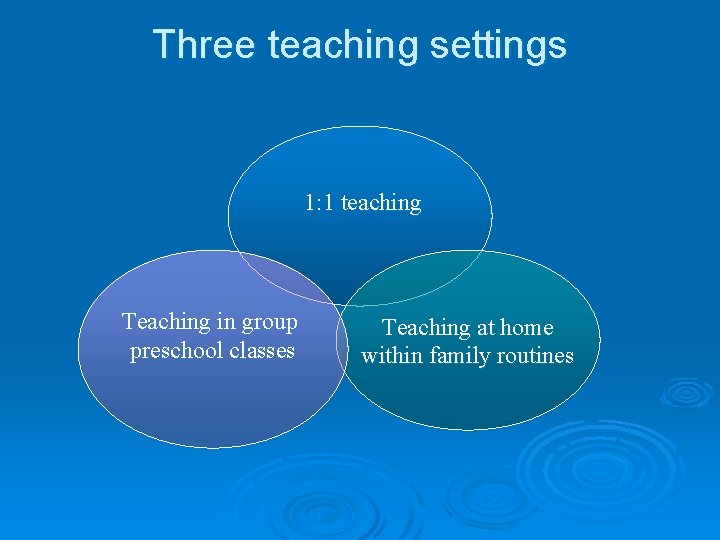
Three teaching settings 1: 1 teaching Teaching in group preschool classes Teaching at home within family routines
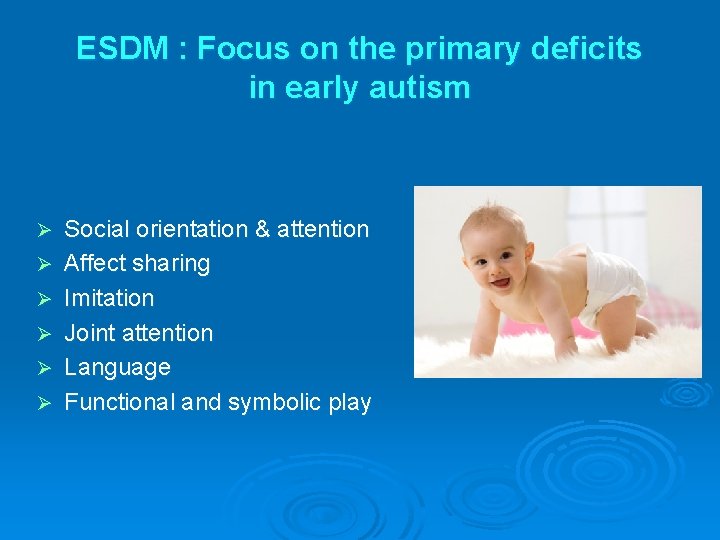
ESDM : Focus on the primary deficits in early autism Ø Ø Ø Social orientation & attention Affect sharing Imitation Joint attention Language Functional and symbolic play
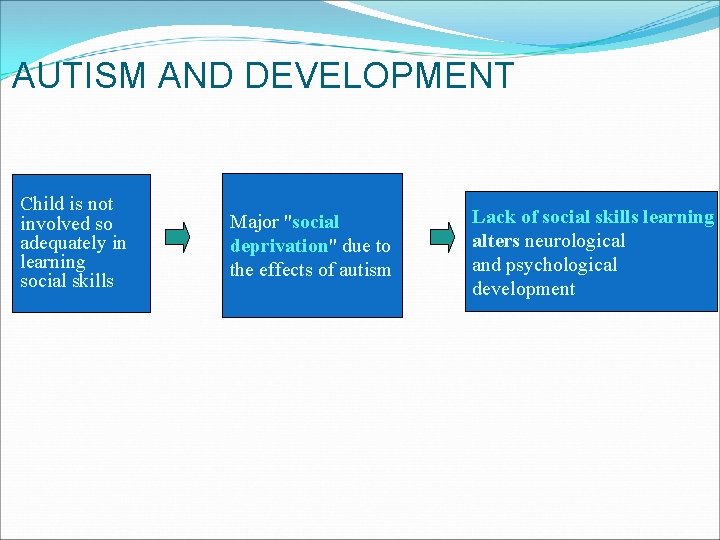
AUTISM AND DEVELOPMENT Child is not involved so adequately in learning social skills Major "social deprivation" due to the effects of autism Lack of social skills learning alters neurological and psychological development
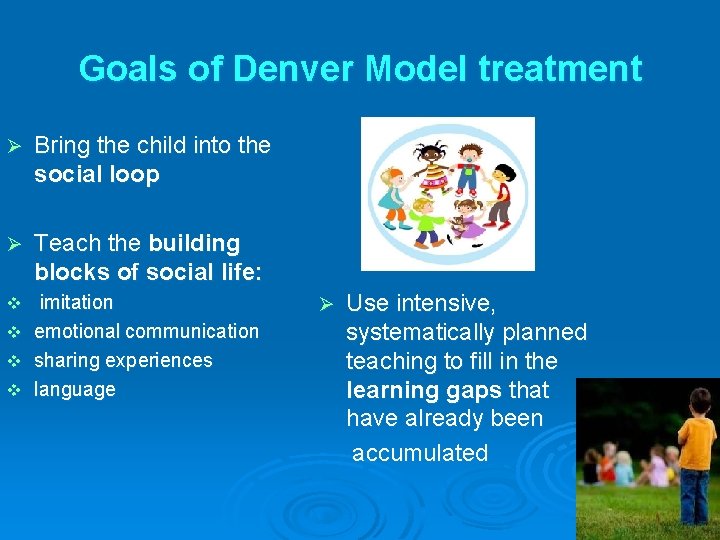
Goals of Denver Model treatment Ø Bring the child into the social loop Ø Teach the building blocks of social life: v imitation emotional communication sharing experiences language v v v Ø Use intensive, systematically planned teaching to fill in the learning gaps that have already been accumulated
Designing the intervention
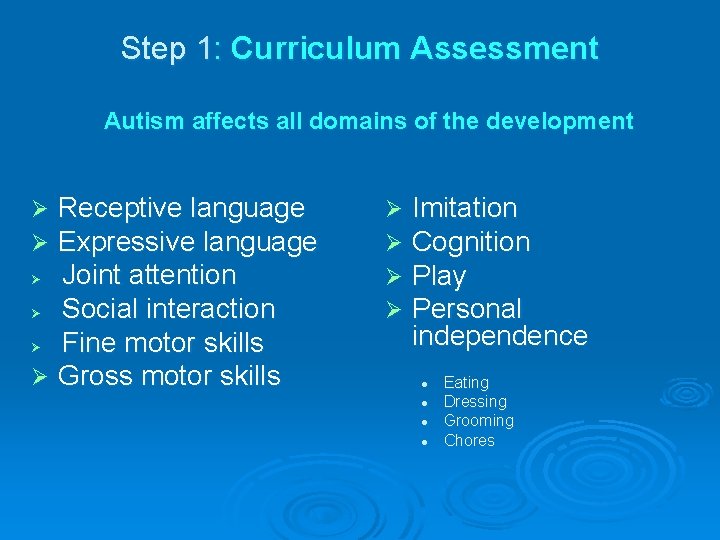
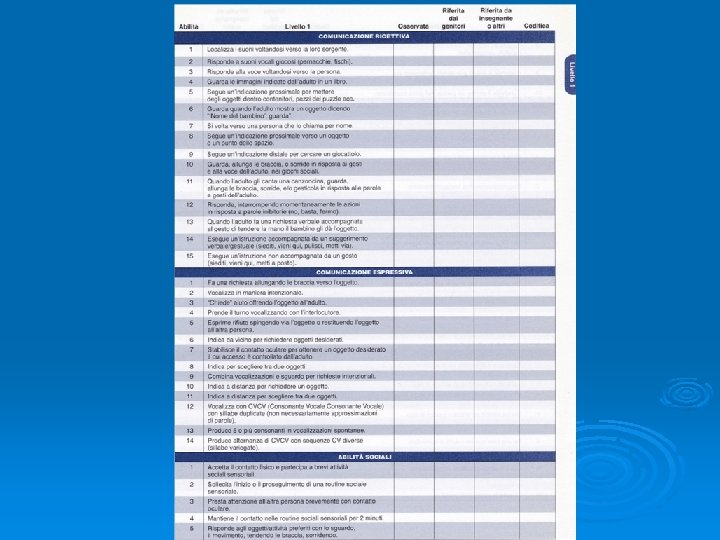
Step 1: Curriculum Assessment Autism affects all domains of the development Receptive language Expressive language Ø Joint attention Ø Social interaction Ø Fine motor skills Ø Gross motor skills Ø Ø Ø Imitation Cognition Play Personal independence l l Eating Dressing Grooming Chores
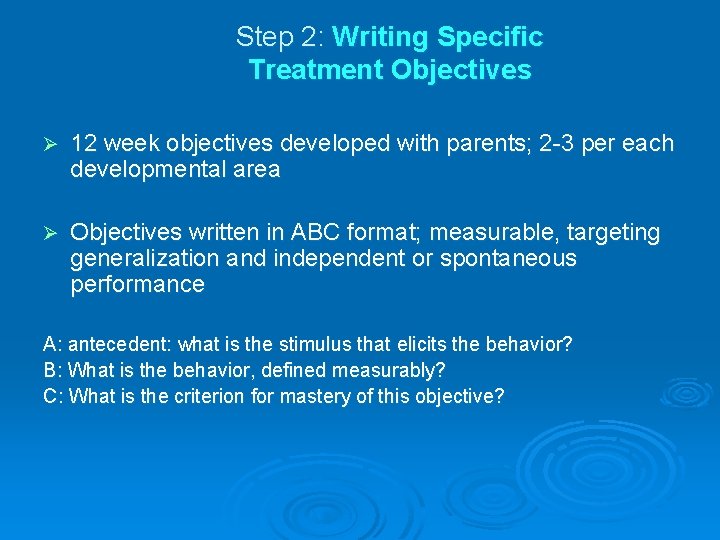
Step 2: Writing Specific Treatment Objectives Ø 12 week objectives developed with parents; 2 -3 per each developmental area Ø Objectives written in ABC format; measurable, targeting generalization and independent or spontaneous performance A: antecedent: what is the stimulus that elicits the behavior? B: What is the behavior, defined measurably? C: What is the criterion for mastery of this objective?
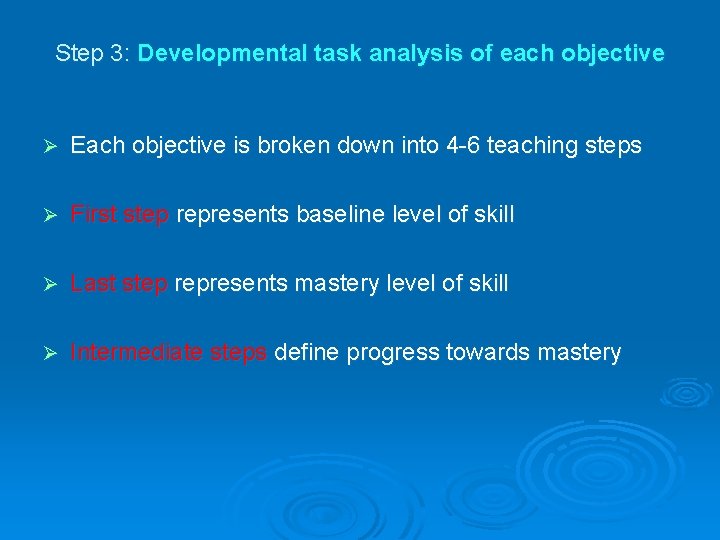
Step 3: Developmental task analysis of each objective Ø Each objective is broken down into 4 -6 teaching steps Ø First step represents baseline level of skill Ø Last step represents mastery level of skill Ø Intermediate steps define progress towards mastery
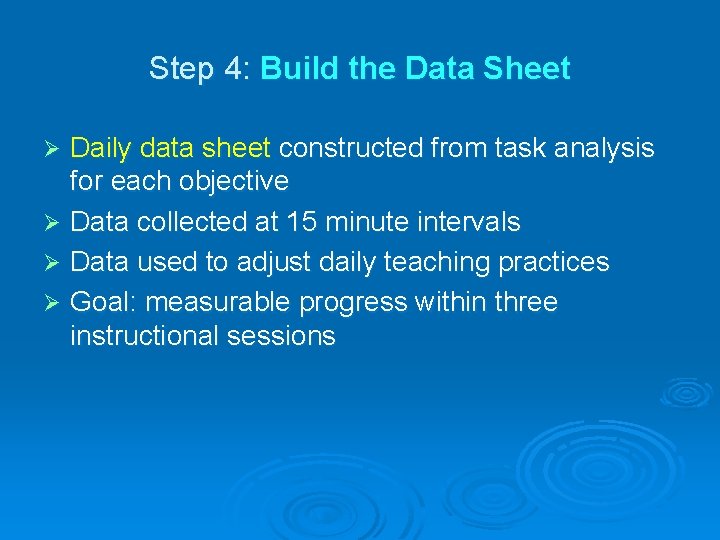
Step 4: Build the Data Sheet Daily data sheet constructed from task analysis for each objective Ø Data collected at 15 minute intervals Ø Data used to adjust daily teaching practices Ø Goal: measurable progress within three instructional sessions Ø
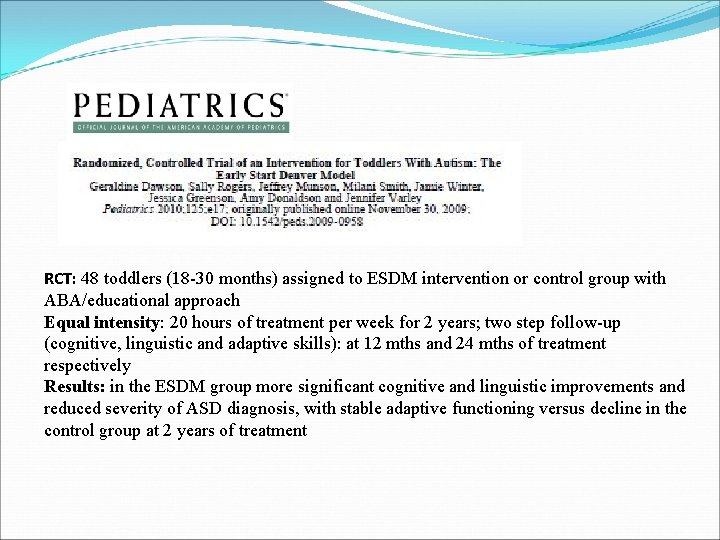
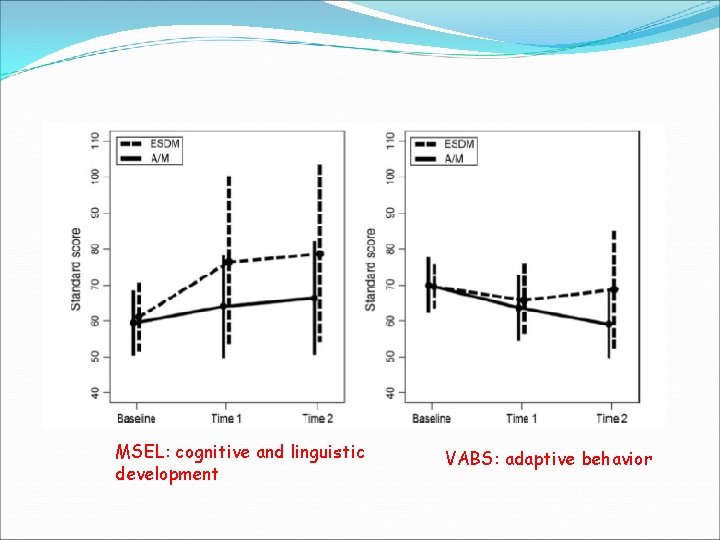
RCT: 48 toddlers (18 -30 months) assigned to ESDM intervention or control group with ABA/educational approach Equal intensity: 20 hours of treatment per week for 2 years; two step follow-up (cognitive, linguistic and adaptive skills): at 12 mths and 24 mths of treatment respectively Results: in the ESDM group more significant cognitive and linguistic improvements and reduced severity of ASD diagnosis, with stable adaptive functioning versus decline in the control group at 2 years of treatment
MSEL: cognitive and linguistic development VABS: adaptive behavior
Pilot experience gained in the Trieste and Gorizia area
Retrospective Study Sample: 35 children, 31 males and 4 females, aged 20 -36 months at the time of diagnosis, evaluated at T 0 and T 1: average duration of treatment 15 mths. Monitored parameters: • Cognitive Development • Linguistic Development • Severity of autism symptoms We have compared these same parameters to the Age and to the Developmental Quotient at the baseline
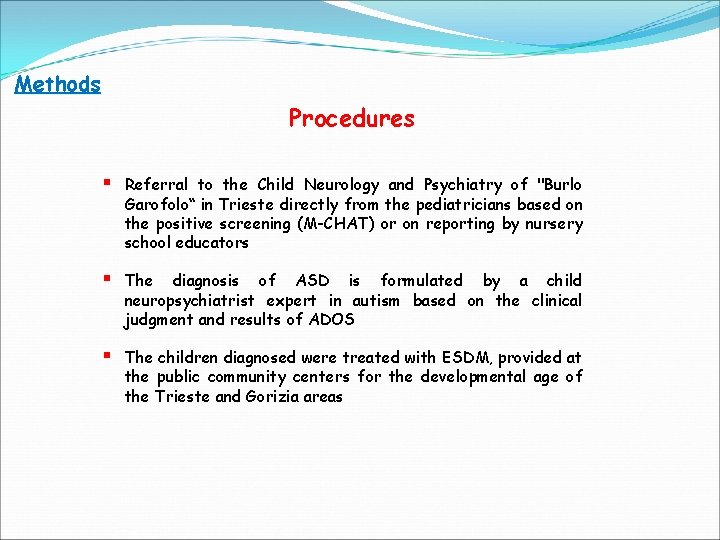
Methods Procedures § Referral to the Child Neurology and Psychiatry of "Burlo Garofolo“ in Trieste directly from the pediatricians based on the positive screening (M-CHAT) or on reporting by nursery school educators § The diagnosis of ASD is formulated by a child neuropsychiatrist expert in autism based on the clinical judgment and results of ADOS § The children diagnosed were treated with ESDM, provided at the public community centers for the developmental age of the Trieste and Gorizia areas
Methods Intervention q The intervention was provided according to the curriculum and principles of ESDM treatment q The average duration of treatment was 15 months q Intervention intensity was on average 3 -5 hours per week of 1: 1 treatment on the child's objectives, associated with approximately weekly parent-coaching sessions (implemented by the parent's direct observation of the session through the unidirectional mirror, or by a shared vision of the video recording the treatment sessions or sometimes through intervention at home). q Similarly, nursery school educators and kindergarten teachers shared the treatment objectives with monthly meetings with therapists and/or assisted directly at the sessions.
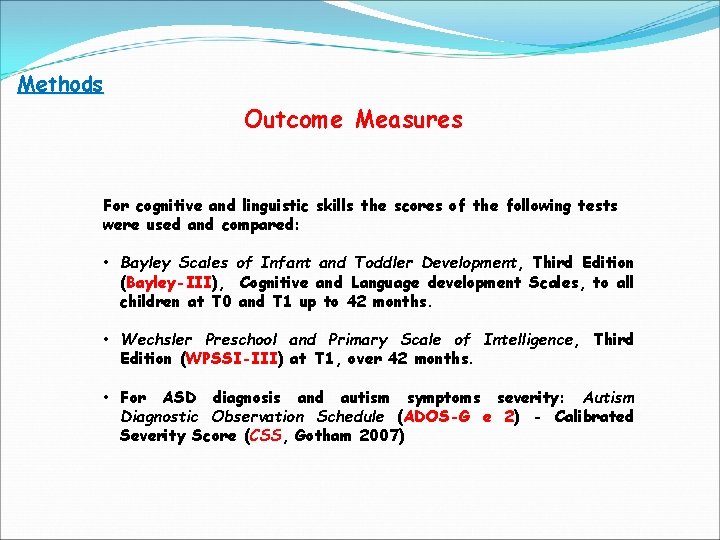
Methods Outcome Measures For cognitive and linguistic skills the scores of the following tests were used and compared: • Bayley Scales of Infant and Toddler Development, Third Edition (Bayley-III), Cognitive and Language development Scales, to all children at T 0 and T 1 up to 42 months. • Wechsler Preschool and Primary Scale of Intelligence, Third Edition (WPSSI-III) at T 1, over 42 months. • For ASD diagnosis and autism symptoms severity: Autism Diagnostic Observation Schedule (ADOS-G e 2) - Calibrated Severity Score (CSS, Gotham 2007)
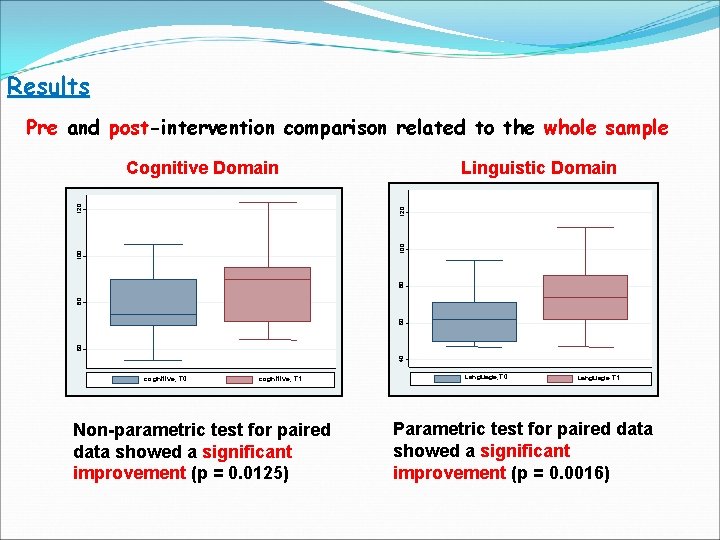
Results Pre and post-intervention comparison related to the whole sample Linguistic Domain 40 60 60 80 80 100 120 Cognitive Domain cognitive, T 0 cognitive, T 1 Non-parametric test for paired data showed a significant improvement (p = 0. 0125) Language, T 0 Language T 1 Parametric test for paired data showed a significant improvement (p = 0. 0016)
Results 0 2 4 6 8 10 Severity autism symptoms ados_pt_t 0 ados_pt_t 1 A significant reduction in ADOS-CSS is observed (p: 0. 0263).
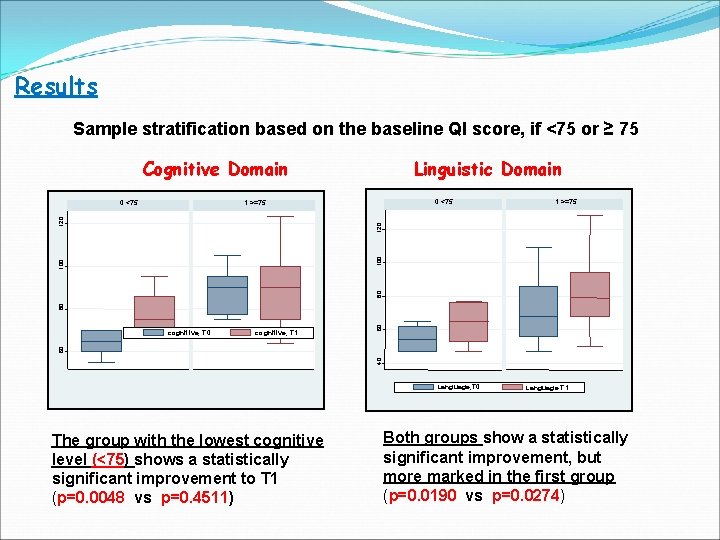
Results Sample stratification based on the baseline QI score, if <75 or ≥ 75 Cognitive Domain 0. <75 1. >=75 cognitive, T 1 40 60 cognitive, T 0 60 80 80 100 120 0. <75 Linguistic Domain Language, T 0 The group with the lowest cognitive level (<75) shows a statistically significant improvement to T 1 (p=0. 0048 vs p=0. 4511) Language T 1 Both groups show a statistically significant improvement, but more marked in the first group (p=0. 0190 vs p=0. 0274)
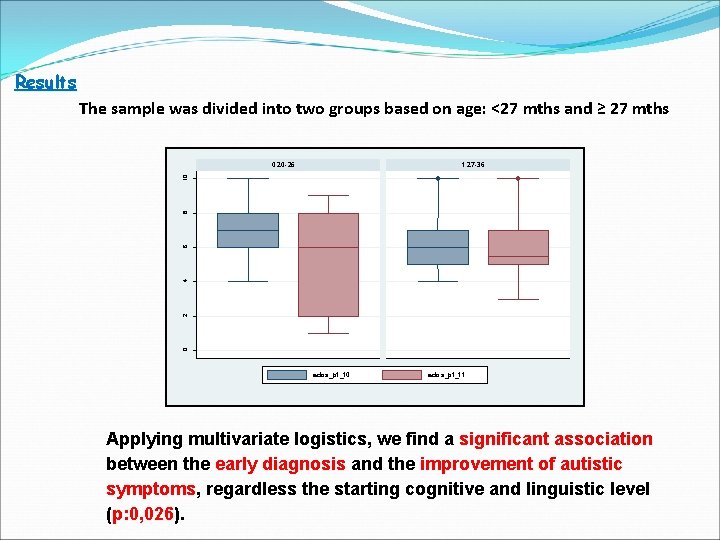
Analyzing the quantitative distribution of the data we observed that 13/19 children among those who were improved in the severity of the symptoms of autism, at the time of diagnosis had an age <27 months Diagnosis age ADOS improvement NO YES Total 20 0 3 3 21 0 3 3 22 2 1 3 24 2 2 4 26 0 4 4 27 2 1 3 28 2 0 2 30 2 1 3 31 0 1 1 33 1 0 1 34 0 2 2 35 1 0 1 36 4 1 5 Total 16 19 35
Results The sample was divided into two groups based on age: <27 mths and ≥ 27 mths 1. 27 -36 0 2 4 6 8 10 0. 20 -26 ados_pt_t 0 ados_pt_t 1 Applying multivariate logistics, we find a significant association between the early diagnosis and the improvement of autistic symptoms, regardless the starting cognitive and linguistic level (p: 0, 026).
Conclusions § Even with the limits of low treatment intensity, it is possible to obtain a significant improvement in cognitive and linguistic development in children treated with the ESDM intervention model; § The lack of a control group treated differently or even untreated requires fair prudence in attributing these results also to the physiological maturation, as well as to the effectiveness of the ESDM treatment; § However we think that the basic factors were the precocity of the intervention and the active involvement of caregivers / educators, so that the children with the lowest cognitive level at diagnosis time seem to be the ones who benefit most from the early intervention with ESDM, in terms of cognitive and linguistic gain.
Evaluation of the effectiveness of a regional program of Earl Diagnosis and ESDM treatment for autism spectrum disorders (ASD): The S. F. I. D. A. project
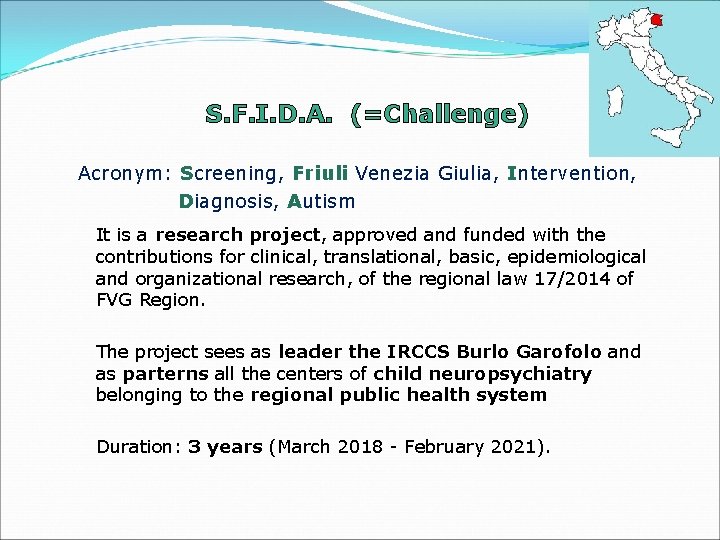
S. F. I. D. A. (=Challenge) Acronym: Screening, Friuli Venezia Giulia, Intervention, Diagnosis, Autism It is a research project, approved and funded with the contributions for clinical, translational, basic, epidemiological and organizational research, of the regional law 17/2014 of FVG Region. The project sees as leader the IRCCS Burlo Garofolo and as parterns all the centers of child neuropsychiatry belonging to the regional public health system Duration: 3 years (March 2018 - February 2021).
Where does S. F. I. D. A. come from? Ø From the approval of the «Regional Guidelines for the care pathway of autism spectrum disorders in developmental age» (DGR 434. 13 / 03/2017); Ø From the approval of ESDM training in the FVG Regional Training Plan 2016 -2018 (DGR 571/2017 with June 2017 integration), addressed to professionals operating in the Public Health Regional System.
Aims Ø To evaluate the effectiveness and feasibility of a FVG Regional Program for Autism Spectrum Disorders (DSA) based on the early diagnosis and application of ESDM model, provided as part of the Public Regional Service; Ø To achieve uniformity of paths both in the diagnostic process of the ASD and in the intervention model by all the Public Structures involved.
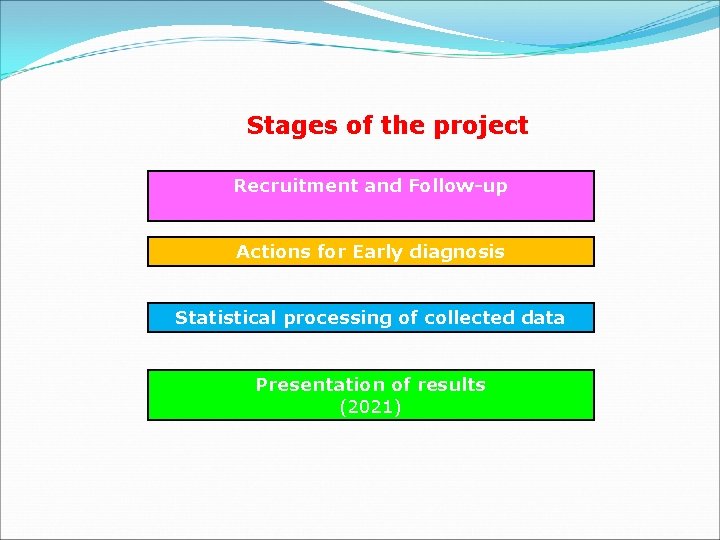
Stages of the project Recruitment and Follow-up Actions for Early diagnosis Statistical processing of collected data Presentation of results (2021)
Thanks for attention !!! and see you in Trieste in 2021….