
The Early Soviet Family in the Documents of
- Slides: 43
The Early Soviet Family in the Documents of the All-Russia Communist Party Census of 1922 Ecole des Hautes Etudes en Sciences Sociales, Paris, 11 mai 2017 Lyudmila Mazur and Oleg Gorbachev Ural Federal University, Ekaterinburg, Russia
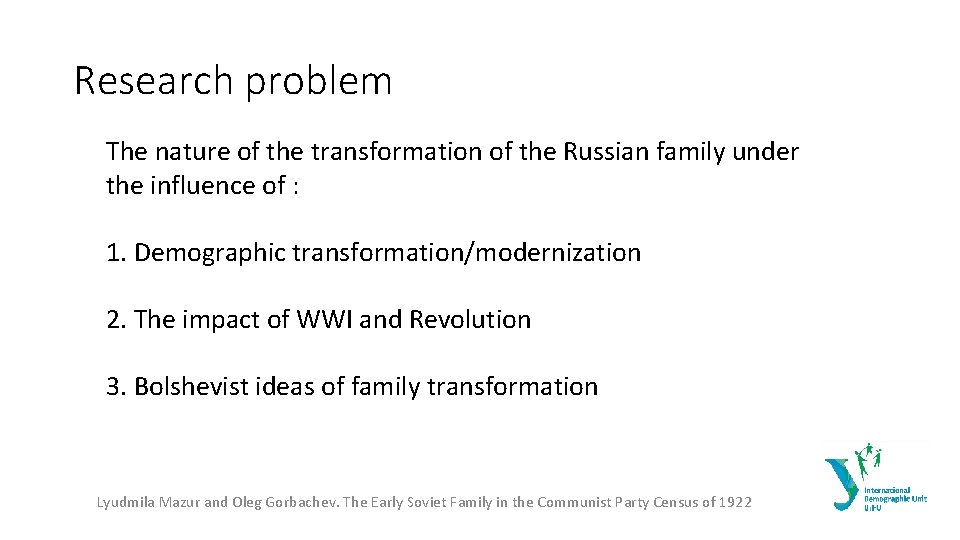
Research problem The nature of the transformation of the Russian family under the influence of : 1. Demographic transformation/modernization 2. The impact of WWI and Revolution 3. Bolshevist ideas of family transformation Lyudmila Mazur and Oleg Gorbachev. The Early Soviet Family in the Communist Party Census of 1922
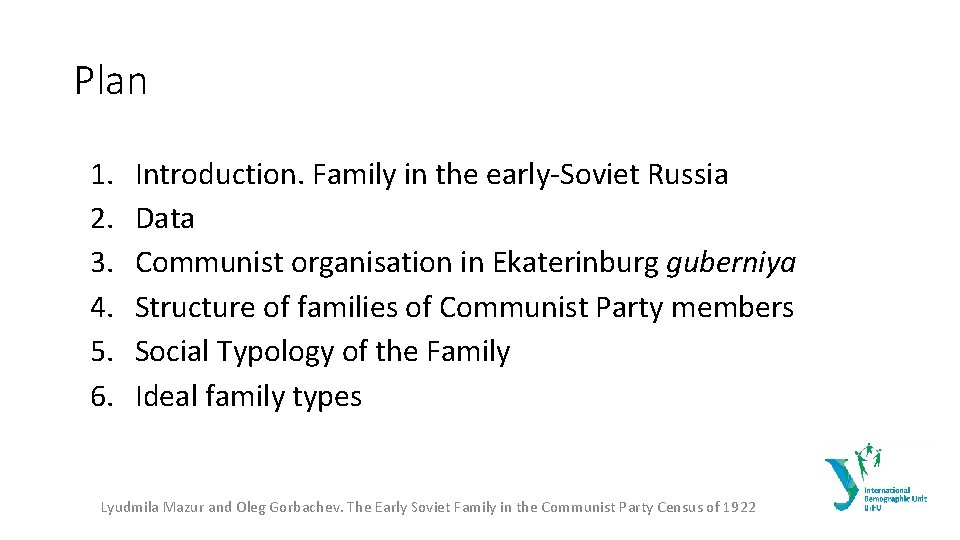
Plan 1. 2. 3. 4. 5. 6. Introduction. Family in the early-Soviet Russia Data Communist organisation in Ekaterinburg guberniya Structure of families of Communist Party members Social Typology of the Family Ideal family types Lyudmila Mazur and Oleg Gorbachev. The Early Soviet Family in the Communist Party Census of 1922
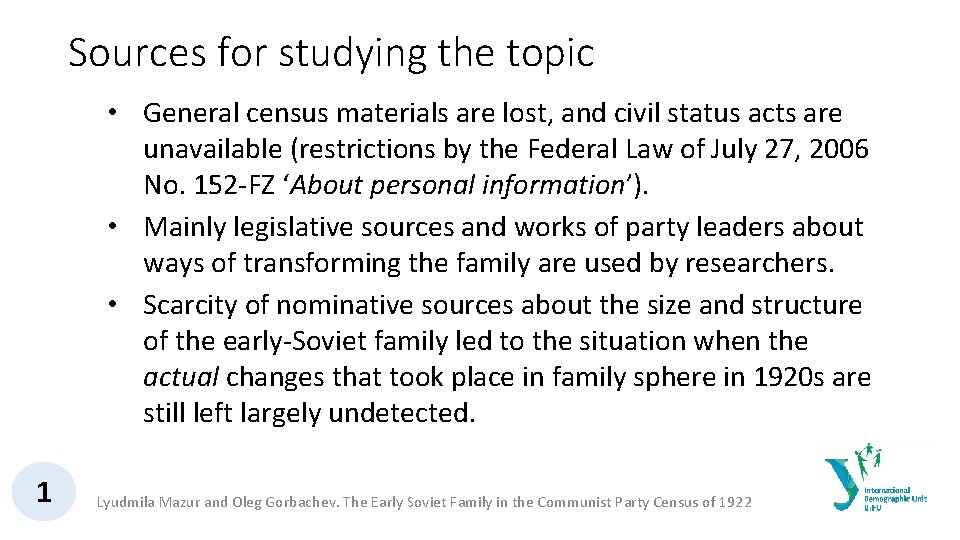
Sources for studying the topic • General census materials are lost, and civil status acts are unavailable (restrictions by the Federal Law of July 27, 2006 No. 152 -FZ ‘About personal information’). • Mainly legislative sources and works of party leaders about ways of transforming the family are used by researchers. • Scarcity of nominative sources about the size and structure of the early-Soviet family led to the situation when the actual changes that took place in family sphere in 1920 s are still left largely undetected. 1 Lyudmila Mazur and Oleg Gorbachev. The Early Soviet Family in the Communist Party Census of 1922
Sources for studying the topic • All-Russia Communist Party Census of 1922 -24 is an auxiliary nominative source. • Census materials allow us not only to reconstruct the structure of Party members' families, but also to verify whether ideological factors in fact did influence the demographic transformation of family life under the Soviet rule. 1 Lyudmila Mazur and Oleg Gorbachev. The Early Soviet Family in the Communist Party Census of 1922
Studying Soviet family policy and transformations of Soviet family Russian sociologists and demographers: Anatoly G. Kharchev, Anatoly G. Vishnevsky, Sergey N. Gavrov, Andrey G. Volkov, etc. Recent gender and family research: Alla I. Chernykh, Barbara Ranes, Lynne Attwood, Becky L. Glass, Katy Turton, Lauren Kaminsky, Margaret K. Stolee, Wendy Z. Goldman, Yanina A. Shapovalova… 1 Lyudmila Mazur and Oleg Gorbachev. The Early Soviet Family in the Communist Party Census of 1922
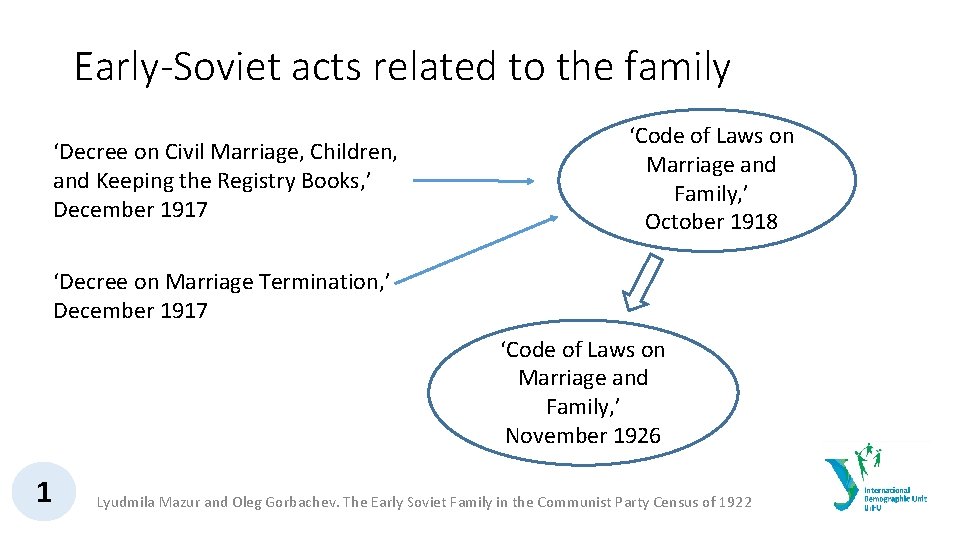
Early-Soviet acts related to the family ‘Decree on Civil Marriage, Children, and Keeping the Registry Books, ’ December 1917 ‘Code of Laws on Marriage and Family, ’ October 1918 ‘Decree on Marriage Termination, ’ December 1917 ‘Code of Laws on Marriage and Family, ’ November 1926 1 Lyudmila Mazur and Oleg Gorbachev. The Early Soviet Family in the Communist Party Census of 1922
Making the new family • Active interference of the state with the family sphere, attempts to regulate not only the marriage itself, but also the mode of life, childhood, old age and so on • Aspirations for the ‘socialization’ of the family sphere (Alexandra Kollontai, Vladimir Lenin) 1 Lyudmila Mazur and Oleg Gorbachev. The Early Soviet Family in the Communist Party Census of 1922
Soviet family: steps of evolution 1920 s: ‘bourgeois’ family as ‘the relic of the past’; 'the family was mostly renounced as a figure which did not fit into the Bolsheviks' concept of socialization of the national economy’ (Anatoly G. Kharchev) 1930 s: the turn to traditional values, restoring of the old patriarchal intra-familial relationships Late 1930 s: a new reference family model, in which all adult members were supposed to work. The main function of this family was to create conditions for the reproduction of the workforce 1960 s: 'the old traditional family was replaced by a sufficiently stable nuclear family of the urban type’ (Anatoly G. Vishnevsky) 1 Lyudmila Mazur and Oleg Gorbachev. The Early Soviet Family in the Communist Party Census of 1922
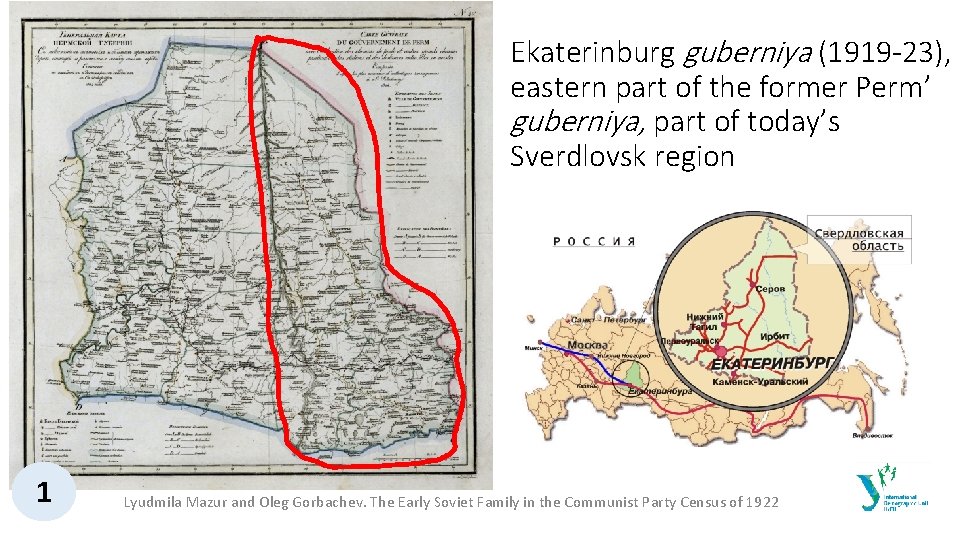
Ekaterinburg guberniya (1919 -23), eastern part of the former Perm’ guberniya, part of today’s Sverdlovsk region 1 Lyudmila Mazur and Oleg Gorbachev. The Early Soviet Family in the Communist Party Census of 1922
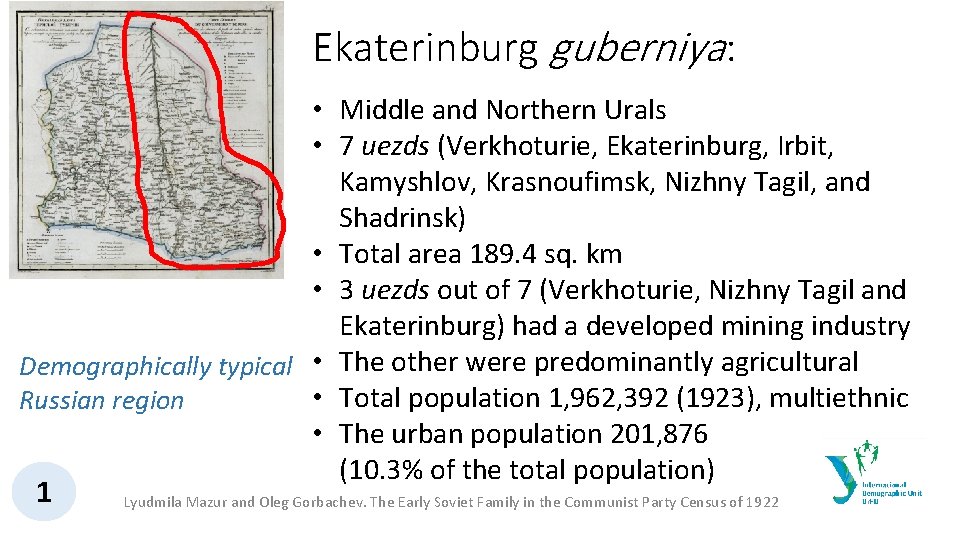
Ekaterinburg guberniya: • Middle and Northern Urals • 7 uezds (Verkhoturie, Ekaterinburg, Irbit, Kamyshlov, Krasnoufimsk, Nizhny Tagil, and Shadrinsk) • Total area 189. 4 sq. km • 3 uezds out of 7 (Verkhoturie, Nizhny Tagil and Ekaterinburg) had a developed mining industry Demographically typical • The other were predominantly agricultural • Total population 1, 962, 392 (1923), multiethnic Russian region • The urban population 201, 876 (10. 3% of the total population) 1 Lyudmila Mazur and Oleg Gorbachev. The Early Soviet Family in the Communist Party Census of 1922
Census • The All-Russia Communist Party Census was conducted in 1922 -24 (2 stages: 1922 – basic; 1924 – additional, ‘Lenin’s Call’) • Purposes: Party cards replacement and purge of Party ranks • By 1923 there remained 373, 000 members out of approximately 700, 000 in 1921 • The majority of those excluded were peasants (44. 8 %) and whitecollar workers (23. 8 %) • In Ekaterinburg guberniya the CP census embraced 12, 038 Communists, representing 0, 66% of the whole region’s population 2 Lyudmila Mazur and Oleg Gorbachev. The Early Soviet Family in the Communist Party Census of 1922
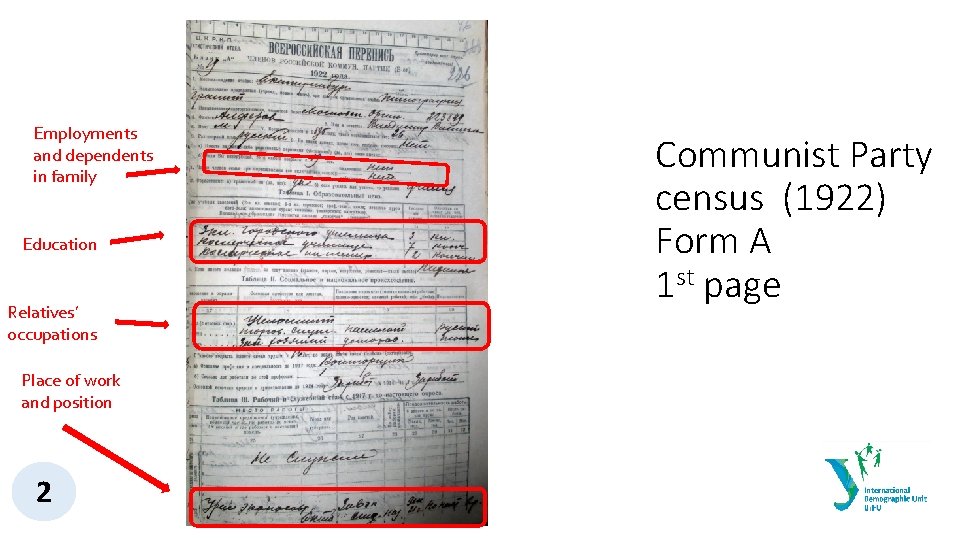
Employments and dependents in family Education Relatives’ occupations Place of work and position 2 Communist Party census (1922) Form A 1 st page
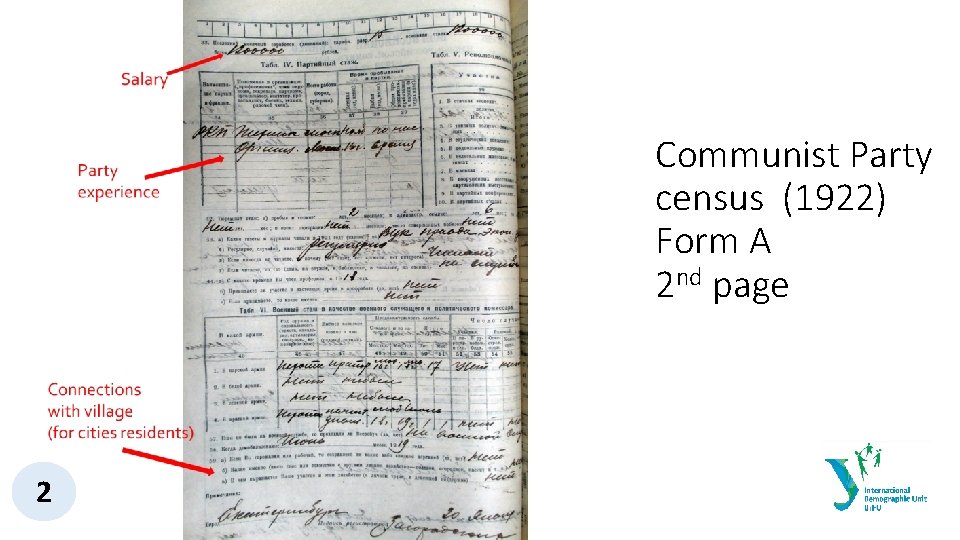
Communist Party census (1922) Form A 2 nd page 2
The opportunities CP census gives: 2 1) analyzing size and structure of CP member’s family; 2) characteristics of consumption-labor family balance taking into account social and professional characteristics of its members; 3) considering transition process from a traditional family to modernized one and options of new family models, which were traced in the 1920 s; 4) together with other social characteristics (education, occupations, age, social origin, participation in revolutionary activity and so forth), it is possible to follow communists’ families strategies and their behavior. Lyudmila Mazur and Oleg Gorbachev. The Early Soviet Family in the Communist Party Census of 1922
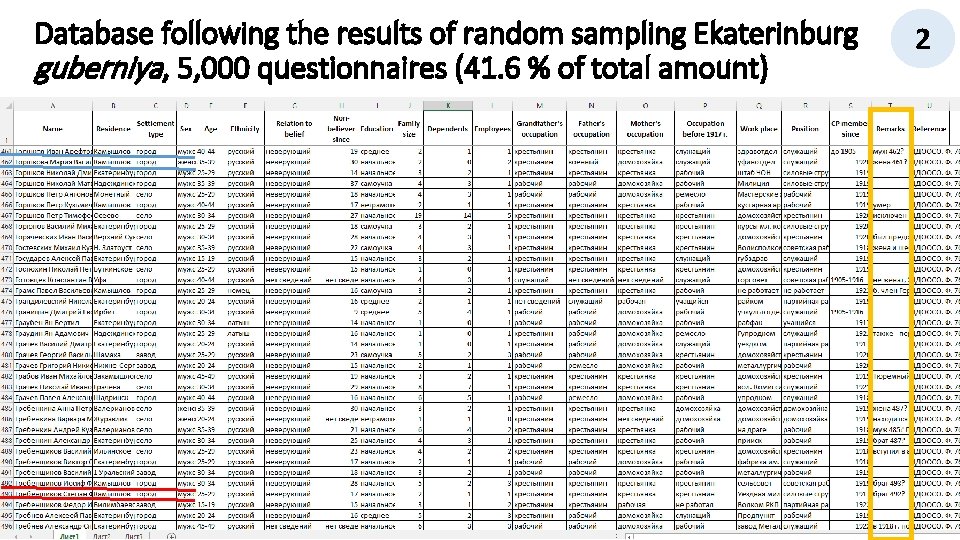
Databases • 1) Basic – 517 forms (3. 5 % Party members) • 2) Master (enhanced) – 5, 000 forms (41. 6 % Party members) • 3) Purposive sampling: choosing the forms with detailed information (254 forms) 2 Lyudmila Mazur and Oleg Gorbachev. The Early Soviet Family in the Communist Party Census of 1922
Database following the results of random sampling Ekaterinburg guberniya, 5, 000 questionnaires (41. 6 % of total amount) Lyudmila Mazur and Oleg Gorbachev. The Early Soviet Family in the Communist Party Census of 1922 2
Methodology • The necessity of applying the typology method, which makes it possible to reveal the variety of the phenomenon under study (ie, the family) • Cluster analysis, typology grouping City - countryside and social groups distributions 2 Lyudmila Mazur and Oleg Gorbachev. The Early Soviet Family in the Communist Party Census of 1922
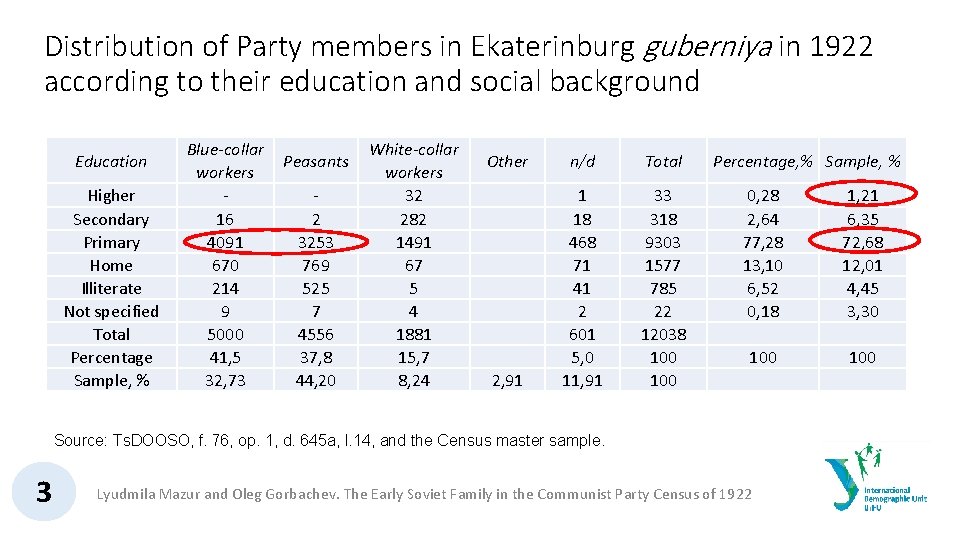
Distribution of Party members in Ekaterinburg guberniya in 1922 according to their education and social background Education Higher Secondary Primary Home Illiterate Not specified Total Percentage Sample, % Blue-collar workers 16 4091 670 214 9 5000 41, 5 32, 73 Peasants 2 3253 769 525 7 4556 37, 8 44, 20 White-collar workers 32 282 1491 67 5 4 1881 15, 7 8, 24 Other n/d Total 2, 91 1 18 468 71 41 2 601 5, 0 11, 91 33 318 9303 1577 785 22 12038 100 Percentage, % Sample, % 0, 28 2, 64 77, 28 13, 10 6, 52 0, 18 1, 21 6, 35 72, 68 12, 01 4, 45 3, 30 100 Source: Ts. DOOSO, f. 76, op. 1, d. 645 а, l. 14, and the Census master sample. 3 Lyudmila Mazur and Oleg Gorbachev. The Early Soviet Family in the Communist Party Census of 1922
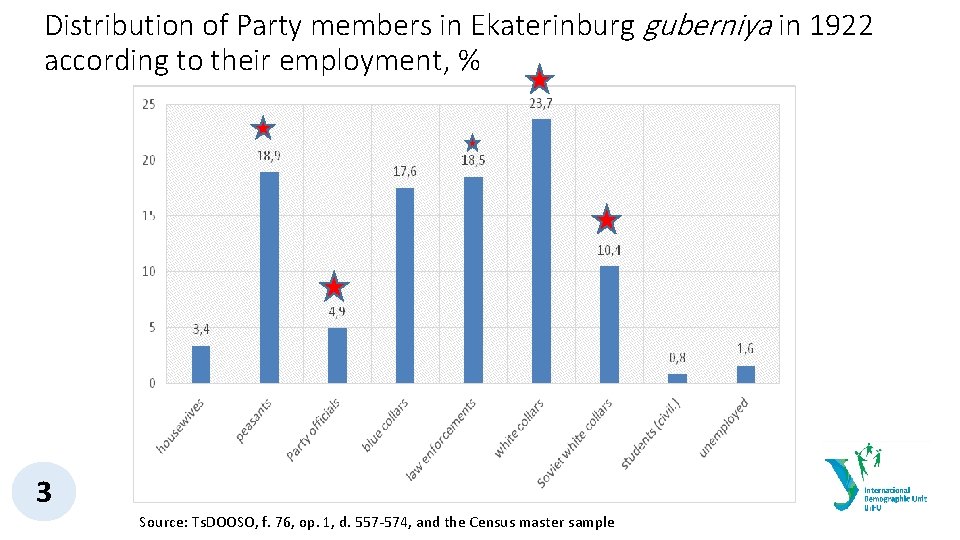
Distribution of Party members in Ekaterinburg guberniya in 1922 according to their employment, % 3 Source: Ts. DOOSO, f. 76, op. 1, d. 557 -574, and the Census master sample
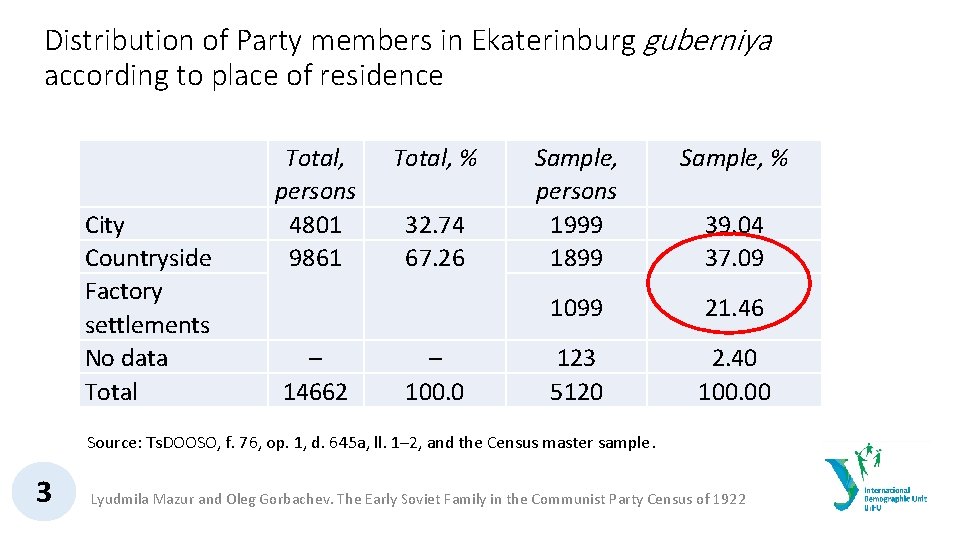
Distribution of Party members in Ekaterinburg guberniya according to place of residence City Countryside Factory settlements No data Total, persons 4801 9861 – 14662 Total, % 32. 74 67. 26 – 100. 0 Sample, persons 1999 1899 Sample, % 1099 21. 46 123 5120 2. 40 100. 00 39. 04 37. 09 Source: Ts. DOOSO, f. 76, op. 1, d. 645 а, ll. 1– 2, and the Census master sample. 3 Lyudmila Mazur and Oleg Gorbachev. The Early Soviet Family in the Communist Party Census of 1922
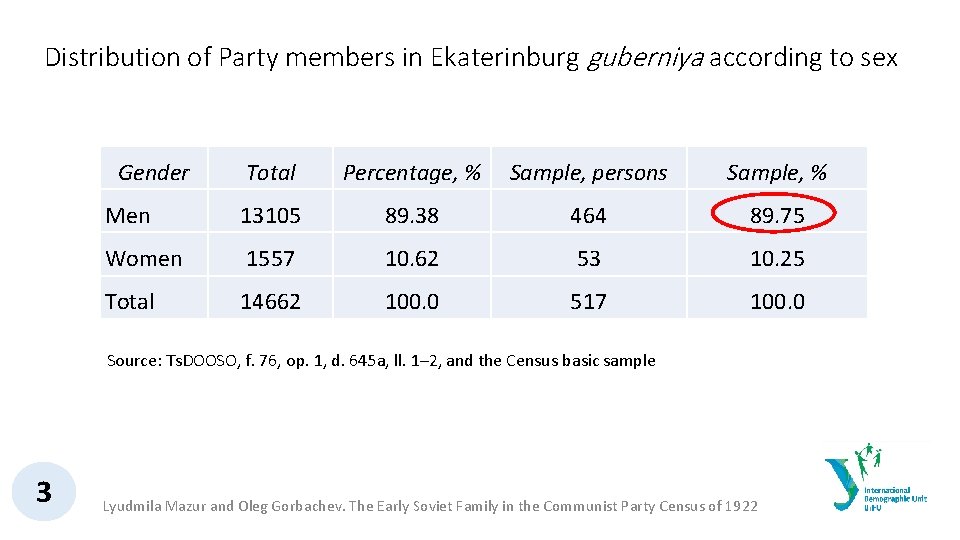
Distribution of Party members in Ekaterinburg guberniya according to sex Gender Total Percentage, % Sample, persons Sample, % Men 13105 89. 38 464 89. 75 Women 1557 10. 62 53 10. 25 Total 14662 100. 0 517 100. 0 Source: Ts. DOOSO, f. 76, op. 1, d. 645 а, ll. 1– 2, and the Census basic sample 3 Lyudmila Mazur and Oleg Gorbachev. The Early Soviet Family in the Communist Party Census of 1922
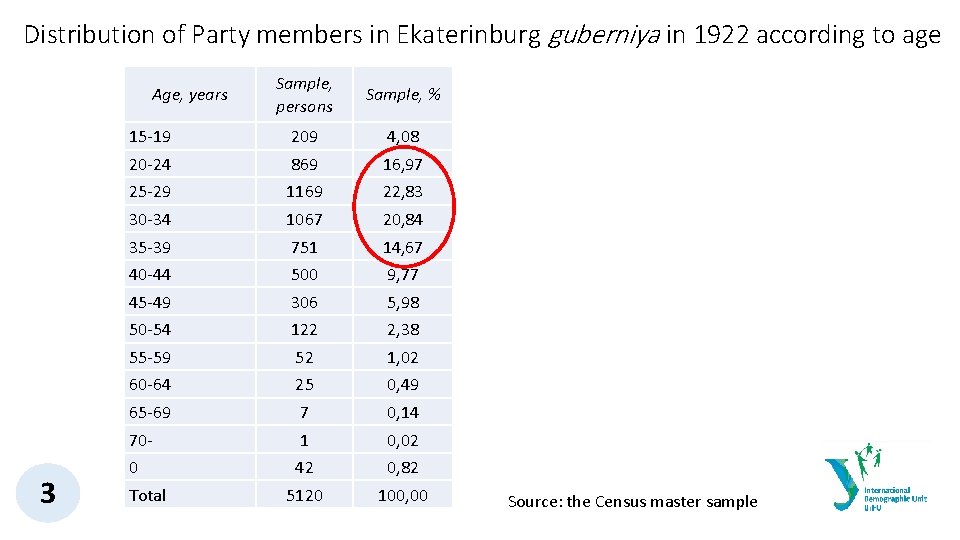
Distribution of Party members in Ekaterinburg guberniya in 1922 according to age Sample, persons Sample, % 15 -19 209 4, 08 20 -24 869 16, 97 25 -29 1169 22, 83 30 -34 1067 20, 84 35 -39 751 14, 67 40 -44 500 9, 77 45 -49 306 5, 98 50 -54 122 2, 38 55 -59 52 1, 02 60 -64 25 0, 49 65 -69 7 0, 14 70 - 1 0, 02 0 42 0, 82 5120 100, 00 Age, years 3 Total Source: the Census master sample
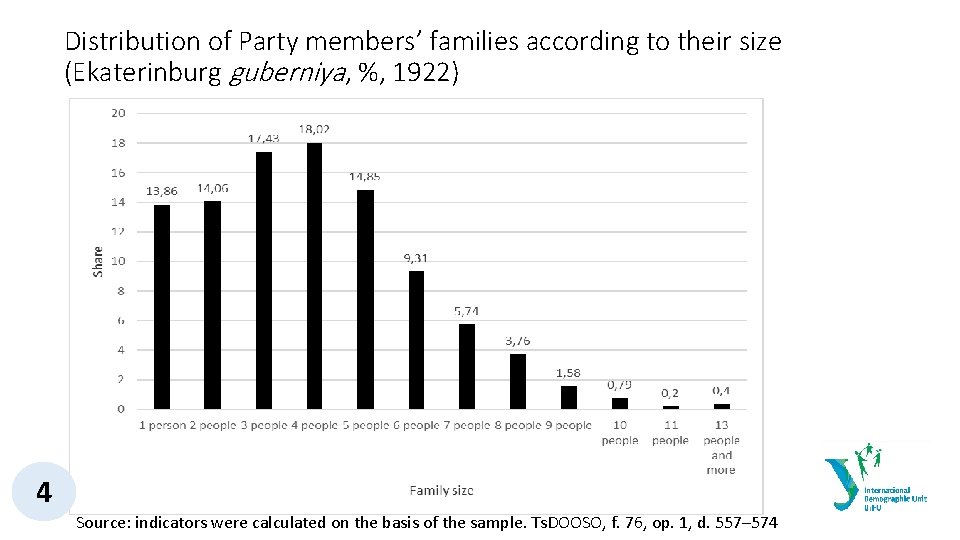
Distribution of Party members’ families according to their size (Ekaterinburg guberniya, %, 1922) 4 Source: indicators were calculated on the basis of the sample. Ts. DOOSO, f. 76, op. 1, d. 557– 574
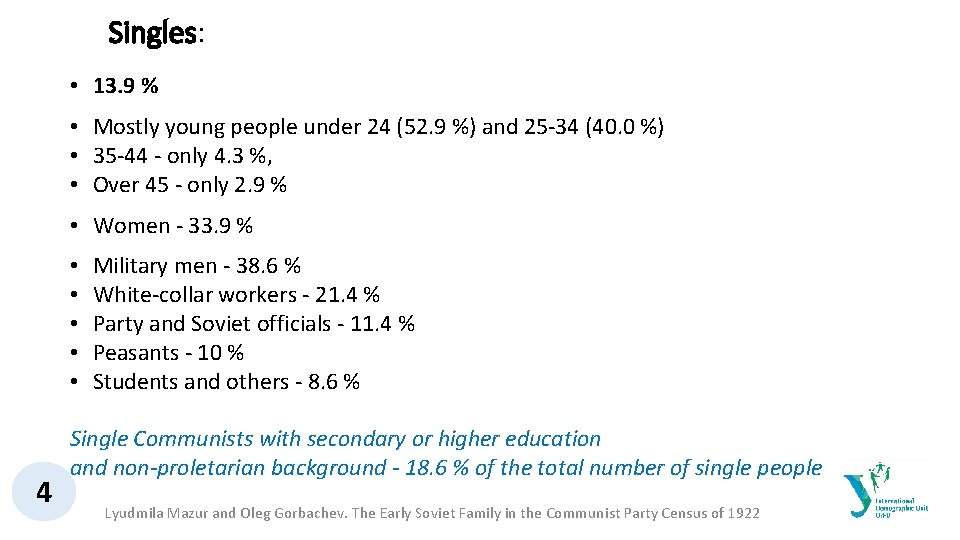
Singles: • 13. 9 % • Mostly young people under 24 (52. 9 %) and 25 -34 (40. 0 %) • 35 -44 - only 4. 3 %, • Over 45 - only 2. 9 % • Women - 33. 9 % • • • 4 Military men - 38. 6 % White-collar workers - 21. 4 % Party and Soviet officials - 11. 4 % Peasants - 10 % Students and others - 8. 6 % Single Communists with secondary or higher education and non-proletarian background - 18. 6 % of the total number of single people Lyudmila Mazur and Oleg Gorbachev. The Early Soviet Family in the Communist Party Census of 1922
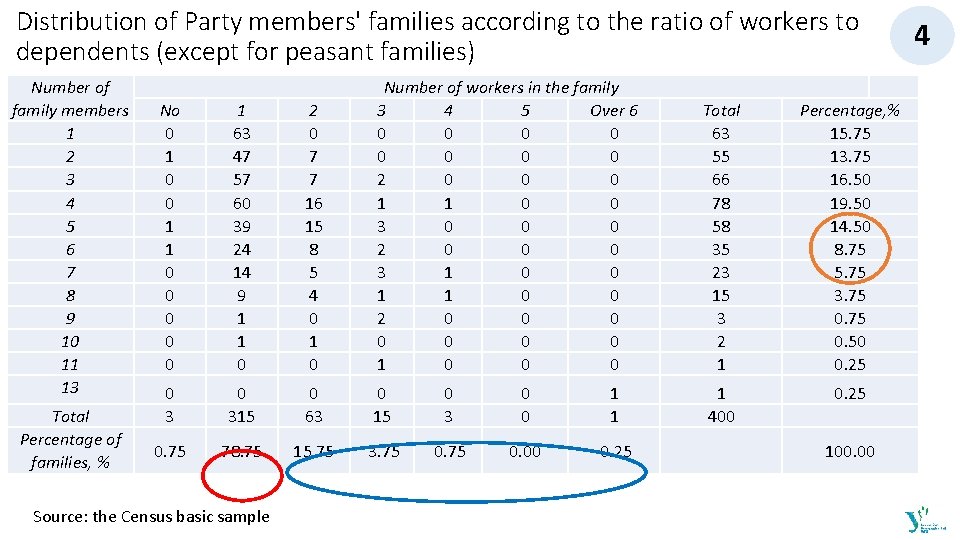
Distribution of Party members' families according to the ratio of workers to dependents (except for peasant families) Number of family members 1 2 3 4 5 6 7 8 9 10 11 13 Total Percentage of families, % No 0 1 0 0 1 1 0 0 0 1 63 47 57 60 39 24 14 9 1 1 0 2 0 7 7 16 15 8 5 4 0 1 0 Number of workers in the family 3 4 5 Over 6 0 0 0 0 2 0 0 0 1 1 0 0 3 0 0 0 2 0 0 0 3 1 0 0 1 1 0 0 2 0 0 0 0 1 0 0 3 0 315 0 63 0 15 0 3 0 0 1 1 0. 75 78. 75 15. 75 3. 75 0. 00 0. 25 Source: the Census basic sample Total 63 55 66 78 58 35 23 15 3 2 1 Percentage, % 15. 75 13. 75 16. 50 19. 50 14. 50 8. 75 5. 75 3. 75 0. 50 0. 25 1 400 0. 25 100. 00 4
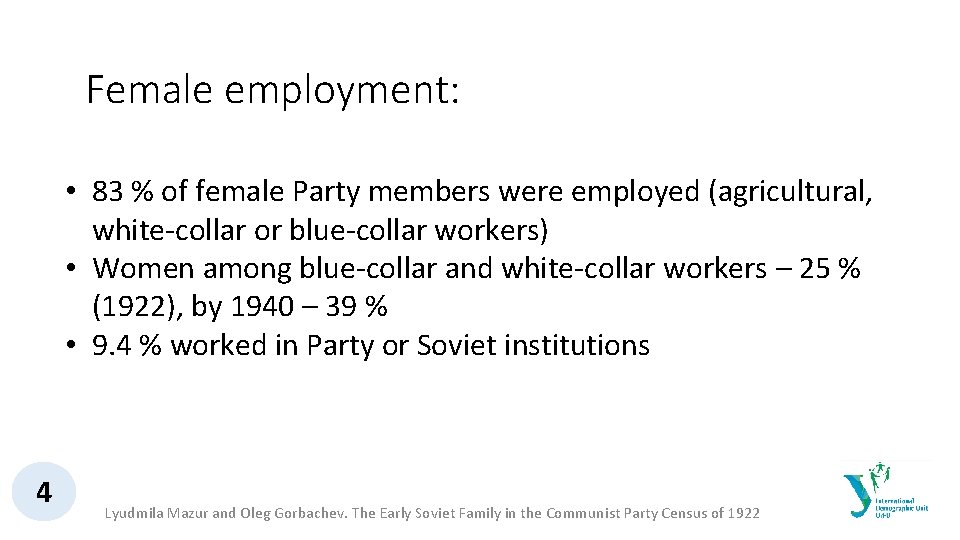
Female employment: • 83 % of female Party members were employed (agricultural, white-collar or blue-collar workers) • Women among blue-collar and white-collar workers – 25 % (1922), by 1940 – 39 % • 9. 4 % worked in Party or Soviet institutions 4 Lyudmila Mazur and Oleg Gorbachev. The Early Soviet Family in the Communist Party Census of 1922
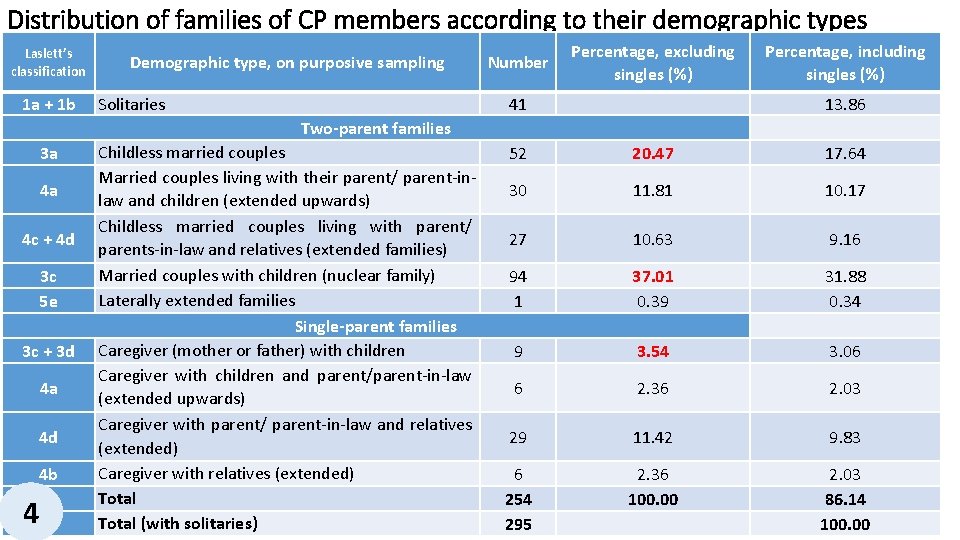
Distribution of families of CP members according to their demographic types Laslett’s classification 1 a + 1 b Demographic type, on purposive sampling Solitaries Number Percentage, excluding singles (%) 41 Percentage, including singles (%) 13. 86 Two-parent families 3 а 4 а 4 c + 4 d 3 c 5 e 3 c + 3 d 4 a 4 d 4 b 4 Childless married couples Married couples living with their parent/ parent-inlaw and children (extended upwards) Childless married couples living with parent/ parents-in-law and relatives (extended families) Married couples with children (nuclear family) Laterally extended families Single-parent families Caregiver (mother or father) with children Caregiver with children and parent/parent-in-law (extended upwards) Caregiver with parent/ parent-in-law and relatives (extended) Caregiver with relatives (extended) Total (with solitaries) 52 20. 47 17. 64 30 11. 81 10. 17 27 10. 63 9. 16 94 1 37. 01 0. 39 31. 88 0. 34 9 3. 54 3. 06 6 2. 36 2. 03 29 11. 42 9. 83 6 254 295 2. 36 100. 00 2. 03 86. 14 100. 00
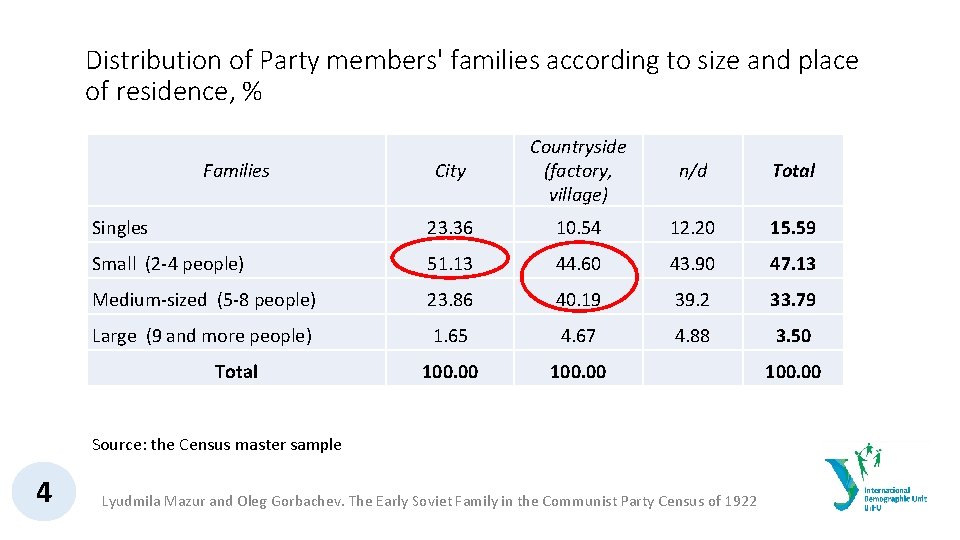
Distribution of Party members' families according to size and place of residence, % City Countryside (factory, village) n/d Total Singles 23. 36 10. 54 12. 20 15. 59 Small (2 -4 people) 51. 13 44. 60 43. 90 47. 13 Medium-sized (5 -8 people) 23. 86 40. 19 39. 2 33. 79 Large (9 and more people) 1. 65 4. 67 4. 88 3. 50 100. 00 Families Total Source: the Census master sample 4 Lyudmila Mazur and Oleg Gorbachev. The Early Soviet Family in the Communist Party Census of 1922 100. 00
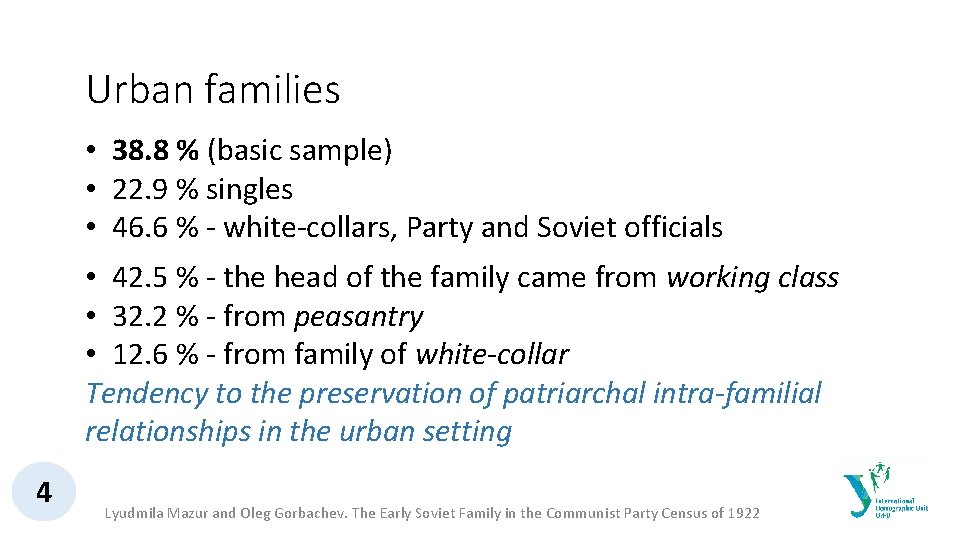
Urban families • 38. 8 % (basic sample) • 22. 9 % singles • 46. 6 % - white-collars, Party and Soviet officials • 42. 5 % - the head of the family came from working class • 32. 2 % - from peasantry • 12. 6 % - from family of white-collar Tendency to the preservation of patriarchal intra-familial relationships in the urban setting 4 Lyudmila Mazur and Oleg Gorbachev. The Early Soviet Family in the Communist Party Census of 1922
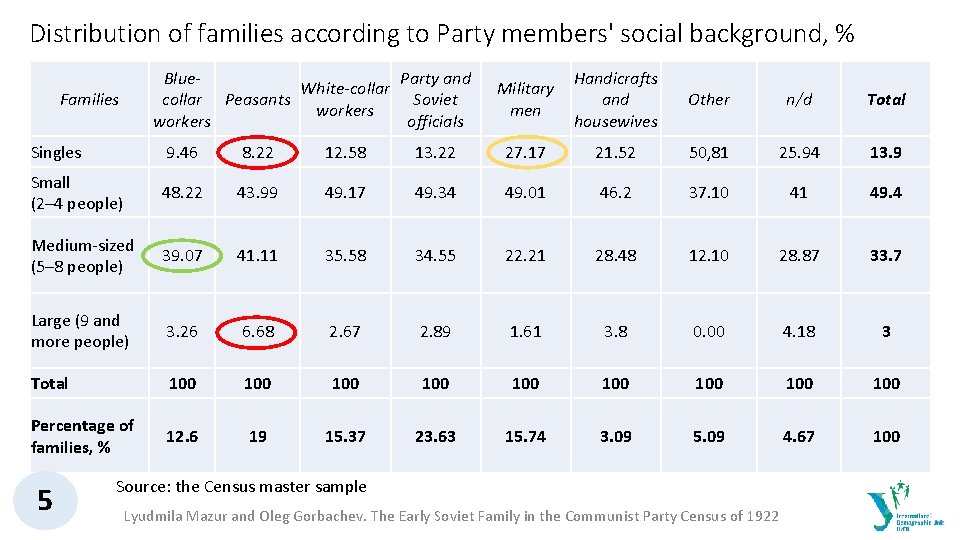
Distribution of families according to Party members' social background, % Blue. Party and White-collar Peasants Soviet workers officials Families Military men Handicrafts and housewives Other n/d Total Singles 9. 46 8. 22 12. 58 13. 22 27. 17 21. 52 50, 81 25. 94 13. 9 Small (2– 4 people) 48. 22 43. 99 49. 17 49. 34 49. 01 46. 2 37. 10 41 49. 4 Medium-sized (5– 8 people) 39. 07 41. 11 35. 58 34. 55 22. 21 28. 48 12. 10 28. 87 33. 7 Large (9 and more people) 3. 26 6. 68 2. 67 2. 89 1. 61 3. 8 0. 00 4. 18 3 Total 100 100 100 Percentage of families, % 12. 6 19 15. 37 23. 63 15. 74 3. 09 5. 09 4. 67 100 5 Source: the Census master sample Lyudmila Mazur and Oleg Gorbachev. The Early Soviet Family in the Communist Party Census of 1922
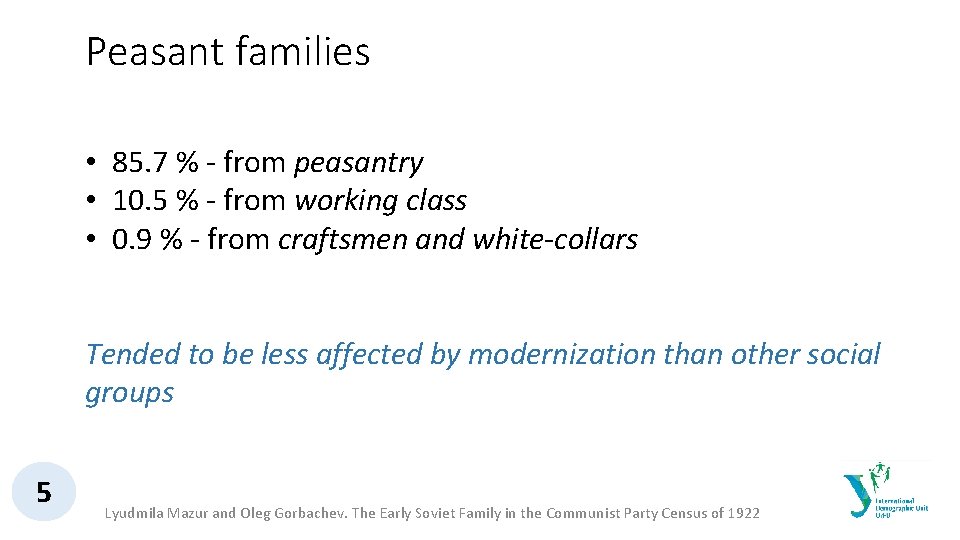
Peasant families • 85. 7 % - from peasantry • 10. 5 % - from working class • 0. 9 % - from craftsmen and white-collars Tended to be less affected by modernization than other social groups 5 Lyudmila Mazur and Oleg Gorbachev. The Early Soviet Family in the Communist Party Census of 1922
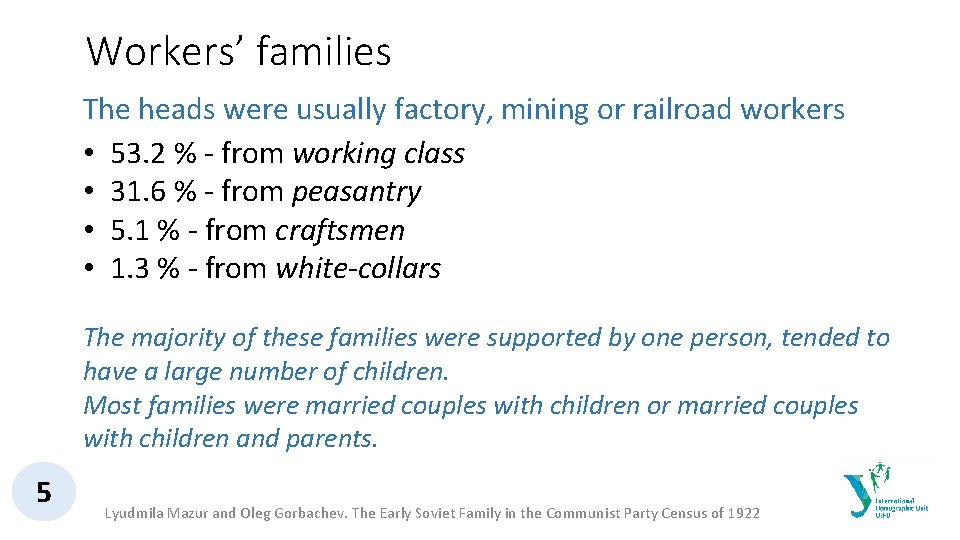
Workers’ families The heads were usually factory, mining or railroad workers • 53. 2 % - from working class • 31. 6 % - from peasantry • 5. 1 % - from craftsmen • 1. 3 % - from white-collars The majority of these families were supported by one person, tended to have a large number of children. Most families were married couples with children or married couples with children and parents. 5 Lyudmila Mazur and Oleg Gorbachev. The Early Soviet Family in the Communist Party Census of 1922
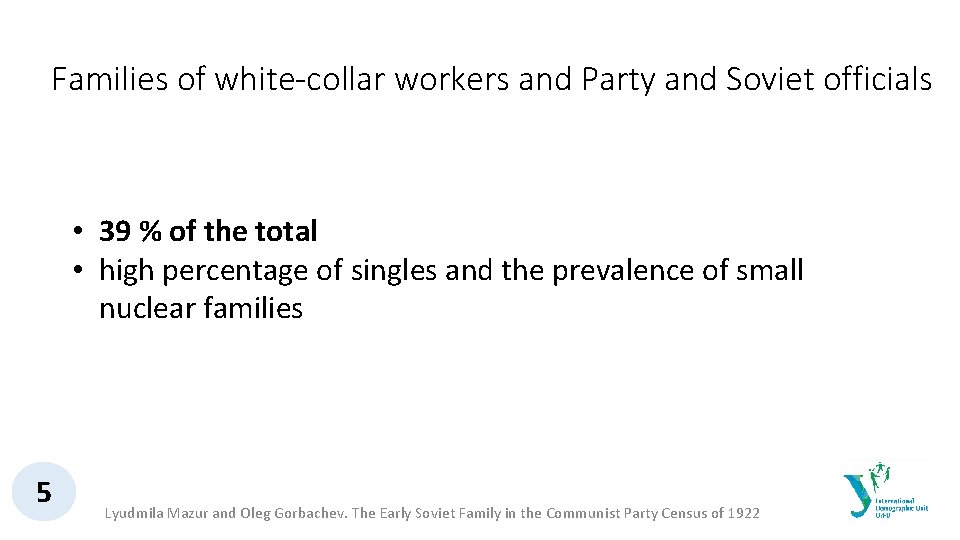
Families of white-collar workers and Party and Soviet officials • 39 % of the total • high percentage of singles and the prevalence of small nuclear families 5 Lyudmila Mazur and Oleg Gorbachev. The Early Soviet Family in the Communist Party Census of 1922
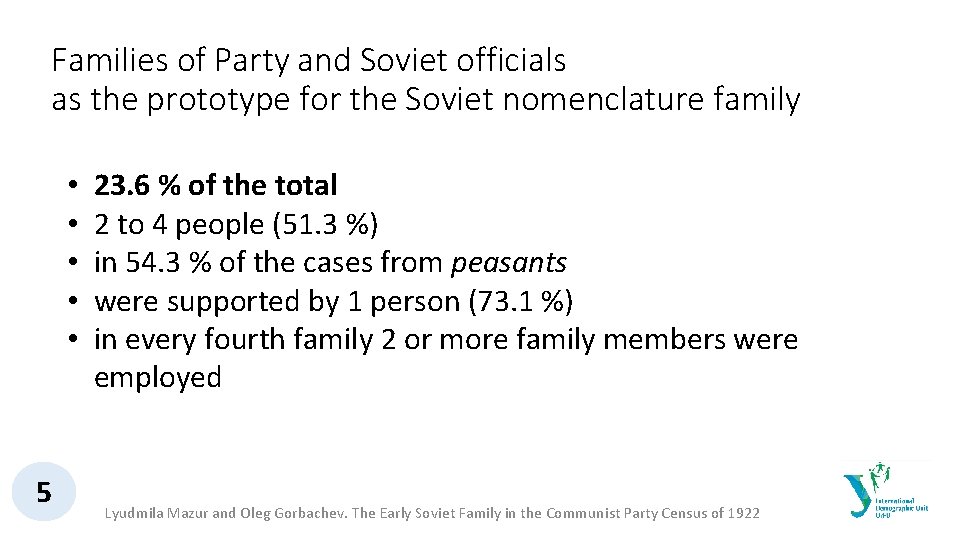
Families of Party and Soviet officials as the prototype for the Soviet nomenclature family • • • 5 23. 6 % of the total 2 to 4 people (51. 3 %) in 54. 3 % of the cases from peasants were supported by 1 person (73. 1 %) in every fourth family 2 or more family members were employed Lyudmila Mazur and Oleg Gorbachev. The Early Soviet Family in the Communist Party Census of 1922
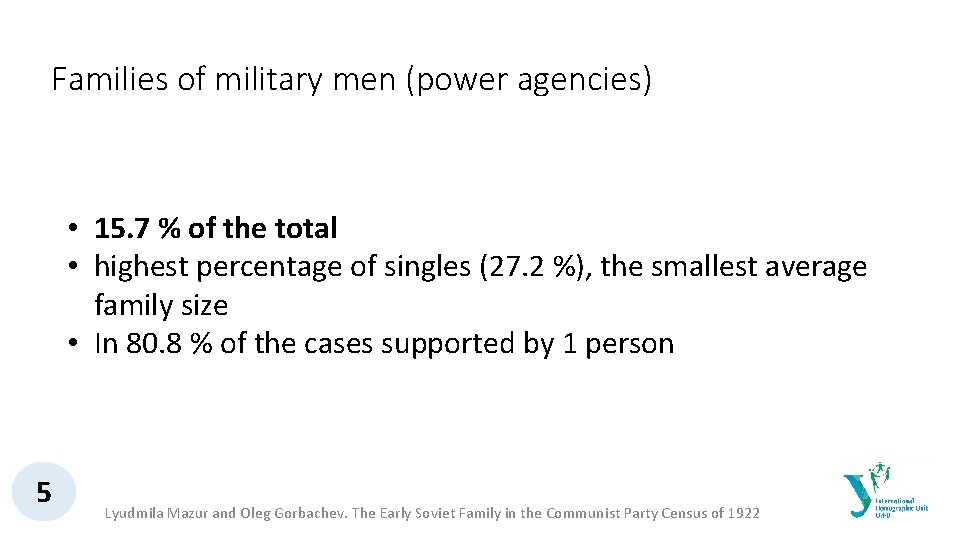
Families of military men (power agencies) • 15. 7 % of the total • highest percentage of singles (27. 2 %), the smallest average family size • In 80. 8 % of the cases supported by 1 person 5 Lyudmila Mazur and Oleg Gorbachev. The Early Soviet Family in the Communist Party Census of 1922
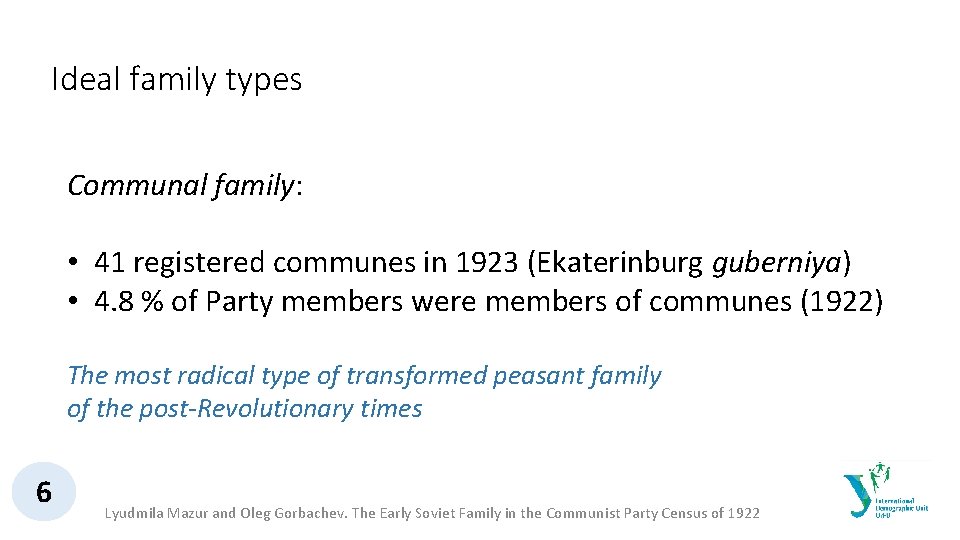
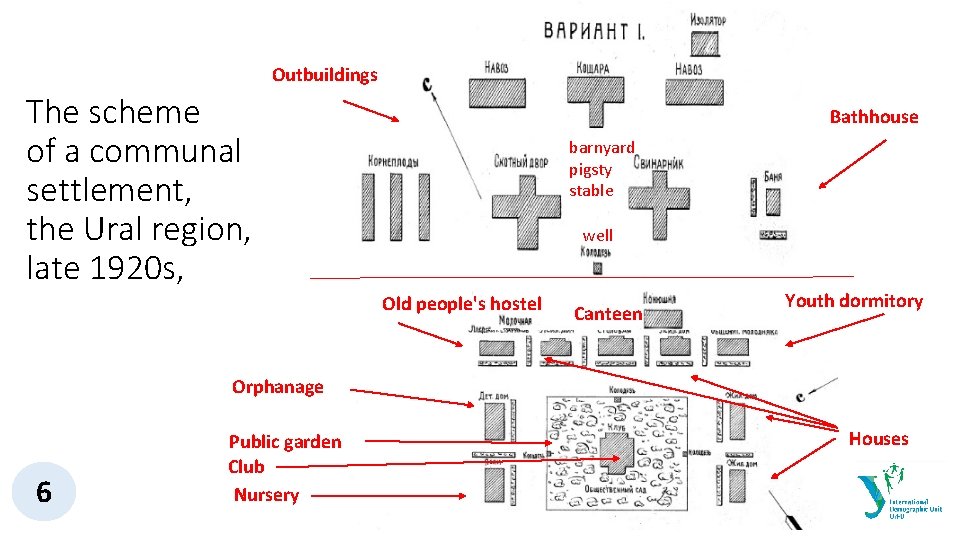
Ideal family types Communal family: • 41 registered communes in 1923 (Ekaterinburg guberniya) • 4. 8 % of Party members were members of communes (1922) The most radical type of transformed peasant family of the post-Revolutionary times 6 Lyudmila Mazur and Oleg Gorbachev. The Early Soviet Family in the Communist Party Census of 1922
Outbuildings The scheme of a communal settlement, the Ural region, late 1920 s, Bathhouse barnyard pigsty stable well Old people's hostel Canteen Youth dormitory Orphanage 6 Public garden Club Nursery Houses
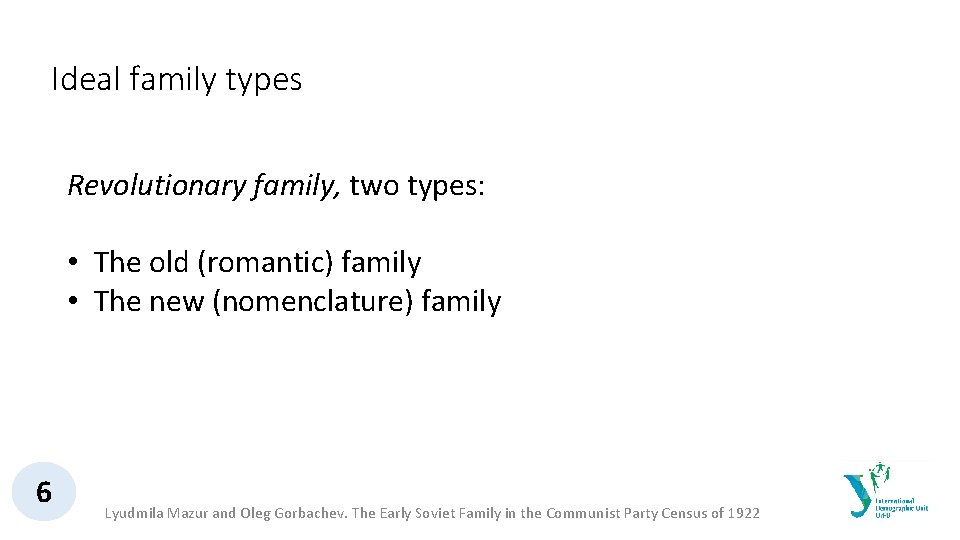
Ideal family types Revolutionary family, two types: • The old (romantic) family • The new (nomenclature) family 6 Lyudmila Mazur and Oleg Gorbachev. The Early Soviet Family in the Communist Party Census of 1922
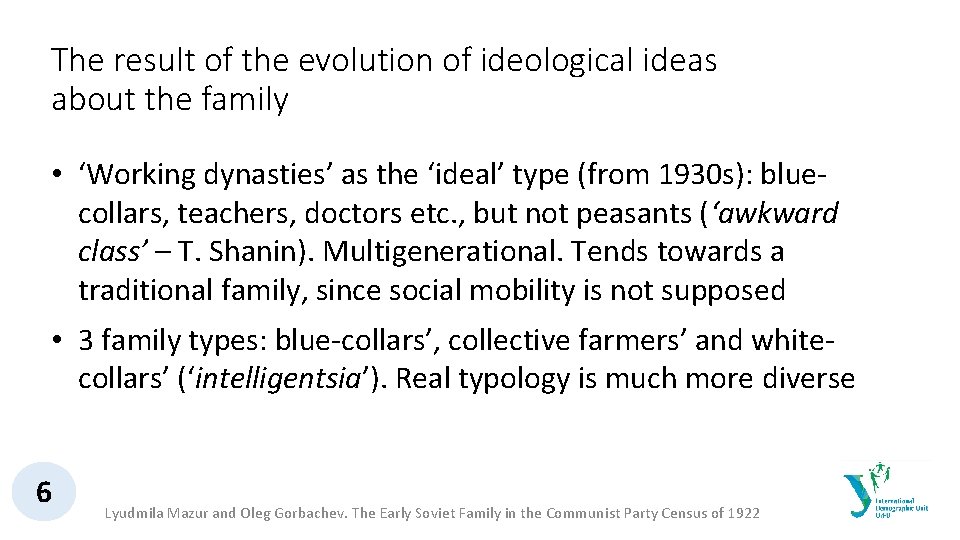
The result of the evolution of ideological ideas about the family • ‘Working dynasties’ as the ‘ideal’ type (from 1930 s): bluecollars, teachers, doctors etc. , but not peasants (‘awkward class’ – T. Shanin). Multigenerational. Tends towards a traditional family, since social mobility is not supposed • 3 family types: blue-collars’, collective farmers’ and whitecollars’ (‘intelligentsia’). Real typology is much more diverse 6 Lyudmila Mazur and Oleg Gorbachev. The Early Soviet Family in the Communist Party Census of 1922
Conclusion • Despite the fact that Communist Party is a small and specific group of Soviet society in this period, it indicates the principal trends of Soviet family evolution. • The party members were the most susceptible to the Communist ideology. This influence manifested itself also through family behavior. • The demographic transition of family organization of Communist Party members left unfinished. • On the materials of the CP Census it is difficult to trace the influence of the WWI and the Revolution on the family Lyudmila Mazur and Oleg Gorbachev. The Early Soviet Family in the Communist Party Census of 1922
Conclusion • Throughout the 1920 -40 s, the traditional family form predominated. USSR as 'halbmoderne Gesellschaft' (Ulrich Beck) • The ideology of the early-Soviet family was a specific form of transition to a modern urban family • Despite the traditionalist pullback from the ideas of the 1920 s in the Stalin years, the patriarchal Russian family was doomed to evolve towards modernity, largely because of the establishment of general female employment. Lyudmila Mazur and Oleg Gorbachev. The Early Soviet Family in the Communist Party Census of 1922
Thanks! Lyudmila Mazur lmaz@mail. ru Oleg Gorbachev og_06@mail. ru Ural Federal University, Ekaterinburg, Russia