
The Early Middle Ages After the fall of
- Slides: 10
The Early Middle Ages After the fall of Rome, waves of invaders swept across Europe. Trade slowed, towns emptied, and learning ceased. From 500 to 1000, Europe was backward and isolated. This period is often referred to as the “Dark Ages. ” Eventually, a new medieval civilization emerged that blended Roman, Germanic, and Christian traditions.
Geography of Western Europe Location q. Relatively small – second smallest in land area of the seven continents q. Lies on the western end of Eurasia, the giant land mass stretching from Portugal to China Resources q. A frontier land – a sparsely populated, undeveloped area on the outskirts of civilization q. Untapped potential üDense forests in the north üRich soil for farming üUnderground mineral resources üSeas for food and transportation üRivers for trade and streams to turn water wheels
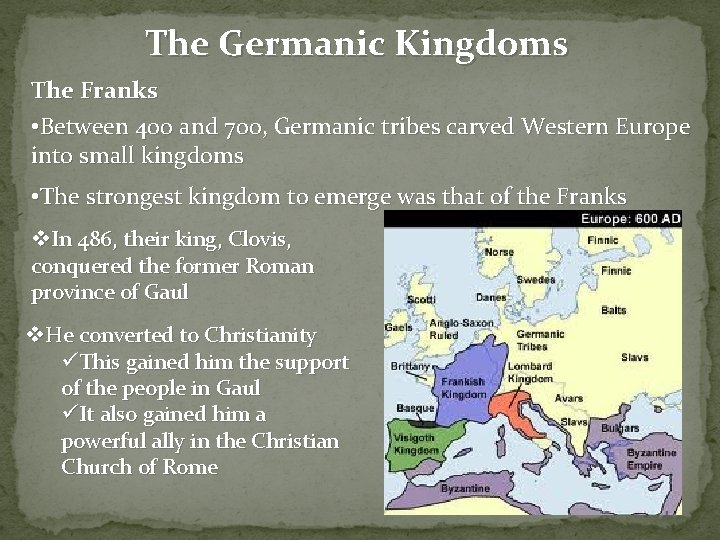
The Germanic Kingdoms The Franks • Between 400 and 700, Germanic tribes carved Western Europe into small kingdoms • The strongest kingdom to emerge was that of the Franks v. In 486, their king, Clovis, conquered the former Roman province of Gaul v. He converted to Christianity üThis gained him the support of the people in Gaul üIt also gained him a powerful ally in the Christian Church of Rome
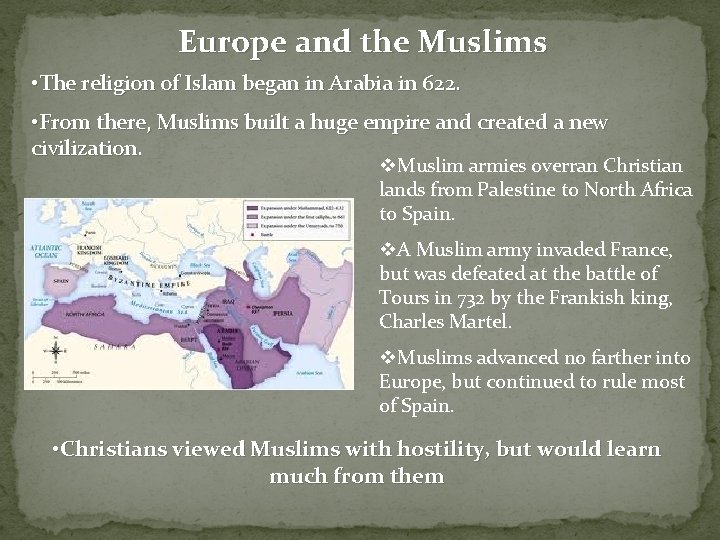
Europe and the Muslims • The religion of Islam began in Arabia in 622. • From there, Muslims built a huge empire and created a new civilization. v. Muslim armies overran Christian lands from Palestine to North Africa to Spain. v. A Muslim army invaded France, but was defeated at the battle of Tours in 732 by the Frankish king, Charles Martel. v. Muslims advanced no farther into Europe, but continued to rule most of Spain. • Christians viewed Muslims with hostility, but would learn much from them
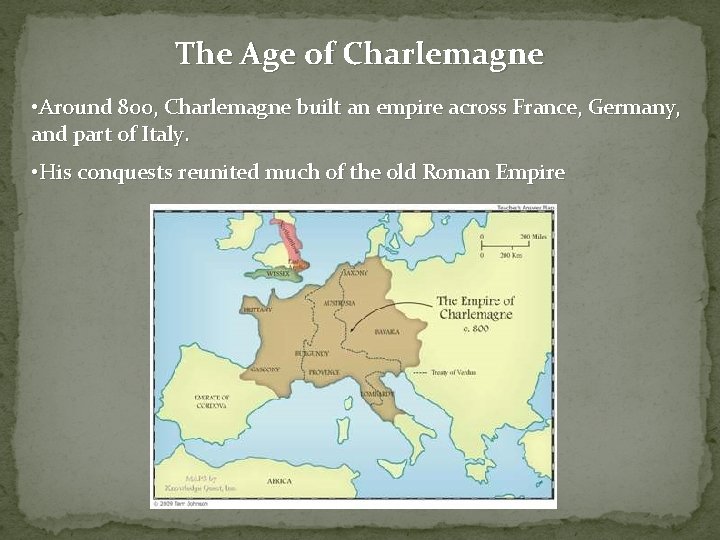
The Age of Charlemagne • Around 800, Charlemagne built an empire across France, Germany, and part of Italy. • His conquests reunited much of the old Roman Empire
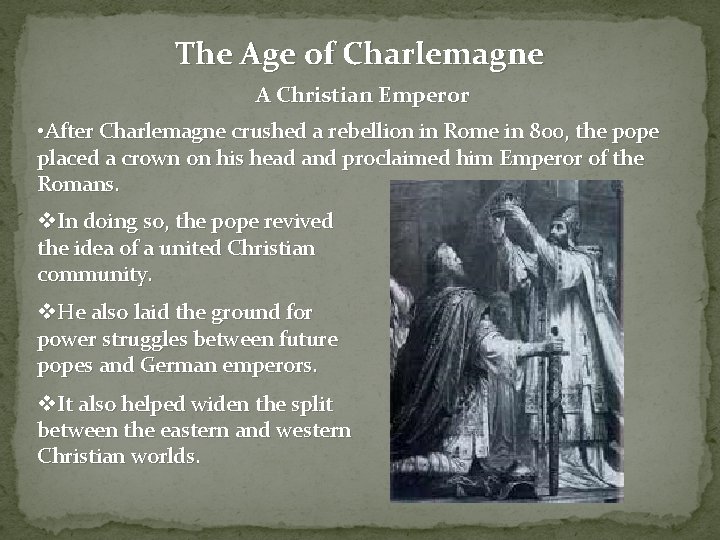
The Age of Charlemagne A Christian Emperor • After Charlemagne crushed a rebellion in Rome in 800, the pope placed a crown on his head and proclaimed him Emperor of the Romans. v. In doing so, the pope revived the idea of a united Christian community. v. He also laid the ground for power struggles between future popes and German emperors. v. It also helped widen the split between the eastern and western Christian worlds.
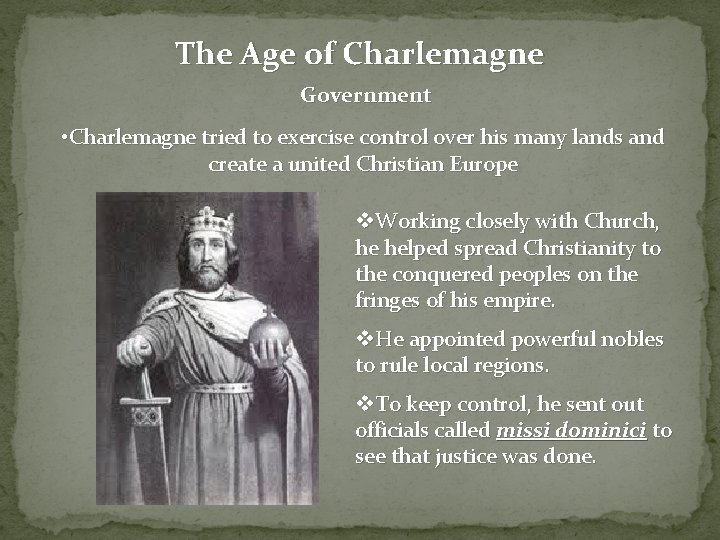
The Age of Charlemagne Government • Charlemagne tried to exercise control over his many lands and create a united Christian Europe v. Working closely with Church, he helped spread Christianity to the conquered peoples on the fringes of his empire. v. He appointed powerful nobles to rule local regions. v. To keep control, he sent out officials called missi dominici to see that justice was done.
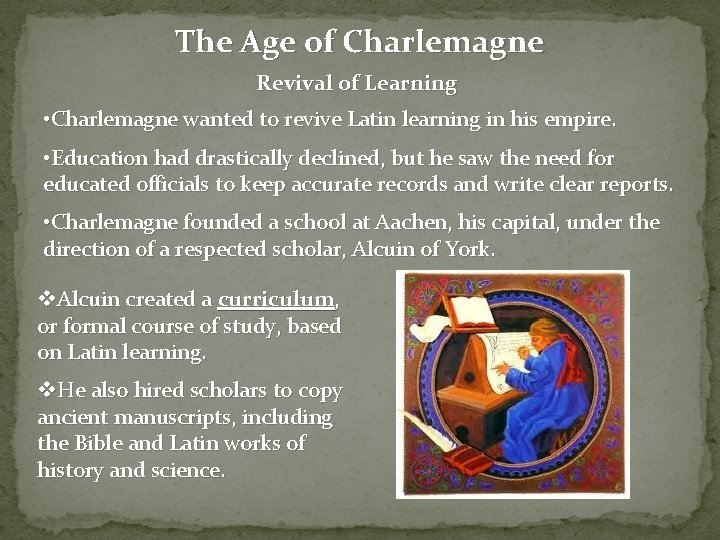
The Age of Charlemagne Revival of Learning • Charlemagne wanted to revive Latin learning in his empire. • Education had drastically declined, but he saw the need for educated officials to keep accurate records and write clear reports. • Charlemagne founded a school at Aachen, his capital, under the direction of a respected scholar, Alcuin of York. v. Alcuin created a curriculum, or formal course of study, based on Latin learning. v. He also hired scholars to copy ancient manuscripts, including the Bible and Latin works of history and science.
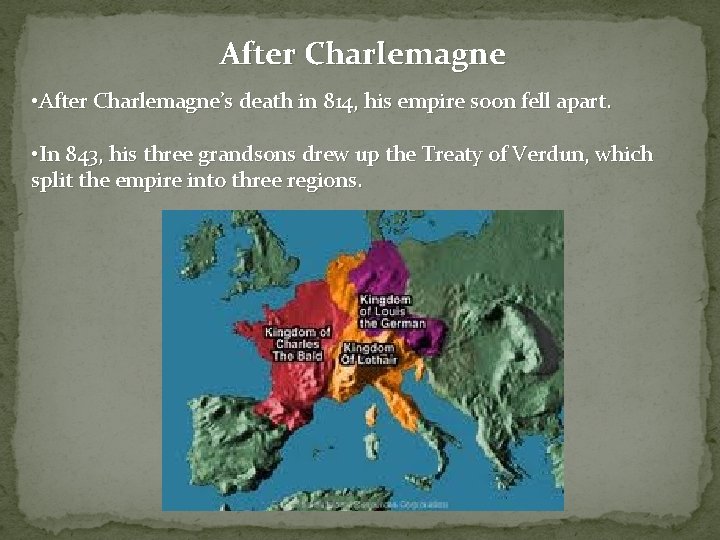
After Charlemagne • After Charlemagne’s death in 814, his empire soon fell apart. • In 843, his three grandsons drew up the Treaty of Verdun, which split the empire into three regions.
After Charlemagne Legacy of Charlemagne A New Wave of Invaders v. In the late 800 s, Muslims v. He extended Christian civilization into northern Europe. conquered Sicily, which became a thriving center of Islamic v. He furthered the blending of culture. German, Roman, and Christian v. From Hungary, the Magyars traditions. overran eastern Europe and v. He set up a strong, efficient plundered Germany, parts of government that later rulers France, and Italy. looked to as an example. v. The Vikings burst out of Scandinavia and looted and burned communities along the coasts and rivers of Europe.