
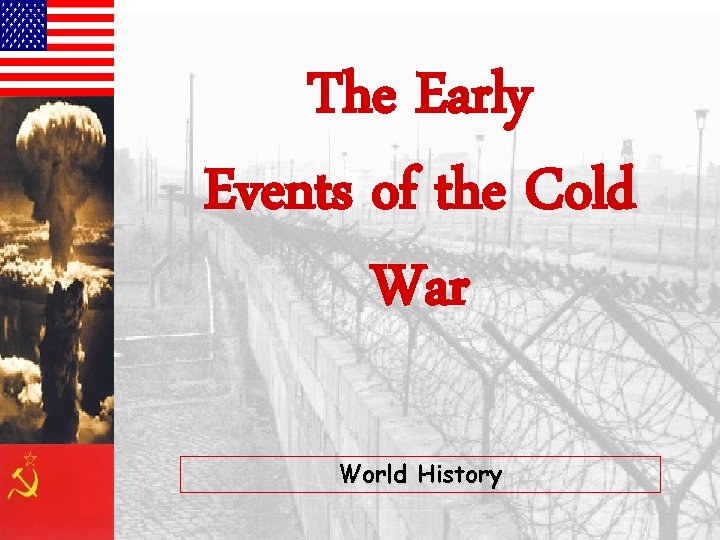
The Early Events of the Cold War World
![Truman Doctrine [1947] • President Harry S. Truman – The U. S. should support](https://slidetodoc.com/presentation_image_h2/1ecf293cd3305c4b77f992008a23daac/image-13.jpg "Truman Doctrine [1947] • President Harry S. Truman – The U. S. should support")
![Marshall Plan [1948] • “European Recovery Program” • Secretary of State, George Marshall •](https://slidetodoc.com/presentation_image_h2/1ecf293cd3305c4b77f992008a23daac/image-14.jpg "Marshall Plan [1948] • “European Recovery Program” • Secretary of State, George Marshall •")
![Marshall Plan [1948]](https://slidetodoc.com/presentation_image_h2/1ecf293cd3305c4b77f992008a23daac/image-15.jpg "Marshall Plan [1948]")
- Slides: 40
The Early Events of the Cold War World History
The Cold War • What was the Cold War? – Conflict over ideas between the world’s two superpowers (U. S. and Soviet Union) for global influence from 1945 -1991 • Was it actually a war?
Origins of the Cold War: • General Causes 1. Resentment over WWII 2. Differing ideologies of government and economic systems 3. Disagreements in post WWII Europe
Resentment Over WWII • Stalin signing the Nonaggression Pact with Hitler in 1938 • Allies leaving the Soviet Union to fend for themselves on the Eastern Front • Waiting to invade Europe until 1944 • Development and use of the atomic bomb
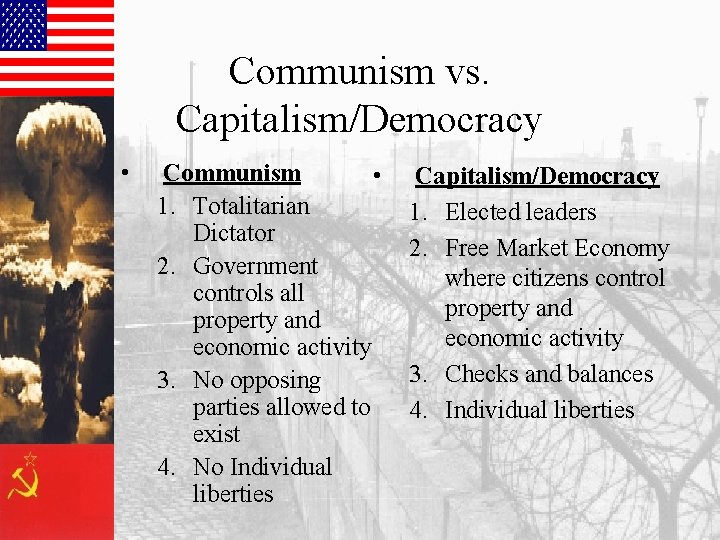
Communism vs. Capitalism/Democracy • Communism • 1. Totalitarian Dictator 2. Government controls all property and economic activity 3. No opposing parties allowed to exist 4. No Individual liberties Capitalism/Democracy 1. Elected leaders 2. Free Market Economy where citizens control property and economic activity 3. Checks and balances 4. Individual liberties
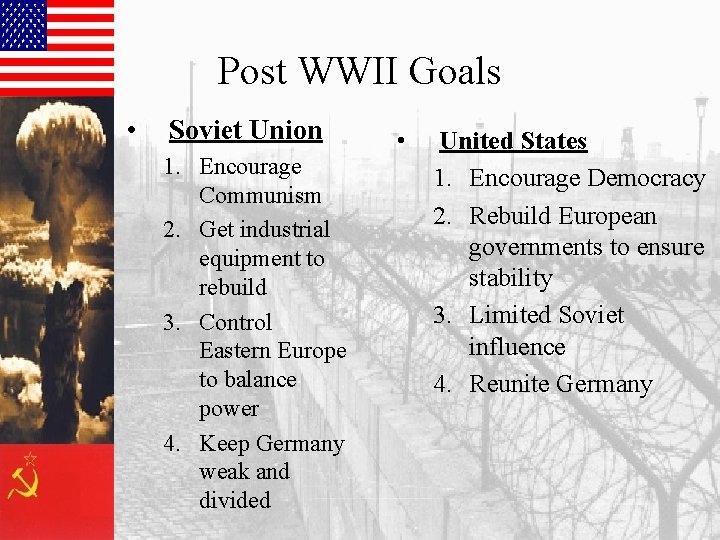
Post WWII Goals • Soviet Union 1. Encourage Communism 2. Get industrial equipment to rebuild 3. Control Eastern Europe to balance power 4. Keep Germany weak and divided • United States 1. Encourage Democracy 2. Rebuild European governments to ensure stability 3. Limited Soviet influence 4. Reunite Germany
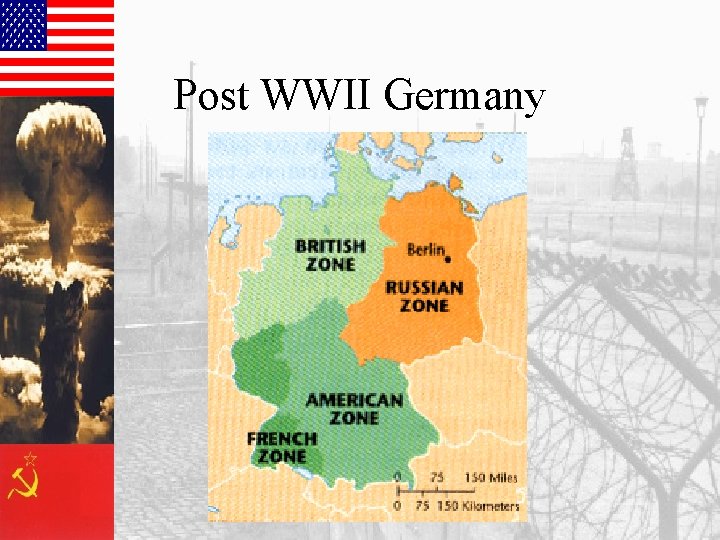
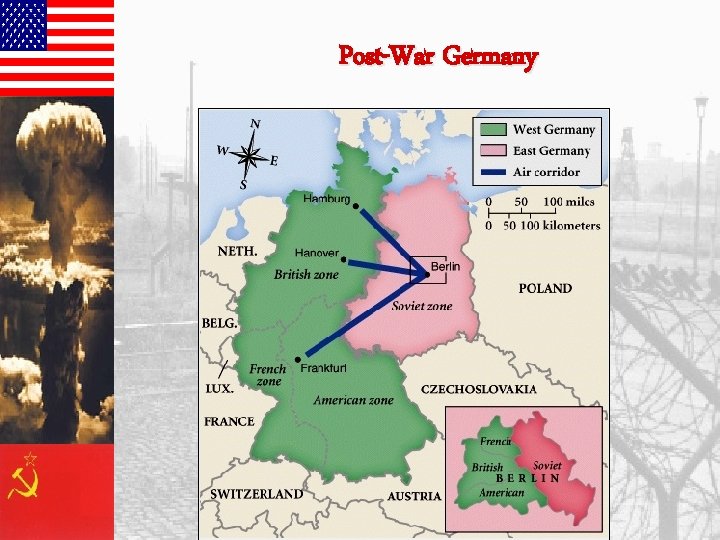
Post WWII Germany
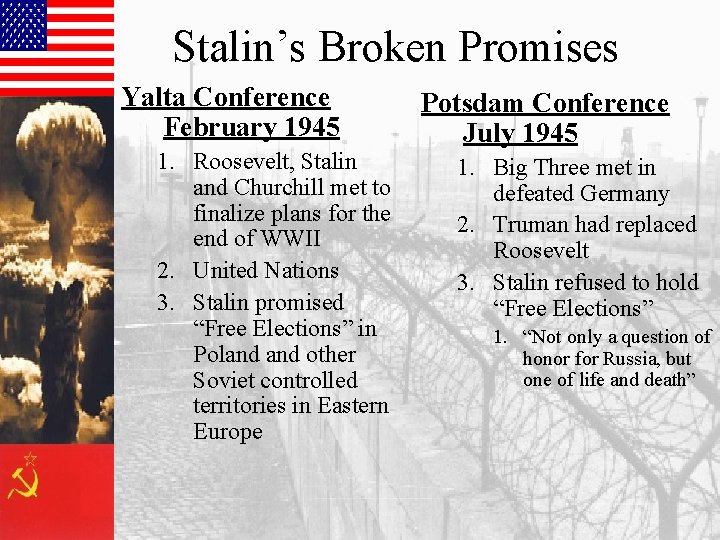
Stalin’s Broken Promises Yalta Conference February 1945 1. Roosevelt, Stalin and Churchill met to finalize plans for the end of WWII 2. United Nations 3. Stalin promised “Free Elections” in Poland other Soviet controlled territories in Eastern Europe Potsdam Conference July 1945 1. Big Three met in defeated Germany 2. Truman had replaced Roosevelt 3. Stalin refused to hold “Free Elections” 1. “Not only a question of honor for Russia, but one of life and death”
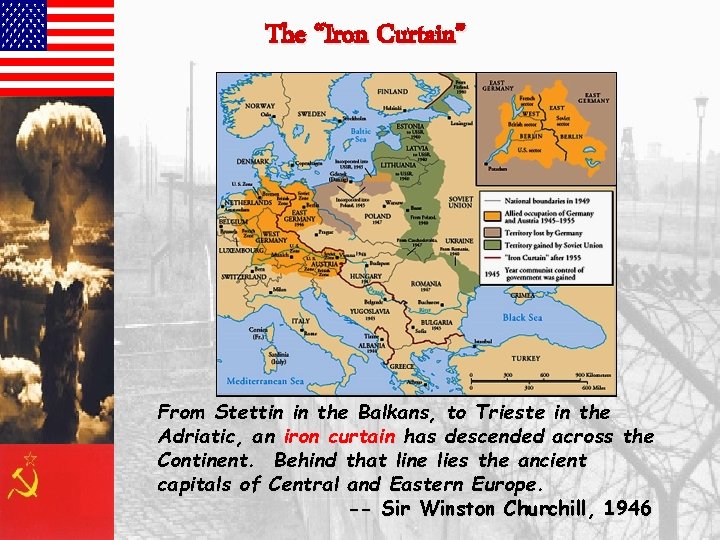
The “Iron Curtain” From Stettin in the Balkans, to Trieste in the Adriatic, an iron curtain has descended across the Continent. Behind that line lies the ancient capitals of Central and Eastern Europe. -- Sir Winston Churchill, 1946
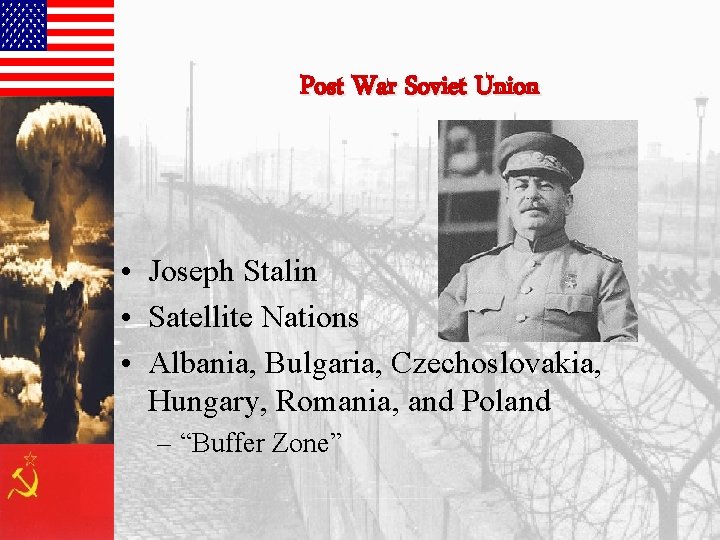
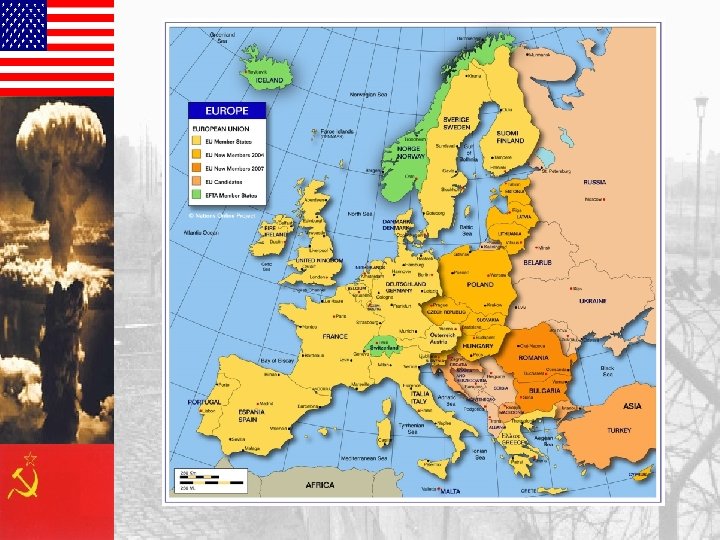
Post War Soviet Union • Joseph Stalin • Satellite Nations • Albania, Bulgaria, Czechoslovakia, Hungary, Romania, and Poland – “Buffer Zone”
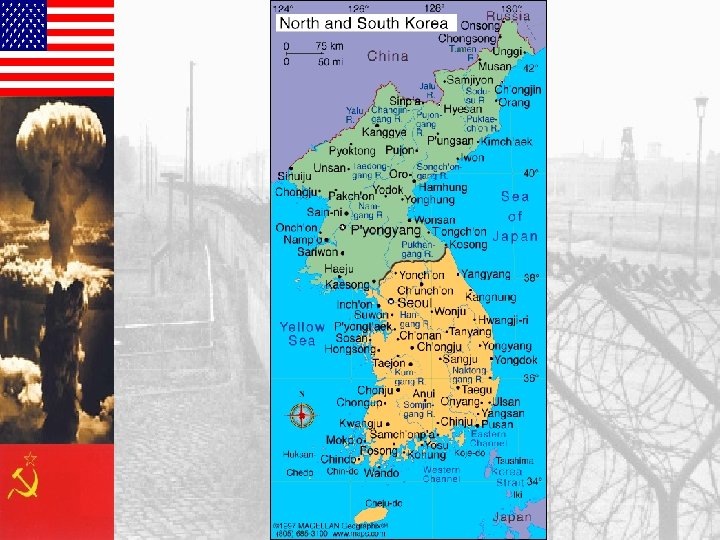
Containment: What is it? • U. S. policy to stop the spread of Communism • An effort to block all Soviet influence throughout the world • U. S. got involved in numerous conflicts and directly involved in two wars (Korea and Vietnam) as a result of this policy
Truman Doctrine [1947] • President Harry S. Truman – The U. S. should support free peoples throughout the world who were resisting takeovers by armed minorities… – What country is President Truman referring to? • The U. S. gave $400 million in aid to Greece and Turkey
Marshall Plan [1948] • “European Recovery Program” • Secretary of State, George Marshall • The U. S. should provide aid to all European nations that need it • $12. 5 billion was given to European countries to help them rebuild and resist Communism
Marshall Plan [1948]
Post-War Germany
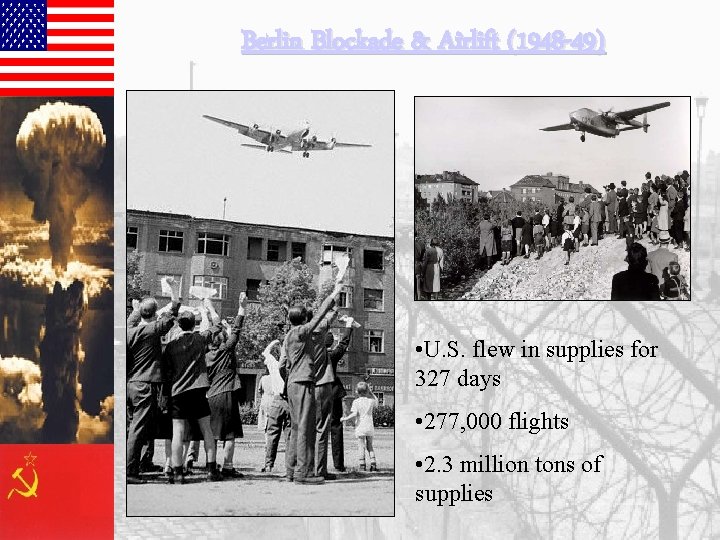
Berlin Blockade & Airlift (1948 -49) • U. S. flew in supplies for 327 days • 277, 000 flights • 2. 3 million tons of supplies
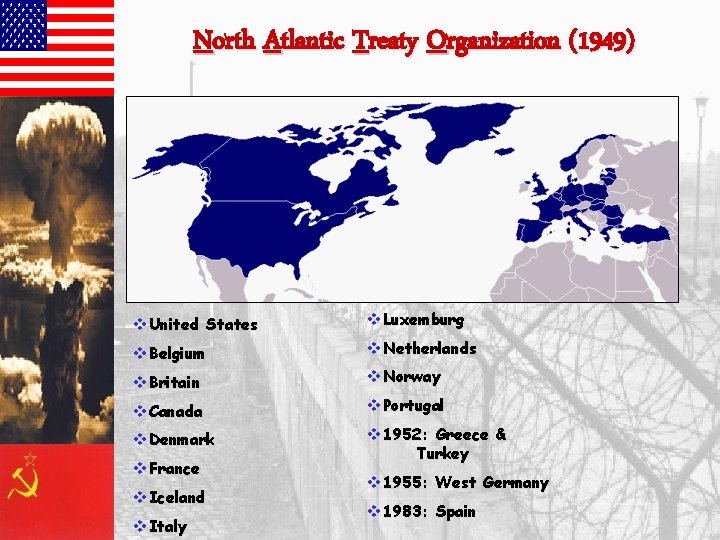
North Atlantic Treaty Organization (1949) v. United States v. Luxemburg v. Belgium v. Netherlands v. Britain v. Norway v. Canada v. Portugal v. Denmark v 1952: Greece & v. France v. Iceland v. Italy Turkey v 1955: West Germany v 1983: Spain
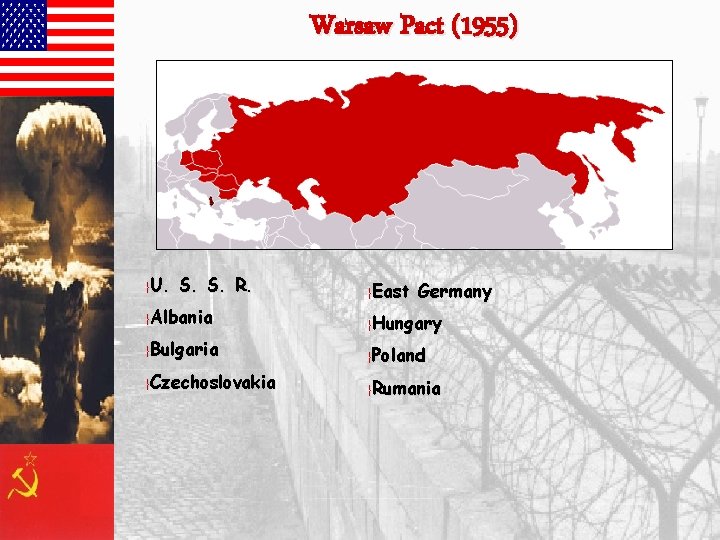
Warsaw Pact (1955) }U. S. S. R. }Albania }Bulgaria }Czechoslovakia }East Germany }Hungary }Poland }Rumania
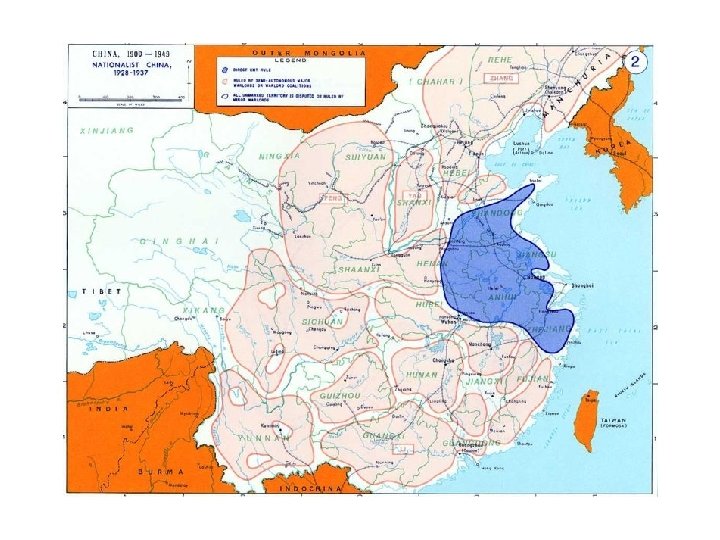
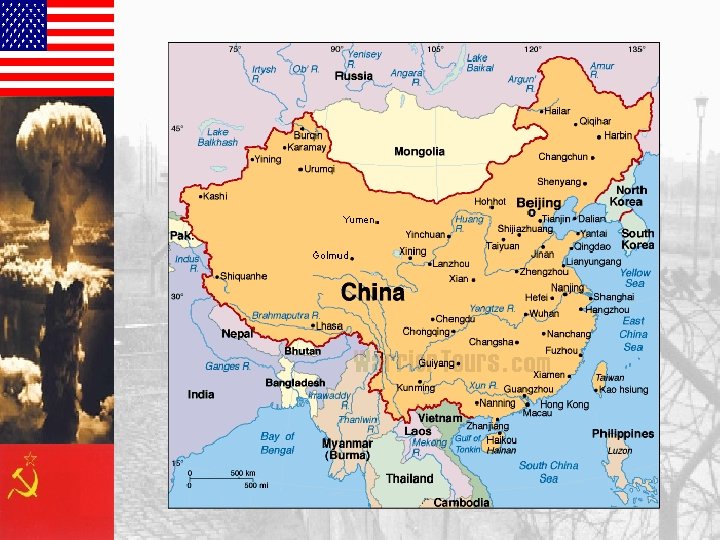
China “Falls” to Communism • Key Terms/Names – Mao Zedong, Chiang Kai-shek • Who did the United States support during the Chinese Civil War? Why? • Who did the Soviet Union support during the Chinese Civil War? Why? • How did the United States “lose” China? • As a result of the Chinese Civil War, how did American foreign policy regarding the spread of Communism in Asia change?
The Arms Race Definition: Race between the U. S. & the Soviet Union to build more powerful weapons of mass destruction
The Atomic Bomb • U. S. first used the atomic bombs on Japan during WWII • By 1949, the Soviet Union tested their own atomic bomb • U. S. no longer had a nuclear advantage • What should the U. S. do? Is this a moral issue?
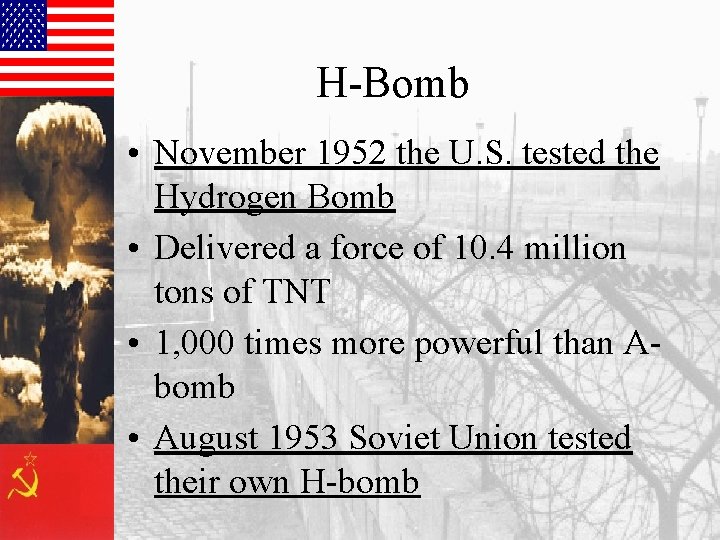
H-Bomb • November 1952 the U. S. tested the Hydrogen Bomb • Delivered a force of 10. 4 million tons of TNT • 1, 000 times more powerful than Abomb • August 1953 Soviet Union tested their own H-bomb
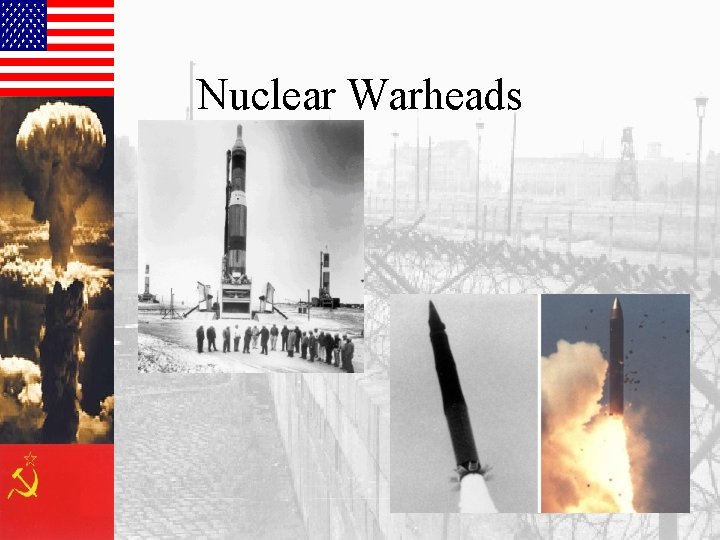
Arms Race (continued) By the late 1950’s – early 1960’s U. S. & the Soviet Union developed nuclear warheads powered by rockets • ICBM’s: Inter-Continental Ballistic Missiles * can be launched by land or sea
Nuclear Warheads
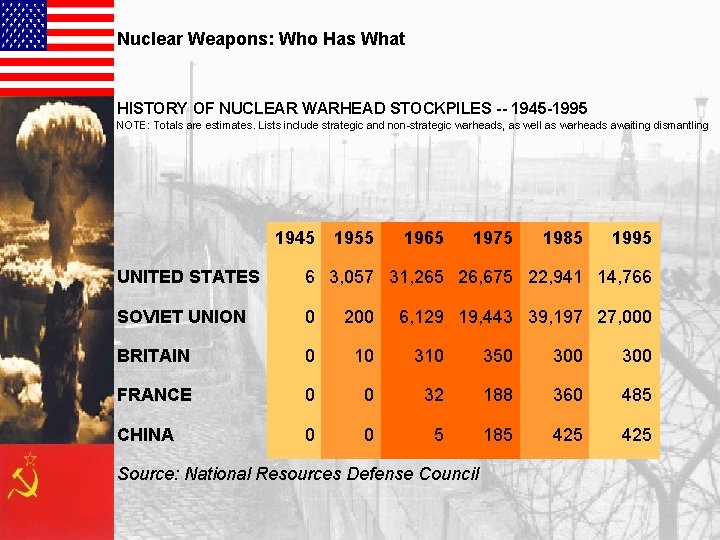
Nuclear Weapons: Who Has What HISTORY OF NUCLEAR WARHEAD STOCKPILES -- 1945 -1995 NOTE: Totals are estimates. Lists include strategic and non-strategic warheads, as well as warheads awaiting dismantling 1945 1955 1965 1975 1985 1995 UNITED STATES 6 3, 057 31, 265 26, 675 22, 941 14, 766 SOVIET UNION 0 200 BRITAIN 0 10 350 300 FRANCE 0 0 32 188 360 485 CHINA 0 0 5 185 425 6, 129 19, 443 39, 197 27, 000 Source: National Resources Defense Council
Purpose of Nuclear Weapons : 1. Why do countries possess Weapons of Mass Destruction (WMD)? • Deterrence: Acquiring military power for the purpose of discouraging attacks 2. Why don’t countries actually use them? • MAD (Mutually Assured Destruction): During a nuclear war, both countries will be destroyed
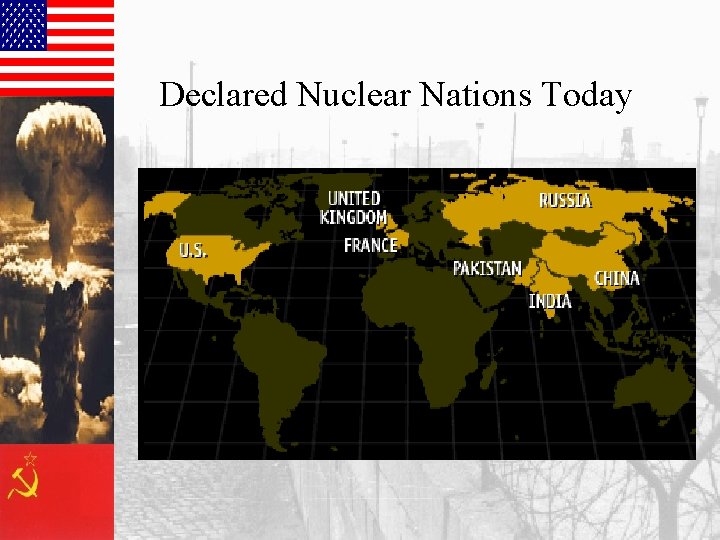
Declared Nuclear Nations Today
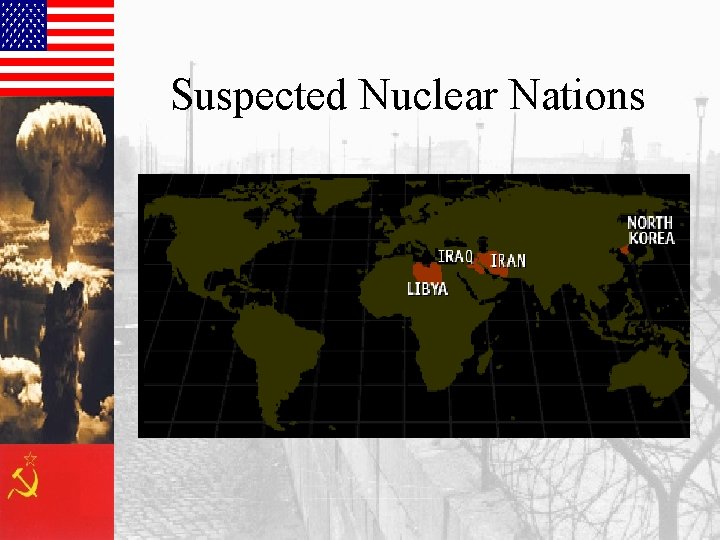
Suspected Nuclear Nations
Recent Nuclear Conflicts • Iran’s Goal – Nuclear Weapons? – Nuclear Energy? • Iran’s radical Muslim leader has made claims about “wiping Israel from the face of the earth” • Is this the type of person the world wants possessing nuclear weapons? • Audio Clips • BBC News Mahmoud Ahmadinejad Comments • NPR Audio Clip Tensions Escalate Over Iran • NPR Audio Clip Iran Expands Nuclear Effort
Writing Prompt • Is it fair for nuclear countries, like the U. S. to discourage other nations from acquiring nuclear weapons? • Think about: 1. What will the nuclear weapons be used for? 2. Are they an unstable nation? 3. Are they threats to the free world? 4. What would happen if the technology for nuclear weapons became widely known 5. What might happen if terrorist organizations like Al Qaeda acquired the technology for nuclear weapons?
Arms Race • 1952 U. S. Exploded the H-Bomb • 1953 Soviet Union exploded H-bomb • Brinkmanship – Threats of massive retaliation using nuclear weapons to serve as a deterrence • John Foster Dulles – U. S. built up massive amounts of nuclear weapons – Soviet Union followed
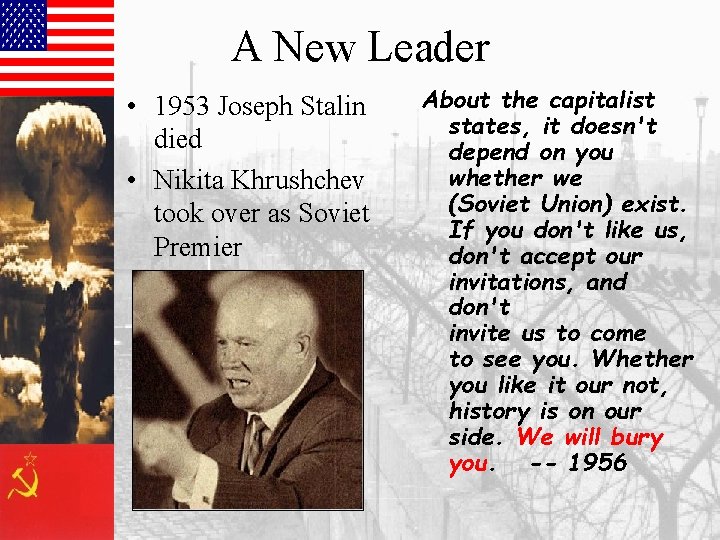
A New Leader • 1953 Joseph Stalin died • Nikita Khrushchev took over as Soviet Premier About the capitalist states, it doesn't depend on you whether we (Soviet Union) exist. If you don't like us, don't accept our invitations, and don't invite us to come to see you. Whether you like it our not, history is on our side. We will bury you. -- 1956
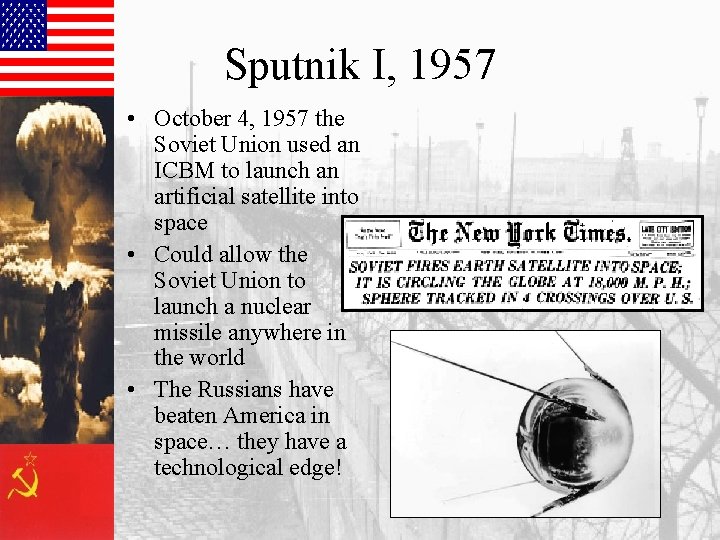
Sputnik I, 1957 • October 4, 1957 the Soviet Union used an ICBM to launch an artificial satellite into space • Could allow the Soviet Union to launch a nuclear missile anywhere in the world • The Russians have beaten America in space… they have a technological edge!
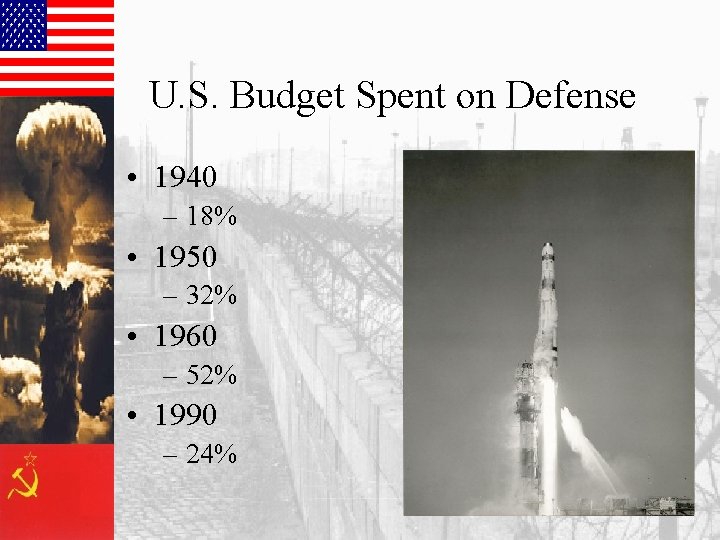
U. S. Budget Spent on Defense • 1940 – 18% • 1950 – 32% • 1960 – 52% • 1990 – 24%
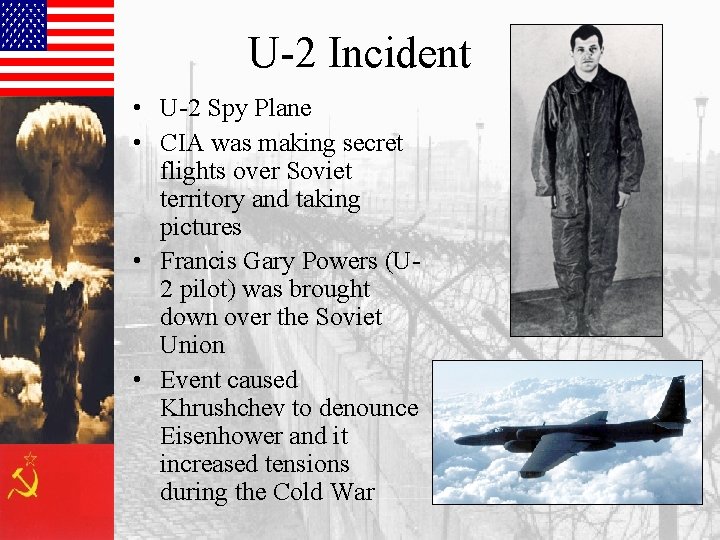
U-2 Incident • U-2 Spy Plane • CIA was making secret flights over Soviet territory and taking pictures • Francis Gary Powers (U 2 pilot) was brought down over the Soviet Union • Event caused Khrushchev to denounce Eisenhower and it increased tensions during the Cold War