
The dynamics of the cognitive dysfunctions in schoolage
- Slides: 16
The dynamics of the cognitive dysfunctions in school-age children with epilepsy. Mimoza MALOKU KUQI Ph. Dc Clinical Psychologist Clinical University Center of Pristina, Kosovo
According the definitions given by the International Leagues Against Epilepsy (ILAE) and the International Bureau for Epilepsy (IBE), (cited by Fisher et. al, 2005), epileptic seizures and epilepsy can often occur in overlapping conditions to each -other.
Purposes of the current paper might be endorsed into two important aims: The first aim is to explore and analyze the cognitive dysfunctions on school-age children suffering from epilepsy. The second aim is to elicit inferences on the factors, nature and comorbidity of idiopathic epilepsy typologies with cognitive deficits in these subjects.
Epilepsy is a neuropsychological disease known since the earliest times, and the dynamism of its development has always been linked by mystery and curiosity. Epilepsy is not a single condition, but rather a group of pathologies united by the association with an increased predisposition to the appearance of epileptic seizures. Even nowadays, in addition to developing scientific knowledge, epilepsy is accompanied by a series of collective prejudices that make life difficult for the individual suffering from it and qualitatively compromise the psychic balance of normal life.
The epileptic seizure represents a transient event with signs and symptoms associated with abnormal, excessive or synchronous neuronal brain activity. In the pathophysiological aspect of development, epilepsy is characterized by a sudden, paroxysmal disorder that is the result of pathological depletion of brain-neuron clusters and neuropsychological or behavioral pathology that have a significant impact on the occurrence of epilepsy and recurrence of epileptic seizures.
In the 2010, after several reviews, researchers have suggested different forms of the epilepsy classification: 1. Epileptic Seizures. Crises can be divided into two main types: partial crises , or focal, according to the most recent terminology, in which a focal or localized onset can be identified, and generalized crises, which are bilateral, symmetrical and without localized onset. Neural discharges seem to start simultaneously and diffusedly in both hemispheres. Focal seizures can then spread to the whole cerebral cortex, giving rise to the so-called "secondarily generalized seizures". The generalized seizures are then divided into two types: convulsive and non-convulsive. The most common seizure type is the tonic-clonic crisis , historically defined as the "Great evil". The classic generalized non-convulsive crises consist of short episodes of suspension of consciousness in the absence of significant motor manifestations, or minor motor phenomena such as short myoclonic, atonic or tonic crises (Ropper and Brown, 2005).
2. Epileptic syndromes. The "epileptic syndrome" or "electro-clinical syndrome", it is refered to a specific complex of clinical manifestations, electroencephalographic characteristics and epidemiological elements that contribute to defining a distinct and clinically recognizable pathology, with therapeutic, prognostic, and neuropsychological and neuroimaging studies (Panayiotopoulos, 2010).
Dysfunctions of the cognitive structure in school -aged children affected by epilepsy. Neuropsychological symptoms are heterogeneous as are epileptic syndromes themselves and include language, memory or attention deficits, visual-spatial, deficits, and learning disorders. The nature of the relationship of epilepsy to cognitive and learning disorders can also be highlighted at these specific situations: epilepsy and learning disorders can be the consequence of the same cerebral impairment, and epilepsy can cause a cerebral lesion that subsequently develops a learning disorder.
After the 2015, scientific interest has grown to the neuropsychological analysis of generalized idiopathic syndromes, which are now raising their spread and diffusions. Most neuropsychological research has focused on cognitive deficits in forms of focal epilepsy, such as frontal lobe epilepsy or temporal lobe epilepsy, due to the direct association of these types of epilepsies with cognitive disorders. Cornaggia(2001) has argued that cognitive functions relate primarily to the capacity of the human brain to process all information coming from the external and internal world and behavioral programming as a result of these processes.
According to the author, the cognitive areas affected by pediatric epilepsy, we might include: Executive functions, or the set of mental processes needed to process cognitive-behavioral schemas in a response to new or changing environmental conditions (Owen, 1997). These executive functions are connected firstly to cognitive flexibility and the ability to plan. solutions to cognitive issues. These include the ability to program, modify and verify an action to achieve a specific goal, such as the ability of the young person to plan and represent at a mental level without requiring memorization of the stages necessary to accomplish this activity. Dysfunctions may include inappropriate social behavior, difficulty in decision making and judgment, difficulty in developing, following and modifying plans, difficulty in organizing, lack of concentration and difficulty in different dimensions of memory.
Visual-spatial capacity, which involves a set of processes that allow the individual the right of interaction with the external world. These skills consist on the ability to integrate information coming from the perceptual space to develop some spatial coordinating points that regulate the organization and use of the materials needed to perform the task. Dysfunctions in these areas include dissorted spatial relationships between objects or between an individual and an object; difficulties in coping or drawing and difficulties in creating grapho-motor sounds; difficulties in spatial organization of holding a sheet of paper and line writing; difficulties in written calculations and geometry and difficulties in reading and visual adjustment. Verbal memory, which in the cognitive psyche refers to the memory of words and other linguistic abstractions Spatial memory, which means that part of the memory that is responsible for recording environmental information and spatial orientation. Included here are both semantic and short or long-term memory. Language and linguistic capacities. This category includes the skills of understanding and using a complex, word-based communication system which consists on the ability to organize words and develop their expression and meaning.
The pattern of cognitive deficits associated with epilepsy at developmental ages carries a direct correlation with the localization of cerebral cortex functions. This phenomenon is mostly expressed in cases of focal epileptogenic lesions. Research by Troyer et al. (1998) have shown that in subjects with lesions in the frontal lobus, phonemic verbal fluency is understood while semantic is relatively reserved.
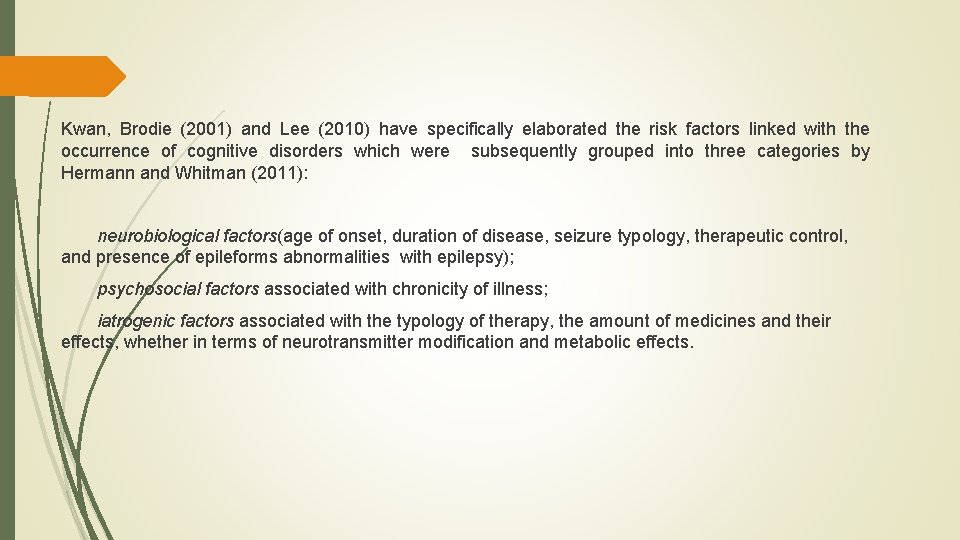
Kwan, Brodie (2001) and Lee (2010) have specifically elaborated the risk factors linked with the occurrence of cognitive disorders which were subsequently grouped into three categories by Hermann and Whitman (2011): neurobiological factors(age of onset, duration of disease, seizure typology, therapeutic control, and presence of epileforms abnormalities with epilepsy); psychosocial factors associated with chronicity of illness; iatrogenic factors associated with the typology of therapy, the amount of medicines and their effects, whether in terms of neurotransmitter modification and metabolic effects.
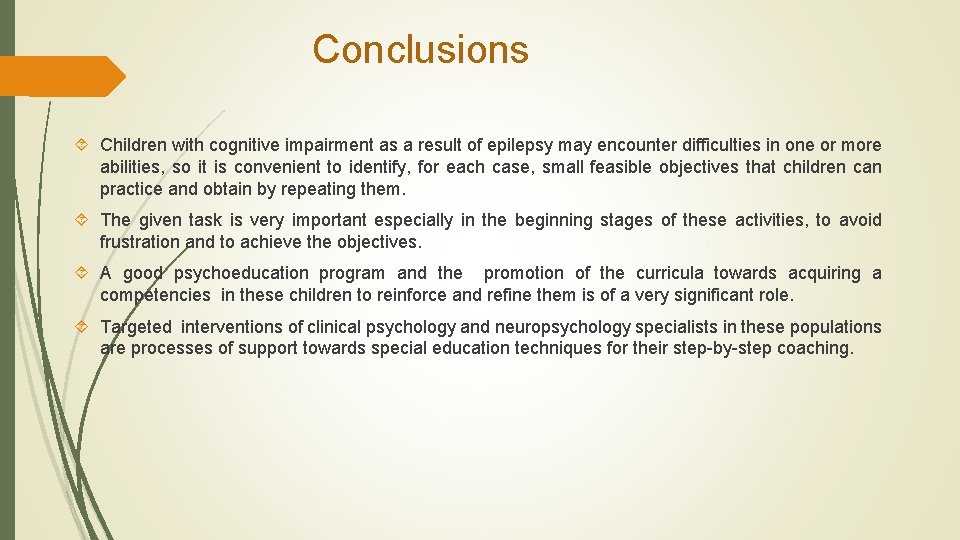
Conclusions Children with cognitive impairment as a result of epilepsy may encounter difficulties in one or more abilities, so it is convenient to identify, for each case, small feasible objectives that children can practice and obtain by repeating them. The given task is very important especially in the beginning stages of these activities, to avoid frustration and to achieve the objectives. A good psychoeducation program and the promotion of the curricula towards acquiring a competencies in these children to reinforce and refine them is of a very significant role. Targeted interventions of clinical psychology and neuropsychology specialists in these populations are processes of support towards special education techniques for their step-by-step coaching.
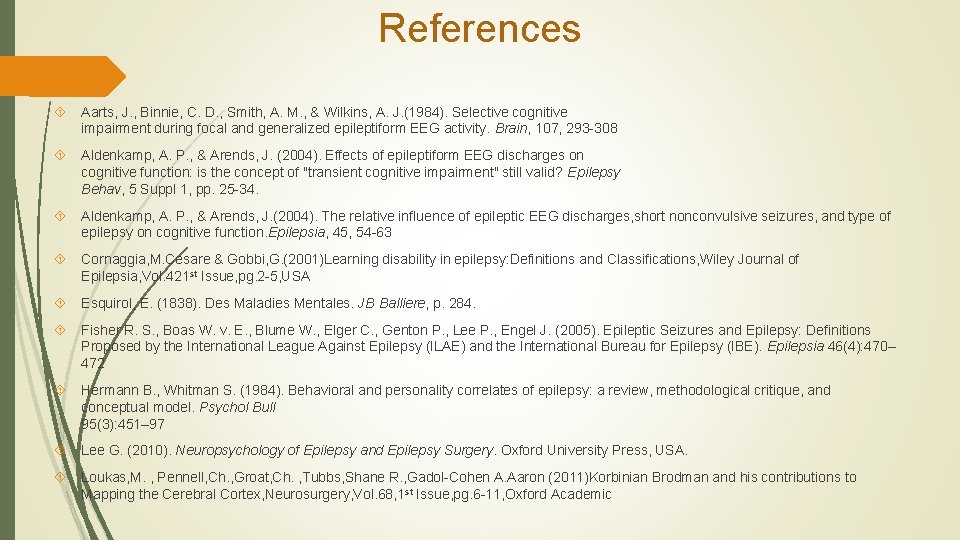
References Aarts, J. , Binnie, C. D. , Smith, A. M. , & Wilkins, A. J. (1984). Selective cognitive impairment during focal and generalized epileptiform EEG activity. Brain, 107, 293 -308 Aldenkamp, A. P. , & Arends, J. (2004). Effects of epileptiform EEG discharges on cognitive function: is the concept of "transient cognitive impairment" still valid? Epilepsy Behav, 5 Suppl 1, pp. 25 -34. Aldenkamp, A. P. , & Arends, J. (2004). The relative influence of epileptic EEG discharges, short nonconvulsive seizures, and type of epilepsy on cognitive function. Epilepsia, 45, 54 -63 Cornaggia, M. Cesare & Gobbi, G. (2001)Learning disability in epilepsy: Definitions and Classifications, Wiley Journal of Epilepsia, Vol. 421 st Issue, pg. 2 -5, USA Esquirol, E. (1838). Des Maladies Mentales. JB Balliere, p. 284. Fisher R. S. , Boas W. v. E. , Blume W. , Elger C. , Genton P. , Lee P. , Engel J. (2005). Epileptic Seizures and Epilepsy: Definitions Proposed by the International League Against Epilepsy (ILAE) and the International Bureau for Epilepsy (IBE). Epilepsia 46(4): 470– 472 Hermann B. , Whitman S. (1984). Behavioral and personality correlates of epilepsy: a review, methodological critique, and conceptual model. Psychol Bull 95(3): 451– 97 Lee G. (2010). Neuropsychology of Epilepsy and Epilepsy Surgery. Oxford University Press, USA. Loukas, M. , Pennell, Ch. , Groat, Ch. , Tubbs, Shane R. , Gadol-Cohen A. Aaron (2011)Korbinian Brodman and his contributions to Mapping the Cerebral Cortex, Neurosurgery, Vol. 68, 1 st Issue, pg. 6 -11, Oxford Academic
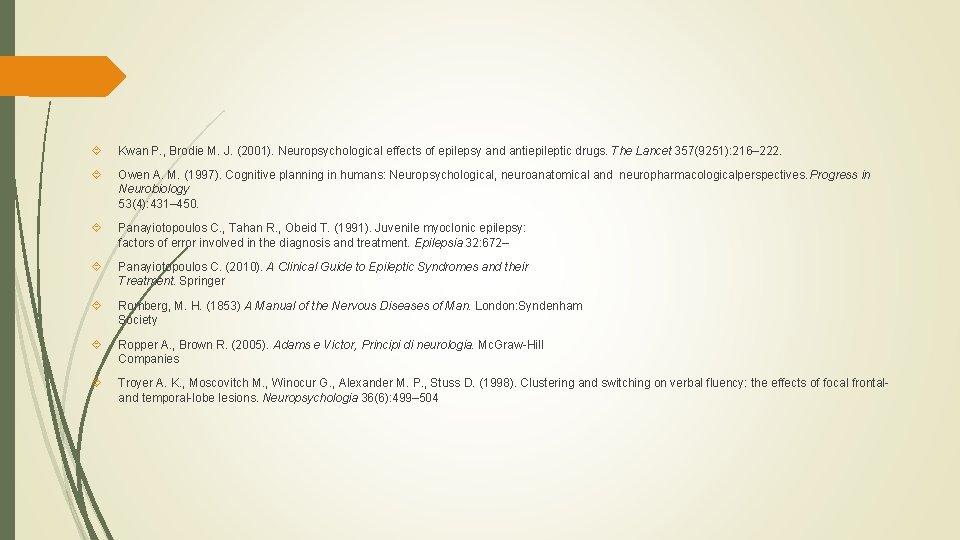
Kwan P. , Brodie M. J. (2001). Neuropsychological effects of epilepsy and antiepileptic drugs. The Lancet 357(9251): 216– 222. Owen A. M. (1997). Cognitive planning in humans: Neuropsychological, neuroanatomical and neuropharmacologicalperspectives. Progress in Neurobiology 53(4): 431– 450. Panayiotopoulos C. , Tahan R. , Obeid T. (1991). Juvenile myoclonic epilepsy: factors of error involved in the diagnosis and treatment. Epilepsia 32: 672– Panayiotopoulos C. (2010). A Clinical Guide to Epileptic Syndromes and their Treatment. Springer Romberg, M. H. (1853) A Manual of the Nervous Diseases of Man. London: Syndenham Society Ropper A. , Brown R. (2005). Adams e Victor, Principi di neurologia. Mc. Graw-Hill Companies Troyer A. K. , Moscovitch M. , Winocur G. , Alexander M. P. , Stuss D. (1998). Clustering and switching on verbal fluency: the effects of focal frontal- and temporal-lobe lesions. Neuropsychologia 36(6): 499– 504