
The DubnaMainzTaipei model DMT and MAID G Y
The Dubna-Mainz-Taipei model (DMT) and MAID G. Y. Chen, S. S. Kamalov, S. N. Yang, D. Drechsel and L. T. NTU Taipei, JINR Dubna, Universität Mainz and S. Ceci and A. Svarc, Rudjer Boskovic Institute, Zagreb v short introduction in DMT model for p. N scattering v numerical results for S 11, P 11 and P 33 v pole positions and residues with AC, SP and RM v conventional Breit-Wigner resonance parameters v MAID PWA for pion photo- and electroproduction v results at the BW positions and at the poles v summary and outlook
Dynamical Models • dynamical meson exchange models for pion-nucleon scattering have been developed over many years, mostly in the energy region of the D(1232) resonance but now they are beeing extended over the full resonance region • the first goal is to extract N* parameters to investigate the structure of QCD and to compare with lattice calculations • an open question is still: how can we understand the very successfull description of N* properties by constituent quark models ? • and why does it fail in some other cases ?
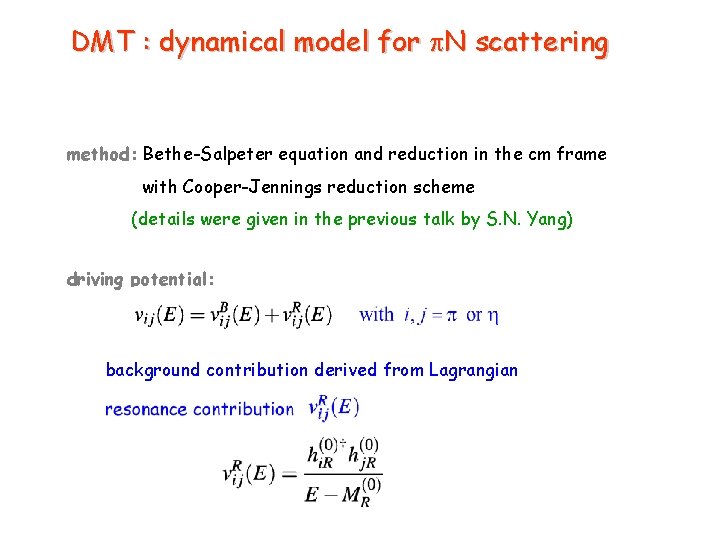
DMT : dynamical model for p. N scattering method: Bethe-Salpeter equation and reduction in the cm frame with Cooper-Jennings reduction scheme (details were given in the previous talk by S. N. Yang) driving potential: background contribution derived from Lagrangian
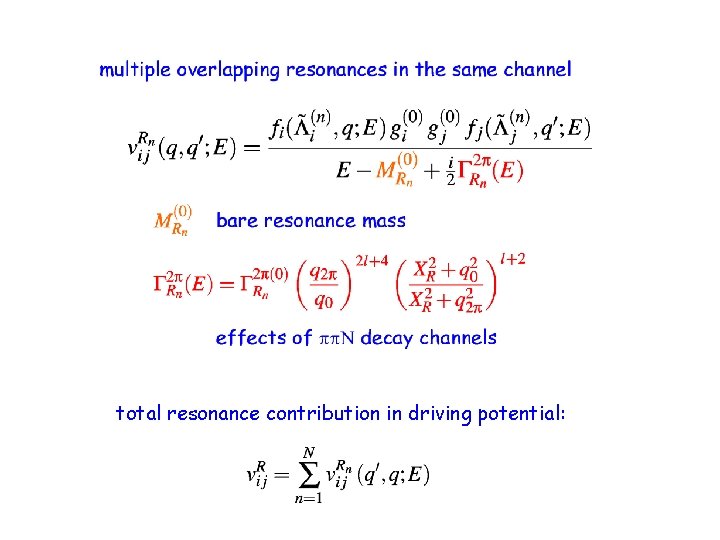
total resonance contribution in driving potential:
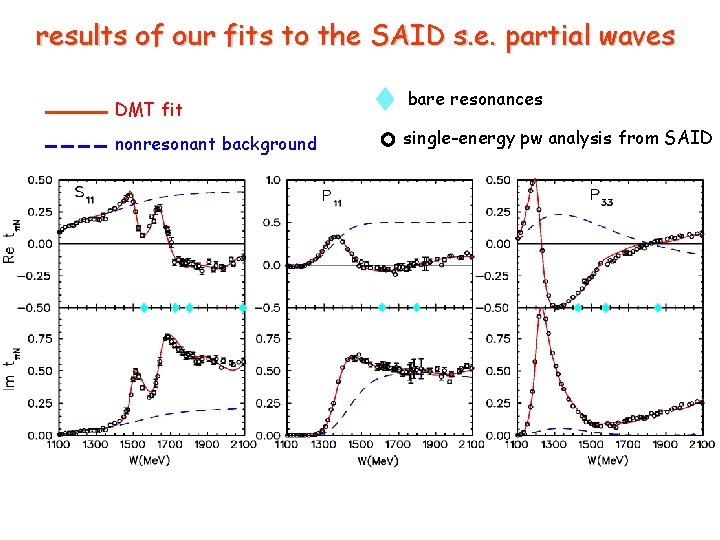
results of our fits to the SAID s. e. partial waves DMT fit nonresonant background bare resonances single-energy pw analysis from SAID
how can we find the resonances in the partial waves?
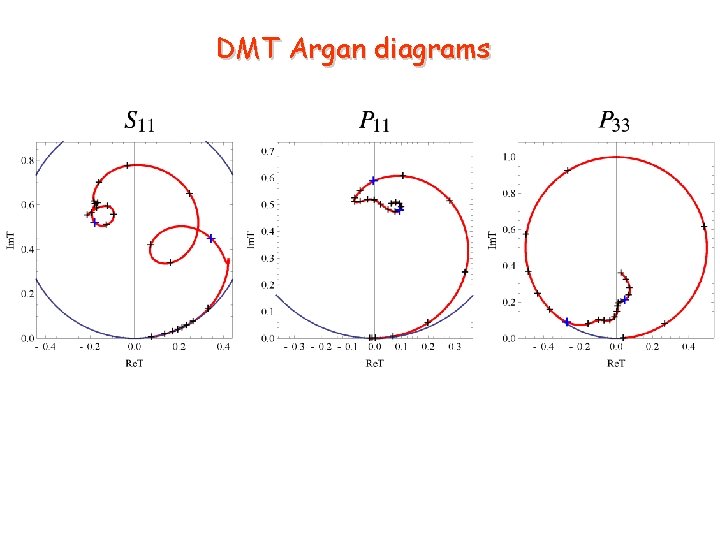
DMT Argan diagrams
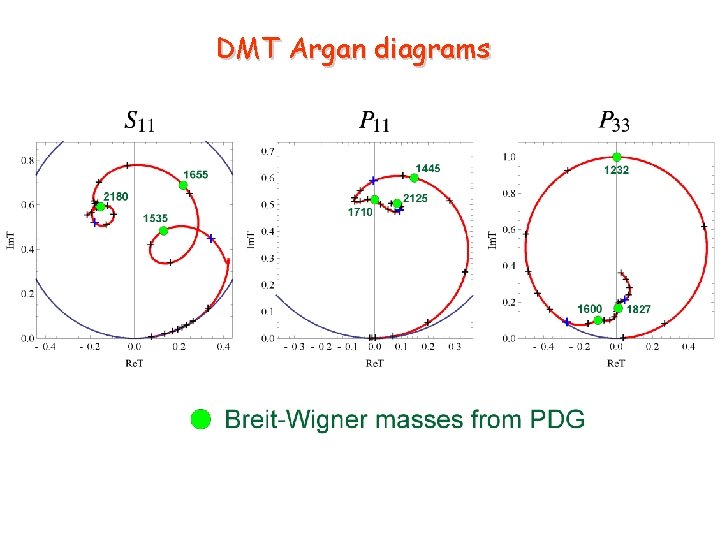
DMT Argan diagrams
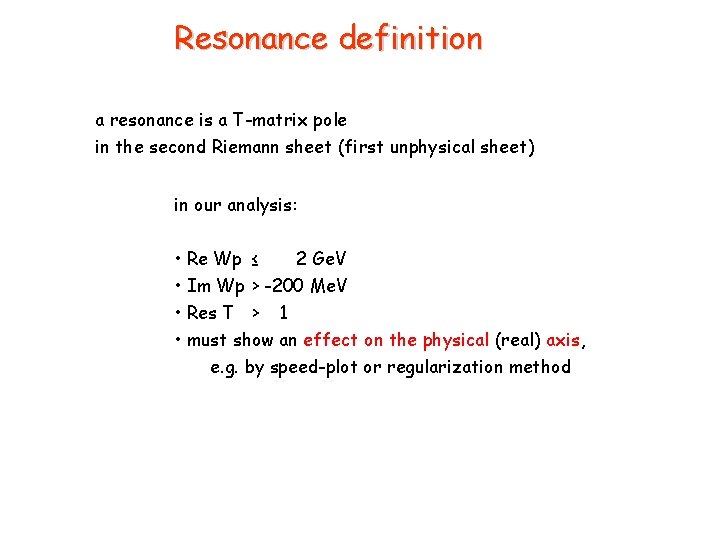
Resonance definition a resonance is a T-matrix pole in the second Riemann sheet (first unphysical sheet) in our analysis: • Re Wp ≤ 2 Ge. V • Im Wp > -200 Me. V • Res T > 1 • must show an effect on the physical (real) axis, e. g. by speed-plot or regularization method
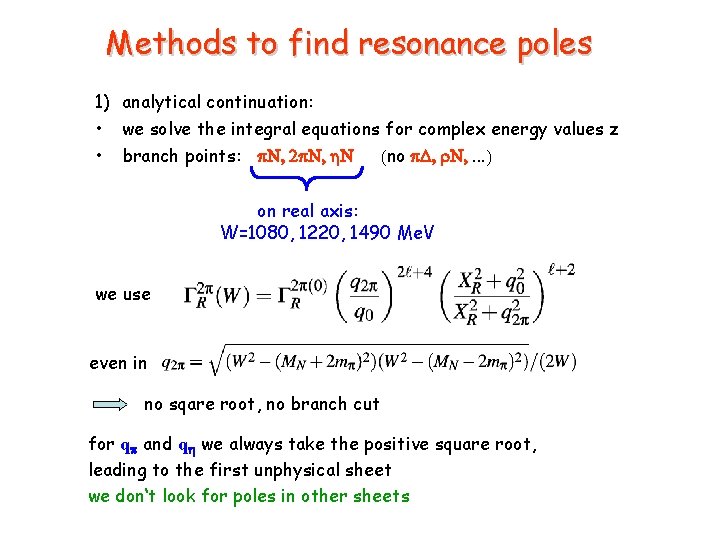
Methods to find resonance poles 1) analytical continuation: • we solve the integral equations for complex energy values z • branch points: p. N, 2 p. N, h. N (no p. D, r. N, . . . ) on real axis: W=1080, 1220, 1490 Me. V we use even in no sqare root, no branch cut for qp and qh we always take the positive square root, leading to the first unphysical sheet we don‘t look for poles in other sheets
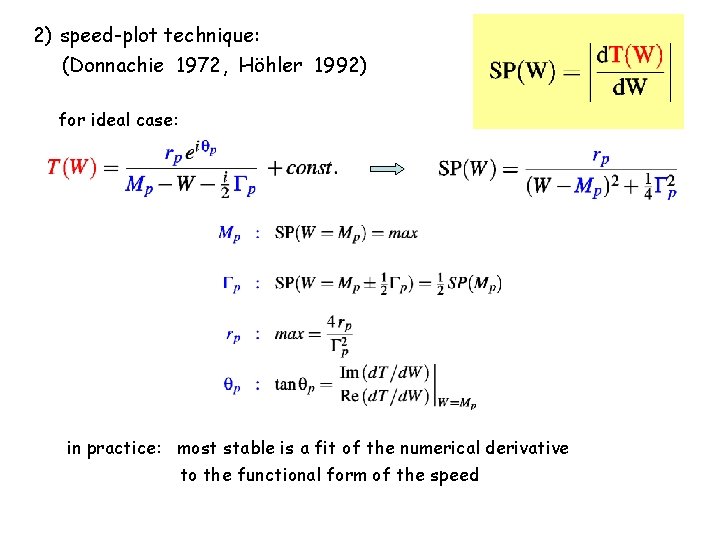
2) speed-plot technique: (Donnachie 1972, Höhler 1992) for ideal case: in practice: most stable is a fit of the numerical derivative to the functional form of the speed
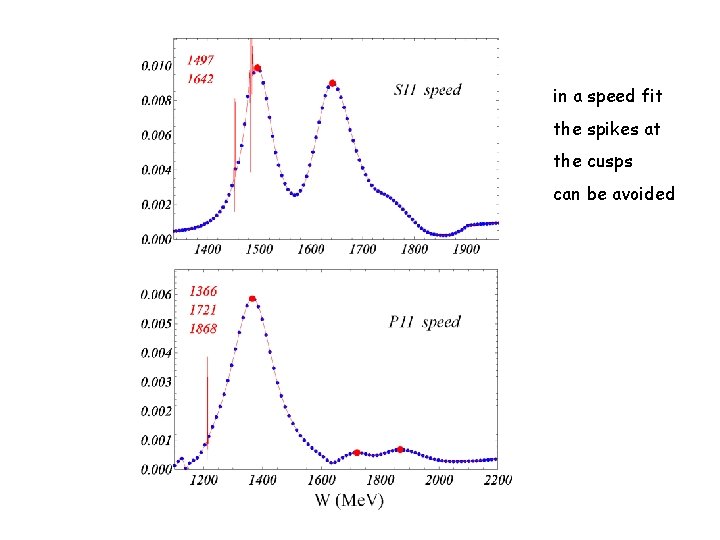
in a speed fit the spikes at the cusps can be avoided
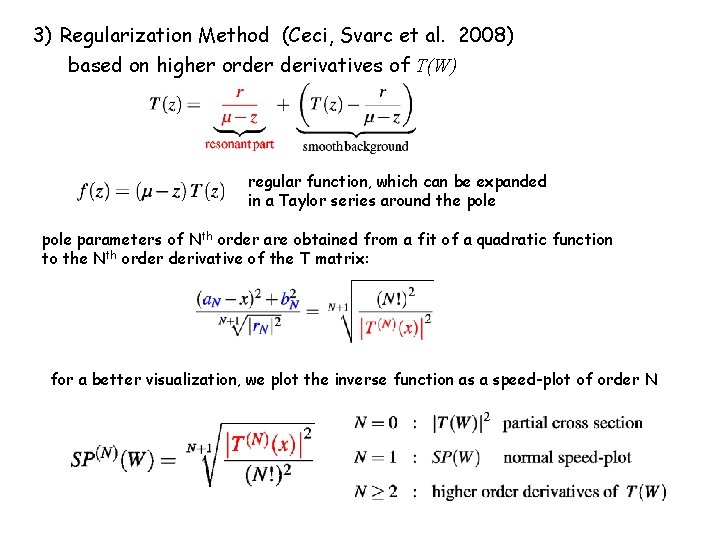
3) Regularization Method (Ceci, Svarc et al. 2008) based on higher order derivatives of T(W) regular function, which can be expanded in a Taylor series around the pole parameters of Nth order are obtained from a fit of a quadratic function to the Nth order derivative of the T matrix: for a better visualization, we plot the inverse function as a speed-plot of order N
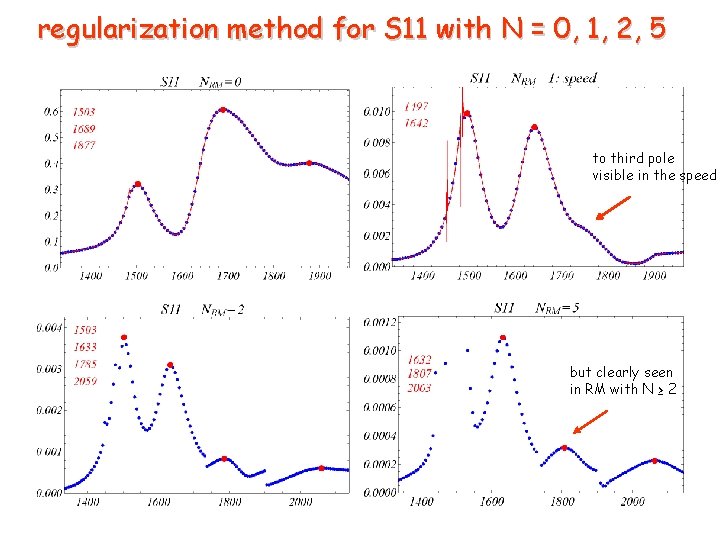
regularization method for S 11 with N = 0, 1, 2, 5 to third pole visible in the speed but clearly seen in RM with N ≥ 2
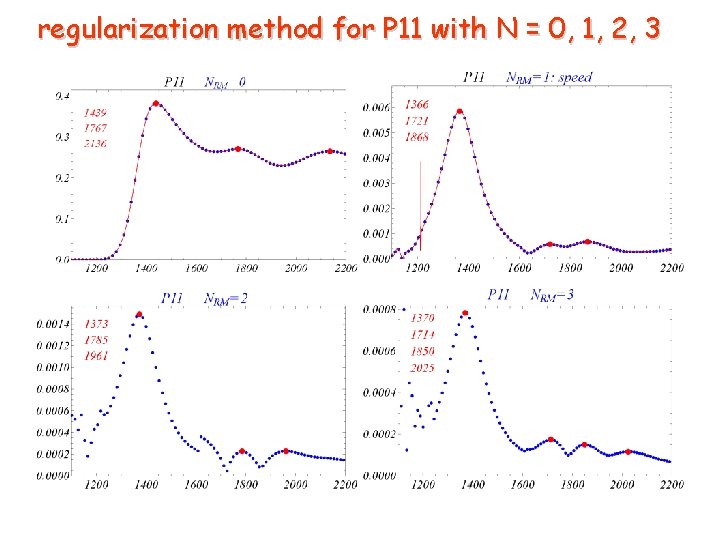
regularization method for P 11 with N = 0, 1, 2, 3
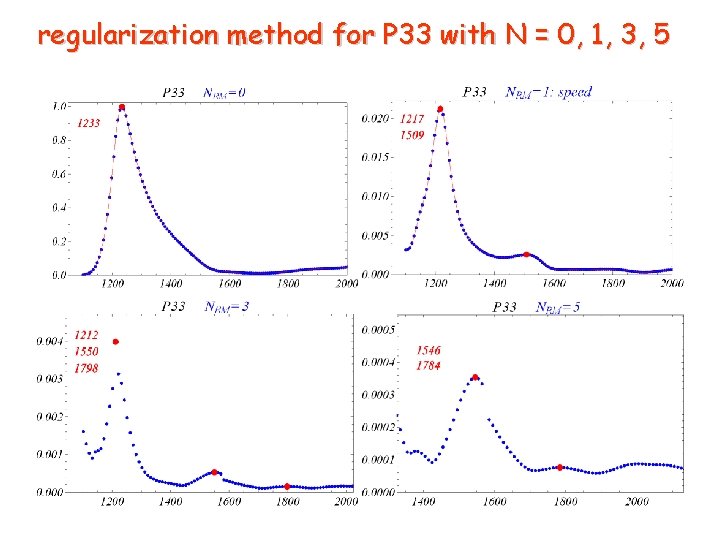
regularization method for P 33 with N = 0, 1, 3, 5
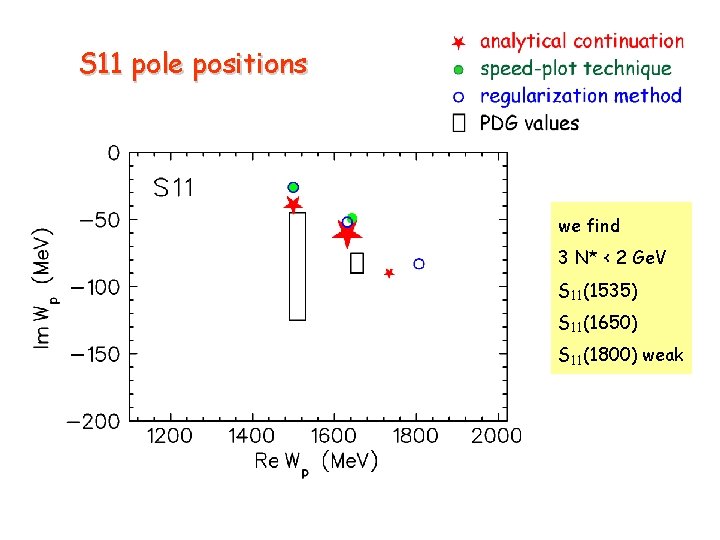
S 11 pole positions we find 3 N* < 2 Ge. V S 11(1535) S 11(1650) S 11(1800) weak
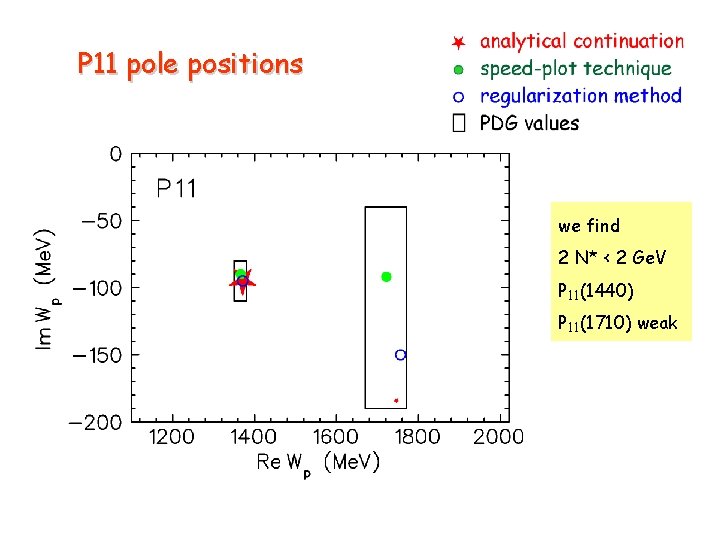
P 11 pole positions we find 2 N* < 2 Ge. V P 11(1440) P 11(1710) weak
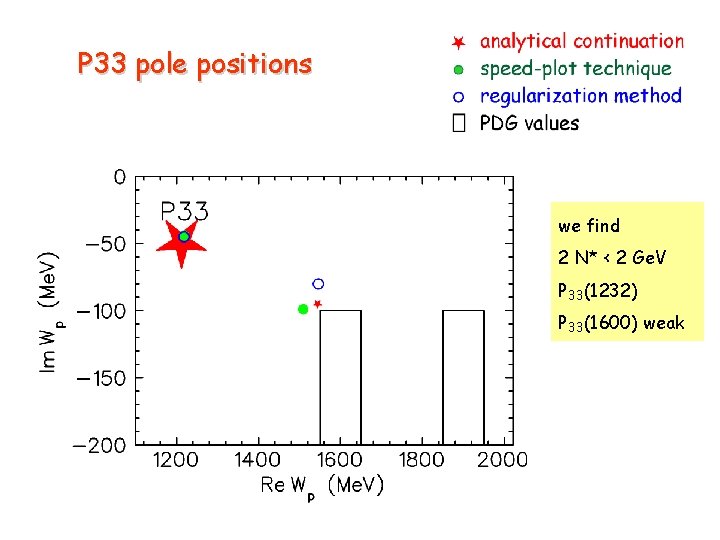
P 33 pole positions we find 2 N* < 2 Ge. V P 33(1232) P 33(1600) weak
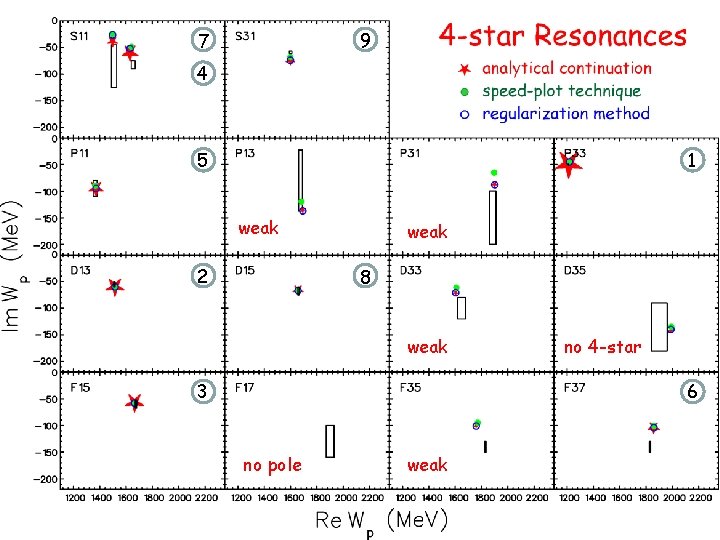
9 7 4 5 1 weak 2 weak 8 weak 3 no 4 -star 6 no pole weak
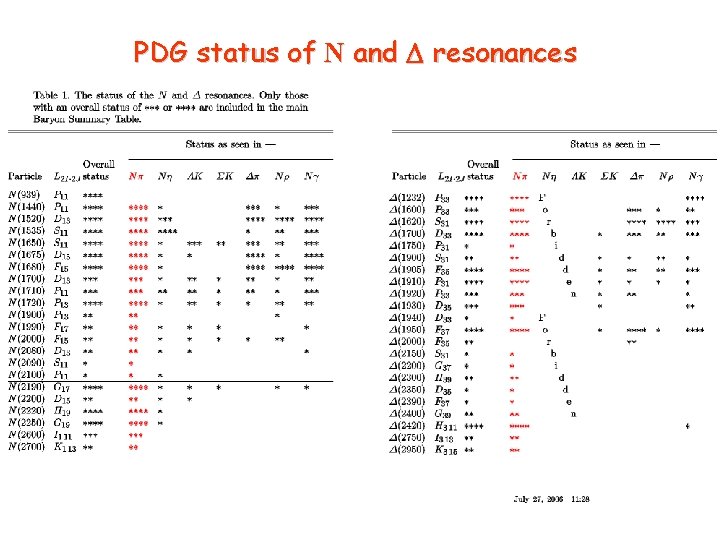
PDG status of N and D resonances
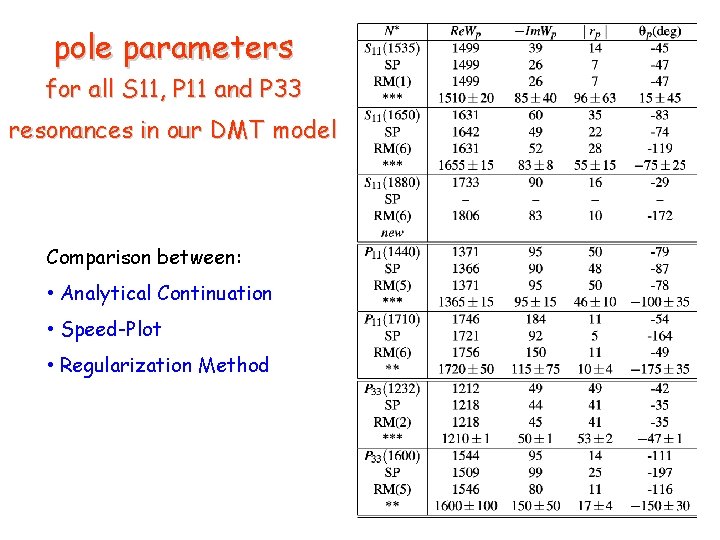
pole parameters for all S 11, P 11 and P 33 resonances in our DMT model Comparison between: • Analytical Continuation • Speed-Plot • Regularization Method
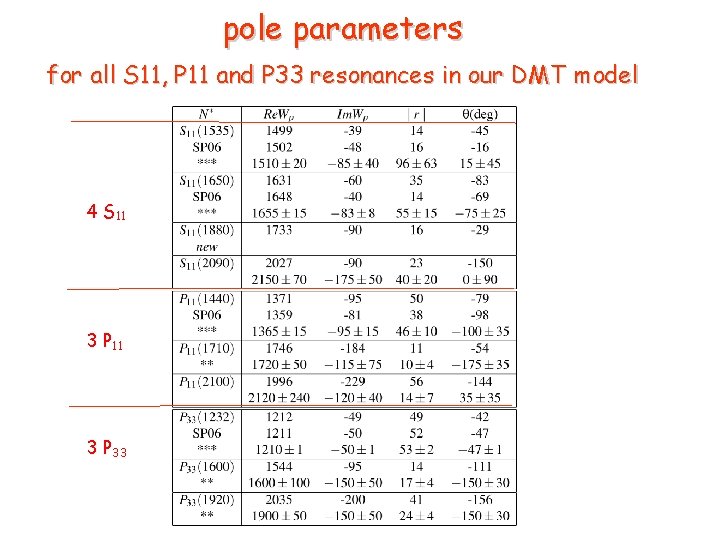
pole parameters for all S 11, P 11 and P 33 resonances in our DMT model 4 S 11 3 P 33
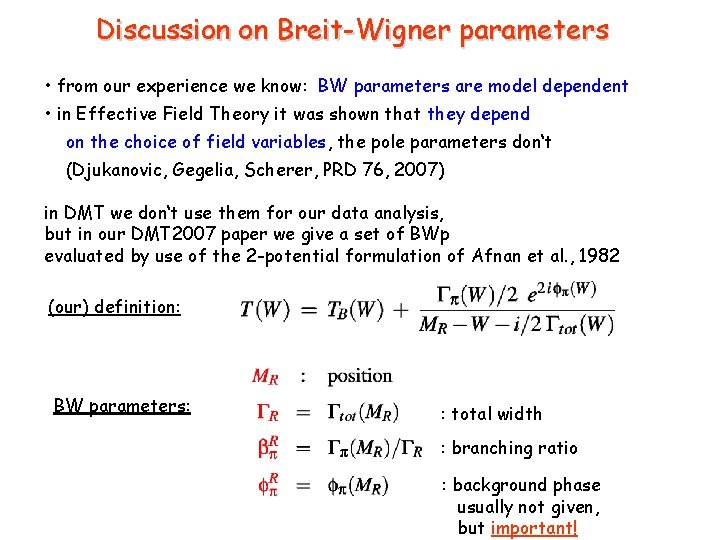
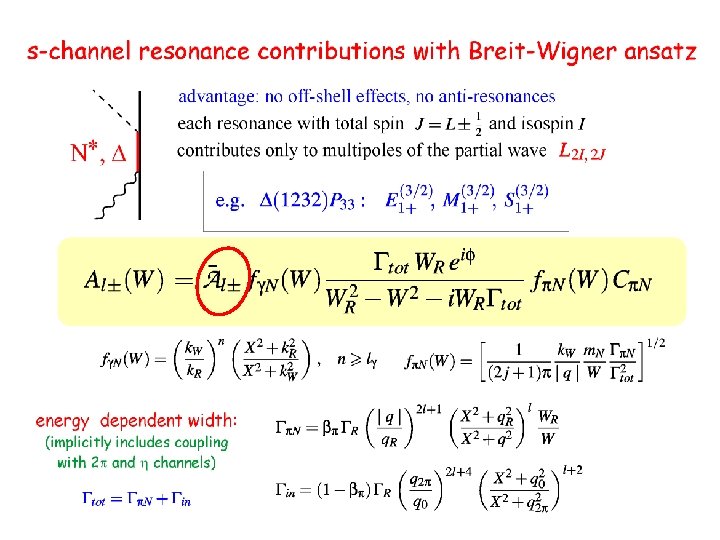
Discussion on Breit-Wigner parameters • from our experience we know: BW parameters are model dependent • in Effective Field Theory it was shown that they depend on the choice of field variables, the pole parameters don‘t (Djukanovic, Gegelia, Scherer, PRD 76, 2007) in DMT we don‘t use them for our data analysis, but in our DMT 2007 paper we give a set of BWp evaluated by use of the 2 -potential formulation of Afnan et al. , 1982 (our) definition: BW parameters: : total width : branching ratio : background phase usually not given, but important!
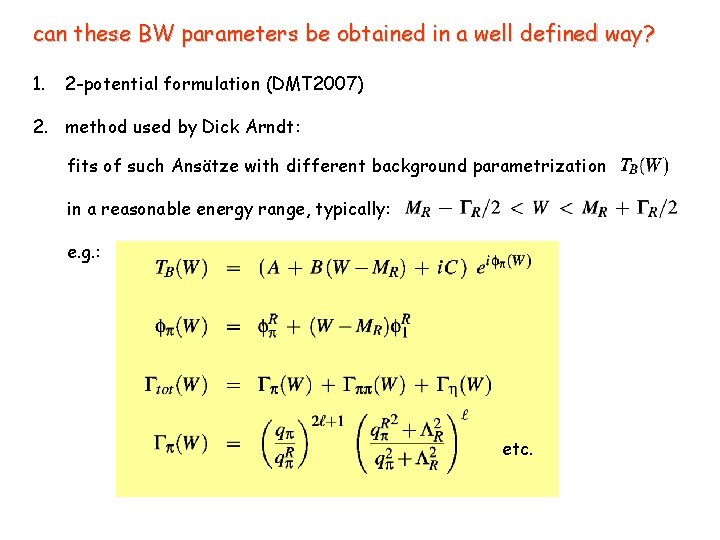
can these BW parameters be obtained in a well defined way? 1. 2 -potential formulation (DMT 2007) 2. method used by Dick Arndt: fits of such Ansätze with different background parametrization in a reasonable energy range, typically: e. g. : etc.
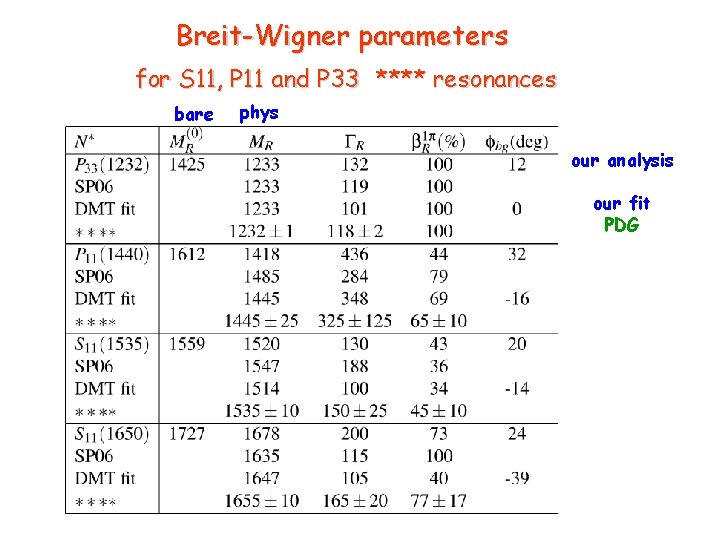
Breit-Wigner parameters for S 11, P 11 and P 33 **** resonances bare phys our analysis our fit PDG
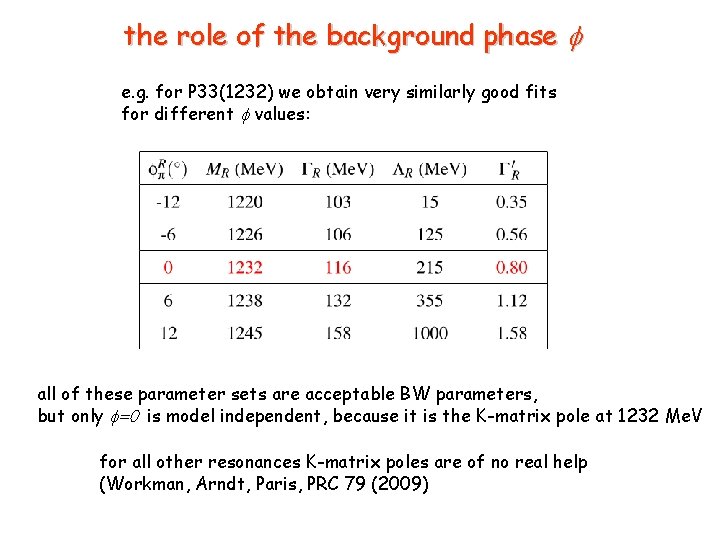
the role of the background phase f e. g. for P 33(1232) we obtain very similarly good fits for different f values: all of these parameter sets are acceptable BW parameters, but only f=0 is model independent, because it is the K-matrix pole at 1232 Me. V for all other resonances K-matrix poles are of no real help (Workman, Arndt, Paris, PRC 79 (2009)
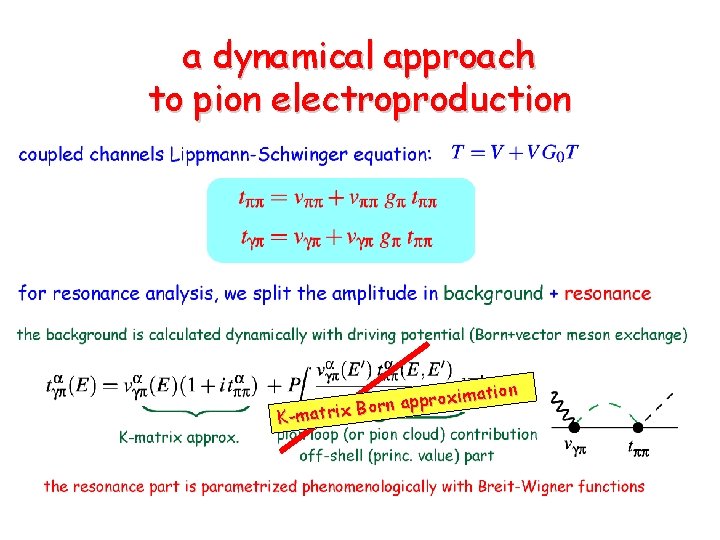
pion photo- and electroproduction
a dynamical approach to pion electroproduction imation x o r p p a n Bor K-matrix
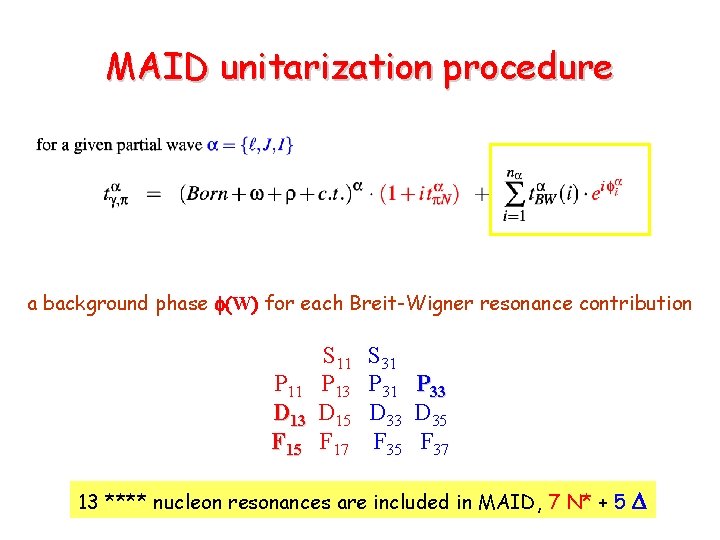
MAID unitarization procedure a background phase f(W) for each Breit-Wigner resonance contribution P 11 D 13 F 15 S 11 P 13 D 15 F 17 S 31 P 31 D 33 F 35 P 33 D 35 F 37 13 **** nucleon resonances are included in MAID, 7 N* + 5 D
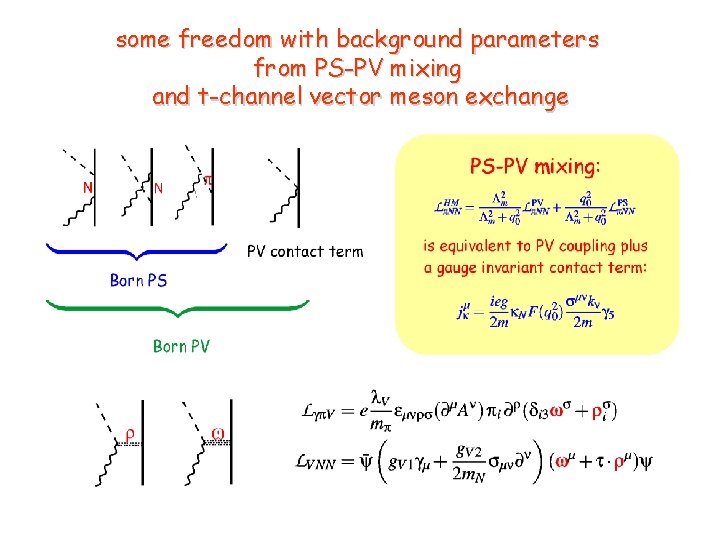
some freedom with background parameters from PS-PV mixing and t-channel vector meson exchange
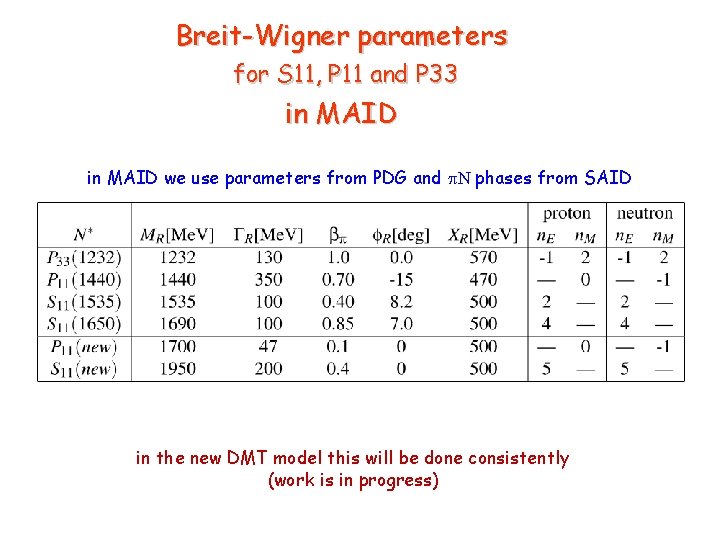
Breit-Wigner parameters for S 11, P 11 and P 33 in MAID we use parameters from PDG and p. N phases from SAID in the new DMT model this will be done consistently (work is in progress)
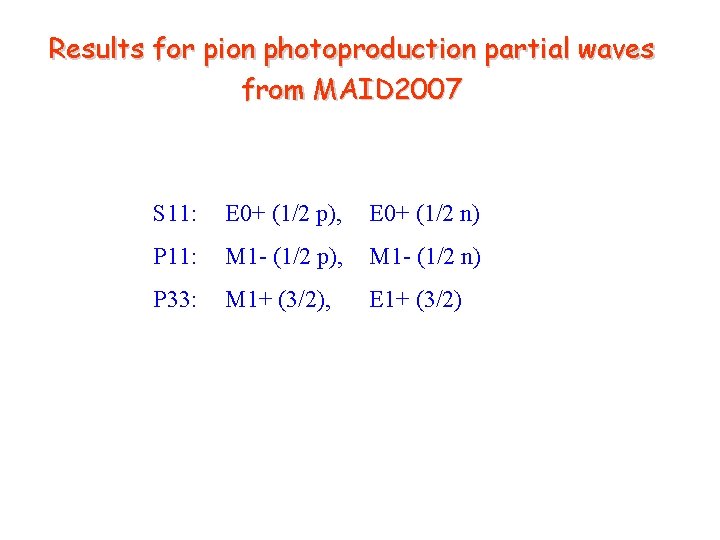
Results for pion photoproduction partial waves from MAID 2007 S 11: E 0+ (1/2 p), E 0+ (1/2 n) P 11: M 1 - (1/2 p), M 1 - (1/2 n) P 33: M 1+ (3/2), E 1+ (3/2)
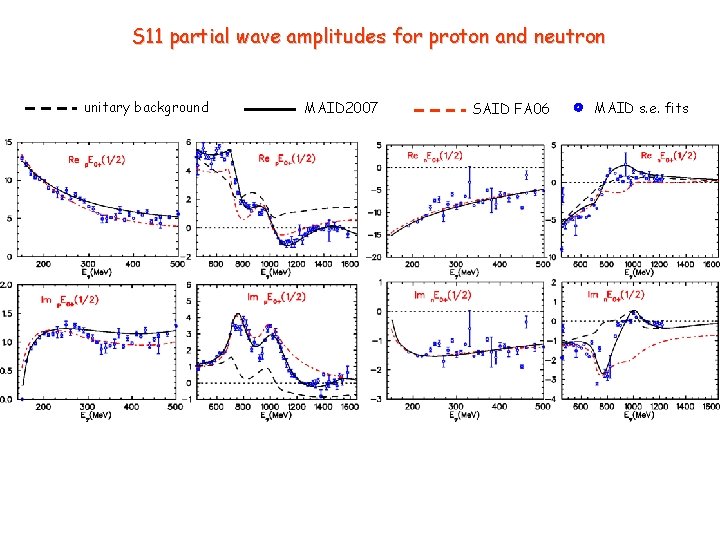
S 11 partial wave amplitudes for proton and neutron unitary background MAID 2007 SAID FA 06 MAID s. e. fits
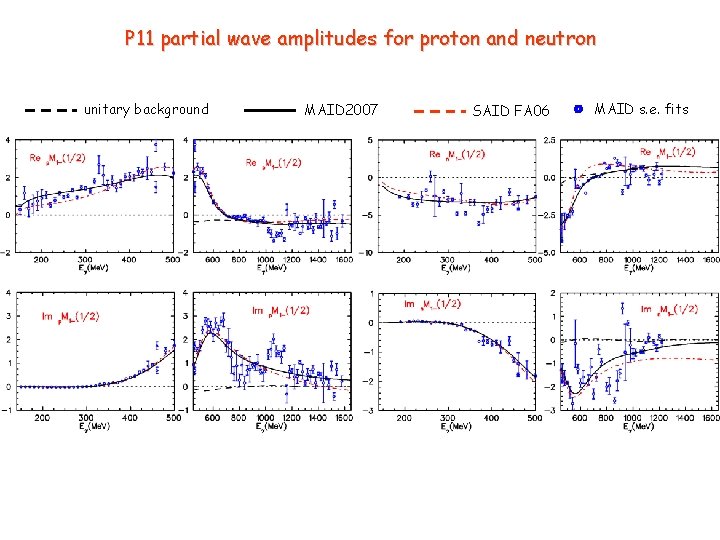
P 11 partial wave amplitudes for proton and neutron unitary background MAID 2007 SAID FA 06 MAID s. e. fits
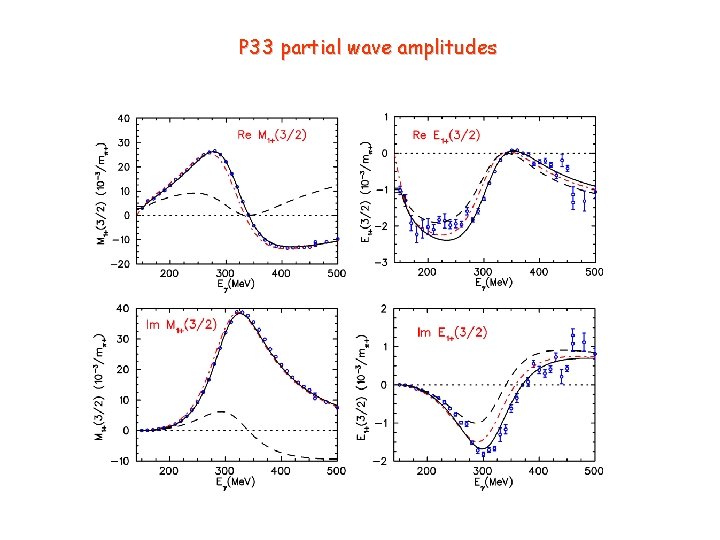
P 33 partial wave amplitudes
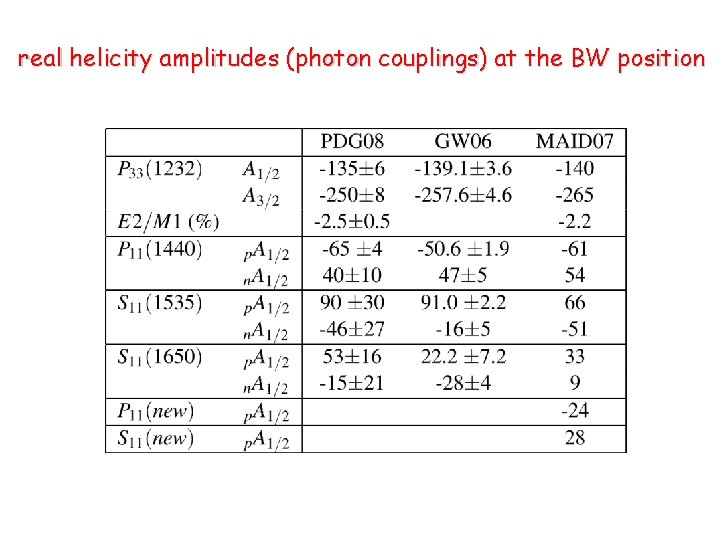
real helicity amplitudes (photon couplings) at the BW position
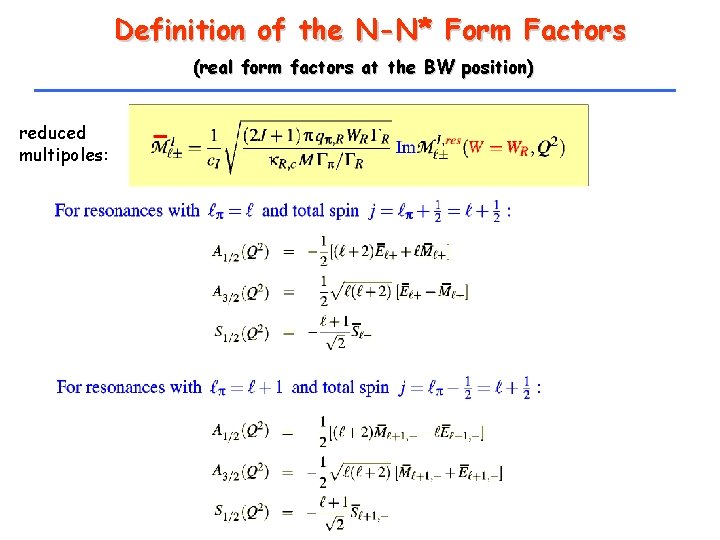
Definition of the N-N* Form Factors (real form factors at the BW position) reduced multipoles:
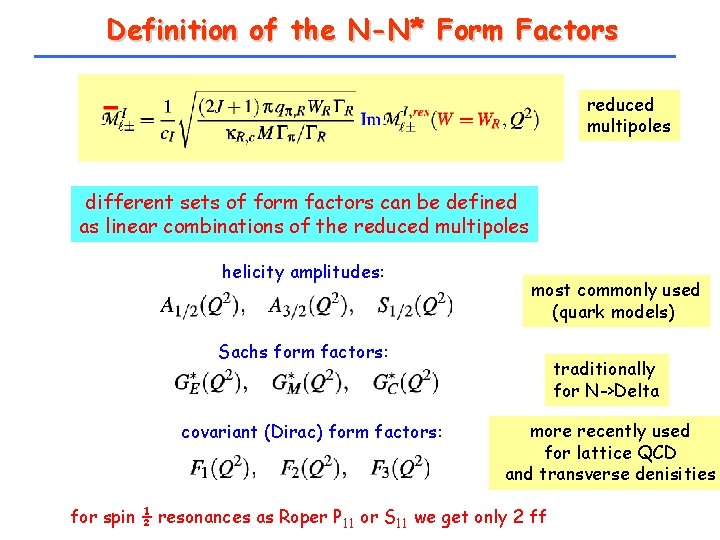
Definition of the N-N* Form Factors reduced multipoles different sets of form factors can be defined as linear combinations of the reduced multipoles helicity amplitudes: most commonly used (quark models) Sachs form factors: covariant (Dirac) form factors: traditionally for N->Delta more recently used for lattice QCD and transverse denisities for spin ½ resonances as Roper P 11 or S 11 we get only 2 ff

MAID results are available for the dominant resonances of the proton isospin form factors P 33(1232) 3/2 G E, G M , G C P 11(1440) 1/2 G M, GC D 13(1520) 1/2 3/2 G E, G M , G C S 11(1535) 1/2 G E, G C F 15(1680) 1/2 5/2 G E, G M , G C
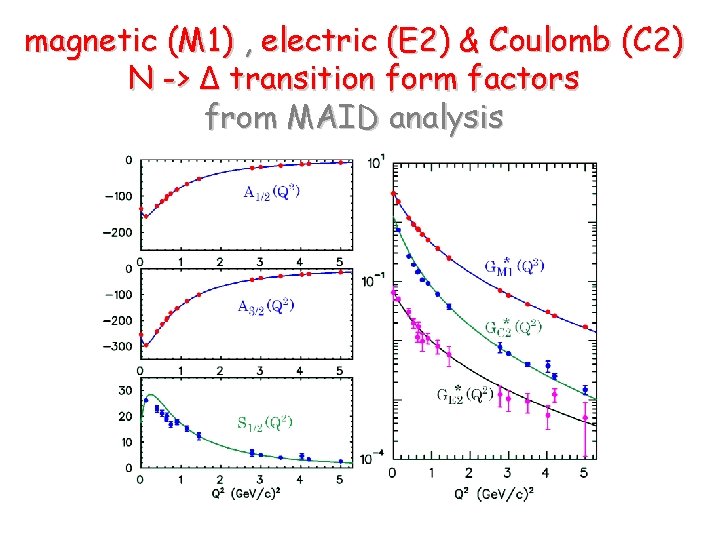
magnetic (M 1) , electric (E 2) & Coulomb (C 2) N -> Δ transition form factors from MAID analysis
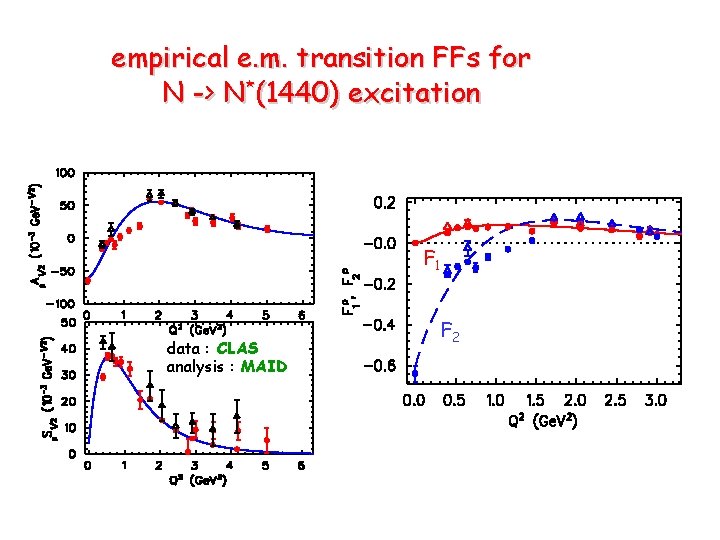
empirical e. m. transition FFs for N -> N*(1440) excitation F 1 data : CLAS analysis : MAID F 2
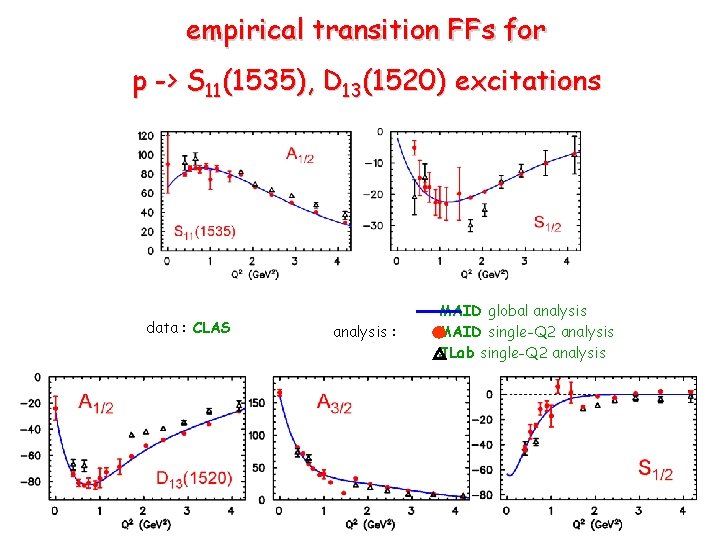
empirical transition FFs for p -> S 11(1535), D 13(1520) excitations data : CLAS analysis : MAID global analysis MAID single-Q 2 analysis JLab single-Q 2 analysis
from Breit-Wigner positions to T-matrix pole positions
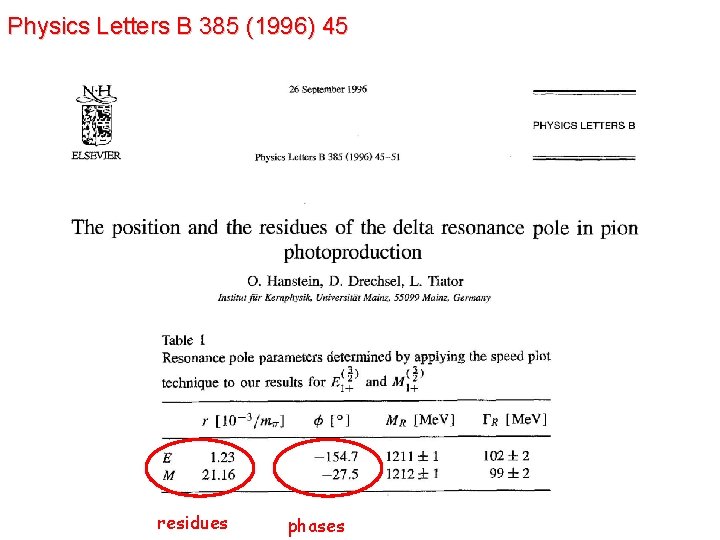
Physics Letters B 385 (1996) 45 residues phases
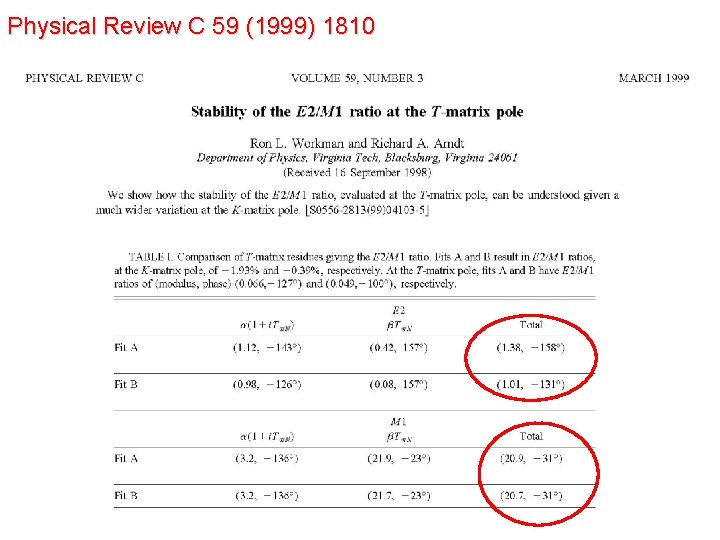
Physical Review C 59 (1999) 1810
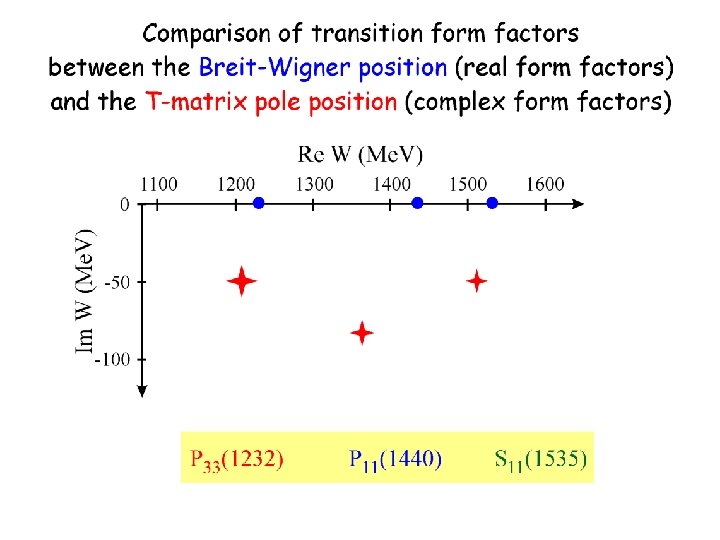
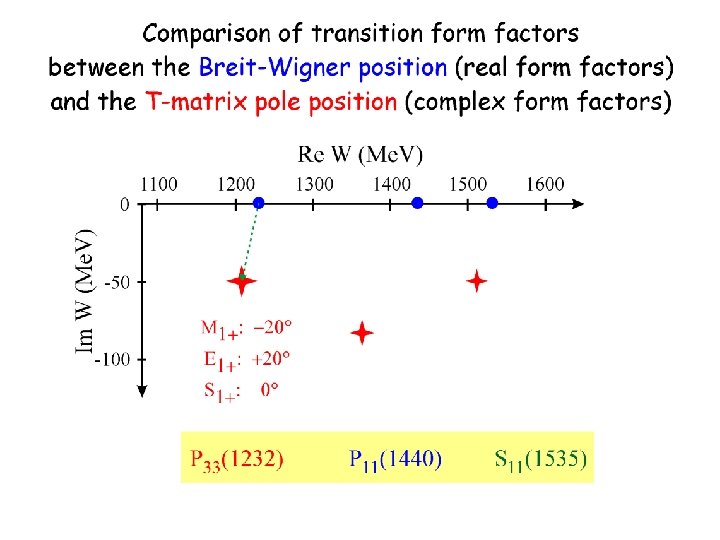
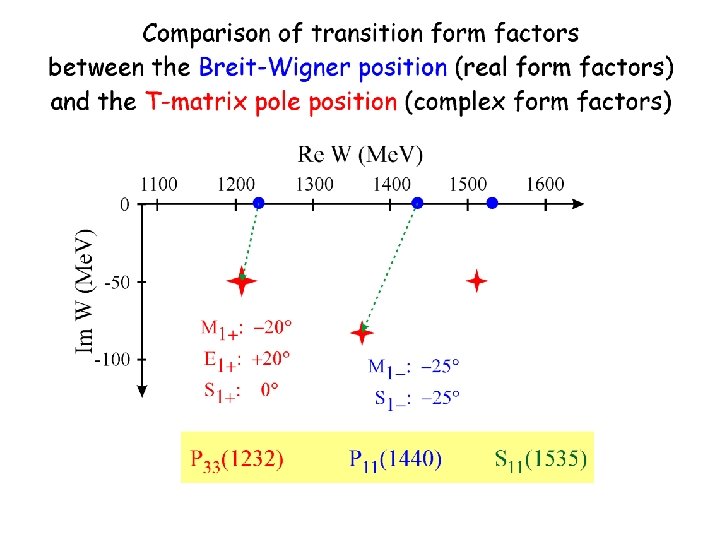
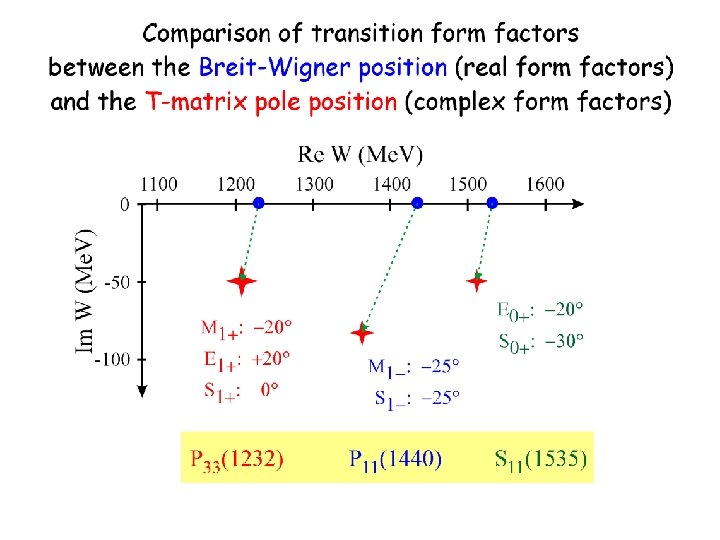
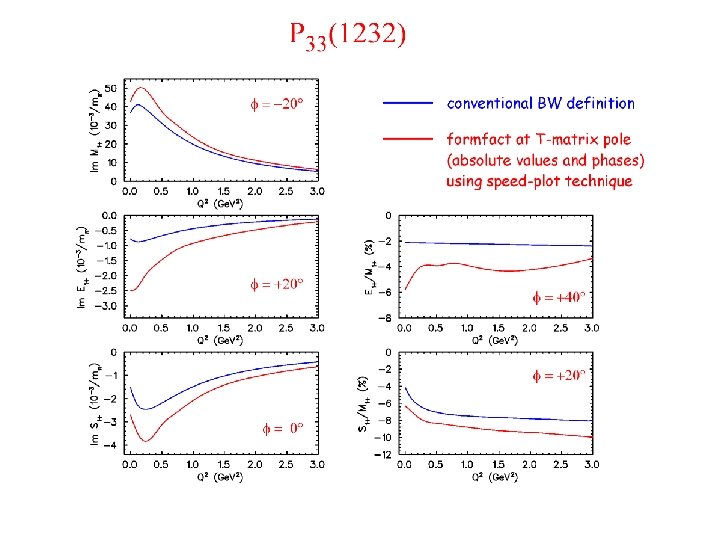
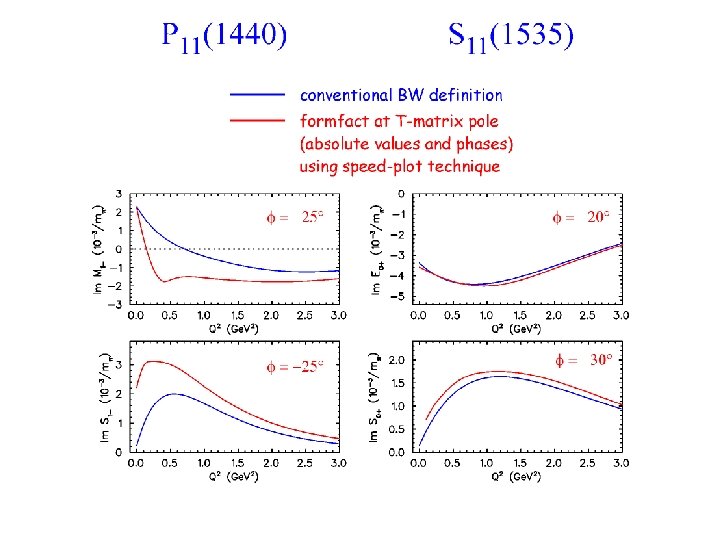
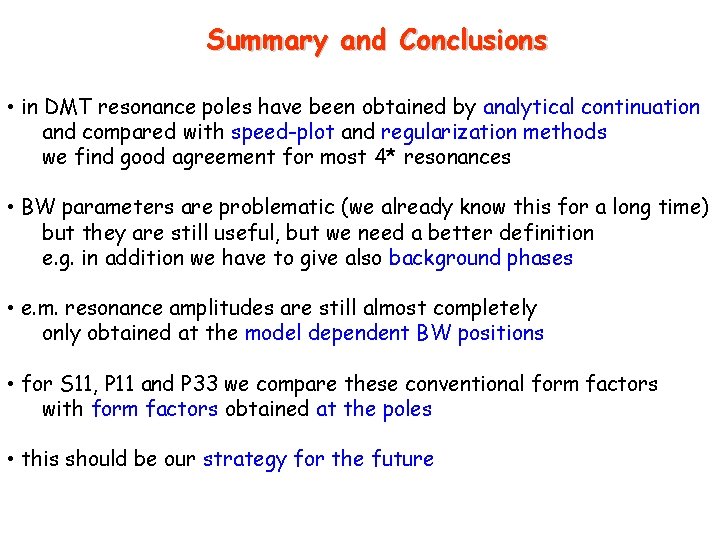
Summary and Conclusions • in DMT resonance poles have been obtained by analytical continuation and compared with speed-plot and regularization methods we find good agreement for most 4* resonances • BW parameters are problematic (we already know this for a long time) but they are still useful, but we need a better definition e. g. in addition we have to give also background phases • e. m. resonance amplitudes are still almost completely only obtained at the model dependent BW positions • for S 11, P 11 and P 33 we compare these conventional form factors with form factors obtained at the poles • this should be our strategy for the future
- Slides: 55