
The Drug Free Workplace EAP Works a division




- Slides: 69
The Drug Free Workplace EAP Works a division of North Pines Center, Inc. CEO, Ken Scroggs LPC, LCSW, LMFT, CEAP 770 -449 -1111 Ken Scroggs LPC, LCSW, LMFT, CEAP 1
Primary Objectives Provide a safe, healthy, and secure workplace; 2. Ensure that all employees perform their job duties in a safe, efficient and productive manner; 3. Ensure equipment and facilities do not pose undue risk or harm: 1. a. b. 4. Properly maintained, and Operated appropriately “Drug and Alcohol Free Workplace” policy protects health, safety, & welfare of employees and citizens Ken Scroggs LPC, LCSW, LMFT, CEAP 2
Training Objectives By the end of this class, you will be able to: 1. Effectively discuss Drug Free Workplace policy 2. Identify signs and symptoms of possible drug use and alcohol misuse 3. Know how to document behaviors leading to “reasonable suspicion” 4. Know the legal issues surrounding this policy 5. Use the Employee Assistance Program, EAP, as a valuable referral source Ken Scroggs LPC, LCSW, LMFT, CEAP 3
For Your Safety These Tests Have Been Made Legal 1. 2. 3. 4. 5. 6. 7. Pre-Employment Random (optional, check with your HR dept) After-Care Return to Duty Reasonable Suspicion Post Accident Consent Ken Scroggs LPC, LCSW, LMFT, CEAP 4
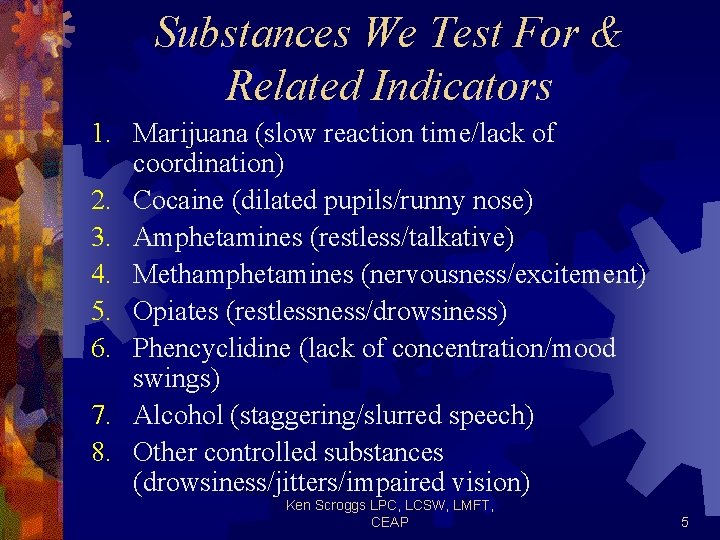
Substances We Test For & Related Indicators 1. Marijuana (slow reaction time/lack of coordination) 2. Cocaine (dilated pupils/runny nose) 3. Amphetamines (restless/talkative) 4. Methamphetamines (nervousness/excitement) 5. Opiates (restlessness/drowsiness) 6. Phencyclidine (lack of concentration/mood swings) 7. Alcohol (staggering/slurred speech) 8. Other controlled substances (drowsiness/jitters/impaired vision) Ken Scroggs LPC, LCSW, LMFT, CEAP 5
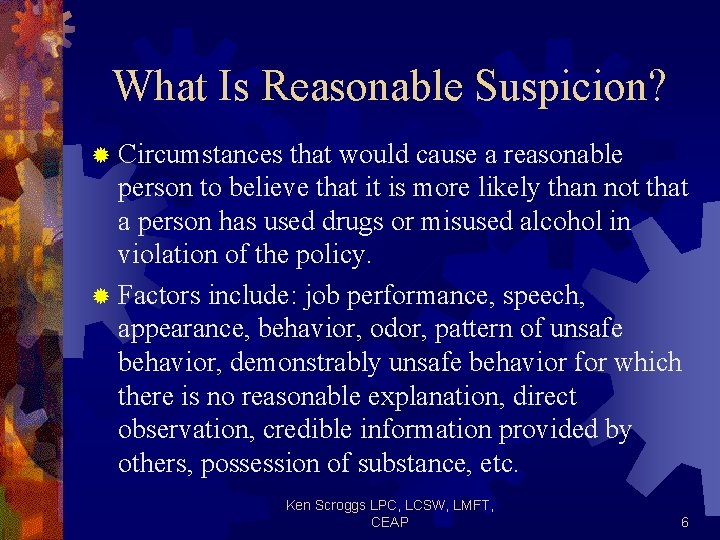
What Is Reasonable Suspicion? ® Circumstances that would cause a reasonable person to believe that it is more likely than not that a person has used drugs or misused alcohol in violation of the policy. ® Factors include: job performance, speech, appearance, behavior, odor, pattern of unsafe behavior, demonstrably unsafe behavior for which there is no reasonable explanation, direct observation, credible information provided by others, possession of substance, etc. Ken Scroggs LPC, LCSW, LMFT, CEAP 6
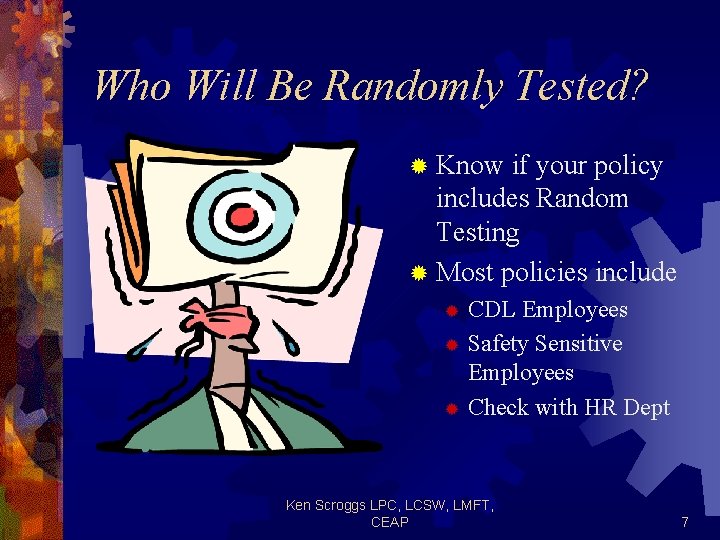
Who Will Be Randomly Tested? ® Know if your policy includes Random Testing ® Most policies include CDL Employees ® Safety Sensitive Employees ® Check with HR Dept ® Ken Scroggs LPC, LCSW, LMFT, CEAP 7
SUPERVISORS ARE THE FRONT LINE!!! ® Responsible for: Realizing and recognizing potential problem(s) ® Looking for indicators ® ® We rely on you for: Documenting changes over time ® Having multiple indicators, since taken alone, each indicator could be caused by something other than substance abuse ® Ken Scroggs LPC, LCSW, LMFT, CEAP 8
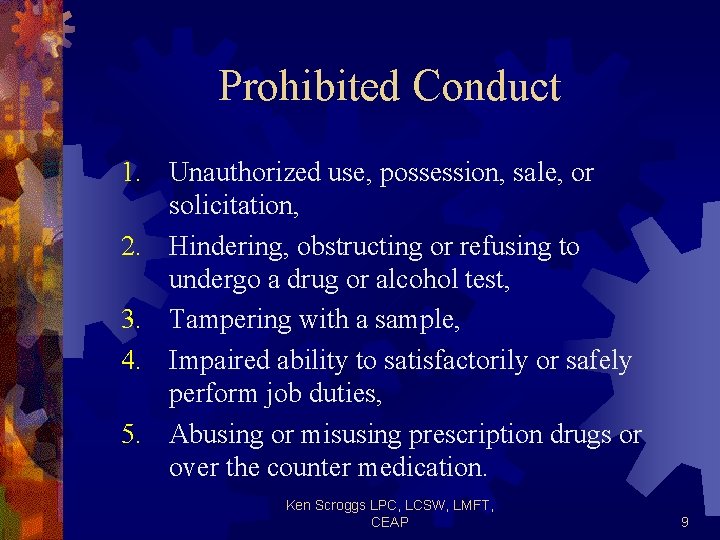
Prohibited Conduct 1. Unauthorized use, possession, sale, or solicitation, 2. Hindering, obstructing or refusing to undergo a drug or alcohol test, 3. Tampering with a sample, 4. Impaired ability to satisfactorily or safely perform job duties, 5. Abusing or misusing prescription drugs or over the counter medication. Ken Scroggs LPC, LCSW, LMFT, CEAP 9
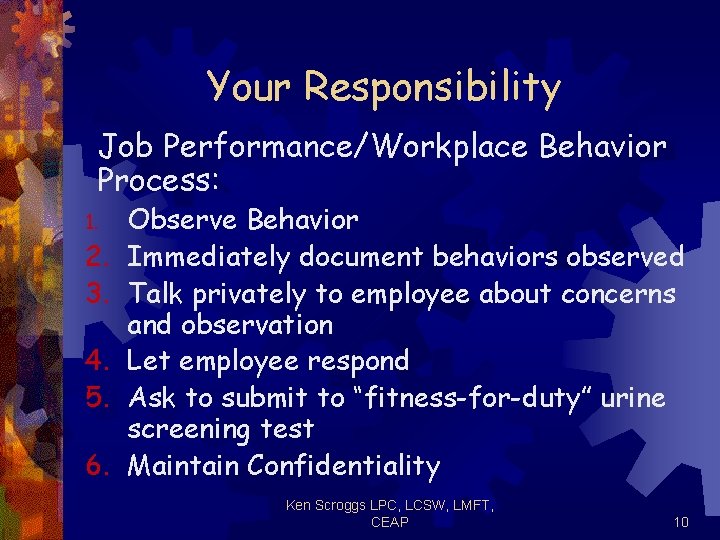
Your Responsibility Job Performance/Workplace Behavior Process: 1. 2. 3. 4. 5. 6. Observe Behavior Immediately document behaviors observed Talk privately to employee about concerns and observation Let employee respond Ask to submit to “fitness-for-duty” urine screening test Maintain Confidentiality Ken Scroggs LPC, LCSW, LMFT, CEAP 10
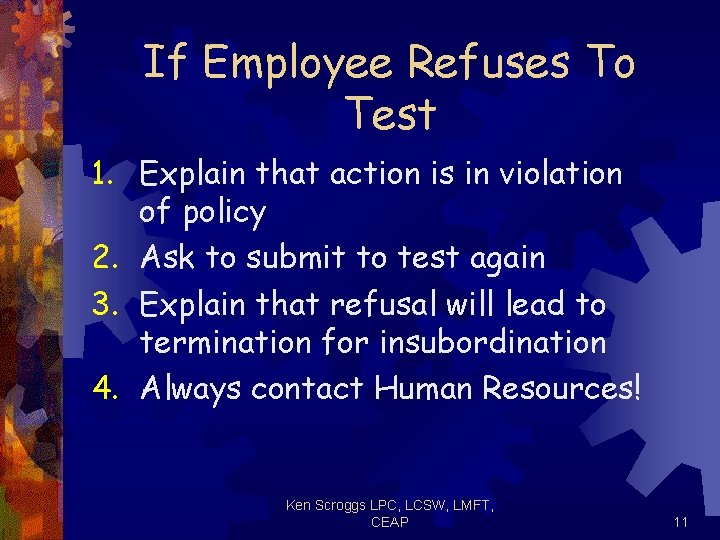
If Employee Refuses To Test 1. Explain that action is in violation of policy 2. Ask to submit to test again 3. Explain that refusal will lead to termination for insubordination 4. Always contact Human Resources! Ken Scroggs LPC, LCSW, LMFT, CEAP 11
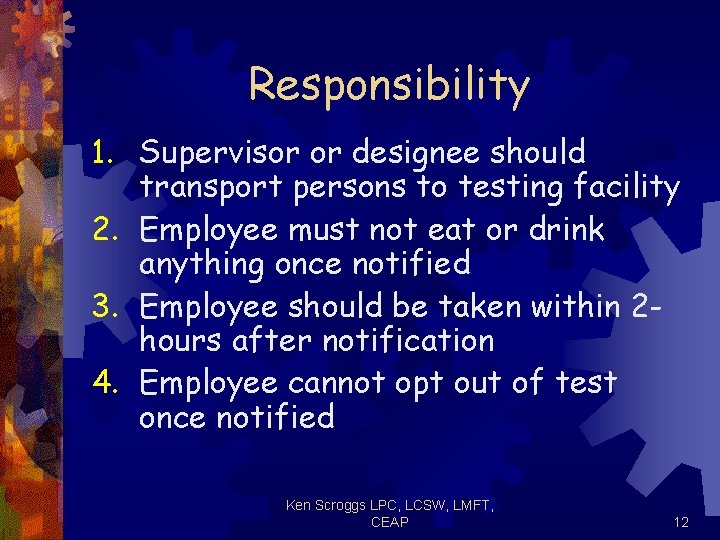
Responsibility 1. Supervisor or designee should transport persons to testing facility 2. Employee must not eat or drink anything once notified 3. Employee should be taken within 2 hours after notification 4. Employee cannot opt out of test once notified Ken Scroggs LPC, LCSW, LMFT, CEAP 12
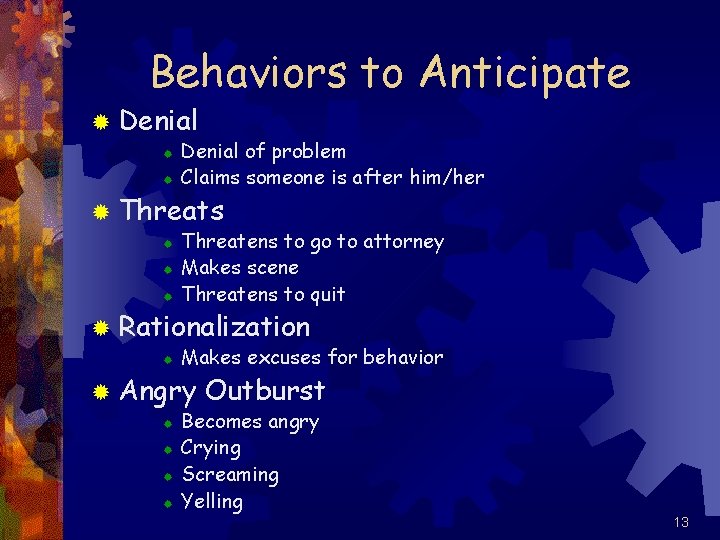
Behaviors to Anticipate ® Denial ® ® Denial of problem Claims someone is after him/her ® Threats ® ® ® Threatens to go to attorney Makes scene Threatens to quit ® Rationalization ® Makes excuses for behavior ® Angry ® ® Outburst Becomes angry Crying Screaming Yelling 13
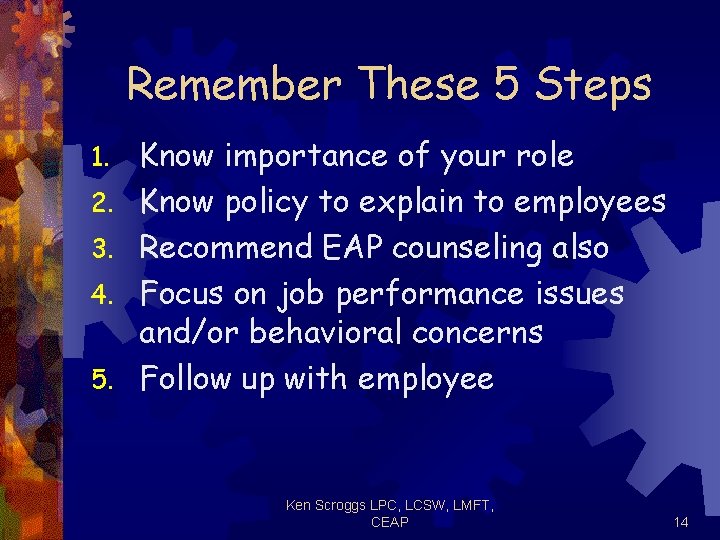
Remember These 5 Steps 1. 2. 3. 4. 5. Know importance of your role Know policy to explain to employees Recommend EAP counseling also Focus on job performance issues and/or behavioral concerns Follow up with employee Ken Scroggs LPC, LCSW, LMFT, CEAP 14
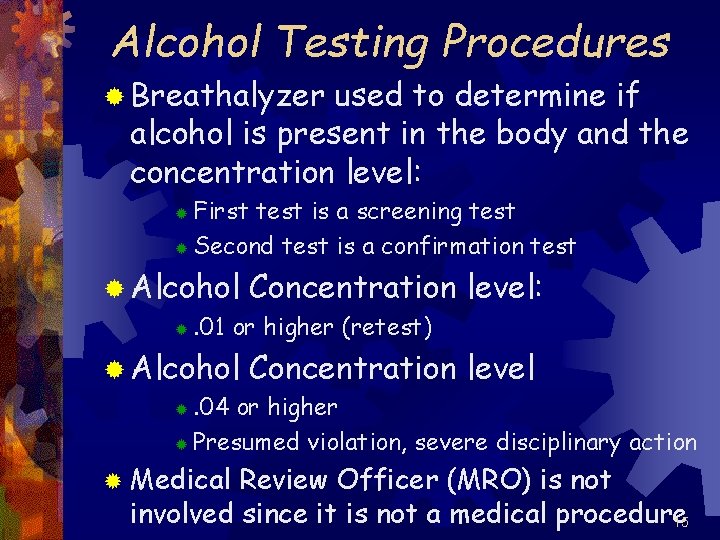
Alcohol Testing Procedures ® Breathalyzer used to determine if alcohol is present in the body and the concentration level: First test is a screening test ® Second test is a confirmation test ® ® Alcohol ® Concentration level: . 01 or higher (retest) ® Alcohol Concentration level . 04 or higher ® Presumed violation, severe disciplinary action ® ® Medical Review Officer (MRO) is not involved since it is not a medical procedure 15
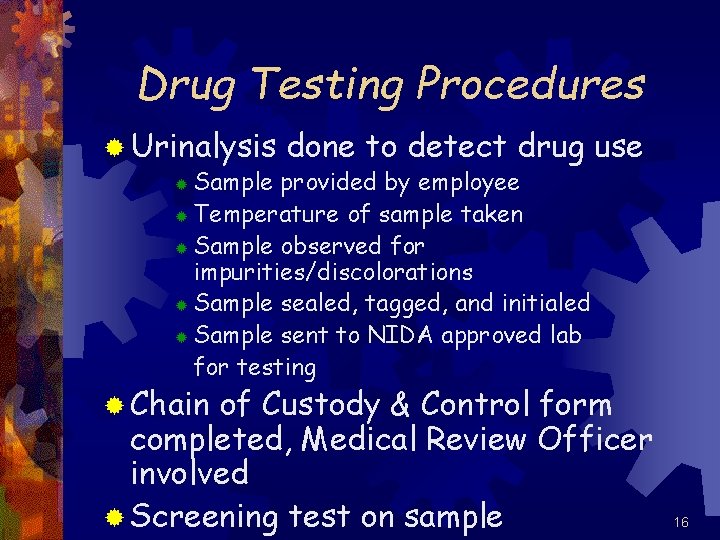
Drug Testing Procedures ® Urinalysis done to detect drug use Sample provided by employee ® Temperature of sample taken ® Sample observed for impurities/discolorations ® Sample sealed, tagged, and initialed ® Sample sent to NIDA approved lab for testing ® ® Chain of Custody & Control form completed, Medical Review Officer involved ® Screening test on sample 16
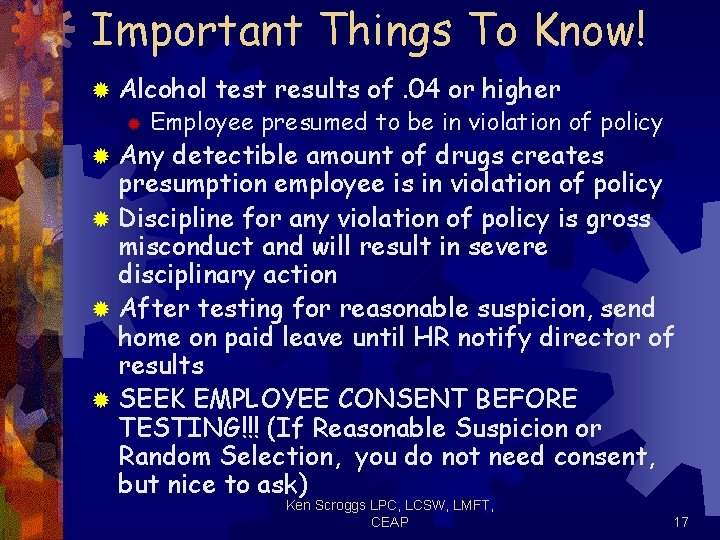
Important Things To Know! ® Alcohol test results of. 04 or higher ® Employee presumed to be in violation of policy Any detectible amount of drugs creates presumption employee is in violation of policy ® Discipline for any violation of policy is gross misconduct and will result in severe disciplinary action ® After testing for reasonable suspicion, send home on paid leave until HR notify director of results ® SEEK EMPLOYEE CONSENT BEFORE TESTING!!! (If Reasonable Suspicion or Random Selection, you do not need consent, but nice to ask) ® Ken Scroggs LPC, LCSW, LMFT, CEAP 17
Silence Is Golden ® Only authorized person(s) will be notified of test results ® Violation of confidentiality is considered gross misconduct and appropriate disciplinary action will follow Ken Scroggs LPC, LCSW, LMFT, CEAP 18
Testing Facility Location Check with your HR dept for the approved testing location ® Most often the company provides you the paperwork to take with you to the testing site ® Ken Scroggs LPC, LCSW, LMFT, CEAP 19
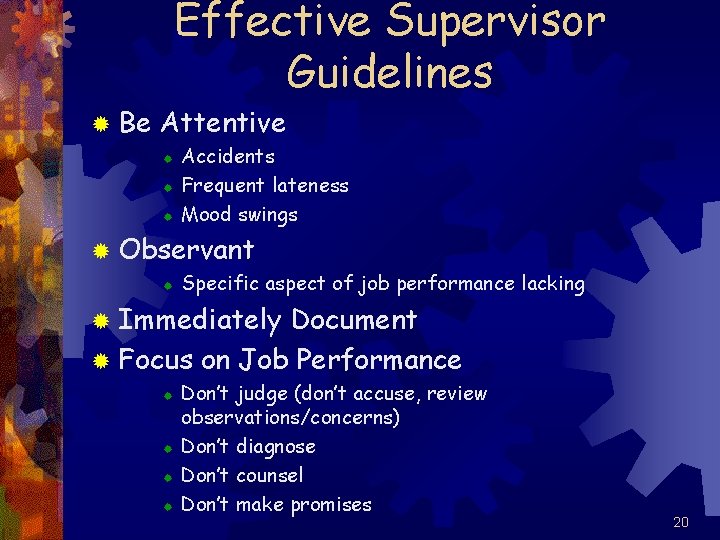
Effective Supervisor Guidelines ® Be Attentive ® ® ® Accidents Frequent lateness Mood swings ® Observant ® Specific aspect of job performance lacking ® Immediately Document ® Focus on Job Performance ® ® Don’t judge (don’t accuse, review observations/concerns) Don’t diagnose Don’t counsel Don’t make promises 20
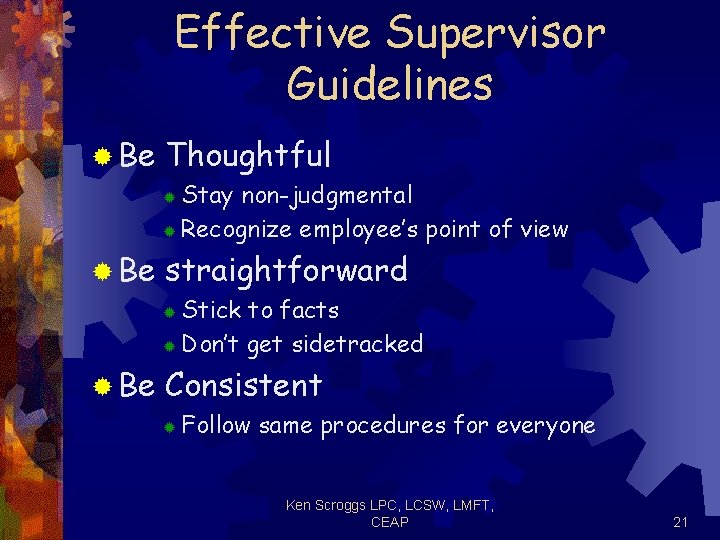
Effective Supervisor Guidelines ® Be Thoughtful Stay non-judgmental ® Recognize employee’s point of view ® ® Be straightforward Stick to facts ® Don’t get sidetracked ® ® Be Consistent ® Follow same procedures for everyone Ken Scroggs LPC, LCSW, LMFT, CEAP 21
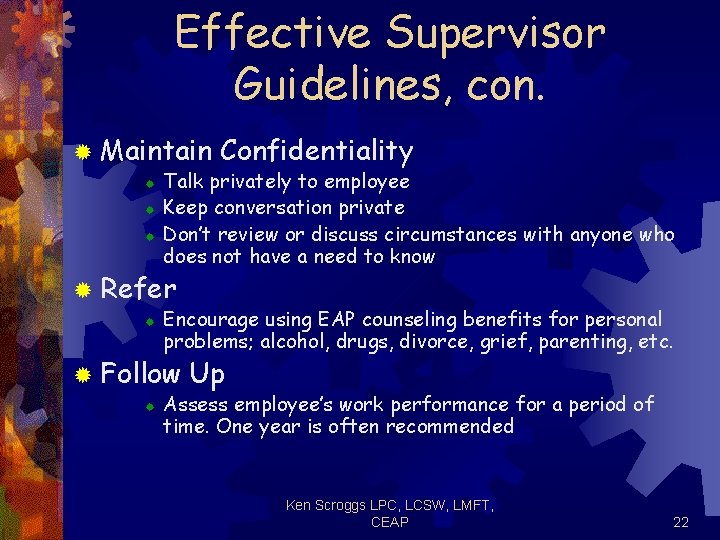
Effective Supervisor Guidelines, con. ® Maintain ® ® ® Confidentiality Talk privately to employee Keep conversation private Don’t review or discuss circumstances with anyone who does not have a need to know ® Refer ® Encourage using EAP counseling benefits for personal problems; alcohol, drugs, divorce, grief, parenting, etc. ® Follow ® Up Assess employee’s work performance for a period of time. One year is often recommended Ken Scroggs LPC, LCSW, LMFT, CEAP 22
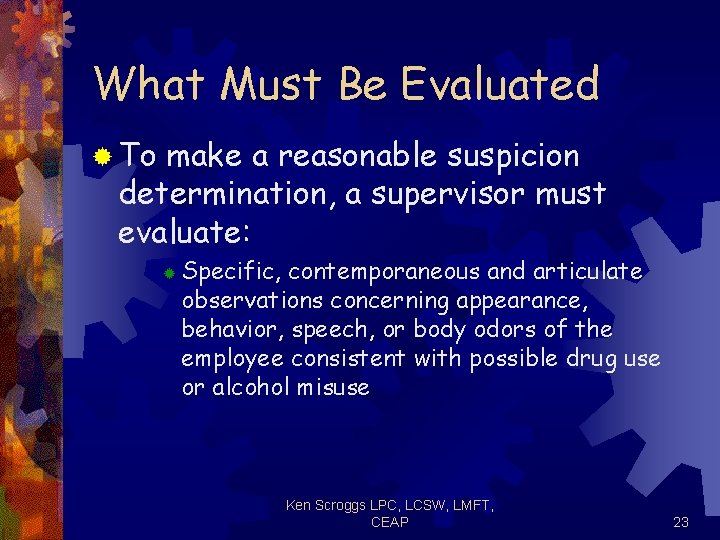
What Must Be Evaluated ® To make a reasonable suspicion determination, a supervisor must evaluate: ® Specific, contemporaneous and articulate observations concerning appearance, behavior, speech, or body odors of the employee consistent with possible drug use or alcohol misuse Ken Scroggs LPC, LCSW, LMFT, CEAP 23
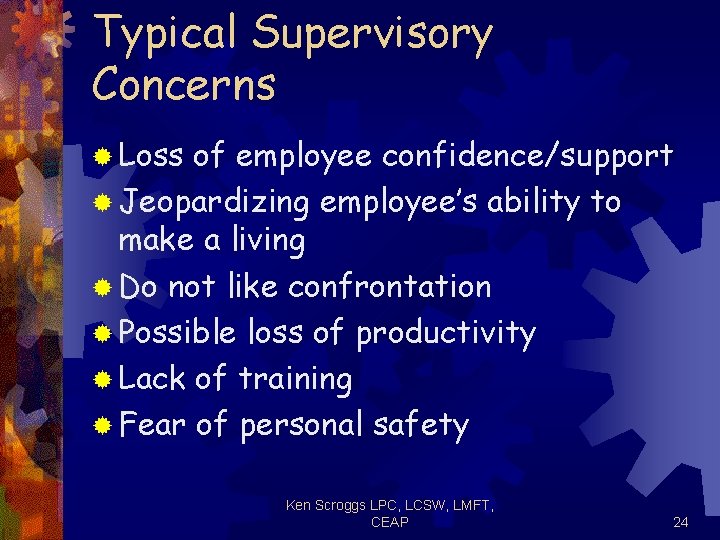
Typical Supervisory Concerns ® Loss of employee confidence/support ® Jeopardizing employee’s ability to make a living ® Do not like confrontation ® Possible loss of productivity ® Lack of training ® Fear of personal safety Ken Scroggs LPC, LCSW, LMFT, CEAP 24
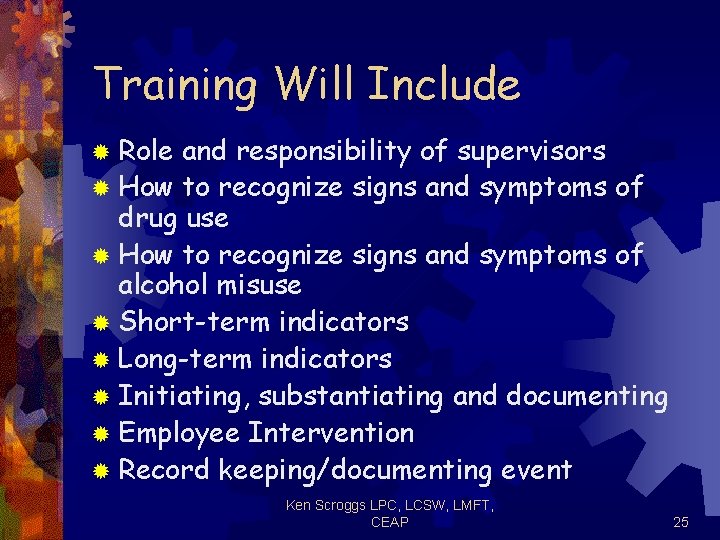
Training Will Include ® Role and responsibility of supervisors ® How to recognize signs and symptoms of drug use ® How to recognize signs and symptoms of alcohol misuse ® Short-term indicators ® Long-term indicators ® Initiating, substantiating and documenting ® Employee Intervention ® Record keeping/documenting event Ken Scroggs LPC, LCSW, LMFT, CEAP 25
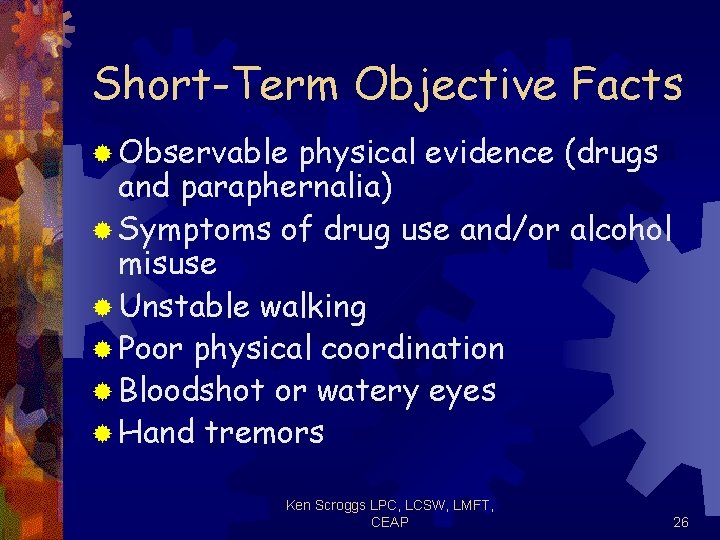
Short-Term Objective Facts ® Observable physical evidence (drugs and paraphernalia) ® Symptoms of drug use and/or alcohol misuse ® Unstable walking ® Poor physical coordination ® Bloodshot or watery eyes ® Hand tremors Ken Scroggs LPC, LCSW, LMFT, CEAP 26
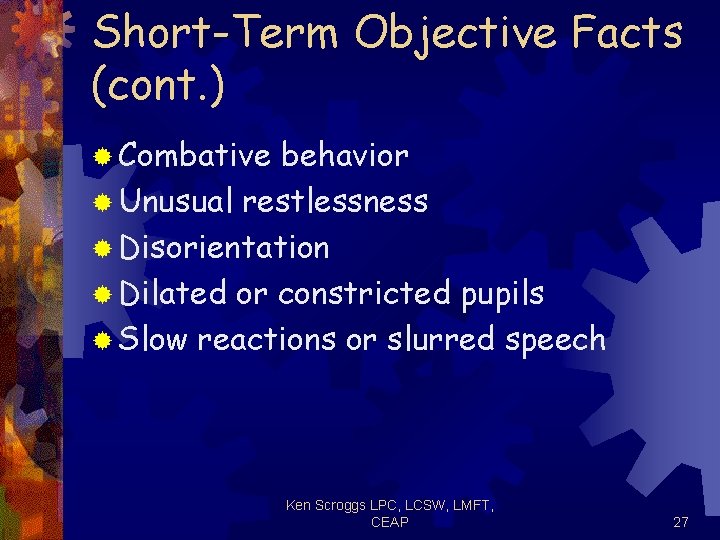
Short-Term Objective Facts (cont. ) ® Combative behavior ® Unusual restlessness ® Disorientation ® Dilated or constricted pupils ® Slow reactions or slurred speech Ken Scroggs LPC, LCSW, LMFT, CEAP 27
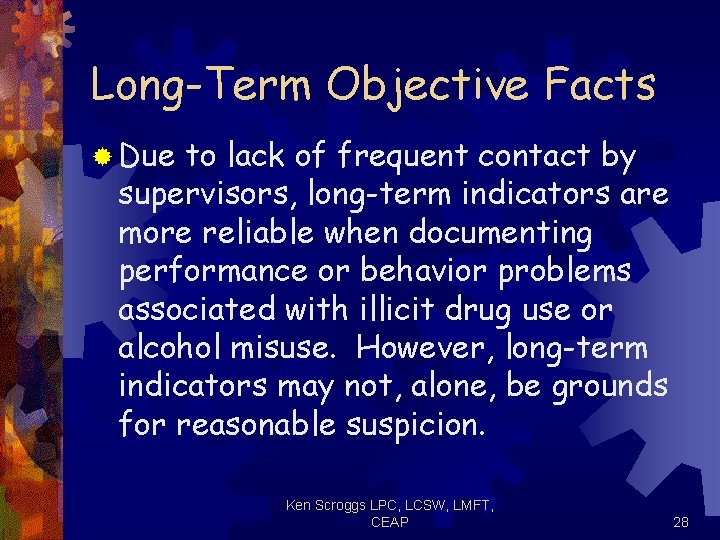
Long-Term Objective Facts ® Due to lack of frequent contact by supervisors, long-term indicators are more reliable when documenting performance or behavior problems associated with illicit drug use or alcohol misuse. However, long-term indicators may not, alone, be grounds for reasonable suspicion. Ken Scroggs LPC, LCSW, LMFT, CEAP 28
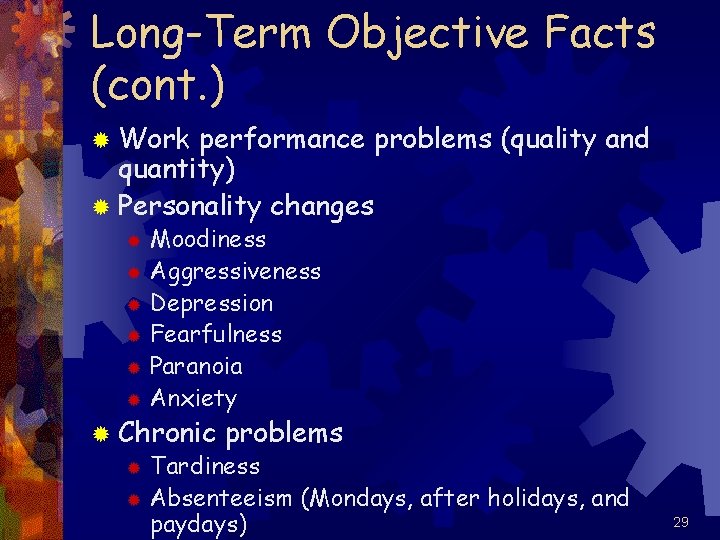
Long-Term Objective Facts (cont. ) ® Work performance problems (quality and quantity) ® Personality changes Moodiness ® Aggressiveness ® Depression ® Fearfulness ® Paranoia ® Anxiety ® ® Chronic problems ® Tardiness ® Absenteeism (Mondays, after holidays, and paydays) 29
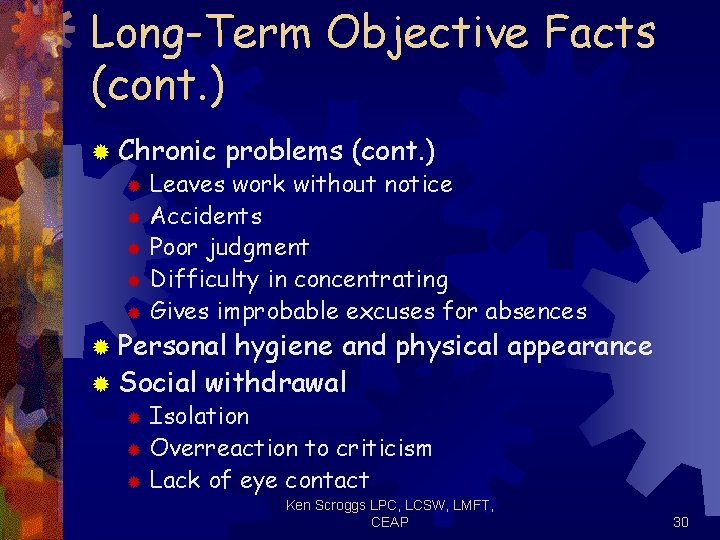
Long-Term Objective Facts (cont. ) ® Chronic problems (cont. ) ® Leaves work without notice ® Accidents ® Poor judgment ® Difficulty in concentrating ® Gives improbable excuses for absences ® Personal hygiene and physical appearance ® Social withdrawal Isolation ® Overreaction to criticism ® Lack of eye contact ® Ken Scroggs LPC, LCSW, LMFT, CEAP 30
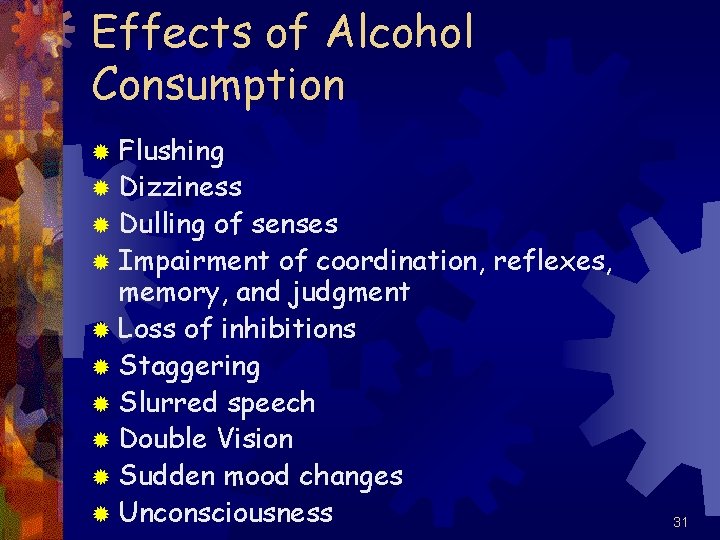
Effects of Alcohol Consumption ® Flushing ® Dizziness ® Dulling of senses ® Impairment of coordination, reflexes, memory, and judgment ® Loss of inhibitions ® Staggering ® Slurred speech ® Double Vision ® Sudden mood changes ® Unconsciousness 31
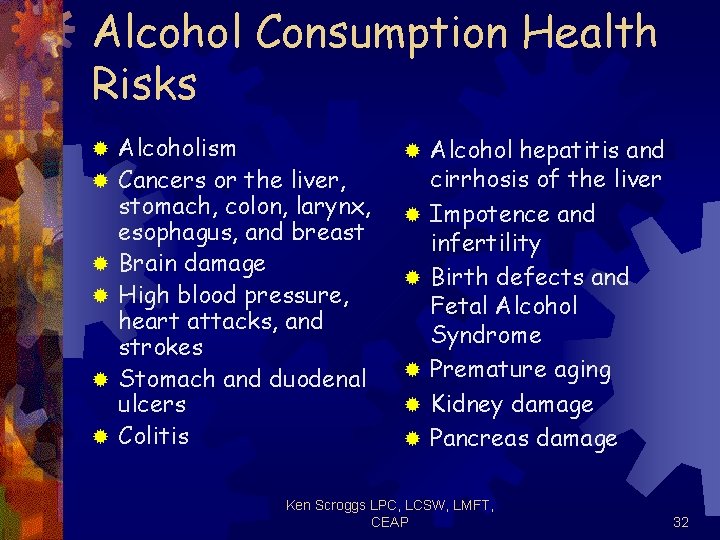
Alcohol Consumption Health Risks ® ® ® Alcoholism Cancers or the liver, stomach, colon, larynx, esophagus, and breast Brain damage High blood pressure, heart attacks, and strokes Stomach and duodenal ulcers Colitis ® ® ® Alcohol hepatitis and cirrhosis of the liver Impotence and infertility Birth defects and Fetal Alcohol Syndrome Premature aging Kidney damage Pancreas damage Ken Scroggs LPC, LCSW, LMFT, CEAP 32
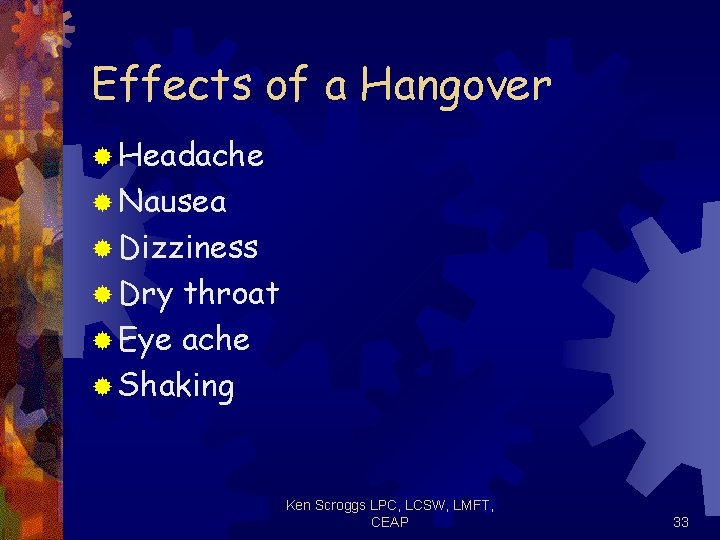
Effects of a Hangover ® Headache ® Nausea ® Dizziness ® Dry throat ® Eye ache ® Shaking Ken Scroggs LPC, LCSW, LMFT, CEAP 33
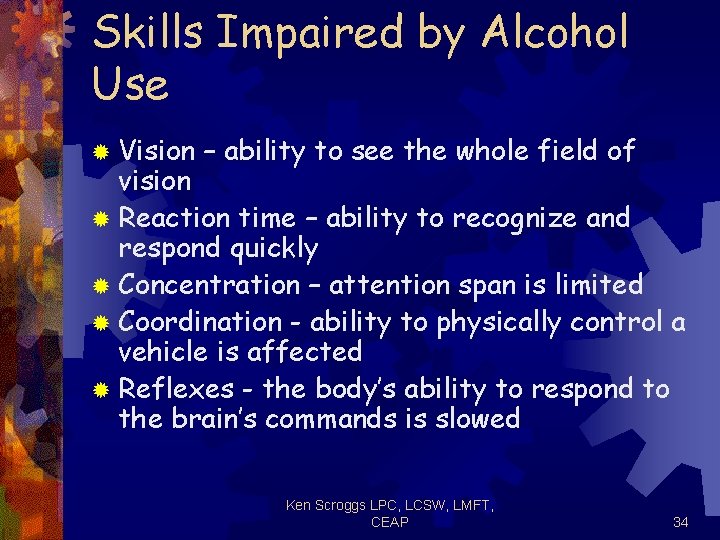
Skills Impaired by Alcohol Use ® Vision – ability to see the whole field of vision ® Reaction time – ability to recognize and respond quickly ® Concentration – attention span is limited ® Coordination - ability to physically control a vehicle is affected ® Reflexes - the body’s ability to respond to the brain’s commands is slowed Ken Scroggs LPC, LCSW, LMFT, CEAP 34
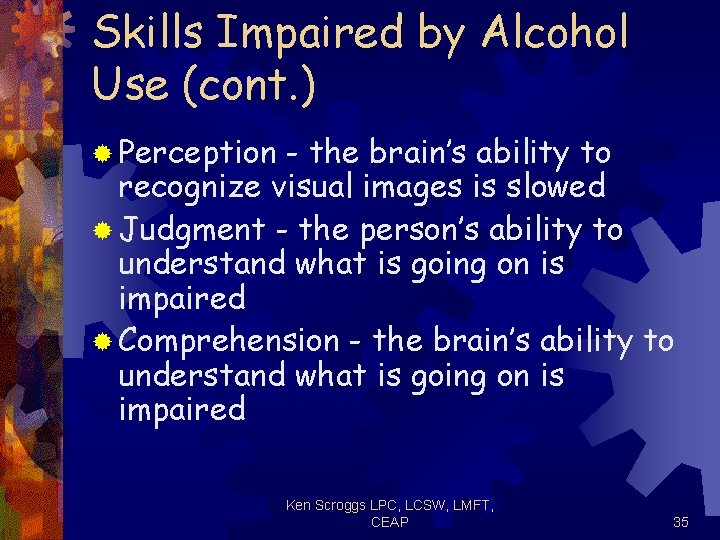
Skills Impaired by Alcohol Use (cont. ) ® Perception - the brain’s ability to recognize visual images is slowed ® Judgment - the person’s ability to understand what is going on is impaired ® Comprehension - the brain’s ability to understand what is going on is impaired Ken Scroggs LPC, LCSW, LMFT, CEAP 35
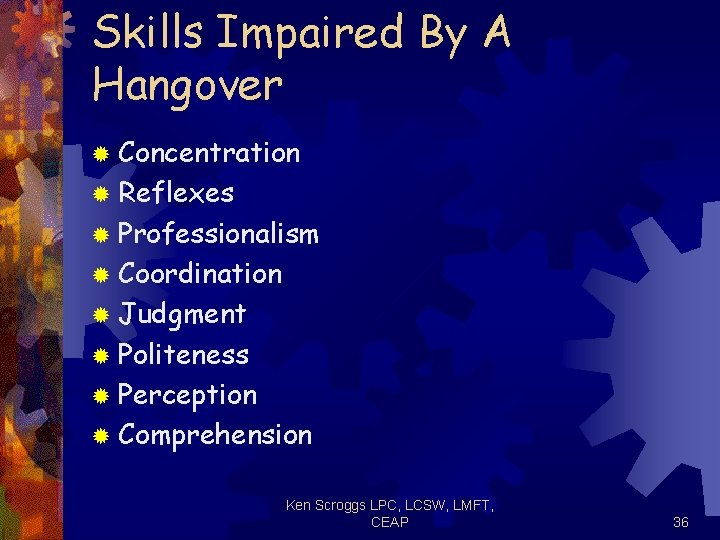
Skills Impaired By A Hangover ® Concentration ® Reflexes ® Professionalism ® Coordination ® Judgment ® Politeness ® Perception ® Comprehension Ken Scroggs LPC, LCSW, LMFT, CEAP 36
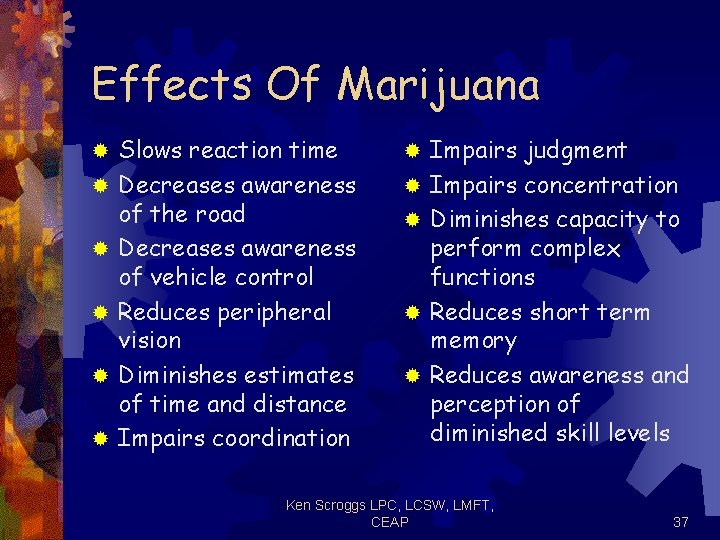
Effects Of Marijuana ® ® ® Slows reaction time Decreases awareness of the road Decreases awareness of vehicle control Reduces peripheral vision Diminishes estimates of time and distance Impairs coordination ® ® ® Impairs judgment Impairs concentration Diminishes capacity to perform complex functions Reduces short term memory Reduces awareness and perception of diminished skill levels Ken Scroggs LPC, LCSW, LMFT, CEAP 37
Common Names For Marijuana ® Pot ® Dope ® Grass ® Roach ® Weed ® Hash ® Joint ® Bud ® Reefer ® Mary Ken Scroggs LPC, LCSW, LMFT, CEAP Jane 38
Marijuana Use Facts ® The amount of marijuana required to generate a high depends on: ® ® THC content of the marijuana Individual’s weight, height, and body type ® Driving skills are impaired for 4 to 6 hours after smoking one joint, but some people show effects for up to 24 hours ® The THC may stay in a person’s system for up to 30 days or longer Ken Scroggs LPC, LCSW, LMFT, CEAP 39
Health Risks of Cocaine Use ® ® ® ® Accelerated heart rate Constricted blood vessels Dilated pupils Increased blood pressure Nasal congestion Runny nose Disintegration of mucus membranes of the nose ® Addiction ® Seizures ® Cardiac arrest ® Respiratory alert ® Stroke ® Death ® Collapsed nasal septum Ken Scroggs LPC, LCSW, LMFT, CEAP 40
Personal Characteristics Associated With Cocaine Use ® False sense of power, control, alertness, well-being, confidence, and strength ® Impulsive ® Unpredictable ® Paranoid ® Reckless Ken Scroggs LPC, LCSW, LMFT, CEAP 41
After-Effects of Cocaine Use ® Restlessness ® Anxiety ® Depression ® Exhaustion ® Mental Fatigue ® Irritability ® Paranoia ® Intensive craving for drug ® Preoccupation with drug ® Overall discomfort Ken Scroggs LPC, LCSW, LMFT, CEAP 42
Effects of Crack Use ® Short, intense high ® Abrupt halt to high ® Deep depression ® Intense craving for more drug Ken Scroggs LPC, LCSW, LMFT, CEAP 43
Common Names For Cocaine ® Coke ® Freebase ® Blow ® Base ® Snow ® Rock ® Speedball ® Snort ® Flake ® Eightball ® Crack ® Toot Ken Scroggs LPC, LCSW, LMFT, CEAP 44
Potential Victims of Cocaine Use By CDL/Safety Sensitive Employees ® Passengers ® Others on the road ® Co-workers ® Public confidence ® Drug user ® User’s family ® User’s friends ® Pedestrians Ken Scroggs LPC, LCSW, LMFT, CEAP ® Society 45
Effects of Amphetamine Use ® Restlessness ® ® Irritability ® Talkativeness ® ® Tenseness ® ® Hyperactivity ® ® Violent ® behavior ® Impaired judgment ® False sense of alertness Diminished concentration Over self-confidence Psychological addiction Brain damage Suicidal depression Ken Scroggs LPC, LCSW, LMFT, CEAP 46
After-Effects of Amphetamine Use ® Depression ® Confusion ® Intense Fatigue Ken Scroggs LPC, LCSW, LMFT, CEAP 47
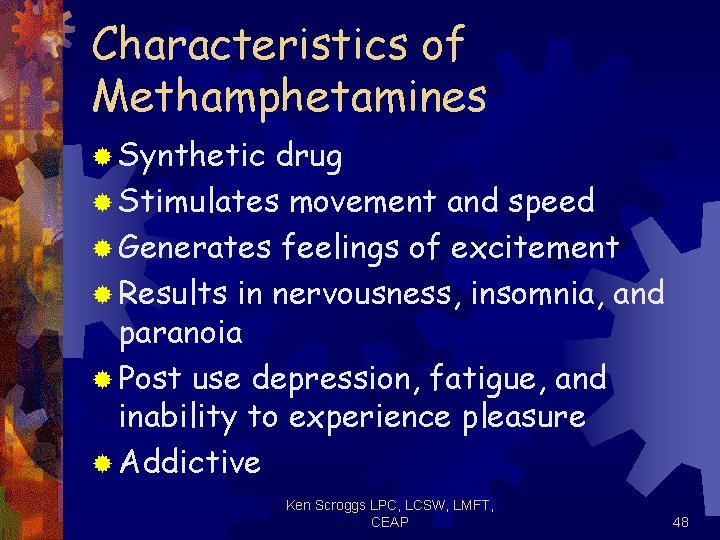
Characteristics of Methamphetamines ® Synthetic drug ® Stimulates movement and speed ® Generates feelings of excitement ® Results in nervousness, insomnia, and paranoia ® Post use depression, fatigue, and inability to experience pleasure ® Addictive Ken Scroggs LPC, LCSW, LMFT, CEAP 48
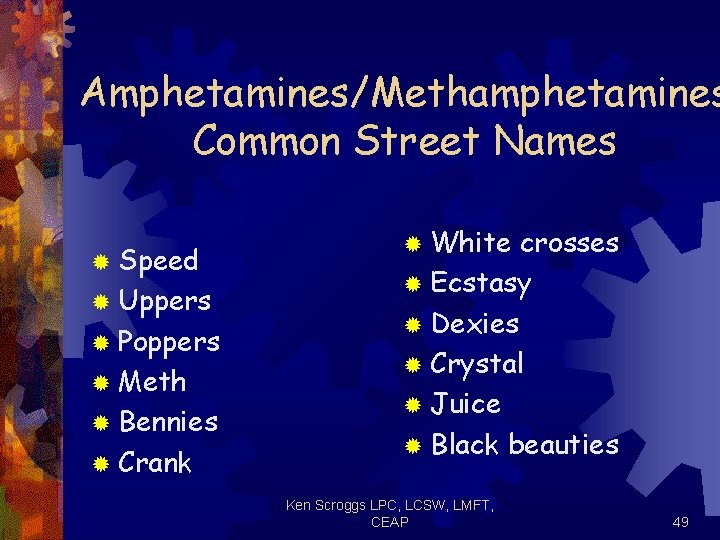
Amphetamines/Methamphetamines Common Street Names ® Speed ® Uppers ® Poppers ® Meth ® Bennies ® Crank ® White crosses ® Ecstasy ® Dexies ® Crystal ® Juice ® Black beauties Ken Scroggs LPC, LCSW, LMFT, CEAP 49
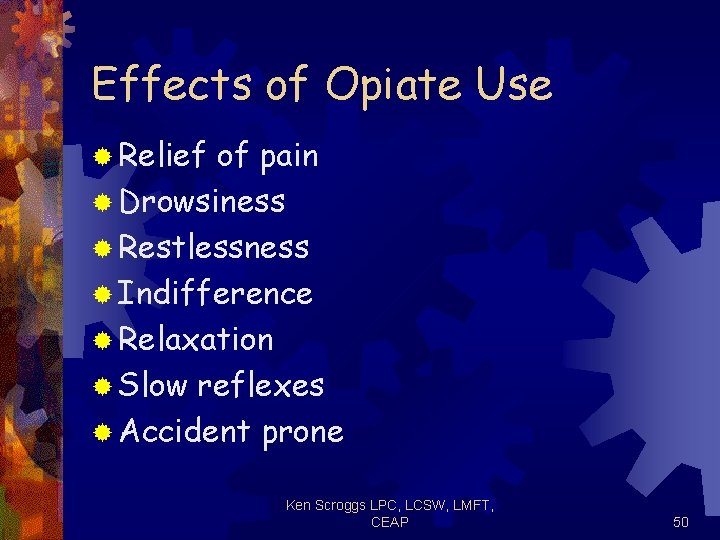
Effects of Opiate Use ® Relief of pain ® Drowsiness ® Restlessness ® Indifference ® Relaxation ® Slow reflexes ® Accident prone Ken Scroggs LPC, LCSW, LMFT, CEAP 50
Common Street Names for Opiates ® Heroin ® Black tar ® Tar ® Opium ® Horse ® Morphine ® Smack ® Mexican brown ® Tylenol-III ® China white Ken Scroggs LPC, LCSW, LMFT, CEAP 51
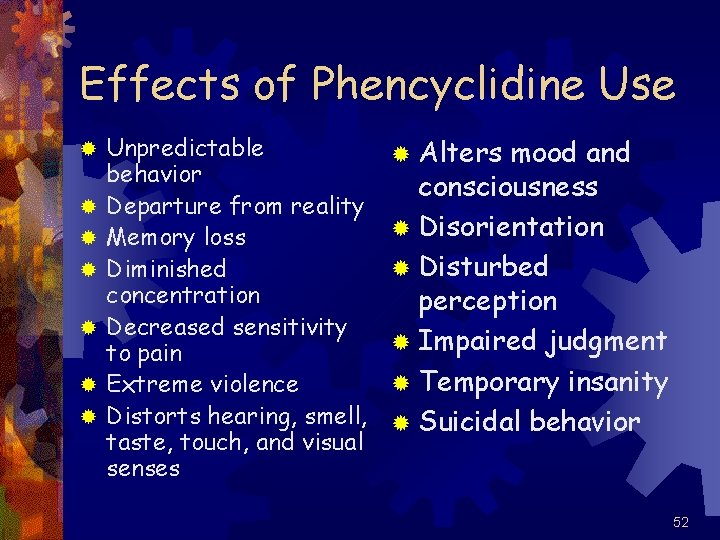
Effects of Phencyclidine Use ® ® ® ® Unpredictable behavior Departure from reality Memory loss Diminished concentration Decreased sensitivity to pain Extreme violence Distorts hearing, smell, taste, touch, and visual senses ® Alters mood and consciousness ® Disorientation ® Disturbed perception ® Impaired judgment ® Temporary insanity ® Suicidal behavior 52
Other Hallucinogens ® LSD ® Peyote ® Mescaline ® Psilocybin Ken Scroggs LPC, LCSW, LMFT, CEAP 53
Effects Common To All Hallucinogens ® Distorts reality ® Unpredictable ® Potential for flashbacks ® Inability to perform job duties Ken Scroggs LPC, LCSW, LMFT, CEAP 54
Commonly Prescribed Drugs ® Tranquilizers ® Barbiturates ® Narcotics ® Hypnotics ® Antihistamines Ken Scroggs LPC, LCSW, LMFT, CEAP 55
Employee Responsibility: Prescription Drugs ® Make sure their physician is aware of their medical history and any other drugs they are currently taking ® Inform their physician about their job duties and ask if the prescribed drug will affect their ability to carry out these functions ® Discuss other treatment options with their physician, if appropriate ® Check warning labels Ken Scroggs LPC, LCSW, LMFT, CEAP 56
Employee Responsibility: Prescription Drugs (cont. ) ® Determine whether or not they should report to work ® Take the medication exactly as prescribed Ken Scroggs LPC, LCSW, LMFT, CEAP 57
Skills Commonly Affected By Prescription Drugs ® Concentration ® Coordination ® Alertness ® Judgment Ken Scroggs LPC, LCSW, LMFT, CEAP 58
Over-The-Counter Drugs That May Impair Performance ® Antihistamines ® Drowsiness ® Slowed reactions ® Impaired vision ® Stimulants ® Jitteriness ® Diminished concentration ® False sense of alertness ® Irritability ® Post-high fatigue 59
Responsible Use Of Over. The Counter Drugs ® Read label ® Check for warnings ® Consult with physician or pharmacist ® Make informed decisions regarding fitness for work ® Take as directed Ken Scroggs LPC, LCSW, LMFT, CEAP 60
Commonly Used Inhalants ® Glue ® Gasoline ® Paint thinner ® Cleaners Ken Scroggs LPC, LCSW, LMFT, CEAP 61
Effects of Inhalant Use ® Drowsiness ® Lightheadedness ® Numbness ® Irritability ® Unpredictable behavior Ken Scroggs LPC, LCSW, LMFT, CEAP 62
FACT ® The intent of the program, as it applies to reasonable suspicion testing, is to provide supervisors with another resource to help them ensure that safety-sensitive employees are fit for duty ® Fitness for duty is a prerequisite for safety! ® Supervisors are on the front-line in identifying substance abuse in the workplace ® Supervisors are not expected to be police or experts in substance abuse ® Supervisors are expected to protect the safety of the general public as well as employees 63
Fact (cont. ) ® The supervisors role is to help orient, train, and inform employees about the policy, and to determine when there is reasonable suspicion for testing ® Supervisors are expected to determine fitness for duty, not what substances an employee may be abusing ® Supervisors should not be concerned with the problems an employee is facing in his/her personal life unless it affects job performance and public safety Ken Scroggs LPC, LCSW, LMFT, CEAP 64
Fact (cont. ) ® Supervisors are expected to be able to articulate and substantiate specific behavioral performance or physical indicators of prohibited drug use and alcohol misuse, but it is not the supervisor’s responsibility to “diagnose” the individual ® Supervisors must remember that a referral for a reasonable suspicion test is not an accusation. It is merely a request for objective data for use in identifying the underlying cause of observed behavior 65
Fact (cont. ) ® The interaction with the employee and all information about the test result should be handled with the strictest confidentiality, and with respect for the employee’s privacy Ken Scroggs LPC, LCSW, LMFT, CEAP 66
Wrap Up 1. 2. 3. 4. 5. 6. 7. Why policy was changed Legal concerns of policy Review of revised policy Steps to follow to report on-the-jobaccident Drugs we test for and their effect on the body Behavioral indicators to look for Q&A Ken Scroggs LPC, LCSW, LMFT, CEAP 67
Always Remember ® Contact the Human Resources Dept. for help and answers to your questions ® EAP Works provides free, confidential counseling for employees and dependents – 770 -449 -1111 Ken Scroggs LPC, LCSW, LMFT, CEAP 68
The Drug Free Workplace EAP Works a division of North Pines Center, Inc. Ken Scroggs LPC, LCSW, LMFT, CEAP 770 -449 -1111 Ken Scroggs LPC, LCSW, LMFT, CEAP 69