
The Double Pulsar Binary System Maura Mc Laughlin
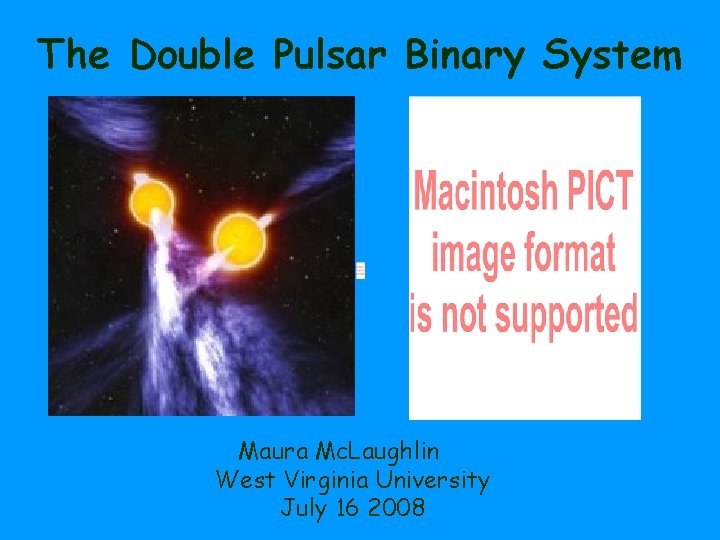
The Double Pulsar Binary System Maura Mc. Laughlin West Virginia University July 16 2008

A double pulsar system? !

The Double Pulsar System: Outline • • Pulsar search history Double neutron star systems Discovery of the double pulsar Interactions - probing magnetospheres and winds Testing general relativity The ultimate fate!! Future prospects
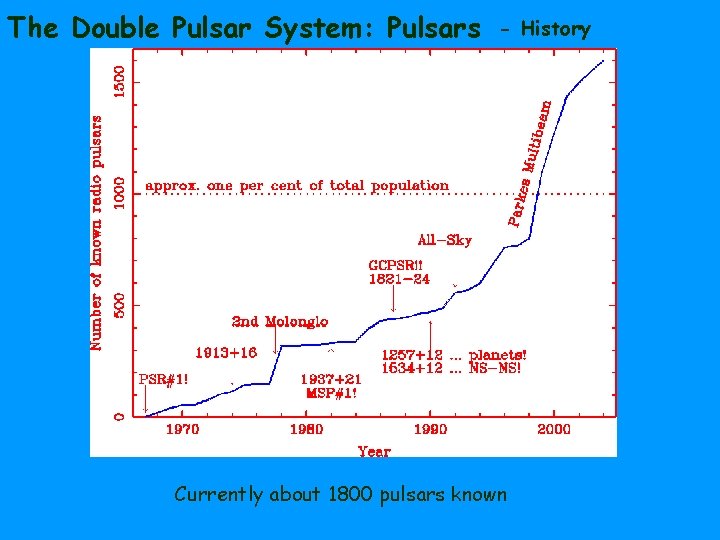
The Double Pulsar System: Pulsars - History Currently about 1800 pulsars known
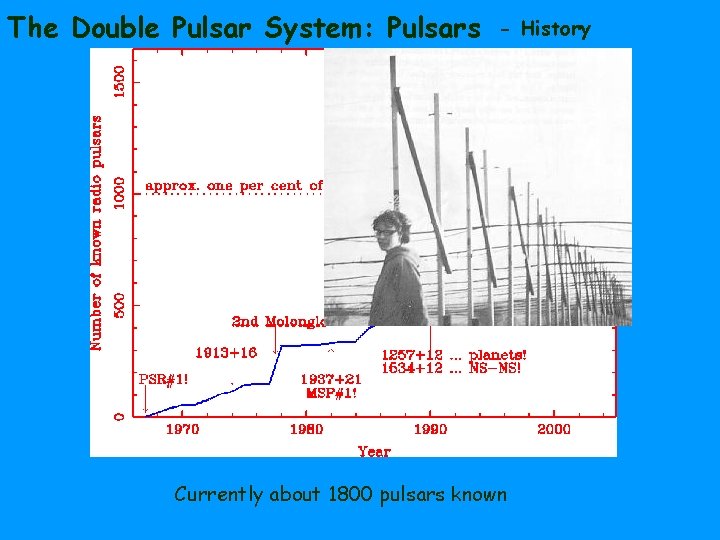
The Double Pulsar System: Pulsars - History Currently about 1800 pulsars known
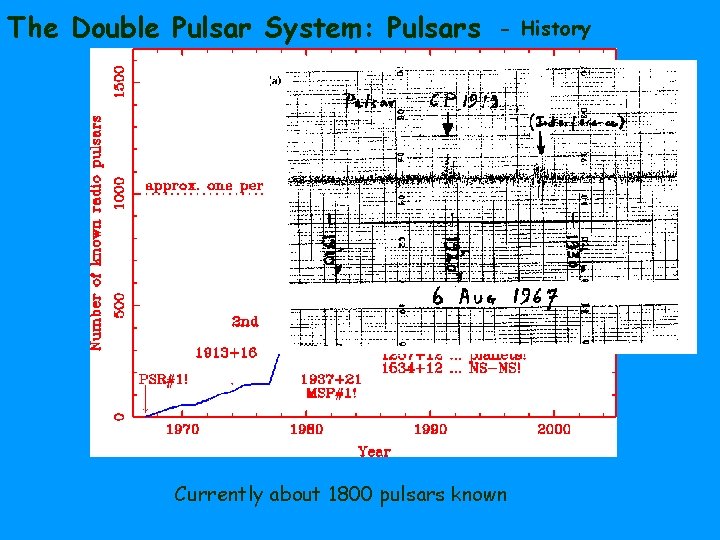
The Double Pulsar System: Pulsars - History Currently about 1800 pulsars known
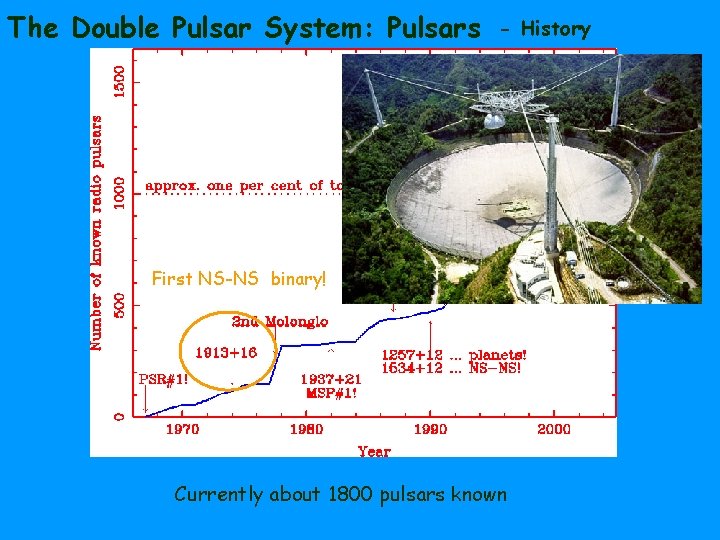
The Double Pulsar System: Pulsars - History First NS-NS binary! Currently about 1800 pulsars known
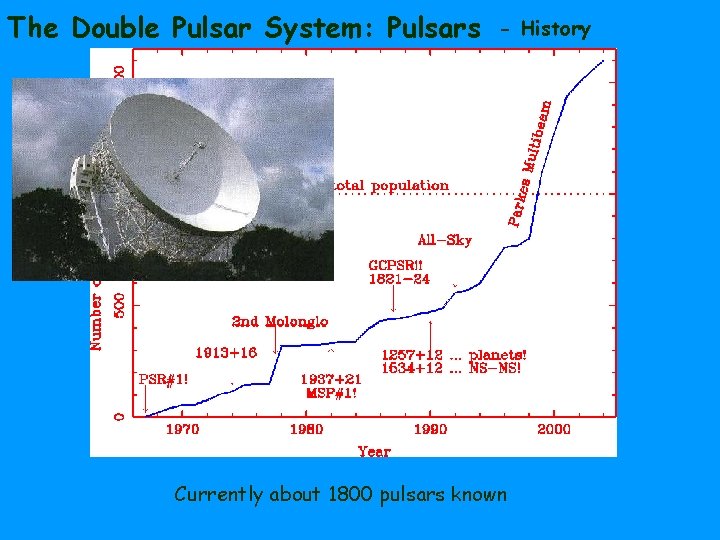
The Double Pulsar System: Pulsars - History Currently about 1800 pulsars known
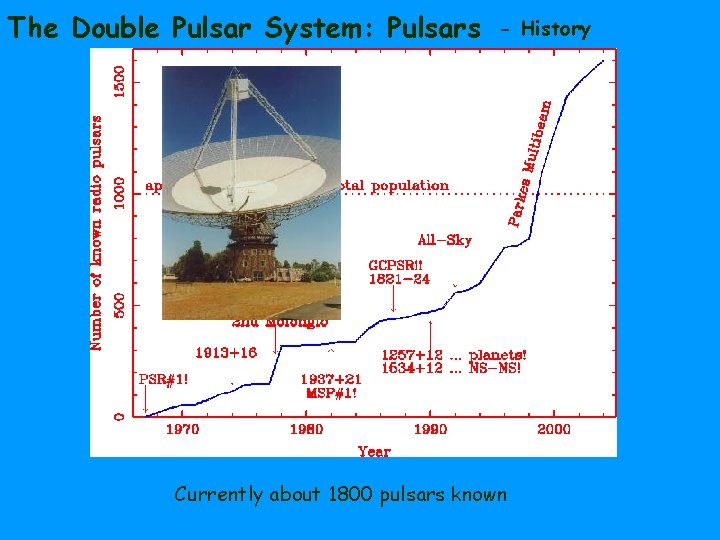
The Double Pulsar System: Pulsars - History Currently about 1800 pulsars known
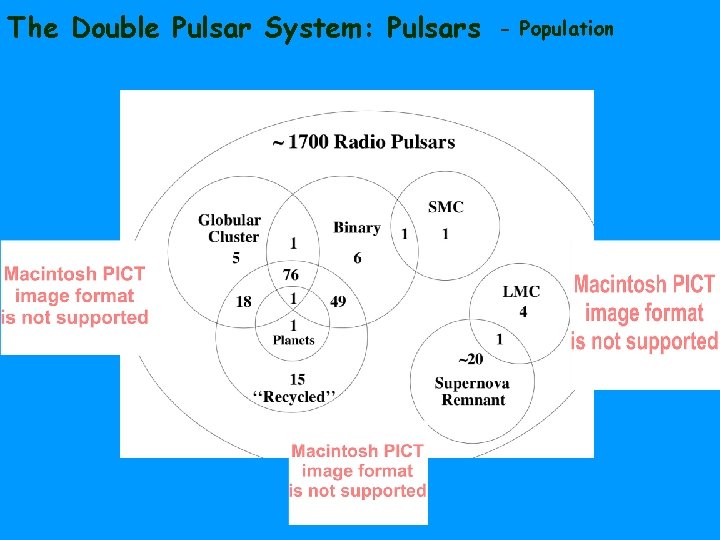
The Double Pulsar System: Pulsars - Population
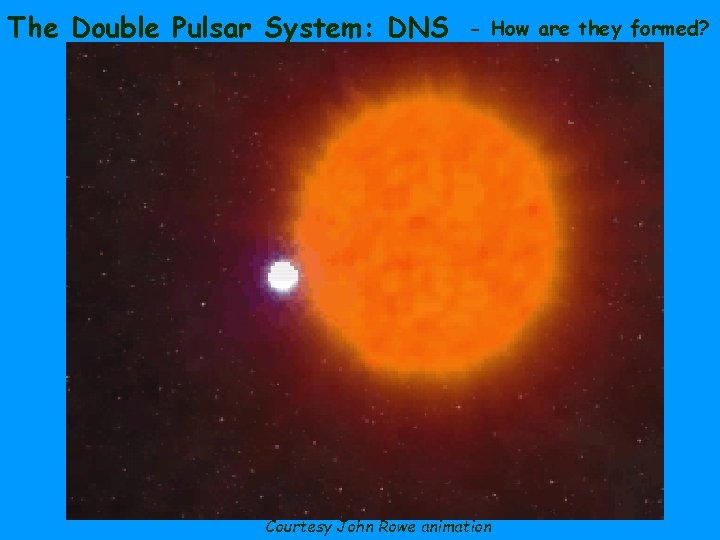
The Double Pulsar System: DNS - How are they formed? Courtesy John Rowe animation

The Double Pulsar System: Pulsars - Population DNS binaries live here 8 double neutron star systems known!
The Double Pulsar System: Pulsars Up until Oct 2003, three more pulsar “Holy Grails”: • pulsar in orbit with a black hole to probe spacetime near black hole • pulsar with spin period faster than 1. 5 ms to probe NS equations of state • pulsar in orbit with other pulsar to test general relativity - Population
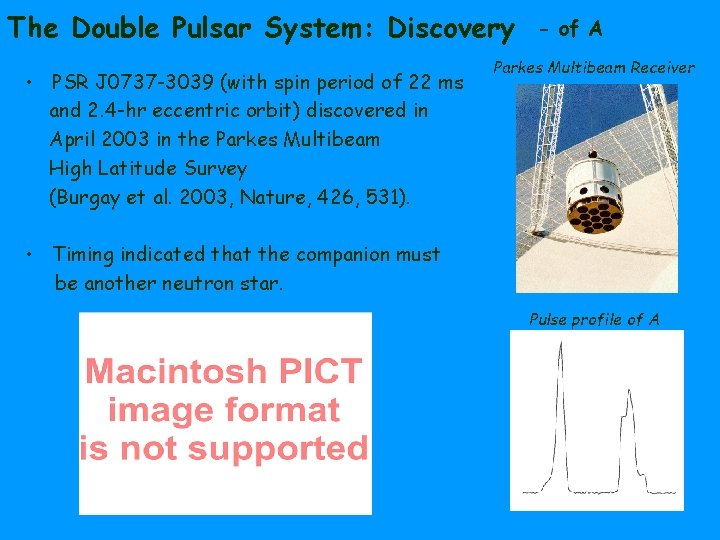
The Double Pulsar System: Discovery • PSR J 0737 -3039 (with spin period of 22 ms and 2. 4 -hr eccentric orbit) discovered in April 2003 in the Parkes Multibeam High Latitude Survey (Burgay et al. 2003, Nature, 426, 531). - of A Parkes Multibeam Receiver • Timing indicated that the companion must be another neutron star. Pulse profile of A
The Double Pulsar System: Discovery - of B • In October 2003, analysis of data taken for studies of PSR J 07373039 (now “A”) shows presence of 2. 7 -s pulsations. • Identical dispersion measure to A and period variations as expected for A’s measured orbit show that this is indeed A’s companion. • In agreement with simple evolutionary models in which A is first-born, recycled neutron star (short period, low B) B is younger, normal neutron star (long period, high B)
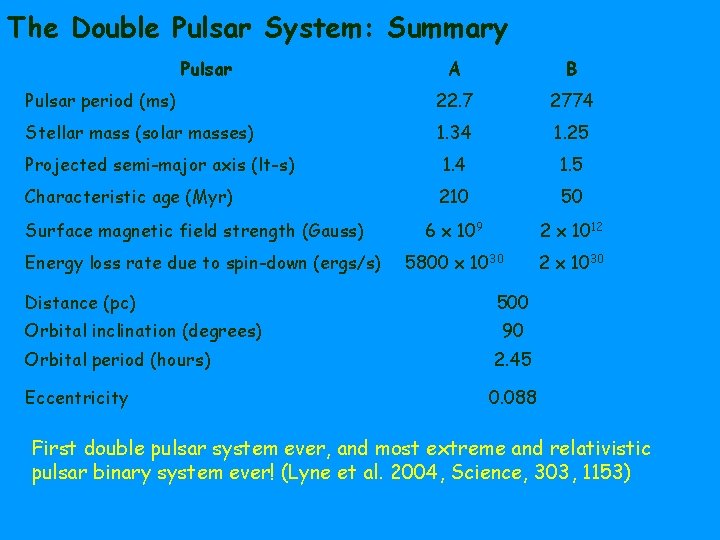
The Double Pulsar System: Summary Pulsar A B Pulsar period (ms) 22. 7 2774 Stellar mass (solar masses) 1. 34 1. 25 Projected semi-major axis (lt-s) 1. 4 1. 5 Characteristic age (Myr) 210 50 6 x 10⁹ 2 x 10¹² 5800 x 1030 2 x 1030 Surface magnetic field strength (Gauss) Energy loss rate due to spin-down (ergs/s) Distance (pc) Orbital inclination (degrees) Orbital period (hours) Eccentricity 500 90 2. 45 0. 088 First double pulsar system ever, and most extreme and relativistic pulsar binary system ever! (Lyne et al. 2004, Science, 303, 1153)
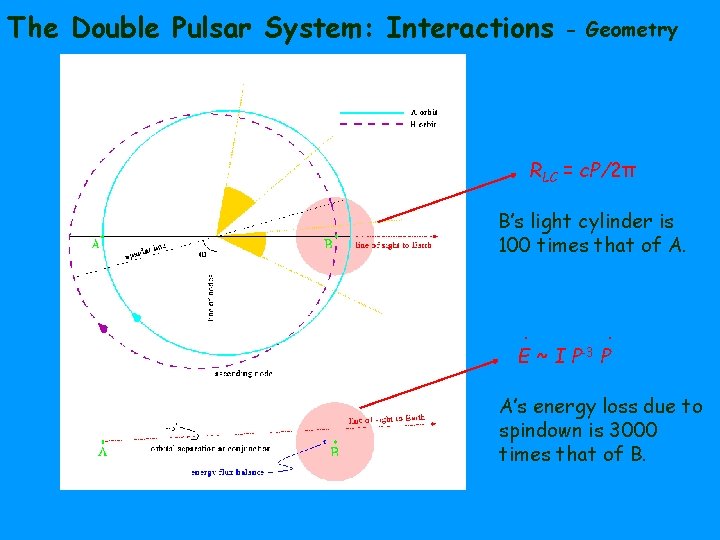
The Double Pulsar System: Interactions - Geometry RLC = c. P/2π B’s light cylinder is 100 times that of A. . . E ~ I P-3 P A’s energy loss due to spindown is 3000 times that of B.
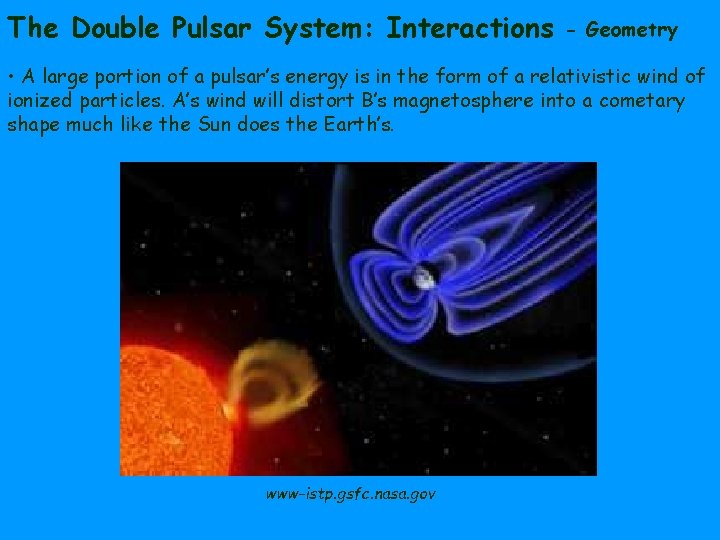
The Double Pulsar System: Interactions - Geometry • A large portion of a pulsar’s energy is in the form of a relativistic wind of ionized particles. A’s wind will distort B’s magnetosphere into a cometary shape much like the Sun does the Earth’s. www-istp. gsfc. nasa. gov
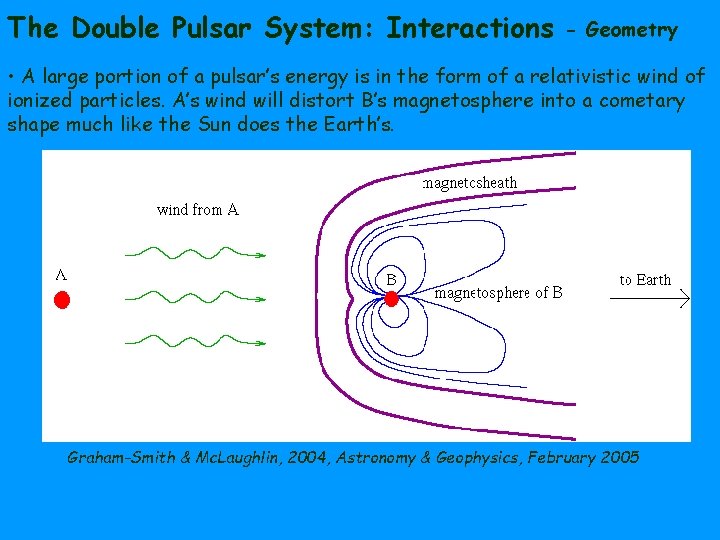
The Double Pulsar System: Interactions - Geometry • A large portion of a pulsar’s energy is in the form of a relativistic wind of ionized particles. A’s wind will distort B’s magnetosphere into a cometary shape much like the Sun does the Earth’s. Graham-Smith & Mc. Laughlin, 2004, Astronomy & Geophysics, February 2005
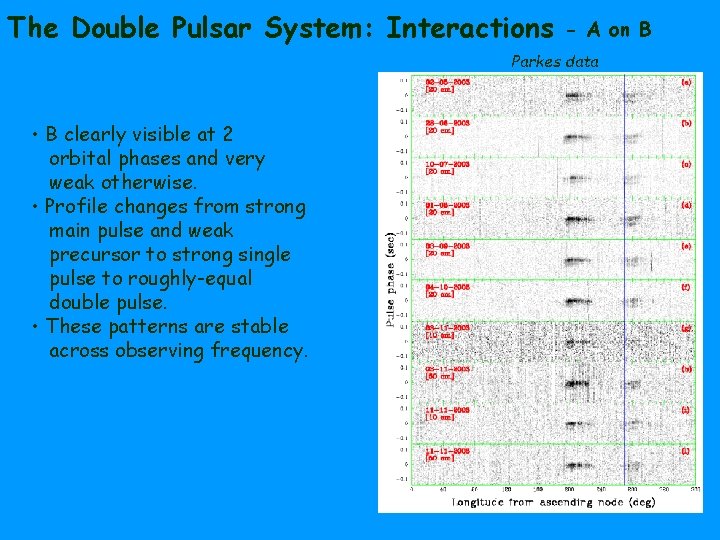
The Double Pulsar System: Interactions - A on B Parkes data • B clearly visible at 2 orbital phases and very weak otherwise. • Profile changes from strong main pulse and weak precursor to strong single pulse to roughly-equal double pulse. • These patterns are stable across observing frequency.
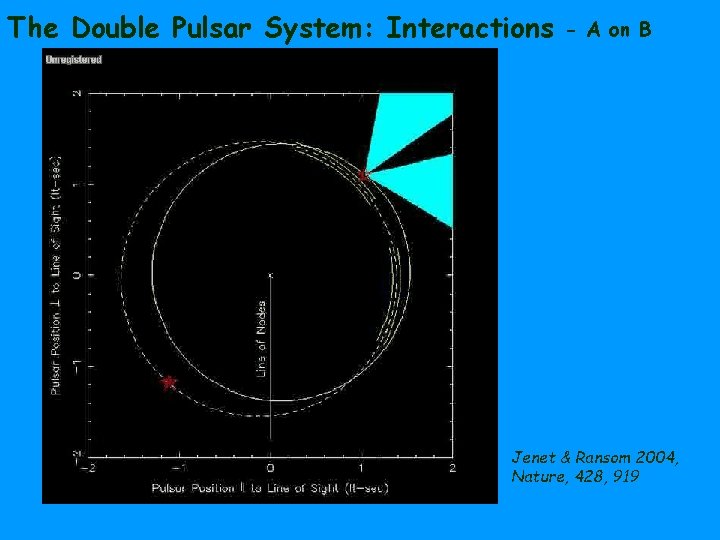
The Double Pulsar System: Interactions - A on B Jenet & Ransom 2004, Nature, 428, 919
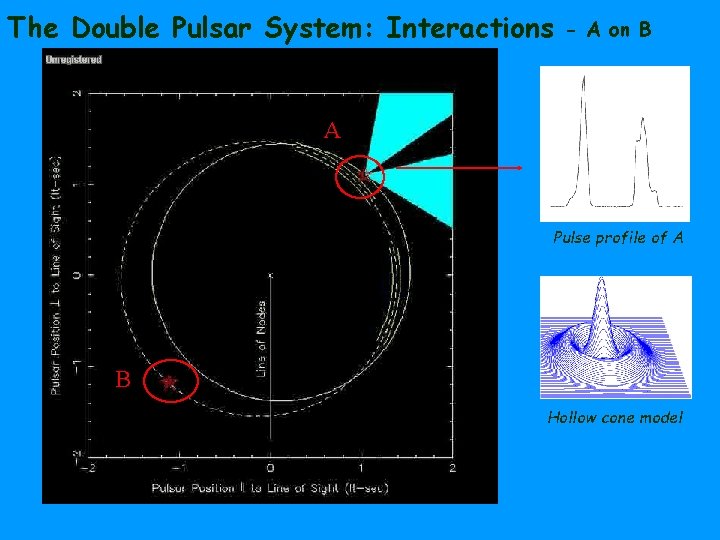
The Double Pulsar System: Interactions - A on B A Pulse profile of A B Hollow cone model
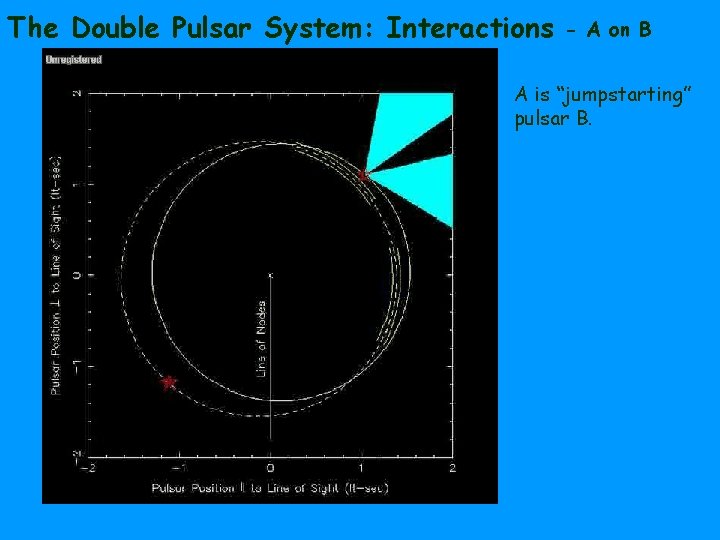
The Double Pulsar System: Interactions - A on B A is “jumpstarting” pulsar B.
The Double Pulsar System: Interactions - A on B We think A is actually “wiggling” B’s emission beam into and out of our line of sight…. Lyutikov 2005
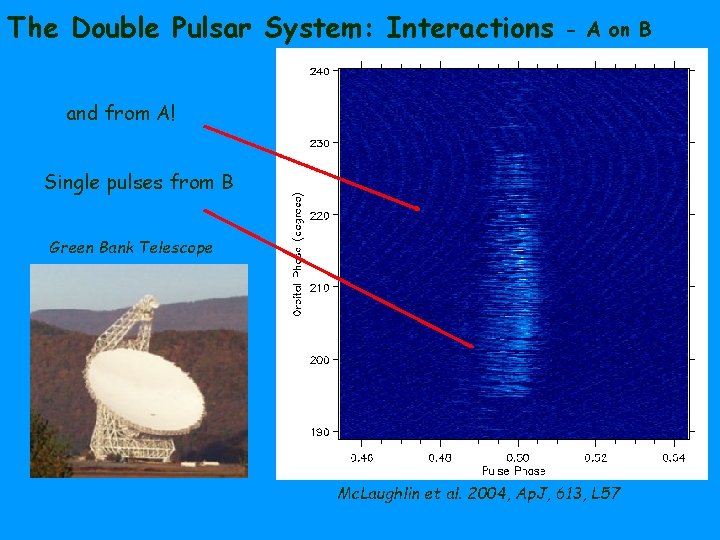
The Double Pulsar System: Interactions - A on B and from A! Single pulses from B Green Bank Telescope Mc. Laughlin et al. 2004, Ap. J, 613, L 57
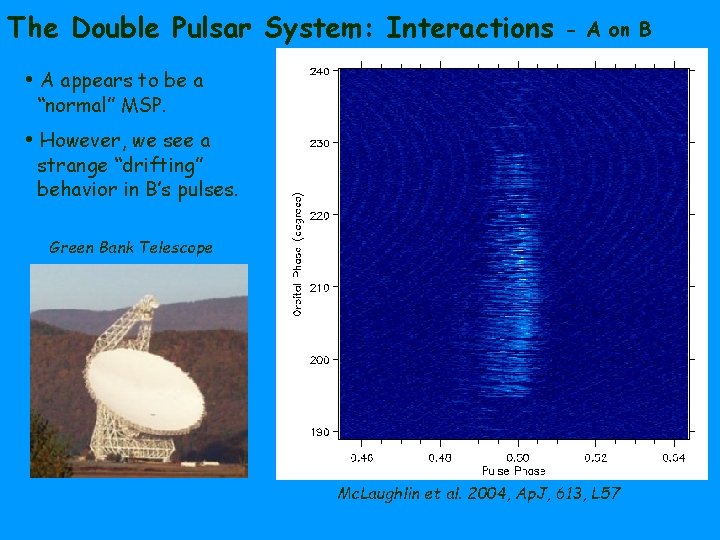
The Double Pulsar System: Interactions - A on B • A appears to be a “normal” MSP. • However, we see a strange “drifting” behavior in B’s pulses. Green Bank Telescope Mc. Laughlin et al. 2004, Ap. J, 613, L 57
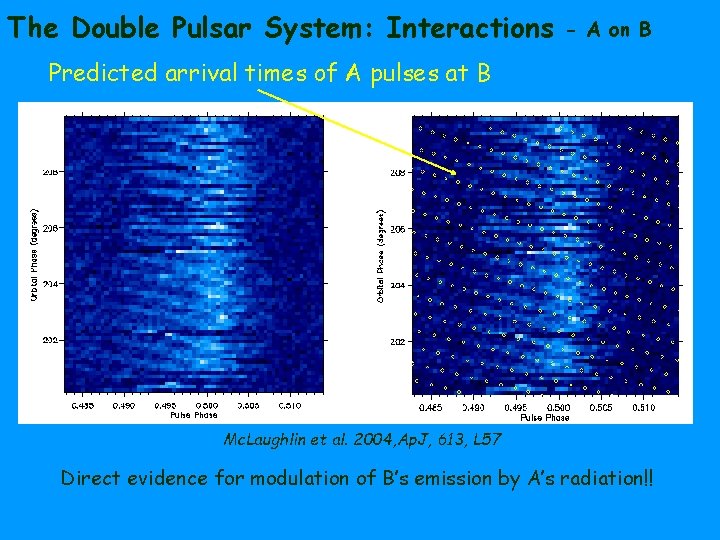
The Double Pulsar System: Interactions - A on B Predicted arrival times of A pulses at B Mc. Laughlin et al. 2004, Ap. J, 613, L 57 Direct evidence for modulation of B’s emission by A’s radiation!!
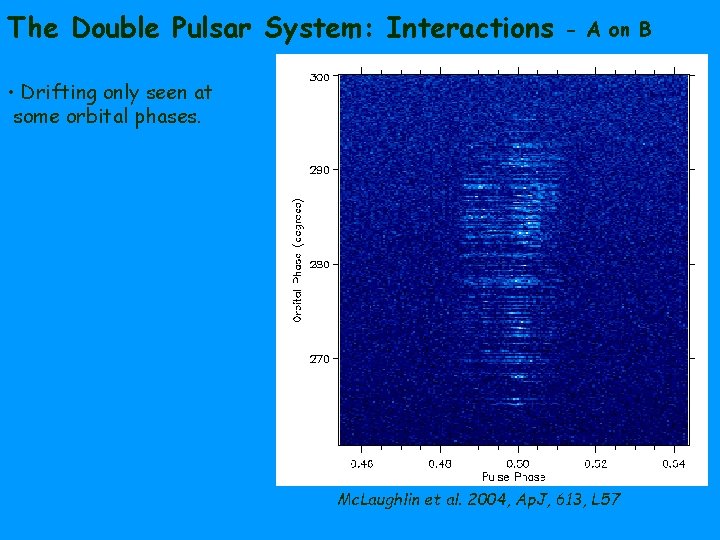
The Double Pulsar System: Interactions - A on B • Drifting only seen at some orbital phases. Mc. Laughlin et al. 2004, Ap. J, 613, L 57
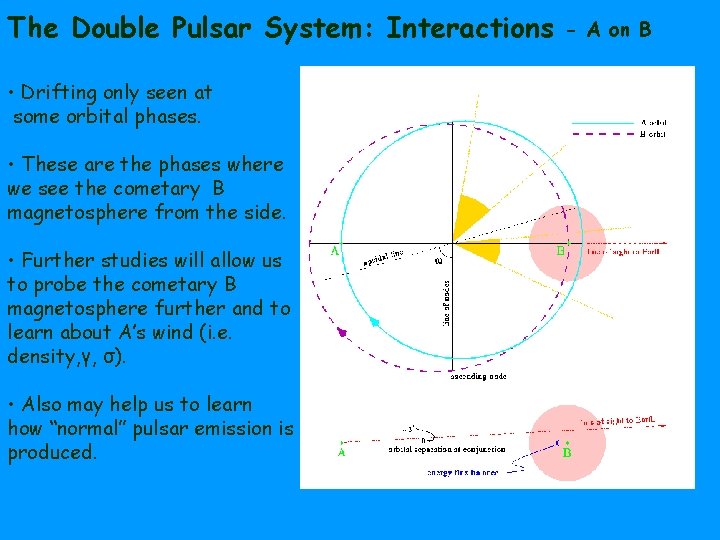
The Double Pulsar System: Interactions • Drifting only seen at some orbital phases. • These are the phases where we see the cometary B magnetosphere from the side. • Further studies will allow us to probe the cometary B magnetosphere further and to learn about A’s wind (i. e. density, γ, σ). • Also may help us to learn how “normal” pulsar emission is produced. - A on B
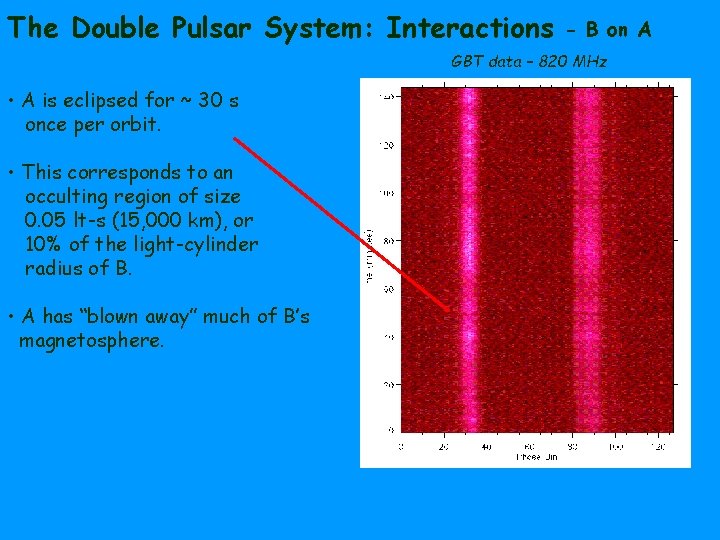
The Double Pulsar System: Interactions - B on A GBT data – 820 MHz • A is eclipsed for ~ 30 s once per orbit. • This corresponds to an occulting region of size 0. 05 lt-s (15, 000 km), or 10% of the light-cylinder radius of B. • A has “blown away” much of B’s magnetosphere.
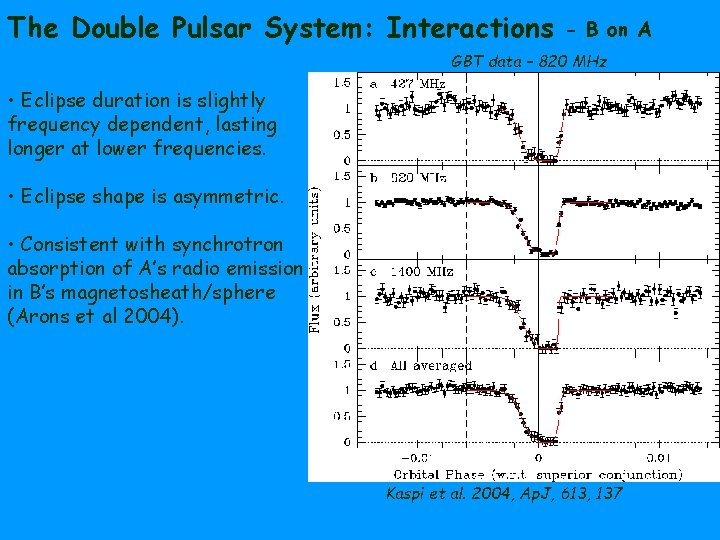
The Double Pulsar System: Interactions - B on A GBT data – 820 MHz • Eclipse duration is slightly frequency dependent, lasting longer at lower frequencies. • Eclipse shape is asymmetric. • Consistent with synchrotron absorption of A’s radio emission in B’s magnetosheath/sphere (Arons et al 2004). Kaspi et al. 2004, Ap. J, 613, 137
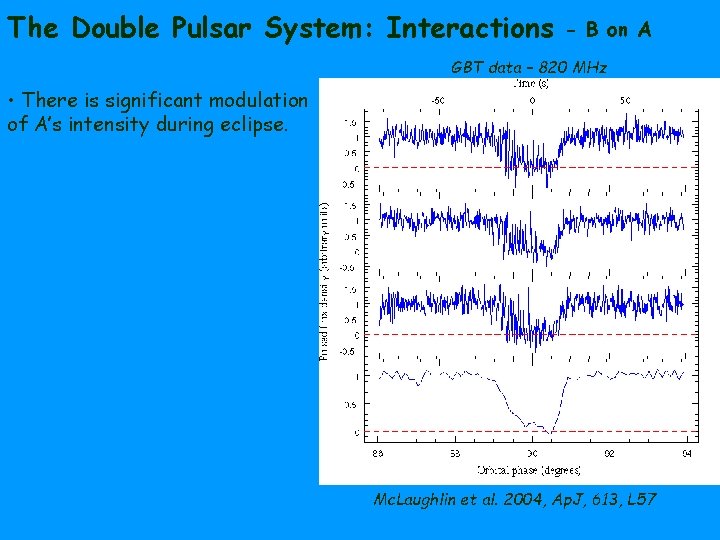
The Double Pulsar System: Interactions - B on A GBT data – 820 MHz • There is significant modulation of A’s intensity during eclipse. Mc. Laughlin et al. 2004, Ap. J, 613, L 57
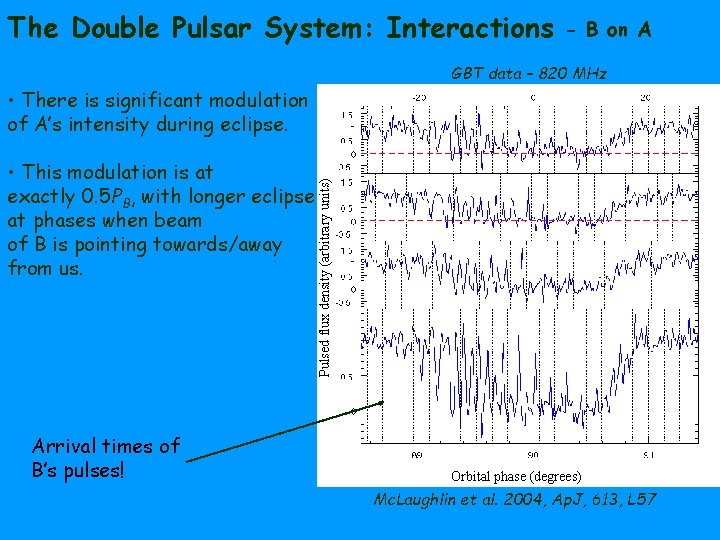
The Double Pulsar System: Interactions - B on A GBT data – 820 MHz • This modulation is at exactly 0. 5 PB, with longer eclipse at phases when beam of B is pointing towards/away from us. Arrival times of B’s pulses! Pulsed flux density (arbitrary units) • There is significant modulation of A’s intensity during eclipse. Orbital phase (degrees) Mc. Laughlin et al. 2004, Ap. J, 613, L 57
The Double Pulsar System: Interactions - B on A
The Double Pulsar System: Interactions - B on A As expected if caused by synchrotron absorption in B’s magnetosphere.
The Double Pulsar System: Interactions - B on A We see significant changes of the eclipse shape with time!
The Double Pulsar System: Testing GR Was Einstein Right? ? ? “Everything should be made as simple as possible, but not simpler. ” - Method
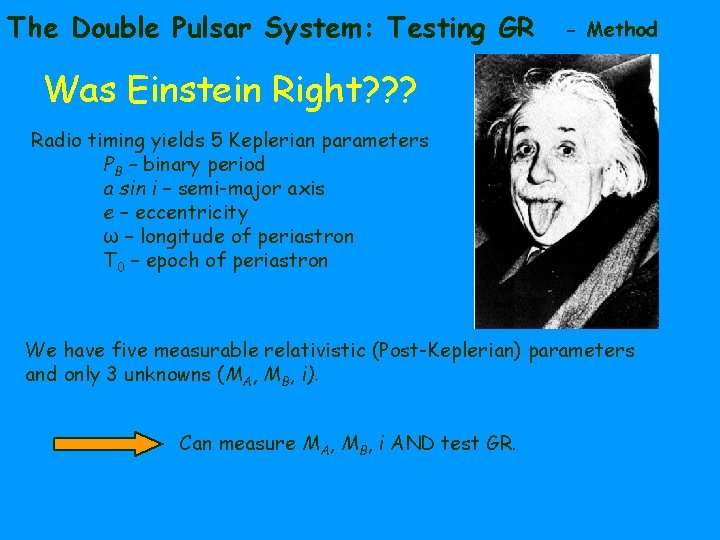
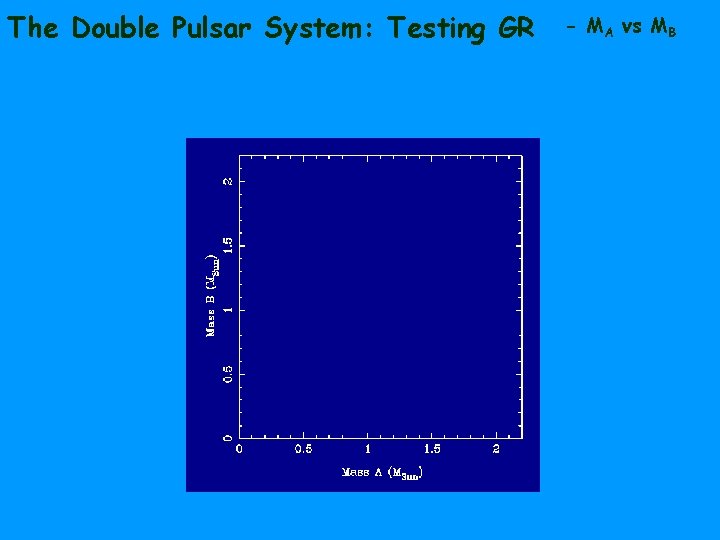
The Double Pulsar System: Testing GR - Method Was Einstein Right? ? ? Radio timing yields 5 Keplerian parameters PB – binary period a sin i – semi-major axis e – eccentricity ω – longitude of periastron T 0 – epoch of periastron We have five measurable relativistic (Post-Keplerian) parameters and only 3 unknowns (MA, MB, i). Can measure MA, MB, i AND test GR.
The Double Pulsar System: Testing GR - MA vs MB
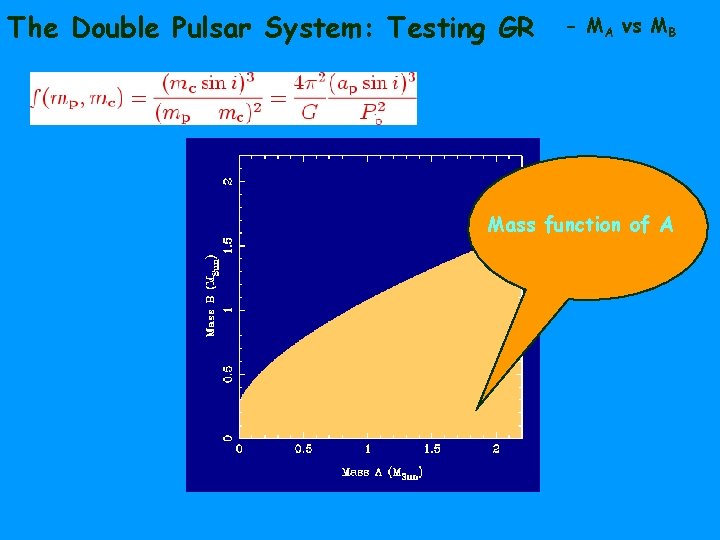
The Double Pulsar System: Testing GR - MA vs MB Mass function of A
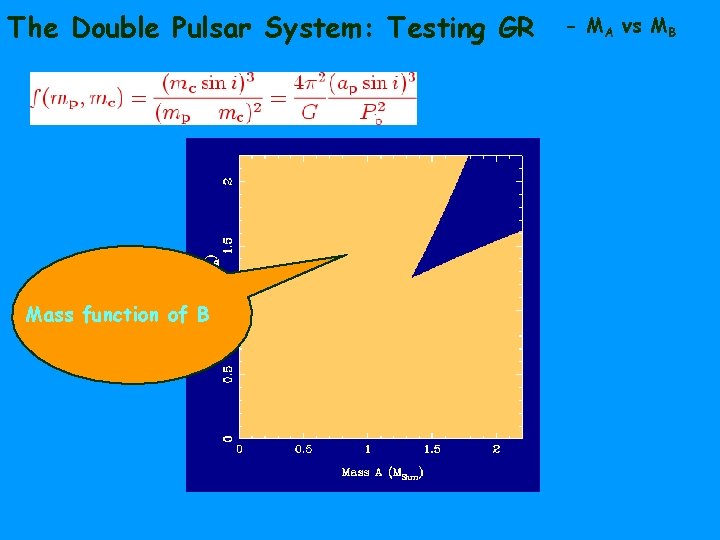
The Double Pulsar System: Testing GR Mass function of B - MA vs MB
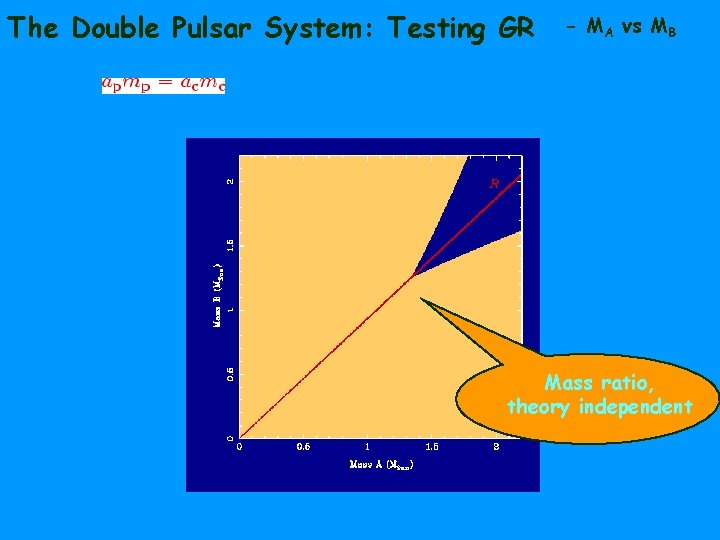
The Double Pulsar System: Testing GR - MA vs MB Mass ratio, theory independent
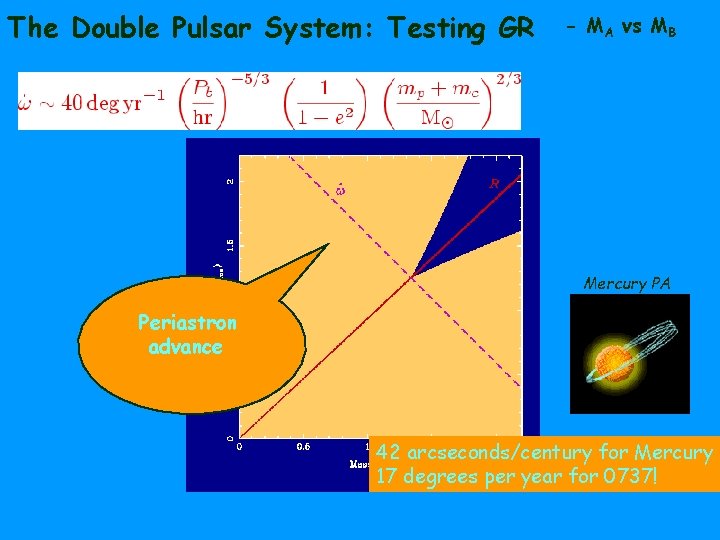
The Double Pulsar System: Testing GR - MA vs MB Mercury PA Periastron advance 42 arcseconds/century for Mercury 17 degrees per year for 0737!
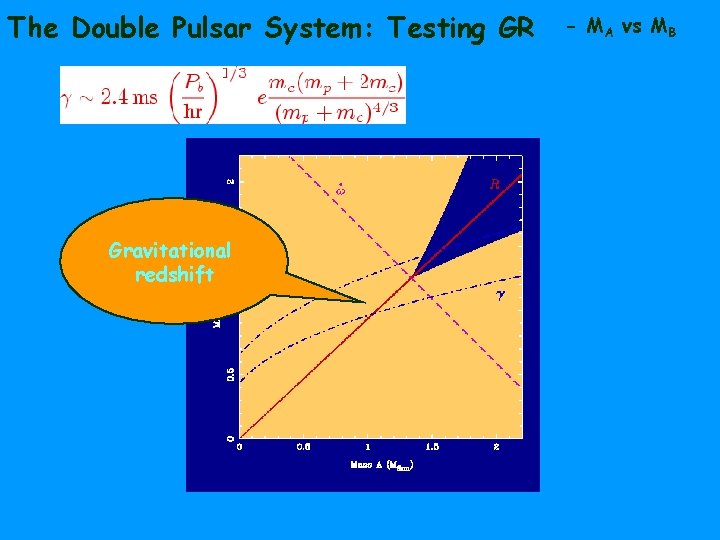
The Double Pulsar System: Testing GR Gravitational redshift - MA vs MB
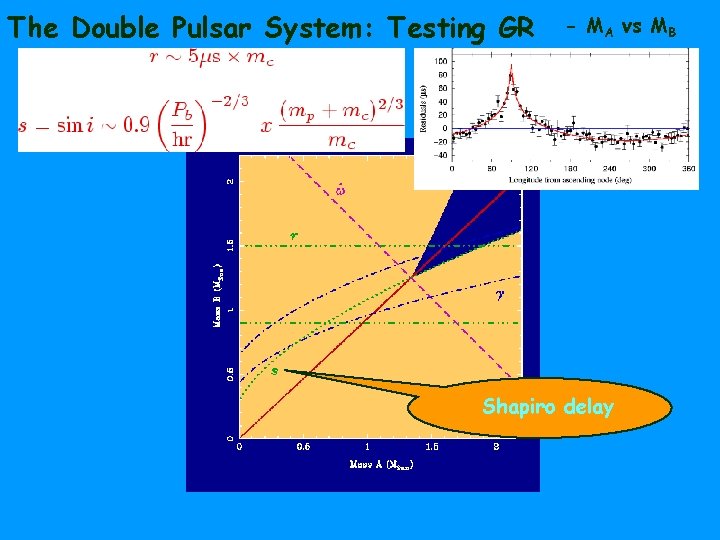
The Double Pulsar System: Testing GR - MA vs MB Shapiro delay
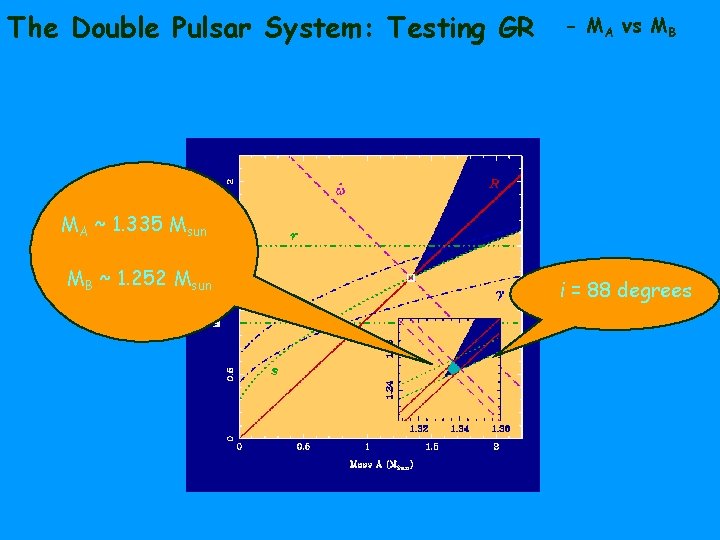
The Double Pulsar System: Testing GR - MA vs MB MA ~ 1. 335 Msun MB ~ 1. 252 Msun i = 88 degrees
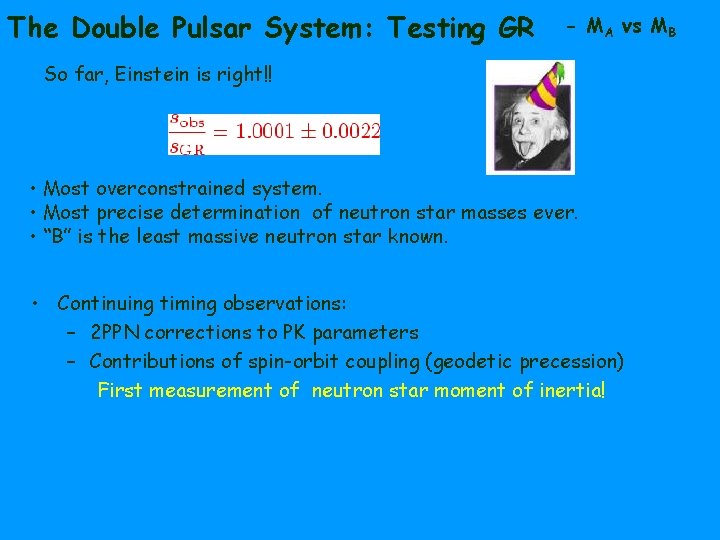
The Double Pulsar System: Testing GR - MA vs MB So far, Einstein is right!! • Most overconstrained system. • Most precise determination of neutron star masses ever. • “B” is the least massive neutron star known. • Continuing timing observations: – 2 PPN corrections to PK parameters – Contributions of spin-orbit coupling (geodetic precession) First measurement of neutron star moment of inertia!
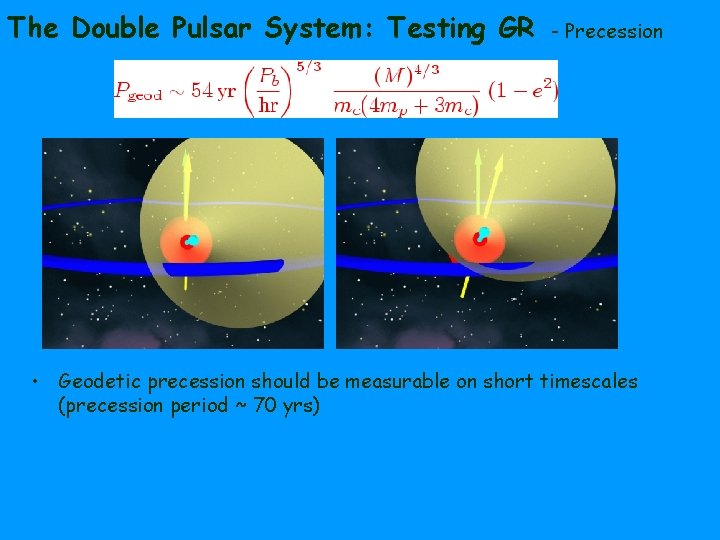
The Double Pulsar System: Testing GR - Precession • Geodetic precession should be measurable on short timescales (precession period ~ 70 yrs)
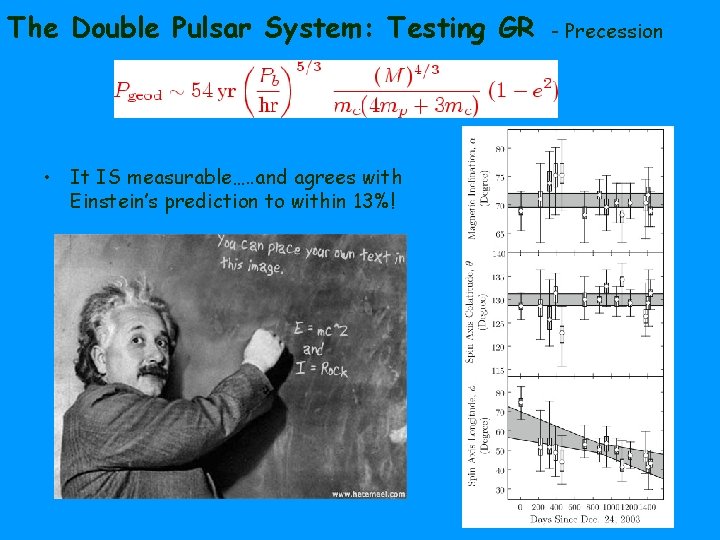
The Double Pulsar System: Testing GR • It IS measurable…. . and agrees with Einstein’s prediction to within 13%! - Precession
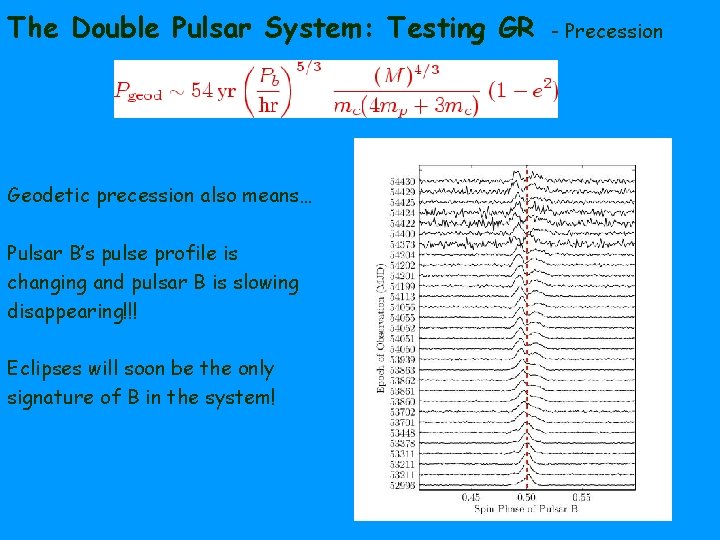
The Double Pulsar System: Testing GR - Precession Geodetic precession also means… Pulsar B’s pulse profile is changing and pulsar B is slowing disappearing!!! Eclipses will soon be the only signature of B in the system! … and for B?
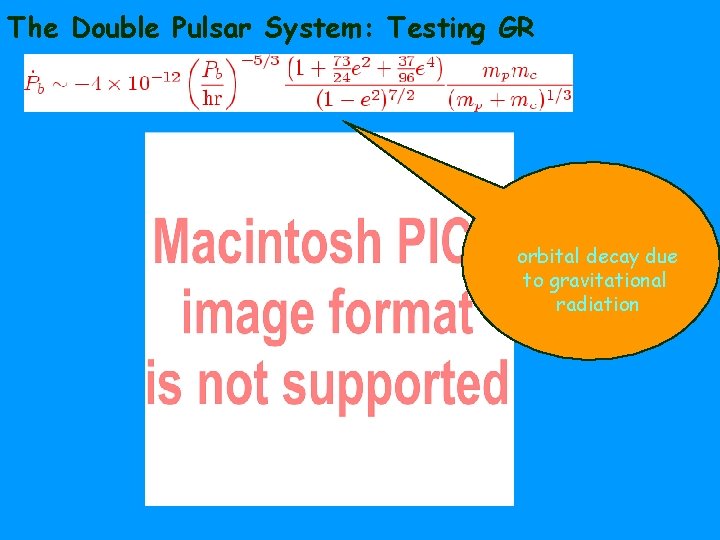
The Double Pulsar System: Testing GR orbital decay due to gravitational radiation
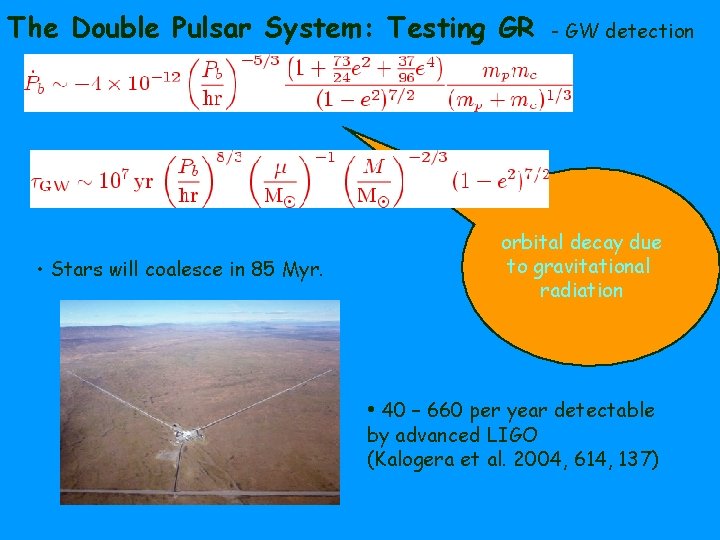
The Double Pulsar System: Testing GR • Stars will coalesce in 85 Myr. - GW detection orbital decay due to gravitational radiation • 40 – 660 per year detectable by advanced LIGO (Kalogera et al. 2004, 614, 137)
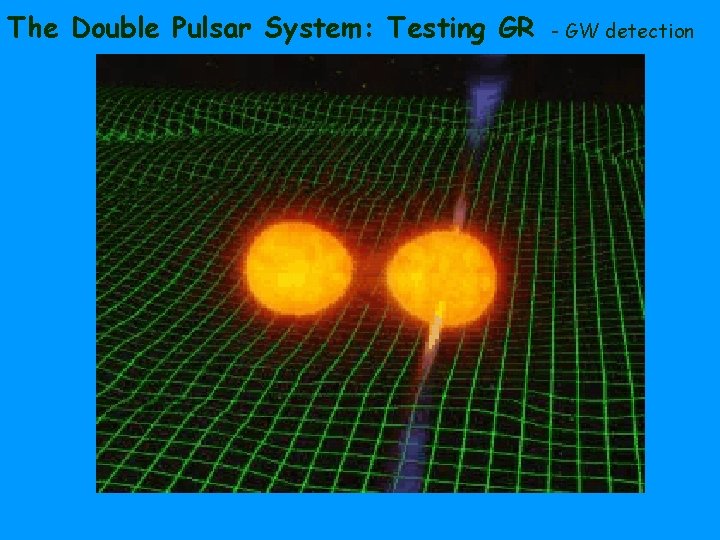
The Double Pulsar System: Testing GR - GW detection
The Double Pulsar System: Future • ISS measurements allow velocity measurements, better determination of i and characterization of ISM properties (Coles, Mc. Laughlin et al. 2004, Ap. J, 623, 392). • X-ray/radio continuum studies allow study of shock interaction between A’s relativistic wind and B’s magnetosphere (Mc. Laughlin et al. 2004, 605, 41). • Future radio observations will yield vital insights into physics of pulsar winds and magnetospheres – may aid understanding of Earth/Sun magnetospheric physics. • VLBI observations will yield precise distance and velocities, making GR tests even more stringent. • Future radio timing will enable most precise test of GR and most precise measurement of neutron star masses ever – will yield first ever measurement of NS moment of inertia. • Future searches with the GBT (!!!!!), ALFA (Arecibo Lband Feed Array) and the SKA (Square Kilometer Array) will yield more of these objects and, possibly, a pulsar/black hole binary!
- Slides: 55