
The Double Chooz reactor neutrino experiment Christian Buck
The Double Chooz reactor neutrino experiment Christian Buck, MPIK Heidelberg LAUNCH 09 November, 11 th 2009
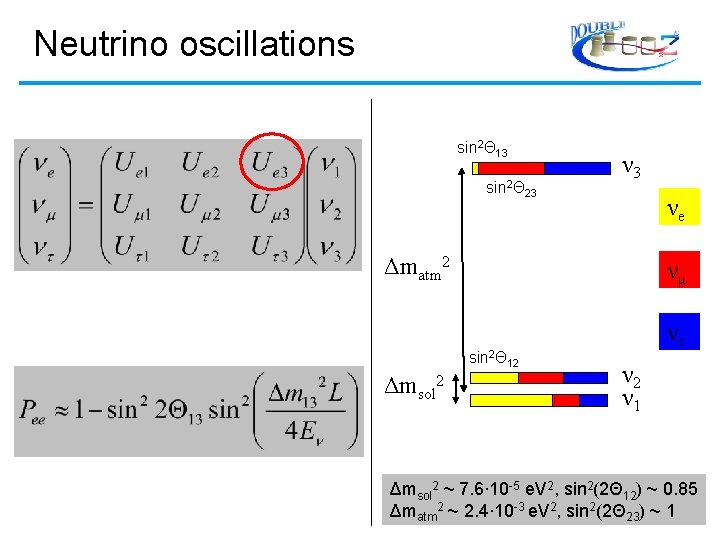
Neutrino oscillations sin 2Θ 13 sin 2Θ ν 3 23 νe Δmatm 2 νμ sin 2Θ 12 Δmsol 2 ντ ν 2 ν 1 Δmsol 2 ~ 7. 6∙ 10 -5 e. V 2, sin 2(2Θ 12) ~ 0. 85 Δmatm 2 ~ 2. 4∙ 10 -3 e. V 2, sin 2(2Θ 23) ~ 1
Why Double Chooz? Ø Improved knowledge of mixing matrix Ø Key experiment to unveil leptonic CP violation Ø Discovery potential: hint given by global analysis Fogli et al. , ar. Xiv: 0905. 3549 (2009) Ø Complementarity to beam experiments - Degeneracies + parameter correlations - Optimize future accelerator experiments Ø Discrimination power of 0νββ Ø Safeguard applications, …
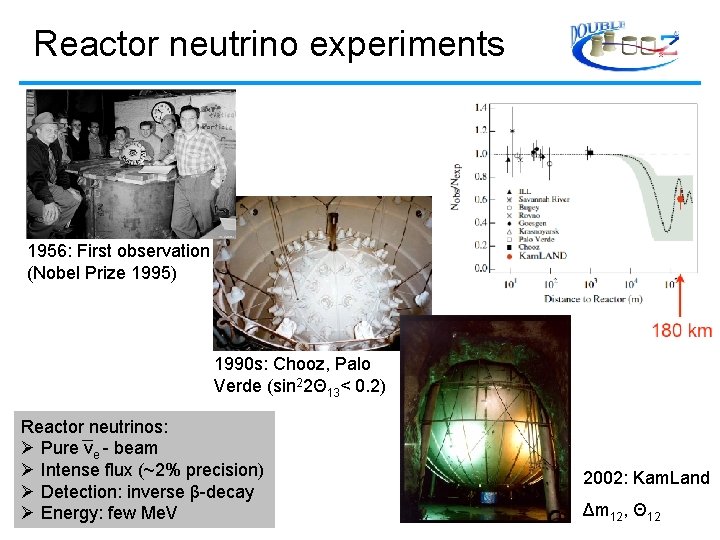
Reactor neutrino experiments 1956: First observation (Nobel Prize 1995) 1990 s: Chooz, Palo Verde (sin 22Θ 13< 0. 2) Reactor neutrinos: Ø Pure νe - beam Ø Intense flux (~2% precision) Ø Detection: inverse β-decay Ø Energy: few Me. V 2002: Kam. Land Δm 12, Θ 12
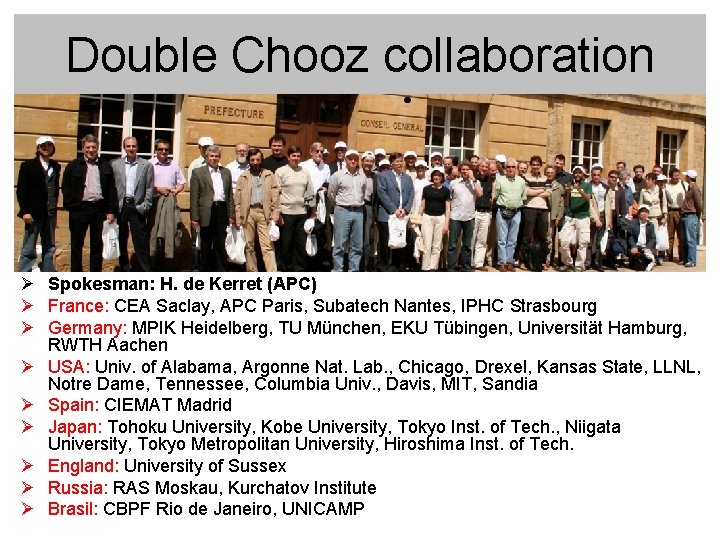
Double Chooz collaboration Ø Spokesman: H. de Kerret (APC) Ø France: CEA Saclay, APC Paris, Subatech Nantes, IPHC Strasbourg Ø Germany: MPIK Heidelberg, TU München, EKU Tübingen, Universität Hamburg, RWTH Aachen Ø USA: Univ. of Alabama, Argonne Nat. Lab. , Chicago, Drexel, Kansas State, LLNL, Notre Dame, Tennessee, Columbia Univ. , Davis, MIT, Sandia Ø Spain: CIEMAT Madrid Ø Japan: Tohoku University, Kobe University, Tokyo Inst. of Tech. , Niigata University, Tokyo Metropolitan University, Hiroshima Inst. of Tech. Ø England: University of Sussex Ø Russia: RAS Moskau, Kurchatov Institute Ø Brasil: CBPF Rio de Janeiro, UNICAMP
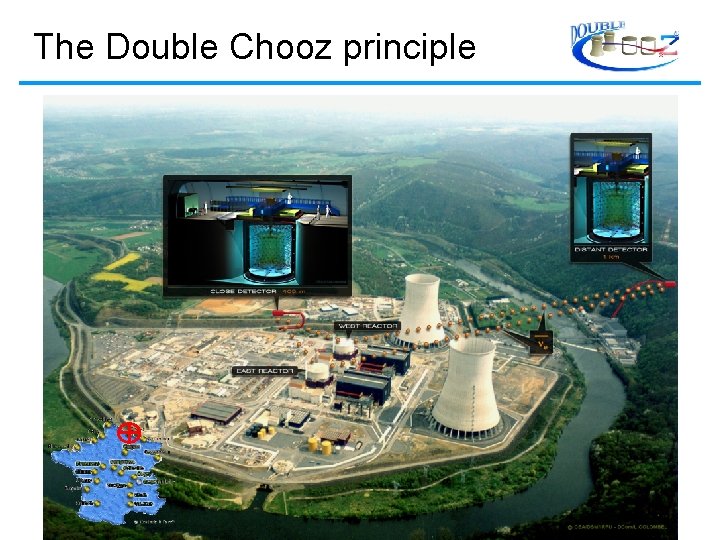
The Double Chooz principle
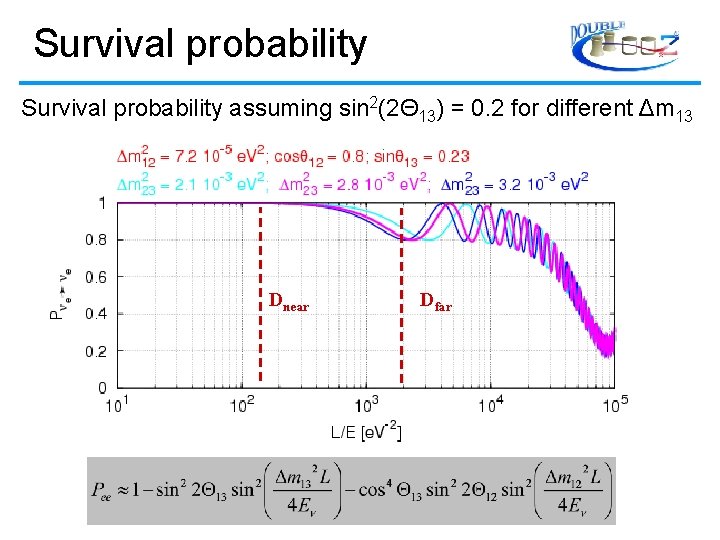
Survival probability assuming sin 2(2Θ 13) = 0. 2 for different Δm 13 Dnear Dfar G. Mention (APC)
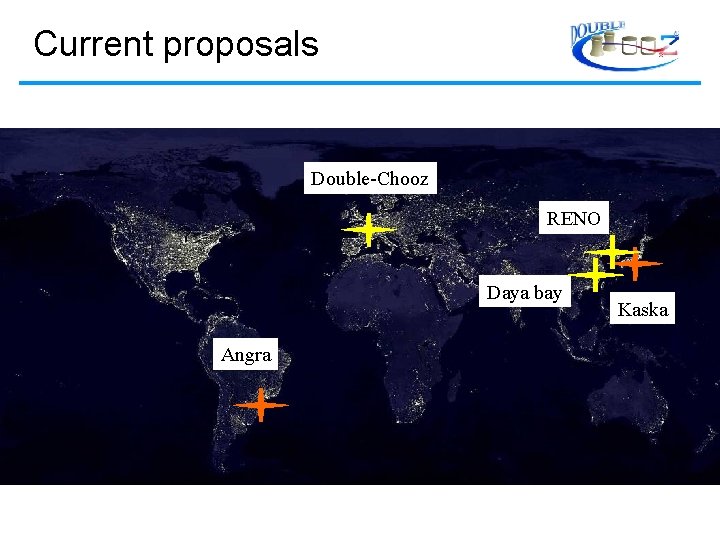
Current proposals Double-Chooz RENO Daya bay Angra Kaska
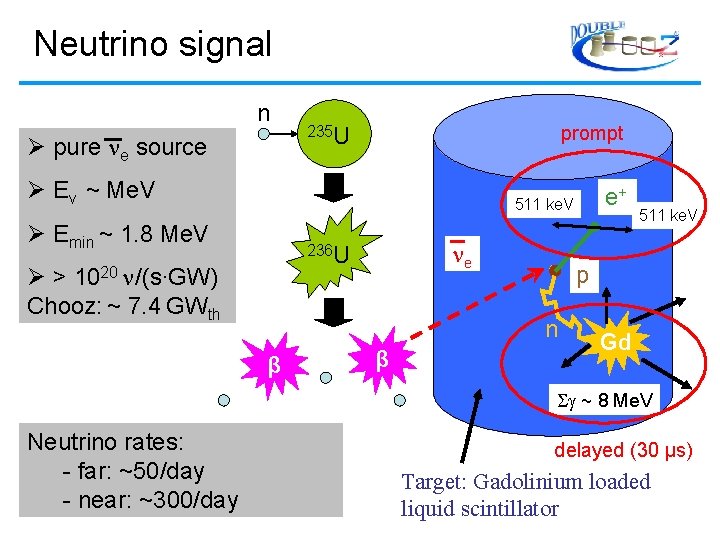
Neutrino signal n Ø pure e source prompt 235 U Ø Eν ~ Me. V e+ 511 ke. V Ø Emin ~ 1. 8 Me. V e 236 U Ø > 1020 /(s∙GW) Chooz: ~ 7. 4 GWth p n β β 511 ke. V Gd ~ 8 Me. V Neutrino rates: - far: ~50/day - near: ~300/day delayed (30 µs) Target: Gadolinium loaded liquid scintillator
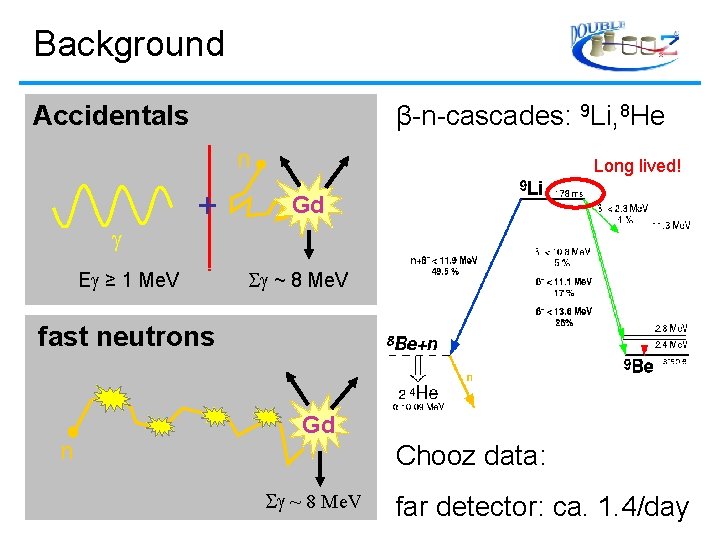
Background Accidentals β-n-cascades: 9 Li, 8 He n + E ≥ 1 Me. V Long lived! Gd ~ 8 Me. V fast neutrons n Gd Chooz data: ~ 8 Me. V far detector: ca. 1. 4/day
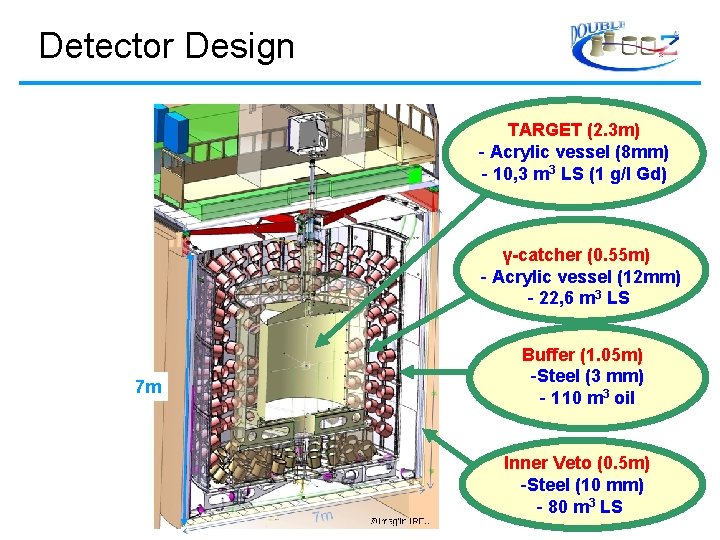
Detector Design TARGET (2. 3 m) - Acrylic vessel (8 mm) - 10, 3 m 3 LS (1 g/l Gd) γ-catcher (0. 55 m) - Acrylic vessel (12 mm) - 22, 6 m 3 LS 7 m Buffer (1. 05 m) -Steel (3 mm) - 110 m 3 oil Inner Veto (0. 5 m) -Steel (10 mm) - 80 m 3 LS
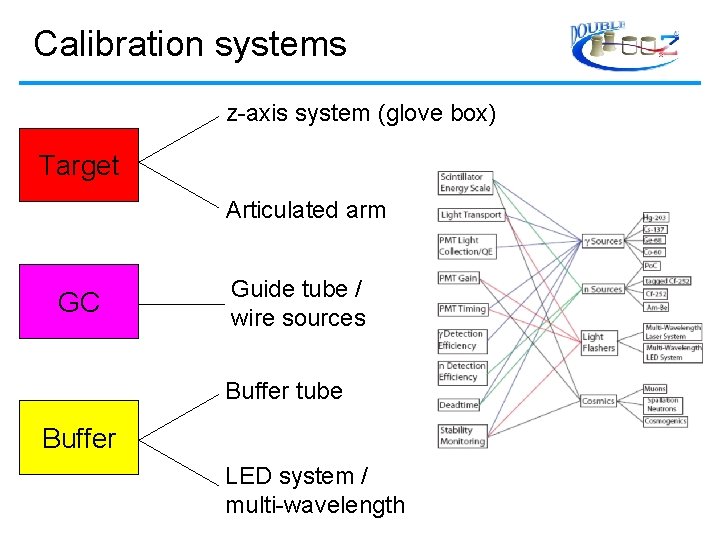
Calibration systems z-axis system (glove box) Target Articulated arm GC Guide tube / wire sources Buffer tube Buffer LED system / multi-wavelength
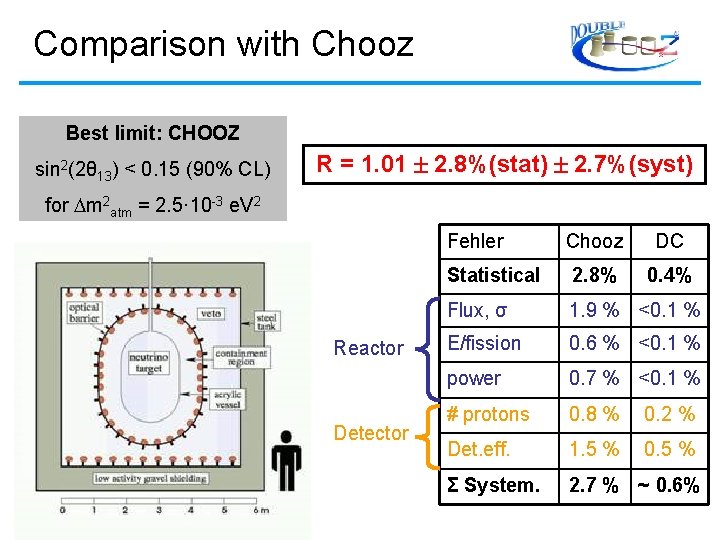
Comparison with Chooz Best limit: CHOOZ sin 2(2θ 13) < 0. 15 (90% CL) R = 1. 01 2. 8%(stat) 2. 7%(syst) for m 2 atm = 2. 5· 10 -3 e. V 2 Fehler Reactor Detector Chooz DC Statistical 2. 8% 0. 4% Flux, σ 1. 9 % <0. 1 % E/fission 0. 6 % <0. 1 % power 0. 7 % <0. 1 % # protons 0. 8 % 0. 2 % Det. eff. 1. 5 % 0. 5 % Σ System. 2. 7 % ~ 0. 6%
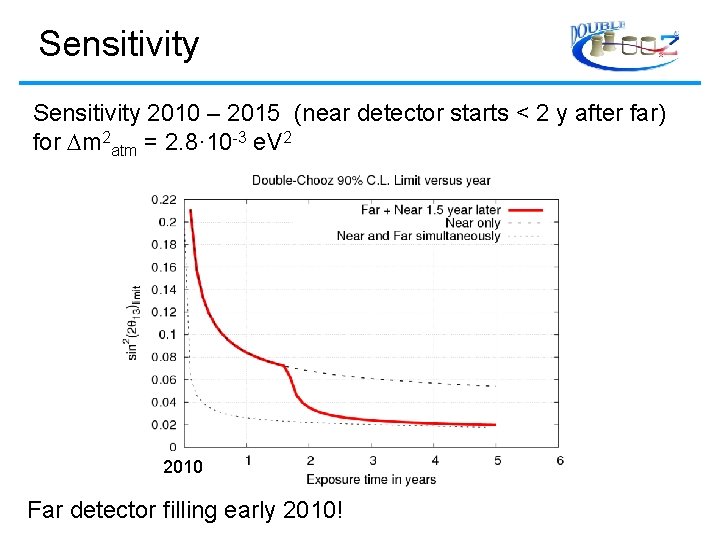
Sensitivity 2010 – 2015 (near detector starts < 2 y after far) for m 2 atm = 2. 8· 10 -3 e. V 2 2010 Far detector filling early 2010!
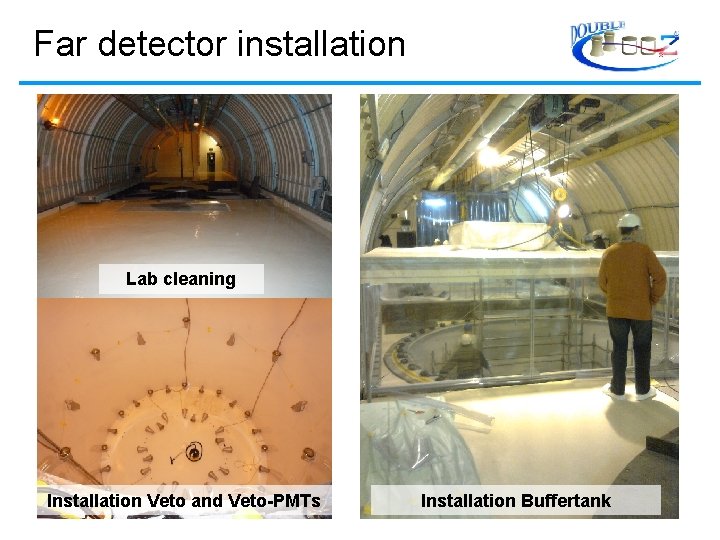
Far detector installation Lab cleaning Installation Veto and Veto-PMTs Installation Buffertank
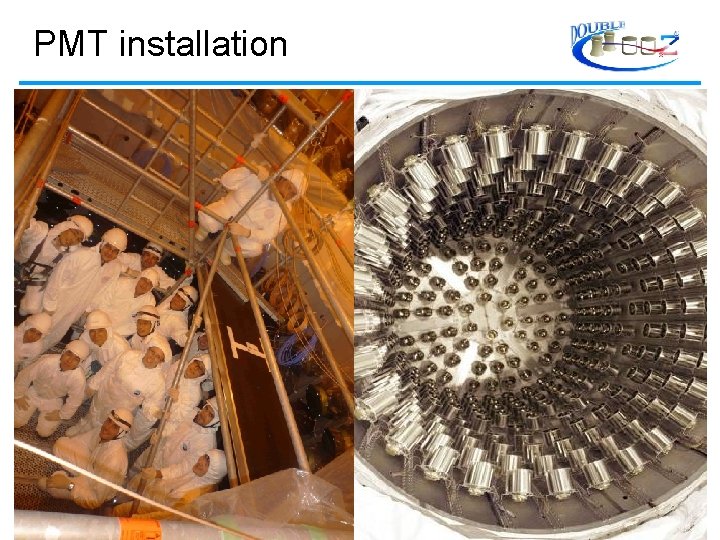
PMT installation
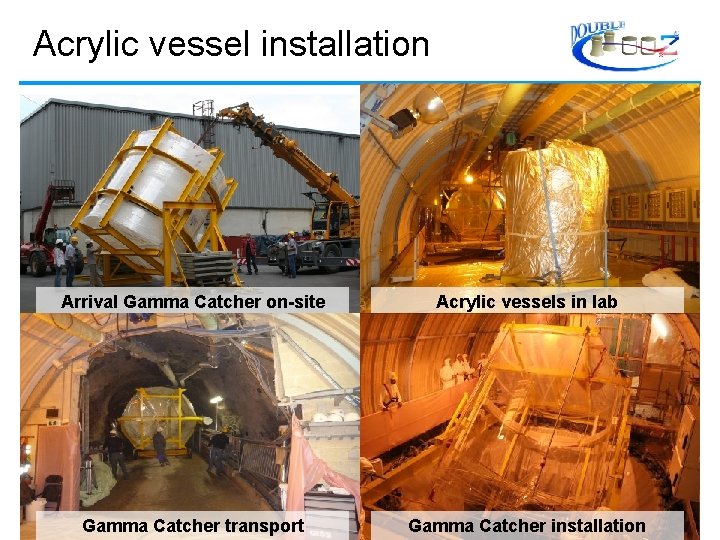
Acrylic vessel installation Arrival Gamma Catcher on-site Acrylic vessels in lab Gamma Catcher transport Gamma Catcher installation
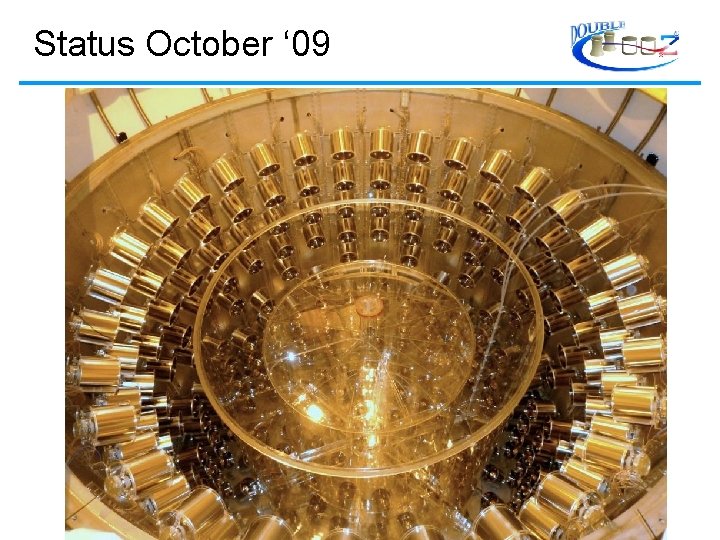
Status October ‘ 09
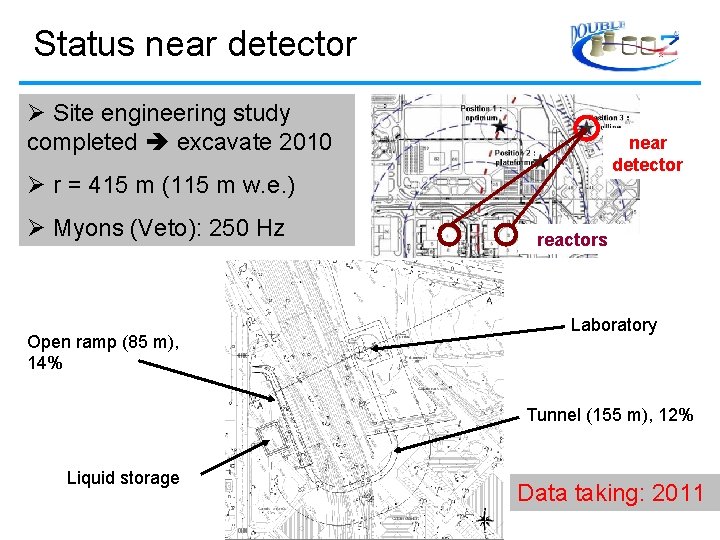
Status near detector Ø Site engineering study completed excavate 2010 near detector Ø r = 415 m (115 m w. e. ) Ø Myons (Veto): 250 Hz Open ramp (85 m), 14% reactors Laboratory Tunnel (155 m), 12% Liquid storage Data taking: 2011
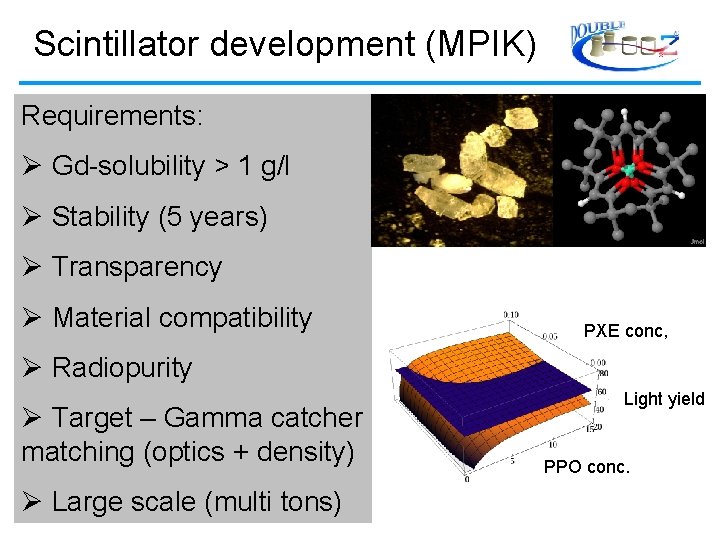
Scintillator development (MPIK) Requirements: Ø Gd-solubility > 1 g/l Ø Stability (5 years) Ø Transparency Ø Material compatibility PXE conc, Ø Radiopurity Ø Target – Gamma catcher matching (optics + density) Ø Large scale (multi tons) Light yield PPO conc.
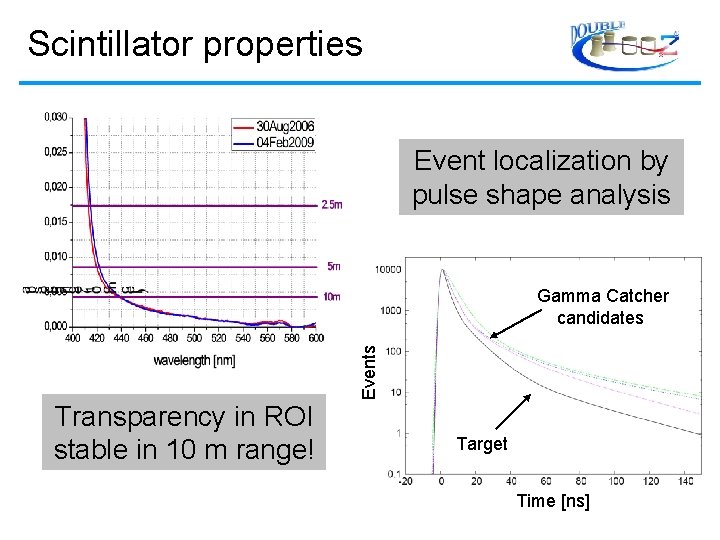
Scintillator properties Event localization by pulse shape analysis Events Gamma Catcher candidates Transparency in ROI stable in 10 m range! Target Time [ns]
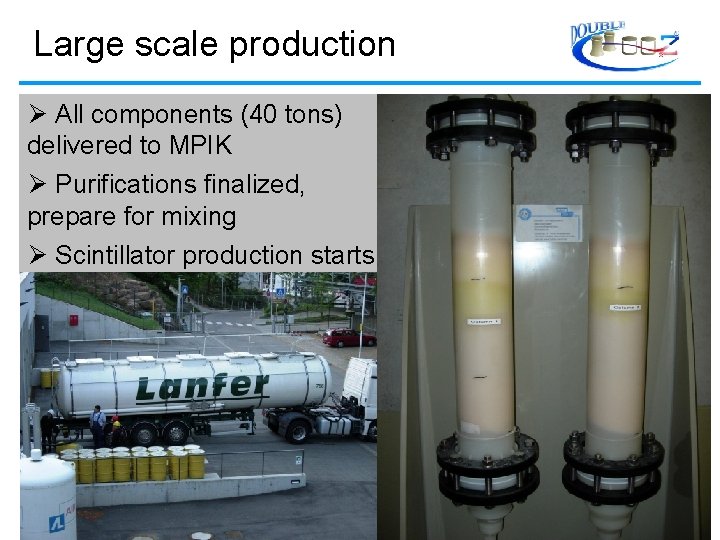
Large scale production Ø All components (40 tons) delivered to MPIK Ø Purifications finalized, prepare for mixing Ø Scintillator production starts
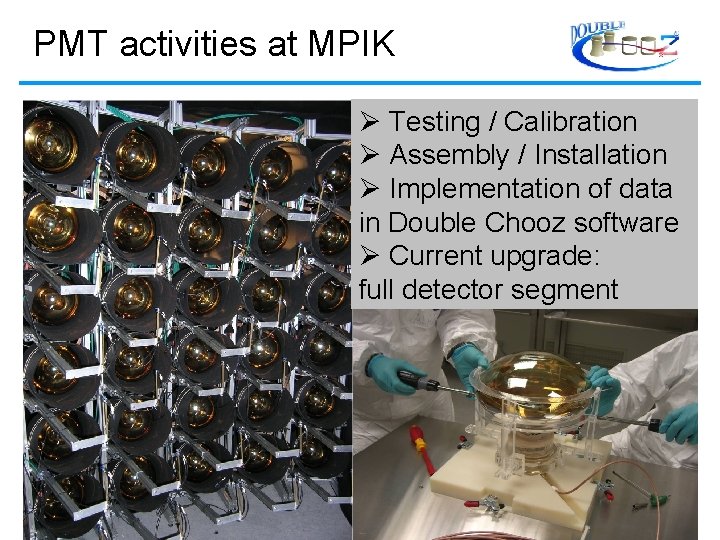
PMT activities at MPIK Ø Testing / Calibration Ø Assembly / Installation Ø Implementation of data in Double Chooz software Ø Current upgrade: full detector segment
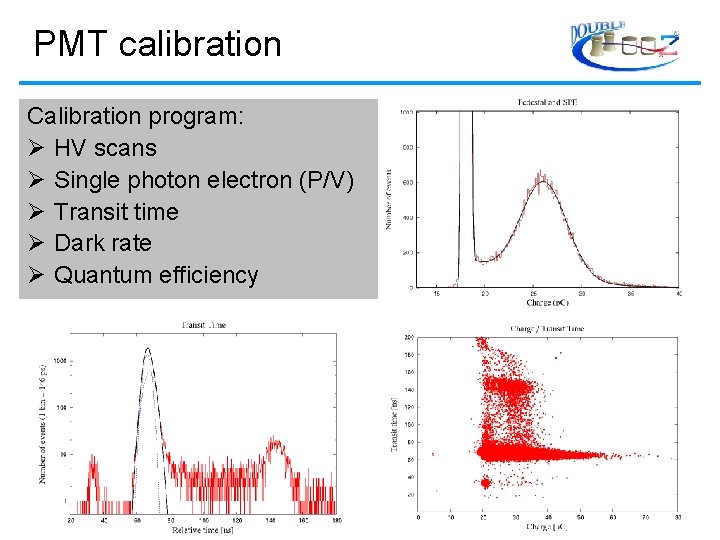
PMT calibration Calibration program: Ø HV scans Ø Single photon electron (P/V) Ø Transit time Ø Dark rate Ø Quantum efficiency
Summary Ø Goal of Double Chooz reactor neutrino experiment: Determination of mixing angle Θ 13 (sin 2(2θ 13) ~ 0. 03) Ø 2 -detector concept to reduce systematical error Ø Detection via inverse β-decay in Gadolinium loaded liquid scintillator Ø Schedule: – Data taking far detector: Spring 2010 – Near detector: end of 2011 Ø MPIK: scintillators, PMTs, Analysis
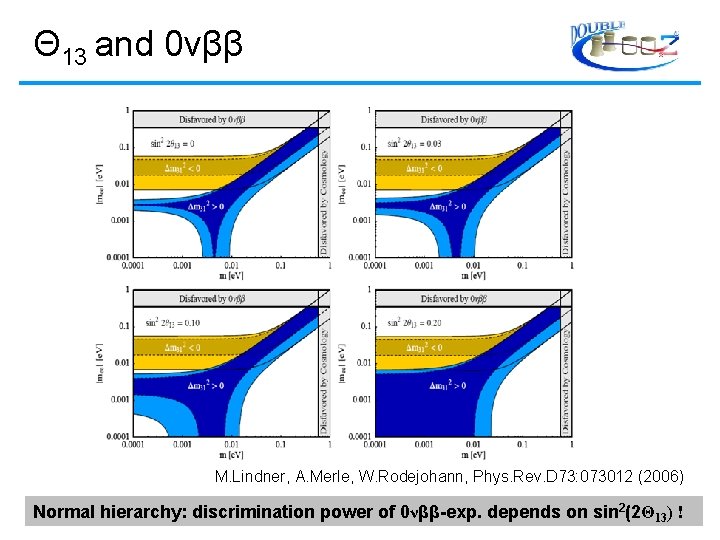
Θ 13 and 0νββ M. Lindner, A. Merle, W. Rodejohann, Phys. Rev. D 73: 073012 (2006) Normal hierarchy: discrimination power of 0νββ-exp. depends on sin 2(2Θ 13) !
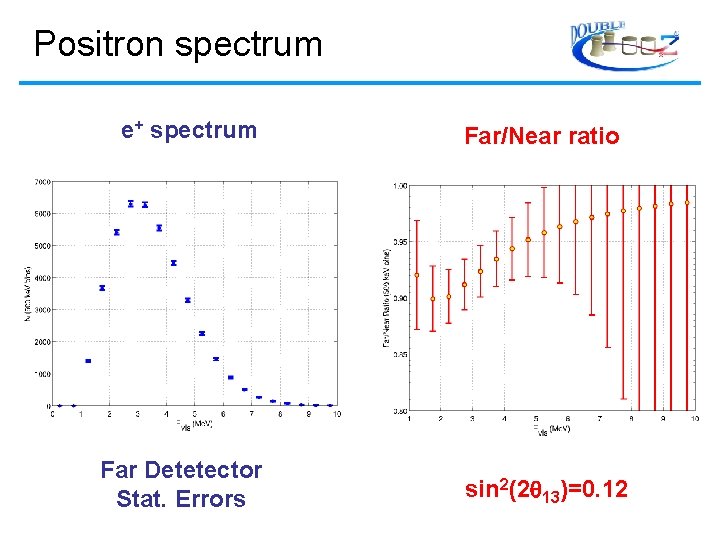
Positron spectrum e+ spectrum Far Detetector Stat. Errors Far/Near ratio sin 2(2 13)=0. 12
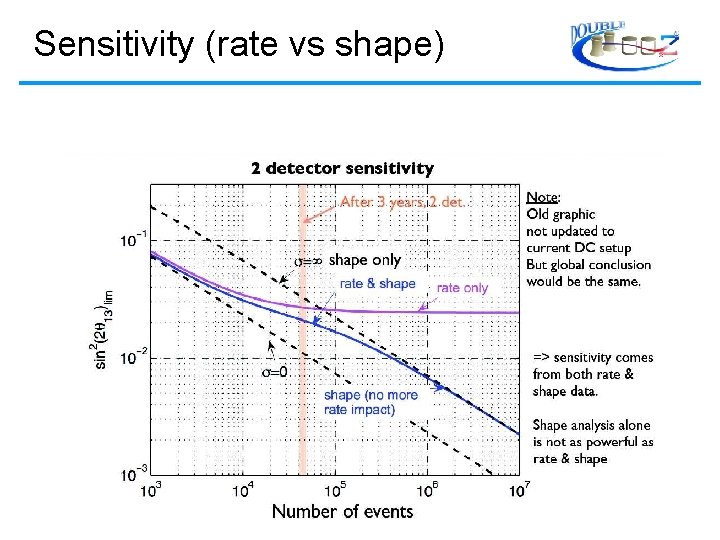
Sensitivity (rate vs shape)
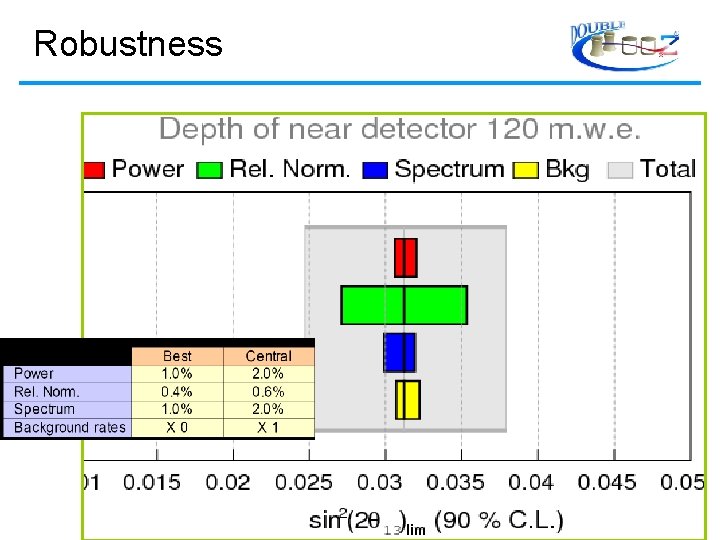
Robustness
- Slides: 29