
The Double Chooz experiment Christian Buck MPIK Heidelberg
The Double Chooz experiment Christian Buck, MPIK Heidelberg for the Double Chooz Collaboration LAUNCH March 23 rd, 2007
Outline Motivation The Double Chooz Concept and Design Scintillator development at MPIK Summary
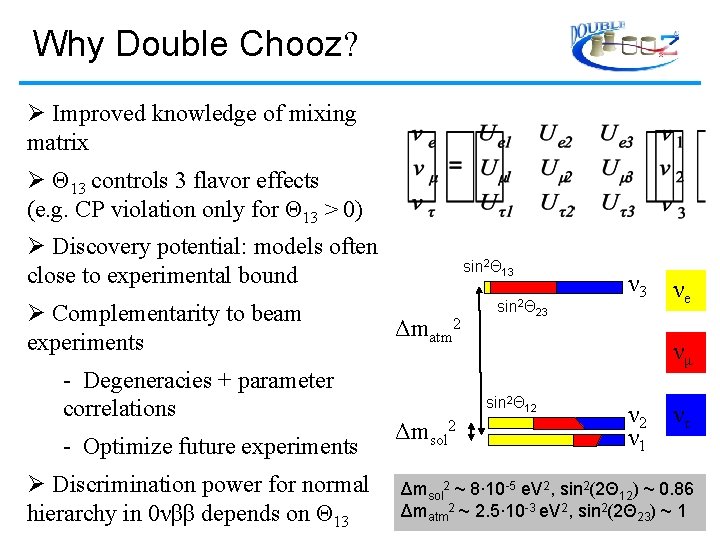
Why Double Chooz? Improved knowledge of mixing matrix Θ 13 controls 3 flavor effects (e. g. CP violation only for Θ 13 > 0) Discovery potential: models often close to experimental bound Complementarity to beam experiments - Degeneracies + parameter correlations - Optimize future experiments Discrimination power for normal hierarchy in 0νββ depends on Θ 13 sin 2Θ 13 Δmatm 2 sin 2Θ 23 Δmsol νe νμ sin 2Θ 12 2 ν 3 ν 2 ν 1 ντ Δmsol 2 ~ 8∙ 10 -5 e. V 2, sin 2(2Θ 12) ~ 0. 86 Δmatm 2 ~ 2. 5∙ 10 -3 e. V 2, sin 2(2Θ 23) ~ 1
Non-proliferation Interest of International Atomic Energy Agency (IAEA) in νe detection - Monitoring of single reactors - Monitoring of countries Intensity and shape of spectrum isotopic composition Use Double Chooz near detector as prototype for reactor monitoring Thermal power (1% ? ) depend on Pu content!
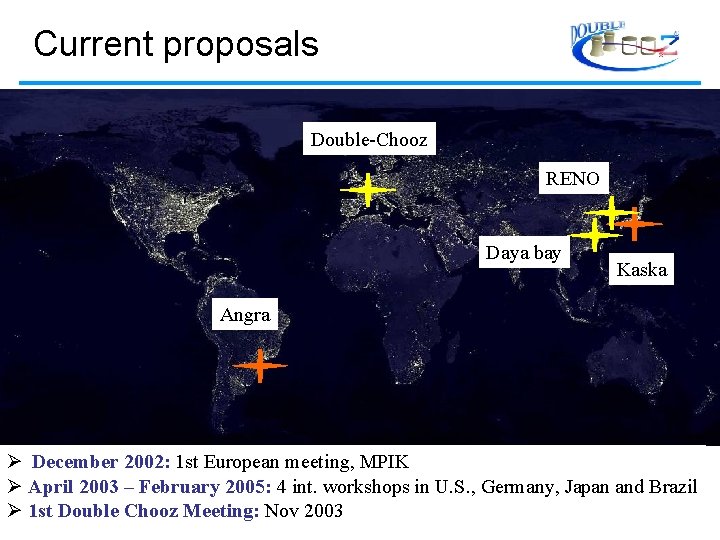
Current proposals Double-Chooz RENO Daya bay Kaska Angra December 2002: 1 st European meeting, MPIK April 2003 – February 2005: 4 int. workshops in U. S. , Germany, Japan and Brazil 1 st Double Chooz Meeting: Nov 2003
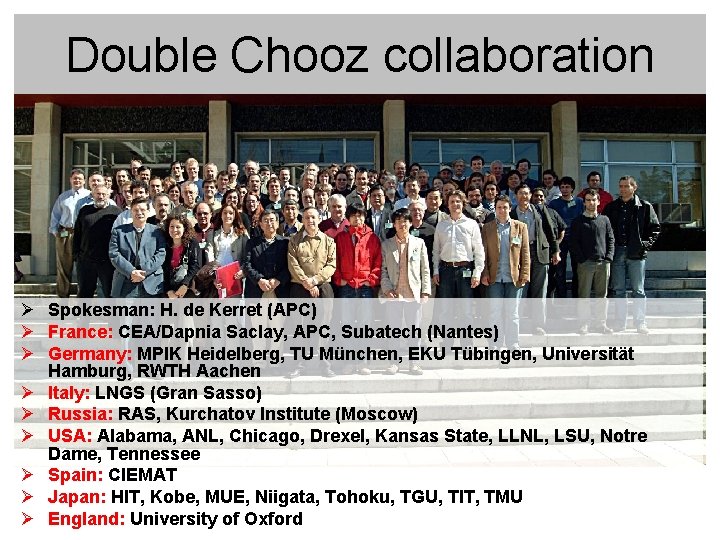
Double Chooz collaboration Spokesman: H. de Kerret (APC) France: CEA/Dapnia Saclay, APC, Subatech (Nantes) Germany: MPIK Heidelberg, TU München, EKU Tübingen, Universität Hamburg, RWTH Aachen Italy: LNGS (Gran Sasso) Russia: RAS, Kurchatov Institute (Moscow) USA: Alabama, ANL, Chicago, Drexel, Kansas State, LLNL, LSU, Notre Dame, Tennessee Spain: CIEMAT Japan: HIT, Kobe, MUE, Niigata, Tohoku, TGU, TIT, TMU England: University of Oxford
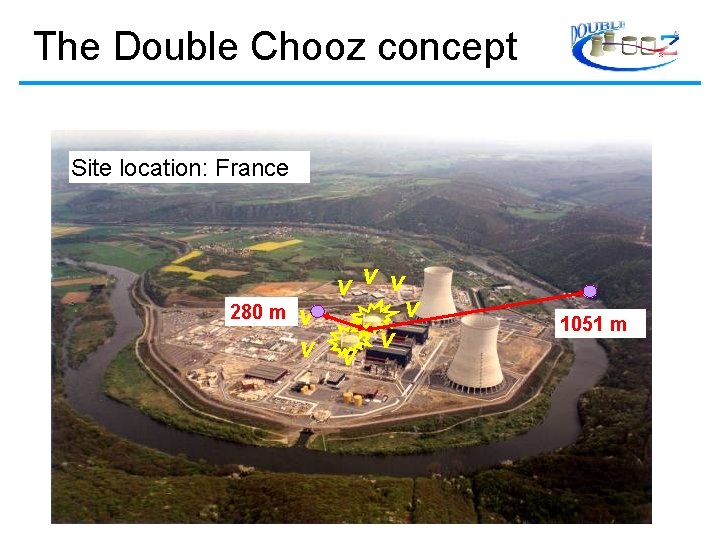
The Double Chooz concept Site location: France νν ν 280 m ν ν ν 1051 m
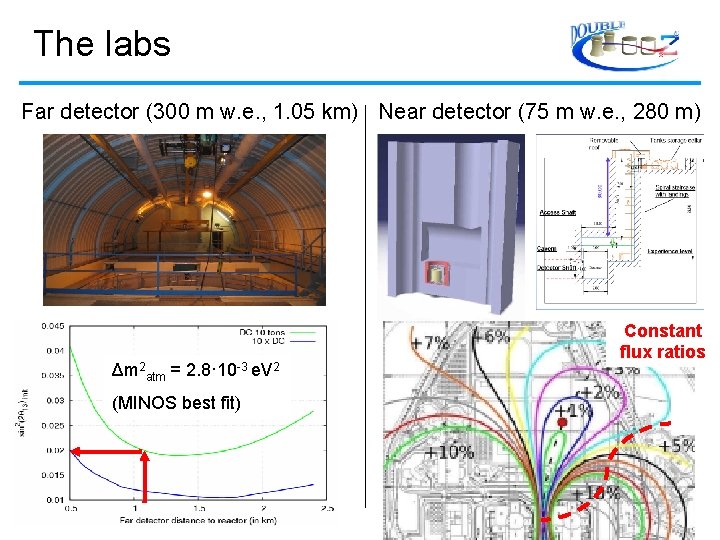
The labs Far detector (300 m w. e. , 1. 05 km) Near detector (75 m w. e. , 280 m) Δm 2 atm = 2. 8· 10 -3 e. V 2 (MINOS best fit) Constant flux ratios
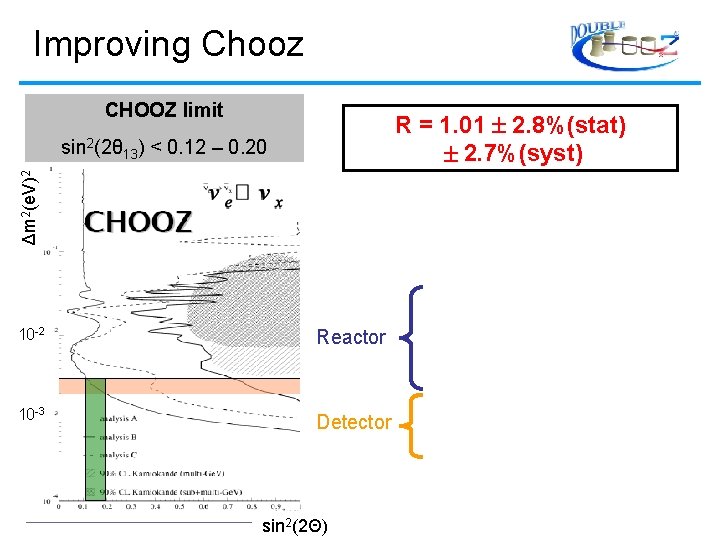
Improving Chooz CHOOZ limit 13) R = 1. 01 2. 8%(stat) 2. 7%(syst) < 0. 12 – 0. 20 Δm 2(e. V)2 sin 2(2θ 10 -2 Reactor 10 -3 Detector sin 2(2Θ)
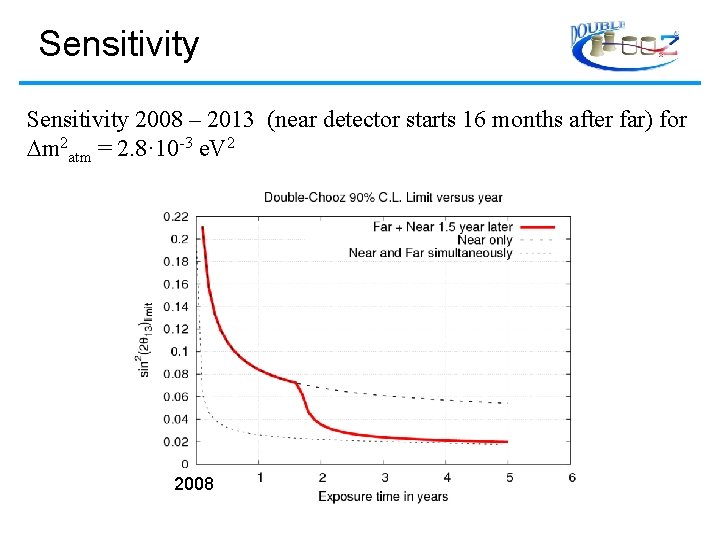
Sensitivity 2008 – 2013 (near detector starts 16 months after far) for m 2 atm = 2. 8· 10 -3 e. V 2 2008
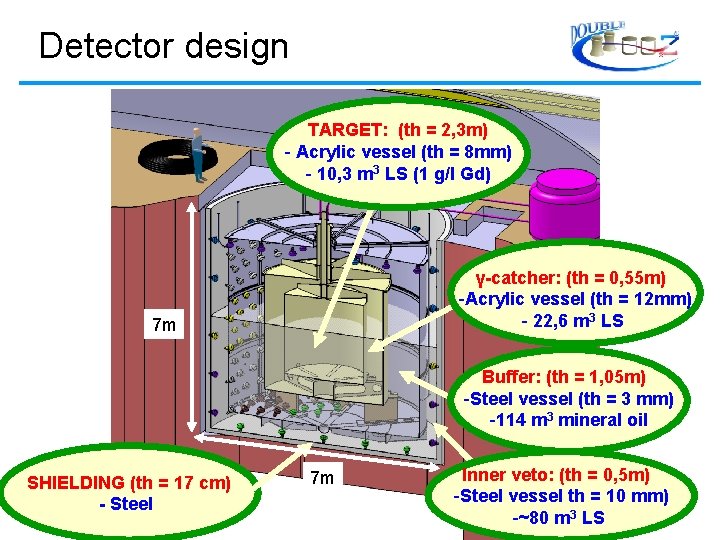
Detector design TARGET: (th = 2, 3 m) - Acrylic vessel (th = 8 mm) - 10, 3 m 3 LS (1 g/l Gd) γ-catcher: (th = 0, 55 m) -Acrylic vessel (th = 12 mm) - 22, 6 m 3 LS 7 m Buffer: (th = 1, 05 m) -Steel vessel (th = 3 mm) -114 m 3 mineral oil SHIELDING (th = 17 cm) - Steel 7 m Inner veto: (th = 0, 5 m) -Steel vessel th = 10 mm) -~80 m 3 LS
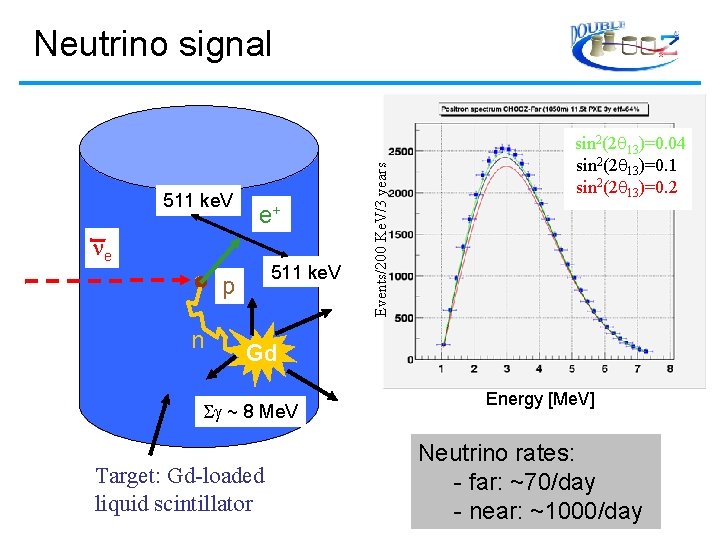
511 ke. V e+ e 511 ke. V p n Events/200 Ke. V/3 years Neutrino signal sin 2(2 13)=0. 04 sin 2(2 13)=0. 1 sin 2(2 13)=0. 2 Gd ~ 8 Me. V Target: Gd-loaded liquid scintillator Energy [Me. V] Neutrino rates: - far: ~70/day - near: ~1000/day
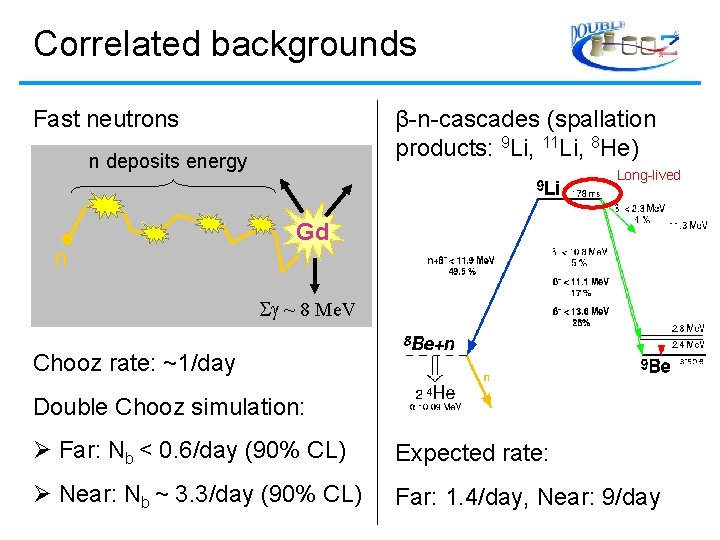
Correlated backgrounds Fast neutrons β-n-cascades (spallation products: 9 Li, 11 Li, 8 He) n deposits energy n Long-lived Gd ~ 8 Me. V Chooz rate: ~1/day Double Chooz simulation: Far: Nb < 0. 6/day (90% CL) Expected rate: Near: Nb ~ 3. 3/day (90% CL) Far: 1. 4/day, Near: 9/day
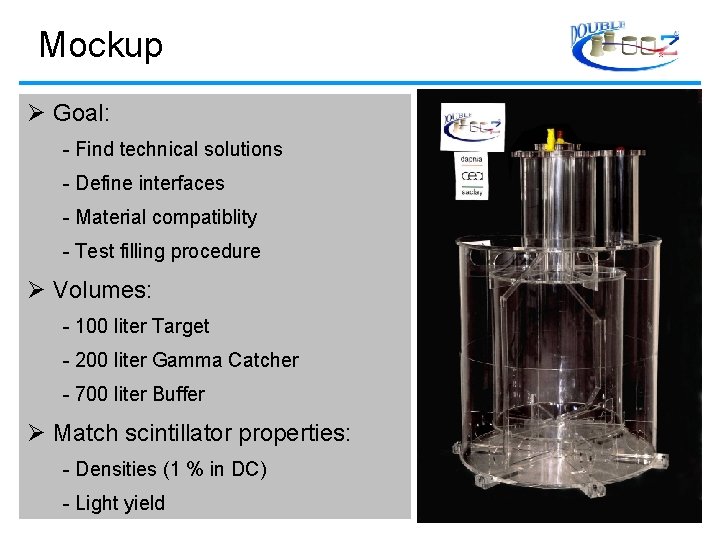
Mockup Goal: - Find technical solutions - Define interfaces - Material compatiblity - Test filling procedure Volumes: - 100 liter Target - 200 liter Gamma Catcher - 700 liter Buffer Match scintillator properties: - Densities (1 % in DC) - Light yield
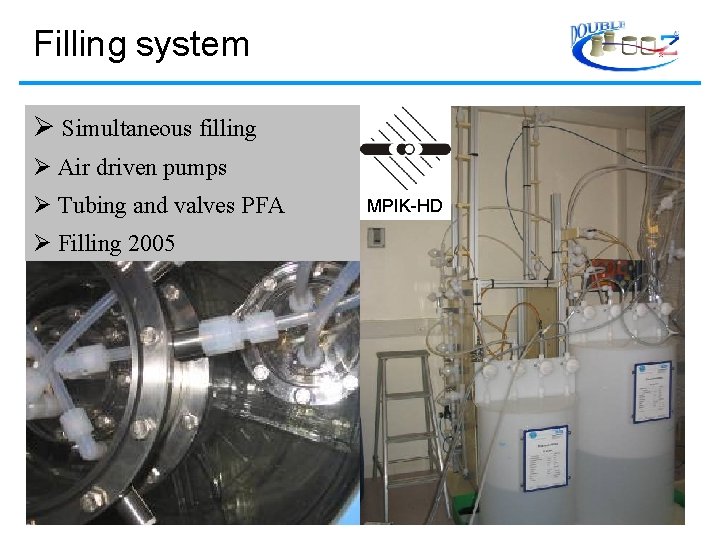
Filling system Simultaneous filling Air driven pumps Tubing and valves PFA Filling 2005 MPIK-HD
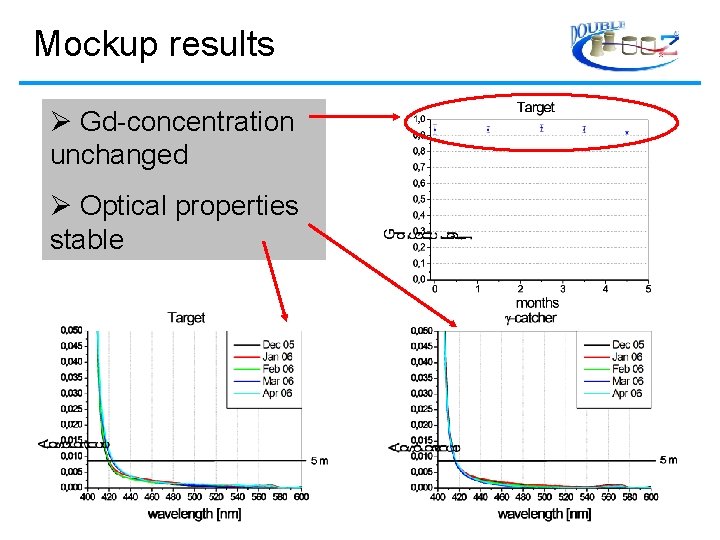
Mockup results Gd-concentration unchanged Optical properties stable
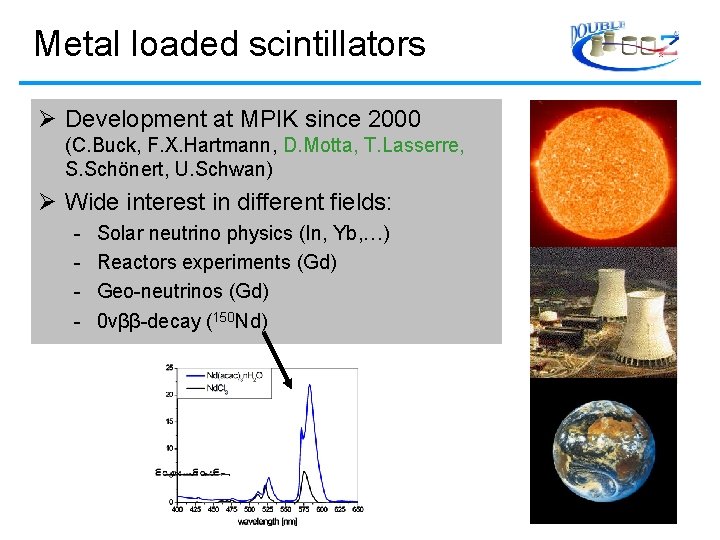
Metal loaded scintillators Development at MPIK since 2000 (C. Buck, F. X. Hartmann, D. Motta, T. Lasserre, S. Schönert, U. Schwan) Wide interest in different fields: - Solar neutrino physics (In, Yb, …) Reactors experiments (Gd) Geo-neutrinos (Gd) 0νββ-decay (150 Nd)
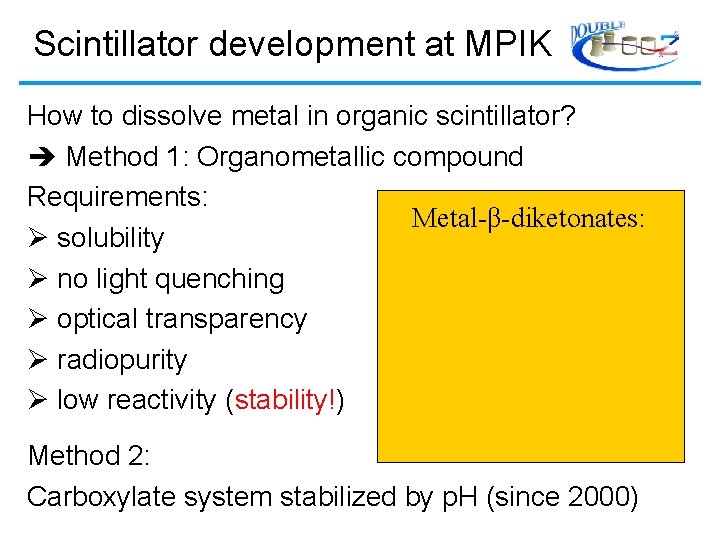
Scintillator development at MPIK How to dissolve metal in organic scintillator? Method 1: Organometallic compound Requirements: Metal-β-diketonates: solubility no light quenching optical transparency radiopurity low reactivity (stability!) Method 2: Carboxylate system stabilized by p. H (since 2000)
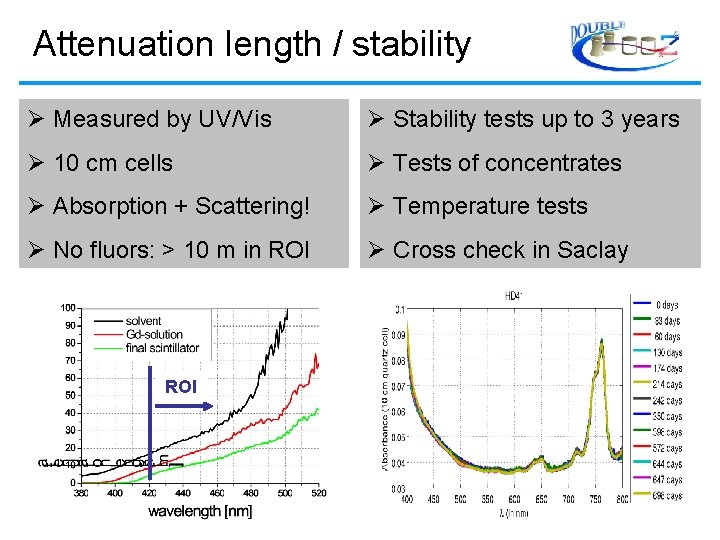
Attenuation length / stability Measured by UV/Vis Stability tests up to 3 years 10 cm cells Tests of concentrates Absorption + Scattering! Temperature tests No fluors: > 10 m in ROI Cross check in Saclay ROI
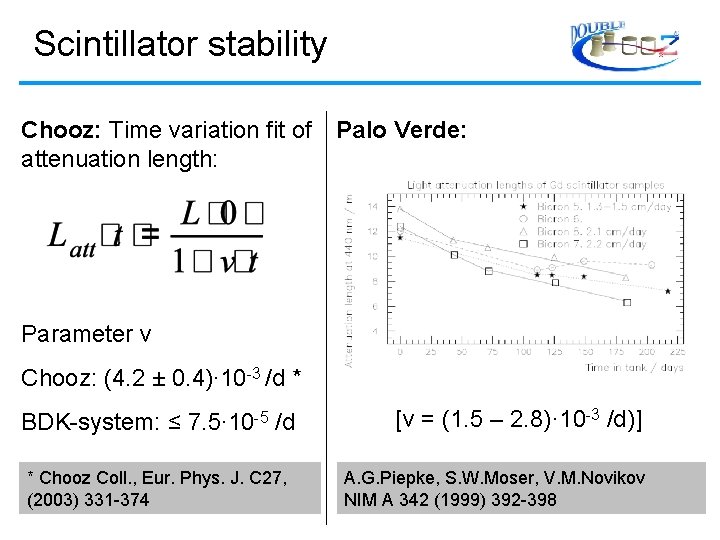
Scintillator stability Chooz: Time variation fit of attenuation length: Palo Verde: Parameter v Chooz: (4. 2 ± 0. 4)∙ 10 -3 /d * BDK-system: ≤ 7. 5∙ 10 -5 /d * Chooz Coll. , Eur. Phys. J. C 27, (2003) 331 -374 [v = (1. 5 – 2. 8)· 10 -3 /d)] A. G. Piepke, S. W. Moser, V. M. Novikov NIM A 342 (1999) 392 -398
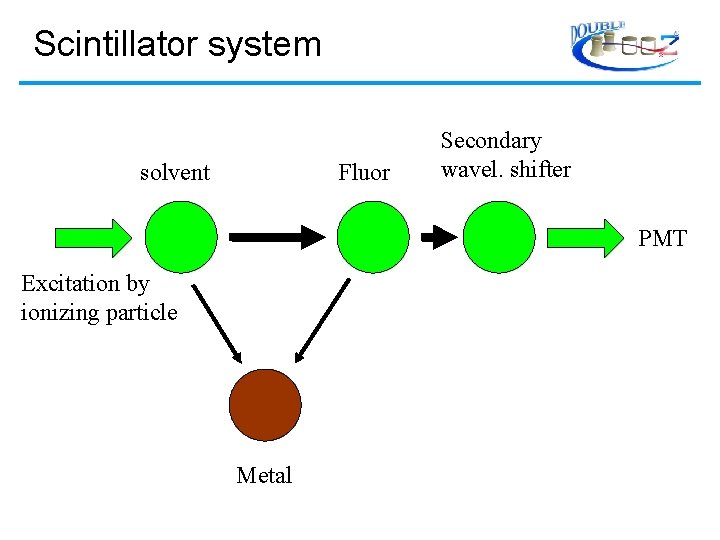
Scintillator system solvent Fluor Secondary wavel. shifter PMT Excitation by ionizing particle Metal
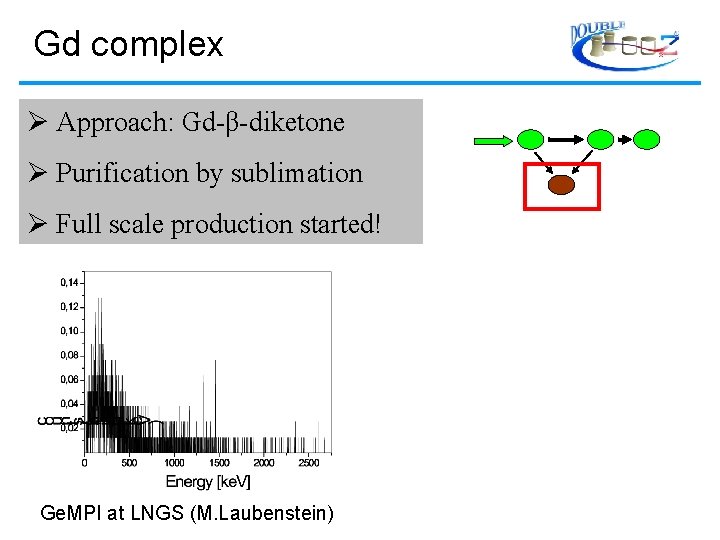
Gd complex Approach: Gd-β-diketone Purification by sublimation Full scale production started! Ge. MPI at LNGS (M. Laubenstein)
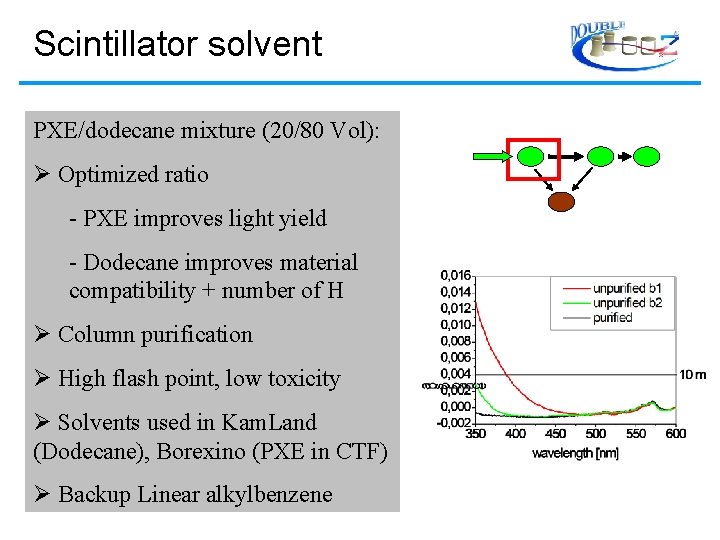
Scintillator solvent PXE/dodecane mixture (20/80 Vol): Optimized ratio - PXE improves light yield - Dodecane improves material compatibility + number of H Column purification High flash point, low toxicity Solvents used in Kam. Land (Dodecane), Borexino (PXE in CTF) Backup Linear alkylbenzene
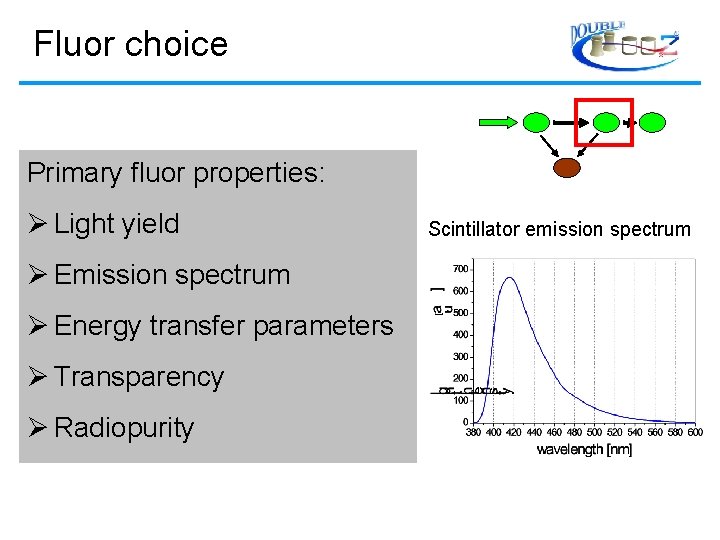
Fluor choice Primary fluor properties: Light yield Emission spectrum Energy transfer parameters Transparency Radiopurity Scintillator emission spectrum
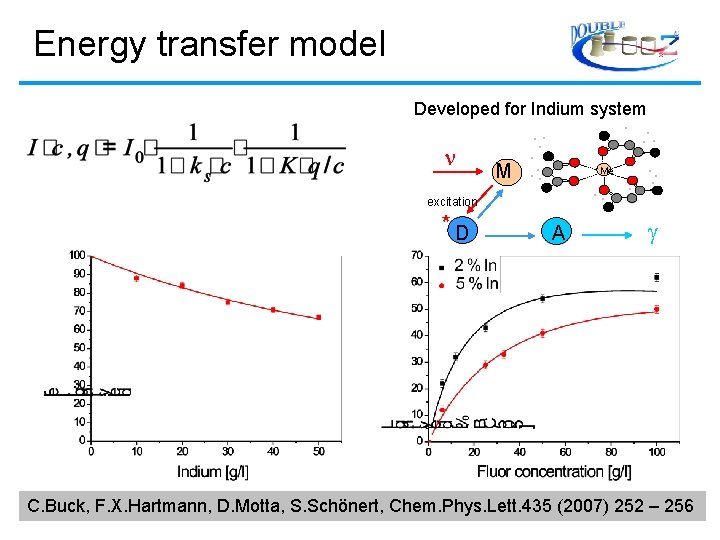
Energy transfer model Developed for Indium system . . . . O M M O O Me I n O M O O M C H excitation *D . . A C. Buck, F. X. Hartmann, D. Motta, S. Schönert, Chem. Phys. Lett. 435 (2007) 252 – 256
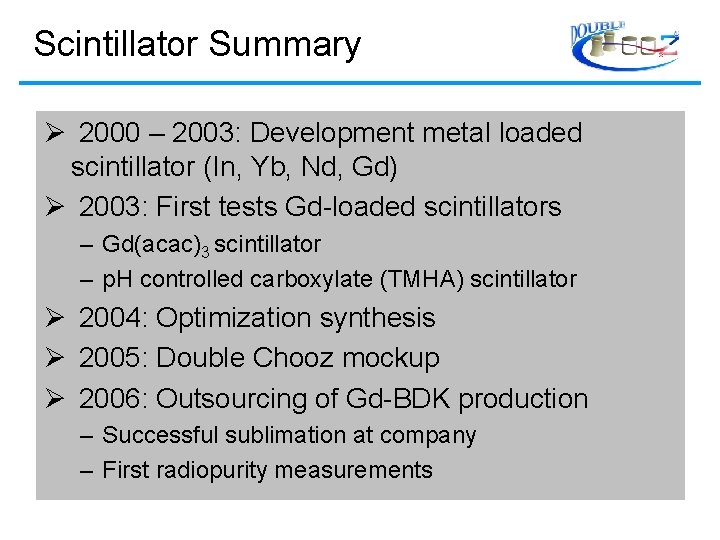
Scintillator Summary 2000 – 2003: Development metal loaded scintillator (In, Yb, Nd, Gd) 2003: First tests Gd-loaded scintillators – Gd(acac)3 scintillator – p. H controlled carboxylate (TMHA) scintillator 2004: Optimization synthesis 2005: Double Chooz mockup 2006: Outsourcing of Gd-BDK production – Successful sublimation at company – First radiopurity measurements
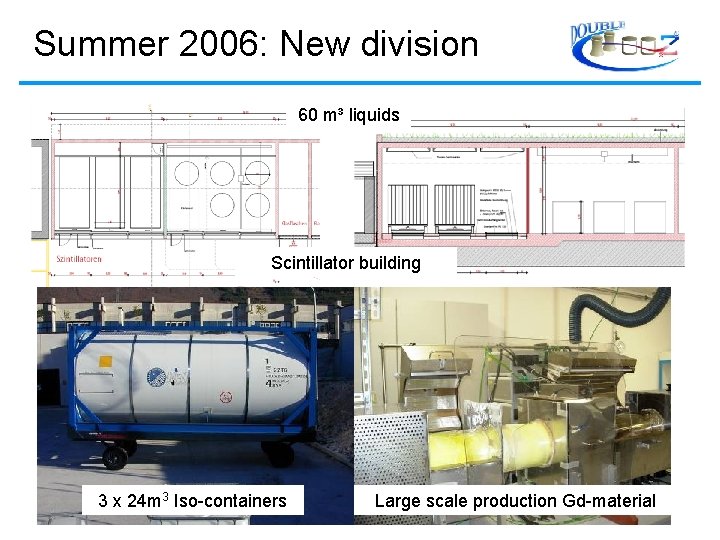
Summer 2006: New division 60 m³ liquids Scintillator building 3 x 24 m 3 Iso-containers Large scale production Gd-material
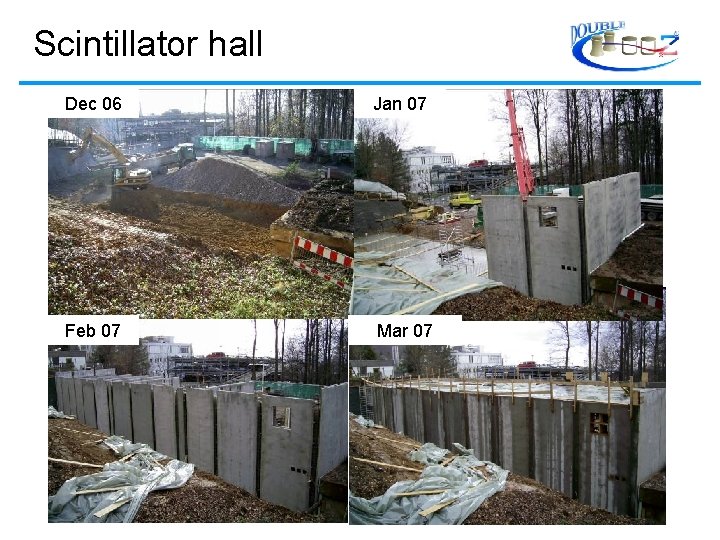
Scintillator hall Dec 06 Jan 07 Feb 07 Mar 07
Summary Double Chooz searches for the neutrino mixing angle θ 13 - Sensitivity: sin 2(2Θ 13) < 0. 02 - 0. 03 (90% CL) bound sin 2(2Θ 13) < 0. 2) (Chooz - Start data taking: 2008 Main hardware contribution of MPIK: - Development + production target Gd-scintillator (10. 3 m³) - Tuning + production of γ-catcher scintillator (22 m³) - Design and construction scintillator mixing system Status - Major components ordered - Construction of scintillator hall
- Slides: 29