
The Doppler Effect Tyler Cash Theory The Doppler
- Slides: 15
The Doppler Effect Tyler Cash
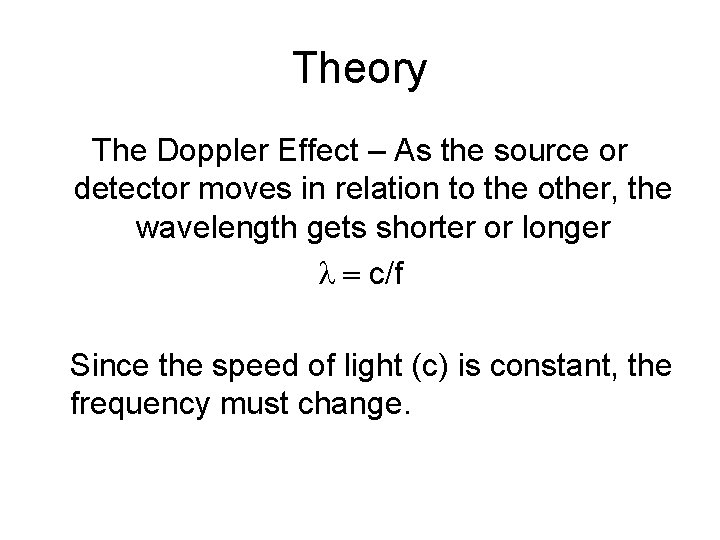
Theory The Doppler Effect – As the source or detector moves in relation to the other, the wavelength gets shorter or longer l = c/f Since the speed of light (c) is constant, the frequency must change.
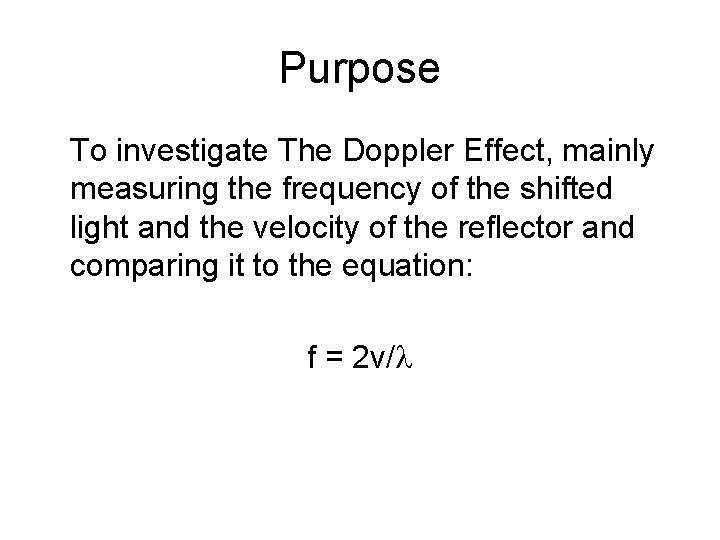
Purpose To investigate The Doppler Effect, mainly measuring the frequency of the shifted light and the velocity of the reflector and comparing it to the equation: f = 2 v/l
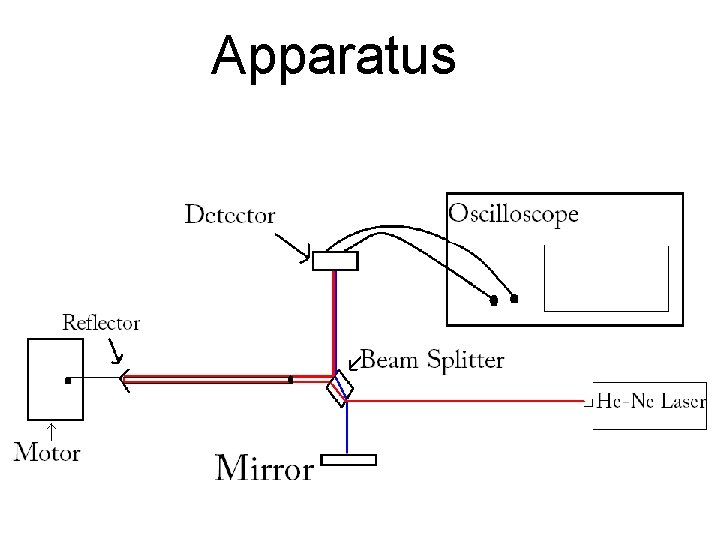
Apparatus
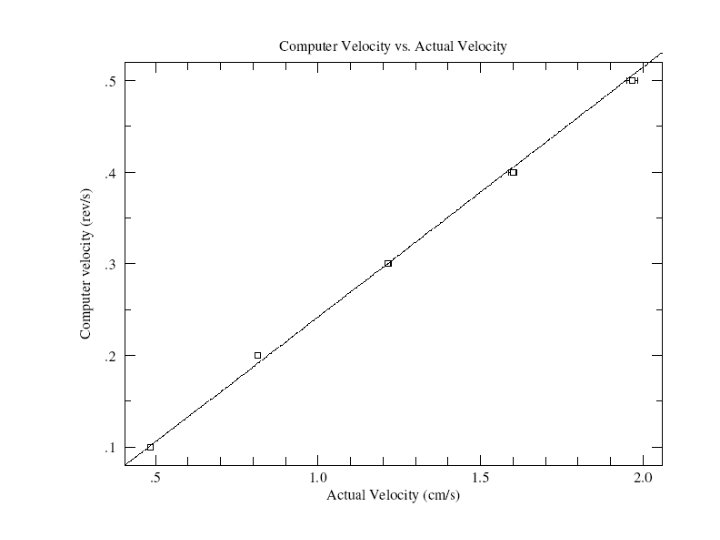
Procedure • Measured velocity of reflector for various computer speeds (error in time measurement and distance measurement) • Calculated ratio of actual velocity to computer velocity
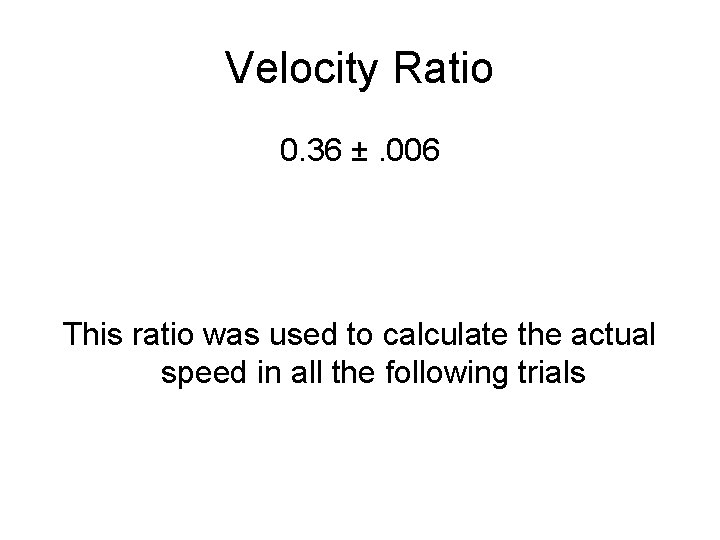
Velocity Ratio 0. 36 ±. 006 This ratio was used to calculate the actual speed in all the following trials
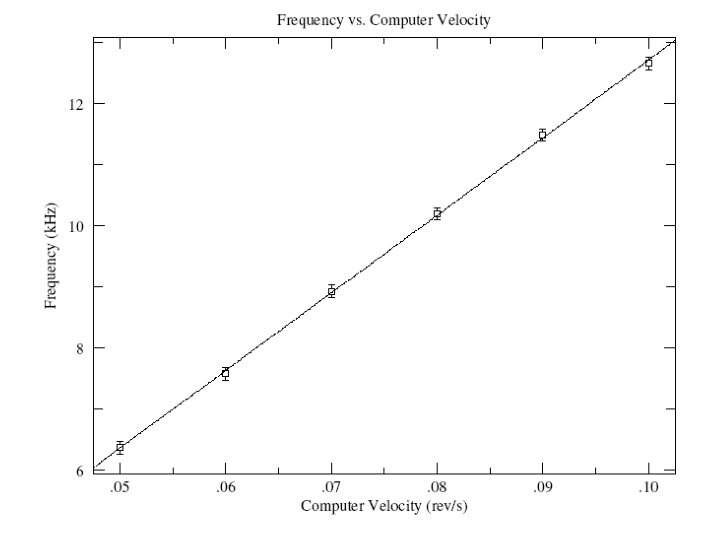
Procedure • Used the Oscilloscope to measure the frequency of the beam from the moving reflector (error in measurement of where the peaks were) • We then plotted the frequency vs. the velocity of the reflector.
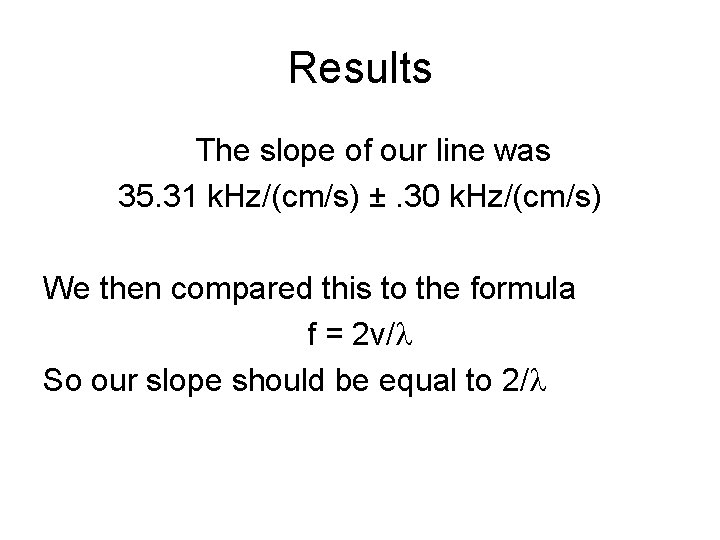
Results The slope of our line was 35. 31 k. Hz/(cm/s) ±. 30 k. Hz/(cm/s) We then compared this to the formula f = 2 v/l So our slope should be equal to 2/l
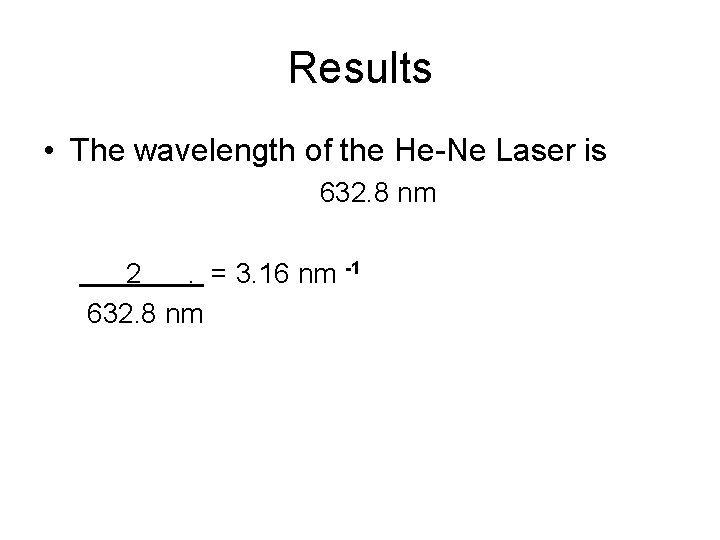
Results • The wavelength of the He-Ne Laser is 632. 8 nm 2. = 3. 16 nm -1 632. 8 nm
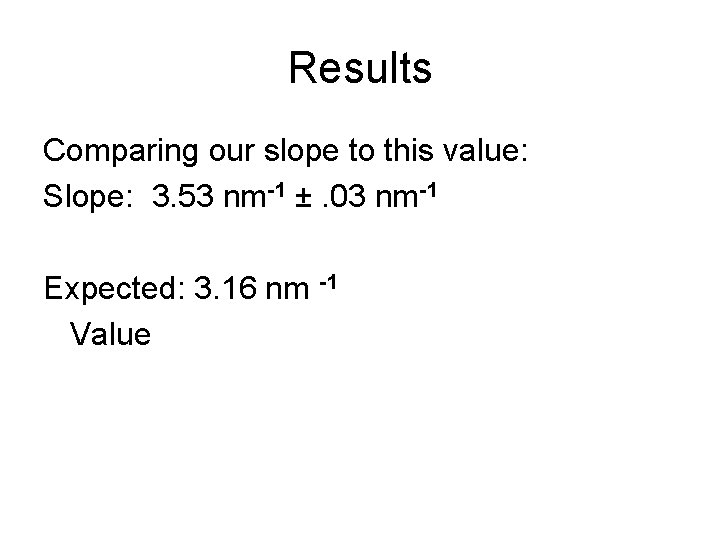
Results Comparing our slope to this value: Slope: 3. 53 nm-1 ±. 03 nm-1 Expected: 3. 16 nm -1 Value
Results • Our value did not agree within experimental uncertainty. • This was somewhat expected because there were some sources of uncertainty we did not account for. For Example: Oscilloscope, Vibration of Reflector, Alignment of Laser, Inconsistencies in the String
Conclusion • Our data was consistent with theory that as the velocity of the detector increases, the frequency increases. • Our value for 2/l was not within experimental uncertainty, but was reasonably close considering the error that was unaccounted for.
Conclusion • We learned that The Doppler Effect applies to light as well as sound. • Using this information, scientists have been able to discover that the universe is expanding. (The light received from distant stars is red shifted, i. e. longer wavelength)