
The DOE Science Grid Computing and Data Infrastructure

- Slides: 20
The DOE Science Grid Computing and Data Infrastructure for Large-Scale Science William Johnston, Lawrence Berkeley National Lab Ray Bair, Pacific Northwest National Lab Ian Foster, Argonne National Lab Al Giest, Oak Ridge National Lab Bill Kramer, National Energy Research Scientific Computing Center and the DOE Science Grid Engineering Team http: //doesciencegrid. org
ØThe Need for Science Grids l l The nature of how large scale science is done is changing u distributed data, computing, people, instruments u instruments integrated with large-scale computing “Grids” are middleware designed to facilitate the routine interactions of all of these resources in order to support widely distributed, multi-institutional science and engineering. DOE Science Grid 2
ØDistributed Science Example: Supernova Cosmology l “Supernova cosmology” is cosmology that is based on finding and observing special types of supernova during the few weeks of their observable life l It has lead to some remarkable science (Science magazine’s “Breakthrough of the year award” (1998): Supernova cosmology indicates universe expands forever), however it is rapidly becoming limited by the ability of the researchers to manage the complex data-computing-instrument interactions DOE Science Grid 3
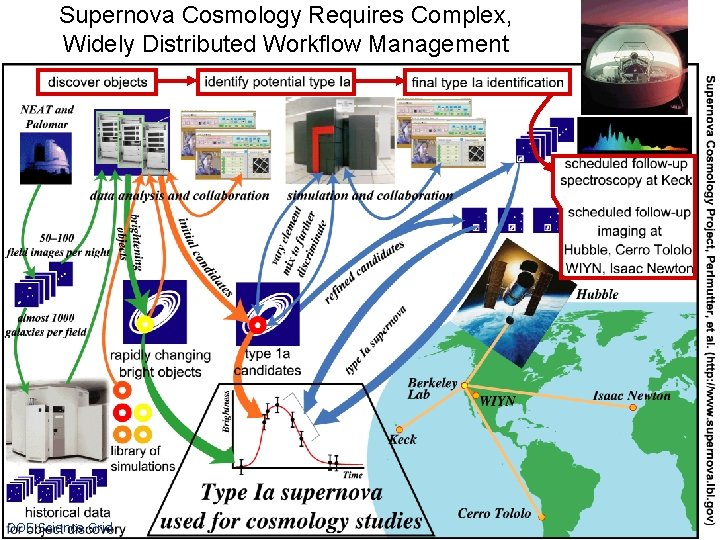
Supernova Cosmology Requires Complex, Widely Distributed Workflow Management DOE Science Grid
l Supernova Cosmology This is one of the class of problems that Grids are focused on. It involves: u management of complex workflow u reliable, wide area, high volume data management u inclusion of supercomputers in time constrained scenarios u easily accessible pools of computing resources u eventual inclusion of instruments that will be semi-automatically retargeted based on data analysis and simulation u next generation will generate vastly more data (from SNAP - satellite based observation) DOE Science Grid 5
What are Grids? l l Middleware for uniform, secure, and highly capable access to large and small scale computing, data, and instrument systems, all of which are distributed across organizations Services supporting construction of application frameworks and science portals Persistent infrastructure for distributed applications (e. g. security services and resource discovery) 200 people working on standards at the IETF-like Global Grid Forum (www. gridforum. org) DOE Science Grid 6
Grids l There are several different types of user of Grid services discipline scientists u problem solving system / framework / science portal developers u computational tool / application writers u Grid system managers u Grid service builders u l Each of these user communities have somewhat different requirements for Grids, and the Grid services available or under development are trying to address all of these groups DOE Science Grid 7
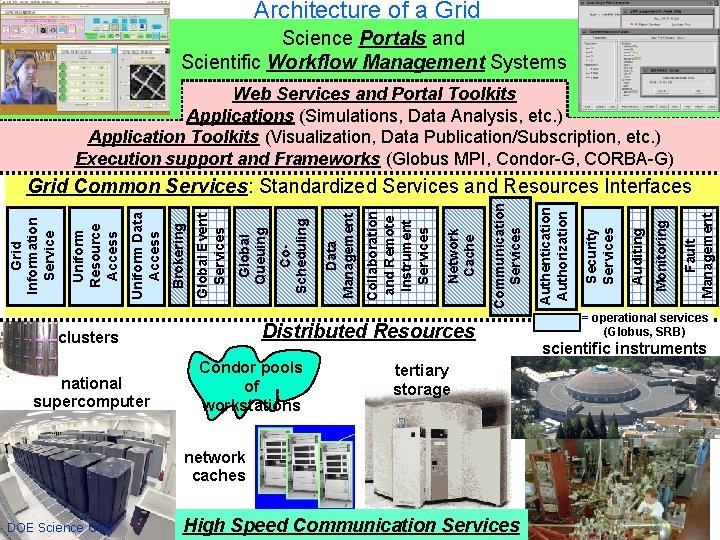
Architecture of a Grid Science Portals and Scientific Workflow Management Systems Web Services and Portal Toolkits Applications (Simulations, Data Analysis, etc. ) Application Toolkits (Visualization, Data Publication/Subscription, etc. ) Execution support and Frameworks (Globus MPI, Condor-G, CORBA-G) Condor pools of workstations tertiary storage network caches DOE Science Grid High Speed Communication Services Fault Management Monitoring Auditing Security Services Authentication Authorization Communication Services Network Cache Collaboration and Remote Instrument Services Data Management Distributed Resources clusters national supercomputer facilities Co. Scheduling Global Queuing Global Event Services Brokering Uniform Data Access Uniform Resource Access Grid Information Service Grid Common Services: Standardized Services and Resources Interfaces = operational services (Globus, SRB) scientific instruments
ØState of Grids l l l Grids are real, and they are useful now Basic Grid services are being deployed to support uniform and secure access to computing, data, and instrument systems that are distributed across organizations Grid execution management tools (e. g. Condor-G) are being deployed Data services, such as uniform access to tertiary storage systems and global metadata catalogues, are being deployed (e. g. Grid. FTP and Storage Resource Broker) Web services supporting application frameworks and science portals are being prototyped DOE Science Grid 9
l State of Grids Persistent infrastructure is being built Grid services are being maintained on the compute and data systems of interest (Grid sysadmin) u cryptographic authentication supporting single sign-on is provided through Public Key Infrastructure u resource discovery services are being maintained (Grid Information Service – distributed directory service) u This is happening, e. g. , in the DOE Science Grid, EU Data Grid, UK e. Science Grid, NASA’s IPG, etc. u For DOE science projects, ESNet is running a PKI Certification Authority and assisting with policy issues among DOE Labs and their collaborators u DOE Science Grid 10
l ØDOE Science Grid Sci. DAC project to explore the issues for providing persistent operational Grid support in the DOE environment: LBNL, NERSC, PNNL, ANL, and ORNL u Initial computing resources l 10 small, medium, and large clusters u High bandwidth connectivity end-to-end (high-speed links from site systems to ESNet gateways) u Storage resources: four tertiary storage systems (NERSC, PNNL, ANL, and ORNL) u Globus providing the Grid Common Services u Collaboration with ESNet for security and directory services DOE Science Grid 11
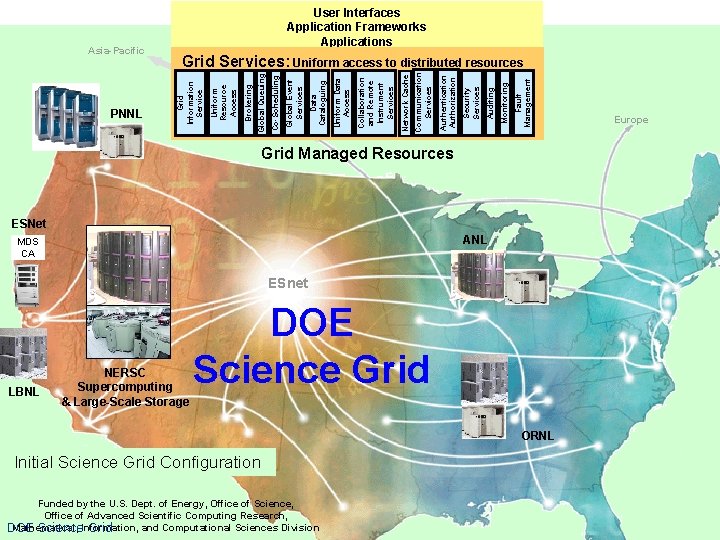
Fault Management Auditing Monitoring Security Services Authentication Authorization Communication Services Network Cache Collaboration and Remote Instrument Services Uniform Data Access Data Cataloguing Global Event Services Co-Scheduling Global Queuing Brokering Uniform Resource Access PNNL Grid Services: Uniform access to distributed resources Grid Information Service Asia-Pacific User Interfaces Application Frameworks Applications Grid Managed Resources ESNet ANL MDS CA ESnet LBNL NERSC Supercomputing & Large-Scale Storage DOE Science Grid ORNL Initial Science Grid Configuration Funded by the U. S. Dept. of Energy, Office of Science, Office of Advanced Scientific Computing Research, Mathematical, and Computational Sciences Division DOE Science. Information, Grid Europe
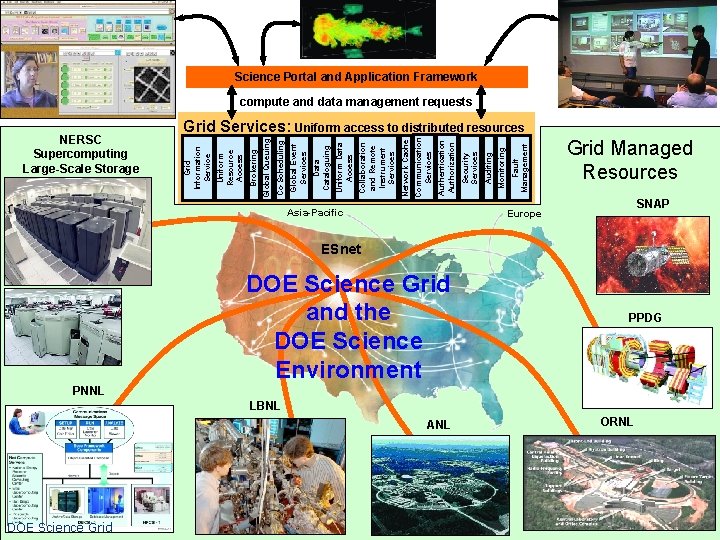
Science Portal and Application Framework compute and data management requests Asia-Pacific Fault Management Monitoring Auditing Security Services Authentication Authorization Communication Services Network Cache Collaboration and Remote Instrument Services Uniform Data Access Data Cataloguing Global Event Services Co-Scheduling Global Queuing Brokering Uniform Resource Access Grid Services: Uniform access to distributed resources Grid Information Service NERSC Supercomputing Large-Scale Storage Grid Managed Resources SNAP Europe ESnet DOE Science Grid and the DOE Science Environment PPDG PNNL LBNL ANL DOE Science Grid ORNL
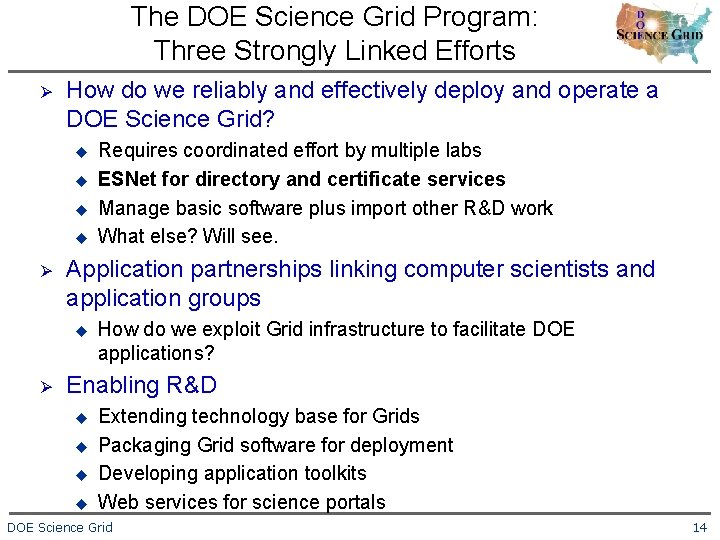
The DOE Science Grid Program: Three Strongly Linked Efforts Ø How do we reliably and effectively deploy and operate a DOE Science Grid? u u Ø Application partnerships linking computer scientists and application groups u Ø Requires coordinated effort by multiple labs ESNet for directory and certificate services Manage basic software plus import other R&D work What else? Will see. How do we exploit Grid infrastructure to facilitate DOE applications? Enabling R&D u u Extending technology base for Grids Packaging Grid software for deployment Developing application toolkits Web services for science portals DOE Science Grid 14
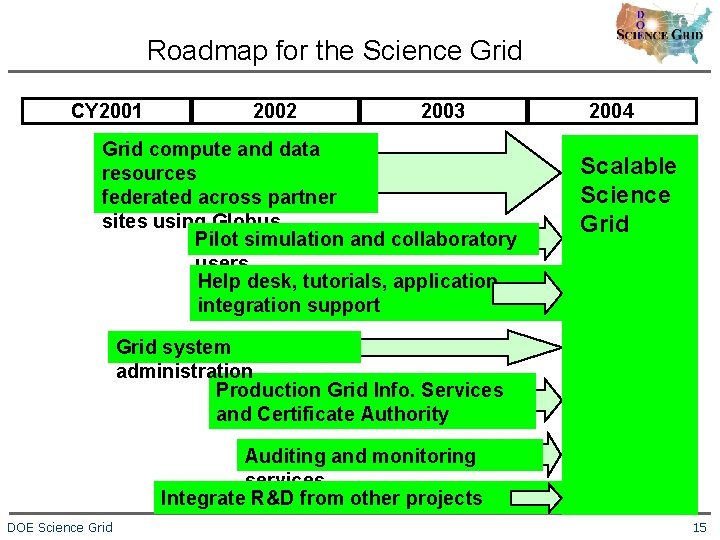
Roadmap for the Science Grid CY 2001 2002 2003 Grid compute and data resources federated across partner sites using Globus Pilot simulation and collaboratory users Help desk, tutorials, application integration support 2004 Scalable Science Grid system administration Production Grid Info. Services and Certificate Authority Auditing and monitoring services Integrate R&D from other projects DOE Science Grid 15
ØSci. DAC Applications and the DOE Science Grid l Sci. Grid has some computing and storage resources that can be made available to other Sci. DAC projects By “some” we mean that usage authorization models do not change by incorporating a systems into the Grid u To compute on individual Sci. Grid systems you have to negotiate with the owners of those systems u However, all of the Sci. Grid systems have committed to provide some computing and data resources to Sci. Grid users u DOE Science Grid 16
Sci. DAC Applications and the DOE Science Grid l There are several ways to “join” the Sci. Grid As a user u As a new Sci. Grid site (incorporating your resources) u l l There are different issues for users and new Sci. Grid sites Users: Users will get instruction on how to access Grid services u Users must obtain a Sci. Grid PKI identity certificate u There is some client software that must run on the user’s system u DOE Science Grid 17
Sci. DAC Applications and the DOE Science Grid l New Sci. Grid sites: u New Sci. Grid sites (where you wish to incorporate your resources into the Sci. Grid) need to join the Engineering Working Group l This is where the joint system admin issues are worked out l This is where Grid software issues are worked out l Keith DOE Science Grid Jackson chairs the WG 18
Sci. DAC Applications and the DOE Science Grid u New Sci. Grid sites may use the Grid Information Services (resource directory) of an existing site, or may set up their own u New Sci. Grid sites may also use their own PKI Certification Authorities, however the issuing CAs must have published policy compatible with the ESNet CA l DOE Science Grid Entrust CAs will work, in principle – however there is very little practical experience with this, and a little additional software may be necessary 19
Science Grid: A New Type of Infrastructure l Grid services providing standardized and highly capable distributed access to resources used by a community l Persistent services for distributed applications l Support for building science portals Vision: DOE Science Grid will lay the groundwork to support DOE Science applications that require, e. g. , distributed collaborations, very large data volumes, unique instruments, and the incorporation of supercomputing resources into these environments DOE Science Grid 20