
The DNA Bead String Exercise Anita L De
The DNA Bead String Exercise Anita L De. Stefano, Ph. D Department of Biostatistics BU School of Public Health Co-Director Biostatistics Program Associate Director Genome Science Institute
Innovation Inspiration • National Heart Lung and Blood Institute (NHLBI) funded Summer Institute in Training in Biostatistics (SIBS) • 6 week intensive summer course for undergraduates • Addressing dearth of Biostatisticians
Innovation Inspiration • Modules in – Biostatistics – Epidemiology – Clinical Trials – Statistical Genetics
Innovation Inspiration • Modules in Lisa Sullivan, Chair Department of Biostatistics Associate Dean of Education, SPH Metcalf Award Winner – Biostatistics – Epidemiology – Clinical Trials – Statistical Genetics Wayne La. Morte, Assistant Dean of Education, SPH Presenting later today Me
Innovation Inspiration • Need to keep up with excellent faculty – Hands on activities – Counting M&M colors to assess statistical distribution • I teach the last week – Even highly motivated students start to wane a bit
Innovation Inspiration • Statistical Genetics – Application of statistical tests to genetic data – Often to identify variation in the human genome that confers risk for disease – Requires understanding of both the statistical and genetic concepts • SIBS students have varying background in biology and genetics
How do I… • Provide a hands on way to “see” DNA? • Show students how DNA is analyzed without taking them into a lab? • Bring students of varying background to the same level • Cover both genetic and statistical concepts? • Have students interact with each other? • Have students interact with me?
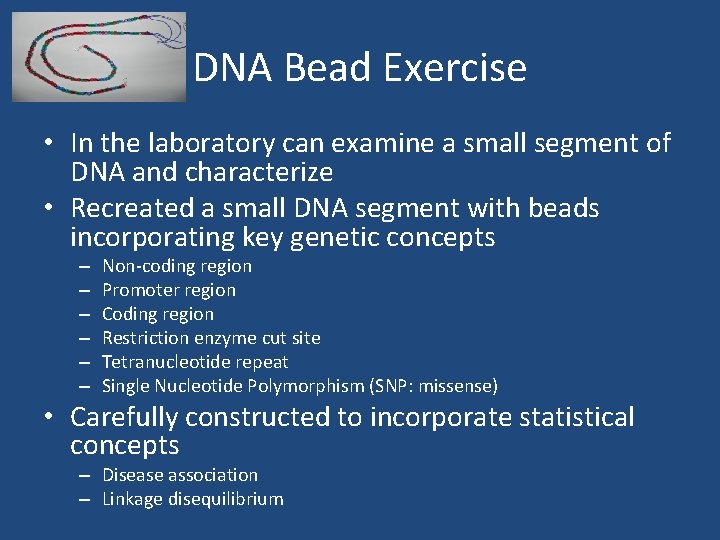
DNA Bead Exercise • In the laboratory can examine a small segment of DNA and characterize • Recreated a small DNA segment with beads incorporating key genetic concepts – – – Non-coding region Promoter region Coding region Restriction enzyme cut site Tetranucleotide repeat Single Nucleotide Polymorphism (SNP: missense) • Carefully constructed to incorporate statistical concepts – Disease association – Linkage disequilibrium
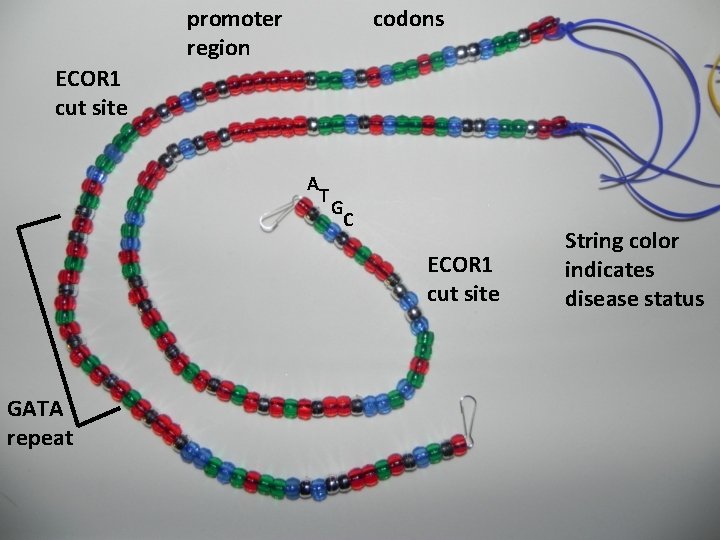
promoter region codons ECOR 1 cut site A T G C ECOR 1 cut site GATA repeat String color indicates disease status
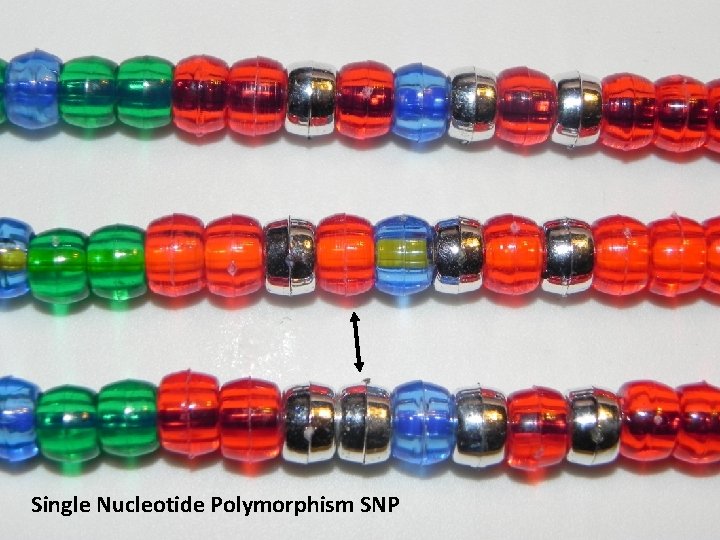
Single Nucleotide Polymorphism SNP
DNA Bead Exercise: Implementation • Randomly hand out bead strings to student – Half blue strings (unaffected with disease) – Half yellow strings (affected with disease) • Students must pair based on same string color • Characterize their “individual” – Affected/Unaffected with disease – Length of DNA segment (based on GATA repeats) – Presence or Absence of ECOR 1 cut site – Amino Acid sequence • Aggregate data across the class
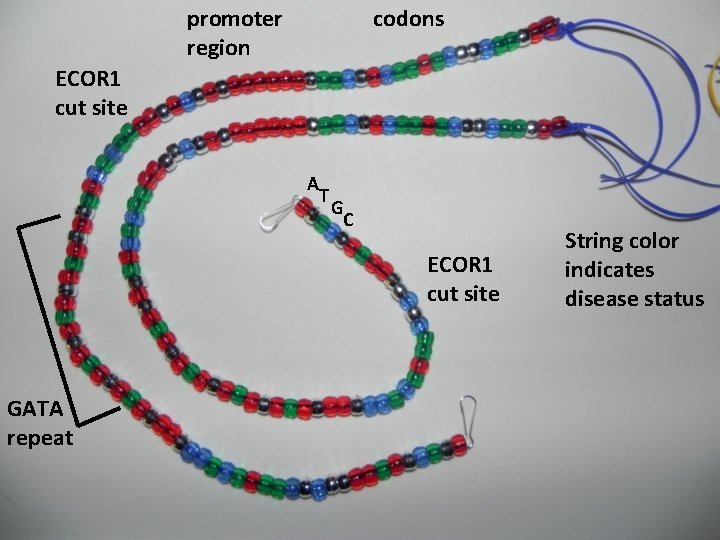
promoter region codons ECOR 1 cut site A T G C ECOR 1 cut site GATA repeat String color indicates disease status
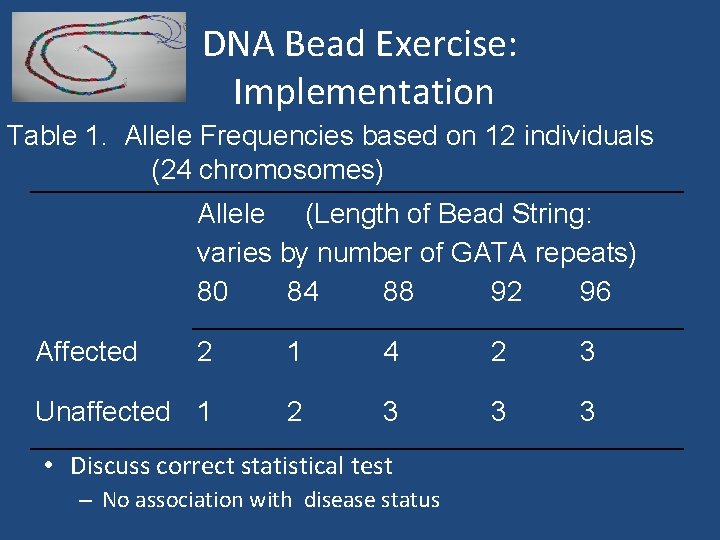
DNA Bead Exercise: Implementation Table 1. Allele Frequencies based on 12 individuals (24 chromosomes) Allele (Length of Bead String: varies by number of GATA repeats) 80 84 88 92 96 Affected 2 1 4 2 3 Unaffected 1 2 3 3 3 • Discuss correct statistical test – No association with disease status
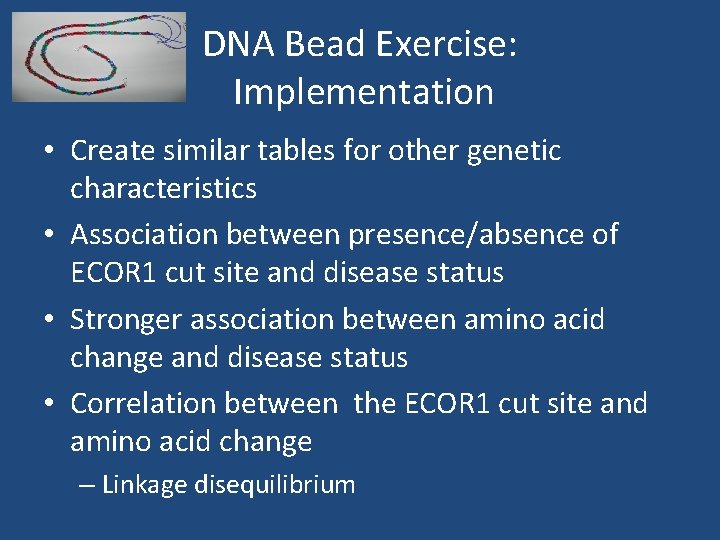
DNA Bead Exercise: Implementation • Create similar tables for other genetic characteristics • Association between presence/absence of ECOR 1 cut site and disease status • Stronger association between amino acid change and disease status • Correlation between the ECOR 1 cut site and amino acid change – Linkage disequilibrium
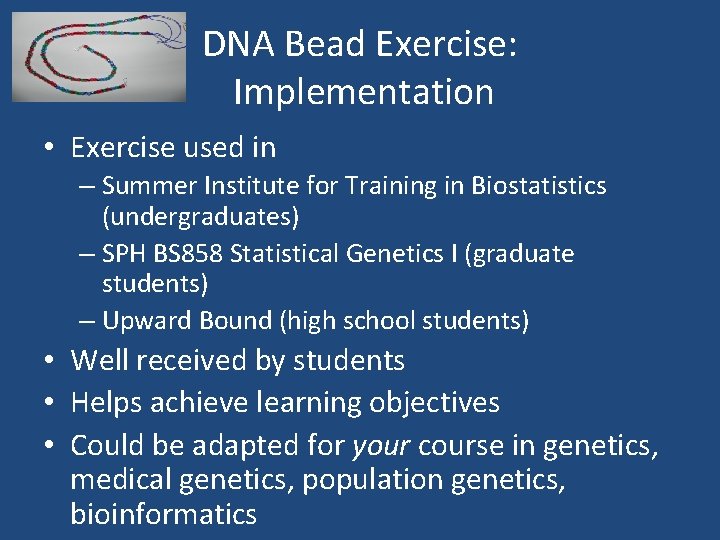
DNA Bead Exercise: Implementation • Exercise used in – Summer Institute for Training in Biostatistics (undergraduates) – SPH BS 858 Statistical Genetics I (graduate students) – Upward Bound (high school students) • Well received by students • Helps achieve learning objectives • Could be adapted for your course in genetics, medical genetics, population genetics, bioinformatics
- Slides: 15