
The diversity of HighMass Xray binaries Ignacio Negueruela
The diversity of High-Mass X-ray binaries Ignacio Negueruela where astrologers roam … Agios Nikolaos October 2010
High-mass X-ray binaries are systems containing a compact object accreting from a massive star. Good separation from LMXBs. Very few intermediate-mass objects: LMC X-3, V 4641 Sgr Fundamental tools for astrophysics, cf. Cen X-3 & Cyg X-1. Massive star is the main (only) contributor to optical and infrared brightness.
X-ray pulsars Most massive X-ray binaries are X-ray pulsars magnetised neutron stars We know of two black hole systems, one in the Milky Way (Cyg X-1; O 9. 7 Iab), and one in the LMC (LMC X-1, O 8 III-V). Others are being found in nearby galaxies: M 33 X-7 and IC 10 X-1 (talks by Fabbiano, Pietsch) Weird cases: Cyg X-3, SS 433; HMXBs? Related to ULXs? (talk by Roberts) Presence of strong magnetic field somehow inhibits jet formation no radio detections. Nature of donor determines main properties.
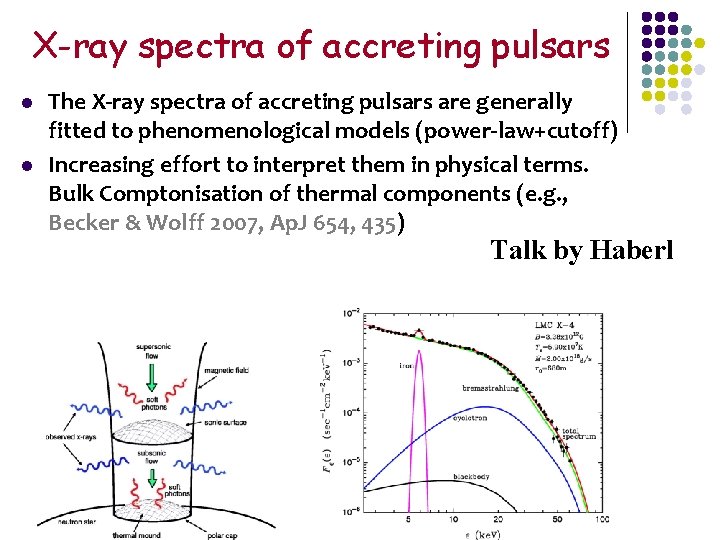
X-ray spectra of accreting pulsars l l The X-ray spectra of accreting pulsars are generally fitted to phenomenological models (power-law+cutoff) Increasing effort to interpret them in physical terms. Bulk Comptonisation of thermal components (e. g. , Becker & Wolff 2007, Ap. J 654, 435) Talk by Haberl
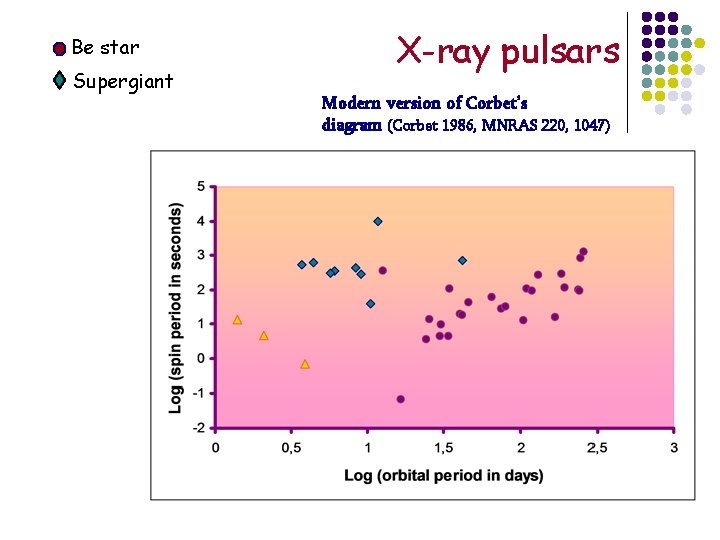
Be star Supergiant X-ray pulsars Modern version of Corbet’s diagram (Corbet 1986, MNRAS 220, 1047)
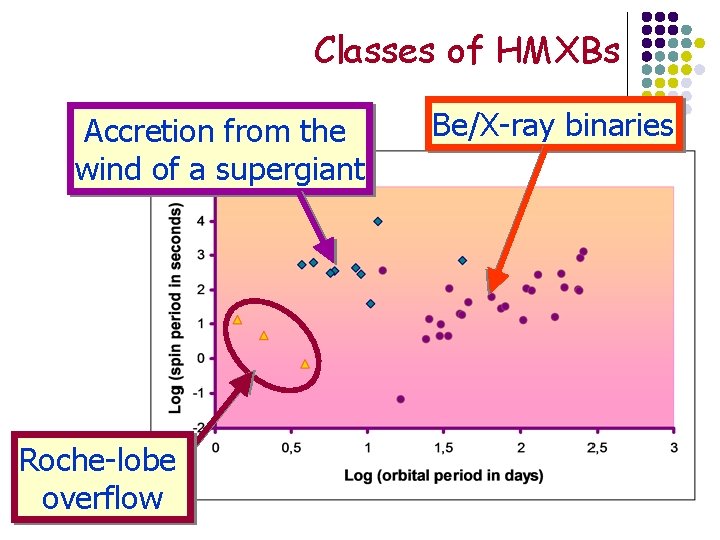
Classes of HMXBs Accretion from the wind of a supergiant Roche-lobe overflow Be/X-ray binaries
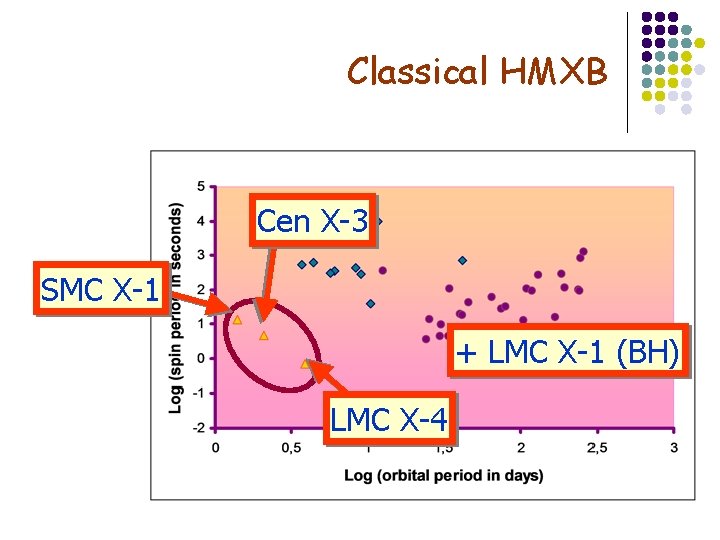
Classical HMXB Cen X-3 SMC X-1 + LMC X-1 (BH) LMC X-4
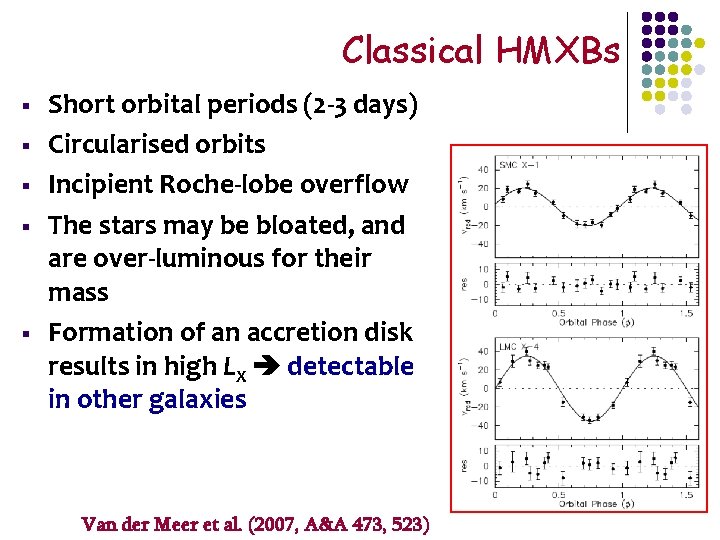
Classical HMXBs § § § Short orbital periods (2 -3 days) Circularised orbits Incipient Roche-lobe overflow The stars may be bloated, and are over-luminous for their mass Formation of an accretion disk results in high LX detectable in other galaxies Van der Meer et al. (2007, A&A 473, 523)
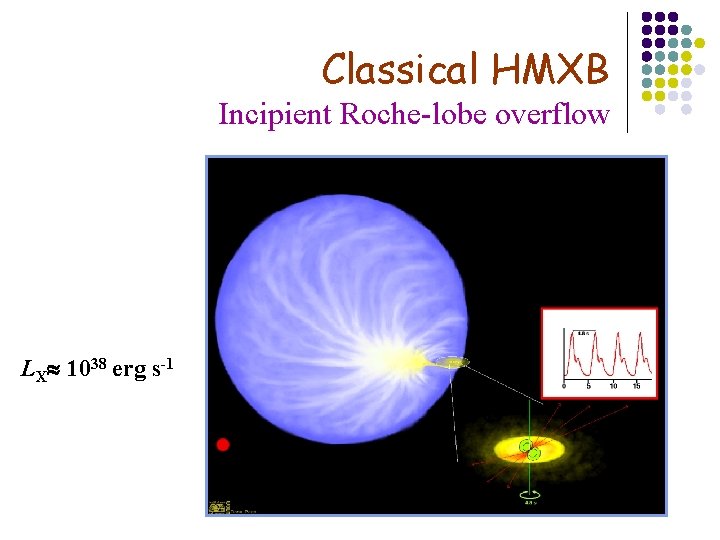
Classical HMXB Incipient Roche-lobe overflow LX 1038 erg s-1
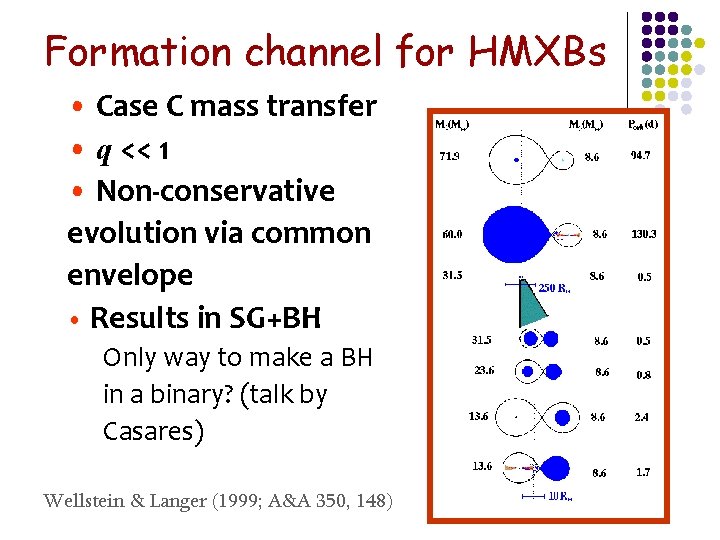
Formation channel for HMXBs • Case C mass transfer • q << 1 • Non-conservative evolution via common envelope • Results in SG+BH Only way to make a BH in a binary? (talk by Casares) Wellstein & Langer (1999; A&A 350, 148)
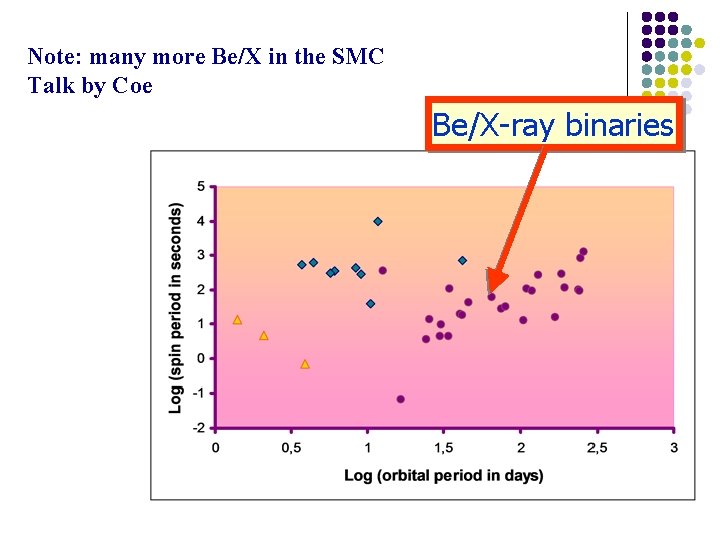
Note: many more Be/X in the SMC Talk by Coe Be/X-ray binaries
Be/X-ray binaries a Be star is an early type (O 7 to A 1) star, not very evolved (luminosity class III-V), which shows - or has shown - emission in the H line (see Porter & Rivinius 2003, PASP 115, 1153 for a review). § Other Balmer and singly-ionised metallic lines (Fe II, Cr II, etc) also seen in emission. He I in emission in stars earlier than B 2. At sufficient resolution, all lines are double peaked. § There is also an infrared excess due to continuum emission.
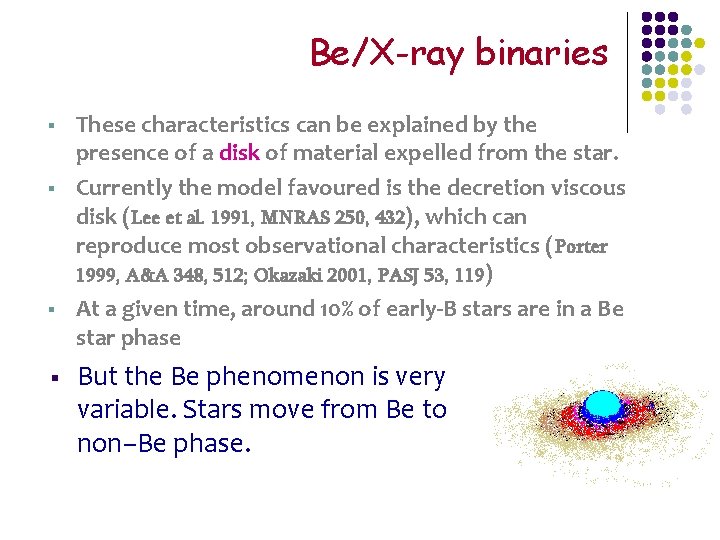
Be/X-ray binaries § § These characteristics can be explained by the presence of a disk of material expelled from the star. Currently the model favoured is the decretion viscous disk (Lee et al. 1991, MNRAS 250, 432), which can reproduce most observational characteristics (Porter 1999, A&A 348, 512; Okazaki 2001, PASJ 53, 119) At a given time, around 10% of early-B stars are in a Be star phase But the Be phenomenon is very variable. Stars move from Be to non–Be phase.
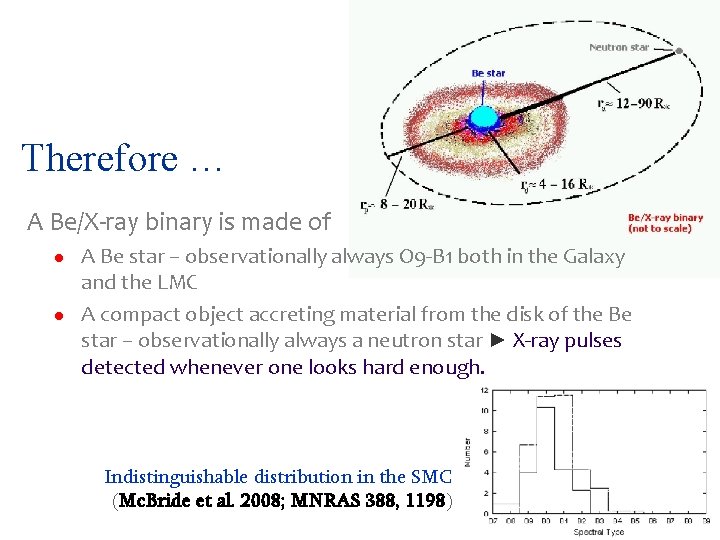
Therefore … A Be/X-ray binary is made of l l A Be star – observationally always O 9 -B 1 both in the Galaxy and the LMC A compact object accreting material from the disk of the Be star – observationally always a neutron star ► X-ray pulses detected whenever one looks hard enough. Indistinguishable distribution in the SMC (Mc. Bride et al. 2008; MNRAS 388, 1198)
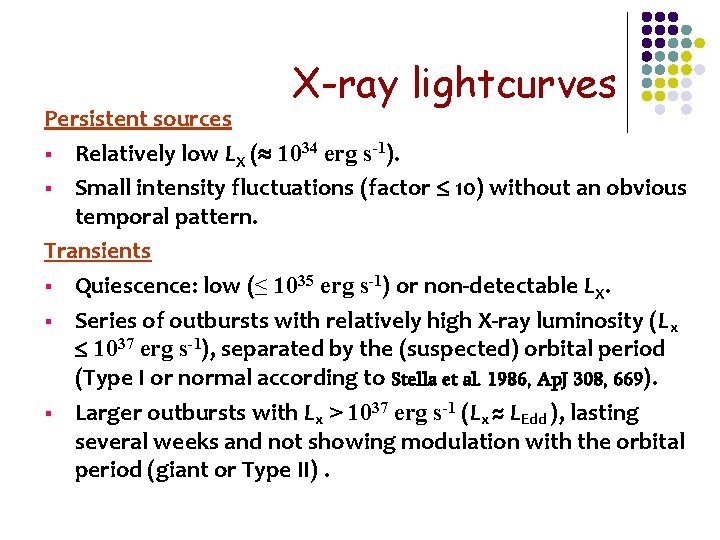
X-ray lightcurves Persistent sources § Relatively low LX ( 1034 erg s-1). § Small intensity fluctuations (factor 10) without an obvious temporal pattern. Transients § Quiescence: low (≤ 1035 erg s-1) or non-detectable LX. § Series of outbursts with relatively high X-ray luminosity (Lx 1037 erg s-1), separated by the (suspected) orbital period (Type I or normal according to Stella et al. 1986, Ap. J 308, 669). § Larger outbursts with Lx > 1037 erg s-1 (Lx ≈ LEdd ), lasting several weeks and not showing modulation with the orbital period (giant or Type II).
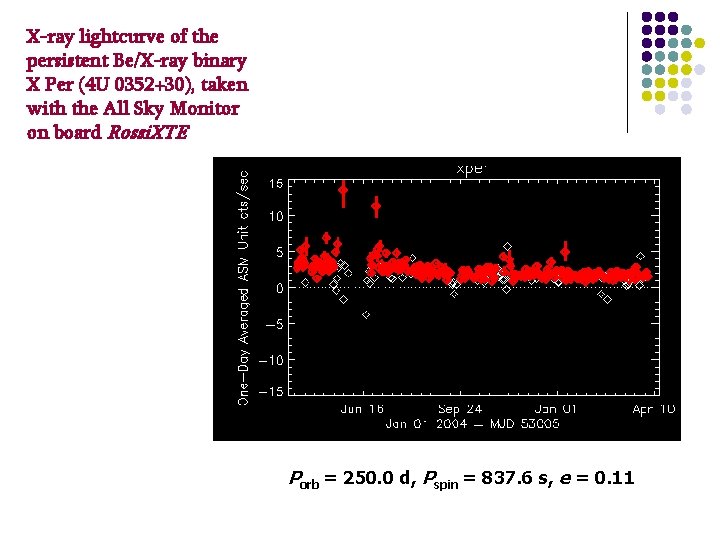
X-ray lightcurve of the persistent Be/X-ray binary X Per (4 U 0352+30), taken with the All Sky Monitor on board Rossi. XTE Porb = 250. 0 d, Pspin = 837. 6 s, e = 0. 11
X-ray lightcurves Persistent sources § Relatively low LX ( 1034 erg s-1). § Small intensity fluctuations (factor 10) without an obvious temporal pattern. Transients § Quiescence: low (≤ 1035 erg s-1) or non-detectable LX. § Series of outbursts with relatively high X-ray luminosity (Lx 1037 erg s-1), separated by the (suspected) orbital period (Type I or normal according to Stella et al. 1986, Ap. J 308, 669). § Larger outbursts with Lx > 1037 erg s-1 (Lx ≈ LEdd ), lasting several weeks and not showing modulation with the orbital period (giant or Type II).
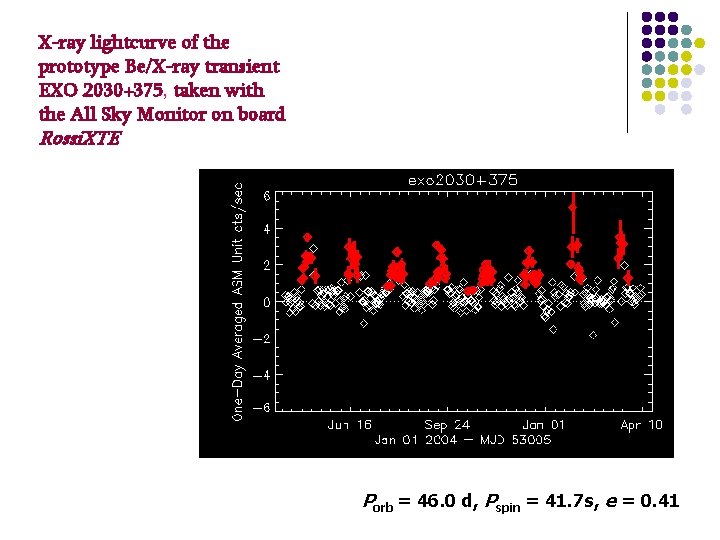
X-ray lightcurve of the prototype Be/X-ray transient EXO 2030+375, taken with the All Sky Monitor on board Rossi. XTE Porb = 46. 0 d, Pspin = 41. 7 s, e = 0. 41
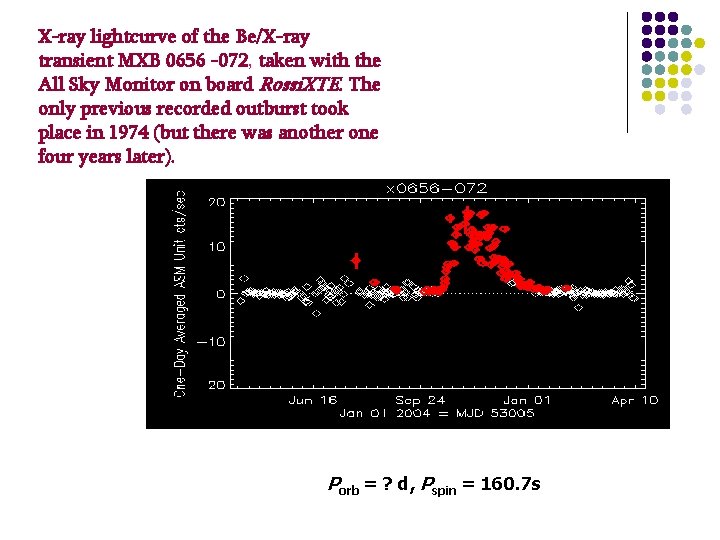
X-ray lightcurve of the Be/X-ray transient MXB 0656 -072, taken with the All Sky Monitor on board Rossi. XTE. The only previous recorded outburst took place in 1974 (but there was another one four years later). Porb = ? d, Pspin = 160. 7 s
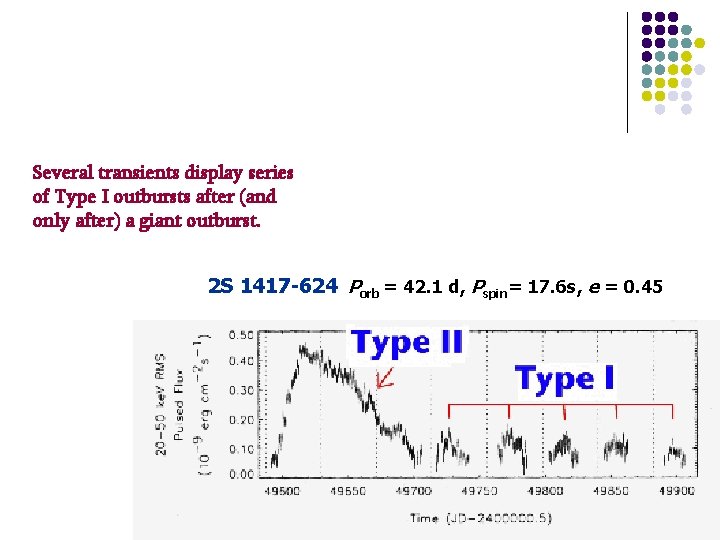
Several transients display series of Type I outbursts after (and only after) a giant outburst. 2 S 1417 -624 Porb = 42. 1 d, Pspin= 17. 6 s, e = 0. 45
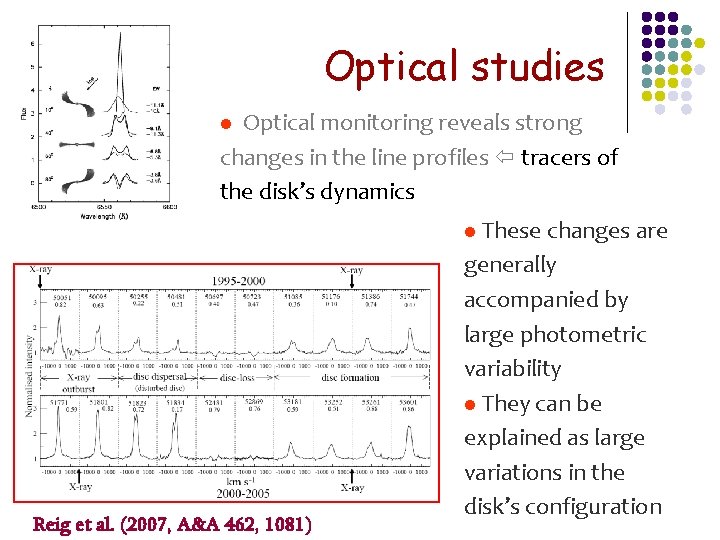
Optical studies Optical monitoring reveals strong changes in the line profiles tracers of the disk’s dynamics l These changes are generally accompanied by large photometric variability l They can be explained as large variations in the disk’s configuration l Reig et al. (2007, A&A 462, 1081)
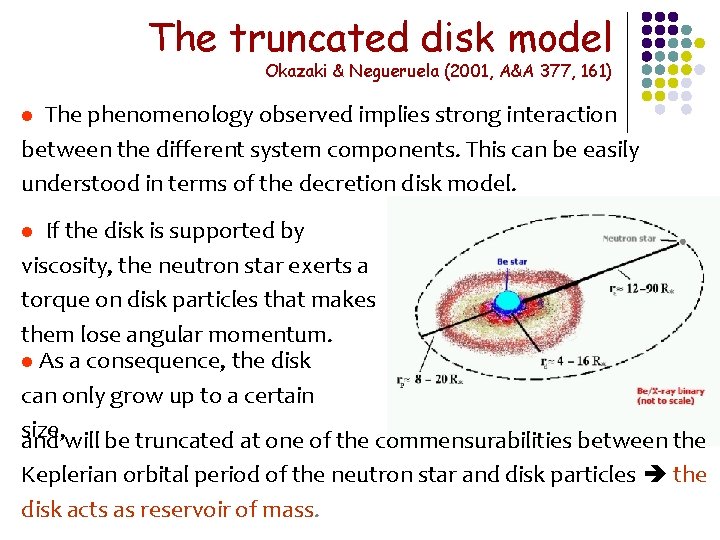
The truncated disk model Okazaki & Negueruela (2001, A&A 377, 161) The phenomenology observed implies strong interaction between the different system components. This can be easily understood in terms of the decretion disk model. l If the disk is supported by viscosity, the neutron star exerts a torque on disk particles that makes them lose angular momentum. l As a consequence, the disk can only grow up to a certain size, and will be truncated at one of the commensurabilities between the l Keplerian orbital period of the neutron star and disk particles the disk acts as reservoir of mass.
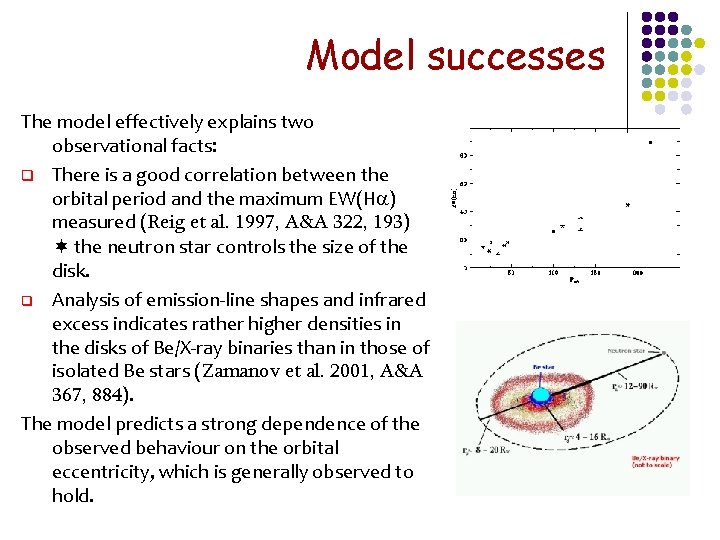
Model successes The model effectively explains two observational facts: q There is a good correlation between the orbital period and the maximum EW(H ) measured (Reig et al. 1997, A&A 322, 193) the neutron star controls the size of the disk. q Analysis of emission-line shapes and infrared excess indicates rather higher densities in the disks of Be/X-ray binaries than in those of isolated Be stars (Zamanov et al. 2001, A&A 367, 884). The model predicts a strong dependence of the observed behaviour on the orbital eccentricity, which is generally observed to hold.
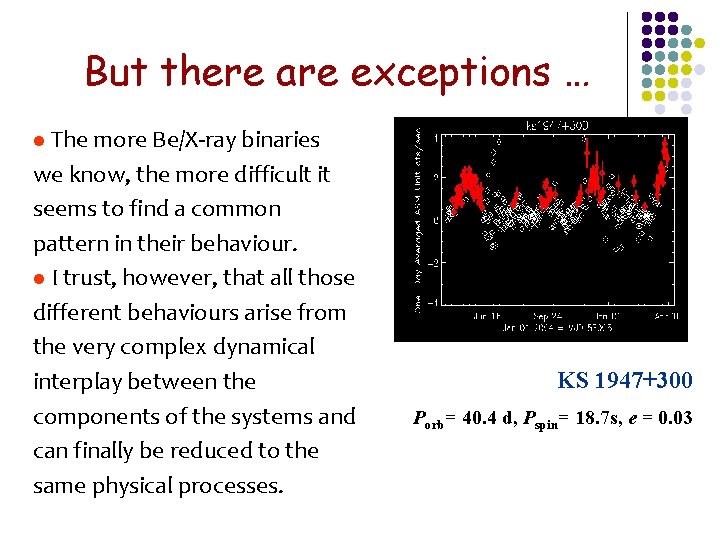
But there are exceptions … The more Be/X-ray binaries we know, the more difficult it seems to find a common pattern in their behaviour. l I trust, however, that all those different behaviours arise from the very complex dynamical interplay between the components of the systems and can finally be reduced to the same physical processes. l KS 1947+300 Porb= 40. 4 d, Pspin= 18. 7 s, e = 0. 03
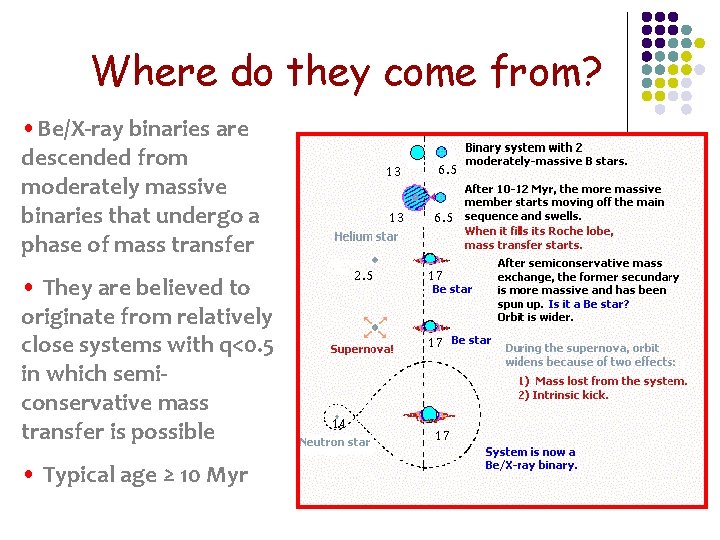
Where do they come from? • Be/X-ray binaries are descended from moderately massive binaries that undergo a phase of mass transfer • They are believed to originate from relatively close systems with q<0. 5 in which semiconservative mass transfer is possible • Typical age ≥ 10 Myr
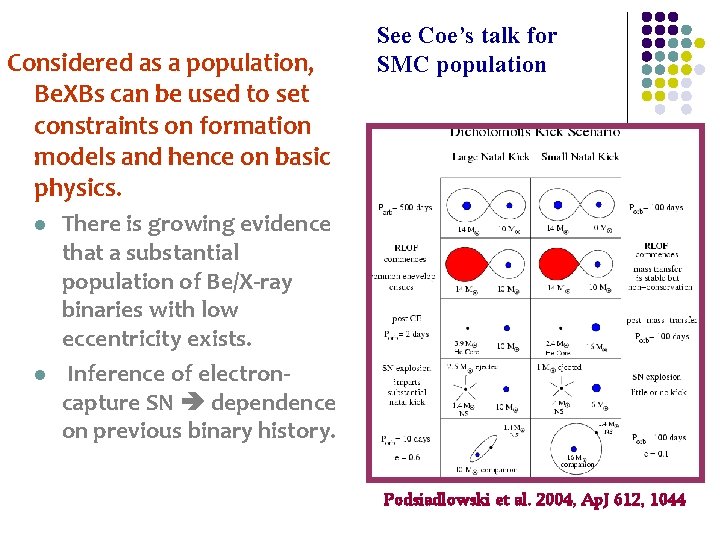
Considered as a population, Be. XBs can be used to set constraints on formation models and hence on basic physics. l l See Coe’s talk for SMC population There is growing evidence that a substantial population of Be/X-ray binaries with low eccentricity exists. Inference of electroncapture SN dependence on previous binary history. Podsiadlowski et al. 2004, Ap. J 612, 1044
The Be + WD mystery l l l Population synthesis models provide tools to analyse populations (e. g. , Van Bever & Vanbeveren 1997, A&A 322, 116; Raguzova 2001 A&A 367, 848). All population synthesis models that have been elaborated predict that, for every Be + neutron star binary, there should be ~ 10 Be + WD binaries. No such system has been conclusively identified. They are very hard to pinpoint, but there should be many!
The Be + WD mystery l l l Population synthesis models provide tools to analyse populations (e. g. , Van Bever & Vanbeveren 1997, A&A 322, 116; Raguzova 2001 A&A 367, 848). All population synthesis models that have been elaborated predict that, for every Be + neutron star binary, there should be ~ 10 Be + WD binaries. No such system has been conclusively identified. They are very hard to pinpoint, but there should be many! This renders the models somewhat suspect!
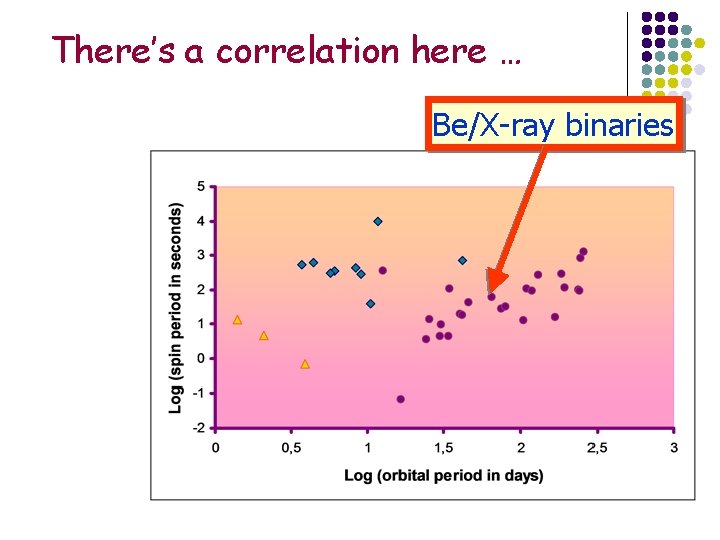
There’s a correlation here … Be/X-ray binaries
Equilibrium at which corotation velocity at the magnetospheric radius equals Keplerian velocity (Corbet 1986, MNRAS 220, 1047; Waters & van Kerkwijk 1989, A&A 223, 196)
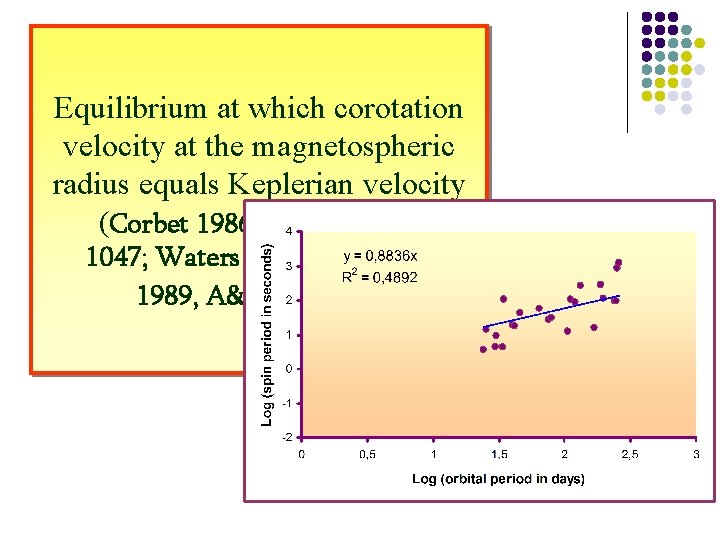
Equilibrium at which corotation velocity at the magnetospheric radius equals Keplerian velocity (Corbet 1986, MNRAS 220, 1047; Waters & van Kerkwijk 1989, A&A 223, 196)
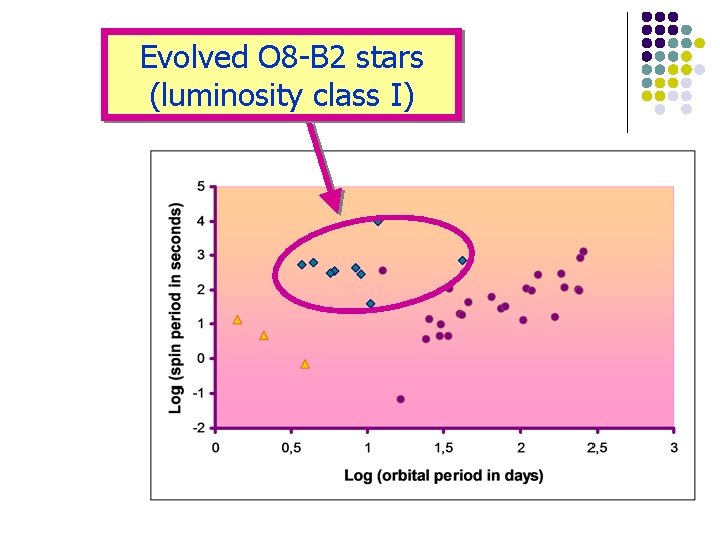
Evolved O 8 -B 2 stars (luminosity class I)
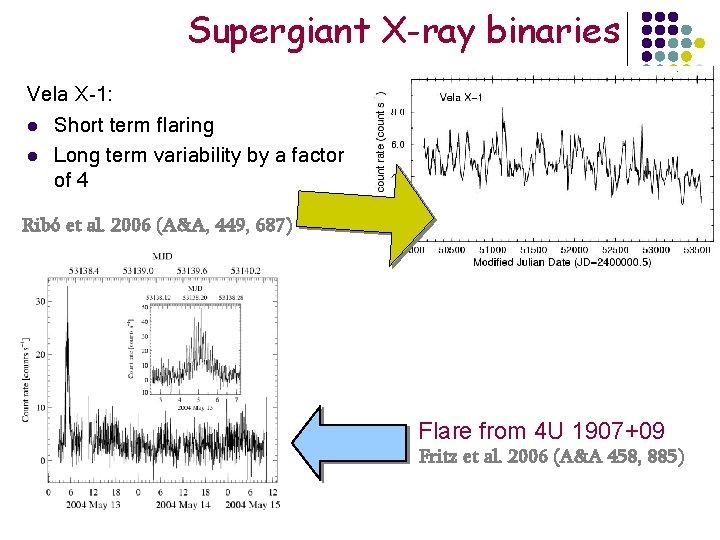
Supergiant X-ray binaries Vela X-1: l Short term flaring l Long term variability by a factor of 4 Ribó et al. 2006 (A&A, 449, 687) Flare from 4 U 1907+09 Fritz et al. 2006 (A&A 458, 885)
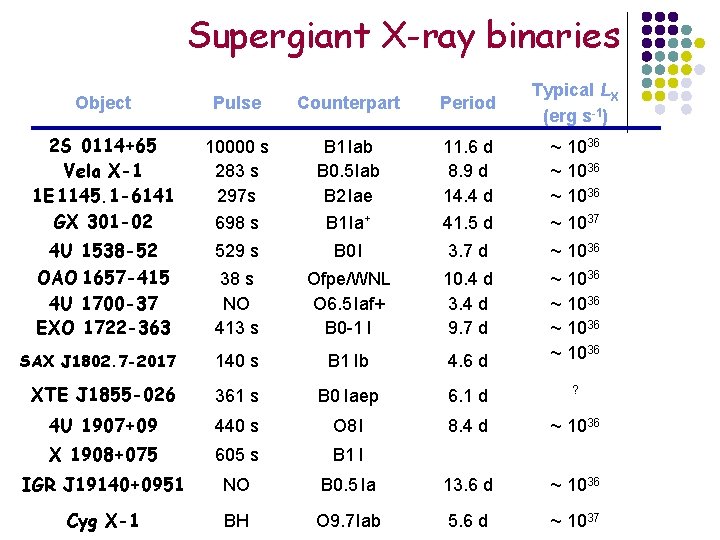
Supergiant X-ray binaries Object Pulse Counterpart Period Typical LX (erg s-1) 2 S 0114+65 Vela X-1 1 E 1145. 1 -6141 GX 301 -02 10000 s 283 s 297 s 698 s B 1 Iab B 0. 5 Iab B 2 Iae B 1 Ia+ 11. 6 d 8. 9 d 14. 4 d 41. 5 d ~ 1036 ~ 1037 4 U 1538 -52 529 s B 0 I 3. 7 d ~ 1036 OAO 1657 -415 4 U 1700 -37 EXO 1722 -363 38 s NO 413 s Ofpe/WNL O 6. 5 Iaf+ B 0 -1 I 10. 4 d 3. 4 d 9. 7 d SAX J 1802. 7 -2017 140 s B 1 Ib 4. 6 d ~ 1036 XTE J 1855 -026 361 s B 0 Iaep 6. 1 d ? 4 U 1907+09 440 s O 8 I 8. 4 d ~ 1036 X 1908+075 605 s B 1 I IGR J 19140+0951 NO B 0. 5 Ia 13. 6 d ~ 1036 Cyg X-1 BH O 9. 7 Iab 5. 6 d ~ 1037
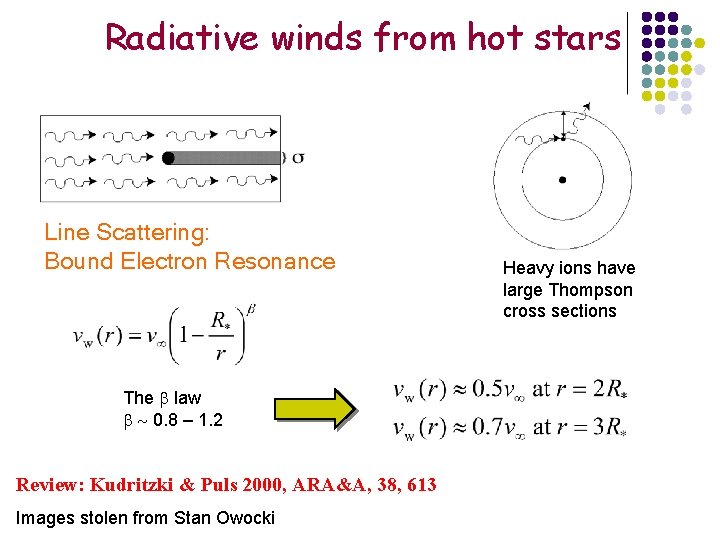
Radiative winds from hot stars Line Scattering: Bound Electron Resonance The law 0. 8 – 1. 2 Review: Kudritzki & Puls 2000, ARA&A, 38, 613 Images stolen from Stan Owocki Heavy ions have large Thompson cross sections
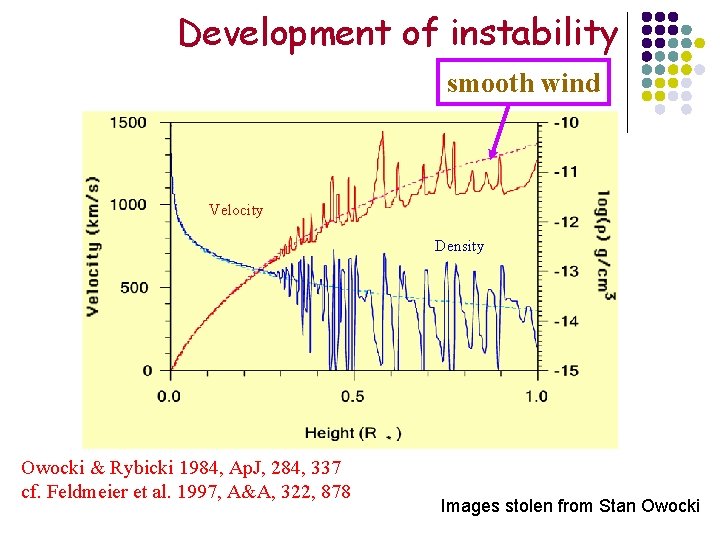
Development of instability smooth wind Velocity Density Owocki & Rybicki 1984, Ap. J, 284, 337 cf. Feldmeier et al. 1997, A&A, 322, 878 Images stolen from Stan Owocki
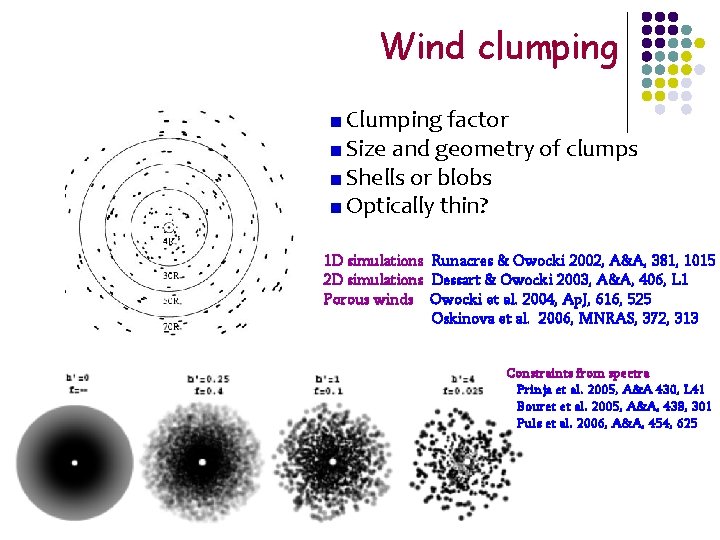
Wind clumping Clumping factor Size and geometry of clumps Shells or blobs Optically thin? 1 D simulations Runacres & Owocki 2002, A&A, 381, 1015 2 D simulations Dessart & Owocki 2003, A&A, 406, L 1 Porous winds Owocki et al. 2004, Ap. J, 616, 525 Oskinova et al. 2006, MNRAS, 372, 313 Constraints from spectra Prinja et al. 2005, A&A 430, L 41 Bouret et al. 2005, A&A, 438, 301 Puls et al. 2006, A&A, 454, 625
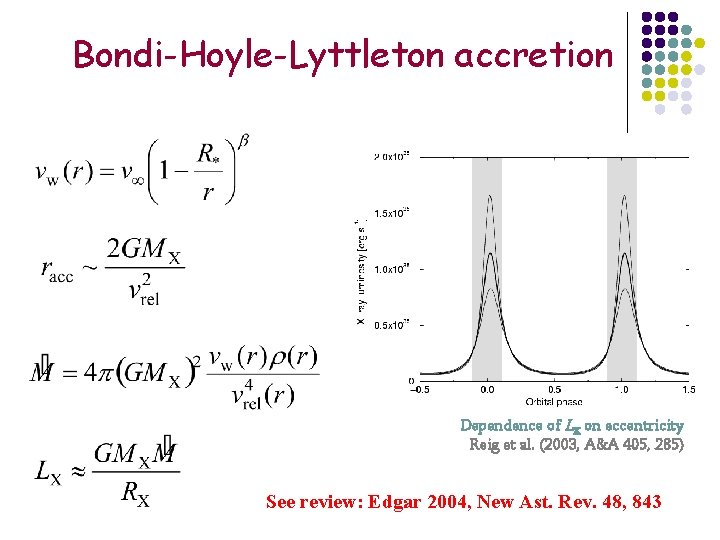
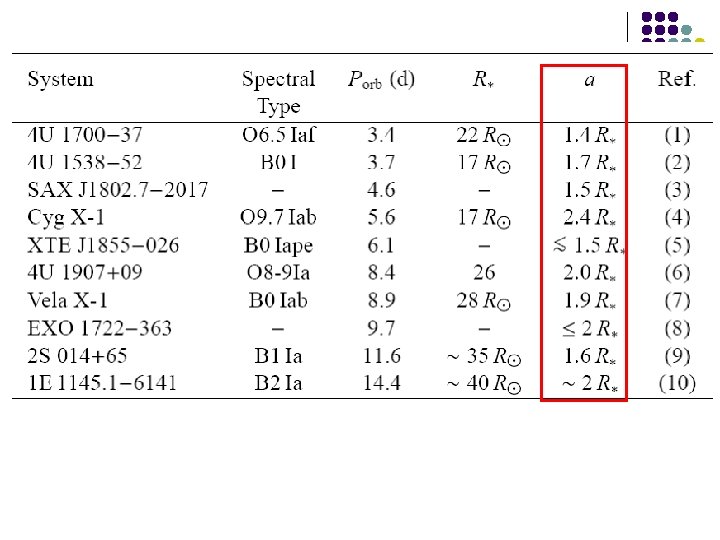
Bondi-Hoyle-Lyttleton accretion Dependence of LX on eccentricity Reig et al. (2003, A&A 405, 285) See review: Edgar 2004, New Ast. Rev. 48, 843
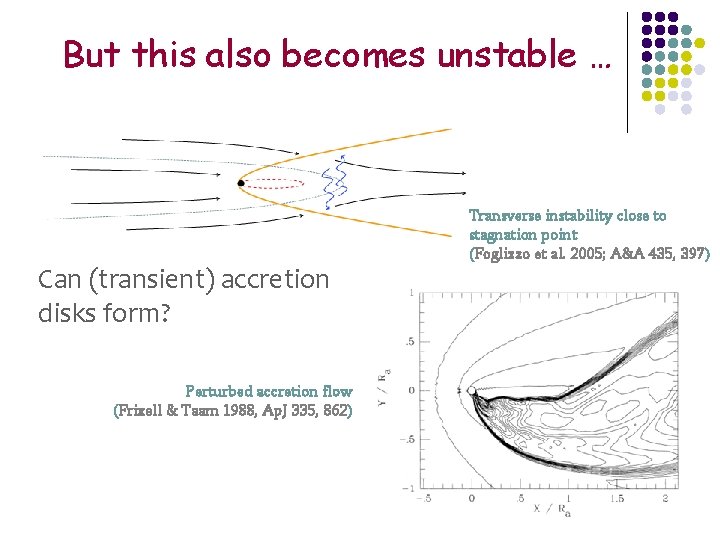
But this also becomes unstable … Can (transient) accretion disks form? Perturbed accretion flow (Frixell & Taam 1988, Ap. J 335, 862) Transverse instability close to stagnation point (Foglizzo et al. 2005; A&A 435, 397)
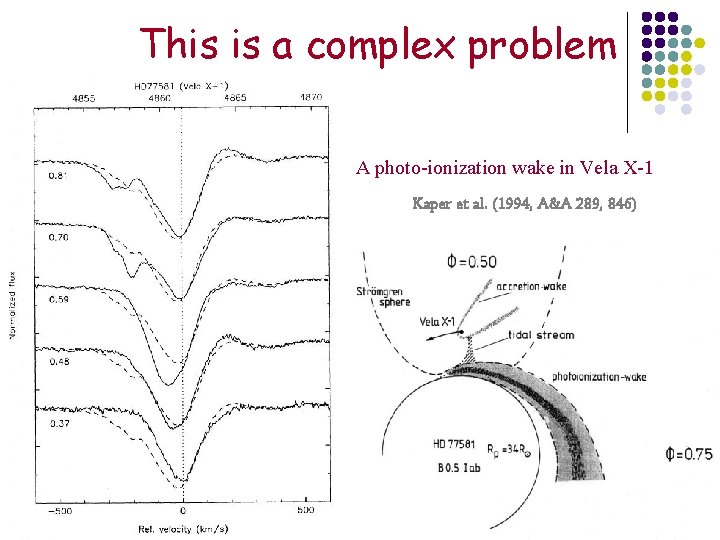
This is a complex problem A photo-ionization wake in Vela X-1 Kaper et al. (1994, A&A 289, 846)
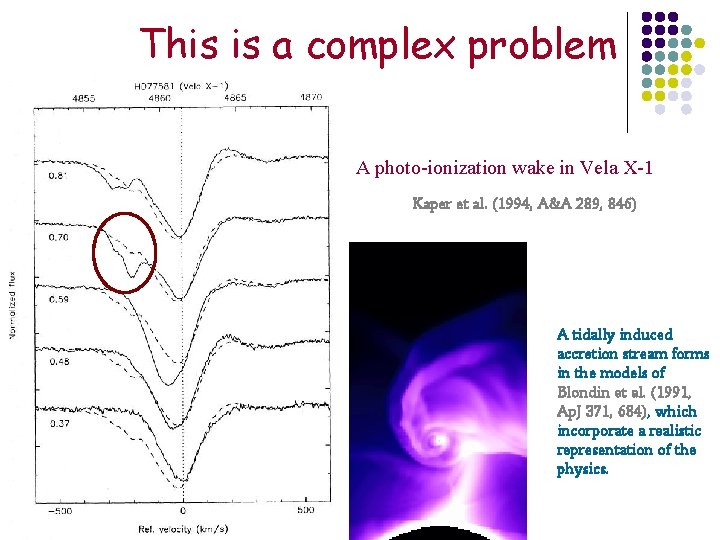
This is a complex problem A photo-ionization wake in Vela X-1 Kaper et al. (1994, A&A 289, 846) A tidally induced accretion stream forms in the models of Blondin et al. (1991, Ap. J 371, 684), which incorporate a realistic representation of the physics.
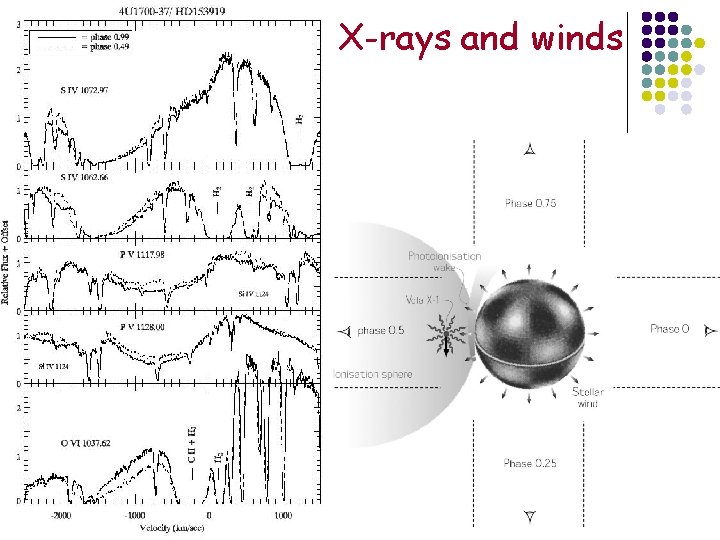
X-rays and winds A photo-ionization wake in Vela X-1 Kaper et al. (1994, A&A 289, 846)
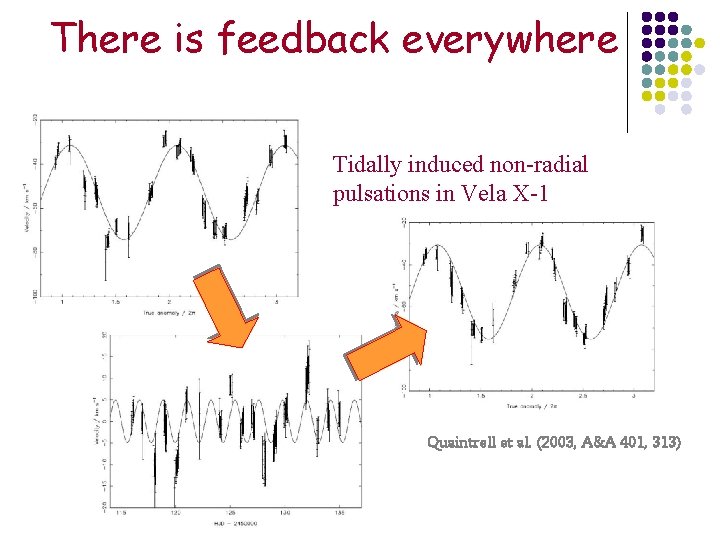
There is feedback everywhere Tidally induced non-radial pulsations in Vela X-1 Quaintrell et al. (2003, A&A 401, 313)
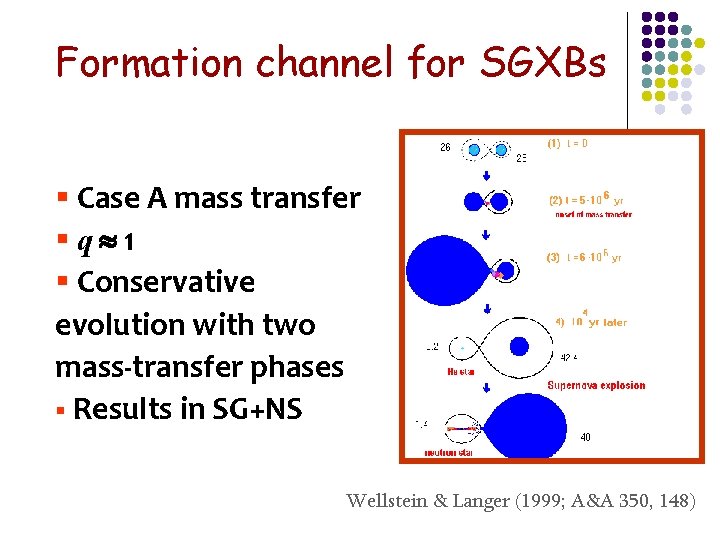
Formation channel for SGXBs § Case A mass transfer §q 1 § Conservative evolution with two mass-transfer phases § Results in SG+NS Wellstein & Langer (1999; A&A 350, 148)
Supergiant Fast X-ray transients l A group of flaring sources with very short outbursts and supergiant companions. l Transient emission composed by many flares reaching LX 1036 -1037 erg s-1 l Persistent emission at lower luminosity l 1033 -1034 erg s-1 Deep quiescence at LX 1032 erg s-1 (Giunta et al. LX 2009, MNRAS 399, 744; Bozzo et al. ar. Xiv: 1004. 2059; Sidoli et al. 2010 ar. Xiv: 1007. 1091) e. g. , Romano et al. 2010, Mem. SAI 81, 332
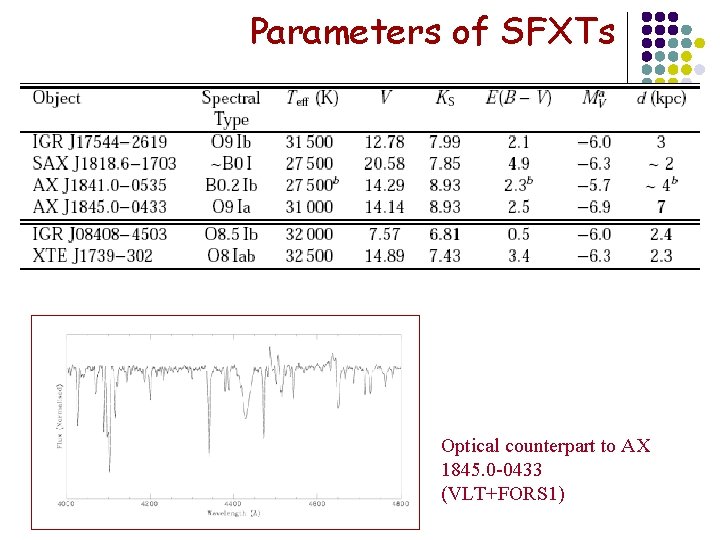
Parameters of SFXTs Optical counterpart to AX 1845. 0 -0433 (VLT+FORS 1)
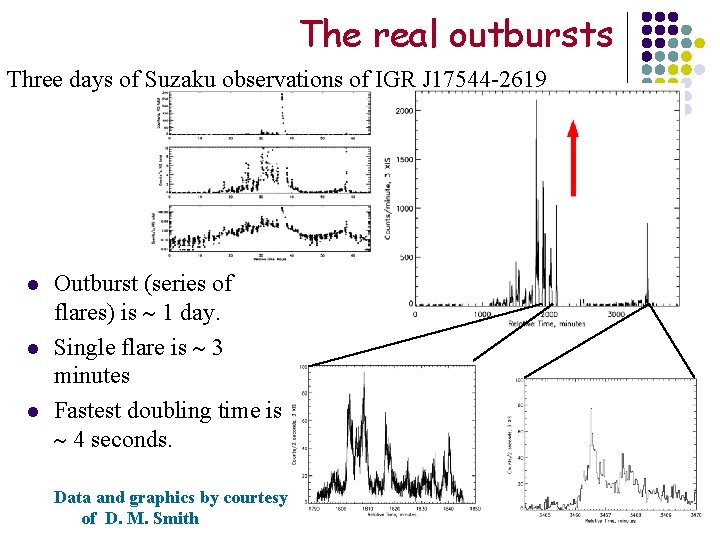
The real outbursts Three days of Suzaku observations of IGR J 17544 -2619 l l l Outburst (series of flares) is 1 day. Single flare is 3 minutes Fastest doubling time is 4 seconds. Data and graphics by courtesy of D. M. Smith
Looking for a difference l This leaves several options: l l l Difference in wind structure Difference in wind geometry Difference in accretion process
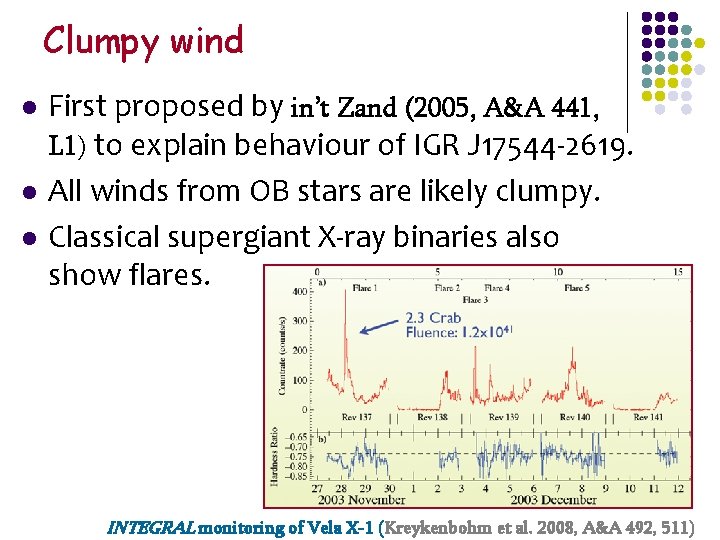
Clumpy wind l l l First proposed by in’t Zand (2005, A&A 441, L 1) to explain behaviour of IGR J 17544 -2619. All winds from OB stars are likely clumpy. Classical supergiant X-ray binaries also show flares. INTEGRAL monitoring of Vela X-1 (Kreykenbohm et al. 2008, A&A 492, 511)
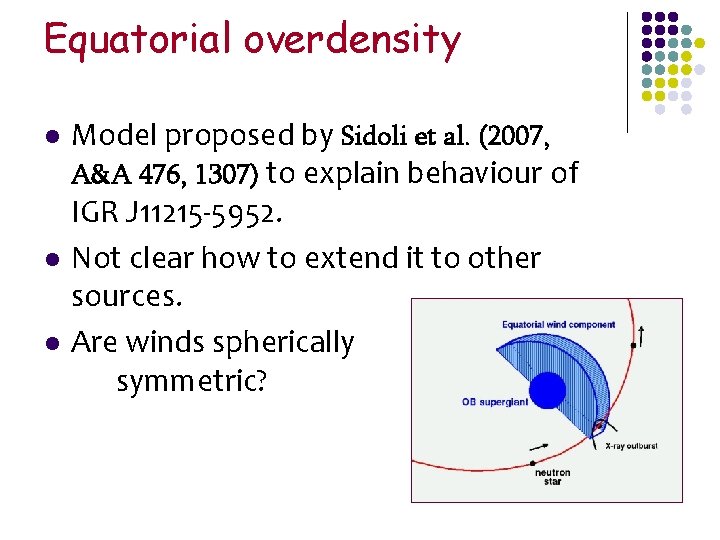
Equatorial overdensity l l l Model proposed by Sidoli et al. (2007, A&A 476, 1307) to explain behaviour of IGR J 11215 -5952. Not clear how to extend it to other sources. Are winds spherically symmetric?
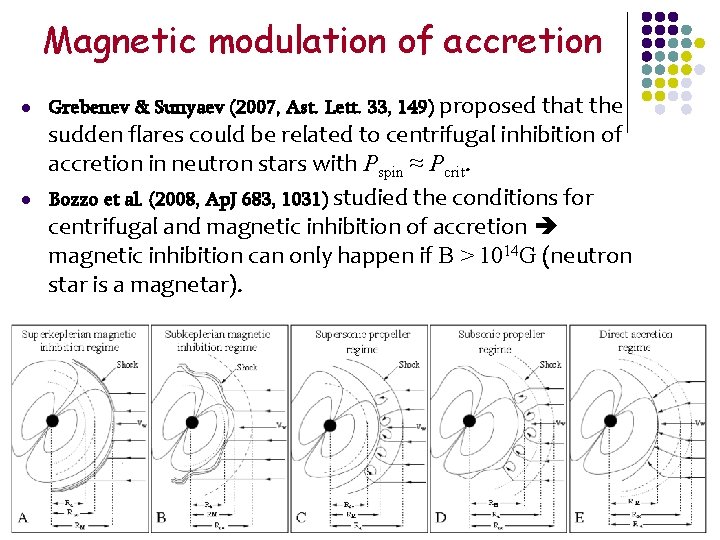
Magnetic modulation of accretion l l Grebenev & Sunyaev (2007, Ast. Lett. 33, 149) proposed that the sudden flares could be related to centrifugal inhibition of accretion in neutron stars with Pspin ≈ Pcrit. Bozzo et al. (2008, Ap. J 683, 1031) studied the conditions for centrifugal and magnetic inhibition of accretion magnetic inhibition can only happen if B > 1014 G (neutron star is a magnetar).
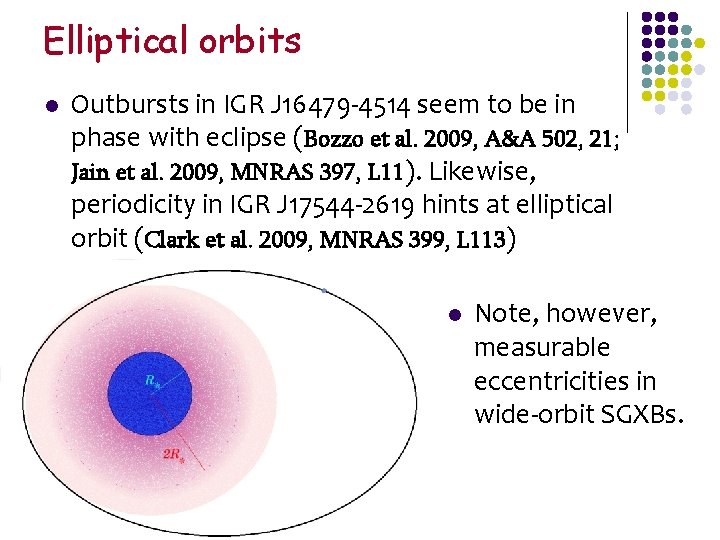
Elliptical orbits l Outbursts in IGR J 16479 -4514 seem to be in phase with eclipse (Bozzo et al. 2009, A&A 502, 21; Jain et al. 2009, MNRAS 397, L 11). Likewise, periodicity in IGR J 17544 -2619 hints at elliptical orbit (Clark et al. 2009, MNRAS 399, L 113) l Note, however, measurable eccentricities in wide-orbit SGXBs.
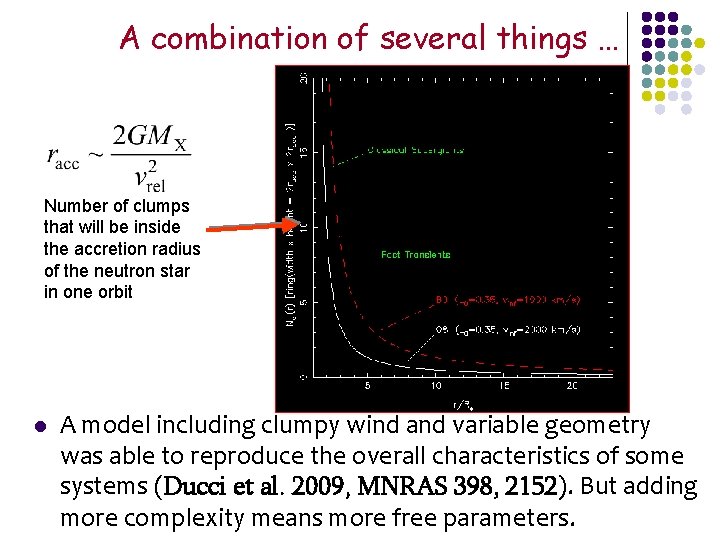
A combination of several things … Number of clumps that will be inside the accretion radius of the neutron star in one orbit l A model including clumpy wind and variable geometry was able to reproduce the overall characteristics of some systems (Ducci et al. 2009, MNRAS 398, 2152). But adding more complexity means more free parameters.
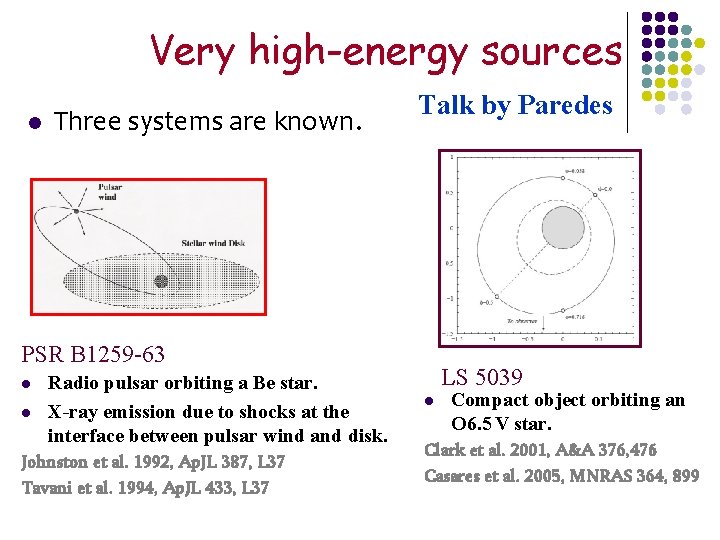
Very high-energy sources l Three systems are known. Talk by Paredes PSR B 1259 -63 l l Radio pulsar orbiting a Be star. X-ray emission due to shocks at the interface between pulsar wind and disk. Johnston et al. 1992, Ap. JL 387, L 37 Tavani et al. 1994, Ap. JL 433, L 37 LS 5039 l Compact object orbiting an O 6. 5 V star. Clark et al. 2001, A&A 376, 476 Casares et al. 2005, MNRAS 364, 899
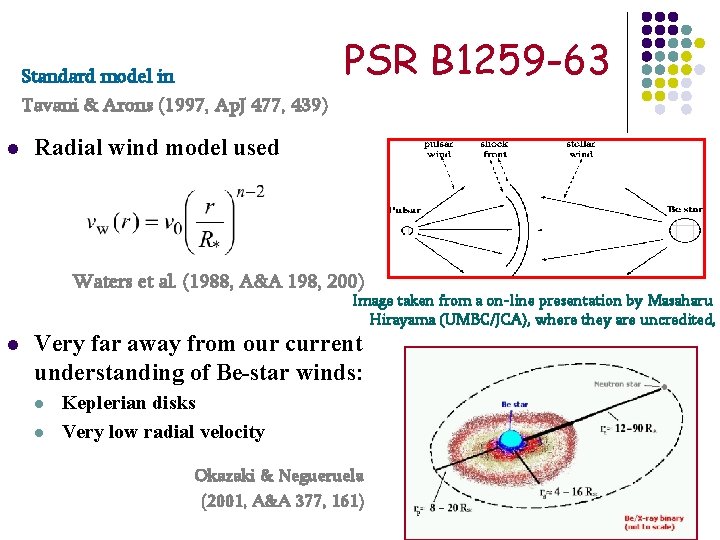
Standard model in Tavani & Arons (1997, Ap. J 477, 439) l PSR B 1259 -63 Radial wind model used Waters et al. (1988, A&A 198, 200) Image taken from a on-line presentation by Masaharu Hirayama (UMBC/JCA), where they are uncredited, l Very far away from our current understanding of Be-star winds: l l Keplerian disks Very low radial velocity Okazaki & Negueruela (2001, A&A 377, 161)
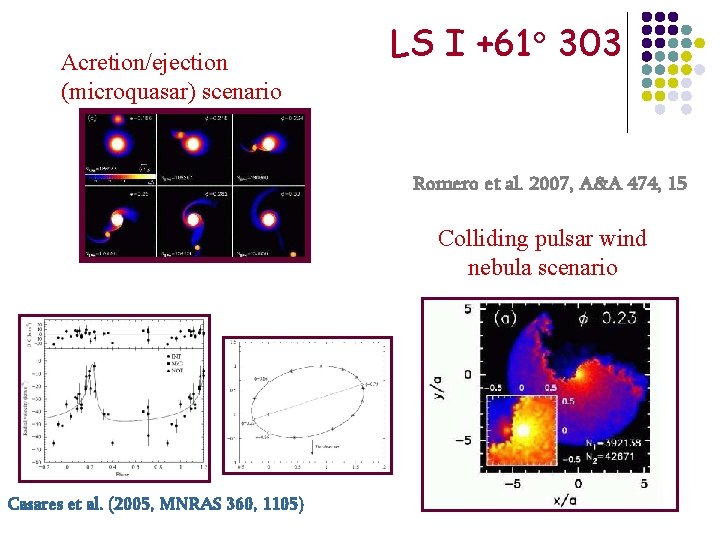
Acretion/ejection (microquasar) scenario LS I +61 303 Romero et al. 2007, A&A 474, 15 Colliding pulsar wind nebula scenario Casares et al. (2005, MNRAS 360, 1105)
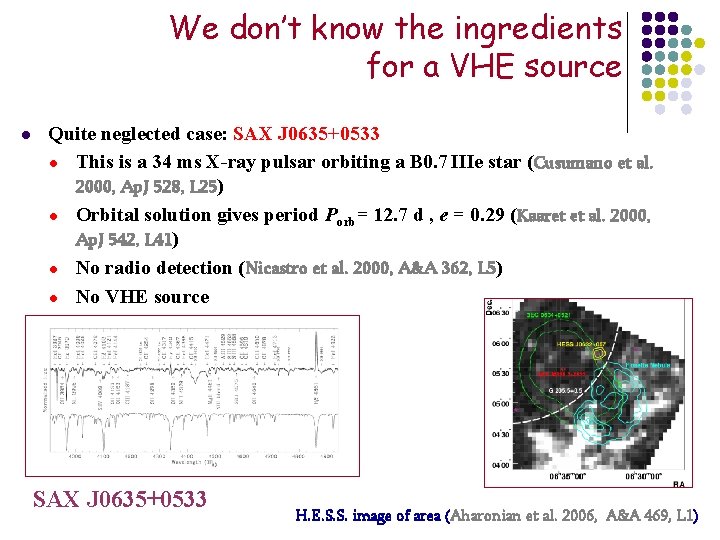
We don’t know the ingredients for a VHE source l Quite neglected case: SAX J 0635+0533 l This is a 34 ms X-ray pulsar orbiting a B 0. 7 IIIe star (Cusumano et al. 2000, Ap. J 528, L 25) l Orbital solution gives period Porb= 12. 7 d , e = 0. 29 (Kaaret et al. 2000, Ap. J 542, L 41) l No radio detection (Nicastro et al. 2000, A&A 362, L 5) l No VHE source SAX J 0635+0533 H. E. S. S. image of area (Aharonian et al. 2006, A&A 469, L 1)
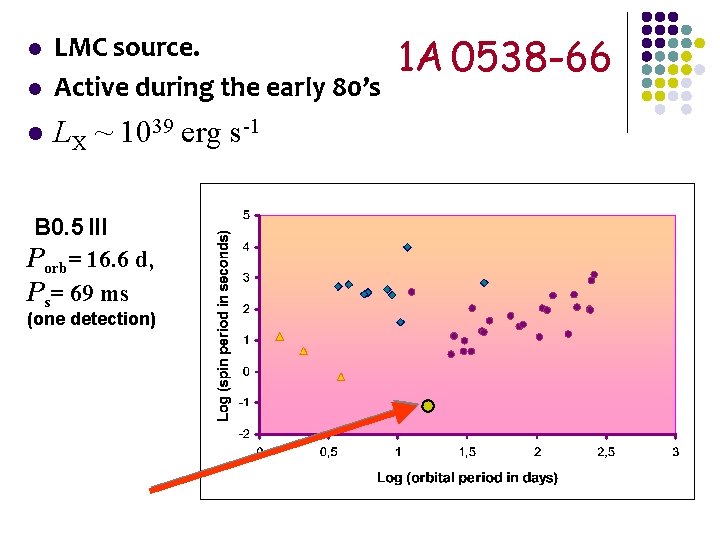
l LMC source. Active during the early 80’s l LX ~ 1039 erg s-1 l B 0. 5 III Porb= 16. 6 d, Ps= 69 ms (one detection) 1 A 0538 -66
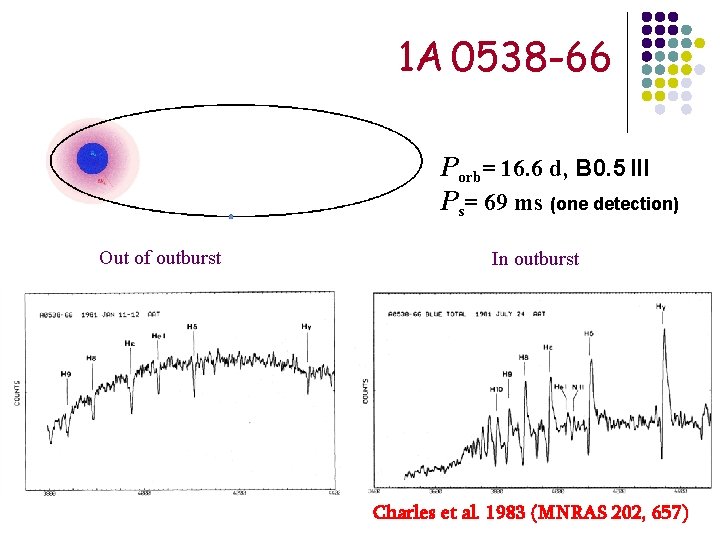
1 A 0538 -66 Porb= 16. 6 d, B 0. 5 III Ps= 69 ms (one detection) Out of outburst In outburst Charles et al. 1983 (MNRAS 202, 657)
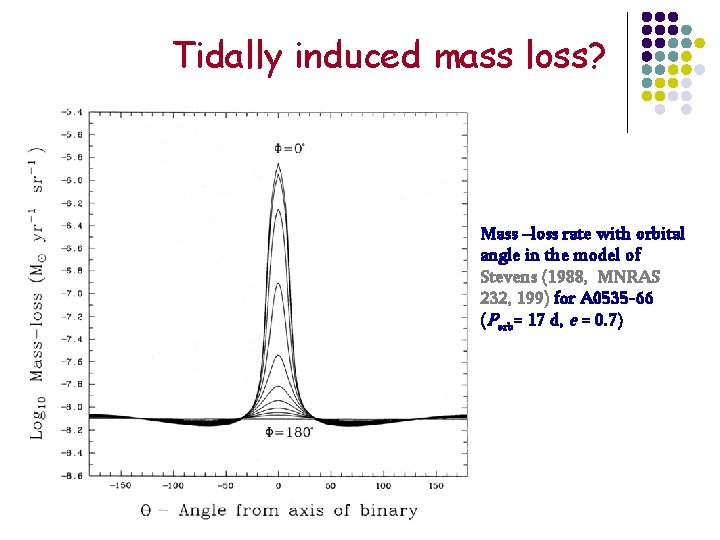
Tidally induced mass loss? Mass –loss rate with orbital angle in the model of Stevens (1988, MNRAS 232, 199) for A 0535 -66 (Porb= 17 d, e = 0. 7)
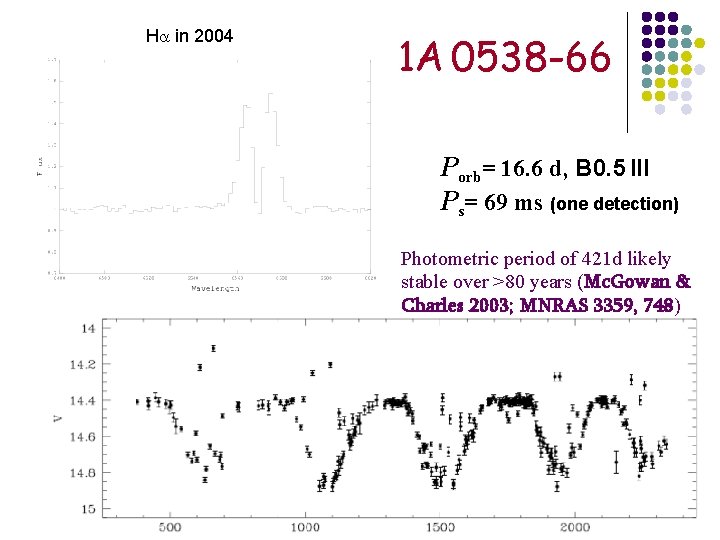
H in 2004 1 A 0538 -66 Porb= 16. 6 d, B 0. 5 III Ps= 69 ms (one detection) Photometric period of 421 d likely stable over >80 years (Mc. Gowan & Charles 2003; MNRAS 3359, 748)
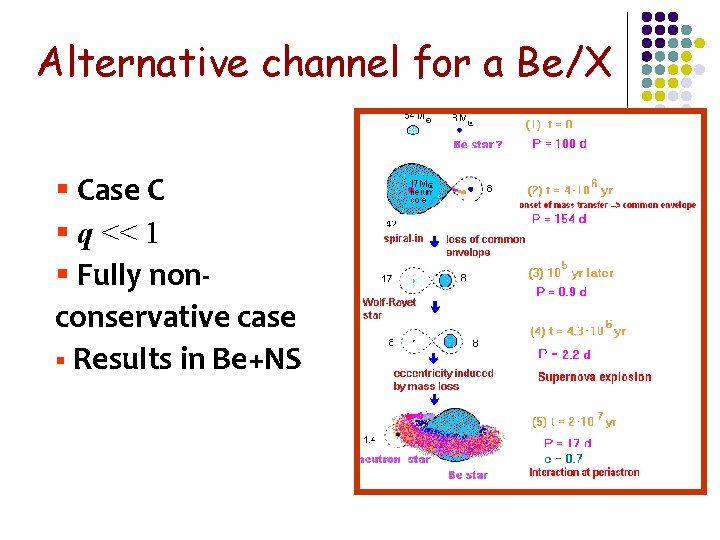
Alternative channel for a Be/X § Case C § q << 1 § Fully nonconservative case § Results in Be+NS
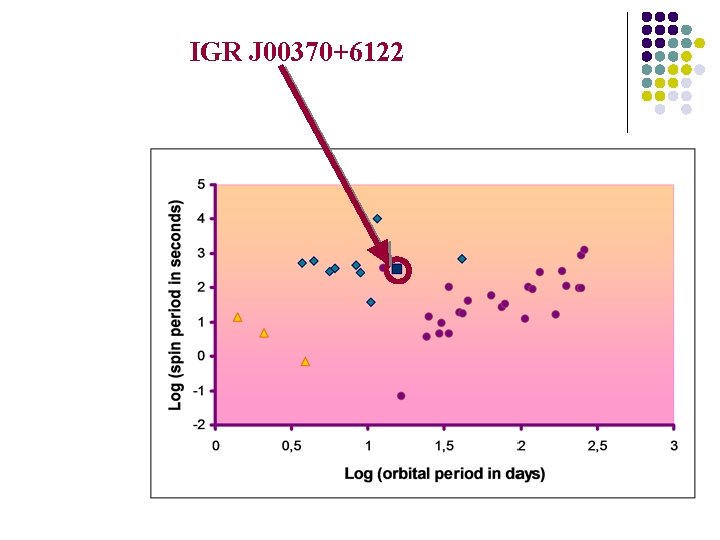
IGR J 00370+6122
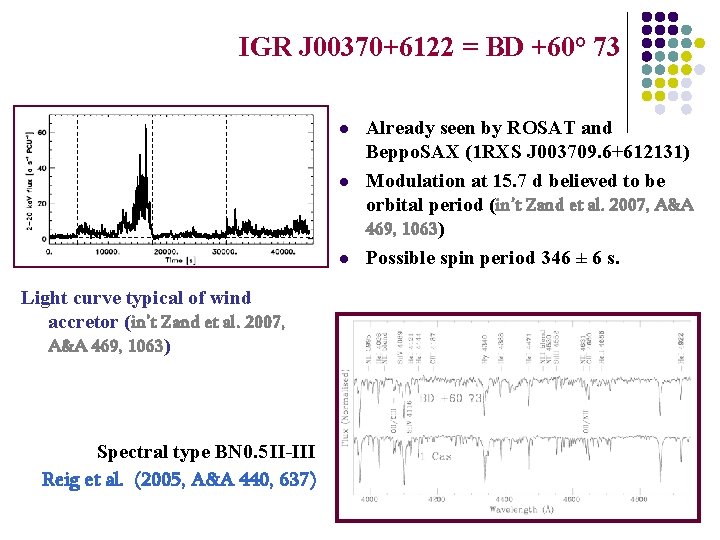
IGR J 00370+6122 = BD +60° 73 l l l Light curve typical of wind accretor (in’t Zand et al. 2007, A&A 469, 1063) Spectral type BN 0. 5 II-III Reig et al. (2005, A&A 440, 637) Already seen by ROSAT and Beppo. SAX (1 RXS J 003709. 6+612131) Modulation at 15. 7 d believed to be orbital period (in’t Zand et al. 2007, A&A 469, 1063) Possible spin period 346 ± 6 s.
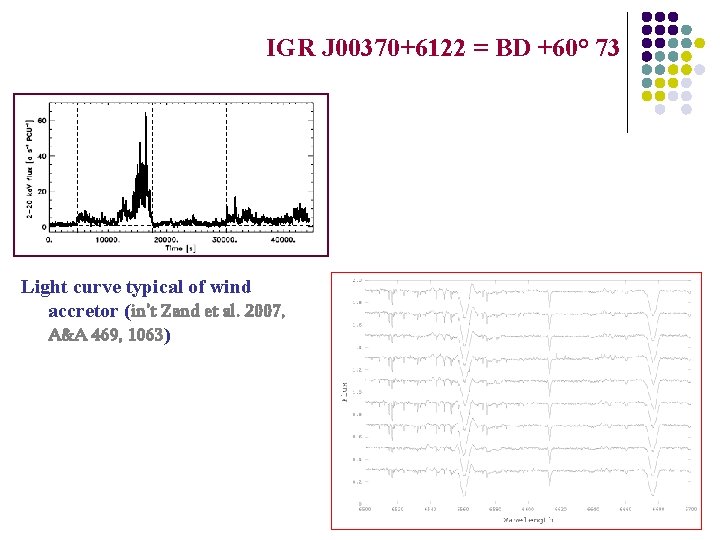
IGR J 00370+6122 = BD +60° 73 Light curve typical of wind accretor (in’t Zand et al. 2007, A&A 469, 1063)
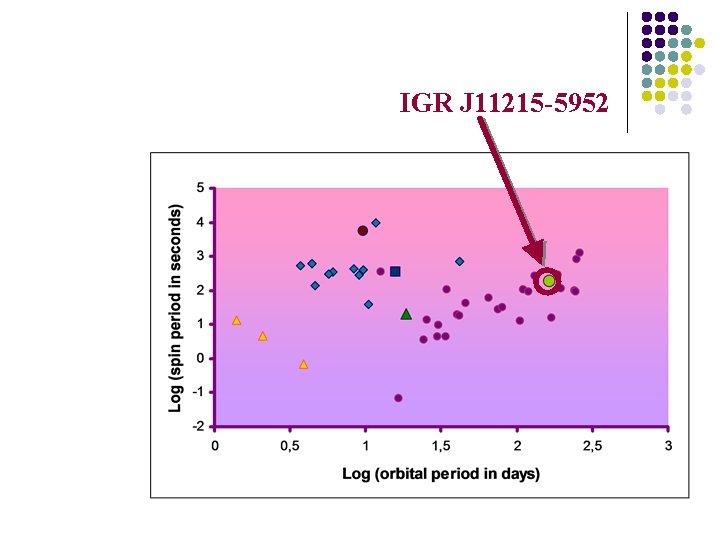
IGR J 11215 -5952
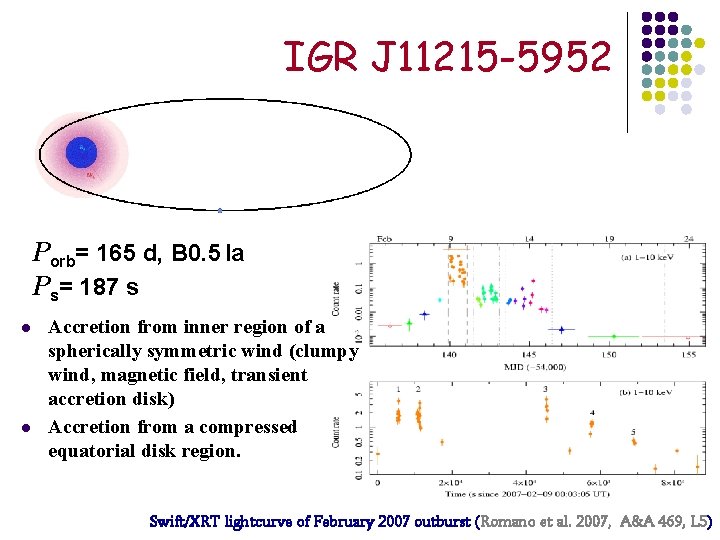
IGR J 11215 -5952 Porb= 165 d, B 0. 5 Ia Ps= 187 s l l Accretion from inner region of a spherically symmetric wind (clumpy wind, magnetic field, transient accretion disk) Accretion from a compressed equatorial disk region. Swift/XRT lightcurve of February 2007 outburst (Romano et al. 2007, A&A 469, L 5)
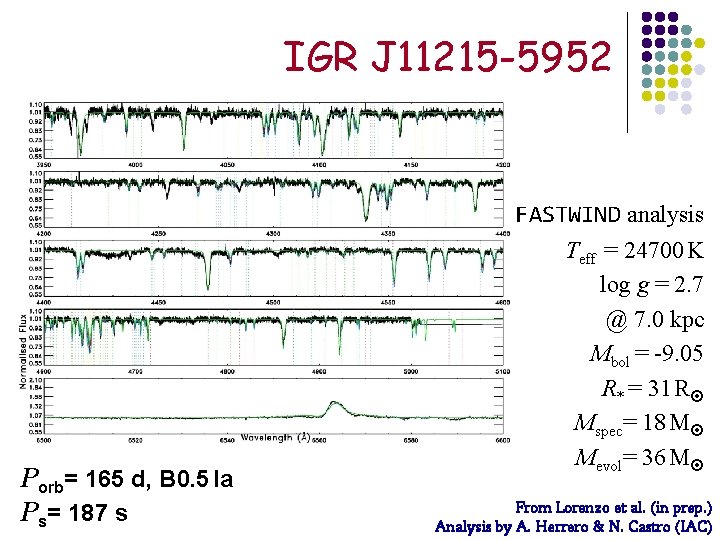
IGR J 11215 -5952 Porb= 165 d, B 0. 5 Ia Ps= 187 s FASTWIND analysis Teff = 24700 K log g = 2. 7 @ 7. 0 kpc Mbol = -9. 05 R* = 31 R Mspec= 18 M Mevol= 36 M From Lorenzo et al. (in prep. ) Analysis by A. Herrero & N. Castro (IAC)
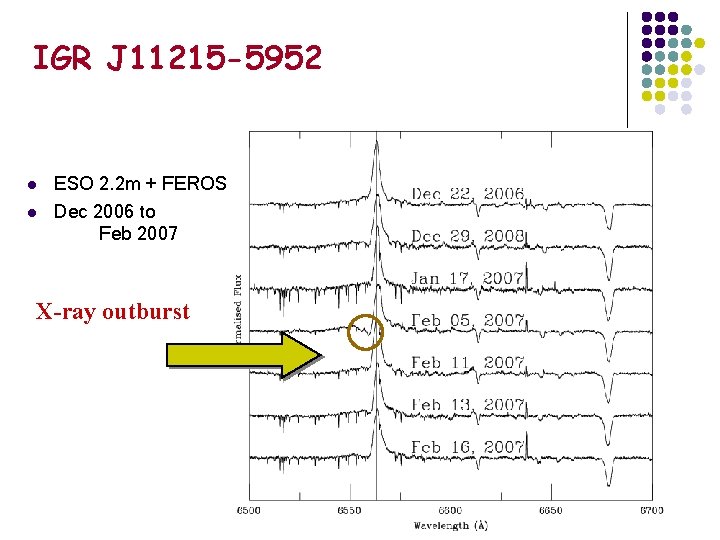
IGR J 11215 -5952 l l ESO 2. 2 m + FEROS Dec 2006 to Feb 2007 X-ray outburst
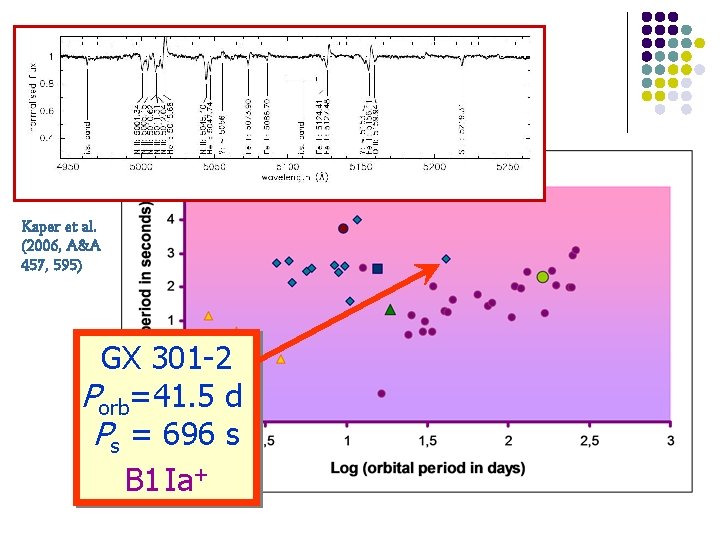
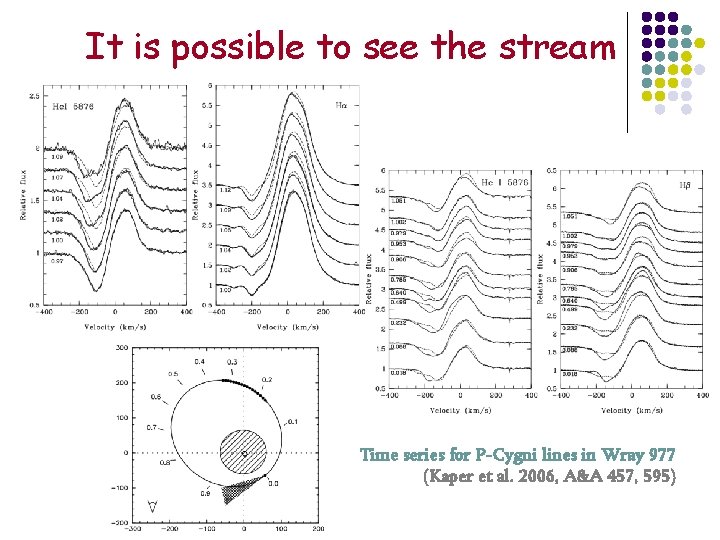
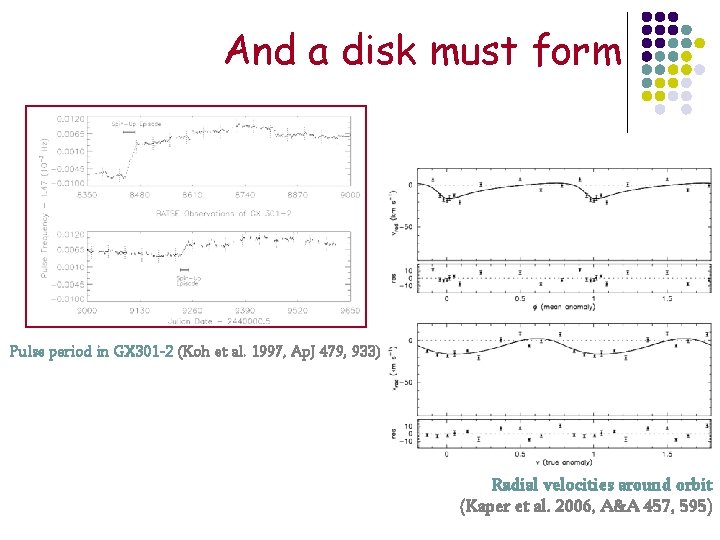
High Mass X-ray binaries Kaper et al. (2006, A&A 457, 595) GX 301 -2 Porb=41. 5 d Ps = 696 s B 1 Ia+
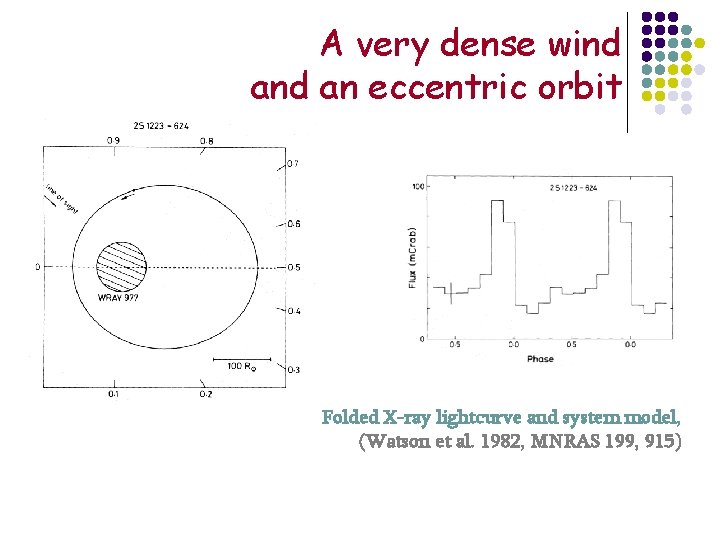
A very dense wind an eccentric orbit Folded X-ray lightcurve and system model, (Watson et al. 1982, MNRAS 199, 915)
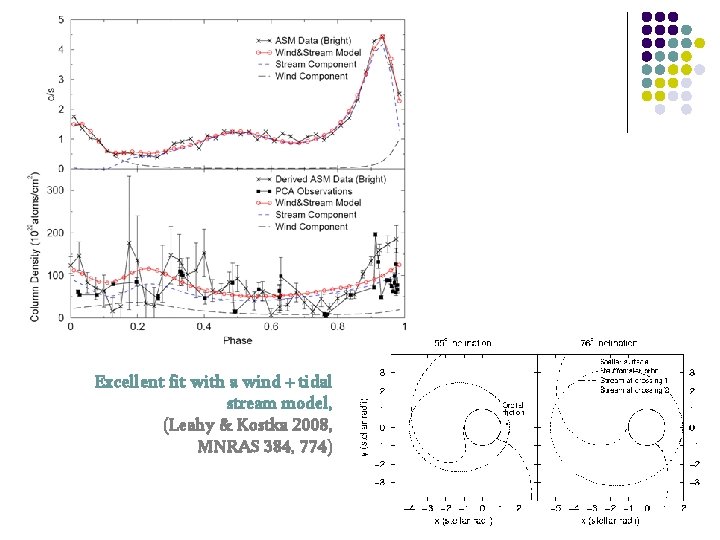
Excellent fit with a wind + tidal stream model, (Leahy & Kostka 2008, MNRAS 384, 774)
It is possible to see the stream Time series for P-Cygni lines in Wray 977 (Kaper et al. 2006, A&A 457, 595)
And a disk must form Pulse period in GX 301 -2 (Koh et al. 1997, Ap. J 479, 933) Radial velocities around orbit (Kaper et al. 2006, A&A 457, 595)
Summary l l l HMXBs provide excellent laboratories to address a wide variety of astrophysical problems. Classical HMXBs are very bright and persistent. We’re starting to see them in nearby galaxies. SGXBs and SFXTs are likely two manifestations of the same phenomenon, giving us valuable insights into the physics of stellar winds. Be/X-ray binaries are an older population. They are much more numerous and trace star formation (as in the SMC; talk by Coe). Unusual system give us glimpses into the evolution of close binaries.
The diversity of High-Mass X-ray binaries Ignacio Negueruela where astrologers roam … Agios Nikolaos October 2010
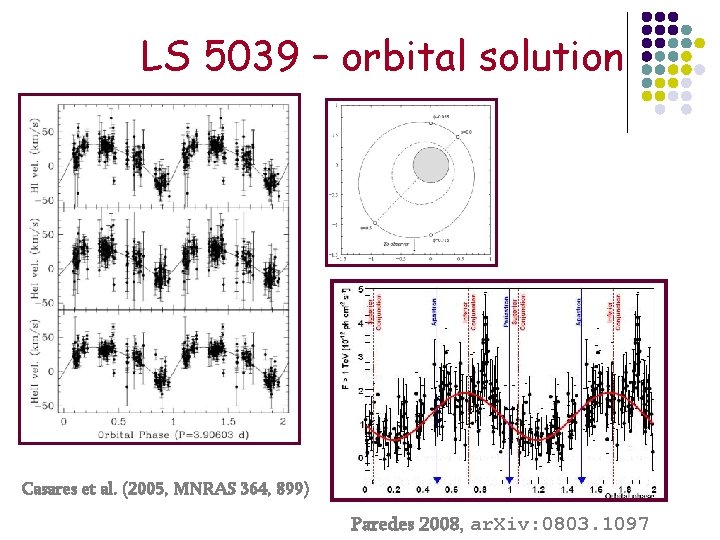
LS 5039 – orbital solution Casares et al. (2005, MNRAS 364, 899) Paredes 2008, ar. Xiv: 0803. 1097
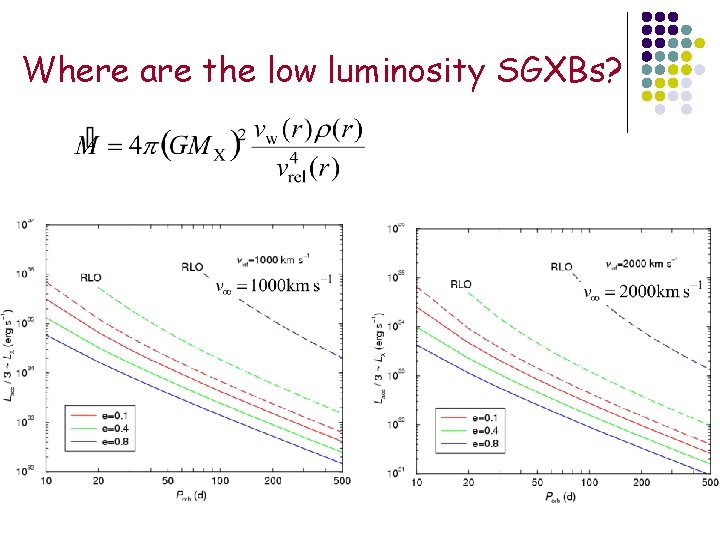
Where are the low luminosity SGXBs?
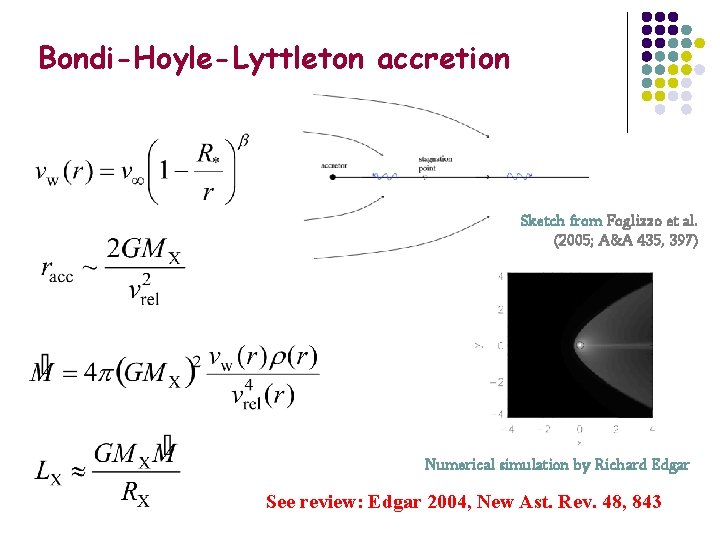
Bondi-Hoyle-Lyttleton accretion Sketch from Foglizzo et al. (2005; A&A 435, 397) Numerical simulation by Richard Edgar See review: Edgar 2004, New Ast. Rev. 48, 843
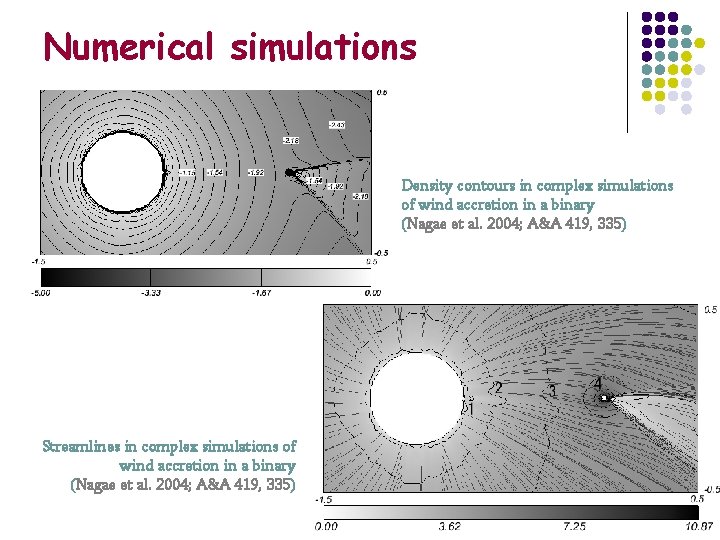
Numerical simulations Density contours in complex simulations of wind accretion in a binary (Nagae et al. 2004; A&A 419, 335) Streamlines in complex simulations of wind accretion in a binary (Nagae et al. 2004; A&A 419, 335)
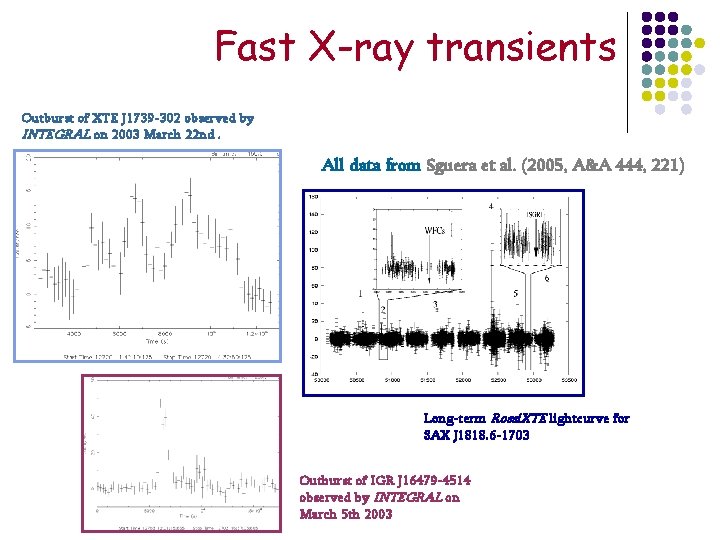
Fast X-ray transients Outburst of XTE J 1739 -302 observed by INTEGRAL on 2003 March 22 nd. All data from Sguera et al. (2005, A&A 444, 221) Long-term Rossi. XTE lightcurve for SAX J 1818. 6 -1703 Outburst of IGR J 16479 -4514 observed by INTEGRAL on March 5 th 2003
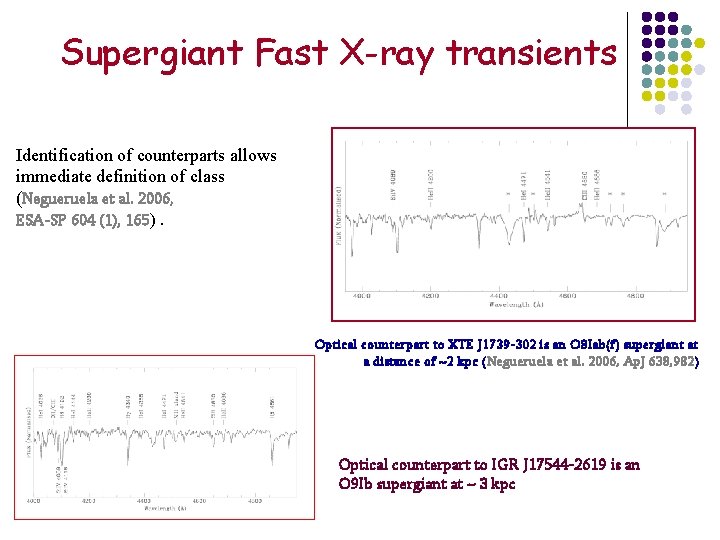
Supergiant Fast X-ray transients Identification of counterparts allows immediate definition of class (Negueruela et al. 2006, ESA-SP 604 (1), 165). Optical counterpart to XTE J 1739 -302 is an O 8 Iab(f) supergiant at a distance of 2 kpc (Negueruela et al. 2006, Ap. J 638, 982) Optical counterpart to IGR J 17544 -2619 is an O 9 Ib supergiant at 3 kpc
- Slides: 83