
The displacements per atom dpa a universal parameter
- Slides: 40
The displacements per atom (dpa), a universal parameter describing the effect of high energy irradiation on Nb 3 Sn – Expected radiation effects in HL-LHC R. Flükiger, and FCCT. Spina, F. Cerutti, A. Ballarino, C. Scheuerlein and L. Bottura CERN, TE – MSC 1211 Geneva, Switzerland Flukiger, CERN, 23. 6. 2017 1
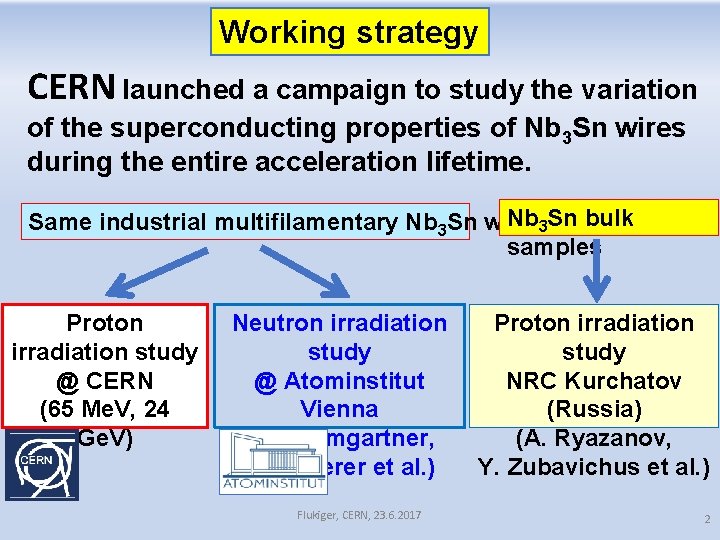
Working strategy CERN launched a campaign to study the variation of the superconducting properties of Nb 3 Sn wires during the entire acceleration lifetime. Nb 3 Sn bulk Same industrial multifilamentary Nb 3 Sn wires samples Proton irradiation study @ CERN (65 Me. V, 24 Ge. V) Neutron irradiation study @ Atominstitut Vienna (T. Baumgartner, M. Eisterer et al. ) Flukiger, CERN, 23. 6. 2017 Proton irradiation study NRC Kurchatov (Russia) (A. Ryazanov, Y. Zubavichus et al. ) 2
Outline • Motivation of this work • Definition of the «displacement per atom» (or dpa) • Relationship between dpa and some physical properties • Expected effects in Hi. Lumi-LHC • Estimated effects in FCC Flukiger, CERN, 23. 6. 2017 3
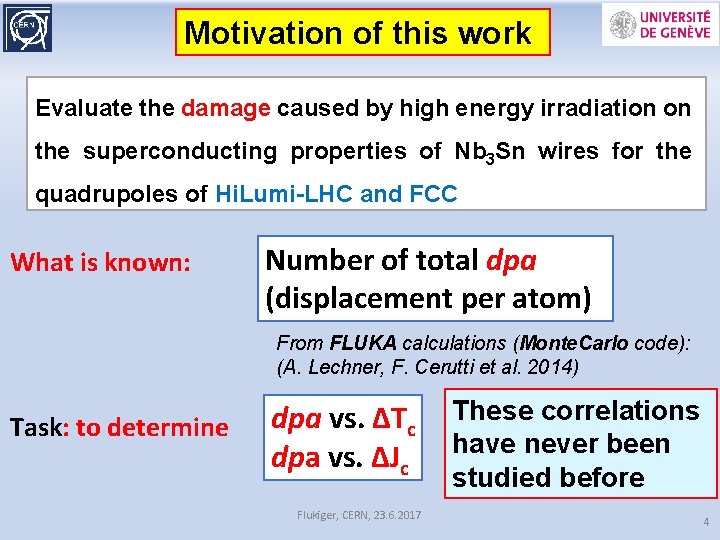
Motivation of this work Evaluate the damage caused by high energy irradiation on the superconducting properties of Nb 3 Sn wires for the quadrupoles of Hi. Lumi-LHC and FCC What is known: Number of total dpa (displacement per atom) From FLUKA calculations (Monte. Carlo code): (A. Lechner, F. Cerutti et al. 2014) Task: to determine dpa vs. ∆Tc dpa vs. ∆Jc Flukiger, CERN, 23. 6. 2017 These correlations have never been studied before 4
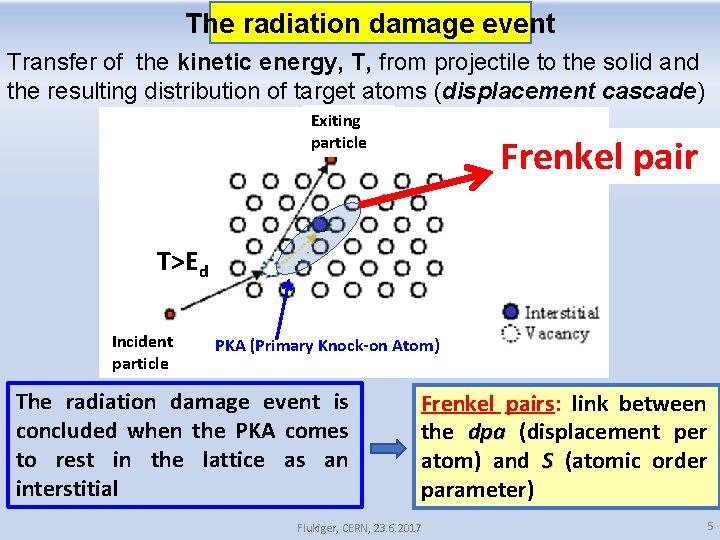
The radiation damage event Transfer of the kinetic energy, T, from projectile to the solid and the resulting distribution of target atoms (displacement cascade) Exiting particle Frenkel pair T>Ed Incident particle PKA (Primary Knock-on Atom) The radiation damage event is concluded when the PKA comes to rest in the lattice as an interstitial Frenkel pairs: link between the dpa (displacement per atom) and S (atomic order parameter) Flukiger, CERN, 23. 6. 2017 5
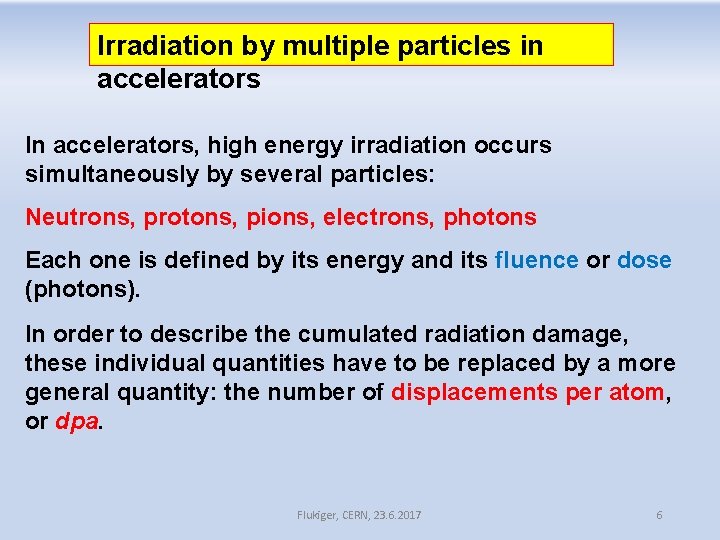
Irradiation by multiple particles in accelerators In accelerators, high energy irradiation occurs simultaneously by several particles: Neutrons, protons, pions, electrons, photons Each one is defined by its energy and its fluence or dose (photons). In order to describe the cumulated radiation damage, these individual quantities have to be replaced by a more general quantity: the number of displacements per atom, or dpa. Flukiger, CERN, 23. 6. 2017 6
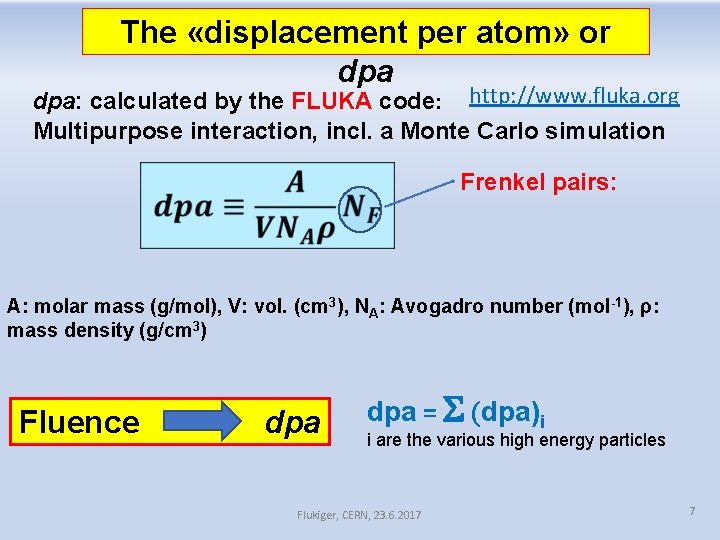
The «displacement per atom» or dpa: calculated by the FLUKA code: http: //www. fluka. org Multipurpose interaction, incl. a Monte Carlo simulation Frenkel pairs: A: molar mass (g/mol), V: vol. (cm 3), NA: Avogadro number (mol-1), ρ: mass density (g/cm 3) Fluence dpa = S (dpa)i i are the various high energy particles Flukiger, CERN, 23. 6. 2017 7
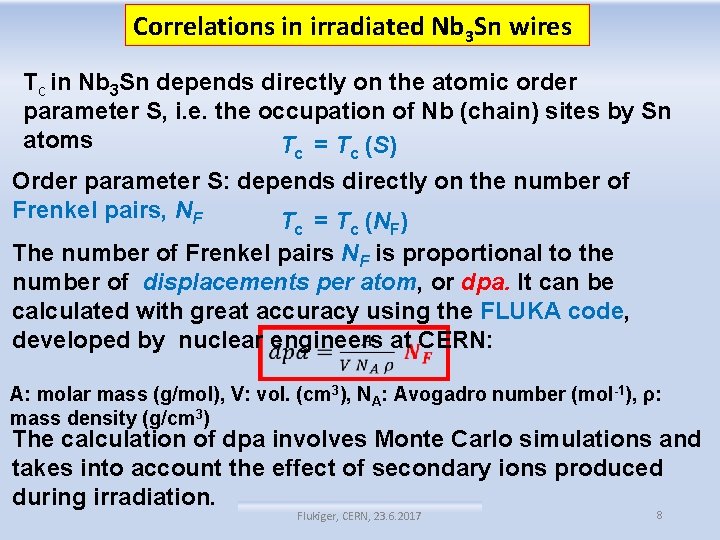
Correlations in irradiated Nb 3 Sn wires Tc in Nb 3 Sn depends directly on the atomic order parameter S, i. e. the occupation of Nb (chain) sites by Sn atoms Tc = Tc (S) Order parameter S: depends directly on the number of Frenkel pairs, NF T = T (N ) c c F The number of Frenkel pairs NF is proportional to the number of displacements per atom, or dpa. It can be calculated with great accuracy using the FLUKA code, developed by nuclear engineers at CERN: A: molar mass (g/mol), V: vol. (cm 3), NA: Avogadro number (mol-1), ρ: mass density (g/cm 3) The calculation of dpa involves Monte Carlo simulations and takes into account the effect of secondary ions produced during irradiation. Flukiger, CERN, 23. 6. 2017 8
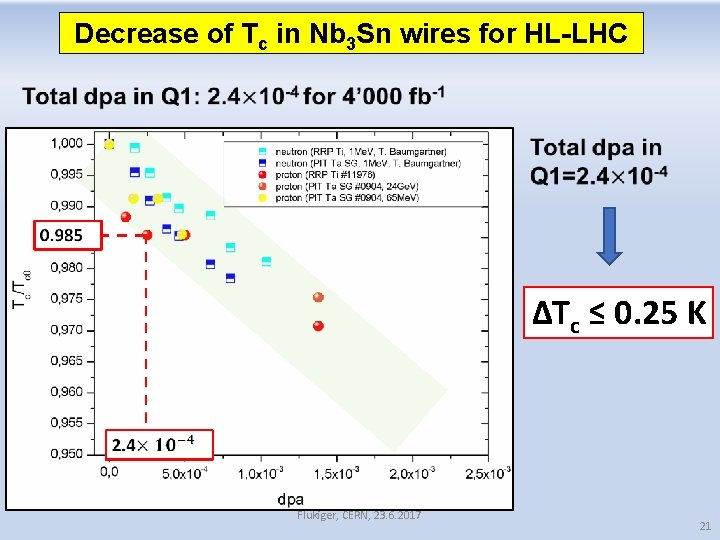
The importance of the number of Frenkel defects It follows that knowing the value of dpa, calculated by the FLUKA code, it is possible to describe the behavior of all physical quantities depending on the number of Frenkel pairs. Quantities depending on the number of Frenkel pairs: * The atomic order parameter, S * The value of Tc * The lattice parameter a Recently, we have shown that the function Tc = Tc (dpa) for Nb 3 Sn wires irradiated by neutrons and protons falls on the same curve. Flukiger, CERN, 23. 6. 2017 9
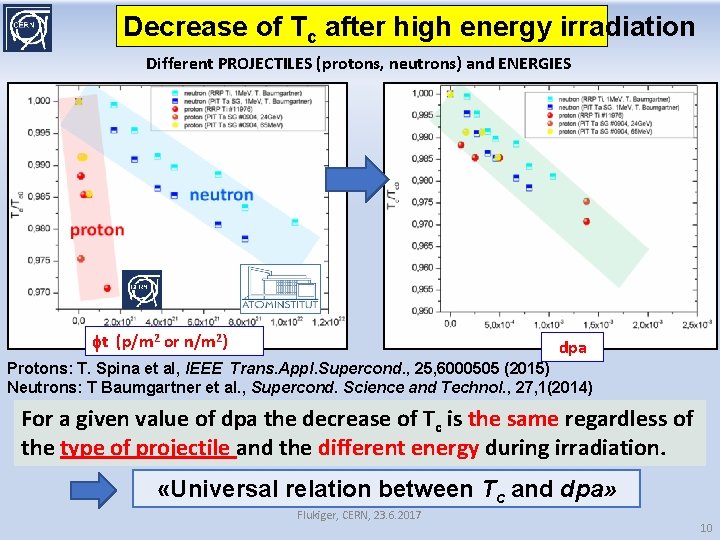
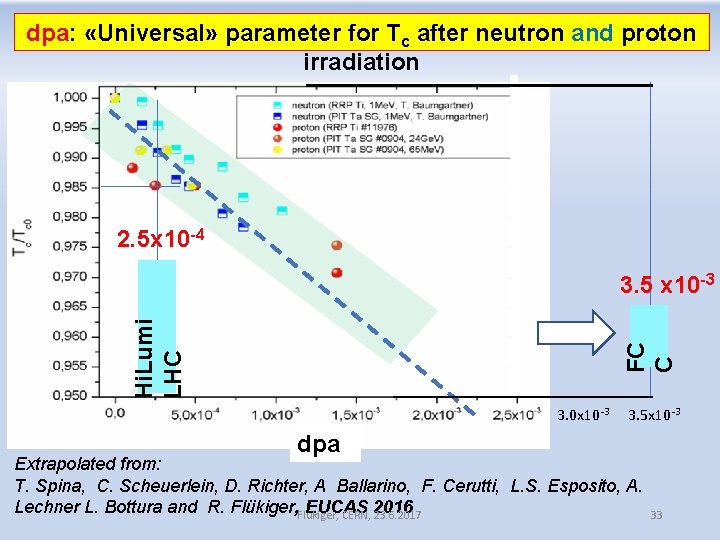
Decrease of Tc after high energy irradiation Different PROJECTILES (protons, neutrons) and ENERGIES ft (p/m 2 or n/m 2) dpa Protons: T. Spina et al, IEEE Trans. Appl. Supercond. , 25, 6000505 (2015) Neutrons: T Baumgartner et al. , Supercond. Science and Technol. , 27, 1(2014) For a given value of dpa the decrease of Tc is the same regardless of the type of projectile and the different energy during irradiation. «Universal relation between Tc and dpa» Flukiger, CERN, 23. 6. 2017 10
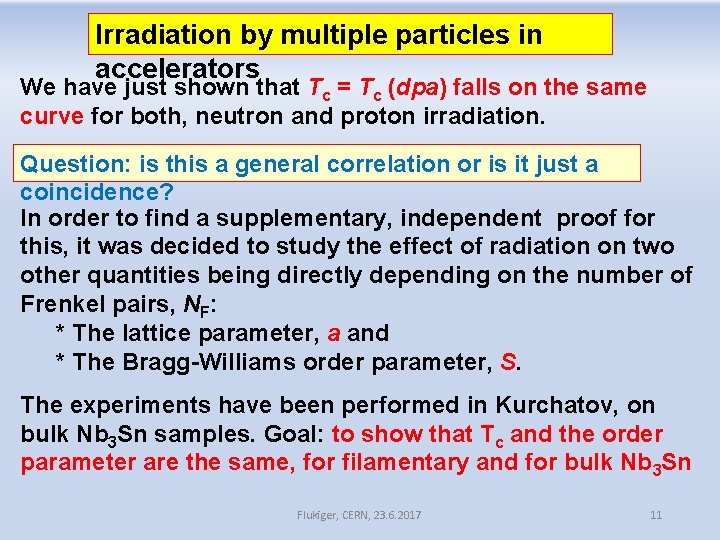
Irradiation by multiple particles in accelerators We have just shown that Tc = Tc (dpa) falls on the same curve for both, neutron and proton irradiation. Question: is this a general correlation or is it just a coincidence? In order to find a supplementary, independent proof for this, it was decided to study the effect of radiation on two other quantities being directly depending on the number of Frenkel pairs, NF: * The lattice parameter, a and * The Bragg-Williams order parameter, S. The experiments have been performed in Kurchatov, on bulk Nb 3 Sn samples. Goal: to show that Tc and the order parameter are the same, for filamentary and for bulk Nb 3 Sn Flukiger, CERN, 23. 6. 2017 11
Determination of the order parameter in bulk Nb 3 Sn Flukiger, CERN, 23. 6. 2017 12
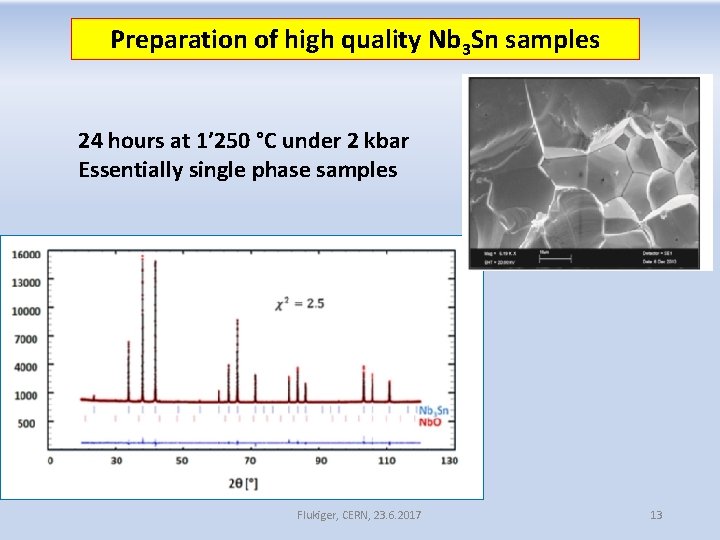
Preparation of high quality Nb 3 Sn samples 24 hours at 1’ 250 °C under 2 kbar Essentially single phase samples Flukiger, CERN, 23. 6. 2017 13
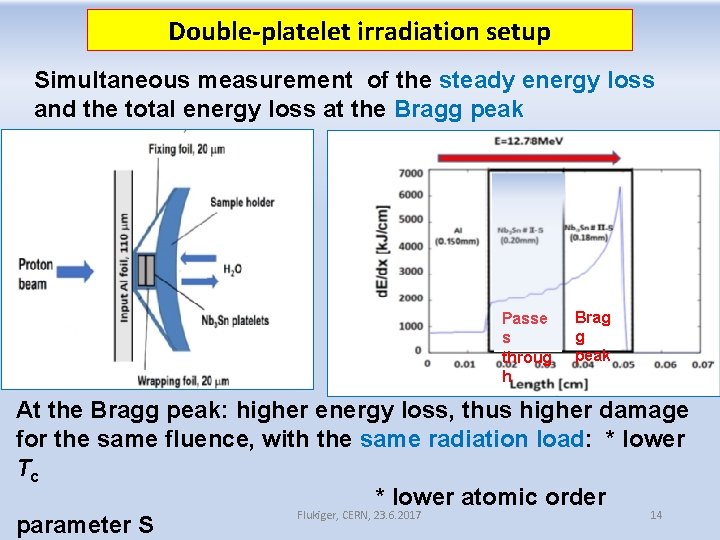
Double-platelet irradiation setup Simultaneous measurement of the steady energy loss and the total energy loss at the Bragg peak Passe s throug h Brag g peak At the Bragg peak: higher energy loss, thus higher damage for the same fluence, with the same radiation load: * lower Tc * lower atomic order Flukiger, CERN, 23. 6. 2017 14 parameter S
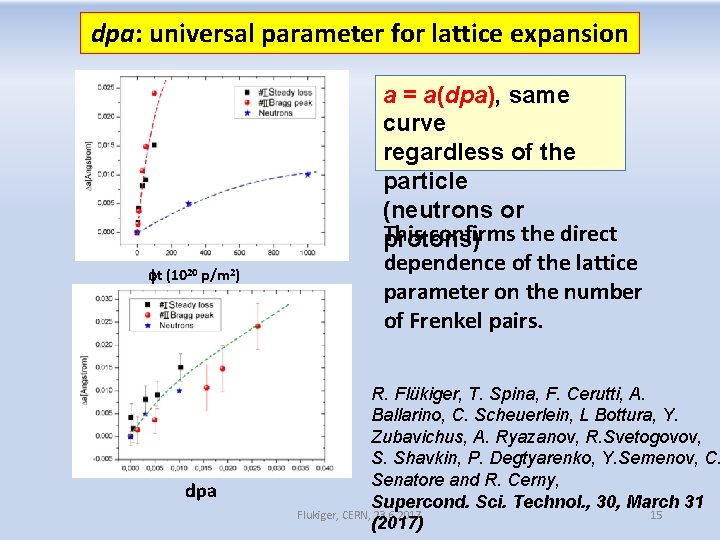
dpa: universal parameter for lattice expansion ft (1020 p/m 2) dpa a = a(dpa), same curve regardless of the particle (neutrons or This confirms the direct protons) dependence of the lattice parameter on the number of Frenkel pairs. R. Flükiger, T. Spina, F. Cerutti, A. Ballarino, C. Scheuerlein, L Bottura, Y. Zubavichus, A. Ryazanov, R. Svetogovov, S. Shavkin, P. Degtyarenko, Y. Semenov, C. Senatore and R. Cerny, Supercond. Sci. Technol. , 30, March 31 Flukiger, CERN, 23. 6. 2017 15 (2017)
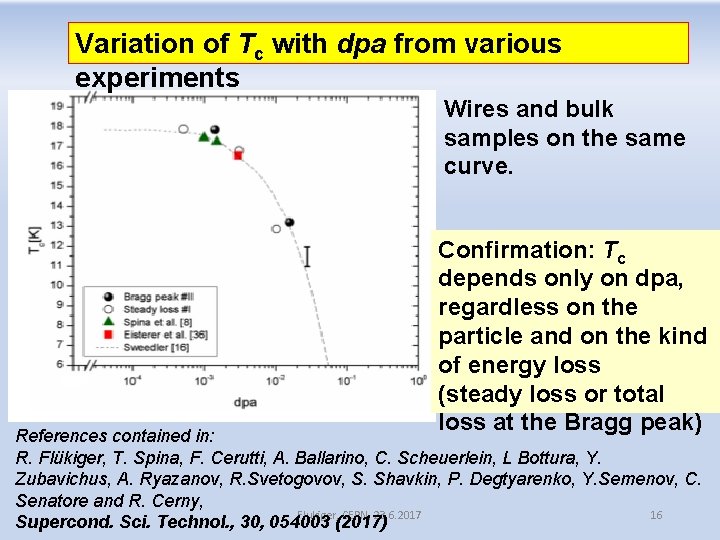
Variation of Tc with dpa from various experiments Wires and bulk samples on the same curve. Confirmation: Tc depends only on dpa, regardless on the particle and on the kind of energy loss (steady loss or total loss at the Bragg peak) References contained in: R. Flükiger, T. Spina, F. Cerutti, A. Ballarino, C. Scheuerlein, L Bottura, Y. Zubavichus, A. Ryazanov, R. Svetogovov, S. Shavkin, P. Degtyarenko, Y. Semenov, C. Senatore and R. Cerny, Flukiger, CERN, 23. 6. 2017 16 Supercond. Sci. Technol. , 30, 054003 (2017)
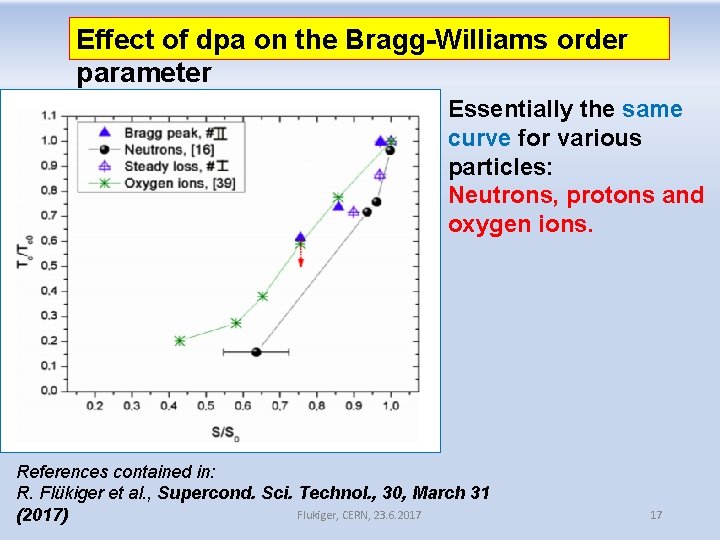
Effect of dpa on the Bragg-Williams order parameter Essentially the same curve for various particles: Neutrons, protons and oxygen ions. References contained in: R. Flükiger et al. , Supercond. Sci. Technol. , 30, March 31 Flukiger, CERN, 23. 6. 2017 (2017) 17
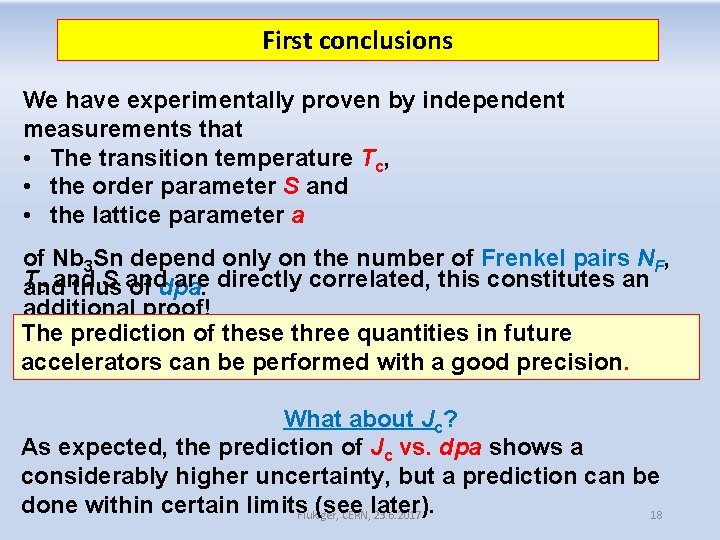
First conclusions We have experimentally proven by independent measurements that • The transition temperature Tc, • the order parameter S and • the lattice parameter a of Nb 3 Sn depend only on the number of Frenkel pairs NF, T S and are directly correlated, this constitutes an c and thus of dpa. additional proof! The prediction of these three quantities in future accelerators can be performed with a good precision. What about Jc? As expected, the prediction of Jc vs. dpa shows a considerably higher uncertainty, but a prediction can be done within certain limits. Flukiger, CERN, 23. 6. 2017 (see later). 18
Variation of superconducting properties in Hi. Lumi-LHC Flukiger, CERN, 23. 6. 2017 19
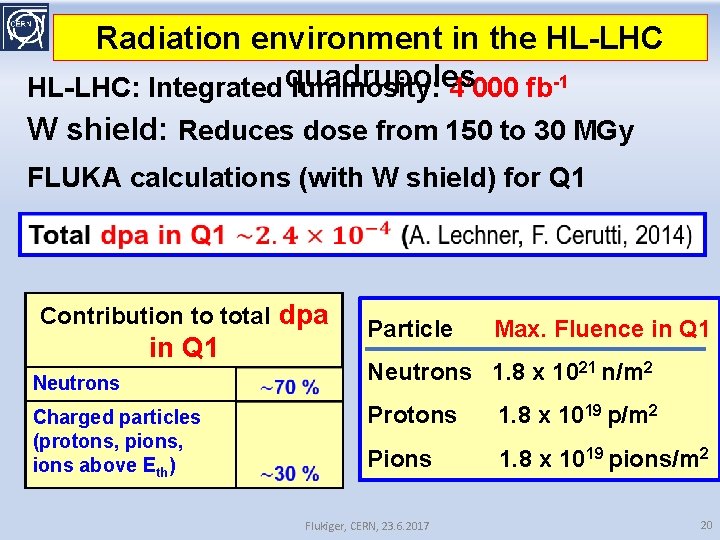
Radiation environment in the HL-LHC: Integrated quadrupoles luminosity: 4’ 000 fb-1 W shield: Reduces dose from 150 to 30 MGy FLUKA calculations (with W shield) for Q 1 Contribution to total dpa in Q 1 Neutrons Charged particles (protons, pions, ions above Eth) Particle Max. Fluence in Q 1 Neutrons 1. 8 x 10²¹ n/m 2 Protons 1. 8 x 10¹⁹ p/m 2 Pions 1. 8 x 10¹⁹ pions/m 2 Flukiger, CERN, 23. 6. 2017 20
Decrease of Tc in Nb 3 Sn wires for HL-LHC ∆Tc ≤ 0. 25 K Flukiger, CERN, 23. 6. 2017 21
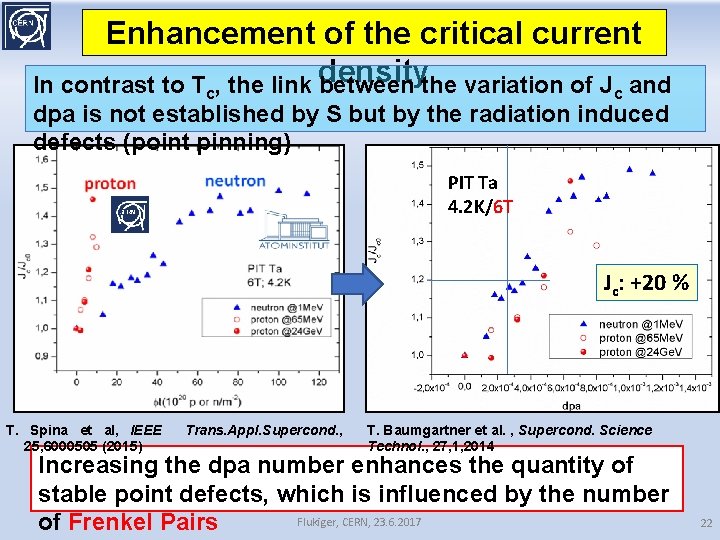
Enhancement of the critical current In contrast to T , the link density between the variation of J and c c dpa is not established by S but by the radiation induced defects (point pinning) PIT Ta 4. 2 K/6 T Jc: +20 % T. Spina et al, IEEE 25, 6000505 (2015) Trans. Appl. Supercond. , T. Baumgartner et al. , Supercond. Science Technol. , 27, 1, 2014 Increasing the dpa number enhances the quantity of stable point defects, which is influenced by the number Flukiger, CERN, 23. 6. 2017 of Frenkel Pairs 22
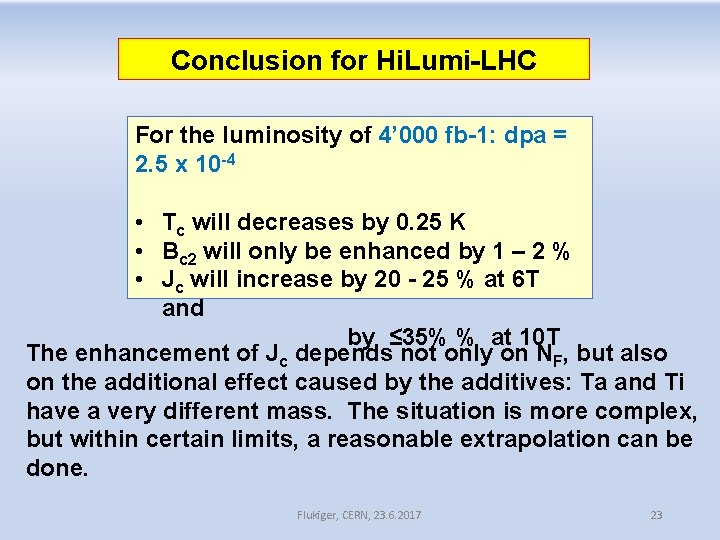
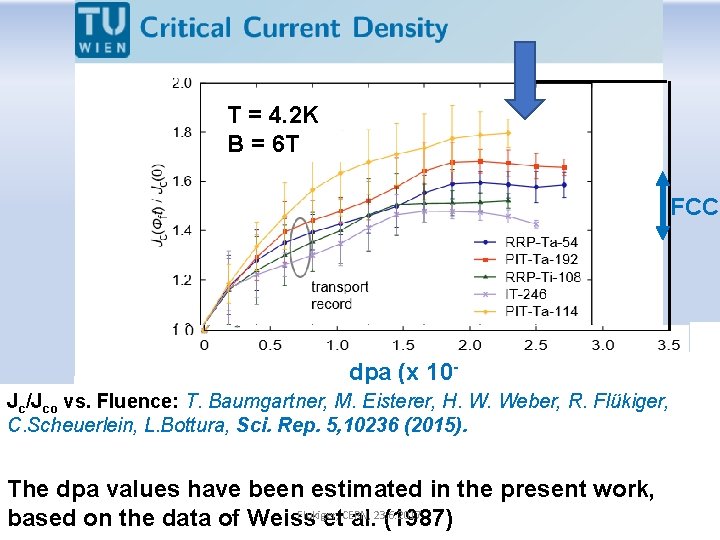
Conclusion for Hi. Lumi-LHC For the luminosity of 4’ 000 fb-1: dpa = 2. 5 x 10 -4 • Tc will decreases by 0. 25 K • Bc 2 will only be enhanced by 1 – 2 % • Jc will increase by 20 - 25 % at 6 T and by ≤ 35% % at 10 T The enhancement of Jc depends not only on NF, but also on the additional effect caused by the additives: Ta and Ti have a very different mass. The situation is more complex, but within certain limits, a reasonable extrapolation can be done. Flukiger, CERN, 23. 6. 2017 23
Estimated variation of superconducting properties in FCC Flukiger, CERN, 23. 6. 2017 24
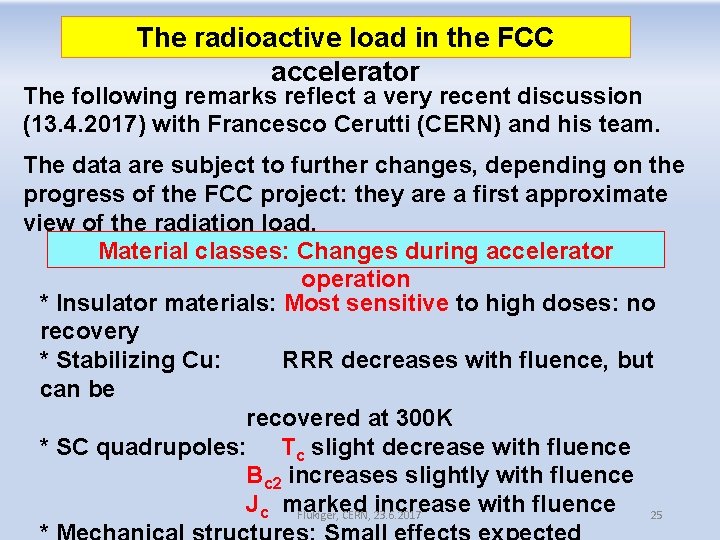
The radioactive load in the FCC accelerator The following remarks reflect a very recent discussion (13. 4. 2017) with Francesco Cerutti (CERN) and his team. The data are subject to further changes, depending on the progress of the FCC project: they are a first approximate view of the radiation load. Material classes: Changes during accelerator operation * Insulator materials: Most sensitive to high doses: no recovery * Stabilizing Cu: RRR decreases with fluence, but can be recovered at 300 K * SC quadrupoles: Tc slight decrease with fluence Bc 2 increases slightly with fluence Jc marked increase with fluence 25 Flukiger, CERN, 23. 6. 2017
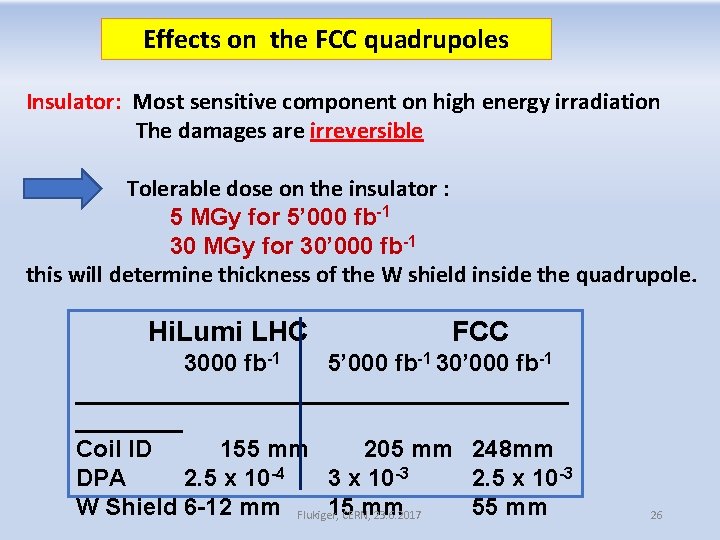
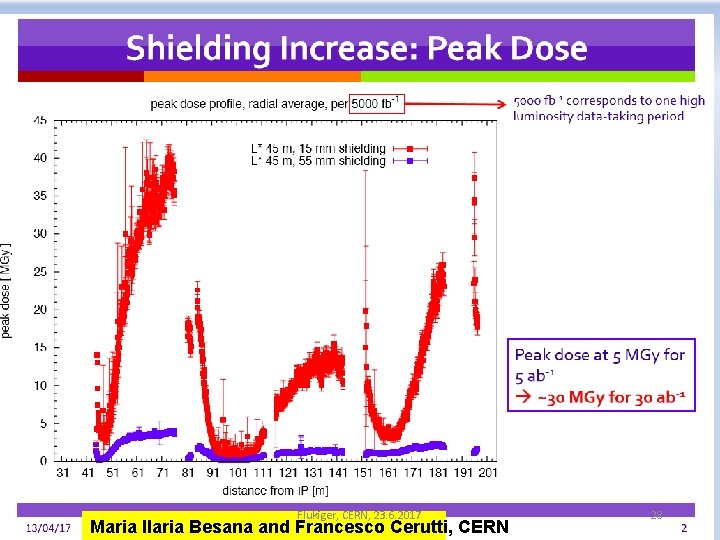
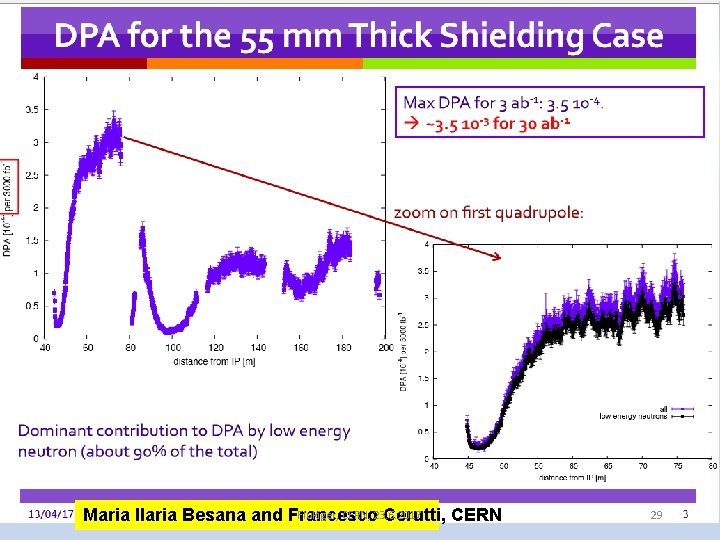
Effects on the FCC quadrupoles Insulator: Most sensitive component on high energy irradiation The damages are irreversible Tolerable dose on the insulator : 5 MGy for 5’ 000 fb-1 30 MGy for 30’ 000 fb-1 this will determine thickness of the W shield inside the quadrupole. Hi. Lumi LHC FCC 3000 fb-1 5’ 000 fb-1 30’ 000 fb-1 ___________________ Coil ID 155 mm 205 mm 248 mm DPA 2. 5 x 10 -4 3 x 10 -3 2. 5 x 10 -3 W Shield 6 -12 mm Flukiger, CERN, 23. 6. 2017 15 mm 55 mm 26
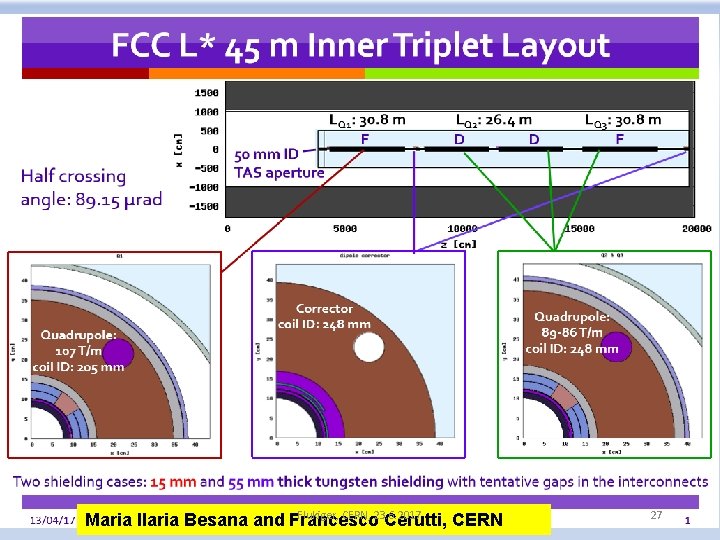
Flukiger, CERN, 23. 6. 2017 Maria Ilaria Besana and Francesco Cerutti, CERN 27
Flukiger, CERN, 23. 6. 2017 Maria Ilaria Besana and Francesco Cerutti, CERN 28
Flukiger, CERN, 23. 6. 2017 Maria Ilaria Besana and Francesco Cerutti, CERN 29
Effects on the superconducting properties of the quadrupoles The following results are based on the following articles, in the frame of collaborations of ATI Vienna (A) and NRC KI, Kurchatov (Russia): Inductive measurements at 6 and 10 T: * T. Spina, C. Scheuerlein, D. Richter, A Ballarino, F. Cerutti, L. S. Esposito, A. Lechner, L. Bottura, R. Flükiger, EUCAS 2016 * T. Baumgartner, M. Eisterer, H. W. Weber, R. Flükiger, C. Scheuerlein and L. Bottura, Sci. Reports, 5, 10236 (2015); FCC workshop, April 2016 * R. Flükiger, T. Spina, F. Cerutti, A. Ballarino, C. Scheuerlein, L Bottura, Y. Zubavichus, A. Ryazanov, R. Svetogovov, S. Shavkin, P. Degtyarenko, Y. Semenov, C. Senatore and R. Cerny, Supercond. Sci. Technol. , 30, 954003 (2017) Earlier publication (so far the Flukiger, CERN, 23. 6. 2017 only paper with transport Jc 30
Estimated variation of Tc in FCC quadrupoles Flukiger, CERN, 23. 6. 2017 31
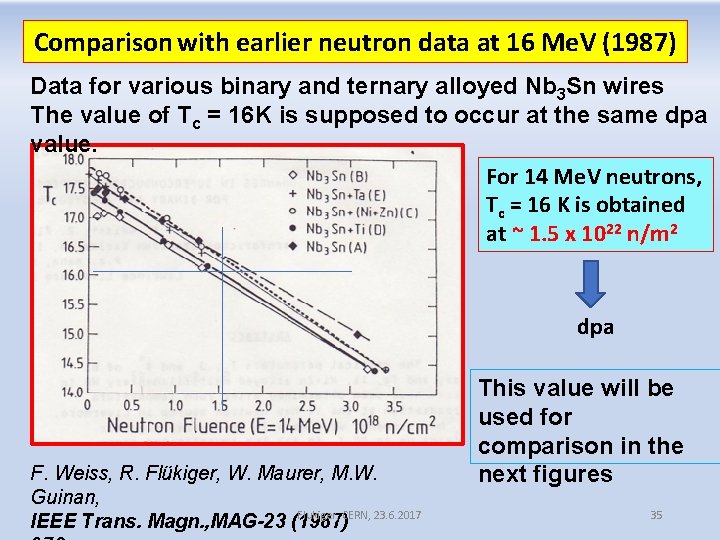
Estimated variation of Tc in FCC quadrupoles This estimation is performed based on: • calculation of the dpa for FCC by Maria Ilaria Besana and Francesco Cerutti, CERN • recent results on Tc vs. dpa obtained by the collaboration with Kurchatov • recent results on Jc vs. neutron fluence obtained by the collaboration with the ATI Vienna, and finally • an earlier determination (Weiss et a. , 1987) of Jc , Tc and Bc 2 vs. neutron fluence on binary and ternary alloyed Nb 3 Sn wires (this «old» study is the most complete so far; it is the only one where Jc was measured by transport (up to 20 T), in contrast to all other articles, where it was measured Flukiger, CERN, 23. 6. 2017 32 inductively).
dpa: «Universal» parameter for Tc after neutron and proton irradiation 2. 5 x 10 -4 FC C Hi. Lumi LHC 3. 5 x 10 -3 -3 3. 0 x 10 -3 3. 5 x 10 -3 dpa Extrapolated from: T. Spina, C. Scheuerlein, D. Richter, A Ballarino, F. Cerutti, L. S. Esposito, A. Lechner L. Bottura and R. Flükiger, Flukiger, CERN, 23. 6. 2017 EUCAS 2016 33
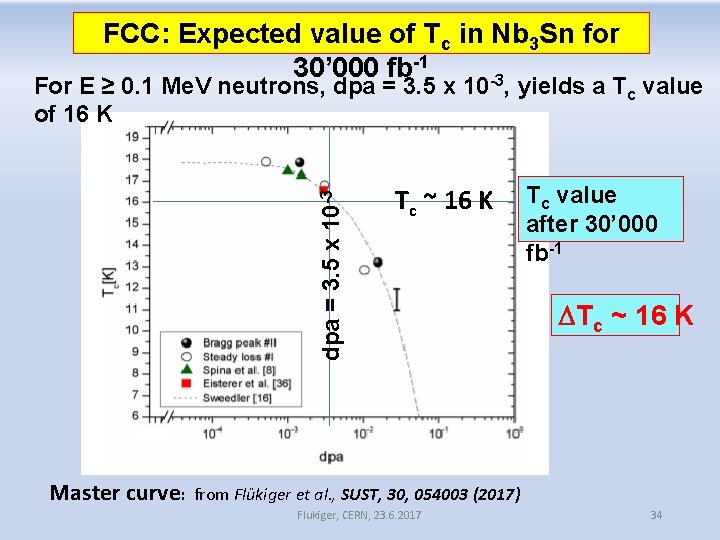
FCC: Expected value of Tc in Nb 3 Sn for 30’ 000 fb-1 -3 dpa = 3. 5 x 10 -3 For E ≥ 0. 1 Me. V neutrons, dpa = 3. 5 x 10 , yields a Tc value of 16 K Master curve: Tc ~ 16 K Tc value after 30’ 000 fb-1 DTc ~ 16 K from Flükiger et al. , SUST, 30, 054003 (2017) Flukiger, CERN, 23. 6. 2017 34
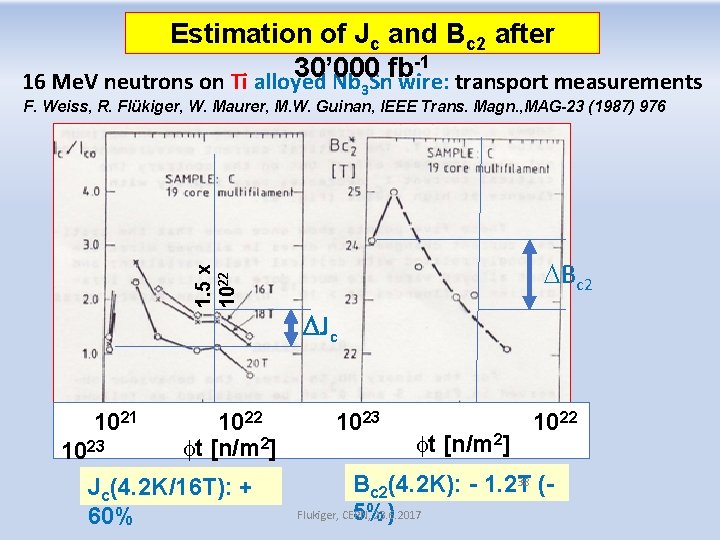
Comparison with earlier neutron data at 16 Me. V (1987) Data for various binary and ternary alloyed Nb 3 Sn wires The value of Tc = 16 K is supposed to occur at the same dpa value. For 14 Me. V neutrons, Tc = 16 K is obtained at ~ 1. 5 x 10²² n/m 2 dpa F. Weiss, R. Flükiger, W. Maurer, M. W. Guinan, Flukiger, CERN, 23. 6. 2017 IEEE Trans. Magn. , MAG-23 (1987) This value will be used for comparison in the next figures 35
Variation of Jc and Bc 2 in FCC quadrupoles Flukiger, CERN, 23. 6. 2017 36
T = 4. 2 K B = 6 T FCC dpa (x 10 Jc/Jco vs. Fluence: T. Baumgartner, M. 3)Eisterer, H. W. Weber, R. Flükiger, -3 Maximum of. L. Bottura, Jc approximately dpa(2015). = 2. 5 x 10 C. Scheuerlein, Sci. Rep. at 5, 10236 The dpa values have been estimated in the present work, Flukiger, CERN, 23. 6. 2017 37 based on the data of Weiss et al. (1987)
Estimation of Jc and Bc 2 after -1 30’ 000 fb 16 Me. V neutrons on Ti alloyed Nb Sn wire: transport measurements 1. 5 x 10²² 3 F. Weiss, R. Flükiger, W. Maurer, M. W. Guinan, IEEE Trans. Magn. , MAG-23 (1987) 976 1021 1023 1022 ft [n/m 2] Jc(4. 2 K/16 T): + 60% DBc 2 DJc 1023 ft [n/m 2] 1022 38 Bc 2(4. 2 K): - 1. 2 T (Flukiger, CERN, 23. 6. 2017 5%)
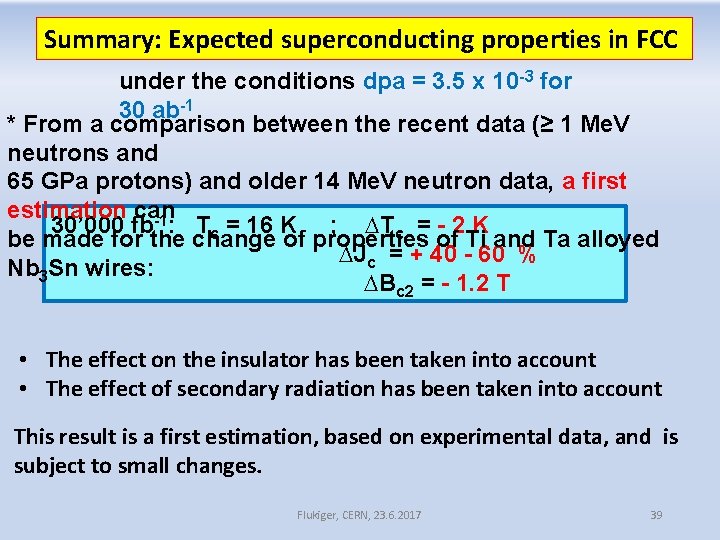
Summary: Expected superconducting properties in FCC under the conditions dpa = 3. 5 x 10 -3 for 30 ab-1 * From a comparison between the recent data (≥ 1 Me. V neutrons and 65 GPa protons) and older 14 Me. V neutron data, a first estimation can 30’ 000 fb-1: Tc = 16 K ; DTc = - 2 K be made for the change of properties of Ti and Ta alloyed DJc = + 40 - 60 % Nb 3 Sn wires: DBc 2 = - 1. 2 T • The effect on the insulator has been taken into account • The effect of secondary radiation has been taken into account This result is a first estimation, based on experimental data, and is subject to small changes. Flukiger, CERN, 23. 6. 2017 39
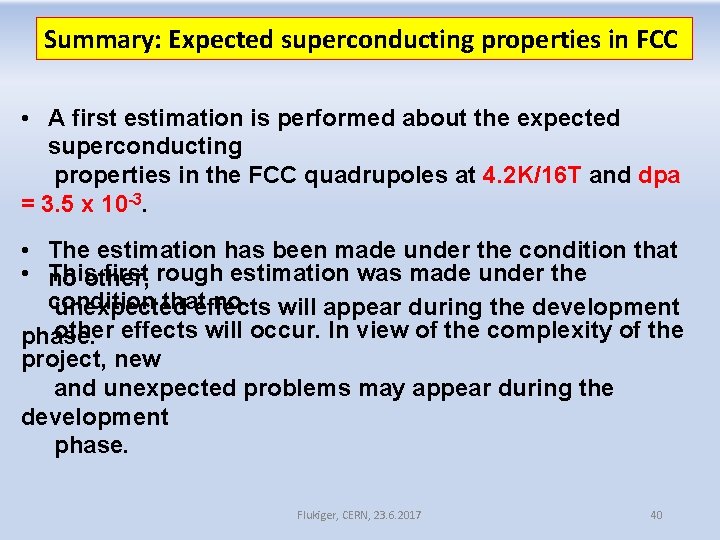
Summary: Expected superconducting properties in FCC • A first estimation is performed about the expected superconducting properties in the FCC quadrupoles at 4. 2 K/16 T and dpa = 3. 5 x 10 -3. • The estimation has been made under the condition that • This first rough estimation was made under the no other, condition that no will appear during the development unexpected effects other effects will occur. In view of the complexity of the phase. project, new and unexpected problems may appear during the development phase. Flukiger, CERN, 23. 6. 2017 40