
The Discrete Time Fourier Transform DTFT of an
![The Discrete Time Fourier Transform (DTFT) of an aperiodic signal x[n] is defined as](https://slidetodoc.com/presentation_image_h/17e2a2afe2c8722ec1bcbe52e402d0ed/image-1.jpg "The Discrete Time Fourier Transform (DTFT) of an aperiodic signal x[n] is defined as")
![Properties of DTFT Symmetry Properties: Suppose that both the signal x[n] and its transform](https://slidetodoc.com/presentation_image_h/17e2a2afe2c8722ec1bcbe52e402d0ed/image-2.jpg "Properties of DTFT Symmetry Properties: Suppose that both the signal x[n] and its transform")

![DTFT Theorems and Properties Linearity If x 1[n] X 1(w) and x 2[n] X](https://slidetodoc.com/presentation_image_h/17e2a2afe2c8722ec1bcbe52e402d0ed/image-4.jpg "DTFT Theorems and Properties Linearity If x 1[n] X 1(w) and x 2[n] X")

![n Time Shifting If x[n] X(w) then x[n-k] = e-jwk. X(w) Proof: Let n](https://slidetodoc.com/presentation_image_h/17e2a2afe2c8722ec1bcbe52e402d0ed/image-6.jpg "n Time Shifting If x[n] X(w) then x[n-k] = e-jwk. X(w) Proof: Let n")
![Convolution Theorem If x 1[n] X 1(w) and x 2[n] X 2(w) then x[n]](https://slidetodoc.com/presentation_image_h/17e2a2afe2c8722ec1bcbe52e402d0ed/image-7.jpg "Convolution Theorem If x 1[n] X 1(w) and x 2[n] X 2(w) then x[n]")
![n Example 2: Determine the convolution of the sequences x 1[n] = x 2[n]](https://slidetodoc.com/presentation_image_h/17e2a2afe2c8722ec1bcbe52e402d0ed/image-8.jpg "n Example 2: Determine the convolution of the sequences x 1[n] = x 2[n]")

![The Wiener-Khintchin Theorem: Let x[n] be a real signal. Then rxx[k] Sxx(w) In other](https://slidetodoc.com/presentation_image_h/17e2a2afe2c8722ec1bcbe52e402d0ed/image-10.jpg "The Wiener-Khintchin Theorem: Let x[n] be a real signal. Then rxx[k] Sxx(w) In other")
![The Modulation Theorem: If x[n] X(w) then x[n]cosw 0[n] ½X(w + w 0) +](https://slidetodoc.com/presentation_image_h/17e2a2afe2c8722ec1bcbe52e402d0ed/image-12.jpg "The Modulation Theorem: If x[n] X(w) then x[n]cosw 0[n] ½X(w + w 0) +")
![n Parseval’s Theorem: If x 1[n] X 1(w) and x 2[n] X 2(w) then](https://slidetodoc.com/presentation_image_h/17e2a2afe2c8722ec1bcbe52e402d0ed/image-13.jpg "n Parseval’s Theorem: If x 1[n] X 1(w) and x 2[n] X 2(w) then")
![n Differentiation in the Frequency Domain: If x[n] X(w) then Fnx[n] jd. X(w)/dw Proof:](https://slidetodoc.com/presentation_image_h/17e2a2afe2c8722ec1bcbe52e402d0ed/image-15.jpg "n Differentiation in the Frequency Domain: If x[n] X(w) then Fnx[n] jd. X(w)/dw Proof:")


![Example: An LTI system is described by the following difference equation: y[n] = ay[n-1]](https://slidetodoc.com/presentation_image_h/17e2a2afe2c8722ec1bcbe52e402d0ed/image-20.jpg "Example: An LTI system is described by the following difference equation: y[n] = ay[n-1]")


- Slides: 26
The Discrete Time Fourier Transform (DTFT) of an aperiodic signal x[n] is defined as And the corresponding Inverse DTFT is defined as 1
Properties of DTFT Symmetry Properties: Suppose that both the signal x[n] and its transform X(w) are complex valued. Then they can be expressed as x[n] = x. R[n] + jx. I[n] (1) X(w) = XR(w) + j. XI(w) (2) The DTFT of the signal x[n] is defined as (3) Substituting (1) and (2) in (3) we get but 2
separating the real and imaginary parts, we have (4) (5) In a similar manner, one can easily prove that 3
DTFT Theorems and Properties Linearity If x 1[n] X 1(w) and x 2[n] X 2(w), then a 1 x 1[n] + a 2 x 2[n] a 1 X 1(w) + a 2 X 2(w) n Example 1: Determine the DTFT of the signal x[n] = a|n| Solution: First, we observe that x[n] can be expressed as x[n] = x 1[n] + x 2[n] where 4
and Now 5
n Time Shifting If x[n] X(w) then x[n-k] = e-jwk. X(w) Proof: Let n – k = m or n = m+k • Time Reversal property If x[n] X(w) then x[-n] X(-w) Proof: 6
Convolution Theorem If x 1[n] X 1(w) and x 2[n] X 2(w) then x[n] = x 1[n]*x 2[n] X(w) = X 1(w)X 2(w) Proof: As we know n Therefore Interchanging the order of summation and making a substitution n-k = m, we get 7
n Example 2: Determine the convolution of the sequences x 1[n] = x 2[n] = [1, 1, 1] Solution: Then X(w) = X 1(w)X 2(w) = (1 + 2 cosw)2 = 3 + 4 cosw + 2 cos 2 w = 3 + 2(ejw + e-jw) + (ej 2 w + e-j 2 w) Hence the convolution of x 1[n] and x 2[n] is x[n] = [1 2 3 2 1] 8
n Tutorial 6 Q 1: Find the convolution of the signals of Example 2 (a) from first principle (b) by using the z-transform. n Correlation Theorem: If x 1[n] X 1(w) and x 2[n] X 2(w) Then rx 1 x 2 Sx 1 x 2 = X 1(w)X 2(-w) where Sx 1 x 2 is called the cross-energy density spectrum. n Tutorial 6 Q 2: Prove the Correlation Theorem. 9
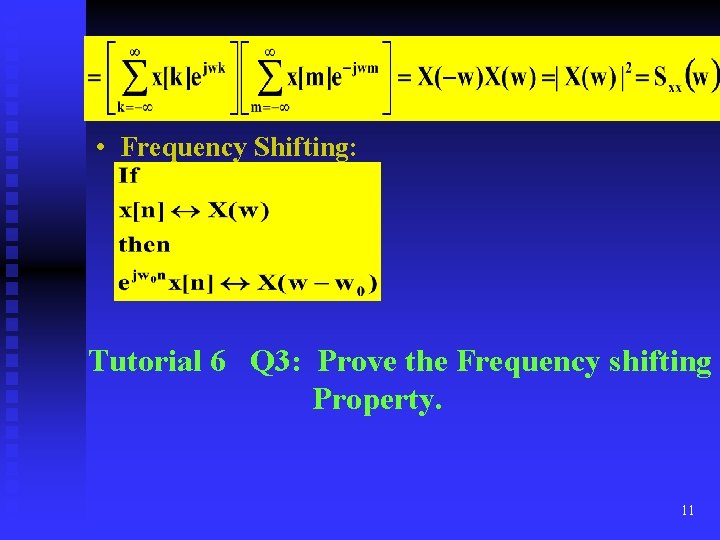
The Wiener-Khintchin Theorem: Let x[n] be a real signal. Then rxx[k] Sxx(w) In other words, the DTFT of autocorrelation function is equal to its energy density function. Proof: The autocorrelation of x[n] is defined as n Now Re-arranging the order of summations and making Substitution m = k+n we get 10
• Frequency Shifting: Tutorial 6 Q 3: Prove the Frequency shifting Property. 11
The Modulation Theorem: If x[n] X(w) then x[n]cosw 0[n] ½X(w + w 0) + ½X(w-w 0) Proof: n 12
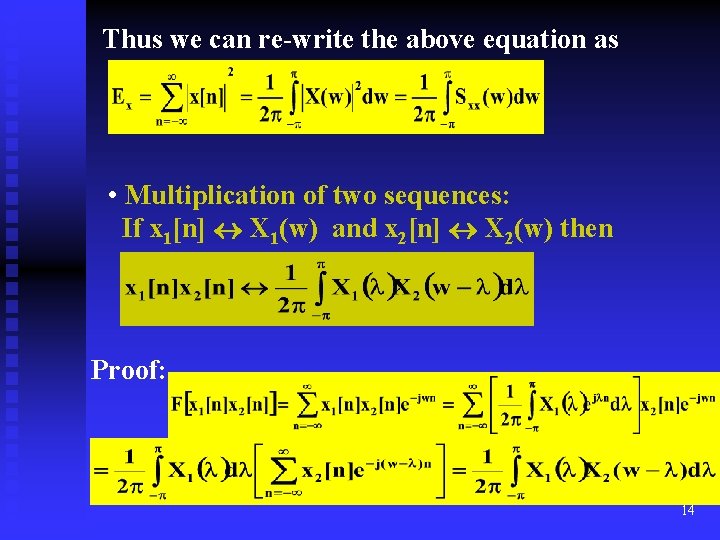
n Parseval’s Theorem: If x 1[n] X 1(w) and x 2[n] X 2(w) then Proof: In the special case where x 1[n] = x 2[n] = x[n], the Parseval’s Theorem reduces to We observe that the LHS of the above equation is energy Ex of the Signal and the R. H. S is equal to the energy 13 density spectrum.
Thus we can re-write the above equation as • Multiplication of two sequences: If x 1[n] X 1(w) and x 2[n] X 2(w) then Proof: 14
n Differentiation in the Frequency Domain: If x[n] X(w) then Fnx[n] jd. X(w)/dw Proof: Multiplying both sides by j we have or 15
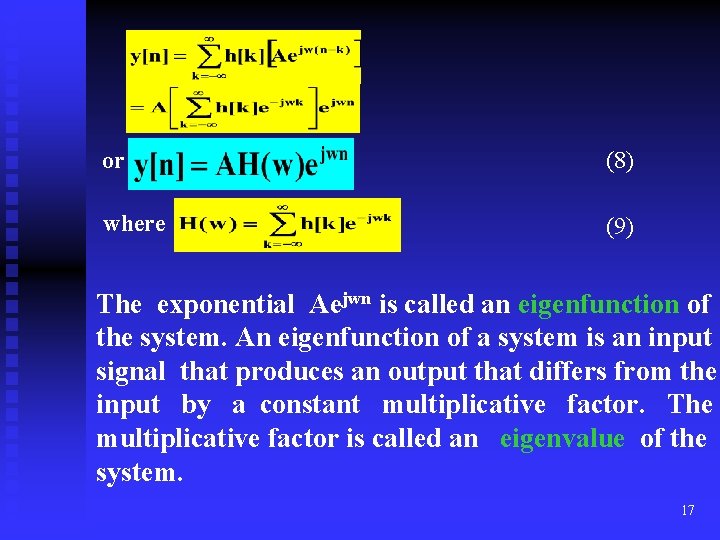
The Frequency Response Function: The response of any LTI system to an arbitrary input signal x[n] is given by (6) In this I/O relationship, the system is characterized in the time domain by its unit impulse response h[k]. To develop a frequency domain characterization of the system, let us excite the system with the complex exponential x[n] = Aejwn. - < n < (7) where A is the amplitude and w is an arbitrary frequency confined to the frequency interval [- , ]. By substituting (7) into (6), we obtain the response 16
or (8) where (9) The exponential Aejwn is called an eigenfunction of the system. An eigenfunction of a system is an input signal that produces an output that differs from the input by a constant multiplicative factor. The multiplicative factor is called an eigenvalue of the system. 17
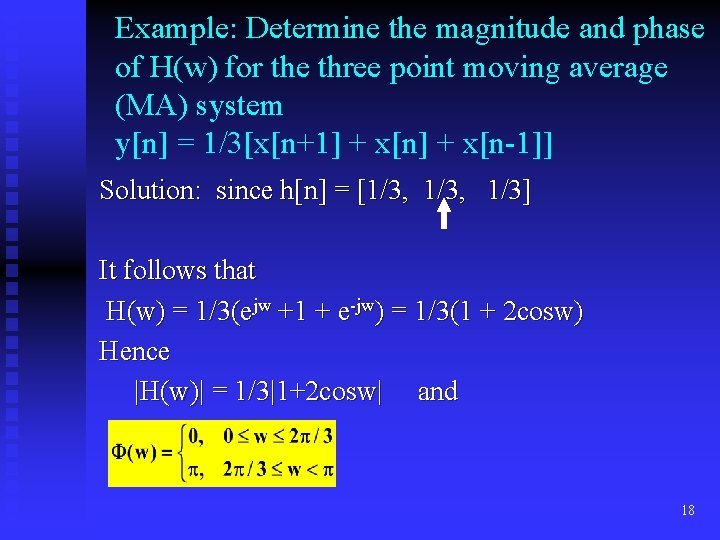
Example: Determine the magnitude and phase of H(w) for the three point moving average (MA) system y[n] = 1/3[x[n+1] + x[n-1]] Solution: since h[n] = [1/3, 1/3] It follows that H(w) = 1/3(ejw +1 + e-jw) = 1/3(1 + 2 cosw) Hence |H(w)| = 1/3|1+2 cosw| and 18
|H(w)| 11 2 /3 0 w (w) 0 2 /3 w 19
Example: An LTI system is described by the following difference equation: y[n] = ay[n-1] + bx[n], 0<a<1 (a) Determine the magnitude and phase of the frequency response H(w) of the system. (b) Choose the parameter b so that the maximum value of |H(w)| is unity. (c) Determine the output of the system to the input signal x[n] = 5 + 12 sin( /2)n – 20 cos ( n + /4) 20
Solution: (a) The frequency response is Now and These responses are sketched on the next slide. 21
(b) It is easy to find that |H(w)| attains its maximum value at w = 0. At this frequency, we have Which implies that b = ±(1 -a). At b = (1 -a), we have and (c) The input signal consists of components of frequencies w = 0, /2 and radians. For w = 0, |H(0)| = 1 and (0) = 0. For w = /2, 22
For w = , Therefore, the output of the system is 23
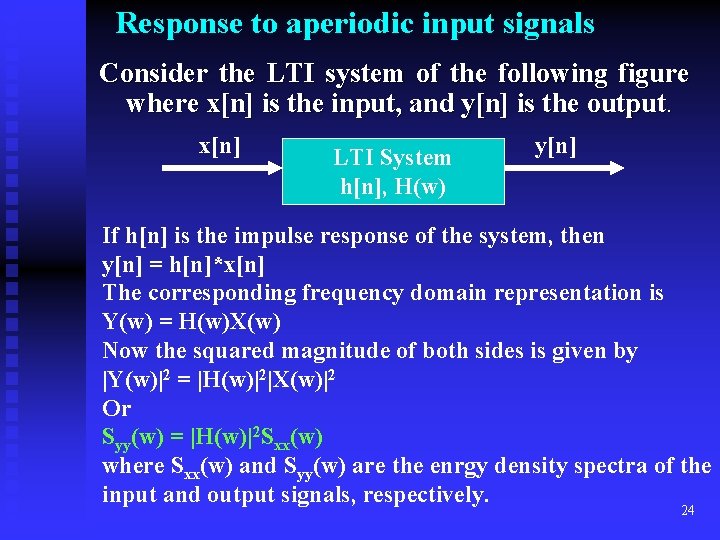
Response to aperiodic input signals Consider the LTI system of the following figure where x[n] is the input, and y[n] is the output. x[n] LTI System h[n], H(w) y[n] If h[n] is the impulse response of the system, then y[n] = h[n]*x[n] The corresponding frequency domain representation is Y(w) = H(w)X(w) Now the squared magnitude of both sides is given by |Y(w)|2 = |H(w)|2|X(w)|2 Or Syy(w) = |H(w)|2 Sxx(w) where Sxx(w) and Syy(w) are the enrgy density spectra of the input and output signals, respectively. 24
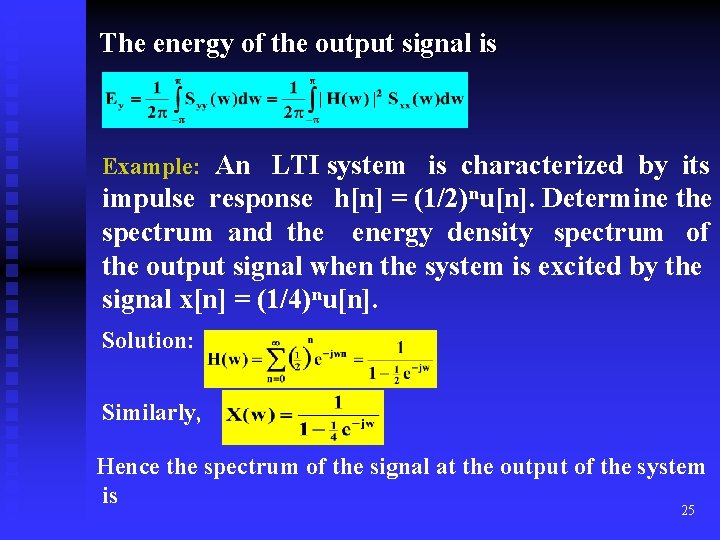
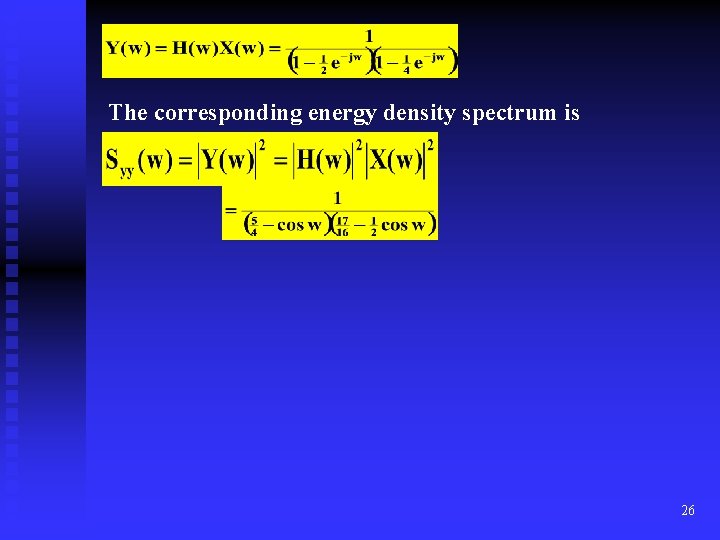
The energy of the output signal is Example: An LTI system is characterized by its impulse response h[n] = (1/2)nu[n]. Determine the spectrum and the energy density spectrum of the output signal when the system is excited by the signal x[n] = (1/4)nu[n]. Solution: Similarly, Hence the spectrum of the signal at the output of the system is 25
The corresponding energy density spectrum is 26