
The Discharge Summary What PCPs and coders want
- Slides: 22
The Discharge Summary: What PCP’s and coders want J Rush Pierce Jr, MD, MPH Lenny Noronha, MD Hospitalist Best Practices Conference November 20, 2009
Objectives n n Clarify the purpose of the DC summary: 1 min Review the literature, our practice: 5 min Assess needs of pcp’s, coders, other readers: 12 minutes Initiate discussion of UNM Best Practices for current ward structure: 30 minutes PLEASE COMPLETE SURVEY DURING THIS PROGRAM
Purposes of discharge summary n n Accurately record what happened in the hospital Assist colleagues with care of patient in the future (pcp, DC fu clinic, ER, etc) Concise report for hospital coders in quality and billing Assist auditors, demographers, researchers
Are discharge summaries complete? - Australian study n n n 80% had chief complaint 40% listed PCP 35% listed pending lab 40% listed complications that occurred in hospital 80% listed discharge meds J Qual Cl Pract 2001: 21: 104
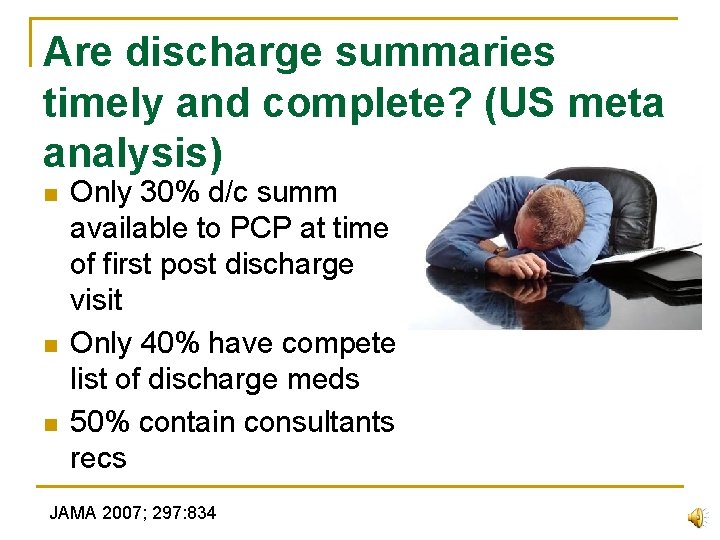
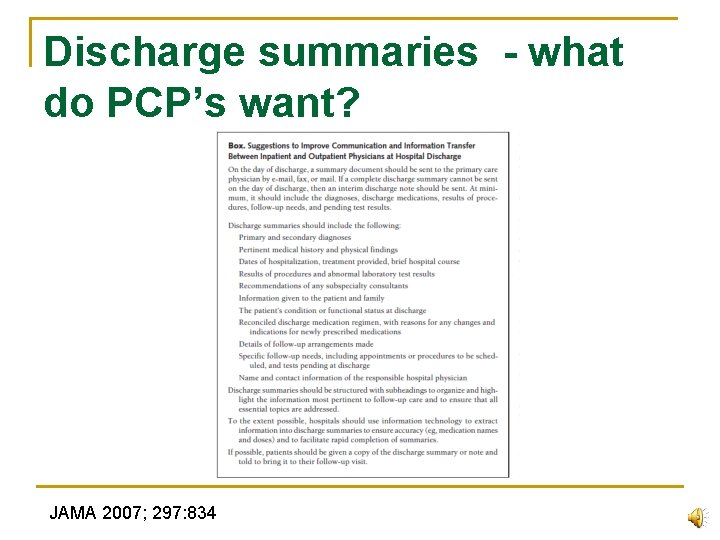
Are discharge summaries timely and complete? (US meta analysis) n n n Only 30% d/c summ available to PCP at time of first post discharge visit Only 40% have compete list of discharge meds 50% contain consultants recs JAMA 2007; 297: 834
Are discharge summaries accurate? n In pts referred to SNF’s medication Boston studies discrepancy between DCs and transfer form n identified in 52% of admissions. CV drugs, opiates, psych meds, hypoglycemics, antibiotics, and anticoags accounted for 50% of descrepancies (JGIM 2009; 24: 630) In pts discharged to rehab on coumadin, only 16% had info about indication, duration, monitoring, and follow-up (Jt Comm Qual Patient Saf 2008; 34: 460)
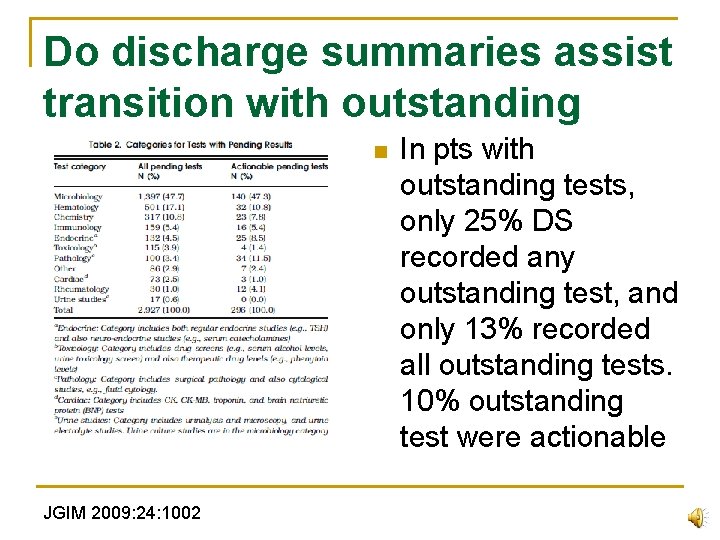
Do discharge summaries assist transition with outstanding n In pts with tests? outstanding tests, only 25% DS recorded any outstanding test, and only 13% recorded all outstanding tests. 10% outstanding test were actionable JGIM 2009: 24: 1002
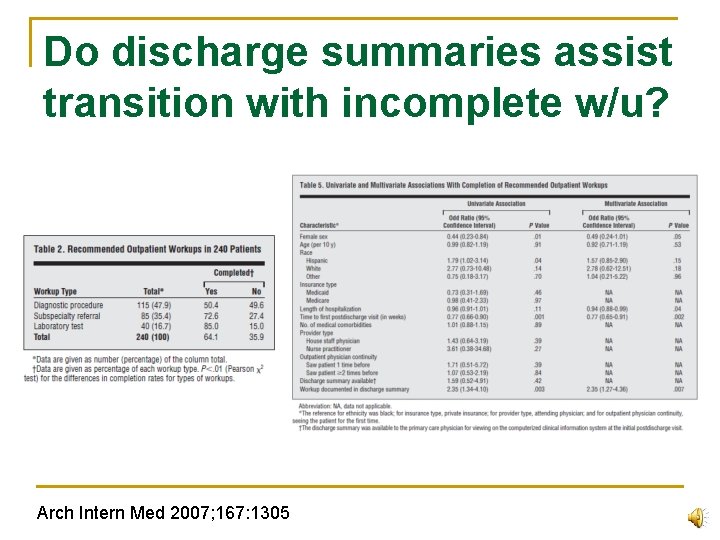
Do discharge summaries assist transition with incomplete w/u? Arch Intern Med 2007; 167: 1305
Discharge summaries - what do PCP’s want? JAMA 2007; 297: 834
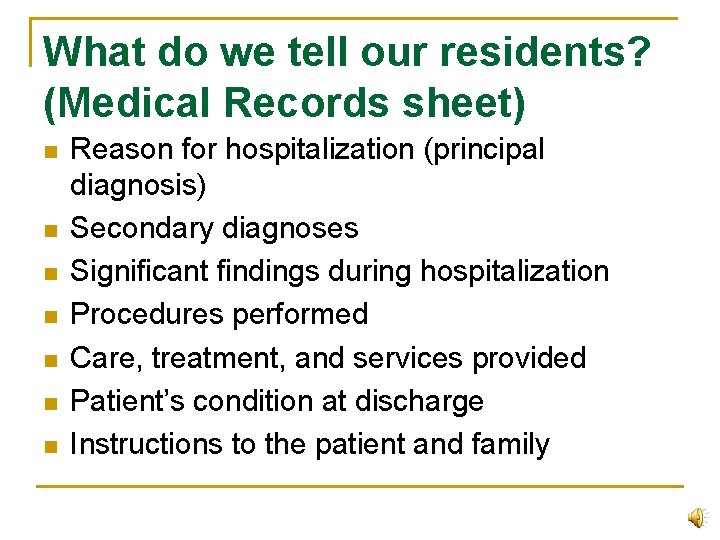
What do we tell our residents? (Medical Records sheet) n n n n Reason for hospitalization (principal diagnosis) Secondary diagnoses Significant findings during hospitalization Procedures performed Care, treatment, and services provided Patient’s condition at discharge Instructions to the patient and family
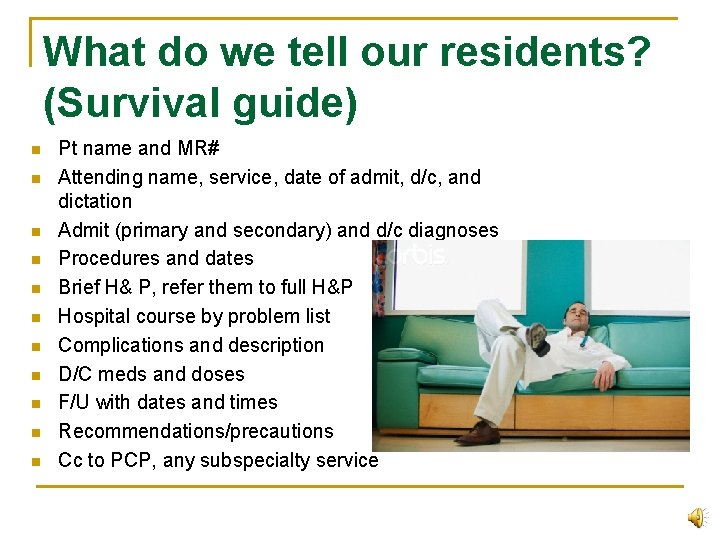
What do we tell our residents? (Survival guide) n n n Pt name and MR# Attending name, service, date of admit, d/c, and dictation Admit (primary and secondary) and d/c diagnoses Procedures and dates Brief H& P, refer them to full H&P Hospital course by problem list Complications and description D/C meds and doses F/U with dates and times Recommendations/precautions Cc to PCP, any subspecialty service
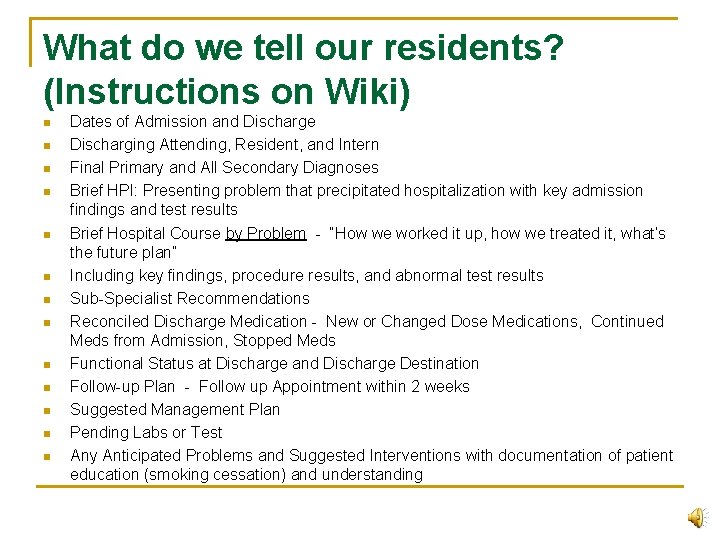
What do we tell our residents? (Instructions on Wiki) n n n n Dates of Admission and Discharge Discharging Attending, Resident, and Intern Final Primary and All Secondary Diagnoses Brief HPI: Presenting problem that precipitated hospitalization with key admission findings and test results Brief Hospital Course by Problem - “How we worked it up, how we treated it, what’s the future plan” Including key findings, procedure results, and abnormal test results Sub-Specialist Recommendations Reconciled Discharge Medication - New or Changed Dose Medications, Continued Meds from Admission, Stopped Meds Functional Status at Discharge and Discharge Destination Follow-up Plan - Follow up Appointment within 2 weeks Suggested Management Plan Pending Labs or Test Any Anticipated Problems and Suggested Interventions with documentation of patient education (smoking cessation) and understanding
What do coders look for? PLEASE COMPLETE A SURVEY DURING THIS PROGRAM !
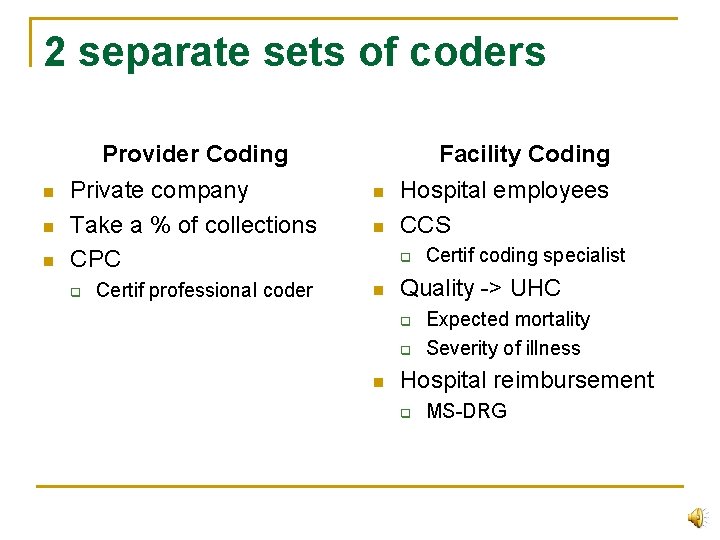
2 separate sets of coders Provider Coding n n n Facility Coding Private company Take a % of collections CPC n Certif professional coder n q n Hospital employees CCS q Quality -> UHC q q n Certif coding specialist Expected mortality Severity of illness Hospital reimbursement q MS-DRG
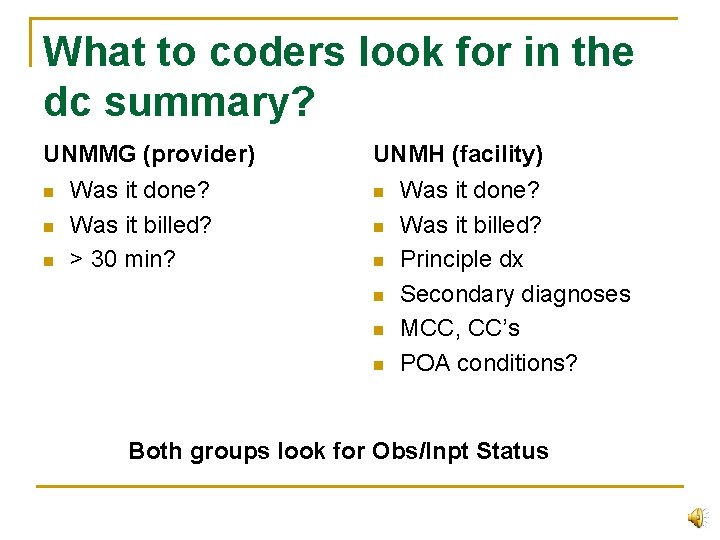
What to coders look for in the dc summary? UNMMG (provider) n n n Was it done? Was it billed? > 30 min? UNMH (facility) n n n Was it done? Was it billed? Principle dx Secondary diagnoses MCC, CC’s POA conditions? Both groups look for Obs/Inpt Status
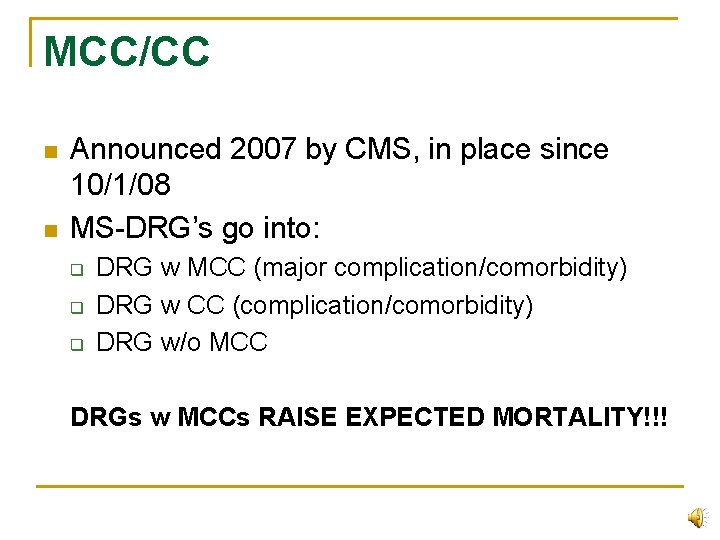
MCC/CC n n Announced 2007 by CMS, in place since 10/1/08 MS-DRG’s go into: q q q DRG w MCC (major complication/comorbidity) DRG w CC (complication/comorbidity) DRG w/o MCC DRGs w MCCs RAISE EXPECTED MORTALITY!!!
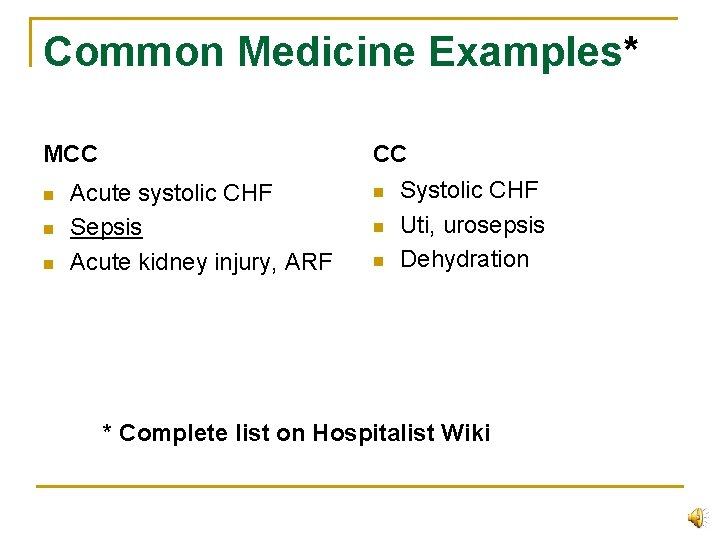
Common Medicine Examples* MCC n n n CC Acute systolic CHF Sepsis Acute kidney injury, ARF n n n Systolic CHF Uti, urosepsis Dehydration * Complete list on Hospitalist Wiki
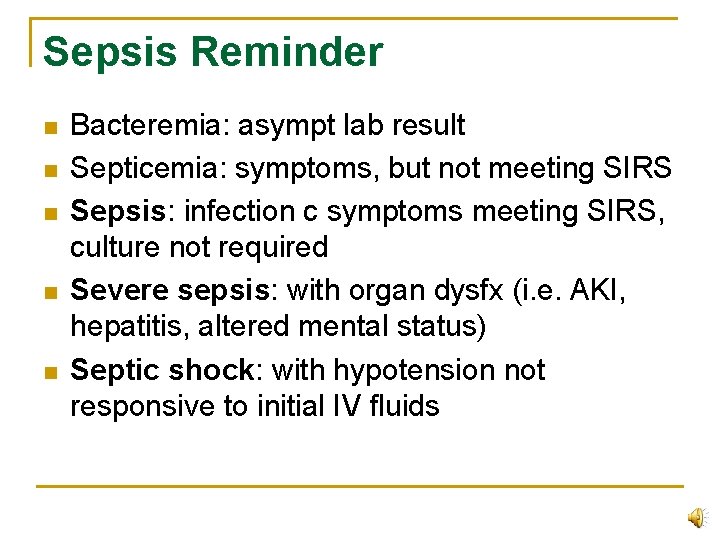
Sepsis Reminder n n n Bacteremia: asympt lab result Septicemia: symptoms, but not meeting SIRS Sepsis: infection c symptoms meeting SIRS, culture not required Severe sepsis: with organ dysfx (i. e. AKI, hepatitis, altered mental status) Septic shock: with hypotension not responsive to initial IV fluids
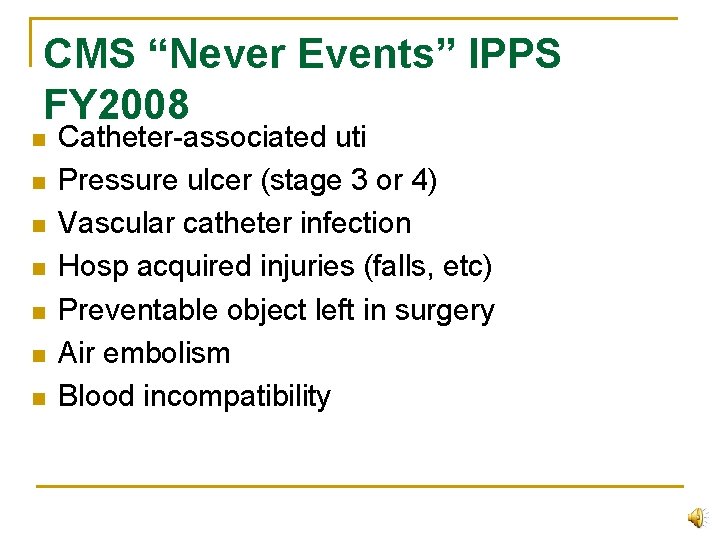
CMS “Never Events” IPPS FY 2008 n n n n Catheter-associated uti Pressure ulcer (stage 3 or 4) Vascular catheter infection Hosp acquired injuries (falls, etc) Preventable object left in surgery Air embolism Blood incompatibility
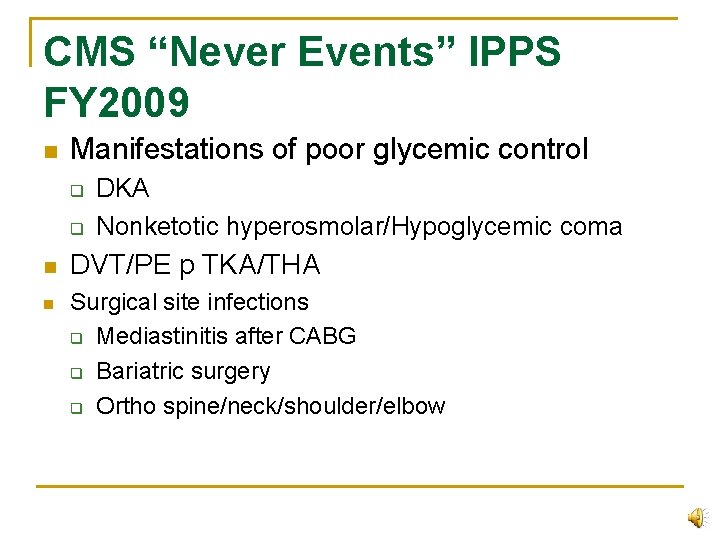
CMS “Never Events” IPPS FY 2009 n Manifestations of poor glycemic control q q n n DKA Nonketotic hyperosmolar/Hypoglycemic coma DVT/PE p TKA/THA Surgical site infections q Mediastinitis after CABG q Bariatric surgery q Ortho spine/neck/shoulder/elbow
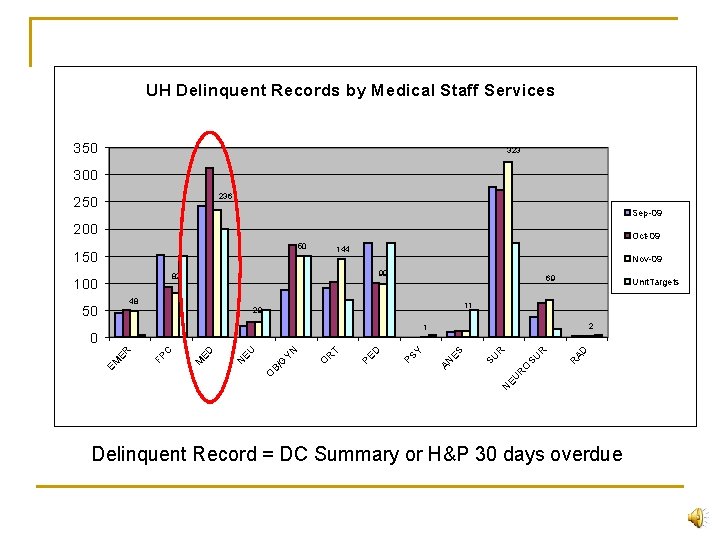
UH Delinquent Records by Medical Staff Services 350 323 300 236 250 Sep-09 200 Oct-09 150 144 Nov-09 99 82 100 69 48 50 Unit. Targets 11 29 2 AD SU N EU R O R R R SU AN Y PS D PE T R O YN B/ G O N EU M ED C FP ER EM ES 1 0 Delinquent Record = DC Summary or H&P 30 days overdue
Discharge summary – questions to address n n n What should our model discharge summary look like? Do we need a standardized DCS “time out”? How extensively should faculty modify resident d/c summaries? Should all summaries be done on day of dc? Who does it when the intern is off/clinic? HAVE YOU COMPLETED YOUR SURVEY?