
The Direction of Intention My God give me


- Slides: 13
The Direction of Intention My God, give me the grace to perform this action with you and through love for you. In advance, I offer to you all the good that I will do and accept all the difficulty I may meet therein. St. Ann, Pray for us. St. Francis de Sales, Pray for us.
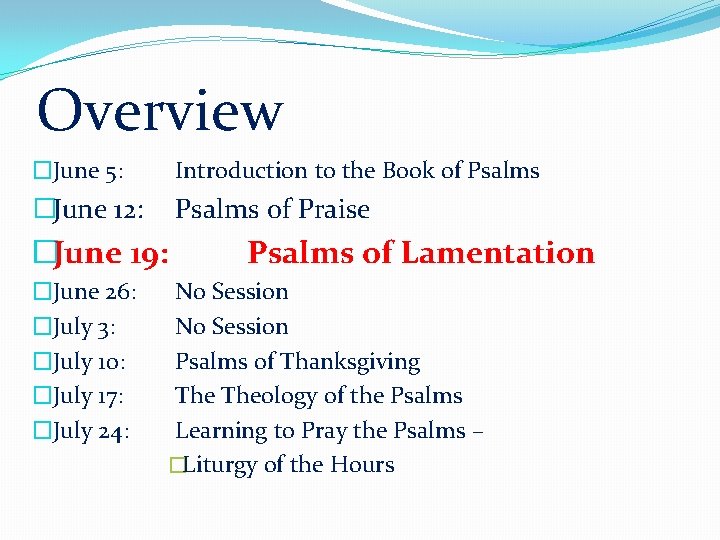
Overview �June 5: Introduction to the Book of Psalms �June 12: Psalms of Praise �June 19: �June 26: �July 3: �July 10: �July 17: �July 24: Psalms of Lamentation No Session Psalms of Thanksgiving Theology of the Psalms Learning to Pray the Psalms – �Liturgy of the Hours
Lament: • • To express grief for or about; mourn: To regret deeply; deplore To grieve audibly; wail. To express sorrow or regret.
Psalms of Lamentation – Lament An Overview �The function of a Lament or Psalm of Petitionary Praise �To provide a structure for crisis, hurt, grief, or despair �To move a worshipper from hurt to joy, from darkness to light, from desperation to hope. �This movement from hurt to joy is first and foremost a spiritual movement �It may take the form of psychological or liturgical experience �It is not necessarily a physical deliverance from the crisis, although that is often anticipated. �The movement "out of the depths"
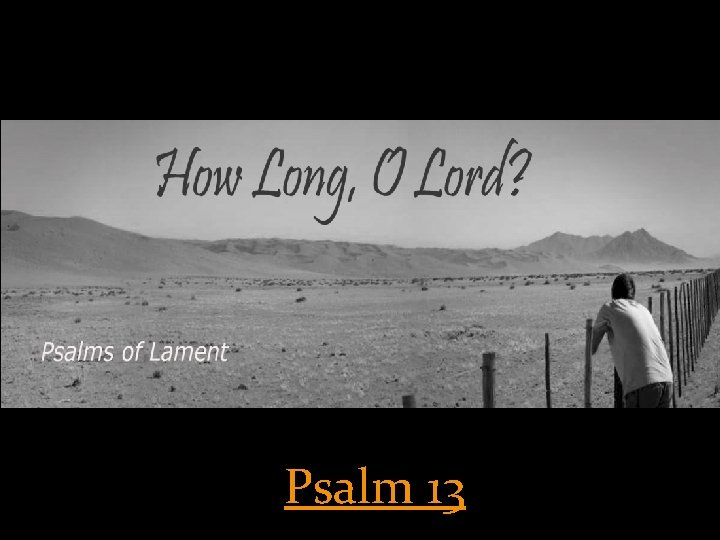
Psalm 13
Psalms of Lament • General format of a Psalm of Lament • An address to God; a complaint; a request • Usually an expression of trust. • Kinds of complaints include: • Concerns with the psalmists own thoughts and actions • Concerns with the actions of an enemy or prevailing attitude • Concerns with God's action or inaction
Types of Psalm of Lament • Types of laments: • Corporate Lament • • Expressing deep sorrow for the travails of a nation and as a group asking for God's blessing or intervention. Commonly found in printed form following major natural disasters, plague, or oppression by surrounding nations. • Psalm 58
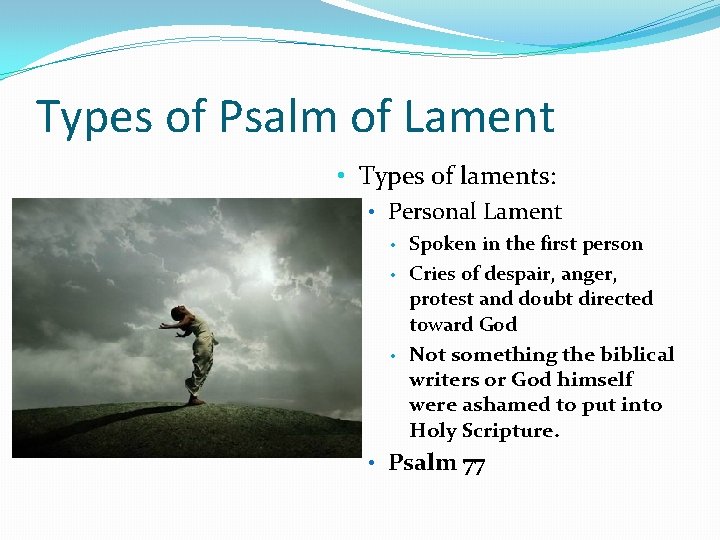
Types of Psalm of Lament • Types of laments: • Personal Lament • • • Spoken in the first person Cries of despair, anger, protest and doubt directed toward God Not something the biblical writers or God himself were ashamed to put into Holy Scripture. • Psalm 77
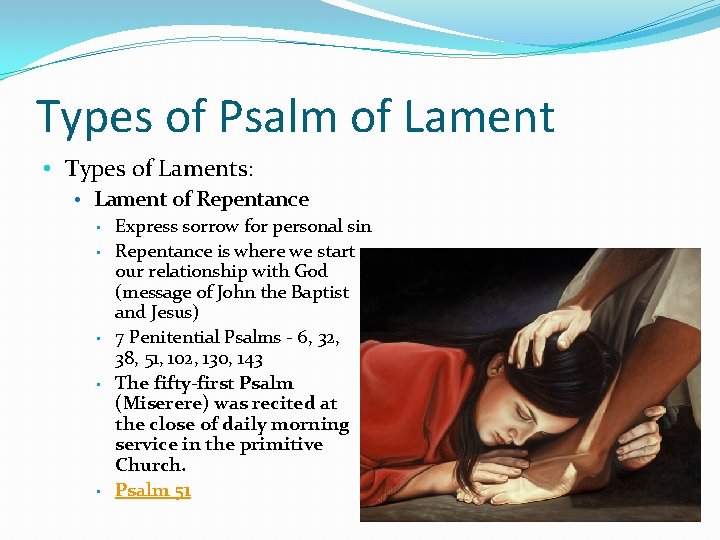
Types of Psalm of Lament • Types of Laments: • Lament of Repentance • Express sorrow for personal sin • Repentance is where we start our relationship with God (message of John the Baptist and Jesus) • 7 Penitential Psalms - 6, 32, 38, 51, 102, 130, 143 • The fifty-first Psalm (Miserere) was recited at the close of daily morning service in the primitive Church. • Psalm 51
Types of Psalm of Lament • Types of Laments: • Lament of Imprecation • An appeal to some supernatural power to inflict evil on someone or some group • If you really don't like someone you can shout an imprecation at them. • More than simply the use of bad language (although that can be involved, too) • An imprecation is a damning curse wishing them nothing but ill. • Psalms of Imprecation: 35, 69, 83, 88, 109, 137, 140 • Psalm 137 • Psalm 140 • Selah (Hebrew: סלה also transliterated as selāh) is a word used 74 times in the Hebrew Bible that means GOD HAS SPOKEN.
Psalms of Imprecation �What are we to make of curses? • There is constant tension in the Bible between love of people and hatred of evil. • Apathy about evil is worse thank ignorance of it. • So what must we do about evil? • We must uproot selfish vindictiveness (Gal. 5: 15, Ja. 4: 13 -16) • We must love the enemies of God (Isa. 48: 9; 2 Pet. 3: 9; Col. 1: 21; Rom. 5: 10) • We must hate & resist evil (1 Cor. 10: 3 -5 & Eph. 6: 12) but trust God to take care of any retribution • In none of the Psalms of Imprecation does the author hope to mete out retribution from his or her own hand.
Understanding the Psalms of Lament �Suffering, pain, grief, loss, doubt, guilt, are part of the human experience �The psalmist does not reject or ignore suffering, but faces it in faith and trust �Recognize the role of anger in dealing with suffering. � It is in these issues before God that true healing may begin. �Psalms of Lament are not meant to be politically correct but to express to God how life really is. �Placing pain, sorrow, grief and anger before God is the only place these things will ever make sense. � It is only God who can transform them. (see: The Cross)